The Active Dot and the Self-Silencing Slow Fade
If you are the low-friction person at work and in dating, you may recognize the slow-fade limbo of rewriting one reasonable question while an active-status dot answers everything except what you need to know.
I met Maya, a 28-year-old UX designer living in Toronto, on a Tuesday night. She had the careful, observant manner of someone who could spot a usability problem in one research session, yet she was carrying several months of dating uncertainty as if it were a design problem that needed more data before anyone was allowed to make a decision.
At 10:47 p.m., she sat on the edge of her bed in the apartment she shared with a roommate. Her tea had gone cold and smelled faintly bitter. The phone in her palm was warm, while the roommate’s television murmured through the wall. Maya typed, Are you still interested in this? Her throat tightened. She deleted the line and opened the other person’s profile instead. The screen showed an active status. Her unanswered thread showed three days.
She looked at me and said, “Why do I keep waiting through a slow fade instead of asking where we stand? I keep calling it patience, but mostly I am postponing the question.”
I could hear the contradiction clearly. Maya wanted to ask what the declining contact meant, but she feared the answer enough to keep waiting. She kept certain evenings free for a possible last-minute message, answered sporadic check-ins warmly, and reread old affectionate texts whenever the present connection felt thin. Anticipatory rejection had become a small emergency siren beneath her breastbone: quiet when the phone stayed dark, shrill whenever it lit up.
I did not tell her what the other person felt, because an active dot, a delayed reply, or an unconfirmed plan cannot give me access to someone else’s private motives. I told Maya that we could examine the behavior, the waiting pattern, the fear beneath it, and the choice still available to her. “We can let the cards help us draw a map,” I said. “Our Journey to Clarity is not about forcing a bloom or predicting an ending. It is about seeing where your attention is going, what evidence is present, and what you want to say.”

Choosing the Compass: The Five-Card Relationship Spread
I invited Maya to place her phone face down and take one slow breath. I shuffled gradually, giving her a quiet transition from watching for a notification to staying with the question in front of us. The act was a focus tool, not a supernatural test. It gave her mind one physical task while her body caught up with what she already knew.
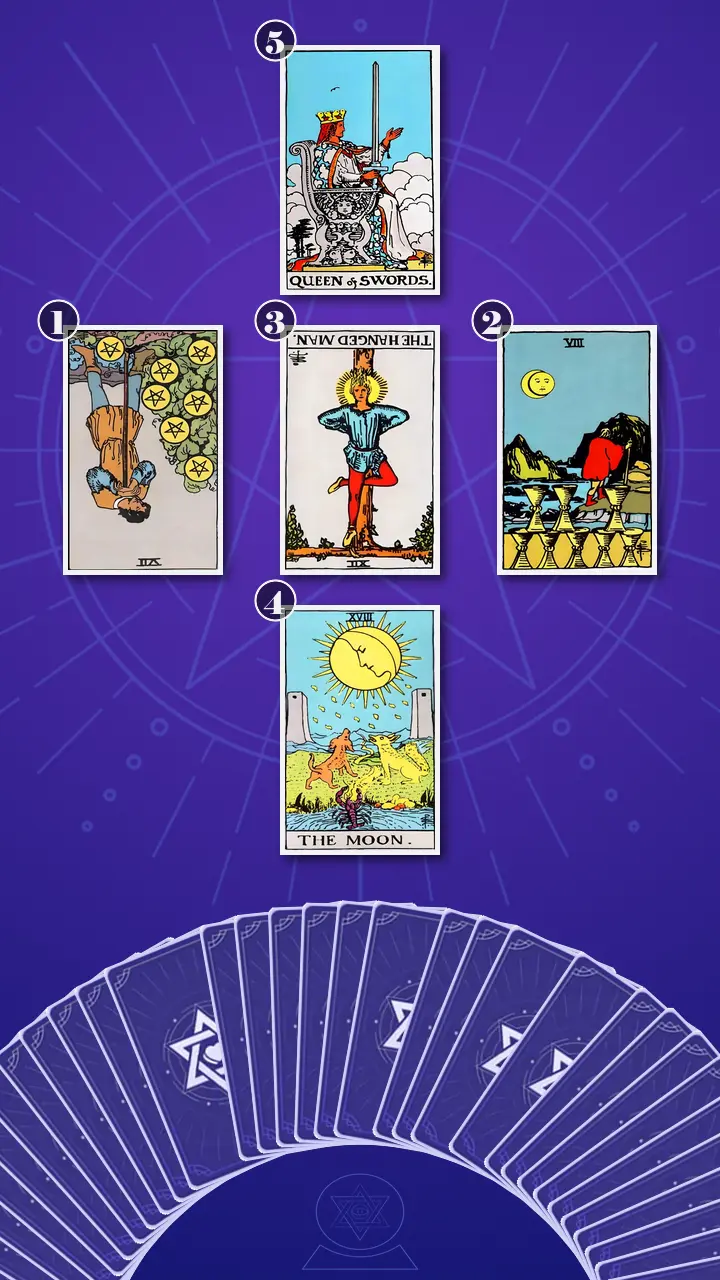
For this reading, I used the Relationship Spread · Context Edition, a focused five-card relationship tarot spread for a connection that is fading without a clear ending. I chose it because the issue was a specific relational stalemate, not a request to diagnose the other person or search through an entire life history. The spread lets me examine Maya’s investment, the other side’s observable contribution, the shared slow-fade dynamic, the obstacle beneath the silence, and the self-led direction available to Maya.
I explained the structure plainly. The first card would reveal Maya’s current stance and contribution. The second would restrict the other side to visible evidence such as replies, planning, and initiative, without pretending to know private thoughts. The center card would show the shared dynamic created between those two positions. Beneath it, a fourth card would expose the uncertainty and fear supporting the stalemate. Above it, the fifth would offer a clarity-based integration, not a guaranteed prediction.
That distinction matters whenever someone asks, Am I being slow-faded or are they genuinely busy? Tarot can help organize the question, but it should not turn guesswork into fact. I wanted the cards to function as an objective cognitive tool: a symbolic structure for separating what happened, what Maya assumed, what she needed, and what only a direct conversation could reveal.
Reading the Map: Card Meanings in Context
Position 1: The Garden That Kept Waiting
I began with the position that represented Maya’s current stance and the observable behavior in the diagnosis: continued investment, message drafting, availability, and waiting without a defined review point. I turned over the Seven of Pentacles, in reversed position.
In its familiar Rider-Waite-Smith imagery, the gardener pauses beside accumulated growth and studies the return. Reversed, the card does not call Maya foolish for having invested. It asks whether she is still evaluating the present or merely protecting the meaning of the past. At 10:47 p.m., she had scrolled back to the weeks when replies were steady, found an affectionate message from a happier stretch, and used that earlier warmth to justify keeping the next Saturday open.
I connected the card to the modern scene directly. Maya was staring at the message history as if the amount of time already invested guaranteed that another week of waiting would finally produce reciprocity. The energy was depleted Earth, an excess of patient attention with too little present return. Her patience had stopped being a neutral virtue and become an overdue return-on-attention review.
I asked her to complete the sentence I could hear underneath the card: “I have already given this so much time, so leaving now would mean…”
Maya’s thumb froze above her phone. Her eyes moved to the blank Saturday square on her calendar, as if the empty space had suddenly become evidence of a decision. Then she gave a brief, bitter laugh. “It would mean I waited for nothing,” she said. “That is too accurate. It is almost rude.”
I let the reaction have room. I did not turn it into a command to walk away. I used my Systemic Friction Auditing lens instead, a way of checking whether more effort could realistically change the structure in front of us. In a product review, I would not tell a UX designer to keep polishing a feature after the usage data had changed simply because the earlier work was sincere. I would ask what the system was producing now, where the handoff had broken down, and whether continuing to push was solving anything.
“Past investment does not guarantee present reciprocity,” I said. “You can value what happened without using it as a contract that requires more waiting.”
Position 2: The Cups Left Standing
I moved to the position that restricted the reading to observable evidence from the other side, such as reduced replies, vague plans, and declining initiative, without claiming access to the other person’s private thoughts or motives. I turned over the Eight of Cups, in upright position.
The red-cloaked figure in the card is physically turning away from cups that remain standing. Nothing has necessarily exploded. There may be no dramatic argument, no clean ending, and no final speech. The image is quieter than that. It shows emotional distance becoming visible through movement away from what once held attention.
I cross-cut the old thread with the current one. The earlier messages contained real affection and detailed plans. The current thread contained a reaction emoji, a four-day gap, and a Sunday plan that had never been confirmed. “I do not know why they are pulling back,” I told Maya, “but I do know that replies, planning, and initiative have declined.”
The Eight of Cups carried receding Water. I treated that movement as data, not as proof of cruelty, avoidance, or secret intention. The card did not tell me why the other person was withdrawing. It asked Maya to stop treating visible withdrawal as a clue she had to decode perfectly before it was allowed to count.
I watched a small drop pass through her chest and shoulders. She stopped supplying explanations for a moment and counted the facts aloud: “I initiated twice. They answered once. There is no new plan. The last two conversations ended with me keeping them going.” Her voice became quieter, but the list made the situation less foggy.
“You can explain every delayed reply and still have no answer,” I said. “You can also acknowledge a change in behavior without deciding what caused it.”
Position 3: The Calendar With No End Time
The center position represented the shared slow-fade dynamic created when diminishing reciprocity met Maya’s delayed-gratification strategy and forced-blooming hope. I turned over The Hanged Man, in reversed position.
The upright Hanged Man can describe a voluntary pause that allows a different perspective. In reversal, the pause has stopped producing insight. It has become resistance, delay, or self-sacrifice without a useful purpose. Maya kept Friday night unbooked, held a finished clarity message in her Notes app, and called both choices giving it space. The energy was blockage: her needs remained outside the conversation while time was asked to make the decision for her.
I pictured the tentative calendar hold she had described. Friday night had no organizer, no confirmed plan, and no end time. Yet Maya declined another invitation and kept checking her phone because the empty square still felt like hope rather than a cost. “I call it giving space,” she said, “but it requires me to keep my Friday open, my phone close, and my needs out of the chat.”
That was the central maintenance behavior. Waiting was not the absence of a decision. It was the choice that kept the ambiguity intact. I used my Macro-Cycle Phase Identification lens here, not to predict the other person’s feelings, but to locate Maya’s recurring attention cycle. Contact would thin, uncertainty would rise, she would explain the gap, and then a small message would restart the waiting. The cycle had a low tide, but a low tide was not a lifelong instruction to remain on the shore.
I told her that a pause could be useful only if it had a review point. “I call the practical version of that the Orbital Sync Protocol,” I said. “It is a 72-hour exercise for pausing forced actions and aligning your psychological expectations with the actual rhythm of your life. It is not a test, a punishment, or a strategy to provoke a reaction. You do not ignore necessary logistics, and you do not monitor their status to see whether they notice your silence. You simply stop making your calendar and nervous system orbit an unconfirmed possibility.”
Maya’s breath paused. Her fingers tightened around the edge of the cushion. Then her gaze drifted toward the calendar app, and I could see the idea moving from a theory into a possible action. She exhaled slowly and said, “Waiting is not nothing when it keeps my life on hold.”
I nodded. “The first change does not have to be a dramatic ending. It can be giving yourself a point at which the pause is reviewed.”
Position 4: The Moonlit Path Between Signals
I placed the fourth card beneath the center. This position represented the main challenge beneath the stalemate: uncertainty, projected explanations, and the fear that asking would confirm rejection and damage Maya’s sense of worth. The card was The Moon, in upright position.
The Moon showed why an unanswered question could feel safer than a clear answer. Its winding path passes between two towers while the dog and wolf respond to the dim light above them. Partial visibility activates instinct, memory, hope, and fear all at once. In Maya’s modern version, the path ran between an unanswered message, an active-status dot, a Story view, and an affectionate memory from six weeks earlier.
“The Moon is not saying that every signal has a hidden meaning,” I explained. “It is showing what happens when limited information gets connected to self-worth. An algorithm trained on three data points and a fear can start to feel like a fact.”
I asked Maya to separate the night into three sentences. “What I saw was…” She said, “They viewed my Story and did not answer my message.” “What I am afraid it means is…” She swallowed. “That they are losing interest because I was more invested.” “What I cannot know without asking is…” Her hand loosened against her knee. “Whether they still want to continue this.”
That distinction brought Alice in Wonderland to mind, not as a cute comparison but as a useful one. When the rules keep changing, it is easy to become absorbed in decoding the environment. Naming what I actually see can be more reliable than obeying every confusing signal. Maya did not need to solve the entire landscape before taking one honest step along the path.
She looked at the active-status dot on her darkened phone and then turned it farther away. Her jaw remained tense, but her hand stopped reaching for it. I saw the fear still there, alongside a new refusal to make fear do the work of evidence.
When the Queen’s Sword Rose Above the Fog
Position 5: The Antidote of Clear Speech
The room became unusually quiet when I placed the final card above The Hanged Man. This position defined Maya’s self-led route to cognitive integration: asking concisely, distinguishing facts from stories, and setting a boundary based on reciprocity rather than predicting the relationship’s outcome. I turned over the Queen of Swords, in upright position.
Her vertical sword separated observation from projection. Her open hand kept the conversation available without commanding an answer. The Queen of Swords was the spread’s antidote to indefinite suspension, not because she demanded coldness, but because she allowed emotional maturity and intellectual clarity to occupy the same sentence.
I connected her to the exact modern action in front of Maya. She could edit the paragraph-long case file in her Notes app down to two calm sentences: “I’ve noticed our contact has dropped off, and I’d like to know whether you’re still interested in continuing this.” The message named a change and asked for information. It did not list every timestamp, argue intent, or apologize for having a need.
At that point, I applied both of my signature lenses. Through Macro-Cycle Phase Identification, I located Maya at the point where her repeating waiting cycle could be interrupted. Through Systemic Friction Auditing, I checked whether more hustle, more availability, or more carefully edited warmth could override the structural pause in reciprocity. It could not. The spread held no Wands card. It was not asking her to create more pursuit or manufacture more chemistry. It was moving from depleted Earth, through receding Water and uncertain night, into clarifying Air.
I remembered another client from years earlier who had brought me a six-slide defense deck for a decision that needed one honest sentence. The extra evidence had not made the decision safer; it had only hidden the decision underneath more evidence. I saw the same structure in Maya’s draft. My work was not to choose for her. It was to help her see which part of the problem belonged to communication and which part belonged to the story fear had attached to the answer.
At 10:47 p.m., with tea gone cold beside her, Maya had typed the question, deleted it, and opened the other profile instead. The screen said active; her thread said three days. Her throat tightened as hope and evidence pulled in opposite directions.
Waiting longer will not turn ambiguity into reciprocity; name what you see, ask what you need, and let the Queen’s upright sword separate facts from hope.
You do not need certainty before you ask. A clear question and a personal boundary stop patience from carrying a connection that was supposed to be mutual.
First, Maya’s jaw went still and her breath stopped halfway in. Then her eyes widened, not with a dramatic revelation but with the recognition of a pattern she had been replaying in private. Her attention moved from the card to the blank calendar square, as if she could see every open evening she had quietly surrendered. Finally, the grip in her hands softened. Her shoulders dropped a fraction, and a shaky breath left her chest. The relief was real, but it was not triumphant. A small, exposed silence followed it, the kind that arrives when a clear path also brings responsibility. Her eyes became bright. “I can name the change without proving intent,” she said. “I can ask without arguing for my worth.”
I asked her to use that new perspective to remember the previous week. “Was there a moment when this distinction might have made you feel different, even before you knew the answer?” Maya opened her Notes app and wrote three headings: Observed, Assumed, and Needed. Under the last one, she wrote, “I need to know whether this is still mutual.” She did not promise to send the message that night. I did not ask her to promise it. Clarity is an option, not an obligation, and a direct message is never required where contact feels unsafe, coercive, or disrespectful.
This was the first movement from suspended hope and fear-driven waiting to clear communication and reciprocity-based self-respect. The card did not guarantee that the connection would continue. It returned the next move to Maya, where it belonged. Their answer could define the connection without defining her worth.
The One-Page Route Back to Her Own Calendar
I gathered the cards into one story. Maya’s Seven of Pentacles reversed showed the past influence of accumulated investment: months of messages had become a reason to wait rather than information to review. The Eight of Cups showed the present evidence of retreat: fewer replies, vague plans, and declining initiative, with the other person’s motives left unknown. The reversed Hanged Man revealed why the slow fade persisted: Maya’s waiting had become an active maintenance behavior. The Moon showed the fear beneath it, the hope-preserving explanations that made uncertainty feel safer than rejection. The Queen of Swords offered the available resource, a concise question joined to a boundary she controlled.
The forced-blooming trap was the story’s central metaphor. Maya had been holding a flower beneath a lamp and waiting for the heat of her attention to open it. The blind spot was not that she had cared too much. It was that she had treated more waiting as evidence of care, and had demanded certainty from herself before permitting a reasonable question. A relationship cannot be made mutual by one person becoming endlessly low-maintenance.
I told her that the Five-card Relationship Spread: Context Edition had done exactly what I wanted it to do. It examined personal investment, observable withdrawal, the shared slow-fade dynamic, underlying uncertainty, and clarity-based integration. It did not solve the other person’s motives. It gave Maya a structure for examining behavior, communication, reciprocity, and boundaries without converting one answer into a verdict.
Then I translated the reading into small next steps. I kept them deliberately ordinary. The point was not to perform a perfect act of self-respect. The point was to create enough room for Maya to make one informed choice.
- Separate facts from storiesAt the kitchen table, set a five-minute timer and divide a Notes page into Observed, Assumed, and Only Askable. Write one visible behavior under Observed, the feared meaning under Assumed, and the information that only a direct conversation could provide under Only Askable.Use observable verbs such as replied, proposed, confirmed, or canceled. If three headings feel like too much, use What I Know and What I Need.
- Run the reciprocity evidence resetFor seven days, record only the last three exchanges: who initiated, whether a question received an answer, and whether a plan was confirmed. For the first 72 hours, use my Orbital Sync Protocol by pausing forced initiating and active-status checking, then release one unconfirmed Friday or Saturday evening by making a small plan or accepting a confirmed invitation.This is an observation period for Maya’s own attention, not a test designed to provoke a reaction. Do not withhold necessary logistical replies or use the plan as online punishment. The minimum version is 24 hours and one recorded exchange.
- Send a two-sentence clarity askAfter the pause, choose a realistic 48-hour window when work is finished and sleep is not imminent. Draft or send, if it feels wanted and safe: “I’ve noticed our contact has dropped off, and I’d like to know whether you’re still interested in continuing this.” Beforehand, write a private boundary such as, “If I do not receive a direct response by Thursday, I will stop holding plans open and step back from initiating.”Direct is not the same as demanding. Drafting only is still a valid minimum version. After sending, mute the thread for one hour and do something that does not depend on the reply. If contact feels unsafe or coercive, Maya can disengage without sending anything.
I emphasized that a personal response window was not a threat and did not force the other person to answer. It simply governed Maya’s time and participation. She could respond to a clear answer, respond to continued vagueness, or respond to silence. The boundary belonged to her, so no prediction was needed.
“The aim is not to become detached before you care,” I said. “It is to let observable reciprocity guide your availability instead of waiting for a reward that may never arrive.”

A Week Later, the Calendar Came Back
Six days later, Maya texted me: “I sent it. They said they could not continue with the consistency I wanted.” She spent the afternoon alone in a café, which felt both peaceful and strange. The next morning she still wondered, “What if I was too much?” Then she accepted a confirmed plan.
The connection did not transform into the perfect outcome because Maya had found the perfect wording. The small proof was simpler. She had asked one clear question, received usable information, stopped checking the active-status dot, and let Saturday belong to her again. The grief and the self-respect existed in the same room.
I reminded her that the cards had not sent the message. Maya had. The reading had helped her move from suspended hope and fear-driven waiting toward clear communication and reciprocity-based self-respect, but she remained the person directing the next orbit of her life.
When the phone lights up and your chest lifts before you even see the name, it can feel safer to keep waiting than to ask the question that might separate your hope from their availability and their answer from your worth. Noticing that split is already a small meeting with clarity.
If you did not need certainty first, what is the smallest clear sentence you might let yourself imagine saying, perhaps one that turns a held-open calendar evening back into your own time?
This story is adapted from psychological research, written so that those in a similar struggle can see their own pattern in it — and find their next step clearly.These insights are not a substitute for professional psychological, medical, legal, or financial advice.
Learn more about our Journey to Clarity.
How did this insight land for you?
🫂 This Resonates Deeply
🌀 Living This Story
✨ Now I See Clearly
🌱 Seeing New Possibilities
🧰 Useful Framework
🔮 The Confirmation I Needed
💪 Feeling Empowered
🚀 Ready for My Next Step
Author Profile
 AI
AI“After a decade of guiding people through the stars, I’ve come to see life much like the orbits of planets: everything has its inevitable cycles. When you feel lost, please don't blame yourself; you might just be in a natural low tide. I’m here to sit under the night sky with you, offering a gentle cosmic perspective to distinguish temporary pain from the beautiful breakthroughs just around the corner.”
In this Timing Tarot Reading :
Core Expertise
- Macro-Cycle Phase Identification: Objectively locating your current position within inevitable long-term cycles to explain current resistance.
- Systemic Friction Auditing: Stripping away the illusion that 'hustle' can override a cyclical low tide or structural pause.
Service Features
- The Orbital Sync Protocol: A 72-hour exercise to intentionally pause forced actions, aligning your psychological expectations with your actual cyclical reality.
Also specializes in :
Explore Related Patterns:
Certainty-Gated Self-SilencingMaya types a reasonable question, feels her throat tighten, deletes it, and checks the active-status dot instead. She knows that only a direct conversation can clarify the connection, yet she makes certainty a prerequisite for starting that conversation. You can become trapped in the same circular rule when you tell yourself that you will speak once you feel sure, even though speaking is the only available route to the missing information. The silence functions as a defense against immediate exposure to rejection, but it also keeps your needs outside the relationship and your calendar inside its ambiguity. Certainty-Gated Self-Silencing names this mechanism because the barrier is not an inability to form the question. It is the internal requirement to eliminate emotional risk before allowing yourself to ask it.
Intermittent ReinforcementMaya describes a repeating sequence in which contact thins, uncertainty rises, she explains the gap, and one small message restarts the wait. The occasional check-in carries more influence than its content would suggest because it arrives unpredictably after a period of absence. You can become more attentive to an inconsistent signal precisely because you cannot anticipate when it will return. Intermittent Reinforcement explains why sparse contact can sustain investment without providing security. Each return briefly renews the possibility of the earlier connection, so monitoring and availability are reinforced even while reciprocity declines overall. Looking at the full sequence, rather than the emotional intensity of the latest message, exposes the conditioning loop and returns attention to consistency rather than surprise.
Rejection SensitivityMaya's throat tightens before she can send the question, and even after receiving a clear answer she wonders whether wanting consistency made her 'too much.' The anticipated rejection is therefore carrying two meanings at once. It may describe the other person's availability, but Maya fears it will also expose something defective about her. You can delay clarity when a relational answer has become fused with a verdict on your worth. Rejection Sensitivity amplifies the emotional stakes of an otherwise reasonable request. Waiting then offers temporary protection because no explicit answer means no explicit verdict. Separating those meanings restores proportion. Someone's capacity or willingness to continue can define the connection without establishing how lovable, reasonable, or worthy you are.
Self-AbandonmentMaya keeps Friday open, declines another invitation, keeps her phone close, and removes her need for clarity from the conversation. No one has confirmed the plan, yet the possibility is allowed to govern real choices. You may protect a connection from pressure by repeatedly making yourself lower-friction, only to discover that your own schedule, preferences, and voice have disappeared from the arrangement. Self-Abandonment names the coping mechanism of preserving relational possibility through repeated self-deprioritization. The issue is not that caring or making room is inherently unhealthy. The pattern emerges when your accommodation is not matched by observable reciprocity and when remaining easy to keep becomes more important than remaining present to yourself.
Information AvoidanceMaya fears the answer, postpones the question, and turns to an active-status dot, a Story view, and old messages instead. These signals provide more material to inspect, but none can tell her whether the other person wants to continue. You may appear to be gathering information while actually avoiding the one piece of information capable of changing your decision. Information Avoidance protects hope by keeping the feared answer technically unknown. The tradeoff is that ambiguity becomes an active commitment of attention, time, and availability. The pattern becomes visible when indirect clues feel safer to collect than direct evidence, even though every new clue leaves the original question intact.
RationalizationMaya calls the delay patience and describes keeping Friday open with her needs outside the chat as giving the connection space. Those descriptions soften the cost of the behavior and make continued waiting sound neutral or generous. You can use similarly reasonable language to reduce cognitive dissonance when part of you already recognizes that the behavior is no longer serving its stated purpose. Rationalization is the defensive layer that makes the stalemate easier to maintain. It does not mean the explanations are deliberately dishonest or that every delayed reply has one fixed meaning. It means the explanation is being used to avoid reviewing what the current pattern is producing. The audit becomes clearer when you compare the label you give an action with its observable effect on your time, voice, and choices.
Uncertainty ToleranceMaya eventually sends the question without knowing whether the answer will preserve the connection. When the answer is disappointing, she experiences grief, still questions whether she was too much, and nevertheless accepts a confirmed plan the next day. You do not need emotional invulnerability before taking a clarity-based action. Uncertainty Tolerance is the capacity to move while an outcome remains unresolved and to let new information be painful without turning it into a total judgment of the self. It does not guarantee calm or a preferred result. It reduces the demand that you predict, decode, or control the answer before deciding how honestly you want to participate.
Relational HypervigilanceMaya deletes the direct question and opens the profile, while an active dot, a Story view, and every flash of the phone pull her attention back toward the connection. Her body responds before the content of the notification is even known. You can start scanning tiny relational signals when uncertainty has made each cue feel potentially decisive. Relational Hypervigilance turns monitoring into a safety strategy. It promises early detection of interest or withdrawal, but ambiguous platform signals cannot reliably reveal private intent or restore mutuality. The more attention you give them, the more psychologically important they become. Shifting from constant cue detection to a limited review of replies, initiative, and confirmed plans reduces the signal noise without requiring you to deny that the uncertainty matters.
Boundary DiscernmentMaya writes a private response window, releases an unconfirmed evening, and later accepts a confirmed plan. Her boundary does not demand that the other person answer on command or prove a particular motive. It determines what she will do with her own time if direct reciprocity remains unavailable. Boundary Discernment separates self-direction from control. You can ask clearly, allow another person to make a different choice, and still decide what level of ambiguity or inconsistency you will participate in. Because the boundary governs your behavior rather than their compliance, it restores agency without turning clarity into an ultimatum.
Reality TestingMaya separates the situation into what she observed, what she assumed, and what only a direct question could establish. She then counts initiation, answers, and confirmed plans without treating an active-status dot as proof of motive. You regain clarity when you let observable verbs carry more weight than emotionally charged but inconclusive signals. Reality Testing does not require dismissing intuition or pretending that uncertainty feels neutral. It checks whether the conclusion is supported by the evidence currently available and marks the boundary of what cannot yet be known. This process interrupts projection because your fear can be acknowledged as fear without being promoted into fact, leaving a cleaner basis for communication and choice.
Sunk Cost FallacyMaya scrolls back to affectionate messages from an earlier phase, keeps another Saturday open, and says that stepping away would mean she had waited for nothing. Past investment has stopped being history and become an argument for further investment. You can remain in a depleted loop when ending the present commitment feels as though it would erase the sincerity or value of what you already gave. The Sunk Cost Fallacy shifts attention away from what the connection is producing now and toward recovering meaning from time already spent. More waiting cannot retroactively guarantee that the earlier investment will pay off. You can value what happened without treating it as a contract that obligates your future availability, and reviewing present reciprocity does not invalidate the care you previously offered.
Explore Related Struggles:
Ambiguity DependenceA small check-in restarts Maya's waiting, while the question about whether the connection is continuing remains unsent. The undefined state preserves a live possibility and postpones the answer she fears, even as her calendar and attention continue absorbing the cost. You may recognize the temporary shelter offered by not knowing, especially when a definite answer feels capable of touching your worth. Naming the ambiguity as a maintained condition gives you a choice about how long you will participate in it, even before anyone else explains their motives.
Clarity-Exposure SplitAt 10:47 p.m., Maya types the question that could tell her where the connection stands, then deletes it and opens the other person's active profile. Her need for clarity moves forward at the same moment that the possible answer makes her pull back, so checking becomes easier than entering the conversation. You may recognize this split when information is urgently needed but asking for it feels like placing both the connection and your worth under review. The question itself is reasonable; the deeper difficulty is allowing clarity to arrive without treating the answer as a verdict on your value.
Endurance-Evidence SplitMaya keeps Saturday open and rereads affectionate messages from an earlier stage while the current thread shows longer gaps, vague plans, and declining initiative. Endurance becomes a way of defending the connection's past meaning, even when the present evidence is asking for a fresh review. When you keep waiting because your patience has already lasted this long, persistence and observation begin pulling in different directions. You can honor what was once real without requiring old warmth to overrule the pattern that is visible now.
Forced Blooming TrapMaya keeps Friday open, answers each sporadic check-in warmly, and adds another stretch of patience whenever a small message appears. Waiting has become an active input into the connection, carrying the hope that more attention and fewer demands might restore the reciprocity that has been fading. You can care sincerely and still reach the point where additional effort no longer changes what the relationship is producing. Recognizing that limit returns your time and participation to you without requiring you to deny the value of what you once hoped would grow.
Low-Maintenance Worth LockMaya answers sporadic check-ins warmly, leaves evenings open, and keeps her need for clarity out of the chat. The less space she takes up, the more she can preserve the possibility of being easy to continue with, but that arrangement makes her acceptance depend on remaining undemanding. You may recognize the bind when asking for ordinary consistency starts to feel like evidence that you are too much. Seeing the condition clearly allows your needs to become information about compatibility and reciprocity, rather than charges you must defend against.
Permission ParalysisMaya's finished clarity message sits in her Notes app while she gathers more status signals, rereads old exchanges, and waits for the situation to become self-explanatory. She treats certainty as the price of admission for asking, even though the unanswered question is the reason certainty is unavailable. When you believe you must already know before you are entitled to inquire, a reasonable conversation becomes an impossible threshold. The question does not need to prove an outcome or justify your worth; it can simply express what you have observed and request the information needed for your next choice.
Sunk Cost ParalysisMaya scrolls back to the weeks when replies were steady and uses that earlier warmth to justify keeping another Saturday available. When she says that stepping away would mean she waited for nothing, the time already spent begins controlling how much more time she feels compelled to spend. When stopping seems to invalidate the entire history, continuing can feel safer than reviewing what the connection offers now. A present-tense decision does not erase your earlier care; it separates the meaning of that care from an obligation to keep paying for it with future time.
Monitoring-Safety FusionThe active dot, the Story view, and the old message thread give Maya fresh material to inspect whenever the unanswered question becomes difficult to hold. Each digital trace offers a momentary sense of access, but none of it confirms a plan, explains the withdrawal, or tells her whether the connection is still mutual. When you use monitoring to stay close to an answer that only conversation can provide, attention remains busy while clarity stays out of reach. Separating online visibility from relational availability lets those signals return to their actual size and gives you room to choose what evidence will guide your time.
Explore Related Emotions:
Certainty HungerMaya treats several months of dating uncertainty like a design problem that needs more data before anyone is allowed to decide. She studies an active dot, a Story view, delayed replies, and old messages, even though none of them can answer whether the relationship is still mutual. Certainty Hunger keeps promising that one more clue will make a vulnerable question unnecessary. You may feel compelled to know the answer before asking for it, but indirect evidence cannot provide the consent, clarity, or reciprocity that only communication can reveal. Seeing that limit returns the unknown to its proper size.
Low-Maintenance ShameMaya answers sporadic check-ins warmly, keeps her needs outside the chat, and later wonders whether asking for consistency made her "too much." Being low friction has become more than a communication style; it is the condition under which she believes she can remain welcome. Low-Maintenance Shame can make ordinary relational needs feel embarrassing, excessive, or strategically dangerous. You may reduce your presence to preserve someone else's comfort and then judge yourself for wanting mutuality at all. Naming the shame exposes the false equation between being easy to accommodate and being worthy of connection.
Need Exposure DreadMaya types, "Are you still interested in this?" Her throat tightens, she deletes the sentence, and she opens the other person's profile instead. The movement away from the message shows that asking is not difficult because the wording is unclear; it is difficult because the question would make her need for reciprocity unmistakably visible. You may feel Need Exposure Dread when expressing a reasonable need seems to place your worth on trial. The feared answer then carries two meanings at once: information about the connection and a possible judgment about whether you wanted too much. Separating those meanings allows the need to remain valid even when the relationship cannot meet it.
Slow Fade DreadAt 10:47 p.m., Maya's tea has gone cold, her phone is warm, and the question she needs to ask disappears from the screen while the active-status dot remains. Earlier affection, present silence, and sporadic check-ins keep the connection visible enough to wait for but too indistinct to rely on. You may experience Slow Fade Dread when a relationship seems to be receding without giving you a clean moment to respond. Waiting preserves possibility for another night, but it also makes every notification carry the threat of confirmation, leaving your attention suspended between hope and an ending no one has clearly named.
Standby Mode AnxietyMaya keeps Friday open despite having no organizer, confirmed plan, or end time, and she declines another invitation so a last-minute message can still fit. Her phone stays close while ordinary life is arranged around a possibility that has made no corresponding commitment to her. Standby Mode Anxiety can feel like being unable to begin your own evening because something relational might happen at any moment. You remain available without feeling chosen, and your calendar becomes a waiting room. Recognizing that held-open time is already a form of participation restores your ability to decide how long uncertainty may occupy it.
Sunk Cost GriefMaya scrolls back to a warmer stretch of messages and uses an old affectionate text to justify keeping the next Saturday open. When she imagines stepping away, the sentence underneath her waiting is immediate: it would mean she waited for nothing. Sunk Cost Grief appears when ending the present investment seems to invalidate everything previously felt, offered, or hoped for. You may keep giving time because stopping would expose a loss that additional waiting temporarily postpones. The past can remain meaningful without being turned into a contract that requires your continued availability.
Bittersweet ReleaseSix days later, Maya receives a clear answer, spends the afternoon alone in a cafe, and finds the quiet both peaceful and strange. The next morning she still wonders whether she was too much, yet she accepts a confirmed plan and no longer organizes Saturday around the active-status dot. Bittersweet Release allows relief and loss to occupy the same room. You may regain your calendar, attention, and capacity to choose while still missing the possibility you had protected. The release is real precisely because it does not require you to erase the care, hope, or grief that preceded it.
Cautious Self-RespectMaya reduces a paragraph-long case file to two calm sentences, sends the question six days later, and accepts a confirmed plan after receiving the answer. She does not prove the other person's intent or apologize for wanting consistency; she simply allows observable reciprocity to guide her availability. Cautious Self-Respect feels exposed because it asks you to act before certainty has made the action emotionally painless. It is not a triumphant declaration that the connection never mattered. It is the quieter recognition that your time, needs, and boundaries can remain legitimate while you are still grieving what the relationship could not provide.
Clarity ReliefMaya counts the observable facts aloud: she initiated twice, received one answer, has no new plan, and carried the last two conversations. Later, she separates Observed, Assumed, and Needed before receiving a direct response. Her grip softens because she no longer has to make scattered signals produce a complete story. Clarity Relief does not require the information to be pleasant. You may feel it when facts, fears, and needs stop competing inside the same sentence, allowing disappointment to become more manageable than indefinite interpretation. The answer can define what the connection currently offers without becoming a definition of your worth.
Regulated CourageMaya places her phone face down, takes one slow breath, and later turns the active-status dot farther away. Six days after first confronting the question, she sends two calm sentences without knowing what answer will return. Regulated Courage is not the disappearance of bodily tension or relational risk. You may still feel exposed while creating enough steadiness to choose your words, protect your boundary, and act without trying to control the response. Courage becomes usable when it can move alongside uncertainty instead of waiting for uncertainty to vanish.
Agency ReliefMaya sends the message herself, stops checking the active-status dot, and lets Saturday belong to her again. The other person's answer does not create the relief by becoming the outcome she wanted; it creates usable information that allows her to direct her own participation. Agency Relief arrives when your next move no longer depends on decoding, persuading, or waiting for another person to create closure for you. You cannot control their availability, but you can decide what evidence guides your time and what level of ambiguity you will continue to accommodate. That distinction makes movement possible without pretending the loss is easy.
Self-Betrayal AcheMaya looks at the blank Saturday square and suddenly sees every evening she has quietly surrendered while keeping her needs out of the conversation. The calendar makes visible what the slow fade has cost beyond the relationship itself: her time has repeatedly been treated as less concrete than someone else's possible availability. Self-Betrayal Ache can emerge when caring for a connection repeatedly requires you to disappear from your own plans, preferences, or voice. The pain is not evidence that caring was a mistake. It is the felt recognition that preserving the possibility of mutuality has begun to require choices that are no longer mutual with yourself.
Explore Related Contexts:
Low-Maintenance Dating PressureMaya keeps Friday open, answers sporadic check-ins warmly, and carries the last two conversations after the other person's initiative declines. She has a reasonable question ready, but preserving the connection requires her to keep that question and her scheduling needs outside the interaction. This places her in a dating role where access is maintained through low friction rather than mutual coordination. When you must remain endlessly easygoing for a connection to continue, your availability starts subsidizing an arrangement that does not provide equal clarity or planning effort. Recognizing that labor makes it possible to assess whether being accommodating is still a free choice or has become the admission price for an undefined relationship.
Slow FadeMaya's thread had been unanswered for three days while the other person's active-status dot remained visible. Earlier affection and detailed plans had given way to a reaction emoji, a four-day gap, declining initiative, and a Sunday plan that was never confirmed. The connection therefore remains technically open while becoming practically less mutual. When you are living through a slow fade, there may be no single breakup event to organize your response around; the external reality is a continuing reduction in contact that asks you to absorb uncertainty until observable behavior, a direct answer, or your own participation boundary provides a stopping point.
Mixed Signal LimboAn active-status dot, a Story view, sporadic check-ins, old affectionate texts, and an unconfirmed Sunday plan all remain visible beside a thread that has gone unanswered for days. None of these fragments establishes where the connection stands, yet each provides enough activity to keep the question open. Digital visibility creates access to signals without creating relational accountability. In mixed signal limbo, you can gather more platform evidence while becoming no closer to usable information, because online activity cannot confirm mutual interest, future plans, or the terms of continued contact. The pressure persists until the connection is evaluated through direct communication and observable reciprocity rather than isolated digital traces.
Sunk Cost Exit DilemmaMonths of messages, earlier affection, and detailed plans remain in Maya's phone while the current exchange offers a reaction emoji, long gaps, and no confirmed plan. She rereads the earlier warmth and keeps another Saturday available because stepping back would seem to confirm that she waited for nothing. Accumulated time has become an informal contract requiring further investment, even though the present connection does not provide a matching return. A sunk cost exit dilemma appears when you are no longer deciding only whether the current arrangement works; you are also being asked to release the idea that more waiting can validate everything already given. Reviewing present reciprocity allows the past to remain meaningful without granting it permanent control over your next decision.