"Maybe Next Week" Stayed Unsent, Then a One-Hour Coffee Felt Possible

The Reply Box and the Empty Seat: Waiting to Feel Healed Before Seeing Friends
“You check who is attending a shared-friend gathering, rehearse how much of the breakup you would disclose, and leave the invitation unanswered when you cannot predict the emotional weather.” I read that sentence aloud at the beginning of my notes because it captured the exact hesitation Maya had brought into the room.
At 8:47 p.m. on the Tuesday before our session, Maya had been sitting on the TTC Line 1 train heading home from her communications job. The fluorescent lights buzzed above her, her coat sleeve smelled faintly of rain, and her phone felt warm in her palm as she watched friends' Instagram Stories from a crowded bar. I could picture her shoulders rising each time she imagined walking in, explaining the breakup, or trying to act normal while secretly hoping someone would notice she needed gentleness.
“I can handle a full workday,” she told me. “I can be polished, answer emails, run a meeting, make everything sound fine. But when the group chat suggests Saturday plans, I freeze. I check whether my ex is going, type Maybe next week, and then delete it. I want to remain part of the group, but I keep thinking I have to feel completely healed before I can show up.”
Her apprehension had a physical shape: it was like a small apartment with every window shut, the air growing heavier while a familiar room stayed visible across the street. Underneath it I could feel grief, loneliness, and the quieter shame of believing that still being affected made her socially difficult or visibly out of place.
I did not tell her to force a return, make the night easy for everyone else, or prove that she had moved on. I said, “I hear how much you miss them, and I hear how carefully you are trying to protect yourself. Let us draw a map of the waiting system itself. Our Journey to Clarity is not about making the cards decide whether you belong. It is about helping you see what choice is actually available to you now.”
Choosing a Map for a Self-Imposed Finish Line
I invited Maya to place both feet on the floor, take one slower breath than usual, and name the question without trying to make it sound reasonable. Then I shuffled the deck at an unhurried pace. The small ritual was a transition from the glowing screen and its imagined audience to a table where one experience could be examined at a time. It was a focusing tool, not a supernatural demand.
For this consultation, I used the Transformation Path Grid (6) · Context Edition. This is a six-card tarot spread for tracing a self-reinforcing pattern from visible behavior to its blocking rule, root fear, turning point, practical action, and integrated understanding. That focused structure suited Maya's question because she was not asking me to read her former partner's motives or predict what the friend group would do. She was asking why she kept postponing contact, and what might make reconnection feel more workable while she was still grieving.
This is also where I explained how tarot works in my practice. Card meanings in context give us an objective set of images and positions with which to compare Maya's actual choices, body sensations, assumptions, and boundaries. A Celtic Cross would have opened a much wider life audit, and a classic Relationship Spread might have shifted attention toward other people's perspectives. The Transformation Path Grid was smaller and more direct: it could show the mechanism without turning a post-breakup social re-entry into a prediction.
I told the reader in her, and the reader beyond her, how I would move through the grid. The first card would show the current condition of postponing shared-friend contact. The next two would expose the recovery rule and the fear beneath it. The fourth card would be the bridge, the point where grief and connection might stop being treated as opposites. The fifth would offer a small action, and the sixth would ask what belonging could mean without a performance of complete recovery.
“The cards will not tell you that you must attend an event,” I said. “They can help us distinguish an actual boundary from an untested fear. You remain the person who chooses, pauses, cancels, leaves early, or tries again.”
The Closed Loop in Six Images
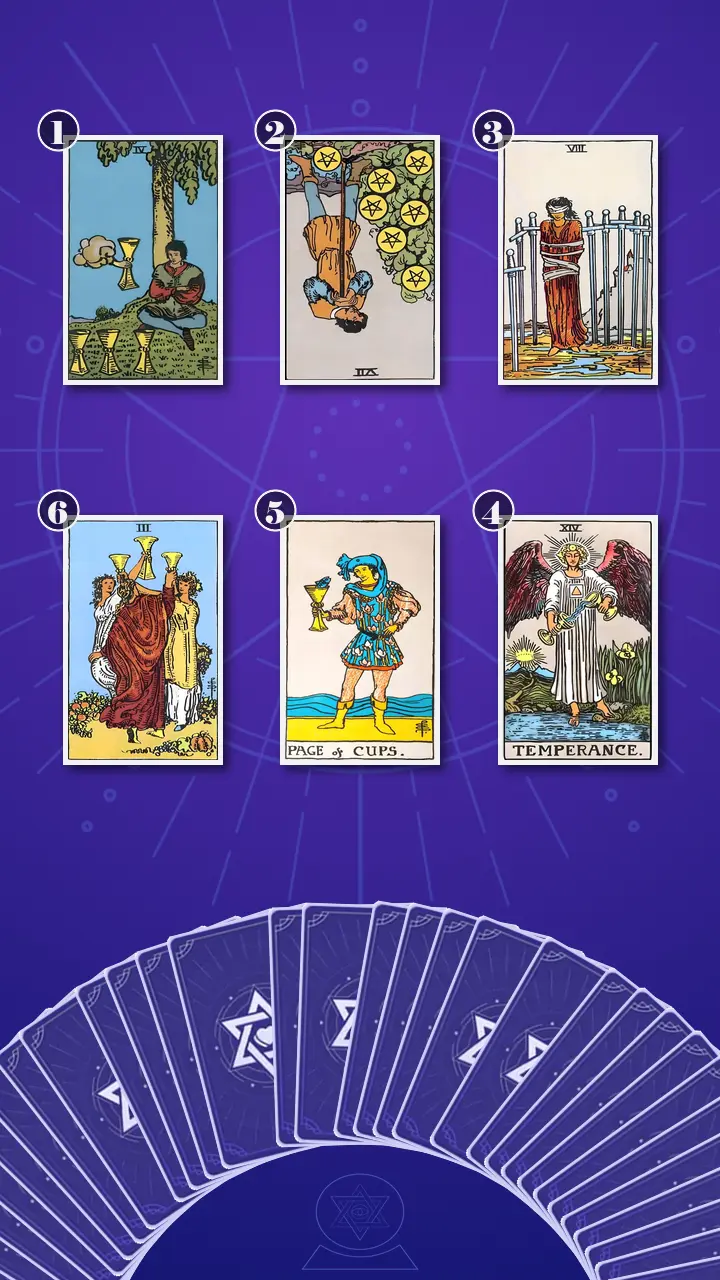
I laid the first three cards across the upper row: present withdrawal, delayed progress-checking, and the underlying restriction. On the lower row, I placed the final three in the unusual reading order suggested by the grid: the turning point on the right, then practical contact in the centre, then integration on the left. The top row described a closed system. The lower row offered a path back toward community, with no promise that the path would feel smooth.
The Fourth Cup and the Open Reply Box
“Now I am turning over the card for the current state: the observable behavior and emotional energy of postponing or declining shared-friend contact while waiting to feel healed.” I revealed the Four of Cups, upright.
The seated figure beneath the tree held the whole opening scene. The arms were crossed, the gaze was lowered, and three cups rested on the ground while a fourth cup extended from a cloud. In real life, this was Maya sitting under the warm glow of her phone in her Toronto apartment, arms folded across her chest as she checked the shared chat and watched the group's Stories. A casual invitation felt impossible to answer because it could not promise that she would feel normal, so her attention stayed fixed on what the breakup had taken while the smaller connection being offered went unacknowledged.
Upright, the Four of Cups showed stagnant Water: feeling was present, but it was held in private and allowed to circulate mainly through memory, comparison, and digital observation. The energy was not a lack of love for her friends. It was an excess of inward attention and a blockage around receiving contact that came without emotional guarantees. She could see every Story and know who was at the bar, but, as I told her, “Watching the group is contact with information, not the same as contact with people.”
I asked, “When the next invitation appears, what do you actually do in the first five minutes? Do you open the chat, check who is attending, draft a reply, or close the app?” Maya's breath stopped for a beat. Her eyes moved from the card to the table as if replaying the sequence, and then she gave a short, bitter laugh.
“That is too accurate,” she said. “Almost cruel. I have been watching the group from bed and calling it responsible healing.”
I let the laugh stay in the room instead of trying to make the card sound kinder than it was. “Responsible healing can still become a name for staying out of reach,” I said. “This card is not ordering you through the door. It is asking whether the fourth cup has to be a full evening, a group event, or a conversation about the breakup. It may be one modest offering you can examine without abandoning your own limits.” Her fingers, which had been gripping the edge of her sleeve, loosened slightly, though her gaze remained guarded.
The Recovery Spreadsheet That Never Reaches One Hundred Percent
“Now I am turning over the card for the blocking pattern: the delayed-gratification rule and the repeated recovery check that make healing feel like a prerequisite for social contact.” The card was the Seven of Pentacles, reversed.
The gardener leaning on the hoe seemed to be inspecting an emotional harvest. In Maya's modern life, each week of distance had become another row in a recovery spreadsheet. She checked whether sadness had dropped enough, decided it had not, and moved her return date forward. The labour of getting through work, cooking for one, and making it through ordinary days was real, but she judged it only by whether it had produced a completely healed version of herself.
Reversed, the Pentacles showed an imbalance in Earth: effort existed, but the measurement system was distorting the results. She had turned a natural, uneven recovery cycle into a progress check with an imaginary deadline. A sad morning became evidence that the entire process had failed. A tight chest became a red score. The more she inspected the harvest, the less she noticed that she had already built skills, survived difficult evenings, and retained access to people who still invited her.
“You are waiting for a number that no real person agreed to,” I said. “That is delayed gratification becoming a rule. The card does not ask you to disprove the rule by accepting every invitation or staying out all night. That would be another way of making your body perform. It asks you to measure one small contact by what it teaches you about your needs, not by whether it proves you are healed.”
Maya looked down at her hands. One thumb rubbed the other in a slow circle, then stopped. “I keep thinking that if I am still sad, I have not made enough progress,” she said. “And if I go too soon, I will have to start over.”
“A wave of grief is not a reset button,” I replied. “It is information. We can ask how much contact, what setting, and which boundary might be workable on that particular day.” The image of the paused gardener made the difference visible: patience was not the same as indefinite postponement, and assessment was not meant to become a verdict.
The Blindfolded Room and the Route That Has Not Been Tested
“Now I am turning over the card for the root and fear: the underlying belief that showing up while still hurting could expose a loss of belonging or make the shared social space feel unsafe.” I revealed the Eight of Swords, upright.
The card showed a blindfolded figure, loose bindings, and a ring of swords. Beyond that immediate circle, an open landscape remained visible. Maya's invitation was one event, but her mind had made it into a closed room where every route appeared unsafe. Before accepting a plan, she imagined someone asking about the breakup, her face revealing that she still hurt, her former partner appearing at the venue, and her inability to leave without making everything obvious.
Upright, the Swords represented constricted Air: too many imagined tabs open at once, each one labelled who will be there, what they will ask, whether I will cry, whether I can leave, and whether leaving will prove I never belonged. The binding was not a prophecy of social rejection. It was the mental restriction created when an untested consequence began to carry the weight of a known fact.
I spoke the inner sentence Maya had been living inside: “If I show up while I still hurt, then everyone will see it, the night will become about me, and my pain will prove I have been displaced from the group.” I let the sentence settle, then asked, “What do you actually know, and what are you rehearsing?”
Maya held her breath. Her eyes went unfocused, as if she were watching the same imagined evening run again from the beginning. Then her fingers tightened around the chair edge, released it, and she said, “I know my ex might be there. I do not know that everyone will notice my face, ask me to explain, or decide I am an outsider. I have been writing the whole evening before it happens.”
I nodded toward the open landscape beyond the swords. “A present boundary might be, I will not attend if my former partner is there, or I need my own way home, or I do not want to discuss the breakup tonight. A feared consequence is, if I leave early, everyone will understand that I failed. Those are different kinds of information. You can respect the first without treating the second as fact.”
As I looked at the blindfold, I remembered an early lesson from my first years reading long-term cycles. I had once assumed that resistance meant a person was doing something wrong. After a decade of guiding people through the stars, I learned to ask a quieter question: is this a personal refusal, or is the system asking for a different pace? The distinction does not remove responsibility. It removes the unnecessary shame of mistaking a low tide for a moral failure.
When Temperance Held Two Cups
I moved to the lower-right card, the one marked as the key transformation: the reframe that lets ongoing grief and connection coexist through moderation, boundaries, and a small test of self-trust. The room seemed to grow quieter around the card. Even the rain against the window softened to a thin, steady texture.
Temperance, upright. The angel poured water between two cups with deliberate hands, one foot planted on land and one in water, while a path led toward a distant light. Nothing in the image demanded that either vessel be emptied before the other could be held. The scene offered balance as a practice, not emotional perfection as an entrance exam.
I translated the image into a Toronto social plan: one trusted friend, a 60-minute coffee, no requirement to explain the breakup, and a pre-decided way home. Maya could arrive tender and still be present. She could decide that the former partner's presence changed the plan. She could leave before the larger group arrived. The point was not to guarantee a good feeling. The point was to make the amount of contact specific enough that she could learn from it.
This was where I used my signature diagnostic lens, Macro-Cycle Phase Identification. I told Maya that I was looking at where she stood in the longer cycle of post-breakup adjustment, not demanding a single emotional snapshot as proof of her character. Her current resistance looked like a low tide in a larger movement: real, uncomfortable, and temporary in the sense that cycles change, but not something she could hustle away by forcing a dramatic return.
Then I applied my Systemic Friction Auditing. I asked what in the current system was creating unnecessary resistance: a group event with an unknown guest list, no exit plan, an unspoken expectation to explain herself, and the belief that a short visit would count only if she stayed all night looking unaffected. No amount of motivational hustle could make that structure feel simple. The solution was to remove friction from the plan, not to blame Maya for failing to overpower it.
The energy of Temperance was patient integration, grounded self-trust, and measured movement between private healing and social connection. It answered the Eight of Swords without pretending that the swords were imaginary. It said that grief and friendship could occupy the same plan when the plan respected dosage, disclosure, and choice.
In that moment, I saw Maya still trapped in the thought that contact had to wait for certainty. It was Saturday afternoon in Toronto; the group chat was filling with plans, she had typed Maybe next week and deleted it, and from bed she had watched everyone's Stories while waiting for the ache to become quiet enough to earn her return. Each quiet day had left her with less evidence that she could come back at all.
You do not need a pass-or-fail certificate that says you are healed enough to belong. You can choose a smaller amount of contact, protect your exit, and let the experience give you information instead of turning it into proof.
I placed my hand beside the two cups, not on them, and said the sentence I wanted the image to carry:
Stop treating healing as a pass-or-fail certificate before belonging, and let Temperance's two cups show you how a bounded social contact can hold both ongoing grief and genuine connection.
Maya froze first: her breath caught high in her chest, her mouth parted, and her eyes stayed fixed on the water between the cups. Then the idea began to move through her; her gaze lost focus as if she were replaying every Saturday she had spent monitoring the group from bed. A flash of anger crossed her face. “But does that mean I was wrong all this time?” she asked, almost sharply. I told her that the waiting had been a protective strategy, not a moral failure, and that a strategy could be updated without being condemned. Her closed hands slowly opened. Her shoulders dropped by a fraction, and the next breath travelled all the way down. When she spoke again, her voice trembled, but it was warmer: “I can be tender and still be present.” The release did not make her fearless. It left a brief, dizzying blankness where the old rule had been, along with the responsibility of choosing what amount of connection she could actually hold.
“Now, use this new perspective to think back over the last week,” I said. “Was there a moment when knowing you could choose the duration, setting, disclosure, and exit might have made the choice feel different?” Maya closed her eyes. The question did not ask her to rewrite history. It gave her a way to find the first practical edge of a new one.
This was the key shift: from protective withdrawal and conditional belonging toward measured social connection and steadier belonging without complete emotional closure. Temperance did not promise that a gathering would feel good or that the friend group would behave perfectly. It returned the decision to Maya, where it belonged.
The Fish in the Cup and the Smaller Opening
“Now I am turning over the card for the action plan: one honest, low-pressure form of contact that replaces indefinite waiting with a bounded social experiment.” The card was the Page of Cups, upright.
The Page held a cup from which a fish appeared unexpectedly. The figure's receptive posture, blue clothing, and shoreline behind them suggested a beginner's willingness to meet feeling without demanding mastery. In Maya's life, the fish was the conversation she could not script. She could decide what to send, but she could not control the friend's response or predict exactly what her own body would feel across a café table.
I offered a message rather than a command: “I have missed you. I am still a little tender, but I would like to grab a short coffee this week.” It was sincere without opening the entire breakup for public review. It named a feeling and a manageable request, leaving room for Maya to choose the venue, the time, and the amount of follow-up.
Upright, the Page showed emotional openness in a small, balanced dose. Its strength was not confidence without nerves. Its strength was curiosity that could coexist with nerves. A low-stakes beta test was more useful here than a full product launch: one message, one friend, one hour, and factual feedback afterward. I reminded her, “You do not have to know exactly how you will feel before you make one honest opening.”
Maya's hand moved toward her phone and stopped just above it. I noticed a flicker of curiosity cross her face, followed by the old urge to revise the message until it carried no risk at all. “What if it turns into a big conversation?” she asked.
“Then you can say, I do not want to get into the breakup today, or you can leave,” I said. “The card does not require you to send anything before it feels like your choice. Even a draft can show you what boundary would make contact more workable.” She nodded, not with certainty, but with the first small interest in what might happen beyond the rehearsal.
The Three Cups and Belonging as Participation
“Now I am turning over the card for integration: a self-defined experience of belonging in which friendship is possible without performing complete recovery or erasing the breakup's emotional impact.” I revealed the Three of Cups, upright.
Three figures raised their cups in a shared circle, with fruit and flowers grounded at their feet. The image did not show an audience grading someone's composure. It showed reciprocal acknowledgment, ordinary nourishment, and a circle made real by participation. Maya did not have to prove she could stay all night, reveal everything, or make the breakup disappear before her presence counted.
Upright, the Three of Cups brought Water back into circulation. The feeling that had been isolated in the Four of Cups could become relational in a chosen and honest way. Its invitation was not to return to the exact social life she had before the breakup. It was to ask which friends could meet the present version of her, and what kind of contact respected both their friendship and her limits.
I asked, “After one bounded visit or conversation, what would belonging mean to you if it did not require you to hide the fact that the breakup still affects you?”
Maya looked at the six cards as a sequence rather than as separate answers. “Maybe belonging would mean I can arrive late, stay briefly, share only what I want, and still count as present,” she said. “Maybe leaving early would not erase the fact that I came.”
“Exactly,” I said. “The circle does not become more real because you ignore your pain. It becomes more honest when you participate at a scale you can hold.”
The One-Hour Doorway to Finding Clarity
I gathered the cards into one story. The Four of Cups showed attention turned toward the loss, so the offered connection looked too small to trust. The reversed Seven of Pentacles showed the invisible healing milestone: Maya kept inspecting her emotional harvest and moving the finish line whenever sadness returned. The Eight of Swords revealed the root fear that a visible tear, an awkward pause, or the presence of her former partner would prove permanent displacement. Temperance interrupted that loop by showing grief and friendship in the same two-cup exchange. The Page of Cups made the reframe behavioral through one sincere message, and the Three of Cups defined belonging as reciprocal presence rather than a reward for perfect composure.
The cognitive blind spot was subtle. Maya thought staying away protected her belonging, but avoidance removed the very evidence she needed about whether a trusted friend could meet her with honest limits. Watching the group online gave her information about where people were, but it could not tell her what a short, supported conversation would actually feel like. In that way, immediate relief quietly increased long-term loneliness and made the old rule seem more convincing.
The transformation direction was not from sadness to instant confidence. It was from protective withdrawal and conditional belonging to measured social connection and steadier belonging without complete emotional closure. The practical question changed from “Am I healed enough to go back?” to “What amount of contact can I choose honestly, and what boundary would let me learn from it?”
The Orbital Sync Protocol
I then introduced my personal communication practice, the Orbital Sync Protocol, a 72-hour exercise for pausing forced actions and aligning psychological expectations with actual cyclical reality. For the next three days, Maya did not have to force herself into a group event, and she did not have to declare herself permanently absent. She could pause the false urgency, separate known facts from imagined social consequences, draft a message in Notes, and notice what her body was asking for without treating every sensation as a command.
“A pause is useful when it creates room for choice,” I said. “It is not useful when it becomes another waiting room with a new label. At the end of the 72 hours, you can decide whether the next small experiment feels like yours. You can also decide that the timing or person is not right. Either way, the information belongs to you.”
I wrote the following next steps beside the Page of Cups and Temperance. Each one was deliberately small, reversible, and specific enough to prevent one coffee from becoming a verdict on an entire social life.
- Choose one smaller doorWithin the next seven days, after the optional 72-hour pause, choose one trusted shared friend and send a short invitation for coffee or a walk in a familiar Toronto neighbourhood. Offer a visible beginning and end, such as 5:30 to 6:30 on Wednesday, rather than promising a full return to the group.Draft the two-sentence message in Notes first. Send it only if it feels like your choice, and remember that you can cancel, leave, or choose another day.
- Make the boundary visibleBefore accepting the plan, write down where you will meet, how long you will stay, how you will get home, and one sentence you can use if the breakup comes up. If your former partner may attend a larger gathering, ask a trusted friend for a heads-up and choose the smaller coffee instead if that is what your capacity supports.Say, “I may head out early, and I do not want to discuss the breakup tonight.” Your exit is a plan, not a failure, and you do not owe anyone a performance or an explanation.
- Record information, not a verdictWithin five minutes after the coffee or walk, write three factual notes: what felt easier than expected, what felt activating, and what boundary you would change next time. Rate the usefulness of the information you gathered, not whether you looked healed or acted perfectly.If the contact feels too exposed, stop and return to the exercise another day. If you leave early, count the boundary that made participation possible; do not turn one coffee into a verdict on your whole social life.
Maya read the list twice. “This feels different from telling myself to be brave,” she said.
“Because it is not asking you to overpower the tide,” I replied. “It is asking you to locate yourself within it, remove unnecessary friction, and choose the smallest movement that still gives you new information. The cards are a map. You are the person who decides whether, when, and how to travel.”

A Week Later: The Quiet Proof
Six days later, Maya sent me a message: “I did the one-hour coffee.” She had chosen a familiar café, told one friend she might leave, and walked out on time. She slept a full night, then woke with the thought, “What if I made it worse?” This time, she smiled at the question instead of letting it cancel the choice.
She did not report a dramatic breakthrough. She still felt tender, and she still did not know whether she wanted to join the entire group the following weekend. But she had one piece of information that Stories could never provide: the friend listened, respected the boundary, and kept the conversation ordinary when Maya did not want to discuss the breakup. On the TTC ride home, her shoulders were not completely loose, but they were no longer pulled up around her ears.
I saw the first evidence of the emotional transformation there: not complete closure, but measured social connection; not a polished return, but steadier belonging that could include grief. Maya had not waited for pain to become invisible. She had chosen the setting, named the limit, gathered information, and remained the author of what happened next.
That is the Journey to Clarity I trust. Tarot did not heal Maya, predict the friend group's response, or grant her permission to re-enter. The images helped her notice the rule she had been obeying, test its assumptions gently, and build an option that respected both her tenderness and her desire for connection. The clearer path came from her own inner intelligence becoming specific enough to act on.
When you keep your body at home until the hurt is invisible, loneliness can start to sound like proof that you no longer belong, even when you are protecting a tender place that has not finished speaking.
If you could let one small, bounded moment of connection be information rather than a test, what kind of contact would feel imaginable without asking you to perform being okay?