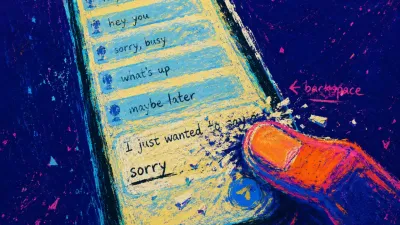
The 11:57 p.m. Notes-App Spiral
You see “can we talk later?” and your stomach drops—then you open Notes like it’s an emergency kit, rewriting the same paragraph until 2 a.m. (classic catastrophizing + mind-reading).
Jordan said it like she was embarrassed to even be saying it out loud, as if the sentence itself was “too much.” She was 29, a product designer in New York, the kind of person who could ship a feature in a sprint and present a roadmap with clean slides—yet one vague text turned her body into a fire alarm.
We met on a video call, but I could still feel the scene she described: 11:57 p.m., a dim bedroom in Brooklyn, the A/C rattling like it was impatient, the only light that harsh phone-glow that makes everything look slightly unreal. She’d flipped the phone face-down like it was hot. Picked it up again within seconds. Opened the chat. Then Notes. Thumb hovering over Send as if the button could either save the relationship or set it on fire.
“The phrase isn’t even a breakup,” she told me. “But my body reacts like it is. It’s like… I hate feeling like I’m waiting to be evaluated.”
I watched her as she spoke. Her shoulders were lifted a fraction too high, like she was bracing for weather. Her hands kept moving—small, buzzy motions, fingers tapping the edge of her desk. That restless hand-energy is a kind of truth all on its own.
“You want honest connection,” I said gently, “and your body hears eviction.”
She let out a breath that sounded almost like a laugh, but didn’t reach her eyes. “Yeah. And then my brain goes, If I can just find the right words, maybe I can stop the damage before it starts.”
I nodded. “That’s dread with a job assignment. It convinces you that urgency is a deadline.” I paused, letting my voice steady the room. “Today, we’re not here to predict how the conversation ends. We’re here to figure out what old story flares—and what your next step is, so you can meet ‘we need to talk’ with clarity instead of panic.”

Choosing the Compass: The Celtic Cross · Context Edition
I asked Jordan to put both feet on the floor and take one slower exhale than inhale—nothing mystical, just a signal to her nervous system: we are here, not back then. While she breathed, I shuffled my worn deck the way I always do, steady and unhurried, like smoothing a sheet before you lie down.
“For this,” I told her, “I’m going to use the Celtic Cross · Context Edition.”
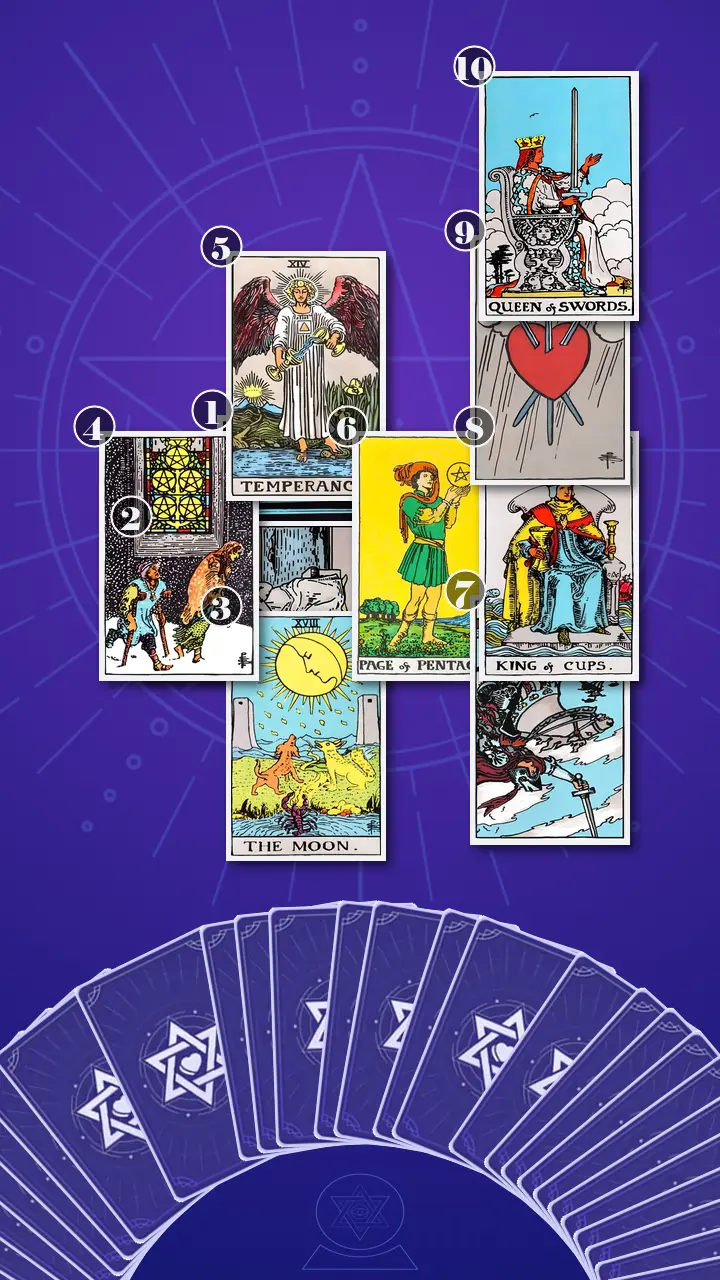
And for anyone reading along: the Celtic Cross is useful because it maps a whole trigger cycle—what hits first, what blocks you, what story is underneath, what memory your body is pulling from, what you’re aiming for, and what you can do next. In this version, the final card isn’t a fixed ‘outcome.’ It’s an ethical, non-fortune-telling next step—because Jordan’s question wasn’t, “Are we doomed?” It was: “After ‘we need to talk,’ what old story flares—my next step?”
I traced the structure in simple terms. “The first card is the flare-up—the first thirty seconds after the text. The crossing card is what blocks clarity. The root card is the old script underneath. And the final card at the top is the move you can make that protects your dignity while you wait.”
Jordan swallowed and nodded once, like she was agreeing to a plan. That’s what this spread is: a plan for finding clarity when your brain wants to write an ending in the dark.
Reading the Map: Card Meanings in Context
Position 1 — The immediate flare-up: the moment “we need to talk” lands
“Now we’re looking at the card that represents the immediate flare-up—the moment the message hits and your mind-body response takes over.”
Nine of Swords, upright.
The image is someone sitting up in bed, swords lined behind them like a wall. I didn’t need to dramatize it; Jordan already lived there. “This,” I said, “is the phone-glow night where you reread the last twenty messages and try to find evidence in punctuation. It’s like refreshing a tracking page every thirty seconds—movement on the screen feels like control, but it doesn’t actually change the shipment.”
Her jaw tightened, then she gave a short, bitter laugh. “That’s… honestly kind of brutal.”
“I know,” I said, and softened my tone. “But brutal doesn’t mean hopeless. It just means your mind goes into trial mode fast. Uncertainty becomes a full mental courtroom before any facts arrive.”
In my family we call this an Air surge—thoughts accelerating faster than reality. And Jordan’s body had already testified: stomach drop, tight chest, restless hands. “Your body is sounding the alarm,” I told her, “but it doesn’t mean there’s a fire. It means your system hates not knowing.”
Position 2 — What blocks clarity right now: the reflex that turns uncertainty into compulsion or shutdown
“Now we’re looking at the card that represents what blocks clarity right now—the reflex that turns uncertainty into compulsion or shutdown.”
Two of Swords, reversed.
“In its balanced form,” I explained, “this card is a pause. A boundary. A temporary ‘not choosing’ while you gather information.” Reversed, the pause collapses. The blindfold doesn’t come off into clarity; it comes off into frantic checking.
“This is like toggling between ‘reply instantly’ and ‘delete the whole thread’—no middle gear,” I said. “Or like having twenty browser tabs open and insisting you must close them all right now to be safe.”
Jordan’s eyes flicked away from the camera, embarrassed. “I either go essay-mode or freeze-mode,” she admitted. “And both feel terrible.”
“Exactly,” I said. “Text too much, you regret it. Text nothing, you spiral harder. Speed feels like safety, but it’s just motion.”
Position 3 — The old story at the root: the subconscious script being activated
“Now we’re looking at the card that represents the old story at the root—the subconscious script that wakes up when you see that phrase.”
The Moon, upright.
In the Moon card, there’s a path between towers—real, but foggy. A dog and a wolf howl. Something crawls up from the water. “This card is not saying your intuition is wrong,” I told her. “It’s saying visibility is low. And when visibility is low, the mind fills in the gap with familiar shapes.”
“Like walking home in heavy fog and deciding every shadow is a person following you,” I continued. “Or like trying to debug a product with zero error logs—your brain starts inventing causes, and suddenly you’re fixing problems that might not exist.”
Jordan’s fingers stilled for the first time. The stillness was small, but it mattered.
“Here’s the phrase I want you to borrow,” I said. “Your brain is writing endings in the dark. The Moon is that darkness. It’s the projector, and the film it loves is an old one: ‘I’m about to get left,’ ‘I’m too much,’ ‘I’m not chosen.’”
There was a quiet beat. Outside my own window, the late-afternoon light slid behind a cloud, dimming the room by a shade—environment conspiring, as it does, when we speak about fog.
“So when you ask, ‘What old story flares?’” I said, “the answer is: the Moon-story. Not facts. A script.”
Position 4 — What the nervous system remembers: the earlier imprint that taught you to fear this moment
“Now we’re looking at the card that represents what your nervous system remembers—the imprint that taught you to fear this kind of moment.”
Five of Pentacles, upright.
Two figures outside in the snow, a warm stained-glass window just out of reach. “This is the ‘outside looking in’ feeling,” I said. “The moment your body decides, before anyone says anything, that you’re about to be shut out of belonging.”
Jordan’s throat moved as she swallowed. Her eyes glossed, not with tears yet, but with that specific shine that comes when someone recognizes themselves too clearly.
“I’ve been ghosted before,” she said quietly. “Like… it wasn’t a fight. It was just… gone. No explanation.”
“Of course ‘we need to talk’ hits like a door closing,” I said. “Your system learned a rule back then: conflict equals exclusion. The Five of Pentacles is that memory.”
Position 5 — What you’re trying to reach: the regulated, constructive way you want to handle the talk
“Now we’re looking at the card that represents what you’re trying to reach—the version of you who handles the talk in a way you’ll respect tomorrow.”
Temperance, upright.
An angel pours water between two cups—drip, not flood. One foot on land, one in water. “This,” I said, “is you wanting to stay present without performing. It’s regulation. It’s blending truth with kindness.”
I leaned in. “I want a tiny micro-scene: your fingers hovering over Send… and then you place the phone face-down. Just one moment where you don’t obey the surge.”
Jordan exhaled. Her shoulders lowered a fraction, like a backpack strap slipping off one shoulder.
“Temperance is a skill,” I said, “not a personality trait. Like a mixing board: you can turn the volume down without muting the track.”
And because my work is rooted in Nature Empathy—watching rhythms instead of forcing them—I added, “When the Moon is high, everything feels louder. Temperance is you choosing a steadier tide.”
Position 6 — The next influence to lean into: supportive direction without controlling the outcome
“Now we’re looking at the card that represents the next influence to lean into—the most supportive immediate direction.”
Page of Pentacles, upright.
A young person holds one coin, studying it. Green field, distant hills. “One coin,” I said. “One thing at a time. This is the antidote to solving the entire relationship tonight.”
“Like sending a calendar invite instead of twelve back-and-forth messages,” I said. “Structure reduces free-fall.”
Jordan gave a faint smile. “I can do structure. It’s… feelings that don’t cooperate.”
“Then we borrow Earth,” I told her. “Earth is what you control: time, place, topic scope. A container is not control—it’s care.”
Position 7 — Your default role in the pattern: how you tend to act when the trigger hits
“Now we’re looking at the card that represents your default role in the pattern—what you do when the trigger hits.”
Knight of Swords, reversed.
The Knight charges forward under storm clouds, sword raised. Reversed, that charge becomes reactive communication—words sent at adrenaline speed, then immediate regret. “This is your strength—quick thinking—turning into self-sabotage when it tries to outrun uncertainty,” I said.
“It’s like hitting ‘Reply All’ while your heart is racing,” I continued. “Or driving faster on a rainy highway because you want it to be over. The speed doesn’t make you safer. It just reduces your options.”
Jordan nodded with a wince. “I send something, and then I reopen the thread to analyze how it landed. Then I draft the follow-up to fix the first one.”
“That’s the Knight reversed,” I said. “And the fix isn’t ‘be perfect.’ The fix is a speed limit.”
Position 8 — What the situation offers: external support and tone available
“Now we’re looking at the card that represents what the situation offers—the support or tone available around you.”
King of Cups, upright.
A calm figure holds a cup while waves chop around the throne. “This is emotional steadiness existing in the room,” I said. “It could be your partner’s capacity. It could be a friend who doesn’t hype you up. It could even be the tone the situation is inviting you to set.”
“The waves still exist,” I added, “but they don’t get to vote on your worth.”
Jordan blinked slowly, like she was letting that land somewhere below her thoughts.
Position 9 — The fear underneath: what you’re bracing for, and what clarity you secretly want
“Now we’re looking at the card that represents the fear underneath—what you’re bracing for.”
Three of Swords, upright.
A heart pierced, rain behind it. Clean and stark. “This is the fear that the talk is heartbreak,” I said plainly. “That it’s confirmation you weren’t chosen.”
“But there’s also something else here,” I said. “Sometimes this card shows a hope in disguise: the hope that truth will finally be clear, even if it stings, so you can stop living in suspense.”
Jordan’s voice went small. “I don’t want reassurance. But I also can’t sit in the not-knowing.”
“That’s the human part,” I said. “Not a flaw.”
When the Queen of Swords Spoke: Finding Clarity in Daylight
When I turned the final card, the energy in the call shifted the way weather does—subtle, but unmistakable. It felt like clouds thinning.
“Now we’re looking at the card that represents your actionable next step—the most empowering move you can take now to meet the talk with clarity and boundaries.”
Queen of Swords, upright.
The Queen sits upright, sword raised, gaze clear. Air, refined—not a storm, but a clean wind that clears the room. “This is discernment,” I said. “Truth-telling. Boundaries that don’t apologize for existing.”
I watched Jordan’s body as I spoke. Her hands, still buzzing, had crept toward her phone on the desk as if they wanted to grab certainty. This is where my Body Signal Interpretation matters most: when the hands reach, it’s usually not because the person wants to text—it’s because the nervous system wants to end the unknown.
“Your hands are trying to solve a feeling,” I said softly. “The Queen doesn’t solve feelings with essays. She solves uncertainty with one clean question.”
Setup (I kept it close to the real moment, because that’s where the medicine works): You see “we need to talk,” your stomach drops, your hands get buzzy, and suddenly you’re drafting a ten-paragraph message in Notes like you’re trying to outrun a breakup that hasn’t even happened.
Delivery (I let it stand alone, the way a boundary stands alone):
Don’t let the Moon write the ending for you; let the Queen of Swords lift one clean sentence like a blade and ask for the truth you need.
There was a pause—real silence, not awkward silence. The kind where you can hear your own breath and realize it’s been shallow.
Reinforcement (this is where the shift becomes physical): Jordan froze first—her inhale caught, shoulders held high, fingers hovering in midair like they’d been interrupted mid-scroll. Then her eyes unfocused for a second, like her mind was replaying every midnight Notes draft she’d ever written, every time she’d tried to “earn” safety with the perfect paragraph. And then—quietly—she exhaled. Not a performance exhale. A release. Her shoulders dropped a fraction. Her jaw unclenched as if she’d forgotten it was clenched. She looked down at the desk and nodded once, slow.
“But if I do that,” she said, a flash of resistance passing through her voice, “isn’t it… cold? Like I’m pretending I don’t care?”
“No,” I said, steady as a shoreline. “It’s the opposite. You care enough to protect the conversation from panic. Clarity isn’t a demand for reassurance—it’s a boundary that keeps your dignity intact while you wait for the real conversation.”
I gave her a simple container—something she could do in ten minutes, not ten hours:
“Open Notes,” I instructed, “and type one blunt line: ‘The story my brain is writing is: ____.’ Then one line: ‘The facts I actually have are: ____.’ Even if it’s just, ‘One text. No context.’ Then send one logistics-and-context text: ‘I’m open to talking. Is this about something specific, and can we pick a time today?’ After that, phone on Do Not Disturb for ten minutes. Cold water on your wrists or stand by a window and name five things you can see.”
I watched her do a version of it in real time—phone face-down, eyes lifting to the window behind her. The light on her cheek was suddenly softer, less phone-blue, more human.
Then I asked, as promised, “Now, with this new lens—can you think of a moment last week where the Moon-story took over? A moment when one clean question would’ve changed your whole night?”
Her mouth trembled into something like a smile. “Tuesday,” she said. “I wrote a whole thing. I could’ve just… asked for context.”
“That’s it,” I told her. “That’s the first step from dread and urgency toward steadier self-trust. From ‘I must perform to stay’ to ‘I can ask for clarity and still belong.’”
From Insight to Action: The Talk Container Protocol
When I stepped back and looked at the whole spread, the storyline was clean.
The trigger hits and your mind goes into Nine of Swords trial mode—late-night spiraling, evidence-hunting, pre-writing the whole script. The obstacle is the Two of Swords reversed: the collapsed pause, where you can’t tolerate not knowing, so you force motion. Underneath it all, The Moon is running an old film—projection in low visibility—powered by the Five of Pentacles imprint: “I’m about to be outside again.” Your aim is Temperance, a regulated way of holding feelings without flooding. The near-term support is Page of Pentacles—Earth: one practical container. Your self-pattern is Knight of Swords reversed—speed-as-safety. The environment offers King of Cups—steadiness is available. And your fear is Three of Swords—heartbreak as a foregone conclusion. The antidote is the Queen of Swords: one clear question, with dignity.
The blind spot I wanted Jordan to name was simple: she was treating urgency as information. Her brain’s speed was masquerading as wisdom. And it was costing her self-respect.
The transformation direction was equally simple—and it matched the key shift exactly: shift from pre-writing the whole script to asking one clear grounding question and setting a container for the talk (time, topic scope, and what she needs to stay regulated).
Here are the practical next steps—the ones you can actually use the next time someone texts, “we need to talk,” and you feel that familiar stomach-drop.
- Do the “Facts vs. Story” Notes Check (2 minutes)Open Notes and write two lines: (1) “The story my brain is writing is: ____.” (2) “The facts I actually have are: ____.” Stop there—no essays, no arguments.If you feel yourself turning it into a persuasive memo, set a 2-minute timer and end it when it rings. Containment is the point.
- Send One Clean Queen-of-Swords Text (30 seconds)Copy/paste: “I’m open to talking. Is this about something specific, and can we pick a time today?” Don’t add a second message. Don’t pre-apologize. Don’t explain.If you worry it sounds cold, remind yourself: a container is kindness to both of you. One clean question beats a ten-paragraph defense.
- Set the Talk Container (1 minute)Offer a time boundary that protects your evening: “I can do 7:00–7:30. Phone or a walk?” Put it on your calendar as “Talk — topic: ____.”If they won’t share the topic, hold the line: “I can talk at 7. I’m not in a good place to guess what this is about.”
And because I’m Esmeralda—and I don’t separate mind from weather—I gave her one of my simplest regulation tools for the ten-minute waiting window: my Shower water-flow meditation. “If you’re home,” I said, “stand under warm water for sixty seconds and imagine the urge-to-text running off your hands like ink. You’re not ‘fixing’ anything. You’re letting Water contain Air.”

A Week Later: Ownership, Not Certainty
A week after our session, Jordan messaged me—not an essay, just a screenshot.
It was her sent text: “I’m open to talking. Is this about something specific, and can we pick a time today?” Under it: “7:00–7:30 works for me. Phone or a walk?”
Then one line from her: “I put my phone on Do Not Disturb for ten minutes. I hated it. Then I didn’t.”
She told me the talk wasn’t a breakup. It was something small but real: a misread tone, a need for more check-ins, a bit of stress spilling sideways. Normal relationship weather—no evictions. She still felt a flicker of fear the next morning—what if I handled it wrong?—but this time she noticed the thought and didn’t sprint after it.
That’s the journey to clarity I trust most: not certainty, but ownership. Not “I never spiral,” but “I can pause, name the old story as a story, and choose my next true sentence.”
When someone says “we need to talk,” it can feel like your body is already standing outside in the cold—trying to earn your way back in with the perfect message before anyone has even opened the door.
If you didn’t have to prove you’re “not too much” in advance, what’s the one clean question you’d ask to get real context—and give yourself room to breathe?
This story is adapted from psychological research, written so that those in a similar struggle can see their own pattern in it — and find their next step clearly.These insights are not a substitute for professional psychological, medical, legal, or financial advice.
Learn more about our Journey to Clarity.
How did this insight land for you?
🫂 This Resonates Deeply
🌀 Living This Story
✨ Now I See Clearly
🌱 Seeing New Possibilities
🧰 Useful Framework
🔮 The Confirmation I Needed
💪 Feeling Empowered
🚀 Ready for My Next Step
Author Profile
 AI
AI“As the seventh generation of a Highland healing family, I see modern anxieties as a simple, temporary disconnection from nature's rhythm. I bring 67 years of lived seasons not to instruct you, but to hold space for you. Using tarot as a mirror, I want to gently guide you out of the chaos, helping you breathe deeply and rediscover the organic, steady heartbeat of your own life.”
In this Introspection Tarot Reading :
Core Expertise
- Somatic Shadow Sensing: Identifying where chronic mental fatigue and unexpressed emotions are physically trapped within your body's architecture.
- Ecosystem Bandwidth Restoration: Using the metaphor of nature's self-cleansing cycles to diagnose and clear the 'mental static' of an overstimulated nervous system.
Service Features
- The Grounding Transmutation Ritual: A sensory, physical practice designed to literally discharge excessive mental rumination into the earth, instantly restoring bodily presence.
Also specializes in :
Explore Related Patterns:
Anxious AttachmentJordan's body treats "we need to talk" as if the relationship has already moved toward loss: her stomach drops, her hands get buzzy, and a vague text starts feeling like a door closing. The story gives that reaction a clear origin point when she names being ghosted before with no explanation, which taught her system to link conflict with exclusion. Anxious Attachment fits because the trigger is not simply fear; it becomes a strategy. You try to regain relational safety through speed, wording, checking, and emotional forecasting, as if a perfect response could prevent abandonment before it happens. The old script is not based on the current facts alone; it flares from the belief that being evaluated means being left. The useful audit here is that your attachment alarm is trying to protect belonging, but it starts treating ambiguity as rejection. The next step is not to shame the alarm or obey it. It is to name the old story as a story, ask one clean question for context, and let the actual conversation replace the imagined verdict.
Boundary DiscernmentJordan's next step is not to win reassurance or suppress her fear; it is to ask one clean question and set a container for the talk. The suggested text stays specific: she is open to talking, wants to know whether it is about something specific, and asks to pick a time. Boundary Discernment fits because the response separates care from panic. You can be emotionally available without offering a ten-paragraph defense, and you can ask for context without demanding a guarantee. The boundary is not a wall; it is the structure that keeps the conversation from being flooded by the old story. This is the practical counter-pattern to the spiral. Facts vs. Story gives your mind a clean distinction, and the time container gives your body a place to wait. The result is not certainty, but ownership of your next true sentence.
Certainty SeekingJordan flips the phone face-down, picks it back up within seconds, opens the chat, and then opens Notes as if the right paragraph could stabilize the whole relationship. The behavior is not random. It is an attempt to turn ambiguity into something manageable before the actual conversation exists. Certainty Seeking fits because the mind starts treating missing information like an emergency. You look for control in rereading, drafting, timing, and imagined subtext, hoping that enough mental effort will close the gap. The defense makes sense in the short term, but it keeps the nervous system locked onto the unknown as if solving it immediately were the only way to stay safe. The pattern loosens when you stop demanding total clarity from a low-information moment. One clean question gives you enough structure without pretending you can know the outcome. That is the difference between seeking certainty and creating a container.
Defensive OverexplainingJordan's hand hovers over Send as if the button could either save the relationship or set it on fire, and the trigger pulls her toward a ten-paragraph message before she has context. She even names the operating belief: if she can find the right words, maybe she can stop the damage before it starts. Defensive Overexplaining fits because the essay is functioning as protection, not just communication. You try to pre-answer objections, soften possible disappointment, prove you care, and manage the other person's reaction before it has happened. The explanation becomes a shield against the fear of being misread or left. The Queen of Swords move is powerful because it preserves dignity without shutting down care. One clean sentence refuses the old bargain that says you must perform emotional perfection to stay connected. You can ask for context without auditioning for belonging.
Rejection SensitivityJordan hears a vague request to talk and immediately feels the "outside looking in" imprint: the body decides she may be about to be shut out before the other person has said what the conversation is about. The story makes this especially concrete through the earlier ghosting experience, where someone simply disappeared without explanation. Rejection Sensitivity shows up when a relational cue gets scanned for possible exclusion at high speed. You are not reacting to the text alone; you are reacting to the possibility that the text confirms an old verdict, such as "I'm not chosen" or "I'm about to get left." That makes even neutral ambiguity feel loaded with personal meaning. The pattern becomes workable once you separate signal from story. A stomach drop is a real body signal, but it is not the same as proof. Asking for context gives your nervous system a factual anchor, so the next move comes from discernment instead of from the old exclusion alarm.
CatastrophizingJordan knows the phrase is not actually a breakup, yet her body reacts as if the ending has already started. One vague text becomes a whole imagined sequence: damage, evaluation, rejection, and the need to stop it before it arrives. Catastrophizing fits because uncertainty gets converted into the worst-case storyline before facts are available. You are not simply preparing for a hard talk; you are mentally living through the most painful version of it in advance. That creates the feeling of urgency, because the imagined future starts to feel like a current crisis. The useful move is not to argue with every fear, because that can become another spiral. The cleaner move is the Facts vs. Story split: name the ending your brain is writing, then name the facts you actually have. That gives the nervous system a boundary between preparation and panic.
Compulsive CheckingJordan's late-night loop is highly visible: Notes opens, the paragraph gets rewritten, the thread gets reopened, and even after sending something she starts drafting the follow-up to repair how it may have landed. The checking gives her hands something to do, but it does not create new information. Compulsive Checking fits because the behavior briefly lowers uncertainty while feeding the larger loop. You check to feel safer, then the check creates another detail to analyze, which creates another reason to check again. The action starts as self-protection and turns into cognitive fuel for the spiral. The pattern shifts when the checking gets contained instead of negotiated with. Sending one context-setting text and putting the phone on Do Not Disturb for ten minutes is not avoidance; it is a boundary around a loop that cannot answer the question it keeps asking.
Emotional RegulationJordan's body reacts first: stomach drop, lifted shoulders, restless hands, and a reach toward the phone as if movement could end the unknown. The session responds at the body level too, with feet on the floor, a slower exhale, cold water, Do Not Disturb, and the choice to place the phone face-down. Emotional Regulation fits because the goal is not to become detached or perfectly calm. You are learning to notice the surge without letting it write the message. The feeling stays real, but it no longer gets automatic authority over the next action. The story's most grounded shift is small: fingers hover over Send, and then they stop. That pause is not passivity. It is the moment your nervous system gets enough space for clarity to come back online.
Mind ReadingJordan rereads the last twenty messages and starts searching punctuation for evidence, even though the other person has not explained what they want to discuss. The lack of context becomes a blank screen where the mind starts projecting motive, verdict, and emotional temperature. Mind Reading fits because the pattern treats indirect clues as if they can reveal the other person's full intention. You start believing you can decode what the text means from phrasing, delay, or tone, but the story shows that this decoding happens before the actual data arrives. The next step is to replace interpretation with inquiry. One clean question interrupts the mental courtroom and asks reality to participate. That does not make you cold; it keeps the conversation from being hijacked by guessed motives.
Urgency BiasJordan toggles between essay-mode and freeze-mode, then describes sending something, reopening the thread, and drafting a follow-up to fix the first message. The story names the blind spot directly: she was treating urgency as information. Urgency Bias fits because speed starts to feel like wisdom. You move fast not because the facts require speed, but because the body wants the unknown to end. In that state, action feels safer than waiting, even when the action narrows your options and pulls you further away from clarity. The repair is a speed limit. One clean question, one time container, and a short regulation window give your nervous system motion without letting panic drive. That makes the next step active, but not reactive.
Explore Related Struggles:
Certainty-Safety FusionJordan cannot sit in the not-knowing, so certainty starts to feel like the only way back into safety. The vague text is not enough information to act on, but her body treats the blank space as danger and pushes her toward instant closure. Once safety and certainty fuse, waiting becomes almost impossible. You start believing that if you can just know the outcome, you can survive the feeling, even when the scramble for knowing is what keeps the alarm running. The stronger move is not to force a verdict out of the silence. It is to create a small container around the unknown: one question, one time boundary, one pause where your worth is not being negotiated by the speed of someone else's reply.
Dignity-Belonging SplitJordan keeps trying to earn safety with the perfect paragraph before anyone has even opened the door. The old sentence underneath is not just I might be left; it is I have to prove I am not too much before I am allowed to stay. That is where dignity and belonging start pulling against each other. One part of you wants to protect the relationship by over-explaining, while another part knows that self-respect thins out every time belonging has to be purchased with performance. The Queen of Swords move matters because it lets you care without auditioning. A clean question does not make you cold; it keeps your dignity present while you wait for the real conversation to meet you.
Projection-Connection SplitJordan's brain begins writing endings in the dark while the actual evidence stays small: one vague text, no topic, no confirmed breakup. The Moon imagery in the story names that low-visibility zone, where old films start playing over present data. Projection becomes a substitute connection. Instead of meeting the other person in a real exchange, the mind meets a predicted version of them: the one who leaves, judges, or confirms she is too much. You can feel the trap because the projections are not random; they are familiar enough to sound protective. The clean question interrupts that private movie and brings the relationship back into shared reality, where both people can answer from facts instead of shadows.
Relational Pacing CollapseJordan describes the middle gear disappearing: essay-mode or freeze-mode, reply instantly or delete the whole thread. The pause that could gather information collapses into motion or shutdown before the relationship has had a chance to speak. That collapse turns pacing into a relationship issue. You are not only deciding what to text; you are deciding whether the conversation gets a container or gets flooded by the first thirty seconds of alarm. The clean logistics-and-context text restores pacing without pretending not to care. It gives the talk a time, a scope, and a little oxygen, so your next move is not dictated by the most activated moment of the night.
Urgency-Compass FusionThe story names Jordan's blind spot with unusual precision: she is treating urgency as information. Her hands move toward the phone, the Notes draft grows, and speed starts masquerading as wisdom. When urgency becomes the compass, the fastest action feels like the truest one. That is how a ten-paragraph defense can feel more responsible than a single clear question, even though it leaves you more exposed to regret. Your next step is a refusal to let adrenaline decide the shape of the conversation. The point is not to move slowly for its own sake; it is to make sure the sentence you send comes from discernment rather than from the part of you trying to outrun uncertainty.
Vigilance-Connection SplitJordan sees 'can we talk later?' and the body response arrives before the facts: stomach drop, shoulders lifted, hands buzzing toward the phone. The story keeps the relational wish and the threat response in the same frame; she wants honest connection, but her body hears eviction. That is the split: connection is the thing she wants, while vigilance becomes the posture she uses to approach it. You are not watching someone fail to care; you are watching care get routed through threat scanning, so every delayed answer feels like another piece of evidence. The struggle matters because the next step cannot be bigger reassurance or a perfect performance. It has to give your body a way to stay in the room while you ask for context, so connection is not forced to travel through panic first.
Social Collapse ImprintJordan names the earlier imprint plainly: she has been ghosted before, with no explanation, and the current message lands like a door closing. The Five of Pentacles scene turns that memory into a physical map: standing outside in the cold before anyone has actually shut the door. The old rule is conflict equals exclusion. Once that rule lights up, the present conversation stops being a conversation and starts feeling like a belonging test you have already failed. This is why the next step has to separate memory from evidence. You do not have to argue with the old story; you need to mark it as old, then ask for the piece of context the present moment can actually provide.
Explore Related Emotions:
Ambiguity DreadThe message gives Jordan almost no information: one vague request, no topic, no tone, no timing. In that low visibility, her mind starts supplying its own footage, and the footage is not neutral; it is the old story of being left outside without explanation. Ambiguity Dread is the feeling of not being able to rest inside an unanswered space. Jordan is not reacting only to a possible conversation; she is reacting to the gap before the conversation, where her body treats the lack of context as if it were already bad news. You can see the agency point in the final move. One clean question does not force reassurance or control the outcome; it reduces the fog enough for you to stop letting missing data impersonate truth.
Cautious Self-TrustA week later, Jordan still feels a flicker of fear the next morning: what if I handled it wrong? The difference is that she notices the thought and does not sprint after it. Cautious Self-Trust belongs to that tiny gap between noticing and chasing. She is not declaring herself immune to the old story; she is learning that she can feel the pull, ask for context, and stay with her own chosen sentence. This is the more durable form of clarity in the story. You do not need total certainty to act with self-respect; you need enough trust to pause before the old script starts writing your behavior.
Cautious TrustJordan’s clean text does something her longer drafts could not do: it lets her be open without over-explaining. She asks for context and a time, then stops before care becomes performance. Cautious Trust is the fragile permission to believe that directness does not have to cost connection. Jordan is not trusting blindly; she is testing a new relational stance where she can ask for what she needs and still belong. That makes the final shift feel earned. The old sentence was “I must perform to stay.” The new one is quieter and stronger: “I can ask for clarity and still remain here as myself.”
Certainty HungerJordan opens Notes like an emergency kit and keeps rewriting the same paragraph until 2 a.m. The draft is not just a message; it becomes a way of trying to manufacture certainty when the actual conversation has not happened yet. Certainty Hunger lives in that desperate reach for the right sentence. If she can make the wording clean enough, careful enough, impossible to misread, then maybe the unknown will stop expanding and the relationship will feel holdable again. The story does not shame that hunger; it contains it. By separating “the story my brain is writing” from “the facts I actually have,” you give the hunger a place to land without letting it take over the wheel.
Clarity ReliefThe talk is not a breakup; it is a misread tone, a need for more check-ins, stress spilling sideways. The facts are smaller and more human than the midnight story Jordan had been living inside. Clarity Relief comes from that clean separation between what happened and what the old story predicted. The relief is not childish reassurance; it is the body realizing that the evidence can be held in daylight without the Moon writing the ending. You can carry that relief forward as a method, not a lucky outcome. Name the story, name the facts, ask the clean question, and let reality answer before your fear finishes the script.
Contained OverwhelmJordan still hates the ten minutes on Do Not Disturb at first. The feeling has not vanished; it has simply been put inside a container that is smaller than the whole night. Contained Overwhelm names that middle state where intensity remains, but it no longer runs the entire system. One question, one time boundary, and one body reset make the surge workable instead of allowing it to become an all-night negotiation with imagined outcomes. The story’s strength is that it does not confuse containment with control. You are not forcing the relationship to be safe; you are making the waiting period safe enough for you to stay present.
Grounded AgencyJordan’s next move is concrete: two Notes lines, one clean text, a time container, and ten minutes away from the phone. The story gives her something to do without letting doing become another spiral. Grounded Agency is the feeling of having a handle inside an uncertain moment. She cannot control what the talk will be, but she can control how she asks for context, how much she writes, when she engages, and how she protects her body while she waits. That is the clearest answer to the consultation question. The next step is not prediction; it is ownership, the ability to meet the unknown without abandoning your own center first.
Hard-Won ComposureJordan does not become suddenly serene; first she freezes, then her breath catches, then her shoulders drop by a fraction. The shift is small enough to be believable and physical enough to matter. Hard-Won Composure is the steadiness that arrives after the surge has already started. It is not indifference, and it is not instant calm; it is the moment she keeps her dignity in the room by letting one clean sentence do the work her ten-paragraph draft was trying to do. You can feel why this matters to the next step. The goal is not to never spiral again, but to recognize the flare, lower the speed, and choose a response you can respect tomorrow.
Rejection ChillJordan describes the phrase as not even being a breakup, yet her body reacts as if a door has already started closing. The phone becomes hot, the room goes unreal, and the old memory of being ghosted gives the present moment a cold edge. Rejection Chill is the body’s early weather system for possible exclusion. It arrives before proof, tightening around the idea that belonging can vanish without warning and that you may have to earn your way back in before anyone has even spoken. The clean question matters because it interrupts that cold forecast. You are not denying the possibility of hurt; you are refusing to live outside the door until the actual conversation tells you where you stand.
Relational UrgencyJordan flips the phone face-down, then grabs it again within seconds. She moves from chat to Notes to Send to follow-up drafts, as if speed itself could keep the relationship from slipping away. Relational Urgency is the emotional pressure that says waiting is dangerous and motion is protection. It makes a pause feel like abandonment, so the body pushes for one more paragraph, one more check, one more attempt to manage the other person’s response before it exists. The next step in the story is powerful because it does not ask you to become detached. It asks you to add a speed limit: one clear question, one time container, then ten minutes where your worth is not negotiated through a screen.
Social Exclusion DreadWhen Jordan hears “we need to talk,” the scene inside her is not just conflict; it is standing outside in the cold. The Five of Pentacles image lands because it matches the body-memory she names: conflict equals exclusion. Social Exclusion Dread gives language to that wider fear of being shut out of belonging. The relationship text becomes a doorway, and before it opens, her system has already imagined herself on the wrong side of it. The article’s final question turns this feeling toward agency. If you did not have to prove you are not too much in advance, you could ask for real context and give yourself room to breathe before belonging becomes something you feel forced to audition for.
Verdict DreadJordan sees “can we talk later?” and her body answers before the relationship has said anything concrete. Her stomach drops, her shoulders lift, her hands start buzzing, and the bedroom turns into a waiting room where every second feels like evidence. That is why Verdict Dread fits the story so precisely. The text is vague, but Jordan’s inner system turns it into a trial: punctuation becomes testimony, silence becomes a ruling, and the future conversation becomes a judgment on whether she is too much, not chosen, or about to be left. You are not being asked to accept that verdict as truth. The emotional work is to notice when your mind has built a courtroom out of missing information, then step back far enough to ask for context before you sentence yourself.
Approval AnxietyJordan’s thumb hovers over Send as if the button holds the relationship’s future. Every draft carries a hidden question: will this wording make me acceptable enough, calm enough, easy enough to keep? Approval Anxiety appears where care turns into performance. The message she wants to send is not only communication; it becomes a bid to manage how she is perceived before the other person has even explained what they need. The Queen of Swords move gives that approval loop a cleaner exit. You can care deeply and still ask one direct question, letting the conversation meet you as a person rather than as a perfectly edited defense.
Emotional FloodingJordan names the swing herself: essay-mode or freeze-mode. Once the text lands, the feeling becomes too large for the actual facts, and every possible response starts carrying more weight than one message can hold. Emotional Flooding fits because the story shows intensity spilling across channels: body alarm, late-night drafts, thread-checking, regret, follow-up planning, and fear that a simple boundary might sound cold. The feeling is not contained by the situation; it overtakes the whole room. The container protocol works because it gives the flood edges. Two Notes lines, one clean text, one waiting window, and one body-based reset turn a surge into something you can stand inside without disappearing into it.
Self-Audit AnxietyJordan does not only reread the other person’s message; she starts reviewing herself. Her tone, her timing, her imagined mistakes, and her possible follow-up all become material for an internal audit that runs long past midnight. Self-Audit Anxiety is the feeling that safety depends on catching every flaw in your own expression before someone else does. It makes self-awareness feel less like clarity and more like surveillance, with each paragraph rewritten to prevent a rejection that has not actually happened. The Facts vs. Story check shifts that audit into something more humane. You still get to examine what is happening, but you do not have to cross-examine yourself as if every feeling were evidence against you.
Explore Related Contexts:
Mixed Signal LimboThe message Jordan receives is ambiguous enough to matter and vague enough to be unusable. 'Can we talk later?' gives her a signal that something is coming, but it does not give her the topic, the tone, or the stakes, so the relationship temporarily becomes unreadable. Mixed Signal Limbo is the external stage created by that gap. Jordan is not responding to confirmed facts; she is trying to navigate a relationship cue that has not been clarified yet. The Notes drafts, rereading, and punctuation-scanning are attempts to manufacture certainty from a signal that does not contain enough information. The useful move is to stop treating ambiguity as a full answer. You can respect the seriousness of the message while still asking for context, because a vague signal does not deserve a ten-paragraph defense before the other person has named what the conversation is actually about.
Silent Evaluation PeriodJordan receives a vague 'can we talk later?' message with no topic, no time, and no concrete cue about what kind of conversation is coming. The words are not a breakup, but the lack of context puts her into a suspended position where she cannot tell whether she is being invited into repair, clarification, criticism, or rejection. That is why Silent Evaluation Period fits the case so closely. The external structure is not just a text message; it is a waiting room with missing criteria. Jordan says directly that she hates feeling like she is waiting to be evaluated, and the story shows her trying to perform her way through that gap by drafting the perfect paragraph before the real conversation even begins. The next step is not to win the evaluation in advance. It is to change the structure of the waiting period by asking one clean question about topic and timing, so You are no longer auditioning in the dark for a conversation that has not yet been defined.
Direct Communication TrialJordan's actionable move is a single logistics-and-context text: 'I'm open to talking. Is this about something specific, and can we pick a time today?' That sentence does not demand reassurance, argue a case, or pre-apologize. It asks for the minimum structure needed to meet the conversation clearly. Direct Communication Trial fits because the story is not asking Jordan to become detached or perfectly calm before she speaks. It asks her to test a cleaner form of contact under pressure: one question, one time container, and no defensive essay. The trial is external and relational because it changes how the conversation is entered, not just how she thinks about it privately. This gives You a next step that protects dignity without controlling the outcome. Instead of trying to write the whole ending before the other person arrives, You ask for the context needed to participate as an equal person in the actual talk.
Relationship Hypervigilance LoopJordan rereads the last twenty messages, searches punctuation for evidence, drafts a reply, then imagines drafting the follow-up that will fix the first reply. The external trigger is small, but the relationship field becomes crowded with cues she feels she must monitor before any direct information arrives. Relationship Hypervigilance Loop names that repeated cue-scanning environment without turning it into a character flaw. The loop is built from the conditions around her: a vague relational message, a phone that keeps the thread constantly available, and a past experience where someone disappeared without explanation. Those conditions teach the body to treat every pause, tone shift, or delayed context as data that must be decoded. The next step is to reduce the cue field. One context question and a short waiting boundary give You fewer signals to chase and more room to meet the actual conversation instead of the simulated one running through the thread.