The 11:42 p.m. WhatsApp Draft
I met Alex, a 27-year-old non-binary junior UX researcher, at 11:42 on a wet Tuesday night. They could ask a stakeholder a clean, direct question in a research session, yet one delayed WhatsApp reply could send them into early-dating uncertainty with three carefully rewritten versions of the same message: "Where is this going?"
On my screen, Alex sat under a cool duvet in their Hackney flat, their laptop balanced against bent knees and their phone hot in one restless palm. The radiator clicked behind them. Outside, tyres hissed over wet pavement, while the white message thread lit their face and showed a warm but noncommittal reply from someone they had seen twice.
"I want clarity," Alex said, deleting the draft again. "But I keep asking clarity to do the work of trust. If they are serious, why should I have to wait?"
I watched their shoulders lift as the typing indicator appeared, vanished, and appeared again. Their anxiety looked like a hand still gripping a Tube rail after the carriage had stopped: knuckles braced for movement, chest cinched against an impact that had not happened. The longing beneath it was simpler. They wanted to know that their interest was mutual and that their vulnerability would not be treated casually.
"You are not asking only for clarity," I said. "You are asking clarity to make waiting feel harmless. You want a real commitment, but the faster you try to secure it, the less room trust has to become visible."
I did not tell Alex to suppress that need, accept indefinite ambiguity, or wait patiently for someone who repeatedly broke plans. At sixty-seven, with seven generations of Highland healing practice behind me, I have no interest in using tarot to overrule a person's boundaries. I use the cards as a mirror: a way to separate what is happening from what fear predicts, so the person in front of me can choose with more authority.
"Let us give this fog a map," I said. "Not a prediction about whether this person will choose you. A clearer view of what happens inside you before trust has had time to grow."

Choosing a Map for Two Different Timelines
I asked Alex to place both feet on the floor, take one ordinary breath, and hold the question without trying to solve it. I shuffled slowly, using the small ritual as a transition from reacting to observing rather than as a performance of mystery.
I chose the Relationship Spread: Context Edition, a five-card relationship tarot spread designed for pace, trust, and communication. It suited Alex's question because the problem was not simply whether commitment was available. The problem was how romantic ambiguity moved through their need for security, their thinking, their communication, and their next choice.
I explained that the centre position would show Alex's observable contribution to the relationship dynamic. The horizontal line would reveal the security need beneath that behaviour and the mental loop blocking trust. The vertical line would offer a balancing principle above and one grounded action below.
I had deliberately contextualised the second position rather than claiming to read the other person's private thoughts. Tarot can help Alex examine the needs and projections they bring into an undefined connection; it cannot ethically invent motives for someone who is not in the room. That boundary matters whenever I explain how tarot works: card meanings gain value through context, reflection, and observable life, not supernatural certainty about another person's mind.
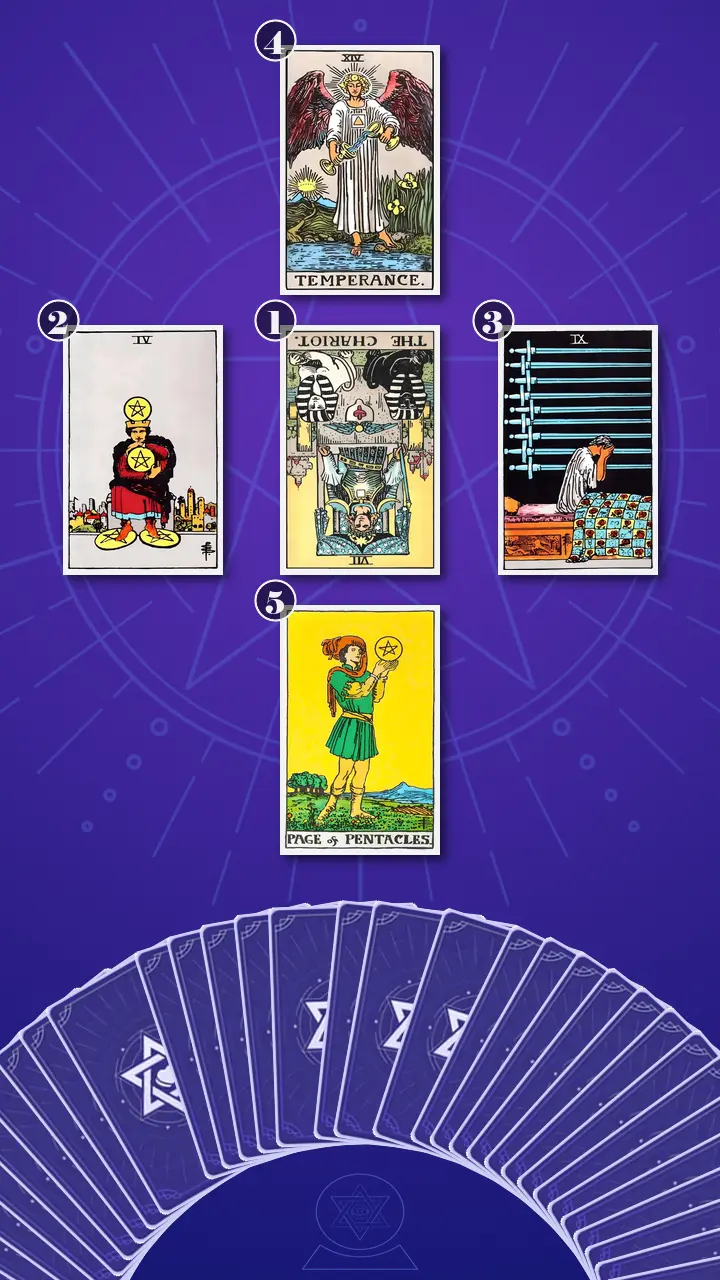
Reading the Pressure Point
Position 1: The Route Alex Was Trying to Force
The card I turned over now represented Alex's current contribution to the relationship dynamic, specifically the pattern of pushing for commitment before trust had time to grow. It was The Chariot, reversed.
The armoured charioteer sat between black and white sphinxes, but no visible reins joined them. In Alex's life, the image was the 11:42 p.m. message after two strong dates: rewriting the request for direction, adding a timeline, and preparing a follow-up before the first answer had even settled. The Chariot's will was in excess, while mutual alignment remained blocked. More precise wording could not make two separate timelines move as one.
"This is like trying to make Citymapper announce the final destination while two travellers have not agreed on the route," I said. "The private sentence is: ‘If I can get a clear answer now, then I will not have to feel powerless, exposed, or unchosen.’ But the answer is being asked to regulate the feeling, not only clarify the relationship."
Alex gave one short laugh, but there was no amusement in it. Their thumb stopped above the draft. "That is so accurate it feels a bit brutal."
"Then let us be precise without being cruel," I replied. "Directness states the need once. Pressure keeps asking until the feeling changes. Wanting direction is not the problem; trying to create mutual direction through unilateral control is what keeps exhausting you."
Position 2: The Label Asked to Hold Everything
The card I turned over next represented the security need Alex was bringing into the connection and the reassurance they were asking commitment to provide. It was the Four of Pentacles, upright.
The figure held one pentacle against the chest, carried another over the head, and pinned two beneath the feet. I saw the same total-body strategy in Alex's description of receiving a warm message, memorising its exact wording, and reopening it once the reassurance had begun to fade. The label was being asked to secure emotion, thought, footing, self-worth, and future direction at once. Security energy, useful in balance, had tightened into an excessive grip.
Alex told me about the previous Sunday: burnt toast at the kitchen counter, the fridge humming, an Instagram anniversary carousel flashing gold balloons across the screen. Within minutes, Friday's reassuring message no longer felt sufficient. Someone else's visible milestone had become an invisible deadline for their own connection.
I call my way of separating those pressures Social Clock Decoupling. I asked Alex to imagine removing the engagement posts, anniversary captions, Hinge discourse, and peer timelines from the room. "Without that artificial clock ticking beside you, what would a healthy pace look like for this actual connection? And if you received a definite commitment today, what would you need it to prove about your worth?"
Alex pressed the phone briefly against their chest, almost mirroring the card. Their brow tightened before their hand dropped back to the duvet. "That I cannot be displaced," they said. "That I was worth choosing before they had time to change their mind."
"That need for security is legitimate," I said. "But a relationship label used this way becomes emotional rent paid in advance. It may feel like security, yet it cannot guarantee how the space will actually be lived in."
Position 3: The Courtroom Above the Bed
The card I turned over now represented the central trust blocker: the mental and behavioural loop that turned uncertainty into pressure before consistent evidence could accumulate. It was the Nine of Swords, upright.
I pointed to the figure sitting awake beneath nine swords. Alex had already described the modern version: 2:07 a.m., the room dark except for the message, "Had a lovely time, busy couple of days but speak soon." With no additional evidence, their mind supplied fading interest, another date, quiet rejection, and a final disappearance. By morning, those forecasts felt factual enough to justify another commitment question.
The sword energy was in excess: analysis had multiplied beyond the available data, while the path to trust was blocked by predictions masquerading as observations. I heard the loop in three beats: "I do not know yet. My mind supplies the worst answer. I treat that answer as a reason to act now."
"Missing information is not the same as bad news, even when your body reacts to both in the same way," I said. "Which details were actually confirmed on the screen, and which ending did your mind write before the other person provided more information?"
Alex's jaw remained fixed for several seconds. Their eyes moved away from me as though they were replaying the night, frame by frame. Then their fingers uncurlled from the phone. "The only fact was that they said they were busy," they said quietly. "Everything after that was mine."
When Temperance Refused the Deadline
Position 4: Two Cups, No Ultimatum
The traffic outside Alex's flat paused at a red light. Their radiator gave one final metallic click, and the room seemed to grow still as I turned over the card representing the balancing principle that could interrupt the urgency: the capacity to communicate needs while allowing trust to develop through time and reciprocity.
It was Temperance, upright.
The angel poured steadily between two cups, with one foot on land and one in water. In Alex's real life, this looked like saying once, "I am interested in continuing, and consistency matters to me. Can we make a plan for next week?" It meant allowing the next few ordinary interactions to reveal whether communication, care, and follow-through were mutual. Temperance carried balanced energy: patience without self-erasure, emotional honesty without pressure, and reciprocity without proof-seeking.
Through my Seasonal Energy Diagnostics, I recognised a familiar mismatch. Alex was trying to force a spring harvest from a connection still in its early growing season. Their exhaustion did not prove that the relationship was doomed or that their desire was excessive. It showed that they were demanding mature fruit from a process that had not yet produced enough shared days. A season cannot be argued into ripeness, but it can be observed. Its pace may eventually reveal growth, incompatibility, or a limit Alex has every right to honour.
I asked Alex to look again at the 11:42 p.m. draft. In that moment, one warm but open reply had become a test: choose me now, or I must assume I am not worth choosing. Their directness had been recruited to settle a deeper fear.
A label can name a relationship, but it cannot prepay trust; trust is the pattern both people freely repeat after the conversation ends.
You do not have to secure commitment to make uncertainty disappear; let Temperance's two cups teach you to exchange clarity in small doses and allow trust to grow through balanced, repeated contact.
First, Alex froze. Their inhale stopped halfway, and their forefinger hovered over the phone as if the body had received the sentence before the mind could translate it. Then their gaze slipped out of focus. I could see them revisiting the status conversations, the sharpened follow-ups, and the brief relief that always faded. Their pupils widened; their mouth tightened.
"But does that mean I have been wrong every time I asked?" they said, sudden heat entering their voice. "Have I been ruining it?"
I let the anger have room before I answered. "No. It means a valid need was carrying an impossible assignment. You were trying to protect yourself with the tool you had. Now you can use directness for information and your own boundaries for protection."
Finally, Alex's fist opened against the duvet. Their shoulders lowered, their eyes reddened, and a long breath left them with a slight tremor. Relief arrived, but so did the vulnerable blankness of having no guaranteed outcome to hold. I asked, "Now, with this new view, think back to last week. Was there a moment when this insight might have made you feel different?"
"On the Northern line," Alex said. "Saturday was still unconfirmed. I was switching between an ultimatum and pretending I did not care. I could have asked for the plan and left the five-year future alone."
I set an eight-minute timer and asked Alex to open a private note with two headings: What happened and What I predicted. They recorded three observable facts from the latest interaction and one small next plan that could provide useful evidence. We excluded online-status checks and response-time scoring; those created screen activity, not relational knowledge.
This was the first move from anxiety-driven pressure for a relationship label to steadier trust based on mutual pacing and observable consistency. Alex was not giving away the power to choose. They were reclaiming the power to observe before investing further.
Position 5: The Researcher Returns to the Evidence
The final card I turned over represented one small, observable step Alex could practise that week to replace premature certainty-seeking with grounded attention to consistency. It was the Page of Pentacles, upright.
The Page studied one pentacle while standing in a cultivated field. For Alex, this became one specific plan, one instance of follow-through, and one neutral entry in Notes. The connection no longer had to become a verdict overnight. It could become a bounded learning process: one need, one plan, and one week of lived evidence.
The Page's practical earth energy was available in balance. It did not promise commitment or instruct Alex to tolerate a pace that felt wrong. It offered a better unit of analysis. As I put it in their UX language, one interaction was a data point, not a completed findings deck.
"What did they actually do? What did I assume it meant? What would one more ordinary interaction show?" I asked. "Intensity can be convincing tonight, but consistency is what you will need next month."
Alex reached for Notes without my prompting. The movement was small, but their hand was steadier. "I know how to work with incomplete research," they said. "I just never thought I was allowed to do that here."
One Need, One Plan, One Week
I drew the five cards back into one story. The Chariot showed Alex trying to create direction through force because waiting felt like losing control. The Four of Pentacles revealed the security and self-worth they wanted a label to hold in place. The Nine of Swords showed why the pressure became urgent: missing evidence was repeatedly converted into imagined rejection. Temperance restored proportion, and the Page of Pentacles turned that proportion into an observable experiment.
The cognitive blind spot was the belief that waiting for evidence meant surrendering power. In reality, Alex had been surrendering attention to forecasts and social clocks. The transformation was not from wanting commitment to pretending not to care. It was from using commitment to eliminate uncertainty toward stating one need clearly, agreeing on one concrete plan, and letting mutual follow-through reveal what was actually available.
Alex frowned when I suggested leaving the larger label question alone for a bounded period. "But if I do nothing about it for a week, am I not handing them the power again?"
"Not in the way I mean it," I said. "My Winter Dormancy Ritual is not passive waiting. It is a conscious pause after you have communicated clearly. Winter does not cancel growth; it prevents exhausted hands from digging up the seed every night to check whether it has roots. You set the endpoint, observe the conditions, and remain free to leave."
- The Two-Cup Pacing Check Before the next date, write this two-sentence statement in Notes: "I am interested in continuing, and consistency matters to me. Would you like to make a specific plan for next week?" Use it once in a calm conversation, ask for one realistic plan, and schedule a seven-day calendar reminder titled "Review actions, not wording." Keep the request to two sentences. If seven days feels too exposed, begin with 48 hours or one interaction. A pause never requires tolerating disrespect, repeated broken plans, deception, or a crossed boundary.
- The Winter Dormancy Ritual After making the clear request, do nothing for seven days to force a final label: no second status conversation, no "last seen" monitoring, and no reply-time scoring. When urgency rises, set an eight-minute timer and write three facts under "What happened" and one feared conclusion under "What I predicted." At the scheduled review point, decide whether to continue, ask a new question, slow down, or step away. The minimum version is three minutes with the phone face down, one body sensation, one fact, and one forecast. If the log becomes another surveillance tool or increases rumination, close it; the practice serves your agency, not the other way around.
I reminded Alex that trust is not one perfect answer. It is a pattern both people remain free to repeat. Their task was not to manufacture a reassuring verdict but to notice whether reciprocity, consistency, and respect were present often enough to support the commitment they genuinely wanted.

A Week Later, the Message Was Still Open
Seven days later, Alex sent me a brief voice note. They had used the two-sentence request. The other person suggested Thursday, confirmed on Wednesday, and arrived when they said they would. Alex recorded those actions without turning them into proof of an entire future.
There was still no relationship label. Alex slept through the night, then woke with the thought, "What if they still lose interest?" They smiled at its familiarity, opened the evidence note instead of WhatsApp, and got out of bed.
I did not mistake one kept plan or one full night's sleep for a solved relationship. The change was smaller and more important: Alex could feel uncertainty without immediately converting it into a verdict on their worth. The cards had not made that happen. Alex had named a need, protected a boundary, and chosen what evidence deserved their attention.
For me, that is the purpose of a Journey to Clarity. The five-card Relationship Spread did not decide whether this connection should continue. It helped Alex move from decoding every message to recognising that words and repeated behaviour must be allowed to meet. The authority remained where it belonged: with Alex.
I know that when one unanswered message tightens your chest, waiting can feel like more than risking a relationship. It can feel like handing someone else the power to decide whether you were worth choosing. Yet noticing that hidden meaning already loosens its grip; you are no longer standing at the beginning of the loop without a map.
If you placed one clear need in one of Temperance's cups and one ordinary act of follow-through in the other, what might you become curious to notice before asking for a final answer?
This story is adapted from psychological research, written so that those in a similar struggle can see their own pattern in it — and find their next step clearly.These insights are not a substitute for professional psychological, medical, legal, or financial advice.
Learn more about our Journey to Clarity.
How did this insight land for you?
🫂 This Resonates Deeply
🌀 Living This Story
✨ Now I See Clearly
🌱 Seeing New Possibilities
🧰 Useful Framework
🔮 The Confirmation I Needed
💪 Feeling Empowered
🚀 Ready for My Next Step
Author Profile
 AI
AI“As the seventh generation of a Highland healing family, I see modern anxieties as a simple, temporary disconnection from nature's rhythm. I bring 67 years of lived seasons not to instruct you, but to hold space for you. Using tarot as a mirror, I want to gently guide you out of the chaos, helping you breathe deeply and rediscover the organic, steady heartbeat of your own life.”
In this Timing Tarot Reading :
Core Expertise
- Seasonal Energy Diagnostics: Diagnosing your deep exhaustion as a misalignment with natural seasons—trying to force a spring harvest during a winter dormancy phase.
- Social Clock Decoupling: Detaching your core self-worth from artificial timelines like peer pressure or societal milestones.
Service Features
- The Winter Dormancy Ritual: A grounded challenge to consciously do 'nothing' regarding a blocked goal for one week, eradicating guilt and rebuilding organic energy.
Also specializes in :
Explore Related Patterns:
Anxious AttachmentOne delayed WhatsApp reply after two dates sends Alex into three rewrites of "Where is this going?", while a warm response provides only temporary relief. The push for commitment is therefore carrying more than a preference for direct communication: it is trying to close relational distance before enough repeated contact exists to show whether the connection is dependable. When early ambiguity feels like possible displacement, you may reach for a label as protection against being left unchosen. Anxious Attachment describes that recurring defensive sequence without making the desire for commitment wrong: uncertainty activates threat forecasting, threat forecasting intensifies bids for closeness, and those bids can become pressure when the answer is expected to regulate both the relationship and your worth.
Certainty SeekingAt 11:42 p.m., Alex keeps rewriting the same commitment question while watching the typing indicator appear and disappear. The wording changes, but the assignment given to the question stays the same: produce enough certainty now that waiting, exposure, and the possibility of rejection no longer feel dangerous. When you ask an early relationship answer to remove all future doubt, Certainty Seeking can disguise itself as exceptional directness. The distinction is functional: directness asks once for usable information, while certainty seeking repeats or sharpens the question because the remaining uncertainty still feels intolerable. No perfect wording can close that loop permanently, because trust depends on evidence that only voluntary, repeated behaviour can provide.
Control CopingAlex adds a timeline and prepares a follow-up before the first answer has even settled, then considers moving between an ultimatum and pretending not to care. These actions try to convert a shared, still-developing process into something that can be directed from one side because waiting has become associated with powerlessness. When you use precision, deadlines, or escalation to make emotional exposure feel manageable, control becomes a coping strategy rather than a neutral planning tool. Control Coping explains why stronger pressure does not create stronger trust: it can briefly restore a sense of agency, but it cannot make another person's pace, feelings, and future choices controllable. Durable agency comes from making a clear request, observing the response, and deciding what you will do with the evidence.
Reassurance SeekingAlex memorises the exact wording of a warm reply and reopens it once the reassurance begins to fade. The same decay appears in the repeated status conversations: each answer can calm the immediate uncertainty, but the relief does not last because the answer is being asked to stabilise emotion, self-worth, and the future simultaneously. When you keep returning to another person's words so that the feeling will change, Reassurance Seeking turns communication into a short-term regulation loop. The need for mutual interest remains valid, but repeated reassurance cannot guarantee that you will never be displaced or disappointed. Recognising the loop lets you use words as information and reserve deeper trust for the consistency that follows them.
Conditional Self-WorthAlex says that definite commitment would need to prove they cannot be displaced and were worth choosing before the other person had time to change their mind. In that frame, an open reply is no longer only information about an early connection; it becomes a pending verdict on Alex's personal value. When you need another person's early choice to certify your worth, Conditional Self-Worth makes commitment carry an impossible psychological burden. Even a reassuring label can only offer temporary relief because future behaviour remains outside your control. Decoupling worth from the verdict does not require lowering your standards; it allows you to evaluate reciprocity without making every delay evidence that you were not valuable enough to choose.
Timing DiscernmentAlex moves from asking for a five-year implication after two dates to working with one need, one specific plan, and one week of lived evidence. A single interaction becomes a data point rather than a completed findings deck, and commitment remains a possible destination rather than an answer that must be produced immediately. When you let the timing of a decision reflect the maturity of the available evidence, Timing Discernment replaces forced progress with proportion. You are not required to tolerate a pace that does not work for you, but intensity alone does not establish consistency. The relevant question becomes whether enough repeated, reciprocal behaviour has appeared to support the level of commitment being requested.
Uncertainty ToleranceAfter making one clear request, Alex leaves the larger label question alone for a bounded week and sets a specific review point. The thought "What if they still lose interest?" returns, but Alex opens the evidence note rather than immediately converting the thought into another status conversation. When you can let uncertainty remain present without treating it as an instruction, Uncertainty Tolerance restores choice between feeling and action. This is not passive waiting or acceptance of indefinite ambiguity. You communicate, set the endpoint, observe the conditions, and remain free to leave; the unresolved feeling no longer has to force a premature verdict.
Boundary DiscernmentAlex is explicitly told that pausing does not require accepting repeated broken plans, deception, disrespect, or a crossed boundary. They can state the need for consistency, set a review point, and remain free to continue, slow down, ask another question, or step away. When you distinguish your standard from your attempt to control another person's response, Boundary Discernment protects agency on both sides. Directness gathers information; your boundary governs your own investment and exit decisions. This prevents commitment pressure from becoming the only available form of self-protection.
CatastrophizingThe message "busy couple of days but speak soon" contains no confirmed rejection, yet Alex's mind supplies fading interest, another date, quiet rejection, and disappearance. By morning, those imagined endings feel factual enough to make another commitment question seem urgent. When missing information is rapidly completed with the most threatening available ending, Catastrophizing creates an action bias: you act now because the forecast feels like an event already underway. The useful audit is not whether the feared outcome is impossible, but whether it has actually been evidenced. Separating what happened from what you predicted restores room for proportion without requiring you to ignore genuine inconsistency when it appears.
Assertive CommunicationAlex replaces three rewritten status messages with two sentences: they are interested in continuing, consistency matters, and they would like to make a specific plan for the next week. The request names the need directly while leaving the other person free to answer through both words and follow-through. When you communicate this way, Assertive Communication separates clarity from pressure. You do not suppress the desire for commitment, but you also do not keep escalating until uncertainty disappears. The request gives you information, the response reveals available reciprocity, and your boundary determines what you do next.
Reality TestingAlex identifies that the only confirmed fact on the screen was that the other person said they were busy; fading interest, another date, rejection, and disappearance were additions made by their own forecast. They then record the suggested date, Wednesday confirmation, and Thursday arrival without turning those actions into proof of an entire future. When you distinguish observations from interpretations, Reality Testing prevents a feared ending from acquiring the authority of a confirmed event. It also prevents one positive interaction from becoming premature proof that everything is secure. The result is not emotional detachment but cleaner evidence: you can remain interested while judging the connection by what both people repeatedly do.
Explore Related Struggles:
Clarity-Timing SplitOne delayed WhatsApp reply produces three carefully rewritten versions of the same question, and you say plainly that you keep asking clarity to do the work of trust. Information and time are being asked to perform the same job, even though a clear answer can name an intention while only repeated contact can show whether that intention has substance. Your directness is not the problem. The friction appears when a request for information is loaded with the task of making waiting feel harmless, so the absence of an immediate label becomes harder to tolerate than the actual evidence requires. The useful distinction is between asking what is available now and demanding that the answer erase what has not yet had time to develop.
Relational Pacing CollapseAfter only two dates, you rewrite 'Where is this going?', add a timeline, and prepare a follow-up before the first reply has settled. The request begins as direct communication, but the extra drafts turn it into an attempt to make two separate dating timelines move as one, using unilateral pressure to manufacture mutual direction. That is why commitment feels urgent before trust has had room to become visible. The label is being asked to stop exposure and waiting at once, while trust can only show whether care and follow-through are freely repeated after the conversation ends. Seeing the timing collapse clearly lets you keep the need for direction without asking one answer to create the entire relationship.
Evidence DisconnectionAt 2:07 a.m., the screen confirms only that the other person had a busy couple of days and would speak soon. Your mind adds fading interest, another date, rejection, and disappearance, and by morning those predictions feel solid enough to trigger another commitment question. The result is a closed evidence channel. New facts have to compete with an ending already written, so action arrives before the other person's next behavior can update the picture. The two headings, 'What happened' and 'What I predicted,' restore a usable separation between observation and forecast without asking you to ignore genuine inconsistency.
Explore Related Emotions:
Ambiguity DreadAt 2:07 a.m., Alex reads a message saying the other person is busy and will speak soon, while their mind supplies fading interest, another date, rejection, and disappearance. The unanswered space stops functioning as missing information and becomes a container for endings that have not occurred. When uncertainty lands this way, you can feel forced to act before reality has had time to clarify itself. Ambiguity Dread names the inner weather beneath that pressure: not simply wanting an answer, but experiencing the absence of one as an approaching verdict on the relationship and your worth.
Cautious TrustSeven days after Alex makes one clear request, the other person suggests Thursday, confirms on Wednesday, and arrives as agreed. Alex records those actions without turning one kept plan into proof of an entire future, and the relationship remains unlabeled. Cautious Trust lives in that measured middle ground. You allow repeated behaviour to matter while remembering that one interaction is not a guarantee and that you remain free to respond to what develops. Trust becomes a provisional openness supported by evidence, not a demand that uncertainty disappear before you can stay present.
Certainty HungerAlex deletes and rewrites “Where is this going?” because no version of the question can guarantee that waiting will be harmless. Even a warm reply fades quickly when it is expected to settle emotion, thought, self-worth, and future direction all at once. The resulting hunger is larger than a reasonable wish for information. You can find yourself wanting an answer to end exposure itself, as though sufficient precision could remove every later change of mind. Certainty Hunger names that unsatisfied internal pull while preserving your agency to ask clearly, assess the response, and decide what pace you are willing to accept.
Grounded AgencyAlex's fist opens against the duvet after they hear that a valid need has been carrying an impossible assignment. They then write down what happened, separate it from what they predicted, and choose one bounded request without surrendering the right to slow down or leave. Grounded Agency emerges when you stop asking commitment to control another person's future and return to the choices that remain yours. You can communicate directly, observe consistency, protect a boundary, and revise your investment without manufacturing a reassuring verdict. The steadiness comes from locating authority in your own attention and decisions.
Guarded LongingOn the Northern line, Alex moves between drafting an ultimatum and pretending they do not care whether Saturday is confirmed. Neither position expresses the simpler truth already present in the story: they want mutual interest, dependable care, and confidence that their vulnerability will not be handled casually. Guarded Longing is what it feels like when a real desire for closeness travels inside protective pressure. You still reach toward connection, but the reach is armoured by an attempt to control how exposed you can become. Seeing the longing beneath the defence lets you state what matters without making the other person's immediate certainty responsible for containing it.
Replaceability DreadAlex presses the phone to their chest and says they want proof that they cannot be displaced, that they were worth choosing before the other person has time to change their mind. Commitment is therefore carrying a deeper assignment than defining the connection: it is being asked to certify that Alex's place cannot be withdrawn. That hidden assignment makes time itself feel threatening. Replaceability Dread is the fear that, if you are not secured quickly, further knowledge will make someone choose differently and expose your vulnerability as disposable. Naming it separates your worth from another person's evolving decision and returns attention to the reciprocity actually available.
White-Knuckle SecurityAlex holds a hot phone in one restless palm, shoulders raised and chest cinched, while three versions of “Where is this going?” wait in the draft. Their body is already gripping for protection before the other person has provided enough behaviour to confirm either safety or danger. You may recognize the wish to make one label stabilize everything at once: mutual interest, emotional footing, self-worth, and the future. White-Knuckle Security captures the felt strain of trying to hold those elements still through certainty, even though the effort leaves you braced rather than genuinely supported.
Grounded CuriosityAlex opens a private note with two headings, “What happened” and “What I predicted,” then records three observable facts and one small next plan. The connection no longer has to become a complete verdict overnight; it can be approached one interaction at a time. Grounded Curiosity allows you to stay interested without forcing incomplete information into a final story. The open question shifts from “How do I secure the outcome now?” to “What does the next ordinary act of follow-through reveal?” That curiosity supports discernment because it keeps both hope and limits connected to observable life.
Timeline PanicAt the kitchen counter, an Instagram anniversary carousel makes Friday's reassuring message suddenly feel insufficient. Someone else's visible milestone becomes an invisible deadline, and a connection that has lasted two dates begins to feel behind schedule. Once that borrowed clock enters the room, you are no longer responding only to the pace of the relationship in front of you. Timeline Panic compresses early dating into an imagined race against lateness, making a label feel urgently necessary before mutual experience has had enough time to accumulate.
Clarity ReliefAlex's fingers uncurl when they recognize that only one fact was confirmed on the screen and that every imagined ending came afterward. Their shoulders lower further when directness is returned to its workable purpose: communicating a need rather than forcing the feeling to change. Clarity Relief is the release that arrives when you no longer have to treat every message as a verdict on your worth. The outcome remains open, but the internal task becomes more precise and manageable: notice what occurred, name what you need, and let your boundaries protect you while further evidence develops.
Explore Related Contexts:
Chemistry to Consistency TestTwo strong dates and warm words do not answer the larger commitment question, but the next interaction adds a different kind of evidence: the other person proposes Thursday, confirms on Wednesday, and arrives as agreed. Alex records those actions without turning one kept plan into proof of the entire future. Chemistry to Consistency Test names the stage where attraction must meet repeated, observable follow-through. For you, the central evidence is not how convincing tonight's intensity feels, but whether communication, care, and reliability continue across ordinary interactions. This stage preserves choice on both sides. You can let a series of data points reveal whether trust has material support, then decide how much further investment the connection has earned.
Early Dating Pace NegotiationAlex and the other person have seen each other twice, and no shared timeline or label has been agreed. Alex eventually says, "I am interested in continuing, and consistency matters to me," then asks for one plan rather than a five-year answer. This is Early Dating Pace Negotiation because two people are establishing how clarity, contact, and commitment will develop while the connection is still new. The tension does not require you to silence your needs; it requires a request that identifies what you need now without assigning the other person a future you have not jointly built. The seven-day review keeps the pace bounded rather than indefinite. You can observe, ask again, slow down, or step away, which keeps your boundary active while leaving mutual timing visible.
Premature Commitment PressureAlex rewrites "Where is this going?" after two dates, adds a timeline, and prepares a follow-up before the first answer has settled. The request is no longer carrying only information; it is being assigned the job of making two separate dating timelines produce one immediate outcome. That is the external structure of Premature Commitment Pressure: an early connection is pushed toward a definitive status before enough shared conduct exists to support it. When you treat the label as the only acceptable proof, every open reply becomes a deadline and each conversation must carry more weight than the relationship has accumulated. The useful distinction is between stating a boundary and controlling the timing of an outcome. You can communicate what you want once and remain free to leave while allowing the other person's follow-through to show whether mutual commitment is actually becoming available.