Acting Fine with Friends Post-Breakup, Then an Honest Text Stayed Sent

At 8:26 p.m., Acting Fine Became a Role
"You are the person who can book the table, make the breakup joke, and keep the group chat moving, then feel your whole body power down as soon as your apartment door closes," I said after Maya finished describing her Friday night.
As she told the story, I could almost hear the packed Queen West restaurant around her. Glasses clinked over overlapping conversations. Twists of citrus peel sharpened the warm air, and her phone felt hot beneath her palm under the table. At 8:26 p.m., someone leaned toward her and asked, "So, how are you doing with everything?"
Maya felt her throat close before she had checked what was actually there. She fixed a smile into place and said, "Honestly, I am doing great." She laughed first when someone made a joke about being single, watched the tension leave her friends' faces, and immediately asked about another person's promotion.
"The table relaxed," she told me. "And part of me was relieved that they were relieved."
Then she brought me to the next shot in the film: 11:40 p.m., shoes still beside the door of her Toronto apartment, a streetcar hissing across wet pavement outside. The room held the faint smell of restaurant smoke and dry radiator heat. She sat on the edge of her bed and typed, "I do not think I am as okay as I looked tonight." She changed it to, "Hope you got home safe," stared at that version, and deleted both.
"I want to process the breakup honestly," she said, rubbing two fingers against the base of her throat. "But I do not want it to become my whole personality. I cannot lose the relationship and then make everyone weird around me too."
Her unresolved grief sounded like a background tab consuming the battery long after the visible window had been closed. Around friends, she supplied laughter, logistics, and a clean lesson about what the relationship had taught her. At home, her shoulders dropped as if she had been carrying the restaurant table back with her.
"I do not hear someone being fake," I told her. "I hear someone protecting her seat in a group that suddenly feels less secure. That protection makes sense. We are going to look at whether it is still protecting you, or whether it has started keeping support out too. Let us draw a map through the fog without asking you to surrender your privacy."

Choosing the Shadow Spread for What Stayed Unsaid
I invited Maya to take one unforced breath and hold the actual question in mind: "Why do I keep acting fine in my friend group after the breakup?" I shuffled slowly. I use this brief ritual as a transition from the answer someone has rehearsed for other people to the question they are ready to examine for themselves.
I chose a five-card layout called The Shadow Spread. For readers wondering how tarot works in my practice, I do not use cards to read an ex's mind, predict which friends will stay, or issue instructions disguised as fate. I use the images as an objective pattern-recognition tool. Card meanings in context can make a protective loop visible enough for the person living it to decide what happens next.
The Shadow Spread suited Maya's question because the central problem was an internal mask-wound-defense cycle, not a request to judge the motives of everyone in the group. A larger spread would have produced noise. These five positions gave us the necessary structure: the social mask, the hidden wound, the rule protecting it, the cost of that rule, and a practical form of integration.
I placed the integration card in the center. The mask went above it and the wound below, forming an axis between public appearance and private reality. The protective rule sat to the left, the emotional cost to the right. The arrangement looked like a polished mask suspended over a hidden heart, with the middle card waiting to bring the divided pieces into contact.
"This spread will not tell you that you have to disclose more," I said. "It will help us distinguish chosen privacy from an automatic performance. You remain the person who decides the audience, the timing, the amount, and whether any message gets sent at all."
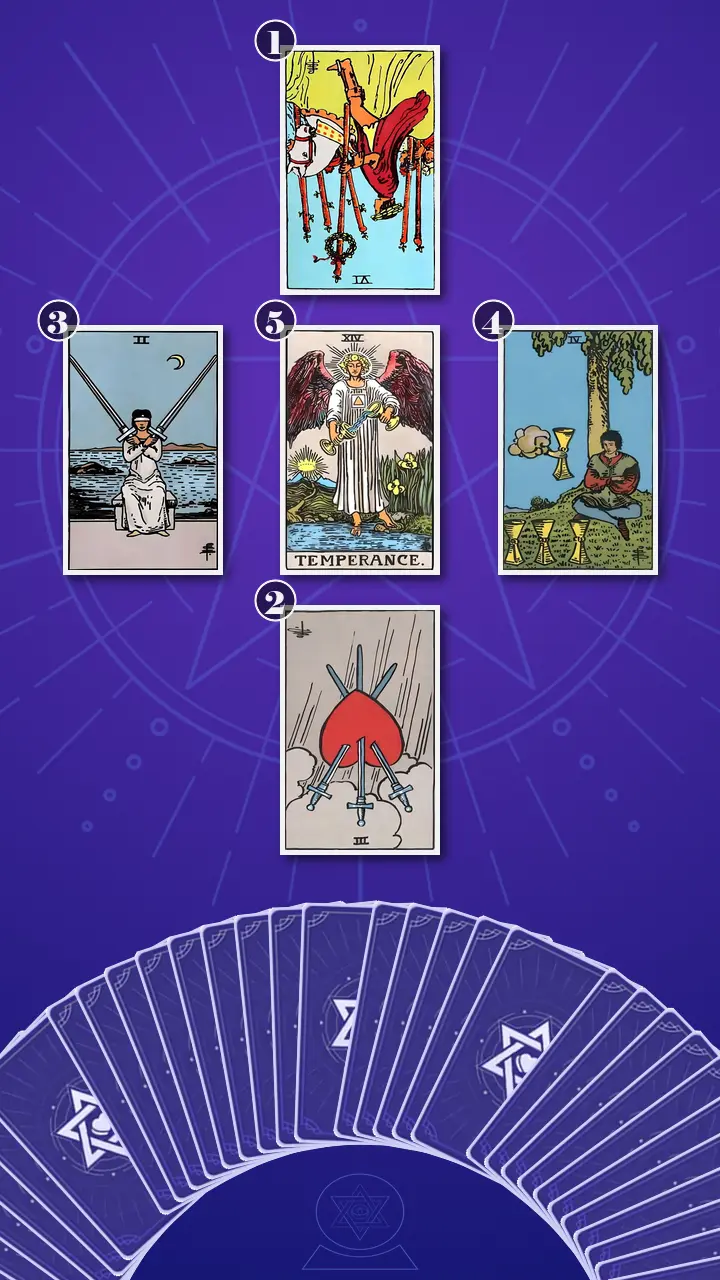
The Laurel Wreath Above the Hidden Heart
Position 1: The Victory Story Everyone Can Handle
"The card I am turning now represents the specific social performance you use to act fine and stay easy to include," I said. I revealed the Six of Wands, reversed.
In the Rider-Waite-Smith image, a rider wears a laurel crown and lifts a wand decorated with another victory wreath while a crowd surrounds him. Upright, the card can describe visible achievement and recognition. Reversed in Maya's social-mask position, its Fire was blocked and overcorrecting. Confidence had become audience management. The appearance of recovery was being used to check whether she still looked socially acceptable.
I brought the card back to the birthday dinner. Maya had given her confident one-line breakup update, laughed at the joke, scanned the table, and offered to organize the next plan. The scene resembled a polished LinkedIn success post published while the private reality was still being negotiated. She looked victorious because she was monitoring the audience, not because her grief had reached the same conclusion.
"What were you watching for after you said you were doing great?" I asked.
"Their faces," she answered immediately. "If everyone looked relieved, I knew I had said the right amount."
She gave a short, bitter laugh and looked away from the card. "That is so accurate it is kind of brutal."
"The accuracy is not an indictment," I said. "It separates authentic recovery from audience-approved recovery. You learned how to keep a socially complicated room steady. The problem is that you now have to become the most upbeat person in the room to maintain the result."
I watched her fixed smile loosen at one corner. She pressed her thumb into her palm and nodded once, sharply.
"You are not hiding the breakup," I told her. "You are hiding its present tense. You can discuss what happened as long as nobody sees what still hurts today."
The Six of Wands reversed did not call her dishonest. It showed a blocked form of Fire: so much energy was being spent projecting composure, usefulness, and momentum that little remained for the slower work beneath the performance. The more convincingly she played recovered, the fewer reasons her friends had to offer a deeper check-in.
Position 2: The Sentence Deleted at 11:40 p.m.
"The next card represents the unresolved breakup pain beneath that performance, the emotional root of what has stayed paused," I said. I turned over the Three of Swords, reversed.
The red heart pierced by three swords hung beneath dense grey clouds and falling rain. Reversed, the card did not tell me that Maya would never heal, nor did it demand visible distress as proof of pain. It showed the Air of the Swords turning inward: heartbreak being analyzed, edited, and declared complete before it had been allowed a clear channel of release.
I returned to the scene she had given me at 11:40 p.m. The bright restaurant disappeared. I could hear the streetcar outside her apartment and see the Notes app illuminating her hands. "I do not think I am as okay as I looked tonight" became "Hope you got home safe," then nothing. Every edit followed the same internal review: That sounds needy. That sounds dramatic. That asks too much.
"Pain becoming private is not the same as pain being finished," I said. "The reversal matters here. The wound has left the public frame, but it is still active in the body that carries it home."
Maya's fingers stopped moving. Her eyes settled on the pierced heart, then lost focus as though the card had become a screen replaying the message deletion. A breath left her slowly through her nose.
"I keep talking about healing like it already happened," she said. "I can explain exactly why the relationship ended. I just cannot say, 'I miss him today,' without feeling pathetic."
"That is the difference between an intellectual conclusion and an immediate feeling," I replied. "One can be complete while the other still needs room. A polished update can protect the mood while abandoning the person giving it."
The Three of Swords reversed invited Maya to name what still hurt without explaining, justifying, or solving it. She did not have to send the words anywhere. The first honest audience could be herself.
Position 3: The Group-Chat Poll with Only Two Buttons
"Now I am turning the card that identifies the protective rule beneath the silence," I said. "This is the belief that equates honest grief with social disruption." The card was the Two of Swords, upright.
A blindfolded figure held two swords crossed over her chest. Behind her, rocky water continued moving beneath a crescent moon. The posture looked neutral, but the peace depended on excluding emotional information. The crossed blades kept the subject closed while the water continued regardless.
I translated the image into Maya's digital life. Her internal group-chat poll offered only two buttons: "I am fine" or "full emotional disclosure." If she opened the subject at all, she feared she would lose control of how large it became. Someone might ask for the entire story, start discussing sides, or carry the conversation back into the group. Faced with those outcomes, silence appeared to be the responsible option.
The Air energy here was not absent. It was in excess and held static. Maya was thinking through every possible reaction until no imperfect sentence could pass inspection. The stalemate looked like caution, but standing still was also shaping the outcome. It preserved the immediate mood while postponing the chance to learn what one carefully chosen friend could actually hold.
"That is exactly it," Maya said. Her arms folded across her chest before she noticed the echo of the card and let them fall again. "If I admit I am hurt, I picture everyone assuming I want them to take my side. I do not. I just do not want to lie every time they ask."
"Then the missing option is not bigger honesty," I said. "It is a better boundary. You can name a feeling and close the door on advice, details, side-taking, or a longer conversation. A custom audience is still honesty."
I tapped the edge of the card, careful not to turn the reading into a promise about her friends. "A boundary cannot guarantee a perfect response. It can give you better information. One person's capacity is specific data, not a verdict on whether your feelings deserve space anywhere."
Privacy is a boundary. Disappearing from your own story is something else.
Position 4: Included in Every Photo, Missing from the Conversation
"The fourth card shows the relational and emotional cost of maintaining the polished breakup narrative," I said. I revealed the Four of Cups, upright.
The seated figure looked down with arms crossed. Three cups stood on the ground while a fourth was extended nearby from a cloud. In Maya's reading, Water had finally appeared, but it was not circulating. The card showed emotional withdrawal and reduced receptivity, not because she lacked feeling, but because part of her needing acknowledgment was never allowed into the room.
I asked her about the unanswered message from a trusted friend: "Want to talk properly sometime?" Maya described seeing it again at Sunday brunch while coffee and toasted bread scented the room. Cutlery tapped against ceramic, but the conversation sounded far away. She appeared in every cheerful group photo and still found herself thinking, They invited me, so why do I feel alone?
"Because social inclusion and emotional contact are not the same experience," I said. "The mask preserves the invitation. It can also remove the point of entry that support would need."
Her jaw tightened first. Then she looked down at the phone beside her as if the unanswered message were still waiting there. Finally, she released a low breath and said, "I thought nobody was really checking in, but I suppose I made every check-in sound unnecessary."
"Some of them may still be unable to give the kind of support you need," I said. "The card does not certify every offered cup as safe or useful. It asks whether your current script lets you notice and test any offer at all."
Being included is not always the same as being known.
I could feel the bittersweet edge of that sentence at the table. Maya had succeeded at protecting her place in the group, yet the same performance had made belonging feel thinner once she got home. I did not ask her to blame herself for that. A strategy built during a destabilizing breakup had done important work. We were simply reaching the moment when its cost had become visible.
When Temperance Turned the Volume Dial
Position 5: The Integrator at the Center
The radiator clicked off, and the room became quiet enough for the rain against the window to separate into individual taps. I returned my hand to the center of the spread. This was the position defining a bounded form of honest communication that could restart healing without asking the group to manage the breakup or choose sides.
I turned over Temperance, upright.
An angel poured water in a measured stream between two cups, with one foot on land and the other in water. A path opened toward distant light. Unlike the blocked Fire, static Air, and unmoving Water elsewhere in the spread, Temperance held balance: emotion moved, but it moved through a structure that could contain it.
I asked Maya to return to Friday night. The loud dinner had ended; her shoes were by the door; the sentence "Honestly, I am doing great" still rang in the silence. In her Notes app, the truth grew shorter, safer, and finally disappeared because she believed only total control could protect her belonging.
This was where I brought in the lens I call Typecasting Analysis. I looked at the social cast list Maya had described: the planner, the joke-maker, the composed ex, the friend who never needs the mood adjusted around her. None of those roles was inherently false. The restriction came from having to remain in character even when the scene had changed.
I did not assume her friends had deliberately assigned the role. Social scripts are often co-written through repetition. Maya performed ease, the table relaxed, and that relieved response encouraged the same performance at the next gathering. It resembled an actor continuing to hit an old stage mark after the set had been rebuilt. What once showed discipline now kept her outside the scene she was actually living.
Temperance offered Group Dynamic Rewriting at human scale. Maya did not need to deliver a dramatic monologue or force the whole group into a breakup summit. One changed line could give the relationship new information: one feeling, one boundary, one selected person. The goal was not to seize control of the audience's reaction. It was to stop making audience comfort the editor of every sentence.
I translated the card plainly: "You do not have to choose between performing recovery and exposing everything. One honest feeling, held by one clear boundary, is enough to let the conversation become real."
Then I gave her the sentence at the center of the reading.
You are not required to keep the social cup polished and full; name one true feeling with a clear boundary, as Temperance pours only what can be integrated.
I let the words remain in the quiet.
For a second, Maya stopped breathing. Her fingers hovered above the edge of Temperance without touching it, and her eyes widened slightly before drifting past me toward the rain-streaked window. I watched recognition move in stages: first the physical freeze, then the unfocused replay of dinners, deleted drafts, and unanswered check-ins, then a flash of anger that tightened her mouth. "But does that mean I got all of it wrong?" she asked, her voice suddenly sharper. "Did I make myself this lonely?" I told her no. She had used a capable, intelligent role to protect belonging when too much already felt unstable. A protective strategy could expire without becoming a personal failure. Her fist loosened on her knee. Her shoulders sank, and a trembling breath left her chest, but relief was followed by a brief, exposed stillness. The path was clearer now, and clarity returned responsibility to her rather than removing it. "So I can tell the truth," she said quietly, "without handing over the whole story."
"Now, with this new perspective, think back to last week," I invited. "Was there a moment when this insight could have made you feel different?"
Maya looked at Temperance again. "When my friend asked if I wanted to talk properly. I thought saying yes meant explaining everything. I could have said, 'I am still having a harder week than I looked on Friday. I do not need advice, but I would appreciate ten minutes of listening.'"
"Exactly," I said. "Honesty has a volume dial; it does not need an on-off switch. Privacy is not the same as concealment, and openness is not the same as unrestricted access."
I set a seven-minute timer and asked her to write three unedited sentences beginning with, "What still hurts is..." She circled one sentence that felt true but potentially shareable, then added a boundary: "I do not need advice or a conversation about sides. I just wanted someone to know." I reminded her that keeping it private still counted as completing the exercise. If three sentences felt too exposing later, she could stop after one, close the note, and decide nothing else that night.
The movement in the spread had become clear. This was not a leap from sadness to certainty. It was a first crossing from audience-managed recovery and guarded grief toward bounded honesty, cautious connection, and self-directed healing. Maya was still allowed to feel apprehensive. Temperance asked only that she make room for a manageable amount of truth instead of waiting to become perfectly unafraid.
Rewriting the Role with One Feeling and One Boundary
I gathered the five cards into one coherent sequence. The Six of Wands reversed showed Maya performing a public victory because belonging felt newly conditional. The Three of Swords reversed revealed the private wound underneath, edited into a lesson before the present-tense ache had moved. The Two of Swords turned that ache into a rigid rule: stay silent or risk making the breakup everyone's problem. The Four of Cups showed the consequence, a life in which Maya remained visibly included but increasingly difficult to reach. Temperance restored movement by combining feeling with structure.
In the film language I naturally use, Maya had bravely stayed inside a painful scene for too long because she believed leaving the role might cost her the rest of the cast. The cards did not tell her to abandon the group or expose herself to everyone. They handed her the pen at the exact line where the script kept repeating.
The cognitive blind spot was the meaning she had assigned to the table's relief. Friends relaxing after "Honestly, I am doing great" did not prove that honest grief had no place among them. It proved they were responding to the cue she had supplied. No bounded test had yet occurred. Equally, one imperfect response would not prove the whole group unsafe. The next direction was to replace the rehearsed claim that everything was fine with one accurate feeling and one explicit limit on the support she welcomed.
I wrote her next steps as small experiments, not moral obligations. Each could be completed without discussing the ex, asking anyone to take sides, or surrendering control over when the conversation ended.
The Temperance Plan for the Next Seven Days
- Write the private truth first. On one evening this week, open the Notes, set a seven-minute timer, and write three sentences beginning with "What still hurts is..." Do not edit for tone. Circle the mildest sentence that remains accurate. Keeping the note private completes the exercise. If resistance rises, write one sentence and stop.
- Send one feeling plus one boundary. Choose one trusted friend, not the full group chat, and send: "I am having a harder week than I looked on Friday. I do not need advice or a discussion about sides, but could you listen for ten minutes sometime?" Judge the experiment by whether the request was accurate and clear, not by whether the reply was perfect. Maya could end with, "I want to stop here," at any point.
- Use the Recasting Exercise. When the next group plan appears, wait ten minutes before volunteering. Intentionally break the automatic planner role with one line: "I can join, but I cannot organize this one." Then put the phone down and let someone else respond. The minimum version is declining one task while still attending. Recasting is a behavioral test, not a dramatic personality change.
"These are ways to gather more truthful information," I told her. "They are not instructions to disclose when you feel unsafe or depleted. You decide the person, setting, medium, duration, and level of detail. Tarot can illuminate the scene, but you remain the writer and director of what happens after it."

Six Days Later, the Message Stayed Sent
Six days after the reading, I saw Maya's name appear on my phone. Her message was brief: "I sent the Temperance text. My friend replied, 'Yes. No fixing. Thursday?' I nearly cancelled, but we walked for twenty minutes after work."
During the walk, Maya shared one present-tense feeling without giving the full history. Her friend made one clumsy comment about being glad the group still seemed normal. Maya felt the old grip return to her throat, but instead of making a joke, she said, "I do not want to handle group logistics right now. I just need you to hear that this week hurts." Her friend paused, apologized, and listened.
Maya did not report a cinematic breakthrough. She still felt exposed on the subway home. She still wondered whether she had said too much. What changed was smaller and more useful: she had experienced discomfort without abandoning her boundary, and she had allowed one person to respond to accurate information.
That night, she slept through until morning. Her first thought was, "What if I made it awkward?" Then she saw the message still sitting there, undeleted, and smiled before the doubt had entirely left.
I thought again about Temperance's stream between the cups. The five-card Shadow Spread had not made Maya fearless or finished her healing. It had helped her replace automatic performance a conscious choice. That was her Journey to Clarity: not certainty about every friendship, but ownership of her own emotional volume.
When your throat tightens and your smile locks into place the moment someone asks about the breakup, protecting your seat in the group may feel safer than letting the hurt enter the room. I hope you remember that noticing this protective script already places the pen back in your hand. You do not owe anyone the full story, and you do not have to keep playing the recovered version of yourself to deserve an invitation.
If you allowed one trusted person to hear one accurate line from your present-tense story, what feeling would you name tonight, and where would you set the Temperance volume boundary?