Wedding-Party Boundary Guilt: Keep the Rehearsal, Return Transport

Boundary Guilt at 10:47 p.m.
Maybe your bridesmaid role started as showing up for a close friend and somehow became a second job, complete with transport coordination, payment deadlines, weekend calls, and the private search “how to step back from wedding party duties.”
When Chloe, a 29-year-old digital project coordinator in London, sat down opposite me, she began with a timestamp rather than a question. She described Tuesday at 10:47 p.m., when she had been perched on the edge of her bed with her work laptop still glowing and a wedding checklist open beside it.
The radiator clicked behind her while traffic hissed over wet pavement outside. She dragged a transport-planning task across Google Calendar, typed, “I need to step back from coordinating this,” deleted it, and tapped a heart in WhatsApp instead. The phone felt hot in her palm, and her jaw stayed locked long after the message disappeared into the group chat.
“It is not one huge request,” she told me. “But somehow it has become a second job. I do not want to step away from the friendship just because I need to step back from the workload. What am I afraid will happen if I scale back my wedding-party role?”
I heard the central contradiction immediately: Chloe wanted a smaller, sustainable bridesmaid role, but she feared that reducing her practical involvement would also reduce her standing in the friendship. She knew what she wanted to say until she imagined her friend reading it.
Her apprehension had become a wire running from the WhatsApp icon through her sternum to her teeth. Every new notification pulled her chest and jaw taut at once. Beneath the calendar pressure sat a harsher private equation: less labour meant less love, and less love meant less secure belonging.
“We are not here to prove that your friend will react well or badly,” I said. “We are here to separate the scene you actually know from the ending fear is writing for you. Let us make a map of the wedding-party scope creep, the boundary guilt, and the friendship underneath both.”

Choosing a Five-Card Compass
I invited Chloe to place both feet on the floor, take one unforced breath, and hold the question in its simplest form. I shuffled slowly, using the movement as a transition from rehearsing every possible reaction to looking at one piece of information at a time.
I chose the Relationship Spread · Context Edition, a focused five-card tarot spread arranged like a bridge crossed by a plumb line. A larger Celtic Cross would have introduced history, environment, and prediction that this question did not need. Chloe needed a clean examination of her behaviour, her assumptions, the emotional bond, the corrective principle, and her next sustainable step.
This is how tarot works in my practice: I do not use it to read the private thoughts of an absent friend or announce a fixed outcome. I use the cards as an external cognitive map. Their images help me place facts, projections, emotional meanings, and available choices where both of us can inspect them.
The card on the left would show Chloe's observable pattern of accepting added work. The card on the right would examine the reactions she imagined, without pretending those reactions were confirmed. The centre would hold the belonging fear beneath the conflict. Above it, the fourth card would establish a fair standard; below it, the fifth would turn that standard into a practical offer of time, money, labour, and availability.
“The cards can help us see the plot,” I told her. “They cannot take the pen out of your hand.”
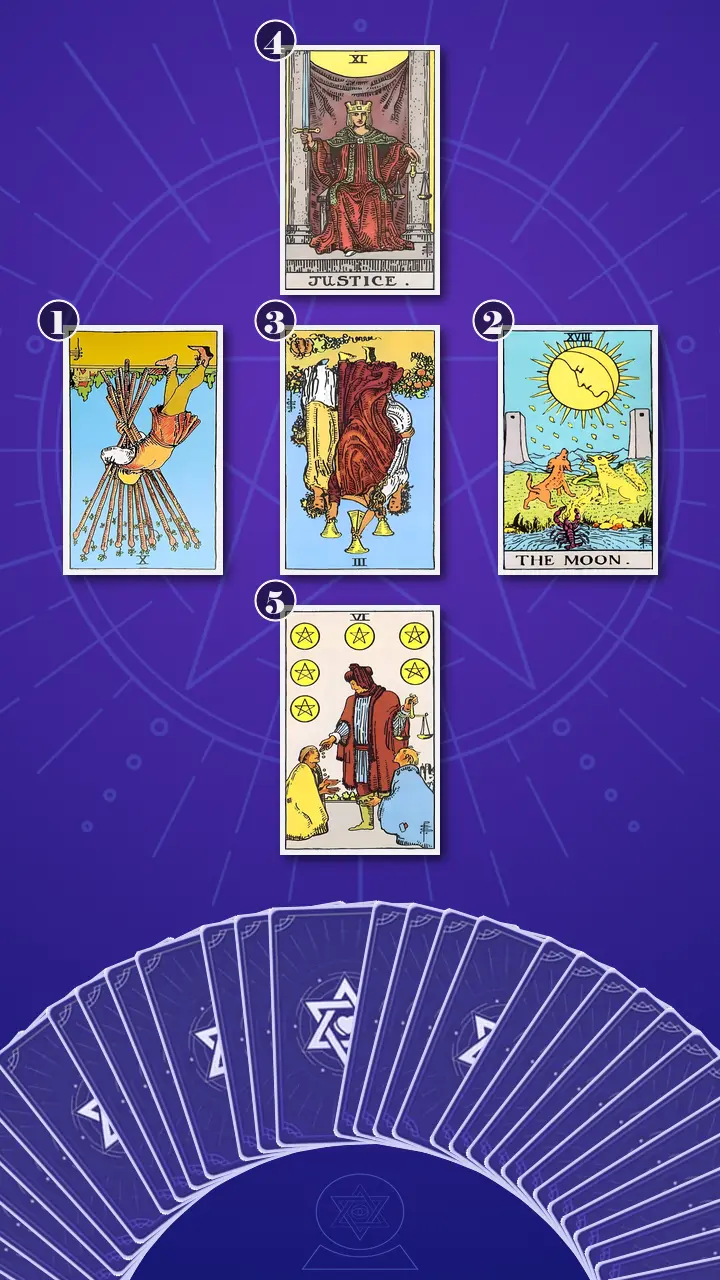
The Second Job Inside the Celebration
Position 1: The Bundle Chloe Could Not Put Down
I began with the position representing Chloe's present stance: the visible pattern of accepting wedding-party scope creep while struggling to release responsibilities she had already absorbed. The card was the Ten of Wands, reversed.
I pointed to the figure bent beneath ten bundled staffs, with the road ahead almost completely blocked from view. The image reflected what Chloe had described: finishing a full day coordinating digital projects, opening the wedding checklist at 10:47 p.m., and treating an empty Saturday as available space for transport planning rather than recovery. She could identify which duties had been added after the original bridesmaid invitation, yet she continued carrying them while privately counting the cost.
In energetic terms, the reversed fire showed an excess of responsibility combined with a blockage around release. This was not a deficiency of care. It was care being routed through an unsustainable task queue. Each “quick favour” reduced the space Chloe needed to see the friendship separately from the administration surrounding it.
“The inner script sounds like this,” I said. “It is only one more thing, and I have already said yes, so I will move my own plan. Then another request arrives, and the same logic runs again.”
I thought of the multiplying tasks in The Sorcerer's Apprentice: one helpful action becomes a whole system moving without conscious supervision, and adding more effort cannot restore control. Chloe's workload had developed the same plot. She was no longer choosing each contribution; she was maintaining the momentum of all the previous yeses.
“Scope is not the same thing as care,” I said. “This reversal is not telling you to drop the entire wedding party in one dramatic message. It is asking which staff belongs in your hands and which one you picked up because leaving it visible felt dangerous.”
Chloe let out a short, bitter laugh. “That is so accurate it is almost cruel.” Her fingers tightened around her mug, then loosened as she looked back at the card.
“Accurate does not have to mean condemning,” I replied. “You found a strategy that bought immediate group harmony. We are simply noticing that the price now includes sleep, money, and genuine warmth. Seeing the cost gives you choices.”
Position 2: The Moonlit Reply on the Northern Line
I moved to the position representing Chloe's perceived expectations: the judgments, reactions, and relational consequences she imagined when considering a smaller role. The card was The Moon, upright.
I traced the narrow path between the two towers. It remained passable, but it was only partially illuminated. On either side, the dog and wolf reflected Chloe's split between socially trained compliance and the instinct telling her that the current workload could not continue.
I connected the image to a morning she had described on the Northern line. She had reread a short WhatsApp message asking whether transport was sorted while the brakes squealed and damp coats pressed around her. Before reaching her stop, she had converted punctuation and response time into a hidden verdict: they asked for confirmation, but perhaps they really meant she was already failing, which might eventually mean she was unreliable, which could become distance.
The Moon did not confirm any of those outcomes. Its energy showed an excess of projection and a deficiency of verified information. The uncertainty was real; the imagined rejection was still an interpretation.
“Your fear is data about belonging, not evidence of rejection,” I said. “It tells us this friendship matters and that exclusion would hurt. It does not tell us what your friend will say.”
I asked Chloe to separate the message into two lines. On the first, she repeated what had actually been written: “Can you confirm transport today?” On the second, she named what she had predicted: “If I cannot, they will decide I only show up when friendship is convenient.”
Her thumb hovered over the edge of her phone. Her gaze went briefly unfocused, as if she were replaying the Tube journey without its imagined commentary. Then she breathed out through her nose and said, “Those are not remotely the same sentence, are they?”
“No,” I said. “Both deserve attention, but only one is evidence.”
Position 3: The Friendship Leaderboard
I returned to the centre, the position holding the emotional foundation beneath the conflict: Chloe's fear that reducing practical involvement could reduce closeness, approval, or belonging. The card was the Three of Cups, reversed.
I showed her the three figures raising their cups inside a celebratory circle. Reversed, the shared ritual could become strained by comparison, overextension, or uncertainty about who still belonged inside it. The harvest at their feet also made visible how a joyful occasion could become crowded by output, purchasing, planning, and performance.
I mapped the card to the moment when three bridesmaids responded with hearts and enthusiastic offers within minutes. Chloe did not know their budgets, workloads, support systems, or private feelings, yet she read their visible participation like a leaderboard. While privately checking a low Monzo balance, she added her name to another task because a quieter sentence was running underneath: “If everyone else can do this and I cannot, maybe I am the optional friend.”
The reversed Cups showed a blockage in the energy of connection. Friendship was being filtered through a metric it could not survive honestly: visible usefulness. Chloe kept attending, paying, planning, and replying to secure her place, but the effort left her too depleted to bring much warmth to the celebration she wanted to enjoy.
I asked, “If resentment is already making you avoid the chat, could continuing to say yes be creating some of the distance you are trying to prevent?”
Her breathing paused. She stared at the three raised cups, pressed her lips together, and rubbed one palm across her sternum. After several seconds she said, “I hate that this is the real part. I do not actually think my friend invited me because I am good at spreadsheets. But I have started acting as if the invitation needs to be renewed every time somebody asks for help.”
“The card is not judging the wedding party or predicting exclusion,” I said. “It is showing me the admission price you have been charging yourself. You can stay in the celebration without becoming its infrastructure.”
When Justice Put the Evidence on the Table
Position 4: The Standard That Includes Chloe
The rain against my window softened as I turned over the card above the centre, the position representing the central challenge and transformation. The room became unusually still. The card was Justice, upright.
I placed its balanced scales at the visual centre of the reading. Unlike the undifferentiated bundle in the Ten of Wands, the scales required comparison: the original bridesmaid invitation on one side, the later transport, purchasing, admin, and availability requests on the other; then Chloe's calendar, budget, energy, and chosen care entered as evidence rather than inconvenient footnotes.
Justice carried balanced, clarifying energy. Its upright sword was not an invitation to be cold. It was the image of one accurate sentence with a clear task and date: “I am still glad to attend the rehearsal and handle X, but I need transport coordination reassigned from this week.” The card asked for accountable honesty, not proof that nobody would have feelings about the change.
As an artist, I have spent enough time editing to know that a cut can reveal what a crowded scene has been trying to say. Looking at Justice's sword, I thought of that clean edit. Chloe did not need a longer defence of her character. She needed to remove the six apologetic paragraphs obscuring the factual line.
I used the method I call Narrative Fork Analysis and laid out her two competing plotlines. In the first, Chloe kept agreeing because agreement looked like the safe choice. The difficult conversation disappeared for an evening, but exhaustion, delayed replies, and resentment returned in the next scene. In the second, she returned one added task, risked a real response, and participated through a contribution she could make without borrowing from sleep or next month's rent.
That exposed what I call Safe-Choice Sabotage Recognition. The automatic yes was not a neutral route that preserved the friendship exactly as it was. It was a defence against the necessary inciting incident: allowing her friend to meet the honest, limited version of Chloe rather than an endlessly useful role. The apparently safer plotline was already changing the friendship through silence and depletion.
I returned her to 10:47 p.m.: the transport task would consume the Saturday on her calendar, and that fact was visible. Her thumb had still tapped the heart while her jaw locked because the feared friendship fallout felt certain, even though it remained unwritten.
A fair boundary is not one nobody dislikes; it is an honest match between what you agreed to, what was added, and what you can sustainably give.
You do not have to carry every task to prove your care; name a proportionate commitment and let Justice’s scales measure honesty rather than self-sacrifice.
I stopped speaking and let the sentences stay in the room.
Her breath stopped first. Her right index finger froze against the mug handle, and her pupils widened as though several weeks of deleted drafts had begun replaying at once. Then anger reached her face before relief did. “But does that not mean I have been doing all of this wrong?” she asked, her voice suddenly sharper. I did not hurry to turn the anger into gratitude. “It means your strategy protected you from immediate discomfort,” I said. “It also created costs you could not keep paying. Recognising that is information, not a verdict on your past self.” Her eyes reddened. Her clenched fingers opened one at a time, her shoulders sank, and a long breath left her chest with a slight tremor. For a moment she looked almost unsteady, as if putting down an invisible bundle had left her unsure what to do with the empty space. “So I have to let them have a reaction,” she said quietly. “Yes,” I replied. “And you remain responsible for the honesty of your message, not for pre-managing every feeling it may evoke.”
I asked, “Now, with this new perspective, think back to last week. Was there a moment when this insight could have made you feel different?”
Chloe returned to the Sunday when she had delayed replying because she resented another added task. “I thought the tension proved I should not set a boundary,” she said. “But the tension started because I had already said yes when I meant no.”
I set an eight-minute timer and asked her to open a private note with three headings: “Originally agreed,” “Added later,” and “Still sustainable.” She sorted the wedding tasks without deciding anything else, circled transport coordination, and drafted: “I can still do the rehearsal and the agreed welcome task, but I need transport coordination reassigned from Friday.”
I reminded her that she did not have to send it that day, explain her entire schedule, or disclose private financial details. If her body began to lock up, she could stop after listing three tasks. The smaller version would still produce useful evidence.
I named the deeper transition I had watched begin. This was movement from fear-driven overfunctioning and imagined rejection toward proportionate responsibility, evidence-based self-trust, and honest participation. It was not certainty about the friendship's outcome. It was the first willingness to let facts and capacity share the scales with care.
Six Coins and No Invisible Overdraft
Position 5: A Finite Offer of Care
I turned to the final position, representing conscious integration: the way Chloe could translate a fair boundary into a sustainable offer without trying to predict the relationship's outcome. The card was the Six of Pentacles, upright.
The scales appeared again, but this time they were being used in an ordinary act of distribution. Six visible coins made the resources countable. I translated them into Chloe's real units: hours, train fares, purchases, planning labour, weekend availability, and emotional attention.
This card held the middle ground she had been unable to see. She could confirm one contribution she genuinely wanted to make, place a limit on additional spending, give a date after which she could not coordinate logistics, and return one added task to the wider group. She did not have to choose between doing everything and disappearing from the wedding party.
The energy here was balanced earth: generosity given a container strong enough to preserve it. I offered Chloe the sentence beneath the image: “I can give this much, by this date, without borrowing from sleep or next month's rent.”
Her hand moved back to the note. She underlined the rehearsal, then drew a box around transport coordination. “I actually want to be at the rehearsal,” she said. “I do not want to run an unpaid logistics department.”
I smiled at the precision of it. “Finite care is still care.”
The One-Task Wedding Scope Reset
I gathered the cards into one continuous story. Chloe had learned at work that picking up an unassigned task kept a project moving and made her reliably useful. Inside the wedding party, that familiar strength had run without a stop condition. The Ten of Wands showed the resulting overload; The Moon showed her filling missing information with rejection scenarios; the Three of Cups revealed why those scenarios carried so much force. She was not merely afraid of returning transport coordination. She was afraid of returning her place in the circle with it.
The spread also showed why more effort could not solve the problem. Like the runaway sequence in The Sorcerer's Apprentice, every automatic yes created another moving part. Justice interrupted the multiplication by comparing the original agreement with later additions and present capacity. The Six of Pentacles then replaced unlimited output with deliberate distribution.
I identified Chloe's cognitive blind spot plainly: automatic agreement created exhaustion and resentment; exhaustion produced slower replies and less genuine warmth; then she interpreted that tension as proof that boundaries endangered the friendship. The loop was using the consequences of avoidance as evidence against honesty.
The transformation was therefore smaller and more practical than becoming fearless. Chloe could move from trying to prevent every possible disappointment to offering one clear list of what she could and could not take on. The friend she cared about was allowed to have a response. Chloe was allowed to make a proportionate decision and stand behind it.
“I can make the list,” she said. “But when I send the message, I know I will turn it into an essay with six apologies.”
I adapted my Protagonist Pivot Action to the reading. In a film, the protagonist does not escape analysis paralysis by understanding every possible ending. The plot moves when she takes one small action that belongs to the more authentic storyline. Chloe's mandate would be one task, one sentence, and one 24-hour window.
- The Justice Capacity AuditDuring one lunch break this week, open Notes and create four headings: “Originally agreed,” “Added later,” “Want to keep,” and “Need to return.” Set a ten-minute timer. Check the next four weeks in Google Calendar and the wedding-related transactions in your banking app, then record two concrete constraints without debating whether they are acceptable.Start with the three tasks creating the most pressure. This is a private capacity check, not a verdict on the friendship, and rest does not need a courtroom defence.
- The Protagonist Pivot: One Task in 24 HoursWithin 24 hours of the audit, choose one contribution that still feels connected to friendship and one added logistical task to return. Use the normal planning channel or message the bride directly: “I am still glad to do [specific contribution], but I need [specific task] reassigned from [date].”Keep the message to three sentences or fewer. Do not add private financial details or six anticipatory apologies. The goal is an accurate scope statement, not a defence brief that guarantees approval.
I told Chloe that these were not commands issued by the cards. They were controlled, revisable next steps built from information she already possessed. Tarot had made the competing plotlines visible; Chloe still decided which one deserved the next scene.

The Reply Without Confetti
Six days later, I received a message from Chloe. During her lunch break, she had completed the capacity audit and discovered that five of her eight current wedding responsibilities had been added after the original invitation. She chose to keep the rehearsal and one welcome task. She returned transport coordination.
Her message had been three sentences long. Four hours later, her friend replied: “Thanks for telling me. I will ask the group about transport. Glad you can still do the rehearsal.” There were no heart emojis or confetti reactions. There was also no argument. The task was reassigned the next morning.
Chloe did not report instant liberation. She felt a sharp flicker in her chest when another bridesmaid volunteered, followed by the old impulse to write a second message offering extra help. This time she checked the note, saw what she had chosen, and left the chat alone.
That night she slept all the way through. Her first thought in the morning was, “What if I got it wrong?” She told me she smiled, made coffee, and left WhatsApp closed until breakfast.
That was the quiet proof of her Journey to Clarity. The cards did not predict the friendship, write the boundary, or create the change. They gave Chloe a structured way to compare evidence, projection, capacity, and care. She was the person who sent the sentence and stayed present for what happened next.
When a new wedding notification tightens your chest and your thumb still taps the heart, the hardest part may not be the task. It may be the fear that putting it down could also put down your place in the friendship. Noticing that hidden equation means you are already beginning to stand outside it.
If care no longer had to look unlimited, what is one part of the celebration you would freely choose to keep on your side of Justice’s scales?