The Warm Phone and the Unsent Apology
I met Jordan, a 27-year-old Toronto nonprofit project coordinator who had said no to a last-minute favor after work and then turned one text into a full explanation because of boundary guilt and the fear of being the difficult friend.
When Jordan described 8:47 PM on the TTC Line 1 train southbound, I could almost feel the warm phone in their palm. Fluorescent lights buzzed above them; their fingers hovered over Send while the draft grew from one honest no into four apologies, three alternative times, and a question asking whether the friend was upset.
Jordan looked at me and said, 'Why am I the bad kid whenever a friend pushes back on my no? I want them to respect my answer, but the moment they sound disappointed, I start treating their reaction like a verdict about my character.' They told me, 'I can say no, but I cannot seem to survive their reaction to it.'
The guilt was not abstract in that room. It moved through Jordan as a phone notification lodged beneath the ribs: a tight chest, a clenched jaw, restless hands, and an urge to check the thread until the screen could certify that they were still lovable. Underneath it sat shame, apprehension, and the quieter resentment of agreeing only to make the discomfort disappear.
I did not need to make the friendship sound dangerous, and I did not need to promise that one perfect boundary would fix it. I told Jordan, 'You said no, they pushed back, and suddenly you are trying to prove you are still a good friend. Let us look at the pattern without putting either of you on trial. Our Journey to Clarity begins by giving this fog a map.'

Choosing the Map: A Seven-Card Relationship Spread
I invited Jordan to put both feet on the floor, take one slow breath, and hold the question in plain language. I shuffled the Rider-Waite-Smith cards slowly, using the movement as a psychological transition from replaying the text to observing it.
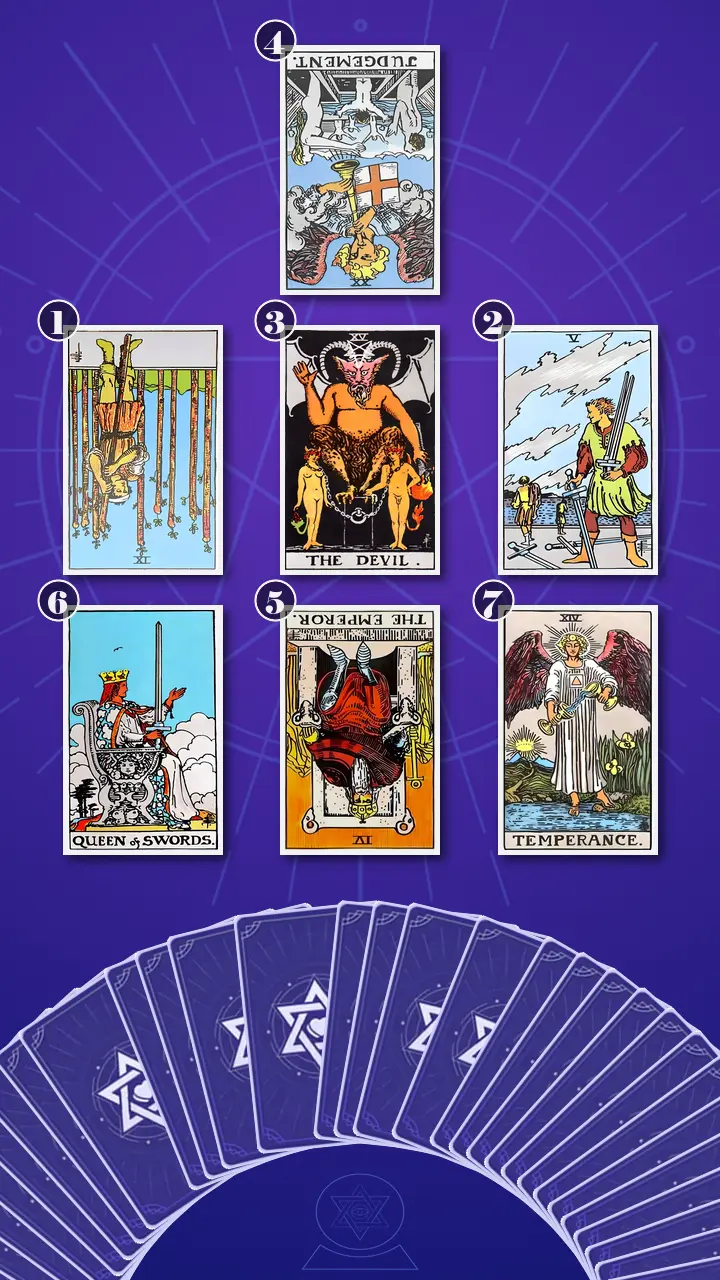
I chose the Relationship Spread · Context Edition, a seven-card relationship tarot spread for friendship boundaries, inherited control patterns, and reciprocal communication. The structure suited the problem because it could show Jordan's position, the friend's visible stance, the dynamic between them, the inner obstacle, the inherited foundation, the practical communication resource, and the kind of connection available when the insight was practiced.
This is how tarot works in this reading: the cards are symbolic mirrors and an objective pattern-recognition tool, not a verdict about the friend's motives or a forecast of the friendship's fate. Position 1 would show the exhausted response after a no; Position 3 would map the repeating boundary-backlash loop; Position 5 would expose the old authority rule beneath it. Position 6 would offer a clear communication practice, and Position 7 would show how care and limits might occupy the same relationship.
Reading the Pushback Without a Verdict
The Guard Who Has Run Out of Arms
I began with Position 1, which shows Jordan's observable response when they say no and the immediate belief that follows a friend's pushback, including the impulse to explain, apologize, or retract. The card was the Nine of Wands, in reversed position.
The upright Nine of Wands speaks of resilience and vigilance after strain. Reversed, that protective fire was depleted and reactive. The boundary was still standing, but it felt like a guard post Jordan had to defend every time someone asked a follow-up question. The image of the bandaged head and forearm, the single staff held before the body, and the eight wands behind it resembled the emotional labor of keeping a phone thread open after saying no, bracing for another test while already tired.
Reversed, the Nine of Wands was the exact moment after Jordan typed, 'I cannot do that tonight,' and began preparing for impact. They added their workload, their sleep schedule, and several replacement times. The card also showed the opposite risk: sending a blunt final text, disappearing from the group chat, or cutting off a workable conversation simply to stop feeling exposed. I asked, 'Can you repeat the limit once and let the other person's disappointment remain theirs?'
Jordan gave a short, bitter laugh. 'Damn, this is exactly me: I say no once, then write a whole closing argument so they know I am not rejecting them.' Their hand moved toward the phone, then stopped. I told them that recognition was useful data, not a new reason to judge themselves. Care does not require a closing argument.
The Conversation That Became a Contest
I turned to Position 2, which shows the friend's visible pushback and what Jordan needs to notice about the interaction without deciding the friend's motives or making a decision for them. The card was the Five of Swords, upright.
The Five of Swords showed a simple scheduling conversation becoming a debate over whose reason counted. Jordan might decline a plan, hear 'Are you sure?' or receive a less-warm reply, and suddenly feel that the original question had disappeared. The exchange now seemed to ask whether Jordan cared enough, whether they were being fair, or who would leave with the better argument.
The energy here was an excess of sharp, adversarial Air: too much mental sparring around an ordinary difference. I pointed to the figure gathering three swords while two others lowered their heads beneath a gray, wind-swept sky. 'I am not using this card to label your friend manipulative,' I said. 'I am asking whether the conversation is moving toward mutual understanding or toward one person having to win.'
Jordan's mouth tightened, and their eyes moved from the swords to the empty space between the figures. They described the familiar aftermath: the request might technically be settled, but their body carried the gray-sky feeling that the friendship itself had been put on trial.
The Notification Loop with a Hidden Price
Position 3 maps how a no, pushback, guilt, and over-explaining feed the Friendship Boundary Backlash as a repeating relational dynamic. I turned over The Devil, upright.
The Devil translated the bond into a repeating notification loop. A friend pushed back, guilt spiked, Jordan explained or agreed, and the tension dropped for a few minutes. That temporary relief taught the nervous system to repeat the repair the next time. The loose chains around the two figures did not prove that the friend intended harm; they showed how fear of losing belonging could make compliance feel compulsory.
In modern life, this could be an expensive birthday weekend, a last-minute favor, or a request placed inside the only quiet evening of the week. Time, money, access, and emotional labor could begin to feel like the hidden subscription price of staying connected. The energy was attachment and compulsion, a blockage in which care became tangled with proving availability.
I asked Jordan, 'When you change your answer, are you moving toward something you genuinely want, or are you paying for the immediate relief of no longer feeling guilty?' Their fingers curled against the edge of the chair. They did not answer at once, and the silence itself showed me how quickly relief had been standing in for choice.
The Inner Courtroom After Midnight
Position 4 names the inner obstacle that turns disagreement into a moral verdict that Jordan is the bad kid, including shame and self-judgment. The card was Judgement, reversed.
Judgement reversed revealed an awakening filtered through an internal tribunal. Instead of hearing the observable fact, 'My friend disliked this answer,' Jordan heard a trumpet announcing a performance review of their character. They reread the message, searched for the exact phrase that might have sounded selfish, rehearsed an apology, and treated a delayed reply as a final evaluation.
The reversed energy was a blocked call to self-trust and an excess of self-condemnation. I pointed to the angel's trumpet and the gray figures rising from their coffins. 'The call is still available,' I said. 'The work is to separate what happened from the inherited verdict attached to it. A friend can be disappointed while the boundary remains reasonable.'
Jordan lowered their gaze and rubbed one thumb over the other. I asked whose standard they were trying to satisfy when they thought, 'I must have handled that badly.' Their answer came quietly: 'The standard that says a good friend should make the whole interaction easy.' I heard the shame in the sentence, but I also heard the first distinction beginning to form.
The Rigid Rule Beneath the Calendar
Position 5 traces the Intergenerational Control Loop by revealing the inherited rule that another person's displeasure makes Jordan responsible for compliance. The card was The Emperor, in reversed position.
This was the spread's major blockage. The upright Emperor can provide structure, limits, and organized responsibility; reversed, that structure had hardened into control. I saw it in the calendar-and-group-chat moment Jordan described: a disappointed message appeared, they reopened the shared Google Calendar, and they began moving rest, work, or money around before checking what they actually wanted or had capacity for.
The stone throne, armor, ram details, and barren mountains made the old rule feel immovable: stability requires obedience; reliability means constant availability; if someone has to ask twice, the first no must have been unfair. I asked Jordan to place the current event beside the old verdict: 'What happened: they disliked my answer. What the old verdict says: I am bad unless I change it.' The distinction did not dismiss the friend's feeling. It removed the feeling's authority to manage Jordan's time.
Jordan's breath caught and their thumb paused above the calendar. Their gaze went unfocused as if an old performance review had opened behind the current text thread. Then they let out a long breath and said, 'Their disappointment is information, not an instruction.' I let that sentence stand. It was not yet ease, but it was a new piece of structure chosen by Jordan.
When the Queen of Swords Held the Line
The Resource That Did Not Need Permission
I turned to Position 6, which offers a concrete, self-led boundary communication practice for saying no without defending personal worth or controlling the friend's reaction. The card was the Queen of Swords, upright.
The Queen's upright Air was clean, balanced, and precise. Her raised sword did not ask Jordan to become cold; it asked them to stop submitting a reasonable limit for a vote. Her direct gaze held reality, while her extended hand kept communication open. The modern translation was simple: 'I cannot take this on tonight, but I care about you.' One honest reason, if genuinely relevant, and then no case file.
The room seemed to narrow around the card. I had reached the practical antidote, but I knew the sentence would touch the fear beneath the question. I let the silence gather before I spoke.
It was 8:47 PM on the TTC, the phone warm in Jordan's hand, and the draft had grown from one honest no into four apologies, three alternative times, and a question asking whether the friend was upset. The real panic was not the message; it was the imagined verdict waiting behind it.
Stop treating a friend's pushback as a verdict that demands compliance, and use the Queen of Swords' upright blade to separate one honest boundary from the inherited rule that belonging requires obedience.
A no is not a character reference. Your friend's disappointment can be real without becoming proof that you are selfish, disloyal, or the bad kid. Clear communication gives the boundary a voice; it does not make you responsible for the reaction.
Jordan's fingers froze above the phone. Their breath stopped mid-inhale, and their shoulders lifted as though the old alarm had physically pulled a cord. For several seconds they stared at the Queen rather than at me. Then their eyes went unfocused; I could see the TTC carriage returning, the typing bubble vanishing, and the imagined review of every word. Their thumb moved toward the draft, stopped, and slowly withdrew. A small sound came from their chest, almost an 'ah' rather than a sob. The jaw softened first. Then the shoulders dropped, the hands opened on their knees, and their eyes shone. Relief arrived with a brief, dizzying blankness: if no one else could certify the boundary, Jordan would have to choose it. They swallowed and said, 'That does not mean I have to make their feeling disappear.' I let the silence hold both truths.
I asked, 'Now, use this new perspective to remember last week. Was there a moment when separating their reaction from your worth could have changed what you did next?' Jordan thought of reopening the calendar, then of closing it without sending the apology.
At that point I used my signature diagnostic lens, Orbital Drift Recognition. I mapped the frequency mismatch between Jordan's newer capacity for rest and the old friendship role that expected instant availability. Outgrowing a role was not the same as outgrowing a person, and a difference in orbit did not make either friend bad.
I followed with Gravity De-linking Analysis, which helped us separate the painful pull of the friend's disappointment from Jordan's actual choice. Two people could be moving through different life phases or needs without forcing alignment by surrendering one person's boundary. I was not asking Jordan to abandon the friendship. I was showing them how to stop using compliance as the rope that kept both orbits artificially close.
This was the first clear movement from shame-driven compliance and abrupt withdrawal toward self-trusting boundaries and reciprocal friendship. The cards had not granted permission. Jordan had begun to hear their own.
The Two Cups That Did Not Require Surrender
Position 7 describes an available pattern of reciprocal friendship in which a no can coexist with care, while leaving the friend's feelings and choices with the friend. The card was Temperance, upright.
Temperance offered balance rather than a prediction. The angel blending two cups, with one foot on land and one in water, showed a middle path between automatic compliance and abrupt withdrawal. Jordan could acknowledge disappointment, keep the original no, and consider another plan only if it genuinely fit both capacity and desire.
The swords in the earlier cards had been objects of contest. Here, the cups became instruments of connection. The question changed from Who is right? to What is true, and can both realities remain in the room? I said, 'Validation is not consent. You can recognize the feeling without reopening the decision.'
Jordan leaned back for the first time since arriving. Their shoulders did not become perfectly loose, and their face still held a trace of worry, but their hands rested open instead of reaching for the phone. Temperance did not promise that every friend would respond warmly. It offered a practice in which care could continue without either person becoming responsible for the whole emotional atmosphere.
Finding Clarity Without a Closing Argument
When I placed the seven cards together, I could see the story of the gate. The reversed Nine of Wands showed Jordan guarding the threshold while already exhausted. The Five of Swords showed pressure turning a scheduling difference into a contest. The Devil revealed the notification loop in which compliance purchased only temporary relief. Judgement reversed turned the friend's reaction into an internal courtroom, and the reversed Emperor showed the inherited authority rule beneath it: another person's displeasure means Jordan must obey.
The Queen of Swords changed the gate from a defensive barricade into a clearly marked boundary. Temperance showed the path beyond it: not total access, not total exclusion, but mutual choice. That answered the central contradiction. Jordan wanted a friend to respect a no while fearing that pushback proved they were the bad kid. The cards showed that disagreement could be real without becoming a moral sentence.
Jordan's cognitive blind spot was not a lack of empathy. It was giving the friend's reaction the status of an emergency alarm at the doorway. Every no became an emergency to manage before Jordan discovered what they actually wanted. The transformation direction was clear: repeat the no once in plain language, share only information that is genuinely relevant, and allow the friend to have a reaction without using that reaction to decide personal worth.
I made the next practice memorable through my Constellation Release Protocol. I adapted it here for an active friendship: it released the duty to force emotional alignment, not the person. The friend could remain in their orbit with their own feelings, while Jordan returned to theirs with a chosen limit. This was a seven-card Relationship Spread for friendship boundaries becoming actionable advice rather than an impressive explanation of why the past had hurt.
- The One-Sentence NoIn one low-stakes text thread with a friend this week, send 'I cannot do that tonight, but I care about you.' Set a 30-minute phone timer before explaining further, apologizing, or offering another time.Use one truthful reason only if it is genuinely relevant. During the pause, record what happens in your chest, jaw, and hands instead of checking the reply for an approval rating.
- Observable Facts and Inherited VerdictsAfter the next pushback, open the Notes app and write one observable fact, such as 'They asked if I was sure,' beside one inherited verdict, such as 'I am bad for saying no.' Add three short lines for the actual request, your capacity, and the choice you made.Wait until the two columns are separate before deciding whether anything needs repair. This distinction leaves room for accountability without treating one disappointed reply as a character review.
- The Constellation Release ProtocolIn a live or text conversation, acknowledge the feeling without changing the answer: 'I get that this is disappointing. I am still not available.' Put the phone down for five minutes and let the friend's reaction stay in their orbit before revisiting the exchange.Return to the conversation only if your preference genuinely changes or a practical question needs an answer. A boundary can stay warm without becoming negotiable.

A Week Later: The Quiet Proof
A week later, Jordan sent a one-sentence no in a group chat, set a thirty-minute timer, and left the phone face down. The friend replied, 'I was hoping you could.' Jordan felt the old alarm flare, made tea, and kept the no. It was clear, lonely, and workable.
I did not take that moment as proof that the friendship was fixed, or as evidence that the friend's feeling no longer mattered. I took it as the first small proof that Jordan could remain present while another person disagreed. The chest could tighten without commanding the hands. The calendar could stay closed until choice, rather than guilt, opened it.
That was Jordan's Journey to Clarity: not discovering a perfect sentence that controls the outcome, but practicing emotional differentiation until care and self-respect could share the same sentence. The tarot offered a map of the pattern; Jordan remained the person who chose the route. A steady friendship, if it continued, would be built through reciprocal limits rather than compliance.
When a friend's disappointment makes your chest tighten and your hands reach for an apology, it can feel safer to give up the no than risk being seen as the bad kid, even while another part of you is tired of abandoning yourself.
If your no could stay yours while your friend kept the freedom to feel whatever they feel, what small moment of extra breathing room would you notice first: the pause before you reopen the shared calendar, the unclenching of your jaw, or the silence after a one-sentence no?
This story is adapted from psychological research, written so that those in a similar struggle can see their own pattern in it — and find their next step clearly.These insights are not a substitute for professional psychological, medical, legal, or financial advice.
Learn more about our Journey to Clarity.
How did this insight land for you?
🫂 This Resonates Deeply
🌀 Living This Story
✨ Now I See Clearly
🌱 Seeing New Possibilities
🧰 Useful Framework
🔮 The Confirmation I Needed
💪 Feeling Empowered
🚀 Ready for My Next Step
Author Profile
 AI
AI“After a decade of guiding people through the stars, I’ve come to see life much like the orbits of planets: everything has its inevitable cycles. When you feel lost, please don't blame yourself; you might just be in a natural low tide. I’m here to sit under the night sky with you, offering a gentle cosmic perspective to distinguish temporary pain from the beautiful breakthroughs just around the corner.”
In this Friendship Tarot Reading :
Core Expertise
- Orbital Drift Recognition: Objectively mapping how personal cognitive upgrades naturally lead to mismatched frequencies with old friends, removing the guilt of outgrowing them.
- Gravity De-linking Analysis: Identifying the painful friction that occurs when two friends try to force an alignment despite moving into completely different life phases.
Service Features
- The Constellation Release Protocol: A psychological closure technique to peacefully accept the natural fading of a friendship, leaving them in their orbit while you transition to your next.
Also specializes in :
Explore Related Patterns:
Emotional Hyper-ResponsibilityJordan says they can deliver the no but cannot seem to survive the friend's reaction to it. The friend's disappointment becomes an emergency at the doorway, prompting Jordan to explain, adjust the calendar, or change the answer so the whole interaction can feel easy again. Emotional Hyper-Responsibility treats another person's discomfort as a task assigned to you. When you assume that being caring means restoring the entire emotional atmosphere, acknowledging a feeling can slide into taking ownership of it. This makes the boundary feel unfinished until the other person is calm, even though clear communication is the part you can control and their eventual reaction remains theirs.
Friendship Role RegressionJordan reopens the shared calendar and starts moving rest, work, or money before checking what they genuinely want. The current request activates a familiar rule that reliability means constant availability and that being asked twice proves the first no was unfair. Friendship Role Regression occurs when present-day pushback pulls you back into an older relational position that once organized belonging. Your current capacity may include rest, limits, and slower availability, yet the familiar role still instructs you to become easy, useful, and instantly responsive. Recognizing the regression separates outgrowing that role from rejecting the person, leaving room to choose how friendship works now rather than automatically reenacting how acceptance used to be secured.
Guilt ConditioningJordan's chest tightens, the jaw clenches, and the hands reach for the phone after a friend pushes back. Explaining or agreeing lowers the pressure for a few minutes, and that temporary relief teaches the same sequence to return the next time a no produces disappointment. Guilt Conditioning describes how relief can reinforce the very response that keeps the loop active. When compliance reliably quiets the bodily alarm, your nervous system learns that guilt is a signal to reverse or defend the boundary rather than an uncomfortable state that can pass. The alarm then feels like proof that action is required, even when the action contradicts your capacity and leaves resentment behind.
Guilt-Driven People-PleasingJordan describes agreeing not because the request has become workable or genuinely wanted, but because agreement makes the discomfort disappear. A disappointed message can send them back into the shared calendar, moving rest, work, or money before they have checked their own capacity, while resentment remains underneath the apparent cooperation. Guilt-Driven People-Pleasing converts guilt into a reason to abandon preference. When you comply to end the emotional pressure, the immediate relief can make the decision feel necessary even when it conflicts with your interests. The pattern preserves short-term harmony by charging your time, energy, and self-trust for it, which is why the eventual resentment is not incidental; it records the choice that guilt displaced.
Personalization BiasJordan hears 'Are you sure?' or receives a less-warm reply and experiences the interaction as a review of whether they care enough. A delayed response becomes a final evaluation, and the friend's dislike of one answer is translated into a verdict that Jordan is selfish, disloyal, or the bad kid. Personalization Bias narrows the explanation for another person's reaction until your character appears to be its central cause. Instead of reading disappointment as information about the friend's hopes, needs, or preferences, you absorb it as evidence about who you are. That attribution makes an ordinary difference feel morally urgent, because defending the boundary now seems inseparable from defending your identity.
Shame BindingJordan does not merely wonder whether the text could have been clearer; they ask why pushback makes them the 'bad kid.' Afterward, the mind becomes an internal courtroom, searching the message for evidence of selfishness and rehearsing an apology as though one boundary has exposed a defective character. Shame Binding fuses a specific action with a global identity verdict. When you move from 'My friend disliked my answer' to 'This answer proves I am bad,' there is no limited communication problem left to evaluate; your whole self appears to be on trial. That fusion explains why a small disagreement can carry such disproportionate force and why changing the answer can feel like the fastest way to escape the verdict.
Defensive OverexplainingJordan's one honest no expands into four apologies, three alternative times, and a question about whether the friend is upset. When pushback arrives, workload details and sleep schedules become evidence in a closing argument designed to prove that the boundary is not a rejection and that Jordan is still a good friend. Defensive Overexplaining uses information as protection against relational uncertainty. If you can produce a complete enough case, you may hope to prevent disappointment, misunderstanding, or a negative judgment of your character. The defense is understandable, but it quietly turns a personal limit into a proposition that appears open to cross-examination, keeping you inside the conversation long after the necessary answer has been given.
Reassurance SeekingJordan asks whether the friend is upset, rereads the exchange, monitors the delayed reply, and checks the thread as though the screen could certify that they are still lovable. The original scheduling question has already been answered, but the phone remains open because a second, less explicit question is waiting underneath it: 'Are we still okay after I said no?' Reassurance Seeking outsources the settling of that uncertainty to another person's response. When you rely on warmth, speed, or explicit approval to restore your sense of relational safety, each check offers the possibility of brief relief while keeping the verdict outside your control. The cycle is not simply about wanting information; it is an attempt to make another person's message regulate your worth and belonging.
Boundary DiscernmentJordan's statement that a friend's disappointment is 'information, not an instruction' marks a precise separation between two realities: the friend owns their reaction, while Jordan owns the decision about personal time and capacity. The same separation appears in the recognition that validation does not equal consent and that care does not require reopening the answer. Boundary Discernment is the mechanism that lets you identify where empathy ends and responsibility begins. It does not ask you to dismiss another person's feelings; it prevents those feelings from quietly acquiring decision-making authority over your boundary. In this pattern, a no can remain yours without requiring the other person to approve it first.
Emotional RegulationJordan feels the familiar alarm in the chest, jaw, and hands, but puts the phone face down, sets a timer, and makes tea without changing the no. The body still reacts, yet the reaction no longer moves automatically from sensation to apology, calendar revision, or compliance. Emotional Regulation here means creating enough space for discomfort to exist without treating it as an emergency command. When you can notice the tightening chest and restless hands without making them responsible for the next text, you gain a pause in which choice can re-enter. The goal is not to feel nothing; it is to remain present while the feeling rises and falls.
Explore Related Struggles:
Autonomy Guilt BindThe warm phone, hovering thumb, tight chest, clenched jaw, and restless hands appear after the no, when you begin building a closing argument instead of sending the limit as written. The boundary is present, but guilt makes holding it feel like an act that needs permission from the other person. Because an apology, an alternative time, or an agreement can make the tension drop for a few minutes, relief begins to compete with genuine choice. You are caught between protecting your available time and purchasing immediate relational quiet, which is why saying no can feel less like an option you own and more like a debt you must settle.
Identity Verdict LockYou say no to a last-minute favor on the TTC, then watch one text expand into four apologies, three alternative times, and a question about whether your friend is upset. When the reply sounds disappointed, the original scheduling fact is displaced by a review of whether you are selfish, disloyal, or the bad kid. You are no longer deciding only what you can do; you are trying to keep a momentary reaction from becoming a permanent definition of you. That turns ordinary pushback into a locked identity verdict, while the work of clarity is to keep the friend's feeling, the observable event, and your character in separate places.
Availability-Worth FusionYou check the thread until the screen can certify that you are still lovable, and the possibility of a less-warm reply reaches into your body before the conversation is settled. The story also names the price of staying connected as time, money, access, and emotional labor, making availability carry more than practical meaning. When constant access becomes evidence of reliability and worth, a limit is asked to prove that you still belong. You are then trying to protect the friendship and protect the image of yourself that the friendship seems to confirm, while rest and capacity are pushed out of the same decision.
Intergenerational Control LoopWhen a friend asks whether you are sure, you reopen the shared calendar and start moving rest, work, or money before checking what you actually want or can carry. Beneath the current text is the rule you named: stability requires obedience, reliability means constant availability, and being asked twice means the first no was unfair. That rule gives another person's displeasure the force of an instruction, so your present capacity has to argue with an old standard before it can count. Seeing the loop does not require dismissing the friend's feeling; it lets you decide whether their reaction is information about the moment or authority over your life.
Explore Related Emotions:
Boundary GuiltJordan's draft grows from one honest no into four apologies, three alternative times, and a question about whether the friend is upset. You are not simply communicating more; you are trying to pay down the discomfort created by another person's pushback, so the boundary starts to feel like something you owe an apology for. The tight chest, clenched jaw, and restless hands give that pressure a physical address. When agreeing makes the tension drop for a few minutes, the no starts to feel like a debt attached to keeping the relationship smooth. You can see the guilt without treating it as evidence that the boundary was wrong, allowing the answer to remain a choice rather than a payment.
Conditional Belonging FearThe repeating loop is concrete in Jordan's exchange. A friend pushes back, Jordan explains or agrees, the tension falls briefly, and compliance begins to resemble the subscription price of staying connected. Time, rest, money, and emotional labor are moved around before Jordan checks what they actually want. You can recognize the fear underneath that transaction, the possibility that belonging will be withdrawn unless you stay available. That fear can be named without deciding the friend's motives; it shows why a small request can feel like a test of whether you still have a place.
Rulebook ShameJordan names the standard plainly. A good friend should make the whole interaction easy, reliability means constant availability, and a second ask proves the first no was unfair. Once that rule enters the present text thread, a reasonable limit is measured against an old performance review and the word 'bad' arrives before the facts have settled. You can notice the inherited rule as a learned measuring stick rather than a description of who you are. The shame belongs to the collision between your actual capacity and the demand to be endlessly easy, not to the existence of a boundary.
Verdict DreadWhen Jordan hears 'Are you sure?' or receives a less-warm reply, the original scheduling question disappears and the exchange becomes a review of who cared enough. You begin rereading phrases, watching for delayed replies, and searching the thread for a decision about your character. A friend's disappointment is converted into an imagined judgment, which makes the next notification feel heavier than the original request. The inner courtroom explains why a simple pushback can feel so consequential. Naming the dread separates the observable reaction from the verdict attached to it, leaving room for the friend to disagree without giving their response authority over your worth.
Approval AnxietyJordan reaches for the phone after saying no and wants the screen to certify that they are still lovable. The question about whether the friend is upset, the rereading of the message, and the search for a phrase that did not sound selfish all place personal reassurance in the other person's reply. You can feel the pull toward an approval rating without handing the reply the job of defining your character. A clear message can communicate care, but it cannot guarantee a warm response, and that uncertainty does not erase the legitimacy of your capacity.
Self-Betrayal AcheJordan describes a quieter cost in agreeing only to make the discomfort disappear, then reopening the calendar and shifting rest, work, or money before checking capacity or desire. The immediate peace comes from overriding the person who first said no, so relief arrives alongside the sense that you have stepped away from your own decision. That ache is the felt gap between caring for a friend and abandoning your own limit. When the calendar can stay closed until a genuine preference changes, you regain evidence that care and self-respect can occupy the same choice.
Cautious Self-TrustJordan sends a one-sentence no, sets a thirty-minute timer, and leaves the phone face down after the friend says, 'I was hoping you could.' The old alarm still flares, but the chest does not command the hands, and the original answer remains in place while Jordan makes tea. That small interval gives your own judgment time to exist before another person's reaction fills the room. Cautious self-trust grows here as a practice of hearing capacity and desire directly, not as a demand for perfect ease or universal approval.
Grounded AgencyJordan pauses above the calendar and recognizes that the friend's disappointment is information, not an instruction. They close the calendar without sending the apology, then later keep the no even while the body tightens and the reply remains less warm than hoped. Your choice becomes visible in the gap between what another person feels and what you decide to do. Grounded agency does not require controlling the friendship's outcome; it lets you remain caring and present while retaining authorship of your time, rest, work, and money.
Explore Related Contexts:
Adult-to-Adult Communication TrialJordan places two statements beside each other: “They disliked my answer” and “I am bad unless I change it.” Later, they send a concise refusal and allow the friend’s less-than-enthusiastic response to remain a response rather than an instruction. The “bad kid” language reveals an unequal social frame inside an adult friendship. One person is positioned as the authority whose displeasure carries judgment, while the other is expected to explain, appease, or obey. Separating the observable disagreement from that inherited hierarchy restores an equal-peer structure to the conversation. An Adult-to-Adult Communication Trial is underway whenever you state your capacity without submitting your character for review. You can acknowledge another adult’s reaction, answer relevant practical questions, and still retain authority over the decision that belongs to you.
Friendship Boundary RenegotiationOne week later, Jordan sends a one-sentence no in the group chat, turns the phone face down for thirty minutes, and keeps the answer after the friend replies, “I was hoping you could.” The friend’s disappointment remains visible, but it no longer automatically reopens Jordan’s calendar. That exchange moves the friendship away from an arrangement maintained through apologies, immediate availability, and unilateral accommodation. You are watching the practical terms of connection being renegotiated so that care does not depend on one person surrendering time whenever the other person pushes back. Friendship Boundary Renegotiation names this unsettled but constructive stage. You can remain available for honest conversation while testing whether the relationship can support a limit that was not approved, softened, or exchanged for reassurance.
Friendship Role Lock-InA disappointed message sends Jordan back into the shared Google Calendar, where rest, work, and money start moving before they have checked what they actually want or can sustain. The practical favor is joined by a second assignment: prove that the refusal does not make them difficult, unreliable, or uncaring. That sequence keeps Jordan inside an on-demand helper role. The role defines a good friend as someone who remains available, makes disagreement easy for everyone else, and repairs any discomfort created by having limits. Pushback therefore carries more power than a routine request because it threatens Jordan’s established position in the friendship. Friendship Role Lock-In identifies the social arrangement beneath the “bad kid” verdict. You can examine whether the relationship recognizes you as a full participant with changing capacity, or mainly rewards the older role that provides access, flexibility, and emotional cleanup on demand.
Conditional Belonging PressureThe last-minute favor begins to consume more than the requested time. Jordan adds apologies, replacement dates, explanations about work and sleep, and a check on whether the friend is upset, as though continued warmth in the friendship must be purchased after the no. Time, money, access, and emotional labor become an informal price of belonging when availability is repeatedly used as evidence of care. The pressure does not require proof that the friend intended to impose a test; it is visible in an interaction where a less-warm response gains enough authority to reorganize Jordan’s calendar and social position. Conditional Belonging Pressure names the structure that makes a refusal feel socially expensive. You can separate the actual terms of the friendship from the inherited rule attached to them, then observe whether connection remains available when you contribute by choice rather than paying for immediate reassurance through compliance.
Care Reciprocity TestJordan’s friend says, “I was hoping you could,” and Jordan leaves the phone face down, makes tea, and keeps the no. Neither person’s position disappears: the friend wanted help, and Jordan was not available. The encounter tests whether care can travel in both directions when the two people want different outcomes. Reciprocity here is not measured by equal favors in a ledger; it is measured by whether one person’s disappointment can coexist with the other person’s control over their own time. You are seeing a Care Reciprocity Test because the friendship must now carry two realities without assigning Jordan responsibility for the whole emotional atmosphere. The available path is mutual recognition, not forced agreement, and the friend’s response over time will provide concrete information about how much reciprocity the connection can sustain.