Leading While Carrying Two Jobs

See how split leadership demands unfold, which tarot cards mirror the pressure, and what related reading insights have surfaced.

Player-coach Overload
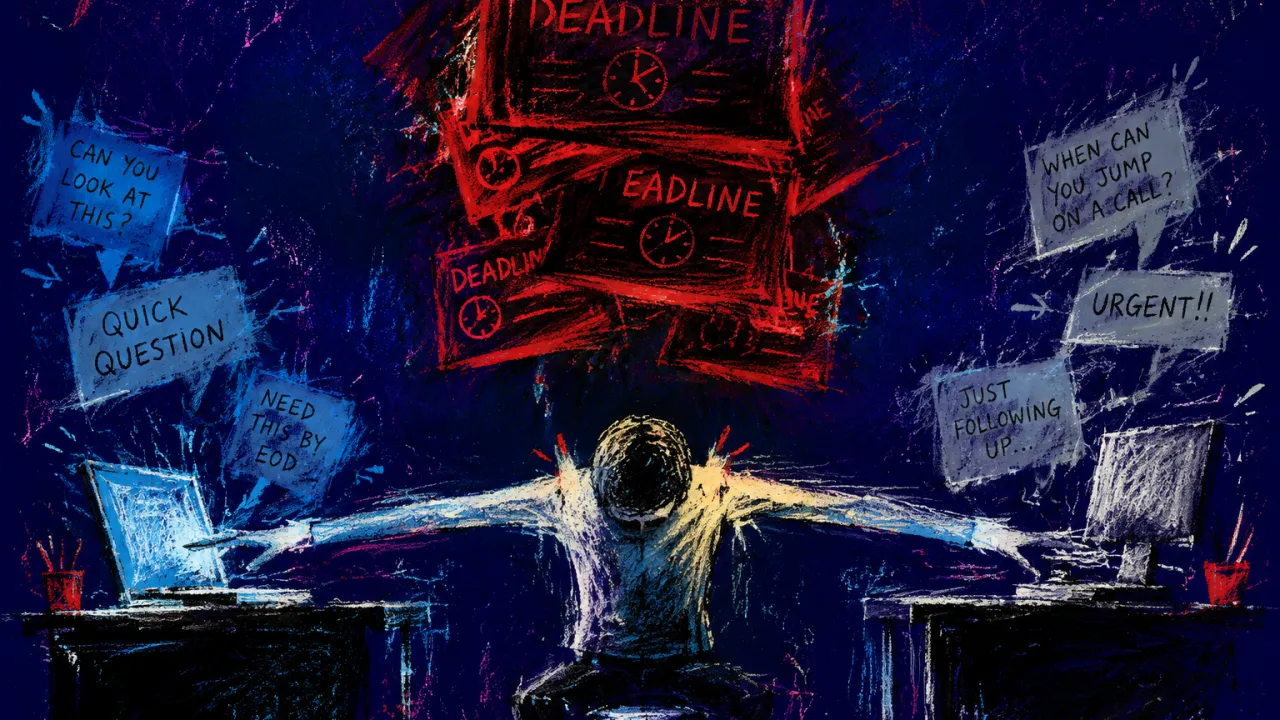
A figure stands between two desks, shoulders lowered beneath red task panels as silver message windows fill both sides.

What is this situation?

Player-Coach Overload: you step into a role where the brief is to keep shipping your own work while guiding everyone else's. By 9 a.m., your calendar is already split between a project deadline, one-to-ones, approvals, and a teammate asking you to unblock something they do not have permission to resolve. You close a coaching call and return to your own task twenty minutes later, only to find a new Slack thread, an escalated client question, and a status meeting added over the focus time you had protected. Senior leaders still measure your individual output, while team members are directed to bring decisions, feedback, and stalled work to you; when either side slips, your name sits beside the missed result. You are expected to develop people, review work, smooth conflicts, and remain available, but no workload has been removed, no meeting load reduced, and little authority added. Lunch becomes the buffer for other people's questions, evenings become the place your own deliverables go, and every handoff creates two more follow-ups. By the end of the week, your shoulders stay lifted even after the laptop closes because the role keeps placing two full jobs into the same hours, much like the figure on the Ten of Wands, bent forward with ten staffs gathered in both arms and the road ahead almost entirely blocked.

Why it's not you?

This is not a personal failure to prioritize; the role has been built around two competing jobs without enough time, authority, or cover for either. When individual delivery and team support are both treated as full-time obligations, the overload comes from the setup, not from a flaw in the person carrying it.

Player-coach Overload in Tarot Cards

Player-Coach Overload is what happens when your deadlines and your team's blocked work are routed through the same limited hours. The shoulders that stay lifted after the laptop closes register an environmental and structural dynamic: responsibility arrives from both sides while time and authority do not expand. The cards below hold up a visual mirror to that divided role without deciding what you should do. Here are the Tarot Cards that reflect its pressure points.

The Emperor
Reversed
Armour remains visible beneath the Emperor's formal robe, while the stone throne presents authority as something rigid, centralized, and difficult to access. Reversed, that seat becomes a barricade rather than a usable source of command: you carry leadership accountability, but permissions, staffing decisions, and scope control remain elsewhere. The role therefore asks you to govern outcomes without giving you the operating leverage that governance requires. You become the person named beside missed delivery and stalled team work even though the structure withholds the authority needed to resolve either cleanly; the image locates the failure in the role design, not in your capacity to lead.
The Chariot
Reversed
The two sphinxes embody distinct workstreams, and the charioteer must coordinate them from a single fixed platform without visible reins. Reversed, the arrangement becomes a career operating system with divided control: senior leaders pull toward personal output while the team pulls toward coaching, approvals, and immediate unblocking. The armoured driver shows that you can bring discipline and resilience, but those resources cannot make incompatible scorecards converge by themselves. When both sides treat your attention as fully available, the role loses traction and your name remains attached to every delayed result; the blocked movement comes from conflicting mandates rather than insufficient commitment.
Justice
Reversed
The scales, upright sword, and formal seat present a complete apparatus for assigning responsibility, measuring results, and enforcing decisions. Reversed, those instruments remain active but no longer operate as a fair system: you are measured on personal delivery and team performance while the time, authority, and cover needed for both remain outside your control. The imbalance becomes visible whenever a missed deadline or stalled teammate is placed beside your name without accounting for the competing demand that displaced the work. You are facing an evaluation design that counts outcomes while excluding capacity constraints, so the most accurate reading is not personal underperformance but structurally distorted accountability.
The Hanged Man
Upright
One foot is fixed to the wooden frame, the other leg folds back, and the hanging figure remains visibly suspended despite the halo around his head. Your own production enters the same suspended state each time a coaching call, approval, or escalation takes precedence, while the organization continues to expect the delayed task to arrive on its original schedule. The halo preserves an important resource: the pause makes the operating contradiction observable. You can see that personal delivery has not stopped because of absent skill or motivation; it has been repeatedly sacrificed to keep the team moving, creating a role where organizational flow depends on your work remaining perpetually deferred.
Temperance
Reversed
The angel attempts to maintain a precise exchange between two cups while standing across two different surfaces. Reversed, the exchange becomes an unstable career contract: individual production and team leadership both require a full stream of attention, but the organization supplies only one person's time and no protected mechanism for transferring capacity. The path toward the distant crown cannot be reached through endless blending when the inputs already exceed the system's limit. You are being asked to make incompatible workloads appear seamlessly integrated, and the resulting spillover shows where the job architecture has failed to distinguish collaboration from unlimited availability.
Two of Pentacles
Upright
Two pentacles occupy the same looping band, while the figure must stay in motion to prevent either from falling. The player-coach career contract uses the same mechanism by keeping individual delivery and team leadership simultaneously active, then treating successful juggling as evidence that both workloads fit. The ships on the waves show that external demand continues to fluctuate even when the juggler performs well. You may be highly capable at switching contexts, but that capability has become the hidden subsidy for a role whose two scorecards exceed stable capacity.
Six of Pentacles
Reversed
A standing figure controls the scales and distributes coins to people positioned below him, making support dependent on a visible allocation system. Reversed, that exchange becomes one-directional: you distribute time, feedback, approvals, and problem-solving capacity to the team while senior leadership supplies little added time, authority, or cover back into your role. The scales remain present but cannot produce reciprocity when the resource flow stops at you. You become both the team's support provider and an under-resourced worker with your own delivery target, revealing a career system that funds collective functioning through the private depletion of its player-coach.
Two of Swords
Upright
A blindfolded figure holds two equal swords across her body while rocky water and a crescent moon sit behind the stalemate. The two blades mirror the two full jobs placed before you, but the organization has avoided choosing which one takes precedence and has transferred that unresolved decision into your calendar. The distinct swords remain visible, which preserves the possibility of naming the actual alternatives: protected individual delivery, protected people leadership, or an explicitly bounded combination. You are not indecisive because the options are unclear; you are holding a no-win choice that the role design has tried to disguise as ordinary prioritization.
Four of Swords
Reversed
The recumbent figure is surrounded by swords even inside a space designed for stillness, keeping the work of vigilance physically close to the body. Reversed, that stillness is interrupted from within: you close the laptop, but team problems, delayed deliverables, and tomorrow's escalation queue continue occupying the mental room. The chamber shows that a recovery container should exist, which helps distinguish unavailable rest from personal resistance to rest. Your internal cache remains active because the external role leaves too many obligations open, not because you lack the discipline to switch off.
Eight of Swords
Upright
A blindfolded and loosely bound figure stands inside a partial fence of swords, with wet ground underfoot and a distant structure behind her. The role creates the same constrained operating space when you are responsible for unblocking teammates but lack permission to make the required decisions, while your own deadlines remain fixed outside the fence. The bindings and sword gaps are visible, preserving the ability to identify which constraints are organizational rather than absolute. You are not immobilized by lack of competence; authority limits, competing metrics, and dependency routing have narrowed the set of actions the career role actually permits.
Nine of Swords
Upright
Nine swords line the wall above a person sitting upright in bed, while the work of the day appears to have followed them into a space meant for sleep. Your internal experience echoes that scene when escalated client questions, team conflicts, and unfinished personal deliverables continue replaying after the laptop closes. The swords remain on the wall rather than entering the body, allowing the pressure to be examined as accumulated open loops. You are carrying the mental residue of a role that leaves two sets of outcomes unresolved each night; the image names the source without converting a workplace capacity problem into a judgment about personal resilience.
Five of Wands
Upright
The staffs cross in several directions while each figure remains occupied with their own position, creating activity without coordinated throughput. At work, you are expected to stay inside that activity as a contributor and step above it as the person who clarifies ownership, reviews work, and settles conflict. Because the competition and confusion are visible, they can be separated from your individual productivity record. The career burden comes from making you the default coordination layer whenever priorities collide, while still treating the time spent restoring team alignment as though it cost nothing.
Seven of Wands
Upright
Six staffs rise toward one worker who must hold his position with a single staff of his own. The scene mirrors a role where teammates, clients, and senior leaders all escalate toward you, while you must simultaneously preserve enough attention to complete the work on which your own performance is judged. The elevated position signals legitimate expertise and a usable vantage point, but it also shows why visibility attracts more demand. You are not merely completing a larger task list; you have become the workplace's contested point of access, and every defence of your own delivery time is treated as a delay to someone else.
Eight of Wands
Upright
Eight staffs cross the sky at once, presenting speed, volume, and converging arrival as one visible event. Your role receives work in the same form: team questions, client escalations, reviews, and status requests travel toward you faster than your own deliverables can move out. The clear sky preserves visibility, but visibility alone does not create capacity. The career bottleneck forms because the organization treats every inbound item as a small interruption while their combined velocity turns you into a queue manager whose original production target remains unchanged.
Ten of Wands
Upright
The worker has gathered every staff into his own arms, making total personal carriage look like the only available method of reaching the town. The player-coach role can install the same belief: because you are capable, visible, and responsible, absorbing every escalation begins to resemble evidence of leadership rather than evidence of missing organizational capacity. The visible road provides a basis for cognitive separation between commitment and over-ownership. You can retain responsibility for meaningful outcomes while recognizing that carrying all production and coordination personally is a system configuration, not a character standard that must be met to prove competence.

Player-coach Overload in Tarot Card Reading Insights

Others facing Player-Coach Overload have brought the same collision between personal deliverables and team needs into their readings. The articles below gather Tarot Reading Insights from those sessions and show what surfaced around that divided role.

Psychological Contexts Related to Player-coach Overload