Portfolio Perfectionism: From a Worth Verdict to Version One
The Final-v12 Loop of Portfolio Perfectionism
I knew the pattern before I drew the first card: if you can explain every product decision in your portfolio but still close an application when it asks for a public URL, fear of being seen may be doing more work than the remaining edits.
Alex, a 27-year-old junior product designer in Toronto, joined our video session from a small desk in their rental at 11:48 on a Tuesday night. Four finished case studies sat open in separate browser tabs. The laptop fan hummed against the quiet room, yesterday's coffee smelled stale beside the keyboard, and the trackpad had grown warm beneath their restless fingers.
Every item on the upload checklist was ticked. Still, I watched the cursor leave the Publish panel, return to the first case study, and select a caption that Alex had already revised twice. A calendar reminder in the corner changed from Publish to Final Review.
"It is basically done," Alex said, rubbing the hinge of their jaw. "But basically is not finished. I keep calling it quality control when I know I am moving the deadline."
I asked what the latest edit had changed. Alex told me it had moved a caption by two pixels, then moved it back. The hiring story had stayed exactly the same.
The apprehension under their words felt less like ordinary indecision and more like a cold coin lodged beneath the ribs: small enough to hide, hard enough to make every breath bend around it. Alex wanted the portfolio to attract recognition and a full-time role. That was precisely why publishing felt dangerous. Once the work was visible, they could no longer use its draft status as an explanation for how people responded.
"I want people to notice it," Alex said. "Which is exactly why putting it live feels so exposed."
I took a sip of coffee and told them, "I am not here to predict what a recruiter will think, and I am not going to tell you to just push through the fear. I want us to tidy up what is actually happening in the ten seconds before Publish. Let us make a map of that moment, then find the part of the decision that is genuinely yours."
Choosing the Shadow Spread as a Working Map
I asked Alex to place both feet on the floor, loosen their hands from the trackpad, and take one unforced breath while holding a single question in mind: "What am I avoiding by never calling my portfolio finished?" I shuffled slowly, treating the pause as a way to focus attention rather than as a performance of mystery.
I chose the five-card Shadow Spread because this question was not asking for a prediction about a job offer. It was asking us to examine a compact psychological loop: the visible behaviour, the hidden fear or desire beneath it, the protection gained by keeping the work unfinished, the quality that could interrupt the loop, and the action that would embody that insight.
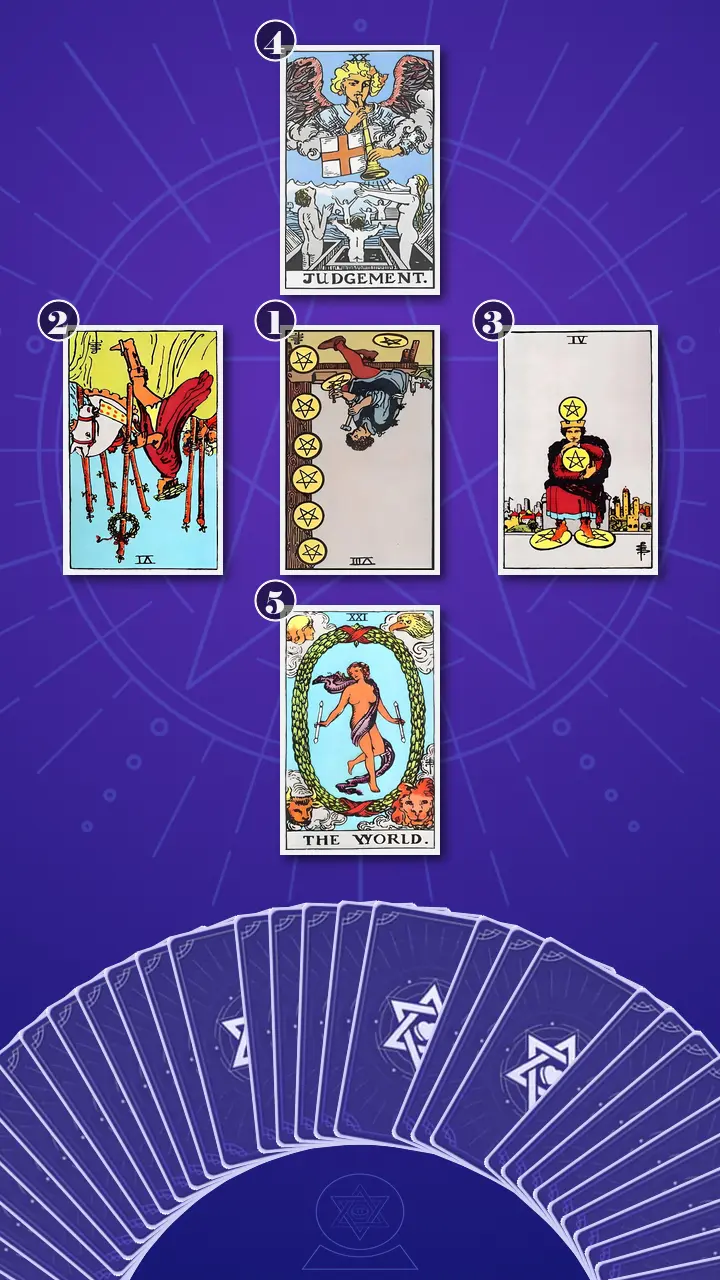
For anyone wondering how tarot works in a situation like this, I use the cards as structured prompts for observation. The first position would show the portfolio completion bottleneck. The two cards flanking it would reveal what publication exposes and what editability protects. The card above the centre would offer the integration key, while the final card below would bring that insight down into a practical definition of done. The spread was deliberately small because Alex did not need ten more variables to analyse. They needed a clean view of the mechanism already operating.
I laid the cards in a cross, like a studio pinboard: diagnosis running horizontally, release running vertically. Nothing in that layout could determine how an audience would react. It could, however, help Alex distinguish evidence from imagined verdicts and choose their next step with their eyes open.
When Craft Becomes Cover
Position One: The Workbench That Never Closes
I said, "Now I am turning over the card that represents the observable portfolio completion bottleneck: the revisions that continue after the content is functionally ready."
I revealed the Eight of Pentacles, reversed.
I pointed to the artisan bent over the pentacle in hand while a row of completed pieces already hung beside the bench. "This card respects craft," I said. "It does not accuse you of caring too much or being unserious. Reversed, though, its Earth energy has become excessive and blocked. The familiar act of working is no longer moving the project toward its purpose."
I brought the image directly back to Alex's screen. At 11:48 p.m., all four case studies were visible and the upload checklist was complete, yet they had zoomed into a thumbnail grid, adjusted its spacing, restored the previous version, and called the hour quality control. The work had not become clearer to a recruiter. The edit had simply delayed the moment when someone could see it.
"The question is not whether this detail could be marginally better," I said. "Almost anything can be edited forever. The question is whether the change improves the problem-contribution-result story or merely gives your hands something controllable to do while the Publish button waits."
Alex did not nod. They gave a short laugh that sounded more bruised than amused, then glanced toward a folder containing final-v12, final-v12-clean, and final-v12-actual.
"That is painfully accurate," they said. "Almost a little cruel."
I let the laugh settle before answering. "The pattern is costly, but it is not ridiculous. Iteration is one of the skills that made you a designer. Your mind is using a legitimate strength to manage an exposed moment it has not learned to tolerate yet. We can respect the strength and still question the job it is doing tonight."
I watched Alex's fingers release the edge of the trackpad. Perfectionism keeps the draft safe by keeping your career waiting, but naming that cost did not require me to shame the care beneath it.
Position Two: The LinkedIn Procession Turned Inward
I said, "Now I am turning over the card that represents what you may be avoiding by withholding finished status: the wish for recognition and the fear of public evaluation."
I revealed the Six of Wands, reversed.
I described the upright image first: a laurel-crowned rider moving through a visible crowd. Reversed, that public Fire does not disappear. It becomes blocked and turns inward as ranking, comparison, and unstable self-evaluation.
I asked Alex to remember the last recruiter message requesting a live link. They told me it had arrived on Line 1 just as a former classmate's polished portfolio launch appeared on LinkedIn. Before any recruiter had viewed Alex's work, they had opened three other designers' sites, compared every hero section and thumbnail, then closed the application.
I said, "That is this card in modern life. You want your work to make an impression, then feel ashamed for wanting that. The inner script becomes, 'I want them to notice me, but if they do not, I will have no explanation left.' LinkedIn becomes an invisible leaderboard, and you withdraw before anyone has actually assigned you a score."
Alex's lips parted, but no words came at first. I saw their gaze move away from the card and hold on the dark window. Their palm flattened against their sternum as though checking the small drop they had felt there.
"I thought I was only afraid of criticism," they said. "But honestly, no response might be worse. It would feel like I was embarrassing for wanting this in the first place."
"Wanting recognition is not a character flaw," I replied. "A portfolio is partly built to attract attention and opportunity. You are not only avoiding criticism; you are avoiding the risk of wanting recognition out loud. Once we admit that wish, it no longer has to disguise itself as another redesign."
I could see the insight land without becoming comfortable. Alex lowered their eyes, pressed a thumbnail into the side of their index finger, then slowly stopped. The goal was not to make visibility painless. It was to let longing and caution exist in the same room without forcing typography to carry both.
Position Three: The Safety of the Password-Protected Draft
I said, "Now I am turning over the card that represents the protective function of staying unfinished: the control and temporary shelter preserved by editability."
I revealed the Four of Pentacles, upright.
I traced the figure's posture: one pentacle held to the chest, one above the crown, and two fixed under the feet. Every part of the body was organised around keeping hold. The Earth energy here was stable enough to protect, but held in excess it became rigidity. There was no free hand to release the work and no free foot to let it circulate.
I translated that posture into Alex's actual portfolio system: a private-preview URL, a password shared selectively, permanent edit access, and a publication date that could always be renamed. While the site stayed editable, Alex controlled the audience, the timing, and whether any reaction had to count as final.
"As long as it is still a draft, I still control what the response means," Alex said quietly.
The laptop fan dropped into silence at that moment, leaving the room unusually still. I noticed Alex exhale into the absence of sound.
"Exactly," I said. "That is why the behaviour persists even though it delays your applications. It is protection, not laziness. The problem is that the same grip protecting your self-worth is also preventing the portfolio from doing its practical job. It can remain perfectly controllable, or it can enter useful circulation. It cannot fully do both."
I asked which control mattered most: timing, audience, interpretation, or whether a response had to feel real. Alex answered, "Interpretation. I want to prevent someone from seeing one weak choice and deciding that is my level."
I told them that no visual system could control every interpretation. A bounded release could protect confidentiality and accuracy, but another cosmetic pass could not guarantee the emotional meaning of an audience response. That distinction would become the hinge of the reading.
When Judgement's Trumpet Replaced the Notification Ping
Position Four: One Honest Review Instead of a Personal Trial
The laptop chimed with an ordinary notification as I reached for the fourth card. Against the stillness of the room, the sound felt almost like the card announcing itself.
I said, "Now I am turning over the card that represents the integration key: honest self-appraisal that can hold ambition and vulnerability at the same time."
I revealed Judgement, upright.
I showed Alex the angel's trumpet and the figures rising with open arms. "This is not a punishing judge handing down a sentence," I said. "Upright, Judgement restores balance through candid appraisal. It asks for a conscious answer to the actual brief, not a total conclusion about who you are."
I returned us to 11:48 p.m.: every checklist box ticked, the upload screen ready, Alex's hand drifting back to the trackpad, and Publish quietly becoming Final Review because one more edit still felt safer than one visible decision.
Here I used what I call Analysis Paralysis Deconstruction. I stripped away every abstract what-if about future recruiters and reduced the review to two grounded categories: a communication blocker a viewer could verify, or discomfort that no design edit could settle. My Complexity Reduction lens made the choice plain. Either the case study answered its brief, or it did not. "Impossible to dismiss" was not a testable third option.
For a moment, my mind moved through twenty years of conversations held over cooling cups of coffee. Again and again, I had seen a decision become workable when a person stopped asking whether it proved their worth and wrote down what the decision was actually required to accomplish. Honest appraisal is a structure, not a sentence.
I said, "The next edit cannot settle what publication is asking: whether you can let a solid version be seen without turning its reception into a verdict on your worth."
You do not need a verdict of perfection before you publish; answer Judgement's trumpet by making one honest review, naming the version complete, and letting it be seen.
I let the sentence remain in the room.
I watched Alex's breath stop first. Their fingers hovered above the trackpad without touching it, and their pupils widened as if a memory had started replaying behind the screen. Then their focus went soft. Their mouth tightened, their eyes reddened at the rims, and both shoulders stayed raised for several long seconds. When the meaning reached them, the first release was not relief but resistance. They pulled their hands into their sleeves and said, more sharply than before, "But does that mean I have wasted months hiding behind design work? Does it mean I was wrong the whole time?" I answered, "No. It means the strategy protected you until its cost became larger than its benefit. Understanding that is information, not an indictment." Their fists loosened inside the fabric. One shoulder dropped, then the other. A shaky breath left their chest, followed by a quieter one. They looked almost lighter, but also briefly unsteady, as though putting down a heavy box had revealed how tired their arms were.
I asked, "Now, with this new perspective, think back to last week. Was there a moment when this insight could have made the experience feel different?"
Alex remembered the Sunday review in a Queen West cafe, when rain tapped the window and the espresso grinder cut through their headphones. Every functional requirement had passed, but they had tested a new type scale because they were confusing two questions: "Does this case study explain my contribution?" and "Will everyone think I am talented?"
"If I had separated those questions," they said, "I could have ended the review without pretending I felt fearless."
"That is the crossing," I said. "Not from fear to perfect confidence, but from contracted fear of visibility and endless micro-editing toward vulnerable pride, bounded completion, and steadier self-trust. The work is editable; your worth is not under review."
I asked Alex to open a plain note and write three completion criteria a recruiter could verify. Together, we kept them observable: four complete case studies; a clear problem, contribution, process, and result in each; and working public links with confidential details removed or anonymised. I set a ten-minute timer for a read-only check of one case study. Alex could stop if the exercise became too exposing, and writing one criterion would still count as a valid minimum version.
They marked all three criteria as passing. Two cosmetic ideas went into a Later Version list. For the first time that night, no new task appeared on the release checklist.
Position Five: The Wreath Around Version One
I said, "Now I am turning over the card that represents the grounded release practice: a bounded definition of done and the real-world publication of the current portfolio version."
I revealed The World, upright.
I asked Alex to look at the oval laurel wreath surrounding the central figure. The wreath creates a complete boundary, but the figure inside it is still moving. Upright, The World holds completion in balance. Closure does not require stagnation, and finishing one cycle does not freeze the person who finished it.
In Alex's working life, the card looked like this: archive the current draft, publish four criteria-complete case studies as version one, test the live URL once, and attach it to one pending application. Any fresh idea would enter the Later Version log instead of reopening the released site during the first wave of exposure.
"Think of it as shipping version one of a product while the backlog stays open," I said. "The release can be complete even though your development is not over. A live portfolio is a dated record of current ability, not a permanent identity document."
I pointed from Judgement's open arms to the moving figure inside The World's wreath. The energy of the spread had changed from overfixed Earth and inward-facing Fire to something more integrated: Water entered when Alex named the vulnerable wish for recognition; Air entered through written criteria; Fire returned through the choice to publish; and Earth became a usable release instead of endless labour.
"This version can be complete while I remain in progress," Alex said, reading the line they had added beneath their criteria.
I nodded. "That is the practice. The World does not promise applause, and I cannot tell you how recruiters will respond. It shows us a healthier boundary between the current work and every future possibility. You remain the person who decides when that boundary is honest enough to hold."
The Coffee Bean Filter and a Version-One Boundary
I gathered the five cards into one coherent sequence. The Eight of Pentacles reversed showed skilled effort detached from a stopping rule. The Six of Wands reversed uncovered the wish to be noticed and the fear that a quiet response would make that wish feel humiliating. The Four of Pentacles explained why perpetual editability offered real short-term safety. Judgement replaced the identity trial with a candid product review. The World turned that review into a version that could finally leave the studio.
The visual story was almost physical: working hands, a public wand turned inward, a closed grip, open arms, then movement inside a finished wreath. Alex had been keeping a painting permanently on the easel so it could never be judged as finished. The blind spot was the belief that completion should wait until visibility no longer hurt. The spread showed a different direction: completion could be based on declared standards even while exposure still made the jaw tighten.
I told Alex that the next move was not to manufacture certainty. It was to move from reassurance seeking to self-authored criteria, then publish the current version on a fixed date once those criteria passed. To make that shift practical, I introduced the Coffee Bean Filter Protocol, my 24-hour sorting exercise for separating real release requirements from emotional noise. I call it a filter because, like separating grounds from a finished cup, it keeps useful substance while removing material that only clouds the decision.
- Run the 24-hour Coffee Bean FilterBefore Wednesday evening, place two sheets beside the laptop labelled Absolute Must-Haves and Emotional Noise. Write each new edit urge on a separate sticky note. A Must-Have must connect to exactly three recruiter-verifiable criteria: four complete case studies, a clear problem-contribution-process-result arc, and working compliant links. Everything else goes under Emotional Noise or into the Later Version log. On Thursday, set a 20-minute timer and mark each case study Pass, Blocker, or Later without editing during the check.If the full exercise feels too exposing, write one criterion for one case study and do a five-minute read-only check. Alex owns the criteria; feedback may inform them, but it does not outrank them.
- Create the Version-One WreathChoose a publication date within the next seven days and create a 30-minute calendar event named Publish Version 1. At the start of the event, duplicate the site into a dated archive, publish the criteria-complete version, test the URL once in a private browser window, and paste it into one pending application. Put all non-blocking improvements in the Later Version log rather than reopening the release.Schedule the event for a rested hour and leave version one untouched for 72 hours after publishing. Confidential or contract-restricted work stays private, anonymised, or replaced with an approved case study; closure never requires violating a real boundary.
I asked Alex to write one final sentence above the calendar event: "I want this work to be noticed, and I am apprehensive about how it will be judged." Both sides had to remain visible. Suppressing the wish for recognition would restart comparison; suppressing the fear would turn the plan into brittle bravado.
A definition of done is a boundary, not a claim of perfection. That was the practical answer produced by the five-card Shadow Spread: feel the exposure, name the standard, make the visible choice, and let a bounded version begin doing real work.
Six Days Later: A Live URL and an Open Future
Six days later, I received a message from Alex. The first line read, "Version one is live." Beneath it was the public URL, followed by a screenshot of the pending application with the portfolio field completed. They had tested the link once, closed Webflow, and left two thumbnail ideas in the Later Version log.
Alex had not solved their whole career. No recruiter response had arrived yet, and publication still felt tender. The concrete change was smaller and more important: the portfolio had moved from private potential into actual use, and Alex had produced evidence that discomfort did not have to make the decision for them.
That night, Alex slept through until morning. Their first thought on waking was, "What if I got it wrong?" They told me they smiled, opened the Later Version log instead of the live site, and left version one untouched.
I held that detail as the quiet proof of our Journey to Clarity. The cards had not published the portfolio, guaranteed recognition, or removed vulnerability. They had helped us organise the clutter around one decision. Alex wrote the standards, chose the boundary, clicked Publish, and kept ownership of what came next.
When I picture a jaw tightening over the Publish button, I remember that a draft may be holding two exposed truths at once: you want your work to be noticed, and you fear that a quiet response will feel like proof that you were never worth noticing. Merely seeing both truths already gives you more choice than another automatic edit.
If your portfolio only had to stand inside The World's wreath as a record of where you are now, which three recruiter-verifiable checks would let you answer Judgement's trumpet and call version one complete this week?