Productive Procrastination: How One Small Draft Interrupts the Loop

The 11:47 p.m. Confetti Trap: When Online Courses Become Productive Procrastination
If a blank document makes your hand reach for YouTube before you have written one bad paragraph, I would ask whether the tutorial loop is protecting you from feedback rather than filling a knowledge gap.
Jordan, a 28-year-old remote marketing coordinator in Toronto, had booked a late video session with me. At 11:47 p.m., they shared their laptop screen. Completion confetti flickered across one tab while a streetcar ground around the corner outside their compact apartment. I could hear the laptop fan humming through the call, and Jordan kept rubbing their fingertips over the warm trackpad as if the next click might settle something their body could not.
In the adjacent tab, a portfolio case study contained only a title. Jordan had just finished another short module, but instead of opening the assignment, they were already reading the syllabus for an advanced course. Their shoulders remained tight even after the progress bar reached 100 percent.
"I am learning all the time, so why does my actual life look the same?" they asked. "I keep thinking the next course will make my direction click. But the second I have to use what I learned without an answer key, I go back to tutorials."
I heard the conflict clearly: gaining another level of knowledge felt controlled and measurable; using existing knowledge meant risking an ordinary, uncertain result. What Jordan called aimlessness felt like standing on a subway platform with six routes open on a phone, watching every train leave because boarding one would close the others.
"I am not going to tell you that learning is the problem," I said. "Curiosity is one of your strengths. I want us to look at what happens at the exact point where curiosity turns away from contact. We are not asking the cards to choose a career or predict an outcome. We are using them to draw a map of the loop, so you can decide where to interrupt it."
Choosing a Map Beneath the Open Tabs
I invited Jordan to place both feet on the floor, take one slower breath, and hold one question in mind: "Why do I keep leveling up courses instead of using what I learn?" I shuffled while they closed the course catalogue. The small ritual was not about manufacturing mystery. It gave their attention a clean transition from compulsive clicking to deliberate observation.
I chose the six-card Transformation Path Grid · Context Edition. This is how tarot works in my practice: the images provide symbolic distance, while a Jungian psychological lens helps me examine the behavior, protective pattern, and unrealized capacity represented by each archetype. Card meanings in context are prompts for investigation, not verdicts handed down by fate.
I selected this spread because Jordan's question described a system, not a single bad habit. A broad Celtic Cross would have introduced more material than this focused loop needed, while a shadow-focused spread could have explored avoidance without showing the entire reinforcement cycle. This grid was precise enough to trace visible behavior, immediate blockage, hidden reward, catalytic realization, practical experiment, and integration.
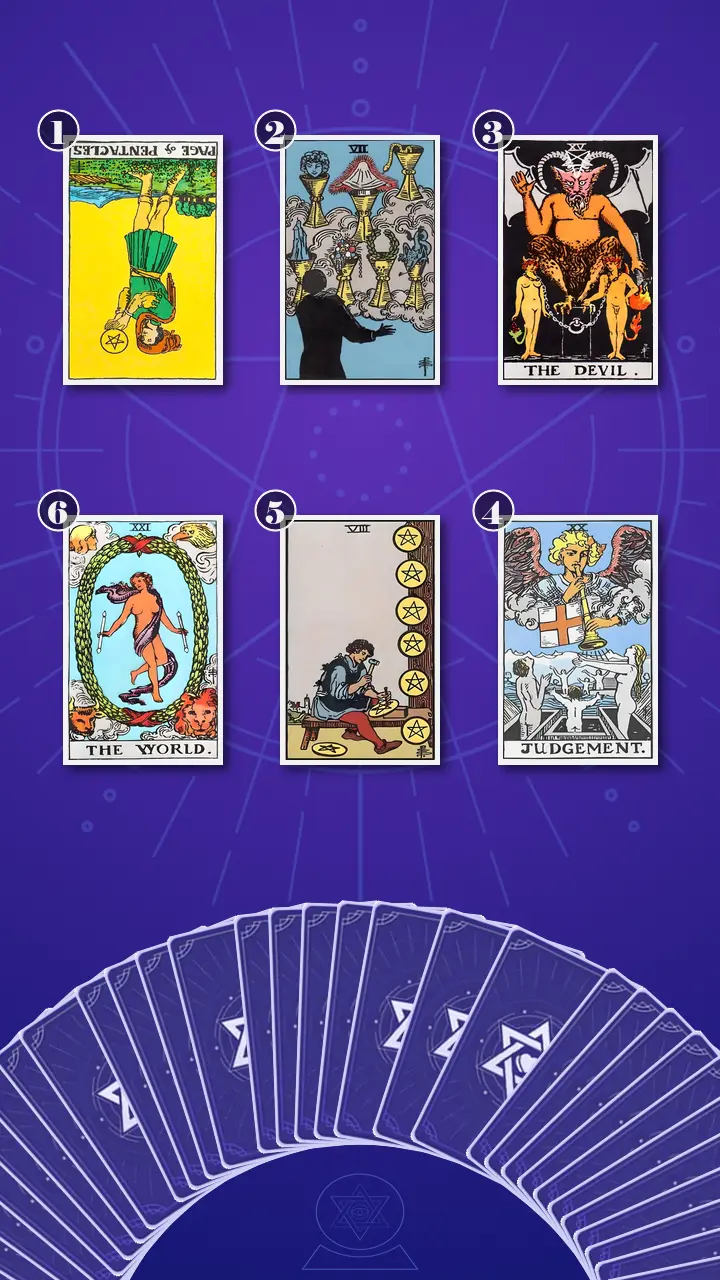
I laid the first three cards across the top row. They would show the course-completion behavior, the abundance of imagined directions, and the reward structure sustaining the loop. I placed the fourth card directly beneath the third as the hinge, the realization capable of changing the pattern. The final two cards would lead back across the lower row through repeated practice and a completed learning cycle. On the table, the layout resembled a level-selection screen becoming a grounded switchback path.
Reading the Course-Reward Loop
Position 1: The Badge Held at Eye Level
"The card I am turning over now represents the observable current-state behavior," I told Jordan. "It shows the course completions, protected streaks, and learner mode that remain visible while practical work is postponed."
The card was the Page of Pentacles, in reversed position.
In the Rider-Waite-Smith image, the Page studies a pentacle held at eye level. Behind the figure, a cultivated field and distant mountains wait to be entered. Reversed, the Page's practical learning energy is not absent, but blocked at follow-through. Attention has become fixed on the token of competence while the terrain where competence develops remains in the background.
I pointed to the two tabs on Jordan's screen. At 11:47 p.m., they had watched another module reach 100 percent and were studying an advanced curriculum as if the next badge could become practical competence. Beside it, the portfolio case study still contained only its title. This was the modern-life scenario of the reversed Page: focused study had become a safer substitute for putting one technique into the field.
"This is a Blockage of earth energy," I explained. "You have the material, concentration, and willingness to learn. The blocked part is contact. You keep holding the symbol of a skill close enough to examine it, but you do not let your hands discover what the skill can and cannot do."
Jordan gave a short, bitter laugh. Their fingers stopped on the trackpad, then folded under their palms. "That is so accurate it is almost cruel," they said. "I am technically making progress, so why does the real file still look exactly the same?"
"The card is not accusing you of doing nothing," I replied. "It is separating two kinds of progress that your dashboard has blended together. Course completion is real. Usable competence is also real. They simply require different evidence. You are not short on input; you are short on contact with your own evidence."
Position 2: Seven Future Selves in the Cloud
"The card I am turning over now represents the immediate blockage," I said. "It shows how course abundance, gamified prompts, and imagined future identities pull your attention away at the moment application becomes possible."
The card was the Seven of Cups, upright.
Seven cups float in clouds before a stationary figure. Each cup offers something glittering, veiled, or dramatic, but none provides ground. In Jordan's life, the cups looked like seven open tabs promising seven identities: strategist, designer, founder, creator, productivity expert, career changer, and purpose-led professional.
I asked about the previous Sunday. Jordan told me they had seen a former colleague announce a project launch on LinkedIn. While takeaway containers sat on the kitchen counter and streetcar brakes squealed outside, they opened courses in creative strategy, design, personal branding, and purpose. Each landing page offered a polished version of who they might become. By the end of the evening, they had compared ratings and saved two discounts, but their existing campaign idea had not moved.
"The Seven of Cups shows an Excess of possibility," I said. "Curiosity has expanded beyond what the present can contain. You do not merely want each course. You want the version of yourself pictured on its landing page. Every new course keeps a possible self alive; practice asks one of them to become real enough to be imperfect."
Jordan's jaw shifted. For a moment their gaze went unfocused, as if they were replaying the LinkedIn scroll and all the tabs that followed. Then they exhaled through their nose. "Keeping every option open feels responsible," they said. "But it also means I never find out whether I actually like doing any of them."
"Exactly," I said. "The blockage is not a shortage of attractive options. It is the protection offered by keeping every imagined self untested. The algorithm has learned that possibility keeps you browsing longer than commitment does. Your task is not to destroy possibility. It is to give one possibility a temporary container."
Position 3: The Chain Made of Small Clicks
"The card I am turning over now represents the root mechanism beneath the loop," I said. "It shows the attachment to measurable rewards and externally structured certainty that protects you from a less measurable question: What happens when I make my own judgment?"
The card was The Devil, upright.
I watched Jordan's shoulders rise before I began. The Devil can provoke fear when it is read carelessly, so I slowed down. I pointed first to the chains around the two figures. They are visible, but they are loose. That detail matters. I was not looking at a sentence imposed on Jordan's future. I was looking at a persuasive pattern in which Jordan still had participation, observation, and agency.
The modern form of that pattern appeared whenever a campaign draft required an original judgment. Jordan would feel a drop behind the ribs. Almost on cue, a streak warning, sale email, or advanced-module recommendation would become unusually attractive. They would complete an easy quiz, receive points and confetti, and feel capable for several minutes. The platform was not choosing Jordan's direction, but its quick certainty was easier to measure than a rough result that might be ordinary.
"This is an Excess of externally rewarded certainty and a Blockage of self-authored evidence," I said. "The sequence is consistent: an exposing task appears, your body tightens, you click toward structured instruction, the platform gives immediate relief, and the unfinished task later becomes evidence that you are still not ready. The loop then restarts."
My mind briefly returned to the learning systems I had encountered while travelling across cultures. The language and symbols changed, but the promise was often the same: follow the approved sequence and uncertainty will disappear. I had learned that an external map can support a journey, but it cannot walk the road or confer an identity on the traveller.
"I know the badge is not the work," Jordan said quietly. Their thumb pressed into the side of their index finger, held there, and then released. "But it gives me relief faster than the work can."
"That makes sense," I replied. "A rough draft delays its reward and includes the possibility of feedback. A quiz gives you a clear answer immediately. We can respect why your nervous system prefers the faster signal without pretending that the signal serves your larger goal. The loop is persuasive, not permanent."
When Judgement's Trumpet Replaced the Notification
Position 4: The Honest Audit
"The card I am turning over now represents the catalytic realization," I said. "It shows the decision or energy capable of interrupting automatic course consumption by measuring learning through behavior rather than platform completion."
The card was Judgement, upright.
As I placed it directly beneath The Devil, a streetcar bell sounded through Jordan's window. Its single clear note cut across the laptop fan and then disappeared. The timing brought the card's central image into the room: an angel's trumpet calling figures to rise from enclosed spaces with open arms.
"Judgement is not punishment here," I said. "It is balanced self-accountability. Instead of asking whether you have consumed enough information, it asks one factual question: Which lesson has changed something you repeatedly do? In practical terms, this could mean opening the last three months of course history, choosing one audience-strategy lesson that still matters, and scheduling a ten-minute campaign draft before the next module."
I could see Jordan trying to turn that audit into another performance review. The old thought was already forming: if the answer showed little applied work, then the past months must have been wasted, and they must have chosen incorrectly. Their shoulders tightened as if honesty could only arrive wearing a judge's robe.
"Another level can explain more; it cannot choose for you," I said.
Another badge cannot choose your direction; answer Judgement's trumpet by turning one lesson into one visible act.
I let the sentence remain between us. Jordan's breath stopped first. Their hand hovered above the trackpad, fingers curved but motionless. Then their eyes shifted away from the card and lost focus, as if a private reel of completion screens, blank files, and abandoned drafts had begun replaying behind them. Their pupils widened. Their mouth opened, closed, and tightened at one corner. "But doesn't that mean I have been doing it wrong this whole time?" they asked, with a sudden edge of anger. The anger cracked almost immediately into grief. Their eyes reddened, their fist closed against the desk, and then, slowly, each finger released. Their shoulders dropped on a long, unsteady exhale. Relief had arrived, but so had the slight dizziness of realizing that clarity would return responsibility to them. "If another course cannot choose," they said more softly, "then I have to make something without knowing what it proves."
"You do," I said, "but that does not mean everything before this was wrong. Learning helped you build language, discernment, and real knowledge. It also became a shelter when application felt exposing. Recognizing the shelter is not a verdict on your past. It is information about what you need now."
This was where I brought in my Limiting Belief Deconstruction lens. I asked Jordan to audit the belief as a mechanism rather than treat it as a personal flaw. The trigger belief was, "I need one more framework before I can act." The protective move was opening another syllabus. The immediate reward was purpose and certainty. The long-term cost was a lack of lived evidence. That missing evidence then seemed to confirm the original belief that they were not ready.
"The belief is generating the proof it uses to defend itself," I said. "That is the hidden architecture. Once you can see the sequence, you do not have to argue with the fear or shame yourself for having it. You can change one link in the chain."
I also used my Imposter Syndrome Decoding lens to separate Jordan's capacity from the fear of being found out. "An ordinary first draft would not prove that you are a fraud," I said. "It would prove that you are doing the part of the process your courses could not do for you. The emerging practitioner is not the learner after all uncertainty has vanished. It is the learner who lets uncertainty produce feedback."
"Now, with this new perspective, think back to last week," I said. "Was there a moment when this insight could have made you feel different?"
Jordan looked toward the blank portfolio tab. "Monday morning," they said. "I had to write one campaign premise. I knew the audience-tension framework well enough to try, but I rewatched the whole module. If I had treated the premise as evidence instead of a verdict, I probably could have typed something."
"What would the first sentence have been?" I asked.
Jordan hesitated, opened the document, and typed a rough campaign premise while I waited. It was not polished, and neither of us pretended otherwise. But one specific action had interrupted the closed circuit before another tutorial could open.
That small moment marked the real emotional transformation: from restless course accumulation and fear of imperfect results to grounded curiosity, applied evidence, and steadier self-trust. It was not complete confidence. It was the first movement from "I must know before I act" to "I can act carefully enough to learn what I do not yet know."
From the Trumpet to the Workbench
Position 5: Seven Days at One Small Task
"The card I am turning over now represents the practical action," I said. "It shows the bounded method that can carry this realization into daily life before more instruction is consumed."
The card was the Eight of Pentacles, upright.
The craftsperson's hands are active. A hammer and chisel meet the pentacle currently on the bench, while completed pieces show the evidence of repetition. I contrasted it with the reversed Page: the same suit had moved from studying the symbol of competence to shaping workable material.
For Jordan, the card suggested opening a folder before opening a course and spending twenty minutes using one strategy technique. Each session could produce a small artifact: three headlines, one campaign premise, a rough layout, or one paragraph of the case study. The pieces did not need to be equally good. Their purpose was to reveal what improved, what remained difficult, and what Jordan genuinely liked doing.
"This is balanced earth energy repairing the earlier Blockage," I said. "The Eight does not demand a dramatic reinvention or a public identity announcement. It asks for sustained contact with one piece of work. Direction is not a prerequisite for practice; it is one of practice's outputs."
Jordan glanced at the advanced-course tab and closed it. Their lips pressed together with a trace of reluctance, but their hands had become still. "Seven days feels almost suspiciously small," they said.
"Small is part of the design," I replied. "This does not have to prove your future. It only has to show you what happens when you use the skill."
Position 6: The Wreath Around a Finished Cycle
"The final card represents integration," I said. "It shows what becomes available when learning is followed by use, feedback, revision, and a deliberate next decision."
The card was The World, upright.
The green wreath forms a clear boundary around a complete cycle. The central figure moves freely inside it, rather than holding knowledge outside the self as a collectible token. I read this as Balance and integration, not as a prediction that Jordan would suddenly discover a perfect calling.
In Jordan's life, The World looked like reviewing seven dated artifacts, asking one trusted colleague one narrow feedback question, revising one piece, and naming the exact gap that remained. Only after that closed learning cycle would Jordan decide whether another lesson could meet a demonstrated need.
"Learning does not end here," I said. "It enters your behavior and returns as evidence. Completion is no longer the moment a platform unlocks another level. It is the moment you can say: I studied this, used it, observed what happened, revised it, and made an informed choice about what comes next."
Jordan looked across the full spread, from the reversed Page holding the pentacle to the craftsperson shaping it, and finally to the wreath enclosing a whole cycle. Their expression held relief and a quieter sadness. Leaving perpetual preparation meant giving up the fantasy that an impressive authority could simply confer the right identity, like waiting for the Wizard of Oz to make the journey unnecessary. It also meant recognizing that capacities become credible through choices made on the road.
The Closed Learning Loop: From Insight to Applied Evidence
I gathered the six cards into one coherent story. Jordan's curiosity had originally offered growth and relief inside a stable job that no longer gave them a clear sense of movement. The reversed Page showed that study had stalled at follow-through. The Seven of Cups multiplied possible identities until choosing one experiment felt like losing the others. The Devil revealed how streaks, badges, and expert-led structure supplied fast certainty whenever independent work felt exposing. Judgement interrupted the loop with a factual audit. The Eight of Pentacles redirected energy into repeated craft, and The World defined progress as a completed study-use-feedback-integration cycle.
The spread's core metaphor was a game in which Jordan had unlocked nearly every branch of the skill tree while declining the first quest that would test the abilities. The problem was not a lack of discipline. Jordan had plenty of discipline. Their effort had been routed toward activities that could certify completion without exposing personal judgment.
I named the cognitive blind spot directly: Jordan had assumed that direction must arrive before practice. Because they had little applied evidence, the absence of evidence felt like evidence of unreadiness. In reality, another framework could add information, but it could not answer the experiential questions: Do I enjoy using this skill? What happens under a real constraint? Which part improves with repetition? What specific gap remains?
The transformation direction was therefore precise: choose one already-learned skill, define one small output, and practise it for seven days before opening another course. Study itself was not being rejected. It was being returned to a closed cycle of learning, application, feedback, and integration.
"But I genuinely do not have twenty spare minutes every evening," Jordan said. "Some days I finish work and my brain is gone."
I adjusted the plan. "Then twenty minutes is the full version, not the entry requirement. Seven minutes counts. A private draft counts. Missing a day gives us information; it does not erase the experiment. The goal is contact, not a new streak wearing more respectable clothes."
I framed the next steps through my Cognitive Reframing Protocol. Instead of leaving the fear as "If my draft is ordinary, maybe I have no direction," we translated it into usable risk data: the first output might be weak; it could remain private; the test could last seven minutes; the result could identify one friction point rather than define Jordan's future. A vague fear became a bounded experiment with an exit, a time limit, and a review question.
- Run the ten-minute Applied-Evidence Audit.On Monday, before opening a learning platform, Jordan will use a plain phone note to list the courses or modules used during the past thirty days. Beside each item, they will write one label: used in a real task, scheduled for a real task, or not yet applied. They will circle one useful lesson and calendar one visible response, such as drafting three campaign hooks with the audience-tension framework.Keep this factual and non-punitive. The minimum version is one course, one useful lesson, and one behavior or output it has influenced.
- Begin the Seven-Day One-Artifact Practice.For seven days, Jordan will open a folder named Seven-Day Practice before opening any course. They will spend the first twenty minutes, or a seven-minute minimum on low-energy days, applying one existing strategy technique. Each session will end with one dated artifact. On day seven, they will compare the first and last pieces, record one improvement, one friction point, and one question, then ask one trusted colleague a single bounded feedback question.The work may stay private and unfinished. No new enrolment is needed unless the completed practice cycle reveals a specific knowledge gap.
"These are experiments, not vows," I said. "You retain the right to pause, change the project after review, keep the work private, or study further when practice identifies a real need. Tarot has not selected your direction. It has helped us make the structure around your choice visible."

A Week Later: Seven Files and One Honest Question
Seven days later, I received a message from Jordan. They had made six dated artifacts and missed Wednesday without restarting the entire plan. Their folder contained rough headlines, two campaign premises, and three versions of a portfolio paragraph. They had also ignored an advanced-course discount long enough for the timer to expire.
"Nothing magically clicked," Jordan wrote. "But draft six was easier than draft one. I noticed I like finding the audience tension, and I get stuck when I have to explain results. That is a real gap, not just the feeling that I need to know everything. I asked a colleague one question about the paragraph, and the feedback was useful instead of fatal."
That night, Jordan slept through until morning. Their first thought was still, "What if I choose wrong?" This time, they smiled, opened the dated folder, and chose the next small draft.
I did not read that message as proof that Jordan had solved their career or escaped every tutorial loop. I read it as quiet evidence of the shift we had mapped: from completion dopamine to grounded curiosity, from externally scored progress to self-authored evidence, and from the protected identity of perpetual learner to the vulnerable, practical role of emerging practitioner.
The cards had not produced Jordan's change. Jordan had. The spread offered enough distance to see the pattern without shame, but their hands closed the course tab, typed the first campaign premise, returned the next day, and asked for feedback. That was the Journey to Clarity: not certainty about an entire future, but a more trustworthy relationship with the next observable choice.
If a blank file is sitting beside a glowing completion badge tonight, and the tightness in your shoulders contains both a longing for direction and a fear of one ordinary draft, noticing that conflict already means you are no longer moving through it automatically.
If direction did not have to arrive before practice, which already-learned skill would you answer with ten imperfect minutes today?