The Tuesday-Night Setup Mode, Lit by a Laptop Screen
You’re a junior UX designer in Toronto who can ship a solid Figma flow—but somehow you’re still buying another notebook because the first page feels too high-stakes (hello, Sunday Scaries planning).
Jordan said it like a confession and a punchline at the same time. On my screen, they were in their condo kitchen at 9:06 p.m.—microwaved leftovers pushed aside, the last hum of the microwave fading out, the overhead light a little too bright for a brain that’s already spent. Their laptop glow was cool on their cheeks; their phone looked warm, like it had been held too long. Their pens were lined up with a care that felt almost ceremonial, like staging a tiny photoshoot for a life that hadn’t started yet.
Three tabs were open—best notebooks for bullet journaling, a planner review, and a YouTube “Sunday reset” setup video—and their jaw tightened in that specific way that means, I am trying to control something that won’t hold still.
“I keep trying to buy my way into consistency,” they said. “And then when the notebook arrives, I freeze. The first page feels like a test I can fail.”
I could hear the contradiction underneath their words, steady as a bassline: you want a perfect setup because it promises follow-through. But you avoid starting because starting imperfectly risks proving you’re not disciplined—or worse, not capable.
The frustration in Jordan wasn’t loud. It was physical: restless hands, a tight jaw, and that buzzing itch to keep researching instead of beginning. It reminded me of watching a meteor shower through glass—so much motion, so little landing. Like their attention was stuck orbiting the blank page, never touching down.
“You’re not ‘bad at planning,’” I told them, keeping my voice gentle and plain. “You’re stuck in setup mode. And we can work with that. Let’s try to draw a map through the fog—something that helps you find clarity without demanding a perfect version of you first.”

Choosing the Compass: The Four-Layer Insight Ladder · Context Edition
I asked Jordan to take one slow breath—not as a mystical ritual, just a clean transition. Then I shuffled my deck the way I do before a planetarium show: not for drama, but to help the mind stop chasing ten directions at once.
“Today we’ll use a spread called the Four-Layer Insight Ladder · Context Edition,” I said.
For readers who wonder how tarot works in a situation like this: I don’t treat cards like a verdict. I treat them like a structured conversation with your own patterns. This spread is especially useful as a tarot spread for perfectionism and procrastination because it doesn’t get lost in endless options—it traces a loop from the visible behavior to the hidden reward, down to the root belief, and then back up into an actionable interruption point.
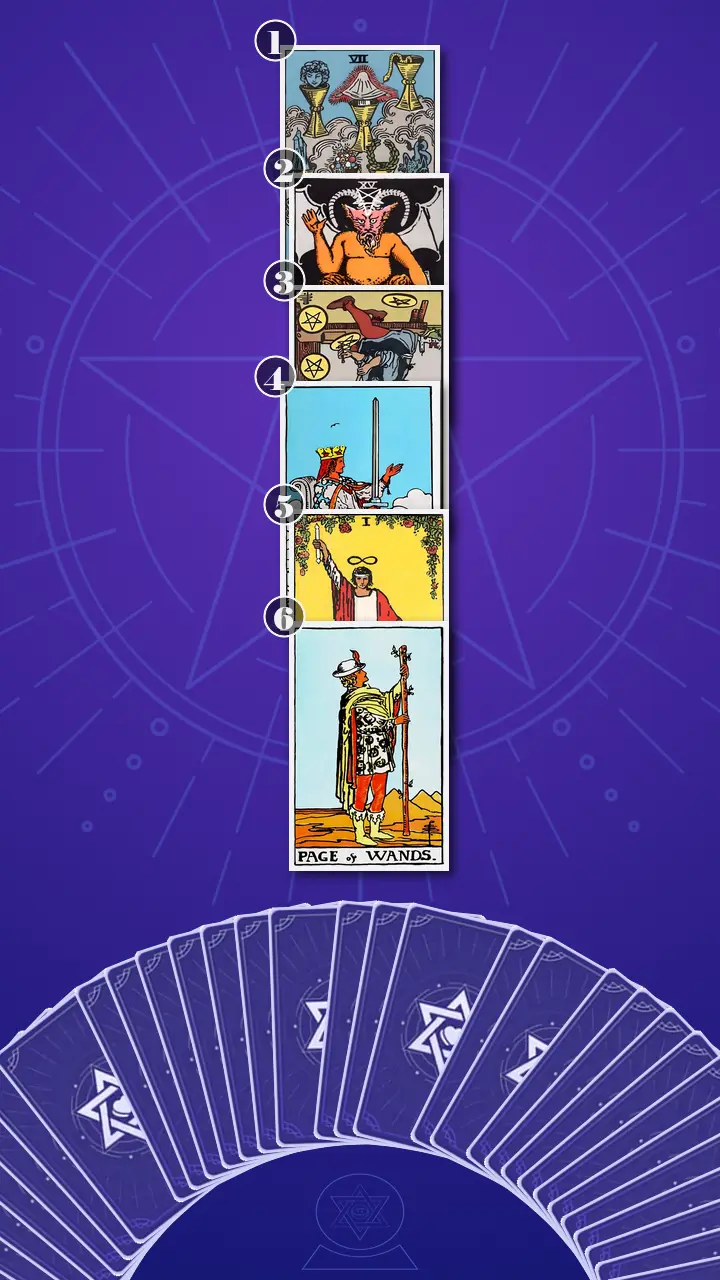
Here’s what I told Jordan we’d look for: the first card would show the observable loop—the notebook-shopping and system-hopping as it actually happens. The second would reveal the hook—the payoff that keeps the loop repeating. The third would name the root mechanism—the belief that turns practice into a high-stakes audition. Then we’d climb back up: the fourth card would show an inner resource, the fifth would be the key shift, and the sixth would offer a next step we could test this week.
Reading the Map: From Choice Overload to Proof-Through-Action
Position 1 — The observable loop
“Now we turn over the card that represents the observable loop: the specific, repeatable behavior around notebook shopping and system-hopping.”
Seven of Cups, upright.
I angled the card toward the camera. “This is the classic ‘too many options’ card. In modern life, it’s 11 tabs deep: best notebooks for bullet journaling, 2026 planner review, minimalist weekly spread, plus saved TikToks that all look like a calmer, more put-together version of you. You’re not choosing a notebook—you’re browsing possible selves, because staying in possibility feels safer than writing a messy first page.”
Energy-wise, the Seven of Cups is excess: too much imagination, too much projection, not enough contact with what’s real. It’s not that your imagination is wrong—it’s that it’s doing the job of protecting you.
“It’s like a recommendation algorithm,” I added, watching Jordan’s eyes flick to their open tabs. “The more you browse, the more it feeds you ‘better options,’ and the harder it gets to choose anything. Options don’t judge you. A page does.”
Jordan let out a thin breath through their nose, not quite a laugh. Their fingers kept tapping the edge of their phone like it was a tiny escape hatch.
Position 2 — The hook
“Now we turn over the card that represents the hook: what reward, urge, or pressure keeps the pattern repeating even when you know it doesn’t help.”
The Devil, upright.
I didn’t soften the name. I softened the meaning. “This isn’t about you being ‘bad.’ The Devil is about attachment—the way something starts running the steering wheel because it gives quick relief.”
“In real life,” I said, “you feel a spike of relief when you hit ‘Buy now,’ like you just solved your consistency problem—then you chase that feeling again the next time you feel behind. The notebook becomes a gatekeeper: Once I have the right one, then I’m allowed to begin. It’s not laziness—it’s an attachment to a quick fix that temporarily numbs the fear of failing.”
Energy-wise, this is blockage—your agency getting outsourced to an object and the promise it sells. The key symbol for me is always the chains: they’re loose. Which means the stuckness is real, but it isn’t permanent.
Jordan’s shoulders rose a fraction, like they’d been bracing for judgment and didn’t quite get it. “That’s… scary accurate,” they said. “It’s like I’m treating a notebook like… permission.”
“Yes,” I said, and I kept my tone steady. “A notebook is a container, not a character reference.”
Position 3 — The root mechanism
“Now we turn over the card that represents the root mechanism: the perfectionism belief and fear that turns practice into a high-stakes test.”
Eight of Pentacles, reversed.
“This is skill-building energy,” I said, “but flipped.” I let the words land. “In the upright, it’s repetition. In the reversed, it’s restarting and tweaking instead of finishing one cycle.”
“Modern translation: you spend an hour designing the perfect weekly spread—headers, trackers, color code—then freeze because you know your real week won’t look like the template. One chaotic day at work makes the page feel ‘ruined,’ so you restart the whole system instead of practicing inside the imperfect week you actually have.”
Energy-wise, this card is deficiency disguised as productivity: not a lack of intelligence, not a lack of desire—just a blocked relationship with the learning curve. The reversed Eight says, You want mastery without the visible beginner phase.
I watched the recognition hit Jordan in micro-actions, exactly like the card: a tiny wince; a tense laugh that sounded like it hurt; then a heavy pause where their eyes unfocused, as if they could see their own drawer of half-used notebooks without opening it.
“I do the restart spiral,” they admitted. “I rewrite headers. I re-draw boxes. I’ll even rip out a page. Then I’m on YouTube again searching ‘minimalist weekly spread’ like I’m… bargaining.”
“That bargain makes sense,” I said. “It goes: I’ll fix the system, then I’ll be consistent. But the loop flips it into: I missed a day, so the whole thing is invalid. That’s not discipline. That’s an audition you didn’t agree to.”
Position 4 — The inner resource
“Now we turn over the card that represents the inner resource: the mindset and boundary you can access to interrupt the cycle in real time.”
Queen of Swords, upright.
The energy in the room changed, even through a screen. The Queen of Swords is crisp. Clean air after a sticky night of scrolling.
“In modern life,” I said, “this is you closing the tabs, muting stationery hauls for a month, and writing one rule on a sticky note: One notebook. One month. No restarts. It’s not dramatic—just clear. You stop negotiating with your anxiety like it’s a committee and make a decision you can respect tomorrow.”
Energy-wise, this is balance: precision without self-punishment. Boundary as agency-restoration.
I leaned into the echo technique here on purpose—like a calm text you send yourself, short sentences, no drama.
“Jordan,” I said, “imagine you text yourself: Decision made. One notebook for a month. Not because you’re bad—because you want your attention back. Then you put your phone down.”
Jordan’s face softened, like someone had finally stopped asking them to argue their case. Their shoulders dropped a little, and their hands—still—rested flat on the table. “That actually feels… relieving,” they said. “Like permission to stop explaining myself.”
Position 5 — The key shift (Key Card)
“Now we turn over the card that represents the key shift: the most direct reframe that moves you from tool-optimizing to action and self-trust.”
For a second, the room went oddly quiet. I’ve seen this pause before, in dark planetarium domes right before I turn on the stars—when everyone is waiting to see what’s been there all along.
The Magician, upright.
In the setup phase, I named the exact moment they’d described—because clarity often starts as brutal specificity.
You know that moment after work when you’ve got three tabs open—planner reviews, ‘best notebooks for bullet journaling,’ and a productivity video—and your hands are busy rearranging pens while the actual first sentence never lands.
Stop auditioning notebooks for the role of ‘the real you’ and start using the tools already on your table—like The Magician, action is what turns potential into proof.
I let the sentence hang there for a beat, the way I let silence hang after naming a constellation—so people can actually see it.
Then I saw the three-step reaction chain happen in Jordan’s body, vivid and immediate: first, a tiny freeze—breath caught, fingers hovering above their trackpad as if they’d been caught mid-scroll. Second, their gaze softened and went slightly unfocused, like a memory replaying: all those first pages that felt like signing a contract. Third, the release: a quiet exhale from deep in the chest, their jaw unclenching as if it had been holding on for weeks.
“Wait,” they said, and the word came out half-laugh, half-grief. “I’ve been treating the notebook like it can… certify me.” Their eyes went a little shiny. “Like if it’s the right one, then I’m the right one.”
“Exactly,” I said. “And here’s where my astrology brain kicks in.”
At the Tokyo planetarium, I’ve taught kids that a black hole isn’t just ‘a scary void.’ It’s a boundary—the event horizon. Past that line, the rules change. You don’t debate the boundary. You respect it.
“My signature tool is something I call Black Hole Focus,” I told Jordan. “It’s basically: pick a boundary so clear your attention can’t keep leaking into the ‘maybe’ universe. Your notebook-shopping loop has its own gravity—an accretion disk of tabs, carts, reviews, and ‘one more system.’ The Magician says: you don’t need more tools. You need an event horizon.”
“So the boundary isn’t ‘be perfect,’” I continued. “The boundary is: for seven minutes, we do not cross into setup mode. That’s how you reclaim agency without forcing motivation.”
I kept it real and invited the reframe to land in their actual week, not in theory.
“Now,” I asked them, “with this new lens—if I start at all, I’m practicing—can you think of one moment last week where this would’ve changed how you felt? Even for sixty seconds?”
Jordan swallowed, then nodded once. “Yesterday. I was going to message my PM with a messy first draft of a user flow question, but I made a new Notion board instead. It looked… productive. But I felt worse after.”
“That’s the shift,” I said. “This isn’t just about a notebook. It’s from restless comparison and frustrated self-doubt in setup mode to grounded self-trust and calm consistency built through repetition. The Magician is you choosing proof over possibility.”
Position 6 — The next step
“Now we turn over the card that represents the next step: a small, practical action you can take this week that proves momentum without needing perfection.”
Page of Wands, upright.
“This is beginner spark,” I said. “Curiosity. Prototype energy.”
“In real life,” I continued, “this is you labeling the notebook Draft 1 and running a seven-day prototype: one small page a day, no redesigning, no aesthetic pressure. You treat each page like a quick experiment—curious, imperfect, real—so consistency comes from showing up, not from having the prettiest layout.”
Energy-wise, this is balanced fire: not a supernova that burns out in two days, but a steady flame you can actually cook with.
Jordan stared at the card, then at the notebook stack off-screen. “I like the word ‘prototype,’” they said quietly. “It feels… allowed.”
The One-Rule Boundary and the 7-Minute Magician Start
I leaned back and stitched the reading into one clean story—because scattered insights don’t help if you can’t carry them into Tuesday night.
“Here’s what your cards say,” I told Jordan. “Seven of Cups is the fantasy safety: endless options, endless possible selves. The Devil is the hook: the clean-slate dopamine and the quick relief of ‘buy now,’ which temporarily numbs the fear of failing. Eight of Pentacles reversed is the cost: you keep restarting instead of building repetition, so you never collect evidence that you can follow through. Queen of Swords is the hinge: one boundary that ends the negotiation. And The Magician—your key shift—says the only thing that turns potential into proof is starting with what’s already on your table.”
“Your blind spot,” I added gently, “is that you’ve been treating the tool like it’s responsible for your identity. Like the notebook is auditioning you. But the transformation direction is the opposite: tools support practice; they don’t grant worth. The shift is from finding the perfect notebook to building trust by using one notebook imperfectly for one week.”
Jordan frowned. “Okay,” they said, then the practical obstacle arrived—honest, human. “But I barely have time. I get home and my brain is mush. Seven minutes feels… fake.”
I nodded. “That’s not you being difficult. That’s the loop trying to protect itself. In astronomy terms, your attention is exhausted—so it goes toward the easiest dopamine. We’re not asking for a lifestyle overhaul. We’re asking for a tiny proof.”
Then I gave them the next steps, clean and doable. I also pulled one of my communication strategies into it—because inspiration is fragile unless you capture it fast.
- Write the Queen-of-Swords ruleOn a sticky note on your laptop, write: “One notebook. One month. No restarts.” When you catch yourself comparing layouts or opening a new tab, say (out loud or in your head): “Decision made,” and write one single bullet instead.Make it so simple you don’t need motivation. If you break it once, don’t litigate it—return tomorrow.
- Do the 7-Minute Magician Start (Draft Week)Grab the closest notebook you already own. On the next blank page, title it: “Draft Week (7 days).” Set a phone timer for 7 minutes. Write only two bullets: “Today I’m avoiding: ___” and “One tiny next step I can do in 10 minutes: ___.” Stop when the timer ends, even if it feels unfinished.If your brain tries to redesign layouts, write “I’m in setup mode” in the margin and return to the two bullets. A first mark matters more than a perfect page.
- Capture urges with Shooting Star NotesWhen you get the impulse to buy a new notebook or watch another setup video, do a 30-second “Shooting Star Note” in Apple Notes: write the urge (“I want to restart”) + the feeling (“I’m scared I’ll mess it up”) + one micro-action (“write the date”). Then do the micro-action in your notebook.Treat the urge like a passing meteor: notice it, record it, let it burn up. You’re building agency, not banning stationery forever.
Jordan read the list twice, lips pressed together—not in resistance, but in concentration. Then they reached off-screen, and I heard the soft scrape of paper. They pulled a notebook into view. Not new. Slightly scuffed. Already imperfect.
“Okay,” they said, voice small but steady. “Draft Week. Seven days. No redesigning.”
A Week Later: Ownership, Not Certainty
Six days later, Jordan messaged me a photo. It wasn’t aesthetic. It was real: “Draft Week (7 days)” at the top, two messy bullets under it, and a margin note that said, “I’m in setup mode.” They added: “I didn’t buy anything. I still felt the itch. I wrote anyway.”
The bittersweet part was honest, too: they’d slept through the night for the first time in a while—then woke up and still thought, What if I mess it up today? Only this time, they wrote that sentence down and kept going.
That’s the quiet proof I trust most. Not a dramatic transformation—just a small, repeatable return to agency. That’s what the Four-Layer Insight Ladder · Context Edition is built for: not perfect answers, but a pathway back to yourself when you’re stuck in setup mode.
When the first page feels like a test of your worth, buying a new notebook starts to feel safer than leaving a single imperfect line behind.
If you treated the next seven days like a prototype instead of a verdict, what’s the smallest ‘messy start’ you’d be willing to let count as real progress?
This story is adapted from psychological research, written so that those in a similar struggle can see their own pattern in it — and find their next step clearly.These insights are not a substitute for professional psychological, medical, legal, or financial advice.
Learn more about our Journey to Clarity.
How did this insight land for you?
🫂 This Resonates Deeply
🌀 Living This Story
✨ Now I See Clearly
🌱 Seeing New Possibilities
🧰 Useful Framework
🔮 The Confirmation I Needed
💪 Feeling Empowered
🚀 Ready for My Next Step
Author Profile
 AI
AI“After a decade of guiding people through the stars, I’ve come to see life much like the orbits of planets: everything has its inevitable cycles. When you feel lost, please don't blame yourself; you might just be in a natural low tide. I’m here to sit under the night sky with you, offering a gentle cosmic perspective to distinguish temporary pain from the beautiful breakthroughs just around the corner.”
In this Study Tarot Reading :
Core Expertise
Service Features
Also specializes in :
Explore Related Patterns:
Aesthetic Identity FusionJordan's breakthrough line is that the notebook feels like it can certify them: if it is the right one, then maybe they are the right one. That turns a normal planning tool into an identity object, where the page, layout, and setup start carrying the emotional weight of self-worth. The mechanism is not just liking nice stationery. The story shows the tool becoming a psychological container for capability, discipline, and future self-image. When the object has to prove identity, the first page becomes dangerous because any messy mark can feel like a verdict on You. Aesthetic Identity Fusion names that attachment between the designed container and the self You hope it will authorize. The useful interruption is to return the notebook to its actual role: a support for practice, not a character reference.
Perfectionism-Driven AvoidanceJordan's tabs, planner reviews, pen arrangement, and repeated notebook shopping create a controlled setup ritual around the blank page. The visible behavior is not simple disorganization; it is a way of staying close to the idea of progress while delaying the moment where an imperfect first mark could feel like evidence against You. The loop works because preparation offers temporary relief. Researching the right notebook, redesigning a spread, or watching another setup video keeps You in a protected zone where possibility still feels untouched by failure. That is the defensive logic of Perfectionism-Driven Avoidance: the standard becomes so high that preparation feels safer than practice. The story keeps returning to the same pressure point: the first page feels like a test, and one chaotic day can make the whole system feel invalid. This pattern matters because the next step is not finding a better tool; it is lowering the emotional threat of beginning so imperfect repetition can become proof of capacity.
Self-SabotageJordan wants consistency, but the repeated sequence keeps blocking the only thing that could build it: using one system long enough to collect evidence. Buying a notebook, freezing at the first page, redesigning layouts, ripping out pages, and returning to setup videos turns preparation into a loop that quietly works against the stated goal. The protective intention is understandable. If the first page feels like a test of discipline or capability, then restarting protects You from visible beginnerhood. But the cost is that the loop prevents repetition, and repetition is exactly where self-trust would have been built. That is why Self-Sabotage fits the story without blaming the person. The behavior is not random failure; it is a defensive cycle where short-term relief preserves the fear underneath and interrupts the long-term outcome You actually want.
Explore Related Struggles:
Evidence DisconnectionJordan wants proof that follow-through is possible, but the proof keeps getting replaced by setup. Even at work, a messy first draft question to the PM turns into a new Notion board that looks productive and leaves them feeling worse. Evidence Disconnection appears when potential keeps substituting for contact with reality. You can imagine the consistent version of yourself in detail, but self-trust has nothing solid to build on until an imperfect action actually happens. The six-day follow-up matters because it is not aesthetic. The messy bullets and the margin note create real evidence, and that evidence is stronger than another perfect plan because it comes from action you already took.
Identity Verdict LockThe first page feels like a test Jordan can fail, and the notebook starts carrying a question it was never built to answer. If it is the right one, then maybe Jordan is the right one too. Identity Verdict Lock forms when a simple tool becomes a character reference. You are no longer deciding how to plan a week; you are trying to avoid a page that seems ready to judge your discipline, capability, and worth. The shift is to separate use from identity. A messy line can show that you started without being asked to prove who you are, and that distinction gives the notebook back its real job.
Perfect Readiness TrapJordan can ship a solid Figma flow, yet at home the first notebook page becomes too high-stakes to touch. The loop moves through buying, reviewing, arranging pens, and watching reset videos before the actual mark is made. Perfect Readiness Trap shows up when preparation starts acting like a safety requirement. You keep trying to make the start feel less risky by perfecting the container, but every added condition raises the threshold for action and makes an ordinary imperfect beginning feel like evidence against you. The next step works because it lowers the gate. One notebook, one month, seven minutes, and Draft Week turn the page back into a place for practice rather than a test of the whole future.
Permission ParalysisJordan says the notebook has become permission. The right one is supposed to make starting feel allowed, but when it arrives, the first page still freezes under the pressure of having to be done correctly. Permission Paralysis appears when agency gets outsourced to a tool. You are not short on stationery or systems; you are waiting for an external container to make the first move feel legitimate enough to count. The closest notebook changes the power structure. When you write one bullet in a scuffed, already imperfect book, the permission moves back into your own action instead of staying trapped inside the next purchase.
System Reset OverloadJordan rewrites headers, redraws boxes, rips out pages, and returns to YouTube for another minimalist weekly spread. One messy workday does not become a normal interruption; it becomes a reason to rebuild the whole system. System Reset Overload is the cost of treating every imperfection as structural failure. You keep trying to repair the routine by replacing it, but each reset erases the continuity that would have made the routine stronger. Draft Week interrupts that reset pressure by changing what success means. The win is not a flawless layout; it is staying with the same imperfect container long enough for repetition to start carrying you.
Aesthetic Self-Management TrapJordan lines up pens with almost ceremonial care, like staging a tiny photoshoot for a life that has not started yet. The headers, trackers, color codes, and reset videos offer a clean image of calm before the week has to become real. Aesthetic Self-Management Trap takes hold when the page has to look like a better self before it is allowed to be useful. You are not just planning; you are trying to manage how your discipline appears, even when no one else is watching. Draft 1 cuts through the performance layer. When the page is allowed to be plain, scuffed, and functional, the tool can support your life instead of auditioning as proof that you have already mastered it.
Explore Related Emotions:
Beginner ShameJordan describes the drawer of half-used notebooks without needing to open it: rewritten headers, redrawn boxes, ripped-out pages, and a return to YouTube as if a cleaner system could erase the discomfort of starting again. The blank page is not neutral in this story. It behaves like a public record of private imperfection. Beginner Shame shows up when practice feels humiliating before it has had time to become skill. You want the evidence of mastery without the visible beginner phase, so every missed day or messy layout starts to feel like proof that you are failing the identity you were trying to build. The pressure softens when the page is allowed to be a prototype instead of a verdict. You do not need a spotless first page to become consistent; you need a place where imperfect repetition is permitted to exist long enough to teach you something.
Capability ShameJordan says the sharpest sentence in the room almost by accident: if it is the right notebook, then maybe they are the right one. That is why the tool carries so much emotional charge. It has stopped being a container for planning and started acting like a certificate of personal adequacy. Capability Shame builds when an ordinary action gets fused with a private question of worth. The fear is not only that the page will look bad; it is that a messy page might confirm something heavier about discipline, follow-through, or whether you are secretly not built for the version of yourself you keep trying to organize. The story begins to loosen when the notebook is brought back down to scale. A tool can support practice, but it cannot grant or revoke your capability. Once that distinction becomes visible, you can start collecting proof through action instead of asking an object to validate you first.
Cautious Self-TrustSix days later, Jordan sends a photo that is not aesthetic and does not try to be. The page says Draft Week, the bullets are messy, and the margin note names the loop plainly: I am in setup mode. They still feel the itch to buy or restart, but this time they write anyway. Cautious Self-Trust grows through evidence small enough to believe. It does not require you to feel fully confident before acting; it asks you to notice the urge, keep the boundary, and let an imperfect page remain part of the record. The trust is cautious because the old fear still speaks, but it no longer gets the only vote. That is why the one-rule boundary matters. One notebook, one month, no restarts gives your attention a stable place to return. Each return becomes a quiet counterexample to the story that you need the perfect setup before you are allowed to begin.
Performance FreezeJordan can ship a solid Figma flow, but the moment the notebook arrives, the first page becomes too charged to touch. Their body gives the pattern away before the explanation does: a tight jaw, restless hands, fingers hovering near the trackpad, and an attention loop that keeps circling reviews and setup videos instead of making one ordinary mark. That is the emotional shape of Performance Freeze. The task is technically simple, but it has been loaded with proof pressure until beginning feels like stepping onto a stage. You are not just choosing paper; you are standing in front of a silent test where the first imperfect line might seem to say something about discipline, capability, or whether you can trust yourself. The freeze protects you from that imagined verdict by keeping you in preparation. It offers motion without exposure, research without evidence, and setup without the vulnerability of practice. The next usable clarity is not to force confidence first, but to shrink the stage until one messy mark can count as real action.
Explore Related Contexts:
Aesthetic Lifestyle CreepJordan keeps buying another notebook because the current one feels too high-stakes, and the clean-slate purchase briefly feels like solving the consistency problem. The drawer of half-used notebooks matters because it shows that the object keeps being asked to carry more than an object can carry. Aesthetic Lifestyle Creep fits the consumer side of the loop. Planner culture, stationery hauls, perfect spreads, and polished reset videos sell a version of life where the right materials seem to certify the right identity. The cost is not only money; it is the steady transfer of attention from practice into presentation. The useful boundary is not an anti-stationery rule. It is a role correction: the notebook becomes a container again, not a character reference. Once the object is demoted back to a tool, one scuffed page can start doing more for your agency than another pristine purchase.
Algorithmic Self-Help SpiralYou have notebook reviews, a planner review, and a Sunday reset video open while the actual first page stays untouched. Later, the same loop reappears through YouTube searches for minimalist weekly spreads, saved productivity aesthetics, and the impulse to make another system before sending a messy PM draft. The external environment around the behavior is doing real work here. Recommendation feeds, setup videos, planner reviews, and stationery content keep converting uncertainty into another tab, another cart, another supposedly better system. That makes the loop feel productive from the outside while it keeps your agency routed through content consumption. Naming this as an Algorithmic Self-Help Spiral gives the problem a boundary. The next move is not to gather better information; it is to interrupt the feed-to-setup pipeline long enough for one imperfect mark, message, or draft to exist before the algorithm gets another vote.
Choice OverloadThree tabs are already open before the first page has a single mark: best notebooks, a planner review, and a Sunday reset setup video. The choice is not simply between products; each option carries a possible version of you who is calmer, more consistent, and more put together. That is what makes the overload structural. A normal purchase decision has an endpoint, but this environment keeps adding better-looking systems and cleaner identities, so choosing one notebook starts to feel like closing every other possible self. The blank page becomes heavier because it has to compete with every polished alternative still glowing on the screen. Choice Overload is a strong fit because the story is not about lacking tools. You are surrounded by tools, tabs, templates, and examples, and the pressure comes from having too many plausible starts without one low-stakes path that is allowed to be real.
Productivity TheaterThe pens are lined up like a tiny photoshoot, the weekly spread gets redesigned, and a new Notion board appears at the exact moment a messy PM question could have been sent. From the outside, all of this looks like preparation; inside the structure of the story, it keeps replacing the work that would actually create evidence. Productivity Theater fits because the visible performance of organization has become a stand-in for movement. The tools, layouts, and dashboards are not neutral props here; they create a stage where you can look like you are starting while the vulnerable first draft, first page, or first message remains offstage. The label also explains why the loop can feel so convincing. You are not doing nothing. You are doing a high-effort substitute activity that borrows the social credibility of discipline while delaying the specific action that would make the week real.
Ready Enough BoundaryThe rule is concrete: one notebook, one month, no restarts. Then the seven-minute start narrows the field even further: two bullets, no redesigning, stop when the timer ends. Those details matter because the boundary changes the external operating conditions before the loop can reopen negotiation. Ready Enough Boundary fits the next step because it does not ask you to become a perfectly disciplined person before beginning. It creates a small protected zone where the current tool is already sufficient, the time limit is already set, and the page is allowed to be useful before it is impressive. The strongest part of this boundary is that it restores authorship over the environment. You are not waiting for the right notebook to grant permission; you are setting the terms under which the notebook gets to participate in your week.
Rigid Planning Lock-InThe first page is treated like a test, and one chaotic workday can make the whole spread feel ruined. Jordan redraws headers, rewrites boxes, rips out pages, and returns to layout searches because the system only seems valid when the week stays clean. Rigid Planning Lock-In names the way the planning structure has become too brittle for real life. A useful routine would absorb missed days, messy notes, and unfinished bullets; this one turns ordinary friction into evidence that the whole system has failed. The external container is no longer helping practice happen; it is enforcing a standard that practice cannot survive. That is why the next step has to reduce the system's authority. A one-notebook, one-month, no-restart boundary makes the container smaller and more durable, so the page can hold an imperfect week without demanding a total reset.
Version 1 Release CycleThe shift begins when the scuffed notebook is labeled Draft Week and the page only has to hold two messy bullets. Jordan already understands prototypes as a junior UX designer, so the next step translates planning into a familiar working format: version one, tested in the real week, improved through use. Version 1 Release Cycle gives the action a practical social shape. The goal is not to produce a beautiful identity system; it is to release a small working artifact into Tuesday-night reality and let it gather evidence. A messy page, a seven-minute timer, and a rough PM question all count because they move the work from potential into contact. This is why the prototype frame is so effective for the story's next step. It makes progress visible without requiring certainty first, and it gives you a repeatable way to treat imperfect output as real work instead of failed preparation.