Creative Visibility Paralysis: Her Hand Froze, Yet the Post Stayed Up

The 11:48 p.m. Anatomy of Creative Visibility Paralysis
I often meet junior designers who can deliver client work by deadline, then spend their late nights hiding the personal portfolio that could build the creative life they actually want. The work is finished. The posting anxiety begins when the work starts to feel like them.
At 11:48 p.m. on a Tuesday, I met Maya over video from her narrow desk beside the kitchen in her Toronto apartment. She shared her screen with me. A finished illustration sat beside an Instagram carousel, and the trackpad had gone warm beneath her palm. I heard the MacBook fan hum through my headphones and, beyond her closed window, the distant bell of a streetcar.
I watched her drag the same three images into a new order, then put them back. She rewrote the opening sentence. She opened a peer's commission announcement, compared the two feeds, zoomed into a detail no one would notice on a phone, saved Draft 14, and closed the upload tab. Her shoulders stayed near her ears. Her breath barely moved the collar of her T-shirt.
“I keep saying it needs one more pass,” she told me, “but one more never ends. If I post it now, I lose control of what it means.”
I heard the central contradiction immediately. Maya wanted strangers, potential clients, and other artists to find her work, yet at the exact moment visibility became possible, her body moved to protect her from it. Her apprehension looked like shrink-wrap tightening around her ribs while the longing to be noticed pressed outward from inside.
“What am I protecting when I freeze before sharing my work?” she asked.
“I don't think we need to make you fearless tonight,” I said. “I think we need to understand what the freeze believes it is saving. Then we can give that protective part a safer job. Let us draw a map through the fog before we ask you to move.”
The work was finished; the imagined trial of her worth was still in session.
Choosing a Staircase Through the Fog
I invited Maya to place both feet on the floor and take three breaths without trying to make them deeper or calmer. I shuffled slowly while she held the consultation question in mind. I use that pause as a change of focus, not as a performance of mystery.
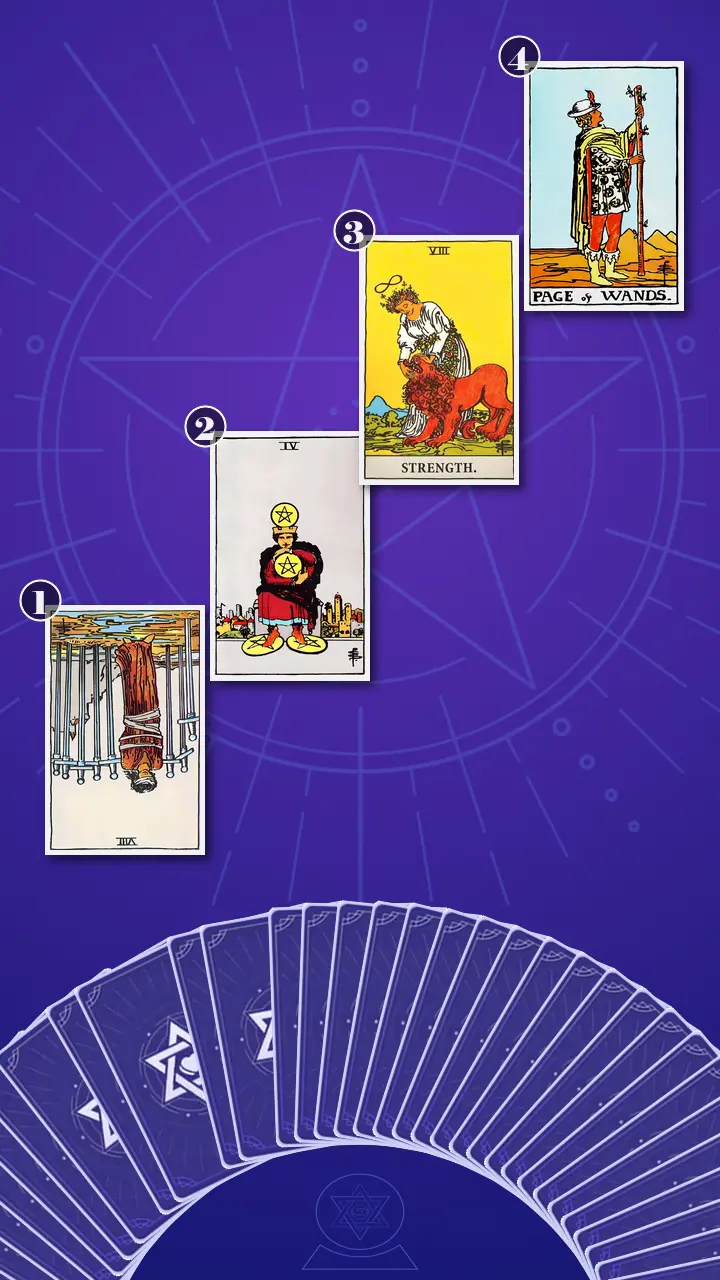
I chose the Four-Layer Insight Ladder · Context Edition, a four-card tarot spread arranged like a diagonal staircase. The layout rises from the lower left to the upper right, with a slightly wider space between the second and third cards. That gap marks the point where understanding a defence becomes choosing a different response to it.
I chose this spread because Maya's question was specific. A ten-card Celtic Cross would have created more information than the problem required. This four-card insight ladder could show the observable freeze, uncover its protective root, identify the inner capacity able to change the pattern, and translate that capacity into one practical visibility experiment.
This is also how I understand how tarot works in a grounded consultation. I do not use cards to announce a fixed future or make claims about an audience that has not responded. I use the images as structured prompts. Each position keeps us from collapsing behaviour, fear, resource, and action into one overwhelming question.
I explained the map to Maya. The first card would show the exact pre-publish behaviour. The second would identify what withholding preserved, especially the link between reception and self-worth. The third would reveal the capacity that could hold both creative desire and self-protection. The fourth would give that capacity a defined piece, audience, and revision boundary.
The Lower Steps: Where the Freeze Leaves Evidence
Position 1: The Audience That Had Not Arrived
“The card I am turning over now represents the observable freeze before sharing,” I said. “It shows the reopening of the file, the minor revisions, and the closing of the publishing screen.”
The card was the Eight of Swords, reversed.
I pointed to the blindfold, the loose bindings, and the incomplete enclosure of swords. Upright, the card often depicts restriction and narrowed perception. Reversed here, I read it as a blockage that had begun to reveal its internal machinery. The fear was real, but the barrier was not as complete as Maya experienced it.
At 11:48 p.m., no one had commented on the carousel. No client had dismissed it. No peer had misunderstood it. Yet Maya had mentally supplied the silence, the criticism, and the misreading before any audience existed. Her inner logic ran: If I can already imagine them saying my work is inconsistent, I need to fix the order and caption before they get the chance.
That forecast filled the screen until returning to Edit looked like the only responsible move. But the loose bindings mattered. Maya could still change the audience, schedule the post, send a private preview, mute notifications, or leave without declaring the work a failure. The available choices had narrowed in her perception, not disappeared in reality.
“If no one has reacted yet,” I asked, “how much of the rejection is happening in the audience, and how much is being rehearsed before they arrive?”
Maya's mouth opened, but no answer came at first. Her index finger hovered over the edge of the trackpad, then drew back. Her gaze lost focus as if she were replaying every upload window she had closed. Finally, she gave a short, bitter laugh.
“That is too accurate,” she said. “Almost cruel. I literally invent a review panel, then revise for them.”
“The recognition can sting,” I said. “But I am not calling you irrational. Your mind is trying to reduce exposure by predicting it. We are simply separating a prediction from an event.”
I described the pattern as an algorithm trained only on feared criticism. Every imagined response became fresh evidence for the same recommendation: keep it in drafts. Maya did not need a more persuasive argument from that algorithm. She needed a small piece of observable reality that it had not already selected for her.
Position 2: The File Held Against the Chest
“The card I am turning over now represents what the freeze is protecting,” I said. “Its particular role is to show where control over reception has become connected to protection of self-worth.”
The card was the Four of Pentacles, upright.
The RWS figure clutches one pentacle against the chest while two more pin both feet to the ground. A busy city stands at a distance. I read the card as Earth energy in excess: a legitimate need for safety has hardened into a grip so rigid that nothing valuable can circulate.
I reminded Maya of a design meetup she had described earlier. A contact had asked where they could see her illustration work. Maya had enough finished pieces to answer, but she said her portfolio was being refreshed and offered to send something privately later. For the rest of that evening, no one could judge the work or define what it meant. The relief was genuine. So was the cost: the possible referral moved on without it.
“If I keep it here, no one can misread it,” I said, translating the card's inner monologue. “If no one can misread it, I do not have to discover what their response might make me conclude about myself.”
Maya pressed a hand to her sternum, almost exactly where the figure held the coin.
“So I am not protecting the illustration,” she said quietly. “I am protecting the possibility that I might still be good.”
“That possibility is part of it,” I said. “While the file remains private, your worth can feel safely undecided. The grip makes sense; it is also why the work cannot travel.”
This was where I used a method I call Cognitive Stratigraphy. On an archaeological dig, I never treat the first object near the surface as the whole history of a site. I record it, notice its context, and work downward without smashing through the layers beneath it. I apply the same patience to an emotional trigger.
Draft 14 was the surface artifact. Beneath it sat the repeated caption changes and comparison tabs. Beneath those sat the wish to control the moment of evaluation. At the deepest layer we could responsibly reach that night was an older belief: if Maya could not control how the work was received, someone else's reaction might become evidence about her value.
I asked when that belief first felt familiar. Maya remembered an early portfolio critique in which a tutor had called her personal work “inconsistent” before the room moved to the next student. She had not experienced the comment as information about a developing body of work. She had experienced it as exposure without time to explain herself.
I did not declare that memory the single cause of her current freeze. One shard does not establish an entire civilisation, and one remembered critique does not justify a diagnosis. I asked only whether an old evaluation rule might still be governing a very different present.
Her fingers tightened around her mug. Her eyes moved from the Four of Pentacles to the closed upload tab. Then her grip loosened by a fraction.
“I have been acting as if every post is that room again,” she said. “Except now I leave before anyone can speak.”
“Yes,” I said. “Privacy protects the work from judgment, but it also protects judgment from being tested.”
I also noted what the spread did not contain. No Cup card had appeared. Maya had been converting vulnerable feelings into technical questions about captions, platforms, posting times, and personal branding. When a peer's commission announcement stung on the Line 1 subway, she opened six tabs about portfolio strategy. Research gave the longing and shame somewhere respectable to hide, but it could not tell her what she actually felt.
When Strength Met the Hand Above Publish
Position 3: Courage With a Nervous Body
“The card I am turning over now represents the inner capacity that can hold your wish to be seen and your wish to stay protected without letting the freeze make the entire decision,” I said.
The room seemed to quiet as I revealed Strength, upright. Even the laptop fan eased for a moment, leaving the streetcar bell outside unusually clear.
I brought us back to the exact setup: 11:48 p.m., a finished illustration, a rewritten caption, the fan humming, and a hand suspended over Publish. Maya wanted the work to be found, but not the instant when another person could form an opinion. She had been asking herself to manufacture certainty before movement.
Strength did not show a warrior forcing a lion into submission. It showed calm hands meeting the lion's jaws. The infinity sign above the figure suggested a capacity that could be practised repeatedly, not one flawless performance of confidence. I read this as balanced, embodied energy: the protective instinct remained present, but it no longer needed sole authority.
In Maya's modern situation, Strength appeared when her chest tightened after the final review and the thought arrived: Pull it back before they decide what it says about you. Instead of debating the thought or reopening the artwork, she could name the protective impulse, keep her preselected audience and revision limit in view, and allow one chosen send to continue.
I used the Cowardly Lion from The Wizard of Oz as a familiar parallel. Courage was not a prize granted after fear disappeared. It became visible in what the Lion was already willing to do while afraid. Maya did not need to unlock a hidden state called confidence before sharing. She needed one boundary sturdy enough to accompany a nervous body.
On digs, I learned that restoration does not mean forcing every surviving fragment into a falsely perfect object. First I stabilise what remains. I preserve what still serves a purpose, and I stop an old fracture from determining the whole structure. I call this Ruins Restoration Thinking.
Applied here, Maya's freeze was not proof that her creative identity was defective. It was a protective structure from an earlier epoch, useful enough to have survived but too rigid for her current life. Strength did not ask her to demolish it. It asked her to preserve the useful boundary, such as choosing who could see the work and when she would check responses, while retiring the old rule that visibility placed her worth on trial.
The protective voice could remain in the group chat. It simply did not need sole admin rights.
I let the central message settle before I spoke again.
You do not need to overpower the fear before you share; meet it with a gentle hand, as Strength meets the lion, and let one bounded act of visibility move you.
I watched Maya's reaction unfold in three distinct movements. First, her breath stopped. Her fingers remained curled around the mug, and her pupils widened as if the sentence had reached a room she had kept locked. Then her eyes shifted away from me and settled on the blank space above the cards. I could see her replaying old drafts, the meetup, the missed open call, and the cursor travelling from Publish back to Edit. Her jaw tightened.
“But doesn't that mean I have been wrong every time I held something back?” she asked, with a flash of anger in her voice. “That I did this to myself?”
“No,” I said. “It means the protection worked by giving you short-term control. We can respect why you used it without pretending the cost is still acceptable. Understanding an old strategy is not a prosecution.”
Her fingers slowly opened. Her shoulders dropped, but the release did not look triumphant. Her eyes reddened, and she gave one uneven exhale that sounded almost like a laugh. For a few seconds she looked unsteady, as though putting down the burden had revealed the weight of choosing for herself.
“Now, with this new view, think back to last week,” I said. “Was there a moment when this insight might have let you feel differently?”
Maya described an illustration open call she had abandoned before midnight. She had interpreted the pressure under her ribs as proof that her portfolio was not ready. From the new perspective, she could imagine reading the sensation differently: a protective part was sounding an alarm because evaluation had become possible. The alarm could be heard without being mistaken for a verdict.
That was the reading's pivotal movement: from contracted apprehension and perfectionistic withholding toward compassionate courage, curious engagement, and steadier creative self-trust. It was not a leap from fear to fearlessness. It was the smaller, more durable shift from automatic obedience to conscious relationship.
I asked Maya to begin a ten-minute Gentle-Hand Visibility Plan in her phone. She named one already-finished piece, one defined audience, one reason for sharing, and one revision limit. Beneath those four lines, I asked her to write: Their response is information; my worth is not under review.
I made the boundaries explicit. She could send the piece to one trusted peer, use a small professional group, schedule a public post, restrict the audience, mute notifications, delay reading responses, or stop after writing the plan. Completing the four lines counted. Strength was not permission for me to push her past her limits; it was the card that returned the limits to her authorship.
“Courage is not a calm body,” I told her. “It is a bounded choice that can include a nervous body.”
Position 4: A Living Message, Not a Permanent Brand
“The final card represents the practical action that can integrate this shift,” I said. “Its role is to turn insight into one visibility experiment using an already-finished piece, a defined audience, and a fixed revision limit.”
The card was the Page of Wands, upright.
The Page studied a sprouting wand in an open landscape. I read the card as balanced, exploratory Fire. It did not demand mastery or a permanent creative direction. It carried a live message into the world and allowed the next piece of information to emerge through contact.
For Maya, the wand became one completed illustration. She could give it a single timed 15-minute functional review, correct only a broken link or wrong crop, close the source file, and share it with the audience she had selected in advance. If she wanted feedback, she could ask one narrow question such as, “Which detail holds your attention first?” She did not need to invite a verdict on her talent.
“This does not have to prove my style,” Maya said, testing the thought aloud. “It can show what I am exploring now.”
“Exactly,” I said. “A post can be a field note, not a final verdict.”
The elemental movement across the cards was now visible. Blocked Air in the Eight of Swords had generated imagined responses. Rigid Earth in the Four of Pentacles had held value still. Strength introduced embodied regulation, and the Page released outward Fire as a modest act of communication. The missing Water reminded us to name the feeling beneath the analysis rather than creating another research project around it.
I asked Maya which piece came immediately to mind. She named an illustration she had finished three weeks earlier. She had already changed its thumbnail five times.
“And which audience would make the experiment real without making it unmanageable?” I asked.
She chose a small illustration community and one trusted peer. I saw curiosity enter her expression before certainty did. That order mattered.
Restoring Movement Without Demanding Perfection
I gathered the four cards into one coherent account. Maya could ship client work because a brief, deadline, and approval chain defined the terms of evaluation. Her personal illustrations carried more of the identity she hoped to build, so publication felt less like delivering an asset and more like exposing the maker. Imagined criticism narrowed her choices; withholding then restored control; that control prevented feedback and visibility; the resulting lack of progress seemed to prove that she was not ready.
The pattern was like maintaining a carefully curated gallery behind a locked door. Every piece stayed safe from interpretation, but no visitor could enter, no conversation could begin, and the silence outside the gallery was eventually misread as evidence that no one would have come.
Maya's cognitive blind spot was not simply perfectionism. She had been treating physical discomfort as evidence that the work needed further revision, while confusing two different domains of control. She could control the piece, audience, timing, feedback question, and notification boundary. She could not control interpretation, attention, approval, or silence. Another edit could change the first domain. It could never secure the second.
The transformation direction was therefore precise: stop waiting to become immune to judgment. Share one completed piece with a defined audience and a fixed revision limit, then study the actual response without converting it into a statement about identity.
The Gentle-Hand Visibility Protocol
- 1. Run the 60-second Trigger Excavation ExerciseAfter the revision window ends, keep the creative file closed. Place both feet on the floor if comfortable and take three unforced breaths. In a phone note titled “What the freeze is protecting,” complete: “My body is doing...”; “The part of me that wants to hide is trying to protect...”; and “I control the piece, audience, timing, and boundaries. I do not control interpretation, attention, or approval.”Tip: Do not use the minute to force calm. The minimum version is naming one sensation and one protective sentence.
- 2. Complete one Fixed-Revision ReleaseChoose one finished illustration by Tuesday and put its filename in the calendar. Give it one 15-minute review on the device normally used for posting. Permit only functional fixes, such as a broken link or incorrect crop. When the timer ends, close the source file and share with one audience selected beforehand: a trusted peer, Close Friends list, small creative community, or public portfolio feed.Tip: A small audience still counts. The purpose is to complete a sharing cycle, not to maximise reach.
- 3. Turn the imagined trial into a Forecast-to-Fact AuditBefore sharing, list three predicted reactions and label each one “forecast.” Choose a single response-check window, such as ten minutes at 7 p.m. the following day, and mute notifications until then. During the window, record only observable facts: the replies received, the words actually used, and whether the predicted event occurred. End with: “What I learned about sharing was...”Tip: Do not translate likes, silence, or critique into a claim about personal worth. Muting notifications is a valid boundary, not a failure of courage.
I told Maya that these were choices, not obligations. She could stop after the first note, use a private send instead of a public post, decline feedback, or postpone the experiment if the boundary no longer felt workable. Tarot had identified the pattern and supplied a language for it. The authority to set the pace remained hers.

Seven Days Later: The Quiet Proof
Seven days later, I received a message from Maya. She had placed the illustration's filename in her calendar, used the 15-minute timer, and caught herself trying to reopen the file to adjust a shadow. She named the tightness in her chest, closed the source file, and shared the image with the small community she had chosen.
She muted notifications until the next evening. When she checked, she found two warm responses and one person answering her specific question about which detail held attention first. The numbers were modest. More importantly, the forecast in her head and the facts on the screen were no longer the same document.
She told me she slept through the night, then woke with the thought, What if I still got it wrong? She smiled at the familiar alarm, made coffee, and left the post where it was. The clarity was real, and so was the remaining vulnerability.
I did not treat that post as proof that her creative visibility paralysis had been permanently solved. It was one small piece of evidence that apprehension could accompany action without controlling it. The cards had not published the work. Maya had used the cards to see the structure of her choice, establish boundaries, and move her own hand.
For me, that is the enduring value of a Journey to Clarity. Clarity does not always arrive as certainty. Sometimes it appears as enough separation between an old alarm and a present decision for one living message to leave the locked gallery.
The Smallest Living Wand in Your Drafts
I would leave the same thought with any creator whose hand goes still above Publish. The tight chest may be protecting the wish for the work to travel while trying to keep its reception away from the part of you that wonders whether you are worth noticing. Recognising that grip does not place you back at the beginning. It gives you a handhold.
I invite you to choose the smallest living wand in your own drafts: if one finished piece could be a field note from where your practice is now, rather than proof of who you must be, which defined audience might you let it reach, and what revision limit would keep your gentle hand on the decision?