Three Open Tutoring Slots, Two Renamed Folders, Then One Booking

The Tutoring Tab That Felt Like a Verdict
"You already have the tutoring link, the workshop reminder, and three open appointment slots, so why are you renaming folders instead of booking?" That was the question waiting between Jordan (name changed for privacy) and me. I could already see that this was academic help-seeking procrastination disguised as preparation, not a lack of information about where support existed.
At 8:40 on a rainy Tuesday evening, I sat beside Jordan's small desk in their Toronto apartment. Their assignment occupied the left side of the laptop; the university learning-support portal glowed on the right. Rain ticked against the window, the laptop fan held a thin mechanical note, and their phone stayed warm in one restless hand. I watched them compare three tutoring slots, rename two folders, check a Brightspace message, and bring the cursor back to the booking form without clicking.
"I already know where the help is," Jordan said. "I just keep thinking I'll book once I know exactly what to ask. Opening the page somehow makes the problem feel more real."
There it was: they wanted to use the study help already available, but the moment that help required a visible commitment, safer preparation took over. Their frustration seemed to hang from their shoulders like a rain-soaked backpack whose straps tightened with every switched tab. Underneath it, I could hear a quieter fear: if they used the help and still struggled, perhaps the assignment would start to feel like evidence about their worth.
"Nothing about this makes you lazy or incapable," I told them. "Postponement can be protective, even when it has stopped being useful. I won't use tarot to predict your grade or tell you what you must do. I want us to look at the loop objectively, find the point where your rhythm falls out of sync, and draw a workable map through it."

Choosing a Compass for the Study-Support Loop
I asked Jordan to place their phone face down, take one unforced breath, and hold one question in mind: "Why do I keep postponing the study help I already have?" I shuffled slowly. I use this brief ritual as an attention shift, not a performance of mystery. It gives the nervous system a moment to leave the browser tabs behind and notice the pattern underneath them.
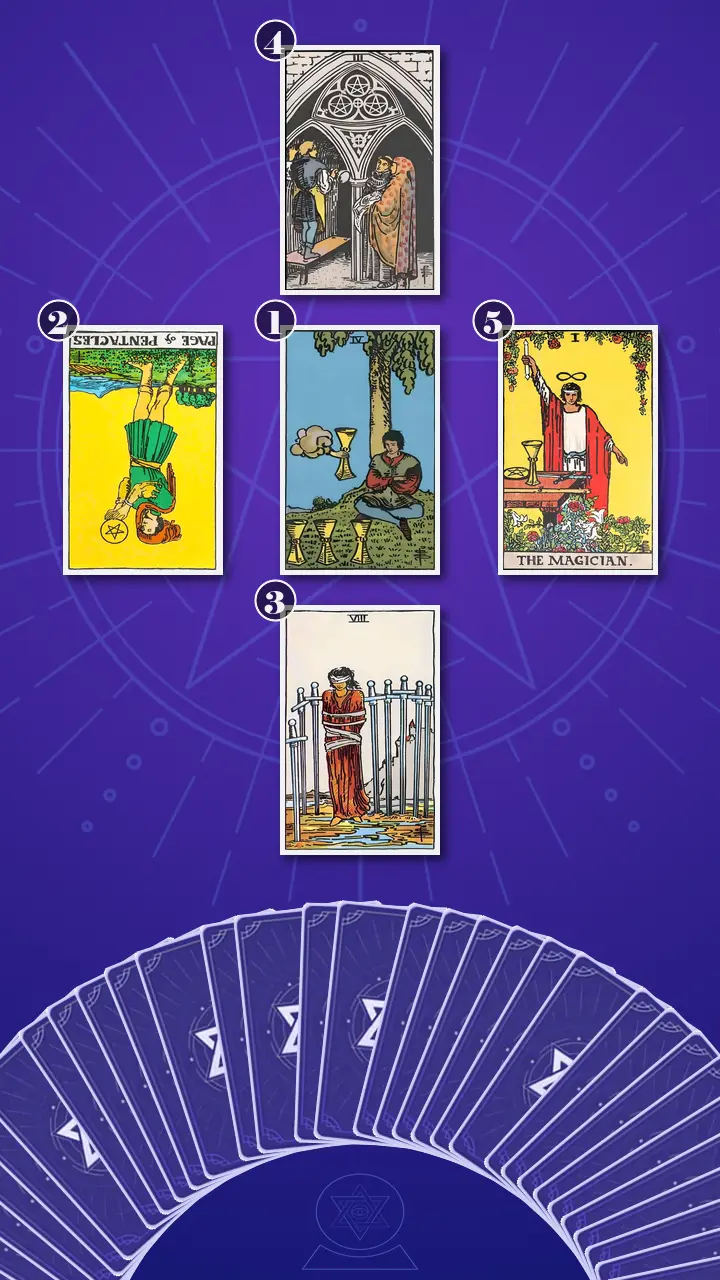
I chose the Five-Card Cross · Context Edition. For anyone curious about how tarot works in a situation like this, the spread matters because it separates a self-reinforcing loop into observable parts. A ten-card spread would have added unnecessary layers. Five positions were enough to distinguish the stalled moment, the established habit, the root belief, the support already available, and the voluntary next step.
I placed the present symptom in the centre. The card to the left would show how learning intention kept becoming planning and postponement. The card below would expose the fear that made delay feel safer. Above the centre, I reserved a place for an accessible resource. The final card on the right would show an integrative response, not a fixed future. The cross became a compass: old pattern to the left, chosen agency to the right, restrictive rule below, collaborative support above.
Reading the Stalled Moment in Context
Position 1: The Offer That Became Background
The first card I turned represented the observable academic resource blind spot: Jordan could see the support while remaining disengaged from the concrete act of using it. It was the Four of Cups, upright.
I pointed to the seated figure's crossed arms and lowered gaze. Three cups stood nearby, while a fourth was offered from a cloud. "For you, that fourth cup is not some unknown opportunity waiting to appear," I said. "It is the workable appointment already visible on your screen."
I brought the card directly back to 8:40 p.m. The difficult assignment and learning-support portal were open side by side. Three saved resources were already sitting in a bookmark folder. A fourth option, an appointment Jordan could actually attend, was in view. Yet their attention remained captured by the unfinished assignment, the tight jaw, and the thought, "I know the help is there, but I cannot use it until I understand the problem better." The booking button became visual background.
I read the Four of Cups as Water in a blocked state. The desire for relief was real, but the emotional current had pooled around frustration and perceived unreadiness. This was not evidence that Jordan did not want help. It showed how completely the discomfort of needing help could occupy the foreground. The help was visible; the moment of use was what kept disappearing.
Jordan let out a short, bitter laugh. Their fingers stopped moving over the edge of their phone. "That is so accurate it feels a little rude," they said.
"Accurate is useful only if it reduces blame and increases choice," I replied. "This card is not accusing you of ignoring an obvious answer. It is showing us the exact two-minute window in which an available resource stops feeling actionable. That is a window we can work with."
Position 2: The Notion Board With Nothing in Done
The next card represented the established procrastination pattern that repeatedly converted learning intention into planning, saving, and postponing. I turned over the Page of Pentacles, reversed.
Upright, the Page studies one pentacle while standing in a field that can be cultivated. Reversed, I saw genuine interest held at eye level but never carried into the field. I translated it into Jordan's Sunday routine: rebuilding a Notion timetable, comparing workshop formats, downloading another assignment template, and moving tutoring reminders later in the week while the live assignment remained untouched.
"Once the system is organised, then I'll start properly," Jordan said, repeating the sentence before I needed to offer it.
"Exactly," I said. "Planning feels productive because it preserves potential without exposing it to feedback."
The reversed Page showed Earth in blockage. Jordan had information, intention, templates, and a real wish to learn, but those materials were not grounding into repeated practice. The planning was not fake. It simply crossed a line: instead of supporting the next action, it replaced that action. I also warned against the Page's overcorrection. Booking three workshops, downloading four new templates, and constructing an elaborate recovery schedule in one night would reproduce the same pattern at a larger scale.
Jordan's eyes moved from the card to their laptop. Their thumb rubbed once across the edge of the phone, then went still. I could almost see them inventorying the colour-coded calendar, the StudyTok videos saved for later, and the carefully labelled bookmark folder that had become proof of intention rather than a route into use.
"The distinction I want you to keep," I said, "is simple. Preparation that ends in contact with the work is support. Preparation that repeatedly postpones contact has become protection."
Position 3: The Invisible Readiness Filter
The third card represented the underlying fear and restrictive rule that made postponement feel safer than testing an available resource. Beneath the centre of the cross, I placed the Eight of Swords, upright.
I drew Jordan's attention to the blindfold, the loose bindings, and the uneven ring of swords with a visible gap. I did not describe the fear as imaginary. The figure's distress matters. So does the opening. The card asks which condition has made a possible route feel prohibited.
I recalled the scene Jordan had described on the TTC. Two tutoring sessions fit their timetable. The train brakes squealed, damp coats pressed close, and the screen brightness stung beneath the carriage lights. Their thumb hovered over one workable slot. Within seconds, each option acquired a disqualifying condition: there was not enough time to prepare, the question was too vague, or another day might produce a better session.
I read this as an excess of Air turning into blockage. Thought was not clarifying the decision; it was surrounding it. The booking calendar had acquired an invisible filter called "Only show slots where I already feel ready," so every real appointment appeared unavailable.
"What exact sentence arrives when your cursor reaches the button?" I asked.
Jordan's breath caught. Their eyes lost focus for a moment, as though they were replaying the last booking page. Their jaw shifted before their shoulders lowered by a fraction. "I can't book until I can explain the problem without sounding confused," they said. After a pause, they added, "Because if I go, and I still don't understand, then maybe I'm just not good at this."
I kept my voice level. "That sentence is the root of the loop. The rule 'I must be ready first' blocks the resource that could help readiness form. Postponement gives you short-term protection from feedback, but the assignment stays difficult. Then the lack of progress seems to confirm that you were not ready. The loop feels logical because each delay supplies evidence for the next one."
I also gave the card a firm boundary. "A visible gap between the swords does not mean every appointment is accessible, every tutor is a good fit, or every time slot should be accepted. Real barriers remain real. Your agency includes rejecting an unsuitable format. What we are examining is the moment when a workable route is rejected because your question is unfinished."
Position 4: One Paragraph on a Shared Screen
The fourth card represented the existing academic support as a collaborative practice through which one current problem could become workable. Above the centre, I turned the Three of Pentacles, upright.
I showed Jordan the craftsperson standing on a bench while two collaborators examined a plan. No one in the image was evaluating the craftsperson's entire worth. They were looking together at work under construction. I translated the scene into a tutor, Jordan, and one confusing paragraph gathered around a shared Google Doc.
"You do not have to explain why you are behind," I said. "You can point to the sentence where the argument stops making sense. The tutor can ask two questions, highlight one line, and help you identify one revision. You leave with a next step for the paragraph, not a verdict on the whole course."
The Three of Pentacles brought Earth back into balance. The reversed Page had held learning as private potential; this card grounded it through bounded collaboration. Feedback became useful because it attached to one visible piece of work. Study support is a tool, not a verdict.
Jordan released a breath that sounded as if it had been waiting beneath the previous card. Their shoulders moved down, then rose slightly again. "One paragraph feels different," they said. "I keep imagining that I'd have to explain the entire mess."
"That is why this is the catalyst card," I told them. "It narrows the exchange. You retain the right to decide which feedback helps, and you never owe a tutor your personal history or a defence of your intelligence. Collaboration becomes safer when it has a clear edge."
When The Magician Put One Tool Into Motion
Position 5: The Action That Creates Its Own Clarity
The final card represented the voluntary next-step experiment that could close the gap between possessing help and applying it. As I turned it, the laptop fan fell silent and the rain thinned to separate drops against the glass. The sudden quiet did not feel supernatural; it simply made the next image easier to see. The card was The Magician, upright.
I pointed to the four suit tools already arranged on the table and to the Magician's gesture linking intention with material action. On Jordan's table, those tools were already present: the support portal, office-hours email, tutoring calendar, workshop recordings, assignment draft, notes, and rubric. The card did not ask for another resource. It asked for selection.
I read The Magician as coordinated elemental balance with restored Fire. Water could acknowledge the discomfort without drowning the next step. Earth could ground one commitment. Air could frame one unfinished question instead of inventing ten prerequisites. Fire could become the click that moved intention into use. In this position, The Magician acted as a bridge from private preparation to focused agency.
I brought Jordan back to the familiar setup: 8:40 p.m., three appointment slots, two renamed folders, the assignment waiting, and the jaw tightening. They had been treating the perfect question, perfect time, and perfect internal state as one enormous downbeat that had to land all at once.
You do not need another plan or a perfect mood; choose one tool already on The Magician's table and let a concrete action create the clarity you have been postponing.
I let the sentence remain in the quiet for a moment.
Readiness is not the entry fee for help; it is one of the things help can build.
Jordan's inhale stopped halfway. Their fingers hovered above the desk, neither reaching for the phone nor folding back into their lap. Their gaze moved beyond the cards and held there, as if several closed booking pages were replaying at once. Then their jaw unclenched, their hands settled flat, and a small flush rose across their face. "But doesn't that mean all the planning was wrong?" they asked, with more heat than relief. I kept my answer steady. "No. It means planning protected you when feedback felt too exposed. A strategy can make sense and still outlive its usefulness." The anger loosened, but it did not turn into instant confidence. Jordan exhaled with a slight tremor and stared at the open space beside The Magician. "That feels relieving," they said, "and kind of awful, because now I can see the click is mine." I watched their shoulders drop while a new vulnerability entered the room: clarity had removed an excuse, but it had also returned their choice.
"Now, using this new perspective, think back to last week," I invited. "Was there one moment when this insight could have changed how the situation felt?"
Jordan nodded slowly. "The office-hours reminder came up while I was stuck on one rubric line. I dismissed it because I couldn't explain the whole assignment. I could have brought the rubric line."
At that point I used a framework I call Cognitive Tempo Calibration. In my years of sound energy research, I have repeatedly noticed how a workable rhythm can collapse when every note is treated as the main beat. Jordan's booking task had swollen into a demand to understand the assignment, choose the optimal support service, construct an impressive question, predict the tutor's response, and feel emotionally ready before pressing submit. No wonder their body stalled.
I did not use the framework to label Jordan or claim that one rhythm suits every mind. I used it to identify a mismatch between the size of the imagined task and the size of the next real action. Their natural working tempo could tolerate a bounded sequence: open one saved resource, compare no more than two workable slots, paste one unfinished question, submit, stop. The Magician did not demand heroic momentum. It asked for one tool to meet one task.
That was the pivotal crossing in the reading: from frustrated, fear-protected preparation to practical self-trust built through supported academic practice. It was not a leap from doubt to certainty. It was a smaller, more honest movement from waiting for clarity to testing whether one chosen action could produce some.
The Loop, Heard as One Complete Phrase
I laid the five cards into one story. The Four of Cups showed the present symptom: support was offered, but frustration made it fade into the background. The reversed Page of Pentacles showed the established habit: genuine interest became dashboards, bookmarks, and future plans instead of practice. The Eight of Swords revealed why the habit persisted: booking had become a test of worth, governed by the rule that Jordan had to be ready first. The Three of Pentacles restored a practical resource by limiting collaboration to one live piece of work. The Magician then coordinated what was already available into one deliberate act.
"Your internal rhythm is not broken," I told Jordan. "It has been knocked out of sequence under pressure. You have been trying to play preparation, certainty, courage, and action on the same beat. The cards suggest a different order: choose, use, learn, then evaluate."
I named the cognitive blind spot directly. Jordan had assumed that readiness should produce action, so a lack of readiness appeared to justify waiting. The spread reversed that relationship. One bounded action could produce information, preparation, and cautious relief that private planning could not supply. The transformation direction was not "become someone who never hesitates." It was "treat support as part of doing the work rather than as a final examination of whether you deserve to do it."
I also made the limit of the reading explicit. Tarot had not booked an appointment, guaranteed a good tutor, or decided which feedback Jordan should accept. It had provided a structured mirror for the intention-action gap. Jordan remained the person who could test the interpretation, adjust the method, choose another format, or decline a resource that did not meet their needs.
The Syncopated Study Session: Three Small Beats
When I proposed a ten-minute experiment, Jordan's eyebrows rose. "But I can spend the whole ten minutes comparing options and still not choose," they said.
It was a practical objection, and I adjusted the plan around it. I introduced my Syncopated Study Session: a rhythm protocol that gives each action one small beat and puts a hard edge around the comparison phase. Instead of demanding a long burst of confidence, it uses brief, slightly offset movements so apprehension does not have to disappear before progress begins.
- Beat One: Open One Route Within the next 24 hours, at the start of one study block, place the current assignment and one already-saved support link on screen. Set a 10-minute timer. Compare no more than two workable appointments, then choose the first option within the next seven days that fits your real schedule and access needs. If neither option works, send one asynchronous question or email instead. Stop when the timer ends so the experiment cannot become another support-comparison project.
- Beat Two: Submit One Messy Question Paste this into the booking field or email: "I am working on [task]. I get stuck at [specific paragraph, problem, or instruction]. Can we look at that part together?" Put one current artefact in a clearly named folder: a paragraph, problem attempt, rubric screenshot, or lecture slide. Allow five minutes for this beat. The question may remain unfinished. You do not owe the tutor a complete academic history, proof of sufficient effort, or agreement with every suggestion.
- Beat Three: Record One Piece of Evidence Immediately after the exchange, spend one minute writing a factual note inside the assignment: "The support helped me clarify, change, or test ___." Evaluate the resource from what happened to the work, not from whether you felt perfectly confident. One trial is not a permanent commitment. You may reschedule within the service's policies, switch formats, try another provider, or decide that a particular kind of support does not fit.
"Success is not becoming calm before you click," I said. "For this experiment, success is one existing academic support resource meeting one current question. The result can be useful, mixed, or disappointing. Any of those outcomes gives you evidence that another evening of comparison cannot."

A Week Later: One Paragraph, Not a New Personality
Six days later, I received a message from Jordan. They had used the ten-minute timer, compared two slots, booked the earlier one, and pasted the unfinished-question template into the form. They brought a paragraph whose argument kept losing focus. During the session, the tutor asked two questions and highlighted one sentence in the shared document. Jordan revised that sentence before opening another study-system tab.
The message ended with a modest evidence note: "The support helped me clarify what the paragraph was trying to prove. I still felt awkward, but at least the awkwardness was happening while the work changed."
Jordan also told me they slept through that night, then woke with the old thought, "What if the next assignment is worse?" The doubt had not vanished. This time, they smiled, opened the document, and knew which kind of question could go on the table.
I did not read that message as proof that tarot had fixed academic procrastination. I read it as Jordan's first piece of self-generated evidence. The cards had offered a map, but Jordan had made the booking, entered the conversation, tested the feedback, and decided what to use. Their Journey to Clarity had produced something more durable than a burst of certainty: one experience of acting before readiness and discovering that readiness could begin there.
If tonight the booking tab is open and your jaw tightens, I want to acknowledge the whole tension rather than flatten it. Wanting help can feel inseparable from the fear that accepting it will turn one hard assignment into a verdict on your worth. Simply noticing that the page has become a verdict is already different from obeying it as one.
If readiness were allowed to arrive after one small use of support, which unfinished question would you place on The Magician's table, and which single tool would you let meet it?