Shame-Driven Student Portal Avoidance—And a Facts-First Way Back
The 10:40 p.m. Portal Glow
At 10:40 p.m. on a Tuesday, I sat across from Taylor at the narrow desk in their Toronto apartment. They clicked the student portal bookmark, and a white login screen filled the laptop. The machine radiated heat beneath their palms; outside, a streetcar bell cut through the low hiss of wet tires.
I said, 'You are a full-time Toronto undergrad who can spend forty minutes colour-coding last month's notes, but a single student-portal badge sends you straight into productive procrastination before the dashboard even loads.'
Taylor looked at the spinning login icon, lifted their shoulders almost to their ears, and closed the tab. The movement was so fast it looked rehearsed. They opened YouTube instead, then clicked into an old lecture folder and began renaming files. I was not looking at laziness or a lack of concern. I was watching shame-driven student portal avoidance after falling behind academically.
'I know avoiding it makes the backlog worse,' Taylor said. 'But opening it feels like making it official. If I can't fix everything tonight, what's the point of looking?'
Their dread had the physical force of missing a stair in the dark: a stomach drop, a hard catch in the breath, and the reflex to grab the nearest safer surface. Closing the portal lowered their shoulders for several seconds. I did not dismiss that relief. It was real, but it came at the cost of the information they needed.
'You want to open it because you want your academic life back,' I said. 'You avoid it because looking might turn a difficult stretch into proof that you are not capable. You are not avoiding school; you are avoiding the moment school might feel like a verdict. Let's give this fog edges without asking you to solve your entire term tonight.'
Choosing the Four-Rung Ladder
I asked Taylor to place both feet on the floor and take one unforced breath while holding a single question: 'What happens between seeing the portal alert and leaving the page?' I shuffled slowly. I use this pause as a transition into focused observation, not as a supernatural test.
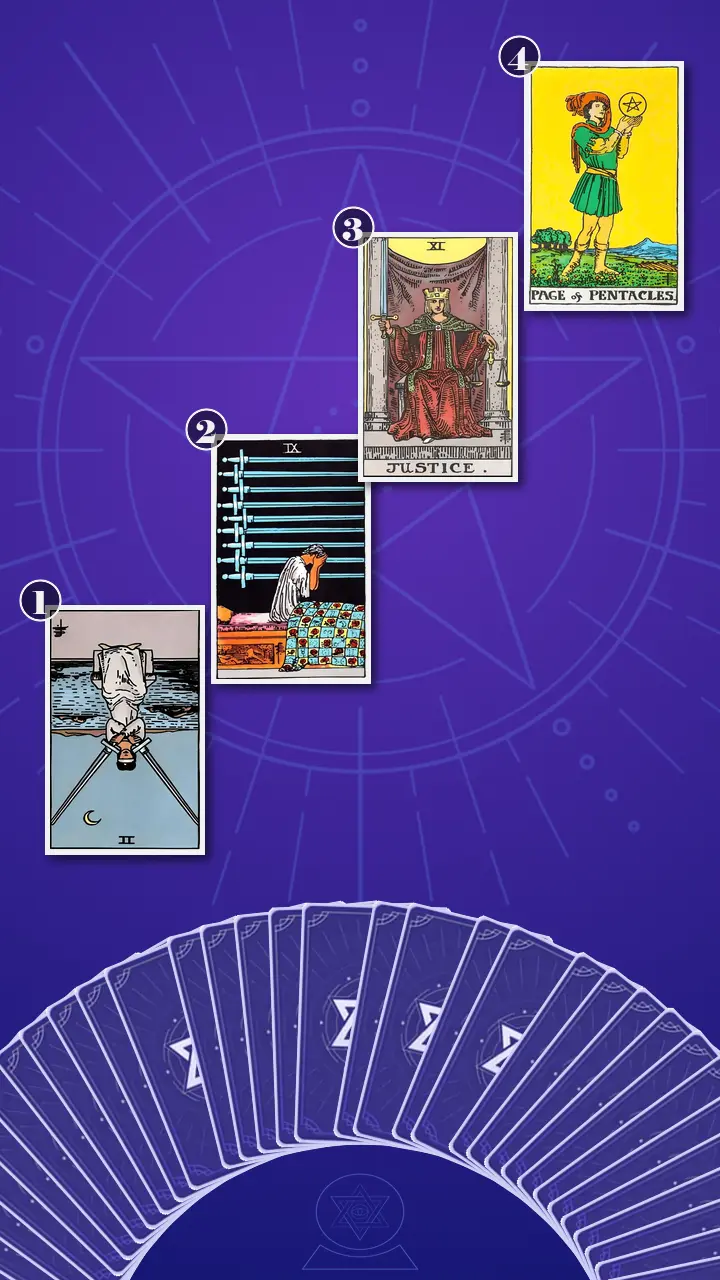
I chose the Four-Layer Insight Ladder · Context Edition, arranged as four cards ascending from lower left to upper right. For anyone wondering how tarot works in my practice, I treat a spread as a structured way to examine a pattern. It does not predict whether Taylor will pass, fail, or recover every assignment. It helps separate what is happening, what maintains it, what could interrupt it, and what action is proportionate now.
A timeline spread would have made this repeating loop look too linear, while a large Celtic Cross would have added more material than the question required. This four-card academic procrastination spread was precise: the first position would show the visible portal-closing symptom; the second would locate the fear beneath it; the third would offer the cognitive transformation; and the fourth would ground that shift in one manageable response.
I left a small gap between the second and third cards. On the table, it looked like the point where a closed-browser loop might finally become a staircase.
The Blindfold in the Browser Window
Position One: The Tab Closed Before It Loaded
I turned over the card representing the observable symptom: approaching the student portal, then closing it, switching tasks, or delaying before the dashboard becomes visible. It was the Two of Swords, reversed.
I pointed to the blindfold and the two blades crossed over the figure's chest. 'Upright, this can be a temporary pause while someone gathers themselves. Reversed, that pause has become a Blockage. The protection is overloaded. It stops information from entering, but it cannot stop the pressure building behind it.'
I described the sequence I had just watched: at 10:40 p.m., Taylor clicked the portal bookmark, saw the login screen begin to load, and switched to a video tab before the dashboard appeared. The thought was, 'I will look when I have enough time to handle every course.' The quieter truth was that enough time never arrived.
The reversed card also showed the overcorrection waiting behind the avoidance. After several days of not looking, Taylor imagined reserving an entire Saturday for a dramatic academic comeback, complete with a rebuilt Notion dashboard and colour-coded calendar. Like endlessly refining a playlist before starting the workout, the preparation had become the activity that prevented the real beginning.
Taylor gave a short, bitter laugh. Their fingers tightened around the sleeve of their hoodie, then released it. 'That is painfully accurate. Almost rude.'
'The card is describing a protection strategy, not insulting you,' I said. 'Closing the page gives your nervous system a brief reduction in pressure. The problem is that the unknown backlog gains weight each time it remains unseen. It feels total because it has no edges yet.'
Position Two: The Dashboard Above the Bed
I opened the card representing the root fear maintaining the procrastination: the belief that seeing the backlog will confirm personal failure and make recovery impossible. It was the Nine of Swords, upright.
Nine swords hung across a black wall while the figure sat upright with their face covered. Here, Air was in Excess. The mind was not short of thought; it was producing so much imagined information that no verified information could enter.
I asked Taylor what happened after they ignored a course notification at night. They told me that they put their phone face-down and then mentally generated a failed grade, several missed deadlines, and an instructor who had already judged them. The portal stayed closed, but an invisible dashboard remained open above the bed.
'So the loop says, “I have not checked, but I already know it is terrible,”' I said. 'Then it adds, “If it is terrible, that says something permanent about me.”'
Through a Jungian lens, I saw the portal functioning as a projection screen. Missing information had become a blank surface onto which Taylor's inner critic could cast its harshest film. Their mind was behaving like a recommendation algorithm trained only on worst-case clicks: failed grade, missed quiz, ruined term, repeat.
Taylor's breathing paused. Their gaze slipped from the card to the dark laptop screen as though they were replaying several nights at once. Then they exhaled slowly and pressed a palm to their stomach.
'I've made the imaginary dashboard worse than any dashboard could physically be,' they said.
'Possibly,' I replied. 'The real one may still contain consequences, overdue work, or disappointing feedback. I will not pretend otherwise. But difficult evidence and the punishment imagined around that evidence are not the same thing.'
When Justice Separated the Fact from the Sentence
Position Three: Justice Without a Courtroom
The radiator stopped clicking, and the apartment became unusually still as I reached across the gap in the spread. I turned over the card representing the key cognitive transformation: separating portal facts from judgments about worth and using a bounded inventory to restore proportion. It was Justice, upright, the central card of the reading.
I showed Taylor the balanced scales and the single upright sword. Justice was not asking them to minimise the backlog or escape accountability. Its energy was Balance: due, overdue, recoverable, and unclear could each have a separate status instead of merging into one giant red warning.
I thought of the different classrooms and achievement cultures I had encountered while travelling. The standards changed, but the internal courtroom often looked the same. One imperfect result became evidence for the prosecution. Justice offered another role: the Fair-Minded Arbiter, willing to review the record without acting as either prosecutor or excuse-maker.
I call this Performance Anxiety Decoupling. I use Justice's scales to separate core self-worth from results, peer comparison, instructor feedback, and academic status. One scale holds the fact: 'Two announcements are unread.' The other does not get to hold the shame story: 'Therefore I am incapable.' The next proportionate choice can be 'Record the dates' without becoming 'Prove my worth by rescuing the whole term tonight.'
I could see Taylor bracing against the same impossible rule: they believed they had to make the correct response to every course the instant they looked. Before the dashboard had even loaded, their mind had assigned them the roles of defendant, prosecutor, and judge.
I made the distinction plain: The portal is an information panel, not a character reference. You do not have to fix the backlog to earn the right to see what is actually there.
You do not need to be caught up before you look; let Justice's scales separate the actual backlog from the shame attached to it, then act on one measured fact.
For one beat, Taylor froze. Their breath stopped, their pupils widened, and two fingers hovered above the laptop trackpad. Their gaze moved out of focus as if the past week were replaying behind their eyes. Then their mouth tightened. 'But if that's true, doesn't it mean I've been making this worse for no reason?'
The anger lasted two breaths before I answered. 'Not for no reason. Avoidance protected you from a feeling you did not yet know how to contain. We can respect why it started without letting it keep choosing for you.'
Their fist loosened. Their shoulders dropped, but the release left them blinking as if the room had shifted slightly under the chair. Their eyes shone. 'That is a relief,' they said, their voice thinner now, 'but it also means I have to decide what to do with the facts.'
'You do, and you retain the right to decide in small units,' I said. 'Now, using this new perspective, think back: was there a moment last week when this insight could have made you feel different?'
Taylor remembered a Sunday course alert in the kitchen. They could have recorded the course name and visible date, they said, without putting their entire degree on trial. That recognition marked the first crossing from anticipatory dread and self-condemnation toward bounded clarity, calm accountability, and cautious academic agency.
The Apprentice Holds One Thing
Position Four: One Pentacle, One Assignment
I turned over the final card, representing the grounded experiment: recording one deadline, choosing one recoverable task, or sending one clarification message. It was the Page of Pentacles, upright.
The Page held one pentacle at eye level while the cultivated landscape waited behind them. Earth entered the spread in Balance after two cards of overloaded Air. The card did not ask Taylor to hold every course in working memory. It asked them to place one visible academic object in front of themselves and stay with it for a defined block of time.
In Taylor's life, that meant circling one recoverable portal item, opening only its instructions, and working for twelve minutes. If the status was unclear, it meant drafting one direct email instead. The Page's inner line was simple: 'I do not need to become fully caught up tonight. I can be a student of this one next step.'
I also named the perfectionism hidden inside Taylor's comeback planning. My Draft Paralysis Deconstruction lens treats the perfect Notion reset as a defence against possible criticism: if the system is never finished, the work never has to become visible or evaluated. The Page replaces that polished future self with an apprentice who is allowed to begin from the actual present level.
Taylor reached for their phone, opened the timer, and then hesitated. 'What if one course tile turns into twenty things and I just spiral?'
'Then one fact is the minimum version,' I said. 'Stopping is allowed. A boundary is part of the exercise, not evidence that you failed it.' Their thumb rested over the ten-minute setting, and this time they did not put the phone away.
The Facts-Before-Verdict Path
I drew the cards into one short story. A draining stretch of the term had made the portal harder to approach. In the present, the Two of Swords showed Taylor covering the warning light by closing the tab. The Nine of Swords revealed why: uncertainty allowed shame to invent a complete case against their capability. Justice interrupted that private prosecution by separating evidence from identity. The Page then moved the reading from an internal courtroom to an apprentice's workspace, where one item could be named, timed, and attempted.
The cognitive blind spot was task fusion. Taylor had treated looking, sorting, catching up, and proving their worth as one enormous assignment. The transformation was separating verified portal facts from shame-based self-judgment, then choosing one proportionate academic response. Looking is one task. Sorting is another. Catching up is not tonight's entry fee.
I gave Taylor two bounded experiments:
- Mute, then map. On one weekday evening at the usual desk, Taylor would use my Inner-Critic Mute Protocol: place both feet on the floor, write 'For ten minutes, academic status is data, not identity,' set an audible timer, and open the portal. On paper, they would create three columns: Course, Next Visible Date, and Status or Unclear. They would record only what appeared, without calculating final grades, opening every file, or planning a total recovery. Tip: The minimum version is one course and one visible date. When the timer rings, log out. If the discomfort exceeds the limit you chose, stop or ask a trusted friend to work quietly nearby.
- Give one item an apprentice block. From the factual list, Taylor would circle one current or recoverable item at their home desk or campus library, open only its instructions, and set a twelve-minute timer. They would write one physical next verb, such as 'read,' 'outline,' 'email,' or 'submit.' If the item's status was unclear, they would draft a two-sentence clarification message to the relevant instructor, teaching assistant, or adviser. Tip: Do not choose the hardest overdue task to prove seriousness. Choose the item most capable of producing useful movement or information. Stopping at twelve minutes remains valid even if the task is incomplete.
'So I am not promising to fix everything,' Taylor said.
'Correct,' I replied. 'You are practising direct contact with reality without using reality as a weapon against yourself. Tarot has organised the questions. You still choose what to view, what to disclose, whom to contact, and what happens next.'
That was the full method: a Four-Layer Insight Ladder four-card tarot spread paired with a bounded 10-minute fact-only student portal review. Its value was not certainty. Its value was enough structure for Taylor to make one informed choice.
A Week Later: One Honest Line
A week later, Taylor messaged me: they had logged in, written four lines, and sent one clarification email. One late task was closed; another was recoverable. They slept through the night, then woke thinking, 'What if I'm still too late?' This time, they smiled and opened the list.
I did not read that message as a miraculous academic comeback. I read it as quieter proof of ownership. The cards had not changed a deadline or guaranteed an outcome. Taylor had changed their relationship to the next fact, moving from imagined catastrophe toward cautious academic agency.
If your own login screen makes your stomach drop, it may be because one dashboard has started to feel like evidence about whether you deserve to call yourself capable, even while part of you is simply trying to learn what remains possible. Noticing that collision already gives you something the avoidance loop does not: a place from which to choose.
If looking did not have to mean fixing everything, which single fact could you let Justice's scales hold for ten minutes?