How One Hard Question Turned a Study-Plan Reset Into Practice

The Sunday Reset That Never Reaches Monday
I met Alex in my Toronto consultation room after years of studying at Cambridge and working on archaeological digs had taught me to pay attention to what lies beneath a tidy surface. As an undergraduate returning to a degree program in Toronto, Alex had opened a fresh study planner on Sunday night, color-coded every block, and called it a reset just after moving the hardest problem set to next week.
At 8:47 p.m., I watched them drag pastel blocks across a blank Notion dashboard while the laptop fan hummed and the radiator clicked. A stack of cold tea and unopened worksheets sat beside the warm screen under the apartment's fluorescent light; when Alex moved the problem set to next Monday, their shoulders lifted as though the room had briefly become easier to breathe in.
"Why restart my study plan instead of facing what I never learned?" Alex asked. I could hear the contradiction clearly: the reassurance of restarting was competing with the shame-triggering discomfort of testing the missing foundation. A new timetable felt like proof of movement until the first unfamiliar question demanded evidence.
I said, "You are not avoiding studying; you are arranging the conditions under which you might finally feel safe enough to begin. The relief is real, and so is the unattempted question underneath it." The uncertainty showed itself as a tight band across Alex's forehead, heavy shoulders, and restless fingers reaching for another tab, like a person repeatedly redrawing a map outside a locked classroom. "We will not put your academic worth on trial," I told them. "We will make the gap specific enough to work with. That is our Journey to Clarity."

Choosing a Map Small Enough to Use
I invited Alex to take three slow breaths and hold the question in mind while I shuffled. The brief preparation was a focus point, not a supernatural test: it gave the body a transition from scrolling and planning into observing.
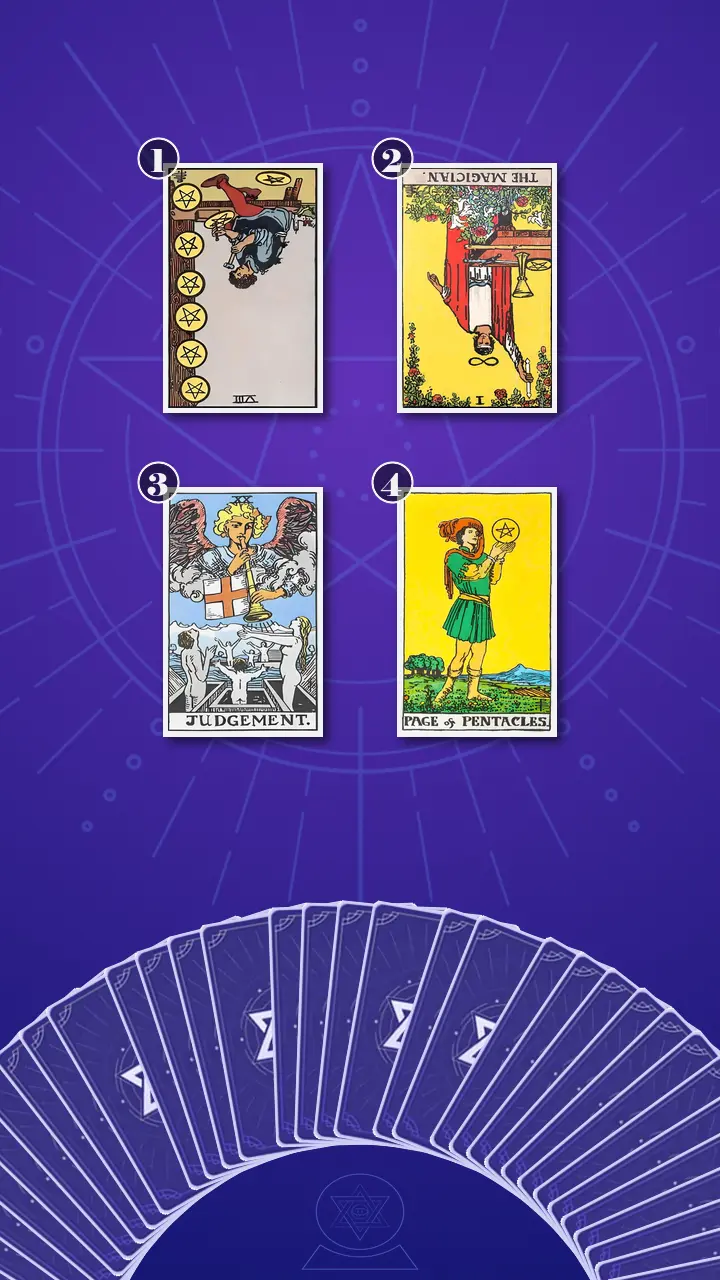
I chose the Four-Layer Insight Ladder · Context Edition, a four-card tarot spread designed for a self-reinforcing study-plan restart loop. Its structure follows the smallest complete sequence I could see: the visible behavior, the hidden engine, the turning point, and the grounded practice that integrates the insight. I use tarot here as an objective cognitive tool. The images give us a language for comparing behavior, belief, evidence, and choice; they do not predict a grade or decide Alex's future.
The upper cards would show the Presenting loop and the Hidden engine. The lower left would reveal the Transformational opening, and the lower right would point to Grounded practice. I asked Alex to treat each card as a question about current evidence, not as a sentence handed down about identity.
The Route We Keep Redrawing
The Workshop of Repeated Mondays
"Now turning over the card for the Presenting loop: the observable restart behavior and its immediate emotional payoff," I said. The card was the Eight of Pentacles, in reversed position.
In the RWS image, a craftsperson works alone at a bench, repeating careful labour while a town sits in the distance. At the start of a new term, Alex keeps polishing the same first-week notes, color-coding the calendar, and replaying an introductory lecture. The unattempted problem set remains just outside the tidy frame. This is busy-looking effort without contact with the repetitions that would show what has actually been learned.
Reversed, the card's Earth energy is blocked and misdirected. Effort is present, but hours, folders, and familiar review have become substitutes for targeted practice. I asked, "When the first unfamiliar exercise appears, what immediate feeling does moving it give you?"
Alex gave a small, bitter laugh. "That is too accurate. Almost cruel." Their fingers rubbed the edge of the worksheet. I answered, "I hear the sting, and I am not calling your effort fake. I am separating the comfort of looking organized from the evidence of learning. What one exercise would tell you more than another complete timetable?"
The Table with Ten Open Tabs
"Now turning over the card for the Hidden engine: the belief and fear beneath the restart," I said. The card was The Magician, in reversed position.
The RWS table holds a cup, sword, wand, and pentacle, a complete set of available tools. Alex's laptop held the modern version: Canvas, Notion, Quizlet, YouTube, and a new productivity template, while a closed-book question remained unanswered. The resources were not missing. Their potential had simply been arranged as a performance of readiness rather than integrated through practice.
Reversed, the Magician shows agency scattered across tools and appearances. I recognized the research bottleneck: when the work exposes a gap, Alex collects another course or cleaner syllabus so the system can feel complete. I said, "If the system looks complete, maybe no one can see what I cannot do." Then I offered the line that cut through the clutter: "You do not need a cleaner system; you need one honest question."
Alex's thumb stopped above the phone. Their breath paused, their gaze went briefly beyond the screen, and then their hand lowered to the table. "If I answer honestly," they said, "I might find out I am not capable enough to be here." I kept my voice level. "That is the fear the card reveals. It is not evidence that the fear is true."
When Judgement Rang Through the Apartment
The Trumpet That Cannot Be Snoozed
The room seemed to narrow around the next card. The laptop still hummed, but the radiator clicked once and fell quiet as I turned to the lower left of the grid.
"Now turning over the card for the Transformational opening: the honest reorientation that can let unfinished learning become information rather than a verdict," I said. The card was Judgement, in upright position.
In the RWS, the angel's trumpet calls figures out of enclosed coffins. I read it as an awakening and an honest review, not a punishment. In Alex's life, the difficult module was the notification that could not be snoozed forever: it was revealing a specific prerequisite and asking for a response.
Here I used my signature lens, Academic Stratigraphy. On an archaeological dig, I do not call a buried layer a verdict on the civilization above it. I separate foundation, later disturbance, and unfinished excavation, then identify the next square to examine. Applied to study, the layers are what Alex can explain, where the explanation breaks, which prerequisite supports it, and which small repetition comes next. A missing layer can be named without becoming an identity headline.
The setup was simple and familiar: it was Sunday evening in the Toronto apartment, a fresh dashboard glowed with precise colours, another introductory lecture waited in the queue, and the problem set had just been moved to next week. I could see why restarting felt safer, but the material was asking for one honest response rather than another beginning.
Stop treating what you never learned as a verdict that demands another restart; let Judgement's trumpet call you to one specific diagnostic exercise, where honest review becomes the beginning of real competence.
I let the silence hold, then gave Alex the shorter version: A gap is not a verdict on whether you belong in the program. It is usable information: name what is missing, and let that evidence choose the next small practice step.
For one beat, Alex's breath stopped and their fingers hovered above the notebook. Their eyes lost focus as the moved worksheet, renamed calendar, and unopened question replayed across the dark edge of the laptop. Then their mouth tightened. "But does that mean I got it wrong before?" The question carried anger, grief, and the sudden weight of responsibility. I said, "It means your earlier strategy protected you when the gap felt threatening. You can thank it for that protection without asking it to lead the next session." Alex looked down and wrote, "I cannot yet explain this step." Their shoulders dropped a fraction. A long breath left their chest, followed by a small, almost disbelieving laugh. The room did not become certain; it became workable. The old verdict loosened into a fact about the material.
Now, use this new perspective to think back to last week: was there a moment when this insight might have made you feel different? For Alex, this was the first movement from shame-driven planning loops and performed readiness toward evidence-based curiosity, grounded practice, and steadier academic self-trust. It was not mastery. It was a door opening onto one classroom.
The Apprentice Who Does Not Need to Look Ready
"Now turning over the card for Grounded practice: the next small study behavior that makes learning observable," I said. The card was the Page of Pentacles, in upright position.
The Page holds one pentacle at eye level, steady and attentive, with an open field behind them. This is a grounded student, not a performer of complete readiness. The energy is balanced through patience and manageable commitment: choose one missing prerequisite, complete a short set of focused questions, and let the result shape tomorrow's block.
I asked Alex to hold one gap in view rather than the whole degree. They looked at the blank page and said quietly, "I do not have to look ready to be in contact with the work." They wrote three questions without opening their notes. The rest of the calendar stayed untouched.
From the Excavated Gap to a Workable Next Block
When I connected the Four-Layer Insight Ladder for Alex, the story was clear. The Eight of Pentacles reversed showed the planner circling a locked classroom, polishing the timetable outside it. The Magician reversed explained why: a crowded table of tools created temporary control while tested understanding stayed out of reach. Judgement opened the door by turning the missing prerequisite into information. The Page of Pentacles offered the next step inside: one concept, one practice set, one piece of evidence.
The blind spot was not a lack of discipline. It was the belief that the route had to be perfectly optimized before Alex could safely touch the terrain. The transformation direction was evidence before reset: replace a full-plan restart with one non-condemning closed-book diagnostic, then build the next study block around the gap it reveals. That is actionable advice, but it is also a gentler definition of belonging. A learner can be unfinished and still be learning.
- Run the One Honest QuestionBefore changing the weekly plan, choose one difficult topic from the current module. Set a 10-minute closed-book timer at your desk or in a quiet campus library corner, write three questions you should be able to answer, and attempt one representative problem without notes.Keep it rough: one sheet, one topic, one timer. Do not turn the diagnostic into a new tracking system.
- Make the Three-Gap Study CheckCircle no more than three missing or uncertain pieces. Compare the first one with a reliable course source, then schedule one 20-minute practice block for it in the existing calendar. Leave the other study blocks unchanged until you have evidence that they need revision.If twenty minutes feels too large after transit or work, use five minutes. A smaller honest attempt is still evidence.
- Use Thesis Stratigraphy for One ArgumentIf the gap appears inside an essay, use my Thesis Stratigraphy Framework on one page: place the course question at the top, then the core claim, supporting evidence, missing prerequisite, and next paragraph or exercise. Let the central argument pierce intellectual clutter without rebuilding the whole syllabus.Finish by recording one sentence that is clearer and one question that remains open. Ask an instructor, tutor, study partner, or trusted course forum only about that targeted question.
A Quiet Proof, Not a Perfect Semester
Six days later, Alex texted me from a library desk: "I did the ten-minute check. I could not explain the prerequisite, so I practised that one for twenty minutes and left the rest of the calendar alone." The photo showed a single page, three circled gaps, and a coffee cooling beside the laptop. The daylight was ordinary, which made the evidence more convincing.
The plan was clearer but not certain: Alex slept a full night, yet woke with the old thought, "What if I am wrong?" They smiled, opened the one highlighted prerequisite, and began a twenty-minute block. The doubt remained; it simply no longer held the timetable hostage.
I replied that the cards had not chosen Alex's academic direction. Alex had used the images to notice a pattern, name a gap, and make a deliberate choice. Our Journey to Clarity had moved from the relief of performed readiness to the quieter confidence of evidence-based study planning, where the learner remains the author of the next step.
When a difficult question tightens your forehead and makes your shoulders heavy, rebuilding the whole plan can feel safer than discovering the missing layer, because the gap seems to be asking whether you belong. I have learned, on excavation sites and at study tables alike, that a buried layer is not the end of the structure. It is the place where careful work can begin.
If you let one unfinished foundation be information rather than a verdict, what small piece of the material would you feel curious enough to look at next?