When Draft Delay Hid Fear of Critique: Separating Work from Worth
The 8:47 p.m. Critique Anxiety Loop
I know I am looking at critique anxiety procrastination when a progress-share reminder lands and the response is to polish file names, formatting, or citations. The sentence beneath all that visible activity is usually: “I keep preparing to write instead of writing.”
At 8:47 p.m. on a Tuesday, Casey appeared on my screen from her rented London flat. A mug of cold coffee sat beside her laptop. The fan hummed, her phone glowed warm in her hand, and the room held the faint smell of takeaway. She changed the first heading for the third time while the central section remained untouched. Her shoulders had crept towards her ears; her jaw looked fixed in place. She wanted to finish before the critique panel, but she was frightened that showing unfinished work would expose something unfinished in her.
“A rough draft feels more dangerous than a blank page,” she said. “If the panel sees the unfinished version, they might think the unfinished version is me.”
I heard anticipatory shame in that sentence, but I saw it more clearly in her body. It was as if she were already standing under the critique-room projector while the slide was still blank: heat rising into her face, pressure pinning her chest, and nowhere comfortable to put her hands.
“That makes sense,” I told her. “Public feedback can feel exposing, especially when time, money, commuting, and part-time work have already made every studio evening feel expensive. I am not going to tell you that the panel is harmless, and I am not going to use tarot to predict what anyone will say. I want us to map the loop between opening the file and leaving it untouched. Then we can find the point where your choice returns.”
I placed both hands around the deck. “Let us give this fog a structure. The cards can reflect the pattern, but they do not get to issue a verdict. Neither does one draft.”
Choosing the Switchback Map
I invited Casey to put both feet on the floor, take one unforced breath, and hold a single question in mind: “Why do I keep delaying my draft before the critique panel?” I shuffled slowly. I use that pause as an attention reset, not as a performance of mystery.
I chose the Transformation Path Grid (6) · Context Edition, a six-card tarot spread for critique anxiety and draft procrastination. A Celtic Cross would have widened the reading across too many parts of Casey's life. A decision spread would have implied that she was choosing between two external options. Her problem was more specific: one recurring process kept providing relief and then returning with more pressure. This grid was the smallest structure that could show the complete mechanism.
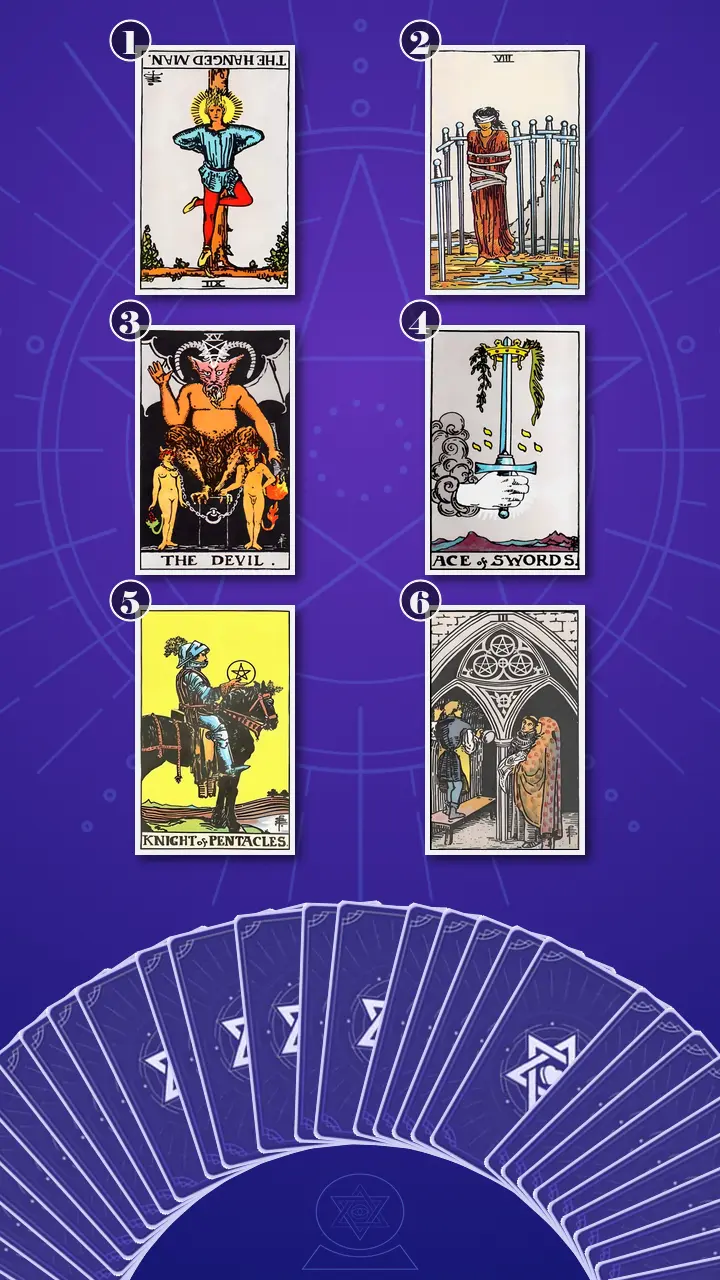
I arranged the cards in two columns and three rows, like a switchback staircase. The first position would show the visible symptom. The second would expose the primary blockage, especially the imagined verdict narrowing her choices. The third would reveal what made the pattern repeat. The fourth, our visual hinge, would identify the recognition capable of interrupting it. The final two positions would translate that insight into a workable routine and a healthier relationship with critique.
This is how tarot works at its most useful for me: card meanings in context become an external model of an internal process. The spread does not decide for the person sitting opposite me. It lets both of us examine the pattern without confusing the pattern with the person.
Reading the Closed Loop
Position 1: The Pause That Looked Like Preparation
I turned over the card representing the presenting symptom, the concrete delay Casey could see on her screen and feel in her body. It was The Hanged Man, reversed.
The suspended figure hangs by one bound foot. A halo shows that perspective is available, but the reversed position suggests that insight is not being translated into movement. I read the energy as a blockage: a pause that may once have been useful has hardened into resistance to exposure.
In Casey's life, the image was almost literal. She opened the London design draft after class, changed its title, rearranged the headings, searched for a better structure, and saved another version without completing the section the panel needed to see. The activity briefly felt intelligent and controlled. Materially, however, the draft remained suspended. It was the academic equivalent of reorganising a Notion board while the difficult task kept moving from Today to Tomorrow.
“Preparation becomes avoidance when it protects you from the one sentence only you can write,” I said. “So before the next research tab, I want you to ask whether the pause is producing a new perspective or postponing the moment your thinking becomes visible.”
Casey gave a short laugh with a bitter edge. “That is so accurate it is almost cruel.” Her fingers tightened around the cold mug, then loosened. I did not rush to soften the truth into something vague.
“Accurate does not mean condemning,” I said. “This card is describing a strategy, not your character. The strategy protected you from a burst of exposure. It has simply stopped giving you a useful return.”
Position 2: The Comments That Had Not Been Written
I turned over the card representing the primary blockage, the belief that made an unfinished draft feel too dangerous to show. It was the Eight of Swords, upright.
The blindfold mattered more to me than the number of blades. The panel had not yet responded, but imagined criticism had already entered the document. The bound hands reflected a felt lack of options; the ring of swords resembled a browser window crowded with possible consequences. Here, Air was in excess: analysis had multiplied beyond the available evidence, while verified information from the actual panel remained in deficiency.
I returned Casey to a familiar London library scene. The cursor waited inside one unfinished section while reference tabs multiplied around it. Her inner monologue ran both sides of an impossible argument: “If I write this sentence, they might see that I am careless. If I make it more cautious, they might see that I do not understand my own claim.” Each possible opening became a trap.
I drew a clean distinction on my notepad: The panel has asked for a draft; my fear is asking for proof. The first request concerned a developing project. The second demanded that one paragraph prove Casey belonged in the room.
Her breath shortened. Her shoulders lifted, her eyes lost focus for a second, and then her jaw shifted as if she had caught herself replaying a memory. “No one has actually said I am failing,” she said quietly. “I have been pre-writing their comments.”
“Exactly,” I replied. “Some external constraints are real. The date is real. The public format is real. Your limited time is real. The conclusion that an awkward paragraph exposes your worth is a prediction. We can respect the real conditions without letting the prediction impersonate a fact.”
Position 3: The Relief Bargain
I turned over the card representing the underlying mechanism, the short-term protection strategy that made procrastination repeat. It was The Devil, upright.
I never present this card as an outside force, punishment, or fixed destiny. I pointed instead to the loose chains around the two figures. The card showed an attachment maintained by a bargain: when drafting felt vulnerable, Casey reached for Instagram, another reference, formatting advice, or a productivity video. Her mood lifted for a few minutes. Then she returned to the same incomplete argument with more pressure attached to it.
The Devil's energy appeared as excess attachment to immediate relief. Scrolling worked like a snooze button for exposure: it delayed the alarm, but the critique date remained on the calendar. Research and document polishing produced small completion signals, much like an algorithm rewarding activity without checking whether the central task had moved.
A reflex from my Wall Street years surfaced. On a trading desk, a position became dangerous when temporary relief was mistaken for improved fundamentals. I adapted that logic into what I call a Research Sunk-Cost Audit. The relevant question was not how many hours Casey had already invested in references. It was whether the next reference had enough likely strategic yield to justify delaying visible work again.
“If the next tab changes your claim, supplies missing evidence, or answers a defined question, it may be useful research,” I told her. “If its real job is to postpone the sentence that could receive feedback, the return is emotional relief, not project progress. That relief is understandable. It is also expensive.”
Casey looked at the six tabs behind our call window. Her cursor hovered over one, then stopped. “I keep telling myself the research will make me safe enough to start.”
“And for a few minutes it does make you feel safer,” I said. “That is why the habit repeats. Naming the bargain gives you a choice point. It does not require you to shame yourself or force through overload.”
When the Ace Drew One Clean Line
Position 4: The Sentence That Separated Draft from Verdict
A bus sighed to a stop somewhere below Casey's window, then the room became unusually still. I turned over the card representing the key trigger, the recognition that could interrupt the repeating loop. It was the Ace of Swords, upright.
A hand emerges from cloud holding one upright blade. The crown does not promise that every decision will be correct. It represents clarity precise enough to test. I read this energy as balanced Air: discernment replacing mental rehearsal, direct language replacing scattered possibilities, and self-trust being placed in a limited next step rather than a flawless result.
I brought Casey back to 8:47 p.m.: cold coffee, warm phone, the Tube journey still sitting in her shoulders, a heading changed again, Behance open, and the central section unnamed. She had been caught between “I need the whole draft to feel safe before I begin” and a much smaller truth: “I am not solving the whole project tonight; I am naming one section.”
You do not need to perfect the draft before facing critique; let the upright sword name one honest and workable section, then cut the link between unfinished work and personal worth.
I let the sentence remain in the air without explaining it away.
Casey's breath stopped first. Her right index finger, which had been tapping against the mug, stayed suspended above the ceramic. Then her pupils widened and her gaze slipped past the screen, as though she were replaying every evening she had made the document prettier without letting the argument exist. Her jaw pushed forward. “But if that is true,” she said, her voice suddenly sharper, “doesn't it mean I have wasted weeks because I was making this about me?”
I let the anger arrive before I answered. “It means you used the best protection you had until you could see its cost. That is not the same as being wrong about yourself. Those weeks are evidence about the loop. They are not a debt you have to repay with an all-night rewrite.”
Her fingers slowly settled around the mug. One shoulder dropped, then the other. Her eyes reddened at the edges, and a thin, unsteady exhale became a deeper breath. The release was not triumphant. I saw the slight blankness that can follow clarity, the vulnerable moment when a familiar excuse disappears and choice becomes real.
“Now, using this new perspective, think back to last week,” I invited her. “Was there a moment when this insight could have made you feel different?”
“At the library,” she said after a pause. “I had ninety minutes, but I decided the whole section had to become panel-ready or the session would not count. I could have written the ugly evidence paragraph. I knew which paragraph it was.”
That was the opening I wanted her to recognise. I used Academic ROI Auditing, one of the strategic lenses I brought with me from high-investment decision work. We compared the likely return on the next twenty-five minutes. Another general case study offered low marginal value because Casey already had enough sources to state a provisional claim. A rough evidence section offered a visible output, exposed the real gap, and could generate specific panel feedback. The return was not certainty. It was better information.
“Your worth does not belong in the ROI calculation,” I said. “We are auditing two work choices, not pricing a person. An unfinished section is information about the work, not evidence about your worth. The panel can question the section without defining the person who made it.”
I asked Casey to open a copy of the file. She closed the extra research tabs, left the main document visible, and typed: “This section is trying to show how the visual evidence supports the accessibility claim.” Beneath it she wrote, “I am drafting the evidence section for 25 minutes.”
We agreed that the full version could be twenty-five minutes, the ordinary version ten, and an overloaded-day version two. When the timer rang, she was allowed to stop, label the file “working draft,” and leave the larger structure alone. Precision had opened the loop without pretending discomfort would disappear.
I named the emotional movement directly. This was the first step from anticipatory shame and draft-as-verdict avoidance to focused momentum and grounded openness to specific critique. It was not a personality transplant. It was one clean distinction: work could be unfinished while the maker remained whole.
The Slow Route Back to the Work
Position 5: A Reliable Route Through the Messy Middle
I turned over the card representing the action translation, the small observable practice that could support the Ace's insight. It was the Knight of Pentacles, upright.
The knight holds one pentacle while the horse stands still before a cultivated field. Nothing in the image suggests a dramatic sprint. Its energy is grounded balance: enough discipline to return, enough restraint to avoid turning one missed session into an exhausted overnight rescue attempt.
For Casey, the modern meaning was simple. She would schedule a modest drafting block after class, open only the named section, and stop at the timer even if the page remained rough. She would record the completed block, leave one visible restart sentence, and return another day. Progress would be measured by contact with the work, not by whether the whole draft finally felt safe.
“Think of it like a dependable TfL route,” I said. “It does not have to be glamorous, and there may still be delays. Its value is that it gets you to the next stop. Track completed work blocks, not the moment the draft finally feels safe.”
Casey opened her calendar. I watched her resist the urge to claim an imaginary four-hour Saturday. Instead, she marked twenty-five minutes after Wednesday's seminar, ten minutes at the kitchen table on Thursday, and twenty-five minutes at the library on Saturday. “That looks almost too small,” she said.
“Small is doing strategic work here,” I replied. “It lowers the price of beginning. You can expand a block when you have capacity, but the minimum version must remain credible on a real London week, not an ideal one.”
Position 6: Letting the Panel See the Building Site
I turned over the final card, representing integration: how Casey could enter the critique panel with self-trust while receiving useful feedback. It was the Three of Pentacles, upright.
I pointed to the craftsperson, the two observers consulting a plan, and the unfinished architectural space around them. The building is visibly in progress. The people have gathered because the work is not finished, not because the maker is on trial. The card's energy was collaborative balance: visible craft, specific exchange, and retained authorship.
In Casey's context, the scene became one rough section and two focused questions at a shared critique table. Instead of asking, “Is this project good?” she could ask, “Where does the visual evidence feel least connected to the claim?” and “What would make this section easier to follow?” That moved her from being judged as a finished person to being seen while learning.
I connected the card to Institutional Resource Leverage. University mentors and critique panels are not oracles, and their comments do not deserve automatic obedience. They are resources whose value improves when the student sets a clear agenda. By bringing a defined section, naming the decision she was testing, and asking work-focused questions, Casey could manage the exchange proactively rather than waiting to absorb a global judgment.
“You are not handing the room the meaning of your worth,” I told her. “You are inviting several trained eyes to inspect a specific part of the project. You can write down every comment, pause before responding, and later decide what to revise, what to investigate, and what is not relevant to this draft.”
Casey looked from the card to the sentence in her document. “So I can ask for help with the argument without asking them whether I deserve to be here.”
“Yes,” I said. “A rough draft can be exposed without becoming a verdict. Critique becomes collaborative when the work is the shared object and your autonomy remains yours.”
The Draft-Not-Verdict Plan
I read the six cards as one coherent story. The Hanged Man reversed showed a pause that had stopped generating perspective. The Eight of Swords showed imagined judgment narrowing Casey's choices before real feedback existed. The Devil revealed why the loop persisted: research, formatting, and scrolling reliably purchased a few minutes of relief. The Ace of Swords cut the project down to one honest boundary. The Knight of Pentacles gave that boundary a repeatable place in real life. The Three of Pentacles moved the rough work from private self-protection into a collaborative setting where feedback could improve craft.
The cognitive blind spot was not simply perfectionism. Casey had been treating the physical sensation of exposure as evidence that the work was not ready. That made every soothing preparation ritual look academically responsible, even when it no longer changed the argument. The transformation direction was to turn the draft from a courtroom exhibit into a working surface: one defined section, one limited block, and questions that kept critique focused on the project.
I also noted the spread's movement from trapped Air into usable Air and then into Earth. The way forward did not depend on waiting for inspiration or complete emotional certainty. It depended on naming the task, giving it a realistic container, and letting specific feedback produce better information.
- Run the Research Sunk-Cost Audit.At the next home, library, or studio session, write the exact section name in a fresh document. Before opening another source, spend sixty seconds asking: Will this source change the claim, supply missing evidence, or answer a named question? If not, close the tab. Write one sentence beginning 'This section is trying to show...' and add rough evidence for 10 to 25 minutes without changing the title, layout, or wider structure.Keep the timer visible and label the file 'working draft.' If ten minutes feels too exposed, use the two-minute version. Stopping when the timer rings is allowed.
- Build the Knight's three-stop route.Before the panel, schedule three modest blocks tied to real locations: after class in the university studio, at a library desk, or at the kitchen table. Work only on the next defined section. Record the date, minutes, and section touched, then leave one restart cue such as an unfinished sentence or a source to verify later.Count a completed block as progress even when the draft still looks unfinished. Adjust the route around work, transit, energy, and access instead of treating one disruption as failure.
- Prepare the Two-Question Critique Bridge.Bring one intentionally incomplete section and mark the exact point where feedback would help. Prepare two work-focused questions, such as 'Where is the evidence least connected to the claim?' and 'What would make the visual logic easier to follow?' After the panel, sort notes into 'revise now,' 'investigate later,' and 'not relevant to this draft.'Write comments down without promising to adopt them. A lower-threshold version is sharing one page with a trusted classmate or taking a screenshot to office hours.
I asked Casey to treat these as experiments, not commandments. She could reduce a timer, pause a conversation, reject feedback that did not serve the brief, or change the routine when her circumstances changed. The purpose of the structure was to return agency to her, not to make productivity another measure of worth.
A Week Later: The Quiet Proof
Six days later, Casey messaged me: “Four hundred and twelve messy words. Two actual questions. I slept through the night.” Her first thought the next morning was still, “What if it is wrong?” She told me she smiled, opened the working draft, and took the Overground to campus.
She had not solved the entire project. She had completed three work blocks, sent one deliberately rough section, and entered the critique with questions about evidence and visual logic. One panel comment still stung. Another showed her exactly where the argument jumped too quickly. She placed them in different columns instead of letting either one become a definition of her.
I took that as the quiet proof of our Journey to Clarity. Tarot had not written Casey's paragraph, erased discomfort, or guaranteed approval. It had helped us make the invisible loop visible. Casey made the consequential moves: she named the section, tolerated its incompleteness, selected the questions, and decided what feedback belonged in her next revision.
I have learned that when a critique date turns one blank paragraph into a tight chest and a clenched jaw, a person can want the draft finished and still fear that showing it unfinished will expose them as not enough. Noticing that conflict is already the first clean cut through the blindfold.
I will leave the Ace's clear line with you: if one rough section could be information about the work rather than evidence about you, what small piece might you let come into view for ten minutes this week?