Purpose-Dependent Procrastination: Testing Value With One Rough Draft

Finding Clarity in the 10:40 p.m. Blank Doc
If your blank coursework document has a perfectly formatted heading beside a newly rebuilt Notion timetable, you may be stuck in productive procrastination, where preparation protects you from testing the task itself.
I met Alex, a 22-year-old final-year student in Toronto, over video at 10:40 on a Tuesday night. They had recently come home from a retail shift. On the left side of their laptop sat a vague assignment brief; on the right, a freshly redesigned study timetable. I heard the laptop fan hum through the call. Alex lifted an untouched mug, took one sip, and grimaced at the cold, tannic tea. Their phone was warm from repeated checking, and the actual coursework document still contained only a polished title.
“I know I can do the work,” Alex told me, opening another tab and then closing it almost immediately. “But if the assignment changes nothing, why am I giving it my evening?”
The question was not laziness disguised as philosophy. Alex worked two evening shifts each week to help cover Toronto rent and food. Every study hour felt like a real expenditure. At the same time, vague phrases such as “critical engagement” seemed to assume that serious students already understood the hidden academic expectations. Alex wanted to complete the coursework, but feared that studying it would be a pointless use of scarce effort.
I watched their shoulders sink toward the desk while one hand kept drifting toward the phone. The disengagement had a physical weight, like wet cement setting around their arms while the cursor blinked in a document they were fully capable of writing.
“It feels a bit like Severance,” Alex said. “I can perform the task, but I don’t know what the larger purpose is supposed to be. Everyone else seems to have accepted rules I never received.”
“You are not avoiding effort alone; you are resisting effort that has not earned your trust,” I said. “I’m not going to claim that every required assignment is secretly valuable, or that the university must be right. I want us to separate two questions: whether the whole course deserves your trust, and what you might choose to make from one bounded encounter with the work. Let’s give this fog a structure.”

Choosing the Compass: The Four-Layer Insight Ladder
I invited Alex to place both feet on the floor and take one ordinary breath while holding the question in mind. I shuffled slowly. I explained that the pause was not a mystical performance; it was a transition from reacting to the blank document toward examining the pattern around it.
I chose the Four-Layer Insight Ladder tarot spread and arranged its four cards as a vertical staircase. I use this spread when a visible habit is being maintained by a deeper internal rule. It is concise enough to keep the inquiry focused while still distinguishing symptom, root, transformation, and action.
For anyone wondering how tarot works in a consultation like this, I do not treat the cards as a verdict or prediction. I use established card meanings in context as an external set of images against which a person can test their assumptions. The cards offer a stable map; the querent decides what fits, what does not, and what to do next.
The bottom position would show Alex’s observable delay pattern. The second would uncover the belief that maintained it. The third would identify the inner resource capable of interrupting purpose-dependent academic procrastination. The top card would translate that resource into one practical study experiment. I told Alex that no card could decide whether their module was worthwhile. Our task was to discover where their freedom of movement had become buried.
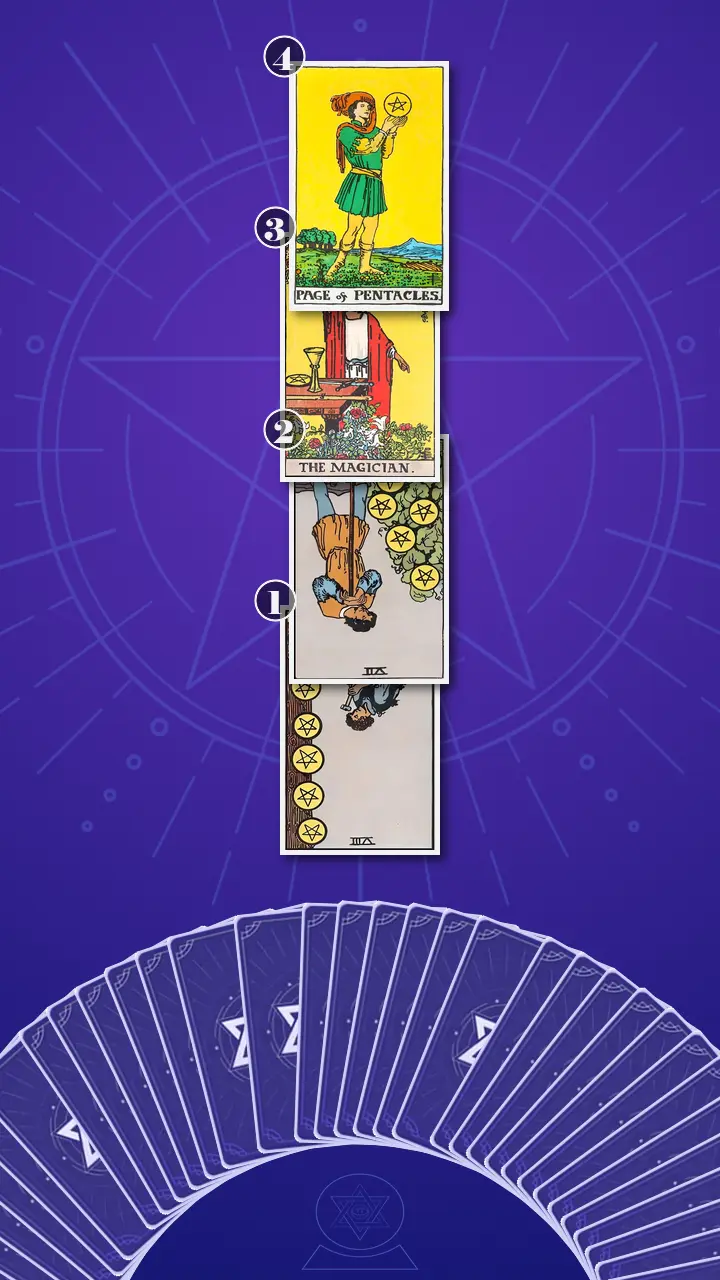
The Workbench Beneath the Unwritten Rules
Position One: The Workbench No One Is Using
I turned over the card representing the present layer: Alex’s observable delay pattern and the stagnant energy that appeared whenever coursework felt pointless. It was the Eight of Pentacles, reversed.
In the Rider-Waite-Smith image, a craftsperson repeatedly hammers pentacles into form. An orderly row of completed work hangs nearby, while a distant town suggests a wider purpose beyond the bench. Reversed, the image looked psychologically familiar: every tool was available, but sustained contact with the craft kept breaking.
At 10:40 p.m., Alex had the brief, readings, notes, timetable, and laptop arranged for work, yet the document contained only a polished title. Whenever the first rough sentence felt repetitive or pointless, they adjusted the layout, reorganized a folder, checked a message, or opened a study-with-me video. The Notion dashboard behaved like an academic loading screen that looked active but never entered the program.
I read the reversed Earth energy as a blockage in practice, with an excess of preparation trying to compensate for a deficiency of meaningful contact. Alex did not lack ability. Their attention kept leaving before repetition had any chance to become understanding. Preparation can look like studying while keeping you safely outside the work.
Alex gave a low, bitter laugh. Their chin dipped, and they looked at the title-only document rather than at me. “That’s too accurate. Kind of brutal, actually. I have everything ready, so why am I still not doing the one thing?”
“The accuracy is about the pattern, not your character,” I said. “I don’t read this card as a moral failure. I read the blank page as a research bottleneck. Something in the current method needs excavation, and rebuilding the timetable is the substitute behavior that briefly gives you control.”
I asked what Alex usually did first after opening an assignment that felt pointless. Their fingers rubbed the edge of the phone case before they answered. “Formatting, then Notion, then probably a video about how to stop procrastinating. Which is embarrassing when I say it out loud.”
“It is recognizable, not embarrassing,” I said. “The substitute activity offers an immediate reward: order without exposure. The cost arrives later, when deadline pressure has to supply the purpose that the brief never made clear.”
Position Two: The Return That Must Arrive First
I turned over the card representing the root layer: the belief that effort without an obvious payoff was wasted, along with the fear of having no control over whether study mattered. It was the Seven of Pentacles, reversed.
The upright image shows a worker leaning on a tool and evaluating pentacles growing on a vine. Assessment itself is sensible. Reversed, however, the pause can become premature withdrawal: demanding proof of the harvest before enough cultivation has occurred to produce evidence.
I connected the image to Alex checking an assignment’s weighting, scanning the rubric for the highest-return sections, and asking whether the module would matter outside the degree before making a substantive attempt. When no immediate answer appeared, they closed the reading and preserved the evening. That protected their time in the short term, but it also removed the chance to discover whether one argument skill, research method, or question might become useful through contact.
Here, Earth energy was blocked by an excess of evaluation and a deficiency of patient evidence-gathering. The question “Is this worth my time?” was reasonable. The rigid condition “I must answer that before I begin” was what kept the card reversed.
“The last time you checked a grade weighting before starting,” I asked, “what result did you need to see before the task felt worthy of your evening?”
Alex’s fingers stopped moving. Their breath held high in their chest, and their gaze shifted past the screen as if they were replaying a moment in the retail staff room. After several seconds, they released the phone and let it rest face down.
“Honestly? I wanted the number to make the decision for me,” they said. “If the assignment wasn’t worth much, I could tell myself not caring was rational. If I can’t see the return, giving it an evening feels irresponsible. That evening could be a shift, sleep, or seeing someone I actually care about.”
I agreed that the tradeoff was real. I also pointed out the hidden loop: Alex was trying to protect scarce time by making a global cost-benefit judgment before gathering local evidence. The relief of closing the reading led to a compressed deadline; the compressed deadline left no room for curiosity; the rushed experience then seemed to prove that the coursework had always been mechanical and empty.
“A reasonable question about value becomes a trap when it must be answered before contact with the task,” I said. “The cards are not asking you to stop questioning the institution. They are asking whether the institution’s vagueness has quietly acquired the power to decide whether you can act.”
When the Magician Made Purpose Local
Position Three: The Table Already Set
The room seemed to narrow around the next card. Even the laptop fan on Alex’s side of the call fell briefly quiet as I turned over the transformation layer, the perspective capable of interrupting the established pattern. The card was The Magician, upright.
The Magician raises a wand while the other hand points toward the earth. A cup, sword, wand, and pentacle rest on the table. I read that arrangement as coordinated agency: a personally chosen reason, a clear question, available information, and a tangible output brought into one deliberate act.
In Alex’s life, the Magician looked less theatrical. It looked like a note beside the keyboard: “For the next 20 minutes, I am practising how to make one claim from two sources.” It looked like closing nonessential tabs, keeping the brief and notes open, setting a timer, and producing an awkward paragraph. The course did not have to become inspiring. Alex only had to decide what this bounded effort would produce.
The Magician’s energy was in balance: enough Fire to begin, enough Air to define the question, enough Water to choose a personally honest reason, and enough Earth to leave something visible on the page. This was not motivation arriving from outside. It was self-directed agency becoming specific.
Before I gave the central line, I returned us to 10:40 p.m.: cold tea, immaculate timetable, title-only assignment. Alex wanted to finish, yet another evening felt too valuable to spend on work that had not explained why it mattered. Their question was still global: “Is the whole course worth me?”
I said, “Meaning does not have to arrive before effort. For this one study block, you can choose what the effort is for.” Then I made the distinction concrete.
Meaning is not a prerequisite you must wait for; choose one useful outcome now, and use the Magician's table to turn the tools already available into a visible first draft.
I left the sentence alone for a moment.
I watched Alex’s breath stop. Their right hand, which had been moving toward the phone, stayed suspended above the desk. For a second their eyes lost focus, as if the previous week’s late nights were replaying behind them. Their pupils widened; the skin around their mouth tightened. Then their shoulders dropped half an inch, but the release did not look easy. It looked like stepping off an escalator that had been carrying them backward: relief followed by a brief loss of balance. Their fingers curled once against the tabletop and slowly opened. “But doesn’t that mean I’ve been doing it wrong this whole time?” they asked. The first words came sharp; the last thinned into a breath. A flush rose under their eyes. I let the objection stand before I answered, because clarity can carry grief for the evenings already lost and responsibility for the next choice.
“No,” I said. “It means your method was trying to protect something legitimate, your control over your time, but it became too absolute to serve you well.”
I invited them back into their own evidence. “Now, using this new perspective, think back to last week. Was there a moment when this insight could have let the evening feel different?”
Alex looked toward the dark window. “Sunday in the library. I had three modules open and spent ninety minutes trying to design a better system. I didn’t need a system. I needed one reason for one page.”
Academic Stratigraphy at the Magician’s Table
At that moment, I thought of a trench wall after rain, when several bands of soil become visible at once. Years on archaeological digs taught me not to treat a crowded section as one undifferentiated mass. Each layer came from a different pressure, and only some layers could support what would be built next.
I call this Academic Stratigraphy. I mapped Alex’s problem in three layers. The upper layer was the visible debris: formatting, tab switching, productivity videos, and increasingly polished schedules. Beneath it sat the protective belief: if effort had not proved its value, withholding that effort preserved control. At bedrock was a more enduring value that the belief had been trying to defend: Alex wanted authorship over what their attention became.
The Magician did not ask Alex to destroy that bedrock. It asked them to build from it. Instead of waiting for the module to supply a complete purpose, Alex could choose a local one: practise a claim, test an interpretation, identify a gap, or turn an unwritten academic rule into a specific question.
“I don’t need to defend the whole degree,” Alex said slowly. “I need to decide what the tools are for right now.”
That sentence marked the key emotional shift. I was watching movement from requiring the whole course to feel meaningful before starting toward choosing a bounded study purpose and building grounded curiosity through visible, imperfect progress. It was not total confidence. It was the first usable form of trust.
Within the next ten minutes, I asked Alex to open the assignment and type one temporary line beneath the title: “For the next 20 minutes, I am using this task to practise making one clear claim.” I made the boundary explicit. They could stop when the timer ended, keep the result private, or abandon the experiment if it produced nothing useful. The minimum version was five minutes and one imperfect sentence.
Position Four: One Pentacle, One Learnable Thing
I turned over the card representing the action layer: one concrete study experiment through which Alex could test restored agency in daily life. It was the Page of Pentacles, upright.
The Page holds a single pentacle at eye level. A cultivated field and distant mountains remain visible, but they are not the immediate task. I read the card as grounded curiosity directed toward one learnable object. The whole educational landscape could remain unresolved while one claim, paragraph, concept, or question received close attention.
In Alex’s situation, the Page selected one claim from the brief and placed three bullets beneath it: what the claim might mean, what evidence could support it, and what remained unclear. A rough paragraph and one question for the instructor would become a learning artifact, not proof that the entire course was worthwhile or worthless.
The upright Earth energy was in balance. The Page did not demand an impressive result or instant passion. It stabilized the Magician’s broad agency by accepting beginner-scale action: look closely, make something small, and evaluate what exists afterward.
“Which single object could you examine this week without turning it into a referendum on your degree?” I asked.
Alex read the brief again. Their jaw loosened before their shoulders did. Then they pointed to one assessment criterion on the screen. “This claim. I could write what I think it means, find two pieces of evidence, and ask about the part I’m still guessing.”
“Exactly,” I said. “This paragraph is an experiment, not a verdict on your degree. A rough paragraph is evidence, not a verdict on your degree.”
I watched Alex lean slightly toward the document. The shift was small enough to trust: not sudden enthusiasm, but attention returning to one object instead of scattering across the whole module.
A Twenty-Minute Purpose Built in Layers
I drew the four cards into one coherent account. The Eight of Pentacles reversed showed preparation replacing practice. The Seven of Pentacles reversed revealed why: Alex was trying to protect scarce time by demanding a convincing return before investing effort. The Magician restored agency by making purpose local and self-chosen. The Page of Pentacles grounded that agency in one modest artifact that could be evaluated after contact with the work.
The pattern resembled standing beside an unmarked road and refusing to move until the entire destination became visible. The unwritten rules and vague signposts were real; Alex had not invented them. The cognitive blind spot was assuming that absent enthusiasm proved the next step had no possible use, while treating preparation as if it could supply the evidence that only practice would produce.
The transformation was not “learn to love pointless coursework.” I would not ask Alex to manufacture respect for an assignment that had not earned it. The direction was narrower and more empowering: stop requiring the whole course to feel meaningful before starting, assign one study block a purpose Alex actually chose, and let one visible output provide information. Tarot had made the structure observable. Alex still held the authority to test it, adapt it, or reject it.
When I suggested a 20-minute first pass, Alex immediately raised a practical obstacle. “After a shift, even 20 minutes can feel like another thing I’ve failed to fit in.”
“Then 20 minutes is not the rule,” I replied. “Use five. One sentence is the valid minimum. A method meant to restore agency fails if it becomes another hidden academic expectation.”
The Thesis Stratigraphy Framework
I adapted my Thesis Stratigraphy Framework into two low-friction next steps. Instead of asking Alex to produce a polished argument from a crowded intellectual site, the method separated the core claim, supporting evidence, and unresolved expectation into visible layers. That made the academic bottleneck specific enough to work with.
- The Magician’s One-Block PurposeBefore one study block this week, Alex will place a note below the laptop that says, “This block is for practising one clear claim.” They will add a temporary “Rough first pass” heading to the assignment, turn on focus mode with access to the brief, notes, and document, and draft before changing formatting or reopening the timetable. The standard version is 20 minutes; the minimum version is five minutes and one rough sentence.Tip: Stop when the timer ends if that protects the boundary. Finishing the assignment is not the test; producing one visible artifact is.
- The Three-Layer Claim ExcavationAt the next encounter with a vague criterion, Alex will spend ten minutes writing three lines beneath one claim: “Core argument,” “Evidence I can use,” and “Unwritten rule I am being asked to guess.” If the final line still blocks progress, they will turn it into a three-sentence message for the instructor or teaching assistant: identify the vague criterion, state their current interpretation, and ask whether one concrete example would meet it.Tip: The message can remain an unsent draft. The first goal is to convert atmospheric uncertainty into one answerable question.
I reminded Alex that these were bounded experiments, not an endorsement of the module. They retained the right to conclude that a task remained low-value, to protect sleep or paid work, to request clarification, and to use accessibility or academic support on their own terms. The Magician’s agency belonged to Alex, not to the institution and not to the cards.

A Week Later: Evidence, Not a Verdict
Six days later, I read Alex’s message: “I wrote 186 ugly words and stopped at the timer. I still think the module is badly designed. This morning I thought, ‘What if I’m doing it wrong?’ Then I opened the paragraph instead of Notion.”
That was the quiet proof I trusted. Alex had not solved university, discovered a passion for every required module, or erased the bittersweet thought of evenings already lost to deadline panic. They had made one choice before certainty arrived. The cards did not write those 186 words. Alex did.
For me, that completed the first movement of the Four-Layer Insight Ladder: stagnant effort became a visible pattern; the fear beneath it acquired language; agency gained a bounded purpose; curiosity found one object it could hold. The Journey to Clarity ended without pretending that clarity meant total certainty.
If a vague brief makes your arms feel heavy at the desk, the strain may not be only about doing the work. It may also be the fear of giving away another evening without any control over whether that effort will matter. Simply separating that fear from the next small action means you are no longer standing at the same starting point.
So if your next study block did not have to justify the whole course, which one object would you place on your own Magician’s table, and what small thing would you make visible before the timer ends?