Saying "No Worries" at Work, Then Naming Anger and Making a Request

Finding Clarity in the 8:47 p.m. Streetcar Replay
I met Jordan, a 29-year-old project coordinator in Toronto who could make almost any deadline “work” in the meeting, then spend the streetcar ride home wondering why everyone else got to be angry. At 8:47 p.m. on the 504, the carriage rattled under fluorescent light, wet coats smelled of rain, and her phone warmed her palm as she reopened a Slack thread. Her jaw locked while she drafted the sentence she had deleted before the meeting.
When she sat across from me, she reduced the problem to one question: “I said the deadline was fine, so why am I still furious? And why am I always the only person trying to keep this team calm?” I heard the contradiction immediately. Jordan kept the peace because she feared being seen as angry, then treated other people’s possible anger as the source of tension she had helped leave unnamed.
She showed me the message she had sent after agreeing to coordinate another rush deck: “No worries, I can make it work!” The exclamation mark looked bright and accommodating. Her body had delivered a different report: raised shoulders, heat climbing into her cheeks, and a jaw that still ached hours later.
I could almost see the resentment as a hot coin held behind her teeth, invisible while she smiled but metallic in every post-meeting replay. Beneath it sat a quieter fear. Rent mattered. Career progression mattered. Her performance reviews praised communication and teamwork. To Jordan, being “easy to work with” had gradually come to mean never letting irritation become visible.
“If I say I’m angry,” she told me, pressing her thumb against the edge of her phone, “I’ll be the person everyone remembers as difficult.”
I told her I was not there to decide whether any coworker was secretly angry, or to turn her reaction into evidence that she was wrong. I wanted to help her distinguish what had happened, what she had inferred, what she had withheld, and what she could choose next. “Let’s make a map of this workplace people-pleasing and resentment loop,” I said. “The goal is clarity, not a guilty verdict.”

Choosing the Compass: A Relationship Spread for Workplace Conflict
I invited Jordan to place her phone face down and take one slower breath before we began. I shuffled while she held one recent resourcing meeting in mind. I use this brief pause as an attention shift, not a mystical test. It helps a question become specific enough to examine.
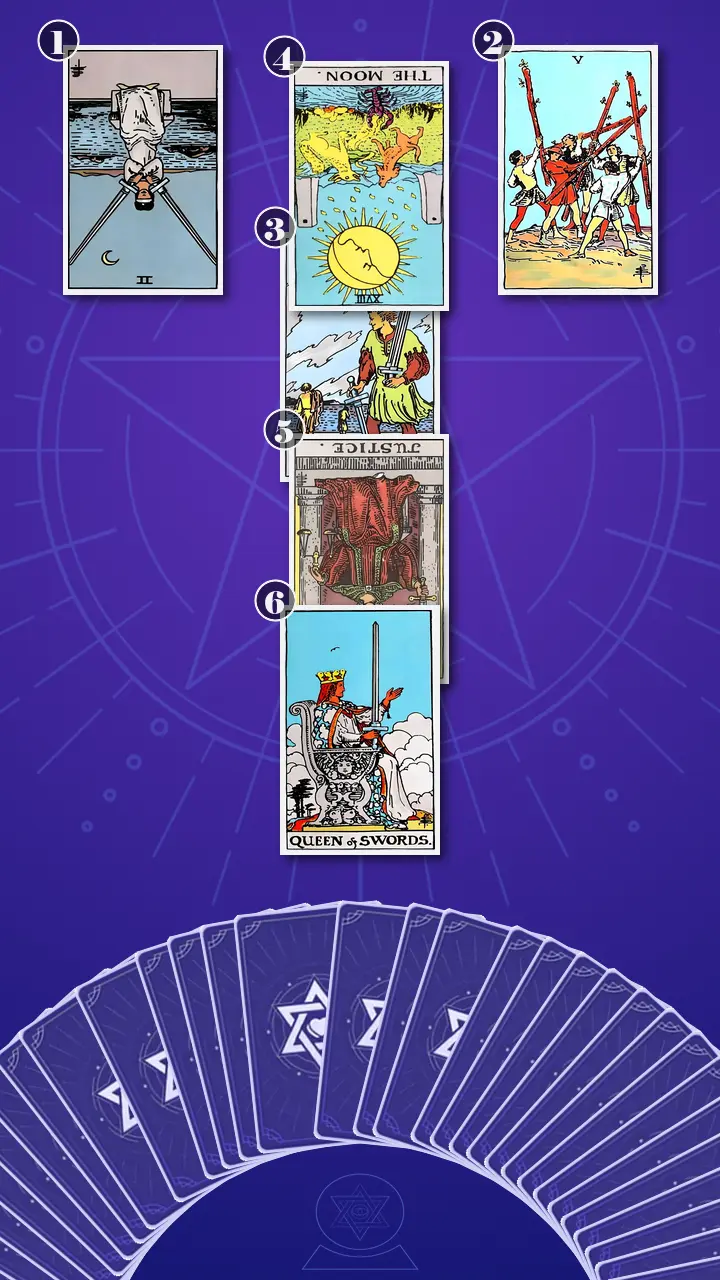
I chose a classic six-position Relationship Spread. Although the name often suggests romance, its structure is equally useful for workplace conflict because it separates one person’s stance, the outer response they experienced, the recurring interaction, the hidden influence, the central obstacle, and the most constructive response.
I chose it here because Jordan was not asking for a prediction or a verdict about her coworkers. She needed a relational map that kept the focus on her perceptions, boundaries, and available choices. Position One would show the behavior with which she entered tense moments. Position Three would expose the peacekeeping-to-blame mechanism at the center. Position Six would identify a self-directed communication path that did not depend on controlling anyone else’s mood.
For anyone wondering how tarot works in my practice, I treat card meanings in context as structured prompts for observation. The cards do not give me privileged access to another person’s motives. They help me organize patterns that the querent can confirm, challenge, or reject against real evidence. Jordan remained the authority on her life throughout the reading.
Reading the Crossroads from “Fine” to the Private Case File
Position One: The Sentence Deleted Before Send
I turned over the card representing the presenting problem: Jordan’s concrete habit of smoothing meetings, saying everything was fine, and withholding irritation before blaming someone later. It was the Two of Swords, reversed.
I pointed to the blindfolded figure and the two swords crossed over the chest. Upright, the image can hold a deliberate pause between opposing positions. Reversed here, that pause had become a blockage. Jordan was not using time to discover her position; she was using professional composure to prevent that position from entering the conversation at all.
I brought the image into her workday. She was in a resourcing meeting with her calendar still unopened. A new deadline landed. Her jaw tightened before her mind produced the agreeable response: “That’s fine, we can adjust.” Later, a cursor hovered over the sentence “I don’t have capacity for both.” She deleted it, relaxed her face for the next video call, and told herself, “I don’t want this, but saying yes will end the awkward moment.”
In energetic terms, the Two’s Air was blocked. Thought was not clarifying the choice; it was holding the emotional information still. The immediate reward was safety and approval. The delayed cost was resentment, because a limit that never entered the meeting could not be considered by the team.
I told Jordan the pattern resembled a Notion project board where every task was marked green while the hidden backlog kept growing. The dashboard appeared calm because the real capacity data had never entered the system. “Fine” could end the moment without resolving the problem.
Jordan gave a small laugh, but there was no humour in her eyes. Her fingers tightened around her mug before loosening again. “That’s so accurate it feels a little cruel,” she said.
“Then let’s slow it down,” I replied. “The card isn’t accusing you of dishonesty. It’s showing the exact second a safety strategy becomes self-silencing. You were trying to protect your place in the room. We’re examining the cost so you can have more than one option next time.”
Position Two: Five Voices, No Confirmed Villain
I turned over the card representing the outer-response mirror: the observable workplace friction Jordan encountered and the way she read coworkers’ anger without claiming access to their private states. It was the Five of Wands, upright.
Five figures held wooden staffs at competing angles. No single person controlled the scene, and no clear victor stood at its centre. I saw a familiar agency meeting in the crowded composition: several people defending timelines, creative priorities, client expectations, and their own overloaded calendars at once.
I connected it to the Thursday debrief Jordan had described. Five voices overlapped about revisions while notifications broke through her headphones. One coworker challenged her timeline. Another interrupted. Jordan’s palms became damp, and she said, “It’s all good, I’ll coordinate,” before ownership had been established.
The card’s Fire was active and somewhat excessive, but active friction was not proof of a personal attack. A busy meeting can resemble five browser tabs playing audio at once: the noise is real, but it does not reveal which tab has a private issue with Jordan. The Five of Wands asked her to treat disagreement as information before translating it into rejection.
“What could a neutral observer have recorded?” I asked.
Jordan looked at the card instead of her phone. “The deadline changed. Two people talked over each other. Someone said my timeline wasn’t realistic.”
“Those things may have had a real impact,” I said. “They still don’t prove what anyone privately felt about you. We don’t need to decide they were harmless. We only need to stop adding certainty where the evidence ends.”
Her shoulders remained raised, but her chin lifted slightly. I watched her begin to separate a shared problem from the idea of a single emotional villain.
Position Three: The Victory That Fixed Nothing
I turned over the card representing the mechanism in motion: the recurring interaction in which surface peace became resentment, and resentment became blame. At the visual centre of the spread sat the Five of Swords, upright.
A foreground figure gathered three swords while two others walked away beneath a grey sky. I read the scene as a victory with no repair inside it. Jordan could stay outwardly reasonable during the meeting, then recover a sense of power by proving privately that someone else had caused the hostility.
I described the modern version I had heard from her: sitting in a Queen West café with a friend, tea cooling beside five selected screenshots, reconstructing the meeting as a case against a coworker. The inner argument became, “I stayed reasonable, so they must be the problem.” Her friend’s validation might soothe the sting for a few minutes, but the deadline, unclear ownership, and invisible capacity limit would remain exactly where Jordan had left them.
The card showed an excess of adversarial Air. Analysis had become prosecution. The sharpness that could have named a boundary was instead being used to collect evidence for a win-lose account after the moment had passed.
“I’m not going to shame you for venting,” I said. “People need witnesses when an exchange has hurt. But the Five of Swords asks a harder question: what do you want repaired here rather than won?”
Jordan’s eyes moved to the two departing figures. She drew a breath, held it, and released it through her nose. “I want the workload to change,” she said. “And I want someone to acknowledge that the deadline was unreasonable.”
“Then proving who was angriest won’t get you either outcome,” I replied. “A private case file can validate the past. It cannot make the request the original conversation still needs.”
Position Four: The Story Inside the Full Stop
I turned over the card representing the underlying fear and disowned feeling: Jordan’s fear that naming anger would cost her belonging, together with the uncertainty that obscured her own share. It was The Moon, reversed.
I traced the winding path between the two towers, then the dog, wolf, and crayfish responding from different levels of awareness. I saw trained professional composure on one side, instinctive alarm on the other, and an unnamed feeling beginning to emerge from below the surface.
I returned to a 9:36 p.m. Slack replay at Jordan’s kitchen table. The radiator clicked, the screen was too bright, and a coworker’s message read, “Need this by EOD tomorrow.” There was no greeting or emoji. Jordan’s jaw locked as she searched older messages for confirmation that the coworker was angry and taking it out on her.
“A clipped message is a fact; an angry motive is an interpretation,” I said. “The deadline conflict can also be a fact. Your irritation can be real. The coworker’s private emotional state remains unknown until there is more information.”
Reversed, the Moon showed blocked clarity and amplified ambiguity. Jordan’s mind was trying to remove uncertainty by supplying a motive, while the heat in her own chest remained unnamed. The invitation was not to assume her perception was false. It was to loosen certainty enough to investigate.
I watched her lips part before she spoke. Her gaze softened, and the hand resting beside her phone opened. “The words were brief,” she said. “The rest of the story came from somewhere in me.”
I nodded. “That somewhere deserves curiosity, not dismissal. A neutral question could be: ‘When you said you needed this tomorrow, is that a fixed deadline, or is there flexibility on timing?’ One question tests the situation without requiring you to accuse, appease, or pretend the impact was nothing.”
Position Five: The Missing Line in the Ledger
I turned over the card representing the blind spot and its cost: the accountability imbalance created when unspoken expectations became accusations about other people’s anger. It was Justice, reversed.
The scales and upright sword normally suggest proportion, evidence, and responsibility. Reversed in this position, they resembled a report assembled after the conclusion had already been reached. I pictured Jordan’s Notes app ledger listing every clipped reply, interruption, and inconvenient request while the sentence “I agreed to the deadline” sat outside the frame.
The card’s energy was imbalanced, not because Jordan’s coworkers were automatically blameless, but because different evidence was being weighed by different standards. Their tone counted. Her silence did not. Their request became evidence of character. Her unspoken expectation remained invisible.
“Your silence belongs in the evidence, not in the prosecution,” I told her. “Including it does not mean you caused the whole dynamic. It means the account becomes complete enough to show where your agency still lives.”
Jordan’s thumb stopped above her phone. Her gaze slipped out of focus as if a series of meetings were replaying behind her eyes. Then her jaw tightened again. “So this is my fault?” she asked, more sharply than she had spoken all evening.
“No,” I said. “Contribution is not total responsibility. A rushed request can still be unreasonable. An interruption can still have an impact. A power imbalance can make directness genuinely risky. Justice is asking you to include what you controlled: the quick agreement, the withheld capacity concern, and the expectation no one else was given a chance to meet. That is accountability without self-attack.”
Her breath left her chest in a long, uneven stream. I saw both discomfort and relief cross her face. She did not have to excuse everyone else in order to recover her part of the story.
When the Queen of Swords Opened Her Hand
Position Six: One Clean Boundary
The rain against the window thinned as I reached the final position, and the heater clicked off. The sudden quiet sharpened the small sound of the card touching the table. I turned over the card representing transformation and action: a clear boundary, an owned feeling, and a specific request that would let Jordan remain engaged in disagreement. It was the Queen of Swords, upright.
I pointed first to the Queen’s uncovered face, then to the vertical sword and the open hand. The sword offered precision. The hand kept the exchange relationally open. Together they showed candour without cruelty, a boundary without a verdict, and self-respect without a demand that everyone remain pleased.
Here, the Air energy had reached balance. Thought was no longer blocked as in the reversed Two of Swords or sharpened into scorekeeping as in the Five of Swords. It could now translate emotional information into a statement another person could actually respond to.
I gave Jordan the workplace version: “The deadline moved to Thursday. That overlaps with the launch report. If Thursday stays, I need one of those tasks reassigned.” The message did not hide the capacity problem, diagnose the coworker’s mood, or attach six months of grievances. It named the observable fact, its impact, and one decision needed next.
Seeing the Queen’s sword, I remembered the clean vertical wall of an archaeological trench. A surface can appear undisturbed until its strata reveal the fracture beneath it. The fracture is not a moral failure; it is evidence of pressure, change, and the point at which a different structure became necessary.
I used what I call Core Competency Excavation. I asked Jordan to search through the strata of her past projects for moments when she had already clarified a brief, flagged a risk, corrected a misunderstanding, or asked someone to choose between priorities. Her expression changed as examples came back to her. Directness was not a foreign personality she needed to install. Beneath the accumulated layers labelled “flexible,” “helpful,” and “easy to work with,” she already possessed discernment, preparation, and precise language. She had used those competencies to protect projects. The Queen asked her to use them to protect her capacity too.
I brought her back to 8:47 p.m.: the moving streetcar, the reopened Slack thread, and the sentence deleted before the meeting. She was still caught in “I must be the calm one,” so every clipped reply looked like evidence while her own earlier heat remained outside the frame.
Do not keep the peace by silencing yourself or protect yourself by blaming others; like the Queen of Swords, separate facts from stories and speak one clean boundary.
I let the sentence remain between us without explaining it away.
Jordan’s breath stopped. Her index finger, which had been tracing the rim of her mug, stayed suspended. For several seconds, her gaze moved beyond the spread as if the streetcar replay were running again, now with the deleted sentence restored. Her pupils widened and colour rose into her cheeks. Then her shoulders dropped one uneven inch and her hand opened, but the release left a blank, almost dizzy look on her face. “But doesn’t that mean I was wrong the whole time?” she asked.
I kept my voice level. “It means the story was incomplete, not that your irritation was wrong. Peacekeeping protected you from one awkward moment, but it also removed your limit from the conversation. Owning that does not excuse rushed work or poor communication from anyone else.” Her eyes reddened slightly. She gave a small, shaky exhale, and her other shoulder lowered. “That’s more responsibility,” she said. “Yes,” I replied, “and more agency. Responsibility gives you a next move. Blame alone leaves the decision somewhere outside you.”
I invited her to test the new perspective against real life. “Now, when you think back to last week, was there a moment when this insight could have changed how you felt?”
Jordan returned to the Thursday debrief where ownership had remained unclear. “I could have said, ‘I’m frustrated that I don’t know who owns the revisions. Can we assign them before I confirm the timeline?’”
I nodded. “That is the crossing this card represents. It is a small movement from contracted self-silencing and retrospective blame toward discerning candour, emotional responsibility, and a clear workplace boundary. Anger can inform a boundary without becoming an attack.”
Two Facts, One Feeling, One Request
What the Whole Spread Said
I read the six cards as one coherent account rather than six isolated messages. Jordan had learned to associate professional belonging with flexibility and emotional neutrality. The reversed Two of Swords showed her withholding a real position. The Five of Wands showed genuine workplace friction with several contributors. The Five of Swords showed the later effort to recover power by winning the retelling. The reversed Moon showed ambiguous signals becoming confident stories, and reversed Justice exposed the missing evidence of Jordan’s own quick agreement. The Queen of Swords restored the resource that had been present all along: precise, bounded communication.
The spread’s central blind spot was simple but uncomfortable. Jordan had assumed that because she looked calm, she had made no contribution to the tension. Her silence felt neutral to her, even though it prevented useful information from entering the system. That did not make her responsible for everyone’s behaviour. It meant she had more leverage than the private case file allowed her to see.
I described the whole pattern as an archaeological profile of one work exchange. The visible layer was a clipped Slack message. Beneath it sat Jordan’s irritation. Beneath that sat the fear of being labelled difficult. Beneath the fear lay an automatic agreement, and beneath the agreement lay a need that had never been spoken. The reading did not ask her to demolish her professional identity. It asked her to stop preserving a surface that could no longer carry the pressure underneath.
The key shift was practical: move from suppressing irritation until it became a judgment about someone else to naming the observable issue, owning the feeling, and making one specific request early. I told Jordan that actionable tarot advice should function as a small experiment, not a command. We chose two next steps that did not require a dramatic confrontation.
The Next 48 Hours
- The Ten-Minute Capacity Pause For the next incoming task, pause before accepting it in Slack or in a meeting. Open the calendar, check the deadlines already in place, and reply, “Let me check current priorities and come back to you by 2 p.m.” If the new work must stay, identify the task that would need to move before confirming. Start with one low-stakes request. If ten minutes is unavailable, take one breath and ask to answer after the meeting rather than agreeing automatically.
- The Seven-Minute Daylight Draft During normal working hours, choose one recent exchange and set a seven-minute timer. Write three lines: “The observable fact was…”, “I felt…”, and “My request is…”. Keep the request to one sentence and remove every guess about the other person’s motive. Sending the draft remains optional. If “angry” feels too exposed, begin with “frustrated,” “concerned,” or “stretched.” You may stop after the first line; a partial exercise still interrupts the replay.
I added one boundary around the boundary work itself. Direct communication is not equally safe in every workplace. If Jordan anticipated retaliation, discrimination, or a threat to employment security, I wanted her to document the issue and consider an appropriate manager, HR process, union representative, or trusted support person. The Queen of Swords represents discernment, not compulsory disclosure.
“Do not build a case when one clear request could test the story,” I told her. “You are not trying to become fearless or perfectly direct. You are giving the workplace one piece of accurate information early enough for a response to be possible.”

A Week Later: The Quiet Proof
Six days later, I received a short message from Jordan. In a resourcing meeting, she had been asked to absorb another rush deck. She had felt the familiar heat rise into her face, but instead of saying yes, she had used the bounded pause: “I have a concern about capacity. Can we look at the priorities before I confirm?”
The room had not transformed into a scene of perfect understanding. Her account lead paused for two uncomfortable seconds, then asked which existing deliverable would move. Jordan opened her calendar, named the conflict, and one deck shifted to Friday. She did not have to prove that the original request was disrespectful in order to change the workload.
She slept through the night. At 7:18 the next morning, her first thought was still, What if they think I’m difficult? This time she smiled, made coffee, and left Slack closed until after breakfast.
I considered that the quiet proof of her Journey to Clarity. She had not solved every workplace dynamic or stopped caring about belonging. She had made one piece of her inner reality visible before it hardened into resentment.
I did not credit the Queen with changing the deadline. The card had offered a map and a language for testing it. Jordan had paused, checked her capacity, and spoken the sentence. Tarot had not decided her future or controlled the room; she had exercised the choice that was already hers.
I know how much safer it can feel to keep the face calm while the jaw locks. When belonging, rent, and career progression all seem to sit behind a tense exchange, making someone else’s tone the whole problem can feel less dangerous than allowing personal anger to take up any space at all. Yet one honest sentence does not have to be a confession or an attack. It can simply carry accurate information.
If one honest sentence entered your next tense room, what observable fact would it carry, and what small request would let your anger become a boundary instead of a private case file?