One Study-Group Question: Choosing Evidence over Self-Judgment
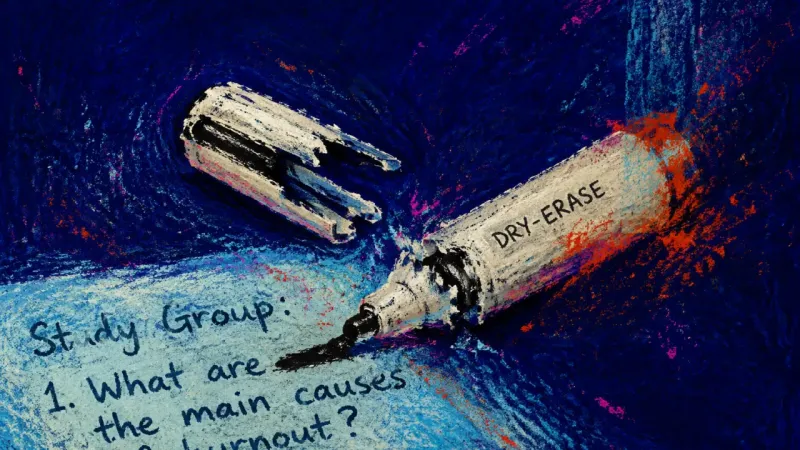
The 6:45 p.m. Discord Spiral
I met Jordan (name changed for privacy), a 21-year-old Toronto undergraduate who kept up with the readings alone, yet watched a two-line request for a study-group link become another night of private review. At 6:45 p.m. on Tuesday, blue-white Discord light warmed their face while the radiator clicked behind a small apartment desk. One unfamiliar term appeared, three search tabs opened, and the laptop fan ran hot. At 7:02, Jordan closed the unsent draft as the session began without them.
“I want the accountability,” Jordan told me. “I want people to compare notes with. But they think out loud, and I feel like every sentence I say has to be defensible. I keep calling it preparation, but I’m still outside the group.”
I could hear the contradiction clearly: Jordan wanted to learn with other people, but participating before they felt smart enough seemed to risk exposing something fundamentally inadequate. Their apprehensive self-doubt had the physical force of a software permission screen lodged in the throat, treating imagined denial as a confirmed setting before anyone had actually responded.
I told them, “I’m not going to use tarot to promise that this group will welcome you, and I’m not going to tell you to just stop overthinking. I want us to separate what the group has actually done from what fear predicts it will mean about you. Let’s draw a map through the fog and find one next step that remains yours to choose.”

Choosing the Doorway: The Five-Card Shadow Spread
I invited Jordan to place both feet on the floor, take one unforced breath, and hold the question in mind while I shuffled: “Why do I wait to feel smart enough before joining the study group?” I use this brief pause as a transition from mental noise to focused observation, not as a test of belief or a mystical performance.
I chose the five-card Shadow Spread. Through my Jungian psychological lens, a shadow is not a bad or doomed part of a person. It is often a protective pattern operating outside full awareness. This spread was precise enough to examine Jordan’s study-group anxiety without pulling unrelated areas of life into the reading: the visible behavior, the fear beneath it, the social trigger, the resource that could integrate the pattern, and one bounded experiment.
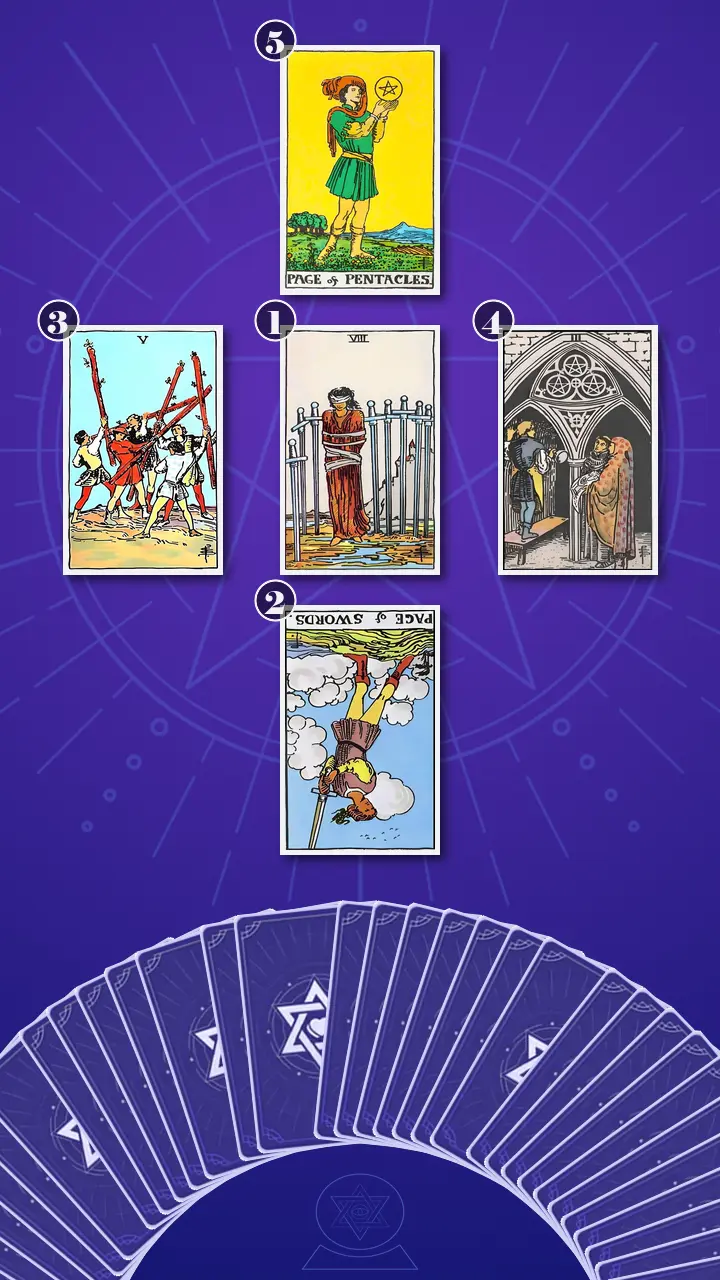
I arranged the cards as a compact cross that resembled a doorway. The center would show how Jordan’s current shadow appeared in daily life. The card below would uncover the private rule beneath the delay. The cards on either side would distinguish competitive friction from reciprocal collaboration, while the card above would turn insight into an observable next step. This is how tarot works in my practice: card meanings in context become prompts for clearer perception, not commands about what must happen.
Reading the Barrier That Had Never Been Verified
Position One: The Eight of Swords and the Unsent Request
I turned over the card representing the observable form of Jordan’s current shadow: opening the study-group invitation, narrowing the available choices, and postponing participation until an undefined standard of smartness had been met. It was the Eight of Swords, upright.
I pointed to the blindfolded figure, the loose bindings, and the swords forming an enclosure that was intimidating but incomplete. “This is not proof that every obstacle is imaginary,” I said. “It shows that anticipated evaluation is restricting your field of vision before you have checked where an opening exists.”
I brought the card directly into Jordan’s Tuesday evening. At 6:45, the meeting-link request was already typed. One unfamiliar term appeared, and their choices seemed to collapse into two impossible options: master the topic alone or enter the group and be exposed. They opened more tabs, missed the session, and reacted to an imagined evaluation as though the group had already delivered it. Yet the screen still held an unsent message, not an observed rejection.
The Eight of Swords showed Air energy in excess and action in blockage. Jordan’s intelligence was generating possibilities, simulations, and counterarguments so quickly that none could be tested. The transit app kept recalculating while the streetcar that could provide real information left the stop.
“What joining requirement has the group actually stated?” I asked. “And which requirement did you create internally?”
Jordan gave a short laugh that sounded more bruised than amused. “That is so accurate it’s almost cruel. No one has said I need to know everything. But I read the chat and think, I could send this, but first I need to understand that term. If I don’t, they’ll assume I’m behind.”
I let the distinction settle without using it to dismiss the group’s semi-closed access process. “Then we have two separate facts to investigate. The group makes newcomers ask visibly for a link, which may be an access problem. Your prediction turns that awkward process into a final judgment about your intelligence. Both deserve attention, but they are not the same thing.”
I summarized the first card plainly: “You keep calling it preparation, but the preparation has become the door you never walk through.”
Position Two: The Reversed Page of Swords as an Internal Examiner
I turned over the card representing the hidden belief beneath the delay: that one imperfect question could expose low intelligence and make Jordan unworthy of belonging. It was the Page of Swords, reversed.
The Page held a sword upright while wind pulled at the landscape and their watchful gaze turned sideways. Upright, I often read this figure as a curious student willing to investigate. Reversed, that curiosity was blocked and redirected into surveillance. The learner had become an internal examiner standing over every draft.
I described the familiar sequence. Jordan wrote a useful question, allowed a ten-minute check, and then quietly expanded that check into an audit of every term. The mind that could have helped classmates compare interpretations began prosecuting the wording instead: “Is this obvious? Let me search it. Now that I found an explainer, asking would look worse. Delete.” Curiosity remained unresolved, and missing another session made real-time discussion feel even less familiar.
This was another Air blockage, but now I could identify its mechanism. Inquiry was not deficient. It was being consumed by overcontrol. An unsent question could not embarrass Jordan, but it also could not bring back evidence.
I used one of my core diagnostic lenses, Draft Paralysis Deconstruction. I explained that perfectionistic preparation can operate as a subconscious defense: if a draft never reaches another person, it can never be corrected, ignored, or misunderstood. The defense is intelligent in the narrow sense that it prevents immediate exposure. Its long-term cost is that it also prevents feedback, familiarity, and any realistic test of belonging.
Jordan’s breathing paused. Their thumb rubbed the edge of their phone, their gaze drifted toward an old deleted-message thread, and then their shoulders rose in a tight, reluctant acknowledgment. “I thought checking proved I cared about doing well,” they said. “I didn’t realize I was using the checking to stop the question from existing.”
“The care is real,” I replied. “The issue is not whether preparation is good. It is whether preparation serves the question or repeatedly replaces contact with the people who could help answer it.”
Position Three: The Five of Wands in a Fast-Moving Chat
I turned over the card representing the cues that activated the pattern, including both the group’s observable behavior and Jordan’s anticipated rejection. It was the Five of Wands, upright.
Five figures crossed their staves without a shared direction. I saw a scene suspended between practice, competition, and badly coordinated conflict. That ambiguity mattered because I did not want to force a reassuring story in which every classmate was secretly welcoming.
I asked Jordan to recall the crowded Toronto streetcar where they had watched five classmates reply at once: one correction, two compressed explanations, a debate about the lecture, an inside joke, and still no clear meeting link. The exchange might contain ordinary academic friction, status signaling, poor facilitation, genuine gatekeeping, or a mixture. Jordan’s apprehension had turned the whole stream into a ranking system before they knew how the group would handle a direct request or a beginner question.
The Five of Wands brought Fire into the Air-heavy spread. In excess, that Fire looked like people competing for visibility, talking over one another, or treating knowledge as social currency. In balance, it could become the productive friction of comparing methods and testing interpretations. Fast replies measure speed and visibility, not the full depth of anyone’s understanding.
I gave Jordan concrete distinctions. If links were repeatedly withheld, newcomers were ignored while insiders received answers, or basic questions were mocked, I would call that evidence of an unhealthy access culture. If people disagreed quickly but still shared information, clarified mistakes, and made room for follow-up questions, I would call that noisy collaboration. Discomfort alone could not prove exclusion, but neither should Jordan be asked to reinterpret disrespect as personal growth.
“Is this ordinary academic friction,” I asked, “or are you being made to fight for basic access? What did the group actually do the last time a newcomer asked a question?”
Jordan’s jaw loosened slightly. “I’ve been blaming myself for all of it,” they said. “But the links really are buried, and one person can be dismissive. Another student asked something basic last month, though, and two people answered normally. I forgot that part.”
I nodded. I had learned across cultures that belonging is rarely clarified by idealizing either the individual or the group. A useful reading needed room for both an internal wound and an imperfect social environment. Jordan was not required to decide that the group was safe before gathering evidence, and they were not required to stay if the evidence showed otherwise.
When the Three of Pentacles Turned the Gate into a Workbench
Position Four: The Antidote Hidden in Visible Learning
The room seemed to quiet as I crossed from the Five of Wands to the card representing Jordan’s integration resource: the capacity to develop competence through visible collaboration, feedback, and partial contribution. I turned over the Three of Pentacles, upright, the key card and catalyst of the spread.
I drew Jordan’s attention to the craftsperson working on a raised bench while two collaborators held the plans. Consultation and skilled work were happening in the same image. Nobody had finished alone and then arrived merely to display a flawless result. The plan, the partial work, and the feedback all occupied one shared space.
At 6:45 p.m., the session link was still unsent. Jordan spotted one unfamiliar term, opened three search tabs, and watched the start time pass while carefully rewritten notes offered relief from the risk of asking in public.
I asked them to picture a different scene. Jordan entered one session with a single incomplete interpretation and said, “I understand the first step, but I lose the reasoning here.” Another student compared notes, someone clarified the transition, and Jordan contributed one useful observation. The meaningful evidence was not flawless performance. It was whether the group shared access, treated partial knowledge respectfully, and produced usable feedback.
The Three of Pentacles showed Earth energy in balance. It grounded the reading in work that could be seen, discussed, and improved. What if the unfinished part was not the admission fee, but the material everyone worked on together?
I used Performance Anxiety Decoupling, another diagnostic lens central to my practice. Jordan’s mind had flattened four distinct tracks into one audio file: the quality of a question, a classmate’s reply, the culture of the group, and Jordan’s core worth. I separated those tracks. A question could need revision without Jordan being unintelligent. A correction could add information without establishing a hierarchy of human value. A dismissive response could reveal poor group culture without becoming a credible assessment of Jordan’s potential.
Readiness is not a private exam you must pass; make one visible contribution and let the Three of Pentacles turn the gate into a shared workbench.
I left a few seconds of silence after the sentence. Even the radiator clicked off, and the clean absence of sound seemed to widen the small space around Jordan’s desk.
I watched Jordan’s breath stop first. Their fingers froze above the warm trackpad, and their eyes lost focus as if the previous Tuesdays were replaying behind them. Then their eyebrows pulled together. “But doesn’t that mean I’ve spent months doing this wrong?” they asked, a brief flare of anger protecting something more tender. I answered carefully: “No. It means the strategy protected you from public embarrassment when that felt necessary. We can respect what it tried to do without giving it permanent control.” Their eyes shone, their shoulders lowered by a fraction, and the fist resting against their knee slowly opened. A long breath left their chest with a quiet, unsteady “Oh.” Relief arrived, but I also saw the slight blankness that can follow clarity, when the old excuse disappears and choice suddenly feels real. “Now, using this new perspective, think back: was there a moment last week when this insight could have made you feel different?”
“When I found the basic explainer,” Jordan said. “I treated it as evidence that my question was embarrassing. I could have treated it as the first piece I brought to the discussion instead.”
I named the change without overstating it. This was not instant confidence. It was one movement from apprehensive self-monitoring and imagined judgment toward grounded beginner confidence and evidence-based participation. Jordan did not have to stop feeling exposed before acting. They needed a way to keep exposure from becoming a referendum on worth.
Position Five: The Page of Pentacles Chooses One Thing
I turned over the final card, representing a conscious practice through which Jordan could integrate the reading: one request, one prepared question, and one observation of the group’s response. It was the Page of Pentacles, upright.
The Page held one pentacle at eye level while fields and distant mountains remained in the background. I read this as balanced Earth: practical curiosity directed toward what could be handled now. The wider academic landscape did not disappear, but Jordan did not have to download the whole course into their head before approaching one task.
I translated the card into a specific modern scene. Before the next session, Jordan would send one direct request for the meeting link and bring one question written in a phone note. They could choose a bounded attendance window and record what happened: Was access shared? Was the response respectful? Did the discussion help? This beginner-sized experiment would replace the impossible task of proving broad intelligence with one learning interaction and one piece of evidence about fit.
The two Pages now mirrored each other. The reversed Page of Swords hovered over an unsent message with a mental blade raised. The upright Page of Pentacles carried one tangible question into contact with reality. Jordan did not need to stop being a beginner. They could choose which kind of beginner to practise being.
“I don’t need a complete performance,” Jordan said as they opened their notes app. “I need one observable next data point.”
I watched them type the first line rather than asking the cards to make the decision for them: “Hey, could someone share the link for the next session?”
The One-Question Workbench
I gathered the five cards into one coherent story. The Eight of Swords showed Jordan treating a prediction as a verified barrier. The reversed Page of Swords revealed why: their curiosity had been recruited into perfectionistic self-surveillance, protecting them from the possibility of visible correction. The Five of Wands confirmed that the environment was not neutral; fast exchanges, unclear access, and occasional status behavior made the fear easier to believe. Then the Three of Pentacles and Page of Pentacles moved the spread from Air, through Fire, into Earth: from thinking about whether participation was safe, through contact with social friction, to one practical experiment.
I also named the missing emotional layer. With no Cups in the spread, embarrassment, envy, and longing had been translated into judgments about competence. Jordan could name those feelings without waiting to eliminate them: “I want to be included. I envy how easily they speak. I’m afraid a correction will feel bigger than it is.” Naming the feelings made them easier to carry and harder to disguise as another prerequisite chapter.
The cognitive blind spot was not simply low confidence. It was the assumption that readiness had to be completed privately and that every group response would describe Jordan’s intelligence. The transformation direction was more precise: make one bounded contribution, evaluate access and reciprocity, and let evidence guide the next choice. The group was being tested for fit as much as Jordan was testing a new behavior.
For the next steps, I adapted my Inner-Critic Mute Protocol. I explained that “mute” did not mean fighting or permanently silencing an inner voice. It meant temporarily removing that voice from the moderator role so Jordan could complete a small, objective task.
- Run the Ten-Minute Inner-Critic Mute Protocol. Before the next weekly session, open the platform the group uses and set a ten-minute timer. Write only two lines: “Hey, could someone share the link for the next session?” and one course-specific question beginning, “Can we compare how we understood...” or “Where did you get from this step to the next?” When the timer ends, do not add another chapter or video to the entry requirement. Sending remains Jordan’s choice, not a test. If ten minutes feels too exposing, use a two-minute draft and stop. Keep the question in one phone note so it cannot expand into five backup questions.
- Use the One-Question Workbench and Culture-Not-Worth Check. Attend one session for a bounded first interval of twenty minutes and bring the single prepared question. Immediately afterward, create four lines labeled Access, Response, Respect, and Usefulness. Record one observable fact under each heading without guessing anyone’s motives or rating overall intelligence. A non-response is information about access, not a command to chase indefinitely. Use one follow-up or ask a teaching assistant, tutor, or one classmate privately. Leave if the interaction becomes mocking, hostile, or inaccessible.
Jordan looked at the first script and frowned. “What if nobody replies? I know I’ll make that mean I was intrusive.”
“Then we decide the boundary before the silence can write the story,” I said. “One request, one reasonable follow-up or official channel, and no indefinite pursuit. Let the response tell you about the culture, not define your worth. You can try office hours, a tutoring centre, or one-to-one study instead. The goal is not to win entry to this particular circle. The goal is to choose support from evidence rather than imagined evaluation.”

Six Days Later: The Quiet Proof
Six days later, I received a message from Jordan. At 6:50 p.m., they had used the two-line script and put their phone face down. The link arrived twelve minutes later without commentary. Jordan attended for twenty minutes and asked where a step in the assigned problem had come from. One student interrupted. Another reopened the example, and Jordan noticed an assumption everyone else had skipped.
Jordan did not report a cinematic transformation. They reported data: access had been shared, the response was mixed but mostly respectful, and the discussion had been useful. They planned to try one more session before deciding whether the group suited them.
That night, they slept through until morning. Their first thought was still, “Did I sound stupid?” This time, they smiled, opened the culture note, and wrote: “Access shared. Respect mixed. Useful answer received.”
I saw that as the honest proof of our Journey to Clarity. Tarot had not predicted acceptance or removed every tight-throated moment. It had helped Jordan separate subconscious protection from present evidence, and then Jordan had chosen the action. The cards offered a map; they remained the person holding the compass.
If tonight you want to join but your throat tightens over one imperfect question, I hope you remember that staying outside can feel safer when uncertainty has been fused with worth. Simply noticing that fusion means you are no longer standing at the exact beginning.
So I will leave you at the Three of Pentacles workbench: if one unfinished question could become material for shared learning rather than evidence submitted for judgment, what small possibility would that let you imagine?