The 8:12 Slack Scroll That Didn’t Feel Like a Win
If you’re an early-career PM in NYC who hears “no notes” and immediately thinks “Did they really look?”, you’re not imagining things—you’re stuck in a very specific kind of imposter syndrome loop.
Jordan joined my Zoom room from a Queens walk-up at 8:12 a.m., still under the duvet. The phone screen lit her face a cool, aquarium-blue; somewhere off-camera, a radiator clicked on and off like it couldn’t decide if it was fully awake either. Her thumb flicked through Slack the way people refresh the weather during a storm.
She tilted the phone toward the camera for a second—one thread, one line from her manager: “Looks good—no notes.”
Her jaw tightened so fast I could almost hear it. “I know that’s… good,” she said, but the words came out like she was reading a disclaimer. “No notes doesn’t feel like a win, it feels like a setup. Like they didn’t really look. And if I stop, I’ll get exposed.”
I watched her shoulders hold themselves a few inches too high, as if her body was bracing for a critique that hadn’t arrived yet. The feeling in the room was familiar to me—the tight, airless pressure of waiting for a verdict that isn’t coming. In her case, insecurity wasn’t a thought; it was a tight chest and a locked jaw, like she was trying to keep a door shut with her ribs.
“When praise feels like pressure, ‘no notes’ lands like a new deadline,” I said softly. “Let’s treat this like a navigation problem, not a character flaw. We’re going to map what happens right after ‘looks good,’ and we’ll look for the one shift that turns feedback into clarity instead of more pressure.”

Choosing the Compass: The Four-Layer Insight Ladder
I asked Jordan to take one slow breath—not as a ritual for the universe, but as a reset for her nervous system. Then I shuffled, letting the sound of the cards become a metronome. In my day job at a Tokyo planetarium, I teach people that motion is easier to understand when you break it into layers: what you see, what’s driving it, what’s stabilizing it, what changes the trajectory.
“Today,” I told her, “we’ll use a spread I call the Four-Layer Insight Ladder · Context Edition.”
For you reading along: this spread is perfect when the issue isn’t a dramatic career crossroads between two external options, but that quieter, nastier question—why reassurance won’t land. It separates the sequence that keeps someone feeling behind at work even after getting “no notes” feedback: visible behavior → conscious thoughts → deeper attachment → regulating resource → turning-point reframe → grounded next step. Six cards keeps it minimal, but it still shows exactly where the loop is gripping.
I pointed to the ladder structure on my desk. “The top card will show what you do on autopilot right after ‘no notes.’ The next will show the thought-script that makes the praise feel unsafe. Then we go deeper—what fear is actually underneath. After that, we look for a stabilizer, then the key insight, and finally the one next step that gets you off the moving finish line.”
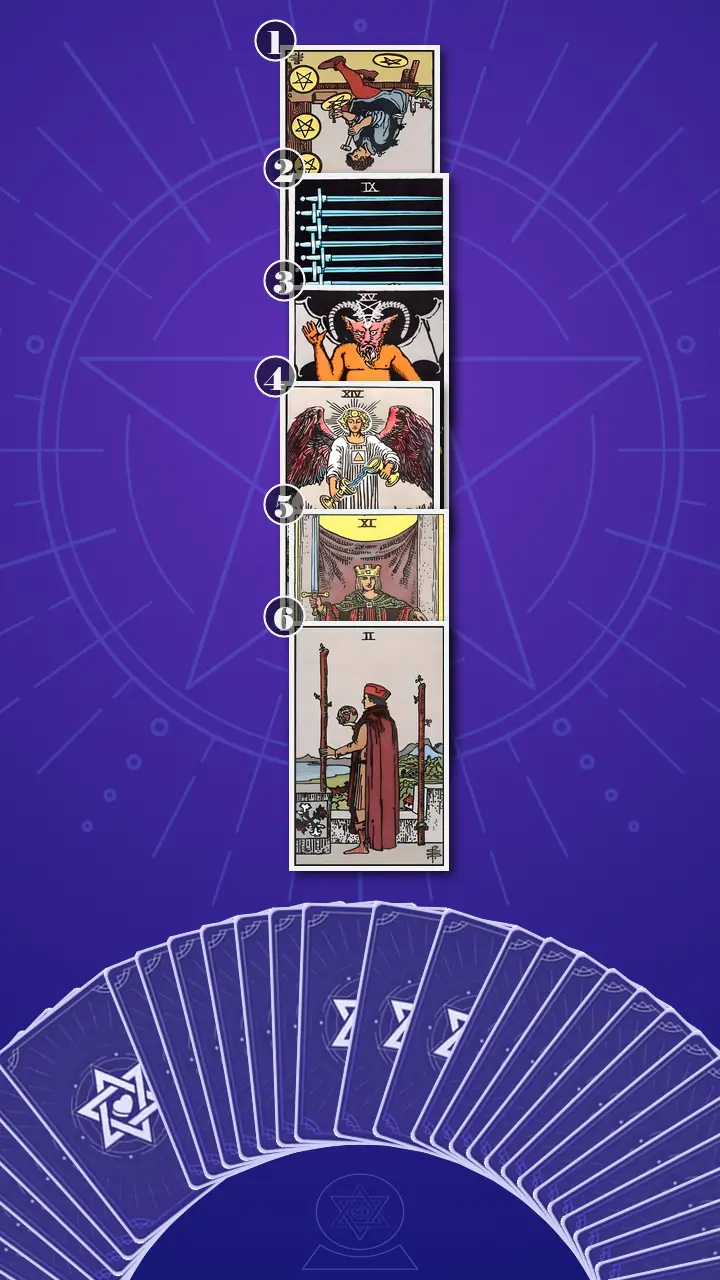
Reading the Map: From Pixel-Pushing to the Real Driver
Position 1 — The Autopilot Move After “No Notes”
“Now we turn over the card that represents the observable work behavior that keeps replaying right after you get ‘no notes’,” I said.
Eight of Pentacles, reversed.
“This is like when your manager drops ‘no notes’ in Slack, and you reopen the already-approved deck and start doing micro-edits—spacing, wording, formatting,” I said. “Then you create a fresh checklist in Notion called ‘v2 polish’ so you can feel like you’re still earning your place.”
Reversed, the Eight of Pentacles isn’t a lack of skill. It’s diminishing returns—effort that’s technically productive, but functionally trapped. I named it plainly: “The energy here is blocked. Your craft is real, but it’s getting rerouted into rework because ‘done’ doesn’t feel safe.”
Jordan gave a tight little laugh—more wince than humor. “That’s… kind of brutal,” she said, but she didn’t disagree. Her fingers started picking at the corner of her duvet like it was a Post-it she couldn’t unstick.
“Quiet time isn’t proof you’re behind,” I added, letting that line sit between us, “Sometimes it’s proof you finished something.”
And then I mirrored the split-screen I could already see in her life: on the left, her hand nudging a headline by a pixel; on the right, her mind hovering over the Slack thread like it was an unexploded device.
Position 2 — The Thought-Pattern That Cancels Praise
“Now we turn over the card that represents the thought-pattern that makes positive feedback feel unsafe or incomplete,” I said.
Nine of Swords, upright.
“You close your laptop at 7:30 p.m., but your brain keeps running the day like a replay,” I said. “You refresh Slack ‘just to check,’ and your chest stays tight like you’re waiting for a shoe to drop—even though the feedback was positive.”
In upright form, the Nine of Swords is excess Air—too much mental motion, not enough landing. “Your mind is doing incident-response mode for a problem that doesn’t exist,” I told her. “An open-tab spiral where none of the tabs are actionable.”
I watched her eyes move away from the screen for a second, unfocusing like she was watching her own week play back. “It’s like… even if nothing’s wrong,” she said, “my brain is drafting the apology email anyway.”
“Exactly,” I said. “And here’s the loop: the more the mind demands certainty, the more the hands keep working. You tell yourself, ‘If I fix one more thing, I can finally relax,’ and then—‘why can’t I relax?’ The card isn’t calling you irrational. It’s showing you your system doesn’t trust the green checkmark.”
Position 3 — The Attachment Underneath the Loop
“Now we turn over the card that represents the underlying fear/attachment that equates being behind with being unworthy,” I said.
The Devil, upright.
Jordan’s expression barely changed, but her body did: shoulders braced, jaw set, like she’d been caught in a flashlight beam. The Devil can be dramatic in movies; in real life it’s often quieter—an internal contract you didn’t realize you signed.
“This is the compliment-as-contract dynamic,” I said, keeping my voice calm. “You treat every compliment like a new performance contract: ‘Great job’ becomes ‘Now don’t mess it up.’ So you keep yourself slightly overworked on purpose—staying available, volunteering for stretch work—because being busy feels like a protective charm.”
The Devil’s energy is sticky, like gravity you mistake for truth. “The chains in this card are loose,” I reminded her. “They feel real in your body, but they aren’t always coming from your manager. Underneath this is one sentence. Let’s name it.”
Jordan swallowed. “If I’m behind,” she said, “it means I’m not… actually good. Like I’ve been getting away with it.”
I nodded—not approving the fear, but honoring how honest it was. “That’s the driver. And it explains why ‘no notes’ doesn’t land as data. If being behind would mean being unworthy, then the nervous system treats rest like danger.”
Position 4 — The Stabilizer That Helps Feedback Land
“Now we turn over the card that represents what helps you metabolize feedback and regulate pace without losing standards,” I said.
Temperance, upright.
“This is the part of you that can build a simple rhythm—ship, review, rest—so your confidence comes from consistency, not last-minute intensity,” I said.
Temperance is balance, not softness. It’s the energy of integration—pouring between two cups without spilling, one foot on land and one in water. “A practical version,” I offered, “looks like: you send the deliverable, then you physically stand up, refill water, and write a one-line ‘task closed’ note. Keyboard click. Laptop lid closed. Like shutting down apps instead of leaving everything running in the background.”
As I described it, I saw Jordan’s breathing change. Not dramatic—just a small exhale that made her shoulders drop maybe 5%.
“That sounds… weirdly nice,” she admitted. “Like permission.”
“It’s not permission,” I corrected gently. “It’s training. Temperance tells your system: cycles can end. You’re allowed to stop reopening the file to soothe a feeling that isn’t actually about the file.”
When Justice Spoke: The Fair-Standards Switch
Position 5 — The Mindset Shift That Reorients Everything (Key Card)
“Now we turn over the card that represents the mindset shift that turns ‘no notes’ into internal calibration rather than more pressure,” I said. “This is the turning point of the whole ladder.”
Justice, upright.
For a beat, the air in my little Tokyo apartment felt like it does right before a meteor shower announcement in the dome—quiet, attentive, as if even the dust is waiting to see what direction the sky will take.
“Justice is objective self-evaluation,” I told her. “Fairness. Evidence. Standards. This isn’t ‘be confident.’ It’s: measure what’s true.”
I gave her the modern translation. “You write down the actual success criteria that were in play—scope, deadline, stakeholder needs—and you score yourself fairly, like you would for a teammate. Then you treat ‘no notes’ as a completed acceptance test, not an ominous silence.”
Justice’s energy is clean Air in balance. Not the catastrophic Air of the Nine of Swords, but the kind that clears a window.
And this is where I brought in my own diagnostic lens—my signature skill, the way I merge tarot with astronomy.
“In my world, I call this Orbital Resonance,” I said. “In a stable orbit, you don’t guess where you are by how anxious you feel. You look at repeatable data: distance, velocity, timing. Your manager saying ‘no notes’ is a data point. A clean one. If you ignore it, you’ll keep adjusting your trajectory based on fear, and you’ll burn fuel you don’t need.”
Jordan frowned—an unexpected flash of irritation. “But if I accept it,” she said, voice sharper, “does that mean I was wrong before? Like… all that extra effort was pointless?”
I didn’t rush past it. “That reaction makes sense,” I said. “Because your system has been surviving on that extra effort. We’re not shaming it. We’re updating the measuring system.”
Setup: You read “no notes,” your shoulders drop for half a second—and then you reopen the file anyway, hunting for a flaw you can fix so you don’t have to sit in the uncertainty of being ‘done.’
You don’t need to earn certainty by working harder; you need to weigh the evidence like scales and decide what’s ‘enough’ with Justice.
I let the sentence hang there.
Jordan’s reaction came in layers—fast, physical, honest. First, a tiny freeze: her breath paused, and her thumb stopped mid-scroll above her phone screen like it had lost its instructions. Then the cognitive shift: her eyes unfocused, staring slightly past the camera, as if she’d replayed a meeting and noticed a detail she’d edited out—someone nodding, the absence of follow-up questions, the calmness in her manager’s tone. And then the emotional release: her shoulders sank, not all the way, but enough that her neck looked less like it was carrying a backpack full of rocks. She pressed her lips together, and when she spoke again her voice was softer, a little shaky.
“So… it’s not that I’m missing more work,” she said. “I’m missing a fair measuring system.”
“Yes,” I said. “Treat ‘no notes’ as data, not missing information.”
I leaned in, gentle but direct. “Now, with this new lens—standards and evidence—think back to last week. Was there a moment you got approval and still felt behind? If you’d weighed the evidence like scales in that moment, what would have felt different in your body?”
Jordan closed her eyes for a second. “Friday,” she said. “After my update. I reopened the doc like ten minutes later. I could’ve… written down ‘approved’ and just stopped.”
“That right there,” I said, “is the emotional shift. From tight insecurity and praise-triggered overwork to fair self-evaluation and deliberate next-priority confidence. Not overnight. But rung by rung.”
Position 6 — The One Direction That Replaces the Moving Finish Line
“Now we turn over the card that represents a concrete way to choose a single forward direction instead of chasing a moving finish line,” I said.
Two of Wands, upright.
“This is the opposite of swatting every notification,” I told her. “Instead of adding random stretch tasks, you choose one direction for the week—one skill, one project focus, one relationship to strengthen—and you make a small plan.”
The Two of Wands is Fire in balance: not frantic, but intentional. “Progress comes from selection, not from doing everything,” I said. “You’re turning ‘prove I’m not behind’ into ‘decide what I’m building next.’”
Jordan nodded, slower this time. “One priority feels… terrifying,” she said, then surprised herself with a small laugh. “But also kind of clean.”
“Clean is the word,” I said. “Justice clears the measurement. Two of Wands chooses the direction.”
The One-Page ‘Evidence + Next’ Reset
I threaded the whole ladder back together for her, like tracing a constellation you can’t unsee once it’s outlined.
“Here’s the story your cards told,” I said. “You get ‘no notes’ (data), but the Eight of Pentacles reversed kicks in—reopen, polish, manufacture a finish line. The Nine of Swords fuels it—mental replay, waiting for hidden criticism. The root is The Devil: the belief that being behind would prove you’re unworthy, so praise turns into a contract you must keep earning. Your stabilizer is Temperance: a close-the-loop rhythm that lets cycles end. Your turning point is Justice: fair standards and evidence. And your integration is Two of Wands: one chosen next priority, not ‘stay busy forever.’”
“Your cognitive blind spot,” I added, “is thinking the feeling of being behind is reliable measurement. It’s not. The transformation direction is: stop chasing the feeling of ‘caught up’ and start building self-trust through objective standards and one next priority—week by week.”
Then I gave her practical next steps—small enough to try in a real NYC workweek, concrete enough to track.
- 20-Minute Final Pass TimerAfter your next “no notes,” set a 20-minute timer for one final review pass only. When it ends, ship it (send the email / post the update) and do not reopen the file for the rest of the day.If 20 minutes spikes your anxiety, do a “10-minute version.” If “all day” feels impossible, start with “don’t reopen for 2 hours.”
- One-Sentence Definition of DoneFor one deliverable this week, write a single sentence at the top of the doc/deck: scope + deadline + stakeholder need. Example: “Done = stakeholder X can make decision Y by Thursday with these 3 points.” Use that as your rubric instead of vibes.If you’re tempted to add more polish, ask: “Is this improving the deliverable—or soothing my nervous system?”
- Evidence + Next Reset (Justice + Two of Wands)Right after approval, take 10 minutes: (1) write three facts (approved by who, met deadline, met scope), (2) write one line: “I met my definition of done,” (3) pick one next priority for tomorrow that moves you forward.Close the tab after. If your chest/jaw tightens, pause and step away—come back later. This is evidence-collection, not white-knuckling.
And because Jordan lived inside Slack the way some people live inside weather, I added my other lens—my intervention tool for friction.
“One more thing,” I said. “When you feel resistance—like you have to check again—I use what I call the Solar Sail Principle. A solar sail doesn’t fight pressure; it uses pressure to change direction. So when you feel the urge to reopen the file, don’t argue with it. Let it cue the reset: water refill, stand up, one-line ‘task closed,’ then decide the next priority.”
Jordan blinked, considering. “So the urge becomes… a trigger for the ritual, not a command?”
“Exactly,” I said. “You’re harnessing environmental resistance instead of letting it steer you.”
I also offered one optional micro-tool from my “planetarium guide” toolkit—something she could do before her first meeting, when the day’s gravity feels heaviest. “Before your morning standup,” I said, “try my Earth-rotation perspective: look out a window for ten seconds and remember the city is moving with the planet, not because you’re pushing it. It sounds small. Small is the point.”

A Week Later: The Quiet Proof
A week later, I got a message from Jordan while I was prepping a show about orbital periods—how long it takes for something to come back around, not in panic, but in rhythm.
“I did the 20-min timer,” she wrote. “Shipped. Didn’t reopen. My body hated it for like an hour… and then it chilled out. Also wrote a definition of done at the top of a doc and it stopped me from ‘just one more pass.’”
She added one more line: “Slept through the night. Woke up and still had the ‘what if I’m wrong?’ thought—but it didn’t hijack my whole morning.”
That’s what I mean by a Journey to Clarity. Not a personality transplant. Not certainty forever. Just a fairer measurement system—and one chosen next step—so praise can finally land as information instead of a threat.
When you get told “looks good” and your chest still tightens, it’s not because you’re lazy—it’s because part of you believes being behind would mean being unworthy, so you keep moving the finish line just to stay out of danger.
If you let “no notes” count as real evidence for just one task this week, what would you choose as your single next priority—something you actually want to build, not something you do to feel safe?
This story is adapted from psychological research, written so that those in a similar struggle can see their own pattern in it — and find their next step clearly.These insights are not a substitute for professional psychological, medical, legal, or financial advice.
Learn more about our Journey to Clarity.
How did this insight land for you?
🫂 This Resonates Deeply
🌀 Living This Story
✨ Now I See Clearly
🌱 Seeing New Possibilities
🧰 Useful Framework
🔮 The Confirmation I Needed
💪 Feeling Empowered
🚀 Ready for My Next Step
Author Profile
 AI
AI“After a decade of guiding people through the stars, I’ve come to see life much like the orbits of planets: everything has its inevitable cycles. When you feel lost, please don't blame yourself; you might just be in a natural low tide. I’m here to sit under the night sky with you, offering a gentle cosmic perspective to distinguish temporary pain from the beautiful breakthroughs just around the corner.”
In this Career Tarot Reading :
Core Expertise
- Career Cycle Phase Identification: Determining if your current bottleneck is a personal skill gap or an inevitable industry-wide macro contraction.
- Promotion Window Calibration: Mapping the trajectory of organizational shifts to locate the path of least resistance for advancement.
Service Features
- The Micro-Orbit Observation: A 30-day tracking strategy to detect subtle organizational 'blueshifts' (opportunities) and 'redshifts' (layoff risks).
Also specializes in :
Explore Related Patterns:
Imposter SyndromeJordan reads 'Looks good, no notes' and her jaw tightens before any critique appears. She can intellectually label the feedback good, but the body treats it like a setup, and the thought 'if I stop, I'll get exposed' turns approval into threat monitoring. That is the core mechanics of Imposter Syndrome in this story. You are not missing a hidden performance review; your system is filtering positive data through the fear that competence is temporary and that rest will reveal you have been 'getting away with it.' The pattern keeps you behind internally even when the work has already met the standard.
Certainty SeekingJordan reads 'no notes' as missing information rather than completed feedback, then refreshes Slack and reopens the file to hunt for a clearer signal. The more her mind demands certainty, the more her hands keep working. Certainty Seeking turns reassurance into another question. You try to earn the feeling of being sure by doing more, but the story shows that certainty is not what closes the loop. Objective criteria, acceptance by the stakeholder, and a chosen next priority are the data points that interrupt the chase.
Perfectionism-Driven AvoidanceJordan reopens the already-approved deck and starts nudging spacing, wording, and formatting after the manager has said there are no notes. The polish looks productive from the outside, but in the story it functions as a way to avoid sitting in the uncertainty of being done. Perfectionism-Driven Avoidance shows up when the standard keeps moving just as the task is about to close. You are not only trying to make the deliverable better; you are using one more pass to delay the vulnerable moment where the evidence says enough and your body has not caught up yet.
Productivity as SafetyJordan keeps herself slightly overworked on purpose, staying available and volunteering for stretch work because being busy feels protective. After 'no notes,' the file is already approved, but stopping makes her nervous system act as if a guardrail has disappeared. Productivity as Safety names that defensive contract. You use motion to manage uncertainty, so quiet time feels less like recovery and more like exposure. The work is real, but it starts carrying an extra job it cannot complete, which is proving you are safe enough to stop.
Anxiety SpiralJordan closes her laptop at 7:30 p.m., but her brain keeps replaying the day and drafting the apology email before anyone has criticized her. The thread is positive, yet her body waits for a verdict that is not coming. Anxiety Spiral describes the open-tab quality of that loop. One ambiguous feeling creates a mental search for danger, the search increases body tension, and the tension makes the next neutral signal look more dangerous. You stay behind internally because the system keeps running incident-response mode after the incident has already been cleared.
Emotional ReasoningJordan's chest tightens, her jaw locks, and the feeling of being behind starts to override the actual Slack message in front of her. The story names the blind spot directly when it says the feeling of being behind is not reliable measurement. Emotional Reasoning is the moment your body state gets mistaken for evidence. You feel under threat, so the positive feedback looks suspicious; you feel unfinished, so the finished task feels unsafe. The pattern does not mean the feeling is fake, only that it is being given the job of a rubric.
Feedback IntegrationJordan starts building an evidence-and-next reset where approval is recorded as approved by a real person, within scope, and on deadline. A week later, she uses a timer, ships the work, does not reopen it, and lets the feedback become information rather than another performance demand. Feedback Integration is the adaptive counter-pattern emerging in the story. You metabolize feedback when it changes your behavior, not when it briefly calms you down. The shift is from seeking a perfect feeling of confidence to letting clean data update your next action.
Compulsive CheckingJordan's thumb keeps moving through Slack at 8:12 a.m., and later she describes refreshing 'just to check' even after the feedback was positive. Friday's approval repeats the same move when she reopens the doc ten minutes later. Compulsive Checking is the behavioral loop that tries to discharge uncertainty through another look. You are not checking because the file clearly needs more work; you are checking because the pause after approval feels intolerable. The check briefly soothes the pressure, then teaches the system to ask for another check.
Explore Related Struggles:
Approval-Safety FusionJordan hears a compliment and immediately turns it into a contract: 'Great job' becomes 'Now don't mess it up.' The manager's approval does not close the loop; it raises the stakes of keeping that approval intact. You can see the pressure in the way praise becomes a new deadline. If approval is the thing that makes you safe, then approval can never simply be received; it has to be protected, defended, and re-earned before it disappears. Approval-Safety Fusion fits because 'no notes' lands as a setup rather than reassurance. The work problem is real, but the deeper bind is that safety has become dependent on staying ahead of an imagined withdrawal of approval.
Evidence DisconnectionThe Slack thread contains a clean data point: 'Looks good--no notes.' Jordan's body reads the same line as a gap in the evidence, tightening around the thought that maybe they did not really look. You are watching two measuring systems collide. The external standard says the deliverable passed; the internal scale treats the feeling of being behind as the more reliable metric. That is why more polishing does not resolve the pressure, because the missing piece is not another edit but a fair way to let evidence count. Evidence Disconnection is the precise fit here because the turning point comes when Jordan names the real issue: she is not missing more work, she is missing a fair measuring system. Once 'no notes' can be treated as information instead of an empty space, the loop has something solid to land on.
Moving Finish Line TrapThe manager's Slack line says 'Looks good--no notes,' yet Jordan reopens the approved deck, edits pixels, and creates a 'v2 polish' checklist. Completion arrives, but the finish line shifts the moment it could count. You can feel the friction in the file itself: the work is accepted, while the hands keep trying to manufacture one more reason to stay in motion. The struggle is not lack of skill; it is the way 'done' becomes unstable when stopping would force you to trust the result. Moving Finish Line Trap fits because the case shows approval turning into another round of proof. The clearest shift is not working less for its own sake, but naming the actual finish line before the loop has a chance to move it.
Productivity-Safety FusionJordan keeps herself slightly overworked on purpose: staying available, volunteering for stretch work, refreshing Slack, and reopening files that have already been accepted. Busy starts functioning like a shield. You can see the cost in the moments where rest would be possible but does not feel usable. The action system has learned that motion is safer than closure, so even a finished task keeps pulling new labor into its orbit. Productivity-Safety Fusion fits because the article shows work being used to soothe the fear of exposure. The reset is not about lowering standards; it is about letting standards, evidence, and one chosen next priority replace the need to prove safety through constant motion.
Performance-Worth FusionJordan says the hidden sentence out loud: if she is behind, it means she is not actually good, like she has been getting away with it. That line turns a workplace status into a verdict about the self. You can feel why positive feedback fails to settle anything under that rule. A deck can be approved, a deadline can be met, and a manager can have no notes, but the body still braces because the real threat is not the task being wrong; it is what being wrong would seem to prove. Performance-Worth Fusion fits because the case keeps tying pace, competence, and personal legitimacy into one fused measurement. Separating the work from the worth is what allows feedback to become calibration rather than a courtroom.
Explore Related Emotions:
Approval AnxietyJordan says the quiet part directly: 'No notes doesn't feel like a win, it feels like a setup.' The praise arrives through a manager's Slack message, but it does not feel warm, final, or trustworthy; it lands like a new kind of pressure. You can trace the shift from feedback to obligation. 'Great job' becomes 'Now don't mess it up,' and the compliment turns into a contract she has to keep renewing through availability, extra polish, and stretch work. Approval stops being information and becomes a demand to preserve the version of herself that earned it. Approval Anxiety belongs here because the distress is not caused by criticism. It is caused by the way positive feedback activates the fear of losing status, trust, or perceived competence the moment she relaxes.
Imposter Exposure FearJordan reads one clean Slack line, 'Looks good—no notes,' and her body reacts before her mind can accept it: jaw locked, shoulders high, chest braced for a critique that never arrives. The absence of correction does not register as safety because the story has made approval feel like a thin surface over possible exposure. You can see the emotional logic in the sentence she gives away: 'If I stop, I'll get exposed.' That is not about the deck anymore. It is the fear that competence only exists while she is still performing it, polishing it, proving it, and staying one step ahead of being found out. Imposter Exposure Fear fits because the feeling of being behind is functioning as a protective alarm. If Jordan keeps herself slightly overworked, she never has to sit still long enough for the deeper question to surface: whether the approval can count as real evidence of her ability.
Clarity ReliefJordan's body changes when the issue is named as a missing measuring system rather than a personal defect. Her thumb stops mid-scroll, her shoulders sink, and the approval starts to look less like a trap and more like a data point. You can feel relief arrive through precision. The question is no longer 'Am I secretly behind?' but 'What evidence says this task met the standard?' That shift gives her something sturdier than vibes to stand on. Clarity Relief fits because the emotional release comes from clean self-audit, not empty reassurance. Once the work can be measured fairly, the pressure loses some of its fog, and Jordan can choose a next priority without using panic as her compass.
Completion AnxietyJordan gets approval and then reopens the already-approved deck, nudging spacing, wording, and formatting as if the file still contains a hidden verdict. The work has technically ended, but her body has not received the signal that it is allowed to stop. You are watching completion become emotionally unstable. 'Done' should create space, but for Jordan it creates exposure, so she manufactures another finish line through micro-edits and a fresh 'v2 polish' checklist. The task becomes a container for a feeling that is not actually about the task. Completion Anxiety is the cleanest name for that aftershock. It is the uneasy internal weather that appears when finishing something removes the cover of effort, leaving her alone with the discomfort of enoughness.
Hypervigilant AnxietyJordan closes her laptop at 7:30 p.m., but the workday keeps running inside her. She refreshes Slack 'just to check,' her chest stays tight, and her mind starts drafting the apology email before anyone has asked for one. You are seeing attention stuck in incident-response mode for a problem that has not appeared. Because her system does not trust the green checkmark, silence becomes something to monitor, and positive feedback becomes a gap where hidden criticism might still be waiting. Hypervigilant Anxiety captures the constant scanning in the story. It is not simple nervousness before a meeting; it is the ongoing bodily readiness to detect danger in ordinary work signals, even when the available evidence says the task is complete.
Rest GuiltQuiet time appears in Jordan's workday, and she treats it like evidence that something must be wrong. Instead of letting the approval stand, she creates more work around it: a new checklist, another pass, another way to look busy enough to feel safe. You can feel how rest has been morally contaminated inside the loop. Stopping does not feel neutral; it feels like falling behind, becoming careless, or failing to keep earning her place. The body reads ease as risk. Rest Guilt names the pressure underneath the overwork. It is the feeling that a completed task still has to be paid for with continued effort, even when the actual work has already met the standard.
Explore Related Contexts:
Feedback Friction WindowThe one-line Slack thread is the hinge of the whole story: 'Looks good—no notes.' Instead of becoming a clean handoff from review to completion, that feedback stalls in Jordan's system and turns into another round of checking, replaying, and file reopening. Feedback Friction Window names the external moment where a work signal arrives but does not convert into clarity. The manager has responded, the deliverable has been accepted, and there is no new task on the table, yet the feedback exchange remains unresolved because it lacks the texture Jordan needs to close the loop. This is why the issue cannot be reduced to simply needing reassurance. The friction sits in the gap between approval and usable closure: you have the signal, but the work environment has not helped you translate that signal into a trusted stopping point.
Performance Criteria Black BoxJordan's first reaction to 'no notes' is not relief; it is the question, 'Did they really look?' The approval exists, but the standard behind it does not feel visible enough to settle the matter, so she searches the deck for proof that the work is really done. Performance Criteria Black Box fits because the story keeps returning to missing measurement. Scope, deadline, stakeholder need, and acceptance criteria only become stabilizing once they are written down and treated as evidence. Before that, the workplace signal is too thin, and the absence of critique becomes another ambiguous data point. For you, this context turns 'feeling behind' into a standards problem rather than a character problem. When the definition of done is not explicit enough to trust, extra polish starts standing in for a shared rubric, and approval cannot do its job.
Praise as Performance ContractJordan reads 'Looks good—no notes' and immediately treats the clean approval as a setup. The manager's line should mark the end of a work cycle, but her next move is to reopen the file, keep polishing, and stay ready for a critique that has not been issued. That is the external logic of Praise as Performance Contract: recognition does not simply acknowledge completed work; it creates a pressure to keep proving the recognition was deserved. You are not dealing with a lack of effort here. You are dealing with a workplace feedback environment where approval gets converted into another performance demand. The practical weight of this context is that praise stops functioning as useful data. It becomes a renewed obligation to stay available, volunteer for more, and keep the finish line moving, even when the actual deliverable has already passed review.
Productivity TheaterAfter the manager approves the work, Jordan reopens the deck and starts adjusting spacing, wording, and formatting. She even creates a fresh Notion checklist called 'v2 polish' so the work can keep looking active after the core deliverable has already cleared review. Productivity Theater applies because the activity remains visible and defensible, but its practical value has dropped sharply. The extra pass is not solving a stakeholder problem; it is keeping her inside a performance posture where movement feels safer than completion. The cost is not laziness or lack of skill. The cost is misdirected effort: you keep producing the appearance of diligence while the real next step is to accept closure, record the evidence, and redirect your energy toward the next priority.
Junior Role Legitimacy ScrutinyJordan is introduced as an early-career PM, and her reaction to approval is not 'I finished'; it is 'If I stop, I'll get exposed.' The line reveals a workplace stage where the role still feels provisional, even when the actual output is accepted. Junior Role Legitimacy Scrutiny captures that social position. In an early-career seat, every deliverable can feel like evidence in an ongoing case about whether you belong, especially when feedback is brief and the hierarchy controls recognition. You keep looking for signs that your place is secure because the role has not yet settled into something internally or externally stable. The specific pressure here is not ambition by itself. It is the sense that approval only holds until the next test, so 'no notes' cannot land as completion; it becomes another moment where you check whether your professional legitimacy is still intact.
Always On AvailabilityJordan joins the call from under the duvet with Slack lighting up her face, then describes refreshing work messages after closing her laptop at 7:30 p.m. The work thread is not contained inside the workday; it follows her into morning, evening, and bed. Always On Availability is the outer stage behind that pattern. Slack becomes the place where approval, silence, and possible critique can appear at any time, so staying reachable starts to feel like part of staying safe at work. You are not just checking a message; you are keeping yourself positioned inside the workplace's evaluation field. This context matters because it turns quiet time into suspect time. When availability becomes a proof of commitment, rest stops feeling like a normal boundary and starts feeling like evidence that you might be falling behind.