An Unread Message, Four Comparisons, Then One Felt Preference

The TTC Scroll That Outlived Its Purpose: Dating-App Choice Overload
I recognized the scene before my querent had finished taking off their coat. I said, “You are a 27-year-old early-career communications specialist in Toronto, riding the TTC with one earbud in, swiping through profiles you are no longer reading and calling it research because closing the app would make the question of what you want feel too close. That is dating-app choice overload in real time.”
I met Jordan in my small Toronto studio, and they took me back to 8:12 a.m. on the northbound Line 1. The fluorescent carriage lights buzzed overhead, the train brakes squealed, and their phone felt warm in one hand. Their eyes had gone dry, but their thumb kept moving after the prompts stopped making sense.
“I keep swiping when I don’t know what I want,” Jordan said. “Maybe the next profile will make it obvious. I am not picky; I am just still gathering information. If I stop swiping, I might have to admit I have no idea what I’m looking for.”
I could hear the contradiction beneath the words: Jordan wanted more searching to reveal their desire, but felt uneasy about stopping while certainty was still out of reach. Their confusion felt to me like a browser with thirty-seven open tabs, each one flashing a possible answer while none became the page they had actually come to read. The restless thumb, tight jaw, tired eyes, and unsettled chest were already telling the story that the app could not.
“You keep telling yourself more browsing is useful,” I said, “but your body is showing us that the search has become heavier than the information it provides. We don’t need to force a final answer tonight. We can make a map of the loop, notice where your own signal disappears, and find one small way to hear it again. That is our Journey to Clarity.”
A Six-Card Map for an Unclear Want
I invited Jordan to place their phone face down and take one slow breath. I shuffled the cards deliberately, using the movement as a practical transition from incoming stimuli to focused observation, not as a test of fate.
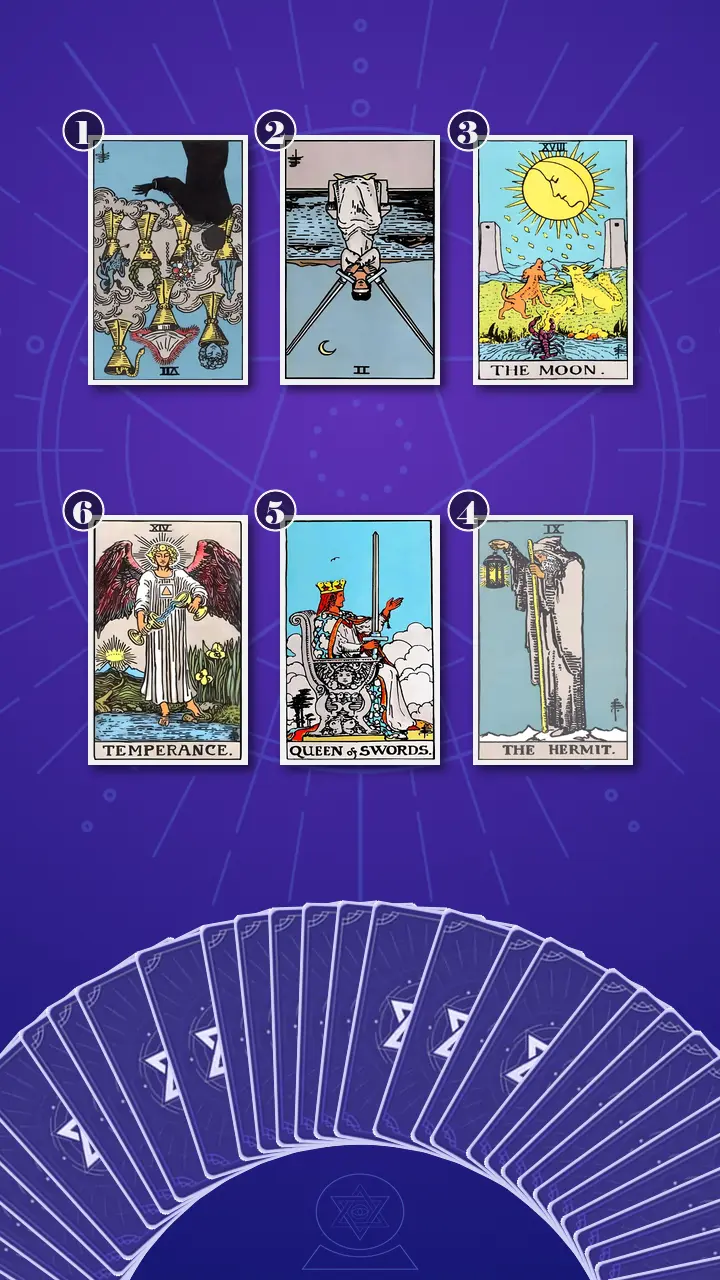
For this reading, I chose the Transformation Path Grid (6) · Context Edition, a six-card Rider-Waite-Smith spread designed to trace a self-reinforcing pattern from its visible behavior to its next workable practice. It suited Jordan because the question was not really which two clearly defined options to compare. The question was why a preference could not form while the stream of options remained open.
That distinction matters to anyone wondering how tarot can help with dating-app uncertainty. A classic decision spread might assume that the choices are already clear, while a broader Celtic Cross could add detail without showing the causal loop. This smaller layout follows present situation, blockage or obstacle, underlying cause, catalyst or turning point, guidance or action, and integration or next step. The cards would not decide whom Jordan should date. They would give us an objective set of visual prompts for separating observation from projection.
I explained that the top row would show the pattern as Jordan experienced it: profile accumulation, postponed judgment, and unclear inner signals. The lower row would show the return of agency: a deliberate pause, clear language and boundaries, and a moderate rhythm that could hold both curiosity and discernment.
The Feed, the Freeze, and the Fog
Position 1: The Seven of Cups and the Feed of Maybe
“Now I’m turning over the card for the present situation,” I said. “This position shows the visible pattern operating right now.” I turned the first card. It was the Seven of Cups, in reversed position.
The seven floating cups immediately gave me the image of an app feed where every new profile appears to contain a different answer: chemistry, safety, novelty, emotional availability, status, or an imagined future. In Jordan’s real life, at 8:47 p.m. after work, they might open the app intending to answer one promising match, then scroll through thirty-five profiles without reading the prompts. Some profiles seemed funny, some attractive, some emotionally available, and some simply new. The more cups appeared, the harder it became to tell whether interest belonged to the person, the fantasy, or the relief of having another possibility.
Reversed, the card showed blocked discernment: an excess of options and a deficiency of a personal criterion. The energy had passed the point of useful discovery. Like the endless-autoplay logic of TikTok or Instagram Reels, the next item was always available, but availability was no longer the same as meaning. I said, “Swiping is useful until it becomes a way to avoid your own answer. More options can keep you open while making you harder to hear.”
Jordan gave a short, bitter laugh instead of nodding. “Damn, this is exactly what I do. I call it staying open, but I am mostly avoiding the moment when I have to say what actually feels good to me.”
I let the recognition land without turning it into a character judgment. “I don’t hear a flaw here,” I said. “I hear a strategy that briefly lowers the volume of uncertainty. We can understand what it protects without asking you to delete the app, choose a person, or perform certainty before you have it.” Jordan looked back at the seven cups, their shoulders still lifted, but their thumb finally resting in their lap.
Position 2: The Reversed Two of Swords Beneath the Unread Message
“Now I’m turning over the card for the blockage or obstacle,” I said. The card was the Two of Swords, in reversed position.
I read the blindfold and crossed swords as the moment when comparison protects Jordan from choosing, while also preventing their judgment from being tested. A match could send a thoughtful question at 9:16 p.m.; Jordan would read it from the lock screen, compare that profile with four others, and leave the message unopened. The app would be active, but the actual decision would be frozen. Reversed, the Two of Swords was not peaceful neutrality. It was information overload, borrowed opinions, and a mental stalemate crowded with movement.
“I am not saying no; I am just gathering more information,” Jordan said, almost before I finished. I heard the sentence as the card’s modern translation. It protected them from the possibility of a wrong choice, but it also kept their own answer untested. I pointed to the still water behind the blindfolded figure. “There is a lot happening on the screen,” I said, “but underneath it, the decision is holding its breath.”
Jordan’s breath stopped for half a second, and their thumb hovered above the dark phone as if an unread message were still glowing there. Their eyes drifted beyond the table, replaying some old comparison loop, and then a long, uncomfortable exhale moved through their chest. Their fingers loosened around the edge of the chair.
“The app can give you data,” I continued, “but it cannot choose what kind of communication feels respectful to you, what pace feels reciprocal, or which discomfort is worth exploring. We don’t have to answer the message now. I only want to notice which decision the postponement is protecting.”
Position 3: The Moon and the Story Filled In by Low Light
“The third card is for the underlying cause,” I said. “It shows the deeper condition beneath the visible loop.” I turned the card and found The Moon, in upright position.
The winding path between the two towers gave me the gap between what a profile actually says and the story Jordan builds around it. I asked what happened on the Sunday when a former classmate’s relationship hard-launch appeared on Instagram. Jordan had seen the post, felt their chest drop, and reopened an app they had deleted the night before. The winter light in their apartment had been gray; a delivery truck had hissed outside; the feed had become a way to prove that possibilities still existed.
The Moon did not predict a secret outcome or warn of an inevitable disappointment. It showed incomplete information becoming projection. A neutral message could start to feel like perfect potential or obvious rejection. A quiet evening could be interpreted as proof of loneliness. Someone else’s engagement announcement could become an invisible deadline. The dog and wolf beneath the uneven moonlight represented the different voices Jordan was trying to distinguish: genuine desire, fear of missing out, imagined expectations, and the need for reassurance.
I thought of my work as an artist. I have watched a scene filmed in blue light make an ordinary doorway look threatening; the camera has not discovered a fact, it has changed the frame. “The question is not whether your feeling is real,” I told Jordan. “The question is what the feeling is responding to. What do you actually know? What are you projecting? And what do you feel when the feed goes quiet?”
Jordan’s gaze settled on The Moon, and the tension around their mouth softened into something less defended and more exposed. They did not look relieved. They looked as if they had finally found the room where the noise was coming from.
The Lantern Made Room for One Honest Signal
Position 4: The Hermit’s Fifteen-Minute Circle of Light
“Now I’m turning over the catalyst or turning point,” I said. The card was The Hermit, in upright position.
The Hermit’s lantern did not promise to illuminate the whole future of dating. It created a small, usable circle of attention. I translated it into a fifteen-minute app-free pause after one conversation: phone face down on the table or inside a bag, no friend vote, no relationship podcast, no search for a better interpretation. The pause was not withdrawal and not a demand to disappear from dating. It was an active source of information.
“You do not need to know what you want from dating,” I said. “For fifteen minutes, you only need to ask, What did I actually feel, want, or not want in that conversation?” I watched Jordan’s hand move toward their phone and stop. The old question, What is the answer?, began to give way to a smaller one: What happened in me?
I asked Jordan to imagine the last train pulling away from a Toronto platform while they sat with the screen dark. The lantern would not show the whole city. It would show enough ground for the next step: a genuine wish to reply, a boundary they did not want to override, a need for rest, or simply the discomfort of not knowing.
Jordan took a careful breath. “Fifteen minutes sounds possible,” they said. “It sounds less like I’m giving something up and more like I’m checking whether I even want to go back.” I nodded. That was the catalyst: not a dramatic decision, but a pause that could reveal information the feed kept interrupting.
When the Queen’s Sword Named the Signal
Position 5: The Queen of Swords and the End of Borrowed Options
The room became very quiet when I reached the guidance or action position. Rain moved lightly against the window, and the phone between us stayed face down. I turned over the key card: the Queen of Swords, in upright position.
Her raised sword gave Jordan a clear way to separate observation from fantasy, while her open hand kept discernment from becoming emotional shutdown. I read the upright energy as balanced clarity: honest language, self-trust, and respectful boundaries that remained receptive to curiosity. In practical terms, Jordan could write three experiences they wanted to feel in a connection, such as consistent communication, room for curiosity, or ease around honesty, and one boundary they would not override.
I returned to the late-night message asking, “What are you looking for?” Jordan’s inner monologue had been, I could answer if I were certain, but maybe I have been waiting for certainty to answer for me. Keeping every profile technically available had felt like openness, but it had also prevented any preference from becoming visible. The Queen’s sword did not order Jordan to close every door. It asked them to stop handing the app the keys.
This was the moment when I used my Narrative Fork Analysis. I placed two competing plotlines in front of Jordan. In the first, the protagonist keeps collecting profiles until an external option finally delivers certainty. In the second, the protagonist names one honest signal and tests it in one small interaction, knowing the result may remain provisional. I did not ask which plotline guaranteed a relationship. I asked which one genuinely served Jordan’s ultimate character-growth arc.
I also named what I call Safe-Choice Sabotage Recognition. The seemingly logical choice to stay open to everyone, gather more evidence, and avoid a preference was not neutral anymore. It had become a defense mechanism against the necessary inciting incident: saying what felt meaningful before knowing exactly where the story would go. “The next scene does not require you to choose a person,” I said. “It asks you to choose whether your own response gets a speaking role.”
I asked Jordan to picture 8:12 a.m. on Toronto’s Line 1: their thumb kept moving after they had stopped reading, while closing the app felt louder than the train. Then a message asked, “What are you looking for?” The uncertainty they had been swiping past became impossible to ignore.
You do not need to keep every profile available to prove that you are open; use the Queen's upright sword to cut through borrowed options and state one preference before you swipe again.
I let the sentence remain in the room. Jordan did not nod. Their breath caught, their thumb hovered above the dark phone, and their eyes fixed on the sword before losing focus as though the unopened message had begun playing again. A flush rose under their cheekbones. Their shoulders stayed high for one beat, and their fingers curled around the chair edge.
“But doesn’t that mean I’ve been doing it wrong?” they asked. There was a brief edge of anger in the question, not because the insight was cruel, but because it touched the protection that had kept them moving. I said, “It means a strategy protected you when uncertainty felt exposed. You can thank it without letting it choose the next scene.”
Their grip loosened. A long breath moved out of their chest, and their jaw released, though their face held the pale, slightly dizzy look of someone who has put down a weight and discovered the room is still there. Their eyes grew bright. They gave a small, uneven laugh, then lowered their voice. “I could answer if I were certain, but maybe I have been waiting for certainty to answer for me.”
I watched relief arrive with a new vulnerability beside it. Jordan was not suddenly certain, and I did not want them to be. The empty space after a familiar habit can feel strangely large. “Now, use this new lens to think back over last week,” I asked. “Was there a moment when this insight might have made you feel differently?”
What shifted was small but decisive: from compulsive option-seeking, loneliness, and fear-driven indecision toward clear discernment, selective engagement, and steadier self-trust. Jordan was not solving dating. They were beginning to let one honest preference guide one small choice.
Keeping the Door Open Without Handing Over the Keys
Position 6: Temperance and a Dating Rhythm That Can Breathe
“The final card is for integration or the next step,” I said. I turned it over. It was Temperance, in upright position.
The angel blending water between two cups showed Jordan how curiosity and discernment could share the same routine. One foot stood on solid ground and one in flowing water, a practical image of staying open without abandoning limits. The card did not call for deleting the app, declaring a permanent type, or exhausting every possibility before resting. It suggested a repeatable rhythm: a modest browsing window, one promising conversation given focused attention, and a short check-in before returning to the feed.
I pointed out how the visual story had changed. The early cards hid or complicated perception through floating cups, a blindfold, and moonlit projection. The Hermit introduced a contained lantern. The Queen gave the signal a clean line and a name. Temperance let the water move without flooding the whole room. “The goal is not to eliminate uncertainty,” I said. “It is to stop letting uncertainty run every minute of the interaction.”
Jordan looked at the six-card grid, following the path from the crowded upper row down through the lantern, the sword, and the blended cups. “So I can stay open,” they said, “but I don’t have to stay endlessly available.”
“Exactly,” I said. “Keep the door open; stop handing the app the keys. You are still the person writing the next act.” Jordan’s shoulders lowered. The movement was not dramatic, but it changed the shape of their breathing.
From More Options to a Steadier Inner Voice
I gathered the cards into one story. The Seven of Cups showed the visible habit: more profiles briefly distracted Jordan from uncertainty and loneliness, then made their preferences harder to hear. The reversed Two of Swords revealed the blockage beneath it: postponed judgment disguised as open-mindedness, with borrowed opinions and extra data standing between Jordan and a real response. The Moon showed how social comparison and incomplete information filled the quiet with stories about desirability, safety, and what a successful dating life was supposed to look like.
The Hermit offered the first interruption, not through isolation but through a limited circle of attention. The Queen of Swords turned that private observation into clear desire language and a boundary. Temperance made the change sustainable. The core contradiction was no longer mysterious: Jordan had been trying to discover what they wanted by keeping every option alive, while fearing that stopping before certainty would expose a lack of trust in their own judgment.
I named the cognitive blind spot plainly. Jordan had been treating availability as openness, information as self-knowledge, and certainty as a prerequisite for honest interest. The transformation direction was a shift from collecting more profiles to pausing long enough to name one felt preference and one boundary before the next swipe. The cards offered a map of attention, not a verdict about Jordan’s future.
I gave Jordan three pieces of actionable advice. Each one was deliberately small enough to test, revise, or set aside. None required a final type, a relationship outcome, or a performance of confidence.
- The Lantern-Then-Sword CheckAfter one dating-app conversation this week, close the app for fifteen minutes and leave the phone face down on the table or in your bag. Write three brief answers: What did I notice? What did I want more of? What did I not want to override?Use the pause as observation, not evaluation. You do not have to reply, make a decision, or return to the app when the timer ends.
- The Protagonist Pivot ActionWithin the next twenty-four hours, open the Notes app before a dating-app session and write three experiences you would like to feel in a connection, then add one plain boundary. Use the note to assess one existing conversation before asking a friend for an opinion.This is a creative mandate, not a dating manifesto. If three qualities feel like too much, write one. Ordinary words are enough, and the note can remain private.
- The Ten-Profile SignalFor one app session this week, view no more than ten profiles and stop at ten or when your attention drops, whichever comes first. Before closing the app, write one concrete quality that drew your interest, even if you are not ready to match.Treat ten as a ceiling, not a quota. If counting feels stressful, use a five-minute timer or close the app when your thumb starts moving without interest.
A Week Later, the Quiet Proof
Four days later, I received a message from Jordan. They had slept through the night after writing the note, but their first morning thought was, “What if I’m wrong?” Sunlight rested on the kitchen counter; they smiled, read one message once, and checked whether curiosity felt real before replying. The doubt stayed, but it no longer held the steering wheel.
I told Jordan that this was the first proof of the journey to clarity: not a perfect answer, not a magically obvious match, but a moment in which attention returned to its owner. The tarot had offered a structured mirror through the Transformation Path Grid. Jordan had supplied the honesty, the boundary, and the next choice. The cards did not write their fate; Jordan picked up the pen.
When the app finally goes quiet and your thumb still wants to move, it can feel safer to keep every possibility alive than to hear one preference clearly and risk wondering whether you can trust your own judgment. That quiet is not a verdict. It is the first frame in which your own signal can appear.
If one small preference and one boundary were enough for this moment, what might you notice in your body during a Lantern-Then-Sword check before deciding whether to stay curious, engage, pass, or close the app?