When Vulnerability Becomes Public Proof: Let One Exchange Answer Back

The 8:47 p.m. Post-and-Check Loop
I met Alex, a 27-year-old freelance social media editor and small London creator, at the point where performative vulnerability and the post-and-check cycle had begun to confuse audience attention with mutual belonging. They had spent the day shaping someone else’s vulnerable Reel into a clean, compelling story. By 8:47 p.m. on Tuesday, they were sitting on the edge of the bed in their shared flat, giving their own difficult feeling the same treatment.
I could see the soft filter reflected in their glasses as they joined our video call. The radiator clicked behind them. A takeaway coffee cup sat on the windowsill, and the phone screen cast a warm rectangle across their restless fingertips. They had added one carefully placed joke to the Instagram Story, taken it out, then added it again because the unsoftened sentence felt too exposed.
“I turned the feeling into something intimate enough to share,” Alex told me, “then waited for the audience to prove I wasn’t alone.”
The replies had been kind. Familiar usernames had sent hearts. Someone had written, “This is so real.” Yet each time the phone went quiet, Alex’s chest felt like a lit room they could see through glass but could not enter. Their throat tightened, their shoulders climbed toward their ears, and one hand kept reaching for another refresh before they had consciously decided to move it.
“I can make a private feeling look intimate without feeling close to anyone,” they said. “If I stop posting, I don’t know whether there’ll be anything left of the connection.”
I heard the contradiction clearly: Alex wanted genuine intimacy with online followers, but the safer and more polished the disclosure became, the more they feared that only the public persona was being welcomed. Their alienation was not an empty room. It was the more peculiar ache of standing outside a crowded digital room while hearing their own voice coming through the speakers.
“I’m not going to tell you that the warmth was fake,” I said. “I’m also not going to ask a comment section to prove something it was never designed to prove. Let’s use the cards to map the difference between being visible, being recognised, and being met. The goal is clarity, not a verdict on you or your followers.”

Choosing a Map Between Seen and Known
I asked Alex to take one slow breath and place the phone face down. I shuffled while they held one precise question in mind: “Why do I perform intimacy for online followers yet still feel outside?” The pause was not a mystical test. It was a practical transition from reacting to observing.
I chose the Relationship Spread · Context Edition, a six-card tarot spread for online intimacy and belonging. This is how tarot works best in my practice: not as surveillance into other people’s hidden motives and not as a fixed prediction, but as a structured way to separate observable facts, emotional interpretations, repeated patterns, and available choices.
I chose this spread because Alex’s problem was relational. A standard relationship reading can examine the self, the apparent relational field, what is offered, what is received, the central tension, and the available guidance. This Context Edition adds an important distinction: audience response may be visible and sincere without demonstrating mutual belonging.
I laid the first two cards at the top for Alex’s inner stance and the online community field as they experienced it. Beneath them, I placed two cards for what Alex offered and what they actually received. The fifth card would name the attachment where those paths converged. The sixth would act as a bridge, translating the reading into one bounded experiment in reciprocity.
“Nothing here will decide which followers care about you,” I said. “We’re staying with what you can observe and what you can choose.”
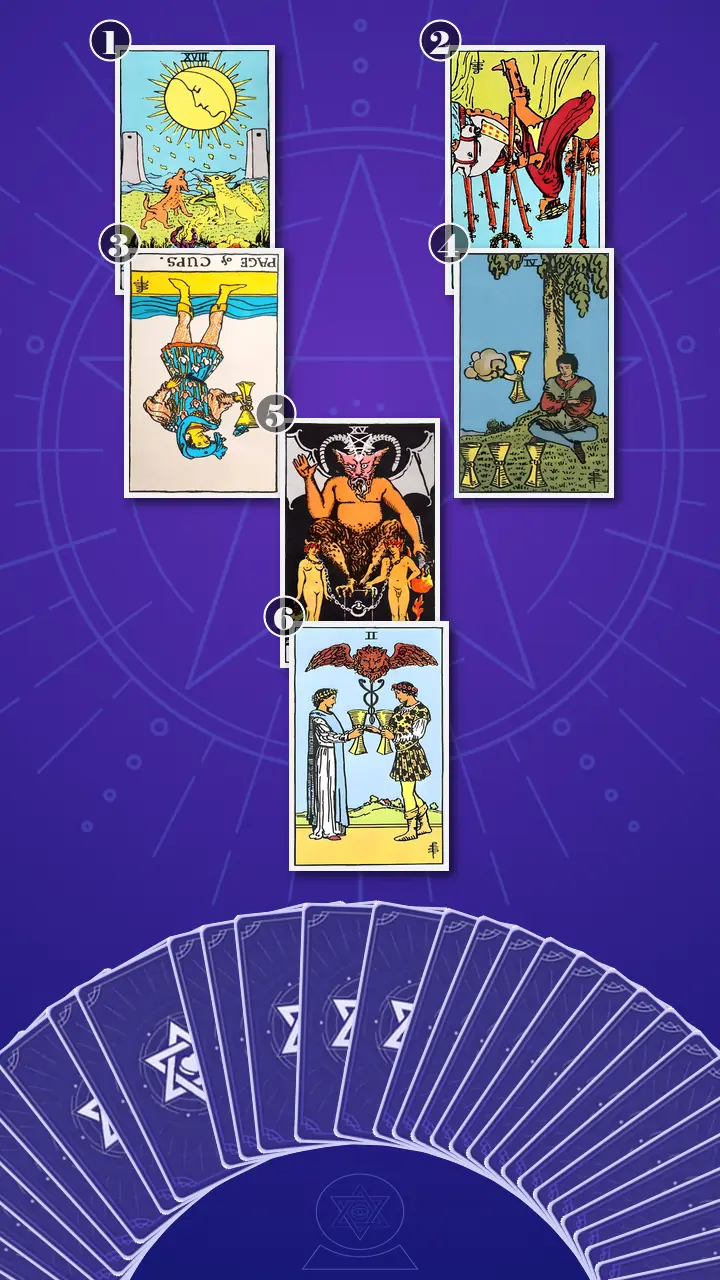
Reading the Two Paths Into the Loop
Position One: The Moonlit Gap Between a Note and a Story
I began with the card representing Alex’s inner stance and the self-concept beneath the question. I turned over The Moon, upright.
The winding path between the two towers immediately echoed Alex’s position between a private feeling and a public Story. Both contained something true. The problem was that Alex kept using views, replies, and familiar usernames to decide which version of the truth they could trust. Like the dog and wolf facing the Moon’s uncertain light, they moved between hope that the audience understood and fear that the persona was the only part anyone could reach.
I read this as an Excess of interpretation combined with a Deficiency of direct evidence. The Moon’s ambiguity was not proof that the connection was false. It showed that comments and view counts left enough blank space for hope and fear to write competing stories. Checking the same screen again could increase the volume of the signals without making their relational meaning clearer.
“When you’re about to post something difficult,” I asked, “what does the post have to accomplish before you can relax?”
Alex’s breath caught. Their eyes drifted away from the screen as if they were replaying the last dozen uploads, and then they gave a short, bitter laugh. “That’s so accurate it feels almost cruel. It has to make people stay.”
“The cruel version would be treating that fear as a fact,” I replied. “The Moon asks us to label uncertainty as uncertainty. It does not ask us to obey it.”
Position Two: A Laurel Made of Notifications
I moved to the card representing the parasocial community field as Alex experienced it through comments, messages, group chats, and recurring audience rituals. I turned over the Six of Wands, reversed.
In the upright image, a rider carries a laurel through a crowd. Reversed, the public victory does not settle into durable confidence. I connected it to Alex posting a carefully framed confession on the journey home, watching likes, saves, and comments arrive, then comparing that response with another creator’s more enthusiastic thread. The post could perform well while Alex still felt no safer about where they stood.
The Fire of recognition was present, but it was caught in Blockage. Attention confirmed visibility, yet Alex asked it to confirm dependable care. At the same time, there was an Excess of scoreboard energy: every familiar username, reply speed, and comment count became a data point in a ranking that no one had formally created.
I asked Alex to separate one observable fact from the meaning their mind added. “A follower wrote a longer reply to another creator” was observable. “They would choose that creator over me every time” was an inference. The distinction did not erase the sting, but it stopped a public interaction from becoming an automatic verdict on Alex’s place in the community.
Their thumb rubbed the edge of the face-down phone. “So a high number can tell me the post landed,” they said slowly, “but it can’t tell me whether I have somewhere to go when there isn’t a post.”
“Exactly,” I said. “A laurel can show recognition. It cannot become a relationship by being counted more carefully.”
Position Three: The Feeling Edited Into a Format
I turned to the card representing what Alex offered through public vulnerability, especially the way a genuine feeling became audience-ready before it became a direct relational bid. I revealed the Page of Cups, reversed.
The fish emerging from the Page’s cup looked like the honest sentence that surprises Alex in a private note. In their daily pattern, that sentence was quickly given a hook, softened with humour, rewritten for maximum relatability, and scheduled for the hour when followers were most active. The emotional source was sincere. The route changed what could be received.
I described the reversed Page as a Blockage in the emotional message and an Excess of shaping around it. The audience could respond to a coherent Story, but the uncertain person underneath had not necessarily asked anyone for listening, company, reassurance, or a second question. The feeling had been made easy to consume before Alex had decided what it needed.
Seeing this card, I briefly remembered the Wall Street decks I used to review late at night. Raw uncertainty would be dressed in immaculate charts until the presentation looked more settled than the underlying position. Good formatting could make risk legible, but it could not remove the risk. Alex’s editing skill was doing something similar: protecting a tender feeling from friction while also protecting it from the conditions of genuine contact.
“What did you edit out of the last post?” I asked.
Alex looked down. Their fingers tightened, then released. “That I didn’t want advice or heart emojis. I wanted someone to ask if I’d eaten and whether I wanted company.”
“That is the original message,” I said. “The Page is not telling you to stop creating or never share publicly. It is asking you to let the original feeling exist before deciding which channel can actually receive it.”
Position Four: Kind Replies in the Wrong-Shaped Cup
I turned over the card representing what Alex received from the exchange and why visible engagement did not reliably become emotional nourishment. It was the Four of Cups, upright.
The seated figure’s crossed arms and the three cups already on the ground reflected Alex reading a stream of kind replies after midnight while the shared flat became silent. The comments were not worthless, and the people writing them did not need to be cast as insincere. Yet none of those replies necessarily created an ongoing, two-way relationship in which someone knew how Alex’s ordinary day had unfolded beyond the content.
I read the card as a Deficiency of relational fit rather than a deficiency of gratitude. The emotional signal was arriving, but it was not the shape of care Alex had been waiting for. A warm comment section is not automatically a mutual relationship.
“These people are being kind, so why am I still checking?” Alex murmured.
“Because gratitude for attention and hunger for reciprocity can coexist,” I said. “You don’t have to insult the kindness to admit it did not answer the deeper question.”
The muscles around their mouth softened. Their eyes glistened, but they did not look away this time. I asked what response would have felt more like someone knowing their ordinary day. After a pause, Alex said, “Someone asking a second question after the Story was gone.”
Position Five: The Refresh Asking the Wrong Question
I came to the card representing the central block maintaining the post-and-check cycle: Alex’s attachment to metrics, repeated disclosure, public recognition, and the promise that one more signal would finally prove belonging. I turned over The Devil, upright.
I told Alex immediately that I did not treat The Devil as a frightening omen or a judgment on wanting attention. In the Rider-Waite-Smith image, the chains around the two figures appear loose enough to be examined. The card makes a binding pattern visible so choice can return.
The modern sequence was precise: Alex posted a feeling, refreshed the dashboard, compared the comments, felt a brief lift, noticed the hollow chest return, and began drafting another intimate update. Each pass carried the same inner line: “Maybe one more refresh will tell me where I stand.” The analytics dashboard had become a stand-in relationship partner, promising a verdict about belonging while being structurally capable of returning only metrics.
The Devil showed an Excess of conditioned repetition and a Blockage around choice. The refresh was asking a relationship question that analytics could not answer. That mismatch mattered because it moved the shame away from Alex’s character and onto an observable loop that could be interrupted.
I also applied what I call Toxic Hierarchy Filtration. I use it to separate real interaction from the subtle status games that gather around professional and creator communities. I asked Alex to filter the scene into three layers: what a follower actually did, what the platform made publicly comparable, and what hierarchy story Alex supplied afterward. The follower’s longer comment was real. The visible ranking architecture was real. The conclusion that Alex occupied a permanently lower social tier was not established by either.
“Does this mean I should delete everything and disappear?” Alex asked. Their voice had a defensive edge, as if total withdrawal were the only alternative they could imagine.
“No,” I said. “That would leave the need for connection untouched and remove some genuine community with it. The loose chain is a boundary, not an exile. We only need one interruption large enough for you to notice what the ritual was promising.”
When the Two of Cups Faced the Crowd
Position Six: The Bridge From Being Watched to Being Met
I turned to the final card, representing the constructive next step: one bounded, self-directed experiment that could clarify belonging without forcing any follower to prove what they felt. The room seemed to contract into silence as I revealed the Two of Cups, upright. At that exact moment, Alex’s phone vibrated once against the duvet. They glanced at it, then deliberately left it face down.
The two figures on the card face one another and exchange cups. There is no crowd to impress and no scoreboard above them. Both people participate. Both can ask, answer, pause, be affected, and set a limit. I read this as Balance: the underused energy of reciprocity, consent, mutual recognition, and emotional presence.
In Alex’s life, the image translated into something deliberately ordinary. Instead of turning the next feeling into a broadcast, they could choose one trusted person and ask whether that person had ten minutes to listen. The exchange might be smaller and less polished than a comment thread, but it would contain observable mutuality. The post could be liked without anyone knowing what to ask next; a reciprocal conversation could leave room for both people to answer.
I asked Alex to picture 8:47 p.m. again. The Story still held warm replies, but the phone felt heavier as the room went quiet. They were rereading comments and trying to decide whether people had met them or only the version they had made easy to recognise.
You do not have to keep turning private feeling into public proof of belonging; let the Two of Cups' face-to-face exchange make intimacy mutual, bounded, and observable.
I let the sentence remain between us without rushing to explain it.
Alex’s breath stopped first. Their fingers hovered above the phone, completely still. Then their focus slipped past the screen as if they were watching a week of Stories, drafts, and unfinished direct messages replay somewhere behind it. Their pupils widened. The muscles along their jaw tightened, and a flash of anger crossed their face before their eyes began to redden.
“But doesn’t that mean I’ve been doing all of this wrong?” they asked. The words came out low and sharp. Their shoulders stayed raised, even as their hands slowly opened on their knees.
“No,” I said. “It means you used the safest available channel for a real need. Now you can see that the channel and the need are not identical.”
Alex released a breath that trembled at the end. Their shoulders dropped, but the relief left them briefly unsteady, as though setting down a heavy bag had revealed how tired their arms were. Clarity had brought responsibility with it: if they wanted a different shape of connection, they would have to risk one small, direct invitation that could receive a no, a later, or an imperfect answer.
“Now, with this new perspective, think back: was there a moment last week when this insight could have made you feel different?” I asked.
Alex remembered the unsent message inviting an acquaintance to walk near London Bridge. They had deleted it and uploaded a close-up video about loneliness instead. “I thought being seen by more people would make me feel known,” they said. “What I haven’t tested is whether one person and I can actually meet here.”
I then used my Network ROI Analytics framework to make the distinction concrete. I drew two columns. The first held audience-return signals: views, likes, recurring usernames, reach, and public recognition. The second held relational-return signals: a second question, remembered details, follow-through, consent, room for both people to speak, and the freedom to pause without performing warmth.
I explained that ROI here was not about extracting value from people or reducing friendship to a transaction. It was about identifying channel fit and energetic cost. A public post could offer high reach and genuine warmth while returning little evidence about reciprocal care. Repeated monitoring could also demand a high cost in tightened throats, disrupted sleep, comparison, and constant availability. The data did not prove that the audience was toxic. It showed that Alex’s belonging portfolio was heavily concentrated in a one-to-many channel that could not reliably supply the return they were seeking.
“Visibility can tell you who saw the window,” I said. “Reciprocity asks who came inside and stayed present.”
The Two of Cups did not guarantee that any particular person would respond well. It offered a better test. Audience warmth could be real attention without becoming mutual belonging. The shift began when intimacy was tested through one bounded, two-way exchange instead of repeatedly performed as public proof.
I named the emotional crossing plainly: this was one step from alienation driven by public proof-seeking toward grounded belonging through reciprocal connection. It was not a promise that Alex would never feel lonely again. It was the first moment in the reading when the difference between being recognisable and being relationally known became observable.
Drawing the Bridge in Ordinary Ink
I gathered the cards into one coherent story. Alex’s work had trained them to turn messy experience into legible content, and The Moon showed how that skill blurred the line between private feeling and imagined audience meaning. The reversed Six of Wands made recognition measurable but unstable. The reversed Page of Cups showed the original emotional message being polished before its need was named. The Four of Cups revealed why sincere warmth still failed to land. The Devil exposed the ritual that kept sending Alex back to the dashboard. The Two of Cups restored a neglected resource: direct language, consent, mutual participation, and the right to stop.
The core metaphor was no longer a person locked outside a digital room. I now saw two streams meeting at a small bridge. One stream carried public expression, creative identity, income pressure, and community. The other carried private need, ordinary friendship, and the wish to be known without producing something. The answer was not to drain either stream. It was to build a crossing between them.
I pointed out the cognitive blind spot: Alex had assumed that feeling hollow after a warm response meant the disclosure had not been honest, strategic, or intimate enough. The cards suggested a different explanation. More refined disclosure could increase recognition while leaving the underlying need unmet because the exchange remained one-to-many.
The transformation direction was therefore specific: move from using public disclosure to secure proof of belonging toward testing intimacy through reciprocal, bounded contact before making the feeling content. I gave Alex three small experiments, each designed to generate information without turning another person’s response into a verdict on their worth.
- Write the Private-First SentenceThe next time a difficult feeling becomes a caption draft, open a private note first and write one sentence beginning, “The part I edited out is…” Leave it untouched for ten minutes. Do not add a hook, joke, lesson, or publishable ending during that time.If ten minutes feels exposing, use a one-minute voice note and delete it afterward. The goal is to hear the original message before choosing a channel.
- Run the Two-Cup Check-InChoose one trusted person from an existing friendship, creator community, or offline acquaintance. Send: “I have a rough day in my head. Do you have ten minutes to listen, or would another day be better?” Keep the exchange private and notice whether both people can ask, answer, pause, and set limits. Afterward, record: “What was actually exchanged?” and “What did I imagine the audience needed to prove?”Send only the first message. A no, delay, or different time is information about capacity, not proof of exclusion. You do not need to explain everything.
- Use the Social Divestment PlanFor one low-stakes personal post this week, set a 24-hour reminder named “No analytics yet,” move the app off the first home-screen page, and mute one ranking-heavy creator thread for seven days. Make no exit announcement and post no indirect explanation. Redirect the first urge to check into three words: time, body signal, immediate thought.Start with a 60-minute pause if 24 hours feels unrealistic. This is a tactical reduction of high-drain, zero-return monitoring, not a demand to abandon social media or genuine community.
I described the last exercise as a quiet application of The Social Divestment Plan. On Wall Street, divestment meant withdrawing capital from a position that no longer justified its cost. Here, the capital was attention. Alex did not need a dramatic purge, a vague-posted farewell, or an aggressively detached persona. They could tactfully reduce their investment in one status-heavy ritual and redirect ten minutes toward a relationship capable of answering back.
“The cards have not ordered you to disclose less or connect more,” I told them. “They have shown you the costs and capabilities of different channels. You decide which feeling belongs where.”

A Week Later, the Second Question
Days later, Alex messaged me: the friend was busy Tuesday, then called Wednesday and asked a second question. Alex slept through the night. Their first waking thought was still, “What if I got it wrong?” This time they smiled and left the Story draft untouched.
I noticed what had changed and what had not. Alex had not solved online loneliness, secured a perfect friendship, or stopped caring about their audience. They had allowed one feeling to remain unperformed long enough to discover what mutual attention felt like in their body. The friend’s initial delay had not become a public referendum. It had remained what it was: a person with a full Tuesday who chose to return on Wednesday.
I did not credit the Two of Cups with making that call happen. The card supplied an image and a test; Alex supplied the courage, consent, message, and boundary. That distinction is central to every Journey to Clarity I guide. Tarot can organise the fog, but the querent remains the author of the next observable choice.
The Relationship Spread · Context Edition had not revealed a secret verdict about Alex’s followers. It had helped Alex separate audience engagement from reciprocal contact and move from being watched toward being met. The proof was deliberately small: one private sentence, one time-bounded invitation, one second question, and one night in which the phone did not have to decide whether they belonged.
If a post is still warm with comments but your chest goes hollow when the screen goes quiet, I hope you remember that wanting to be known does not make you needy, and recognising the limits of a broadcast does not make its warmth unreal. Noticing that you are caught between the editable version and the person behind it already means you are no longer standing at the beginning.
If one feeling could remain off-camera long enough to become a small Two of Cups exchange, whose name would you place beside it, and what second question would you quietly hope they ask after the post is closed?