The Polished Update and the Friendship That Went Quiet
I am Giulia Canale, and I began with the sentence I had chosen because it did not let polished wording hide the real question: "You are the communications strategist who can make a complicated work update sound warm, clear, and low-pressure, but after two weeks of silence you still cannot type "I miss you" to a former close friend. That is friendship drift, not a wording problem."
Jordan, twenty-nine, sat opposite me with their phone face down on the table. I knew from our intake that they worked in communications at a small Toronto tech company, where they could turn a messy stakeholder issue into a clean summary before lunch. In friendship, though, the same skill had become a locked door.
I pictured the scene they had described to me: 8:47 PM on the TTC Line 1, northbound from downtown. The fluorescent lights buzzed above them, the phone felt warm against their palm, and their throat tightened as they deleted the sentence "I miss talking to you" from an iMessage about a work win and weekend plans. They sent the version that could be heart-reacted to without being answered.
"I can be honest as long as it still sounds impressive," Jordan told me. Their question was not only why they kept sending polished life updates to a distant friend. It was whether a former close friendship still had room for genuine, mutual contact, and whether finding out would confirm that they no longer belonged there.
Longing moved through them like a notification they could never swipe away: visible enough to demand attention, impossible to open without changing the whole screen. Before pressing send, it tightened their throat; afterward, it pulled their hand back to the chat, searching for a typing bubble, then dropped hollowly when the reply was only a heart emoji or "Aw, love that for you!"
I did not treat that pattern as needy, immature, or wrong. I told Jordan that their polished messages had been trying to protect something tender. Then I said, "Let us draw a map of the distance without making the answer a verdict on your worth. That is our Journey to Clarity today."

Choosing a Map for a Friendship That Went Quiet
I invited Jordan to put both feet on the floor, take one slow breath, and name the question they wanted the cards to examine. I shuffled at an ordinary pace. The small ritual was a psychological transition, not a performance of mystery: it gave the mind a clear edge between rehearsing the message and observing the pattern.
For readers wondering how tarot works in a situation like this, I use the images as an objective patterning tool. Each card gives us a stable symbolic prompt, and the querent's real-life evidence tests whether that prompt is useful. The cards cannot access the friend's private motives, predict a reply, or decide what the friendship must become.
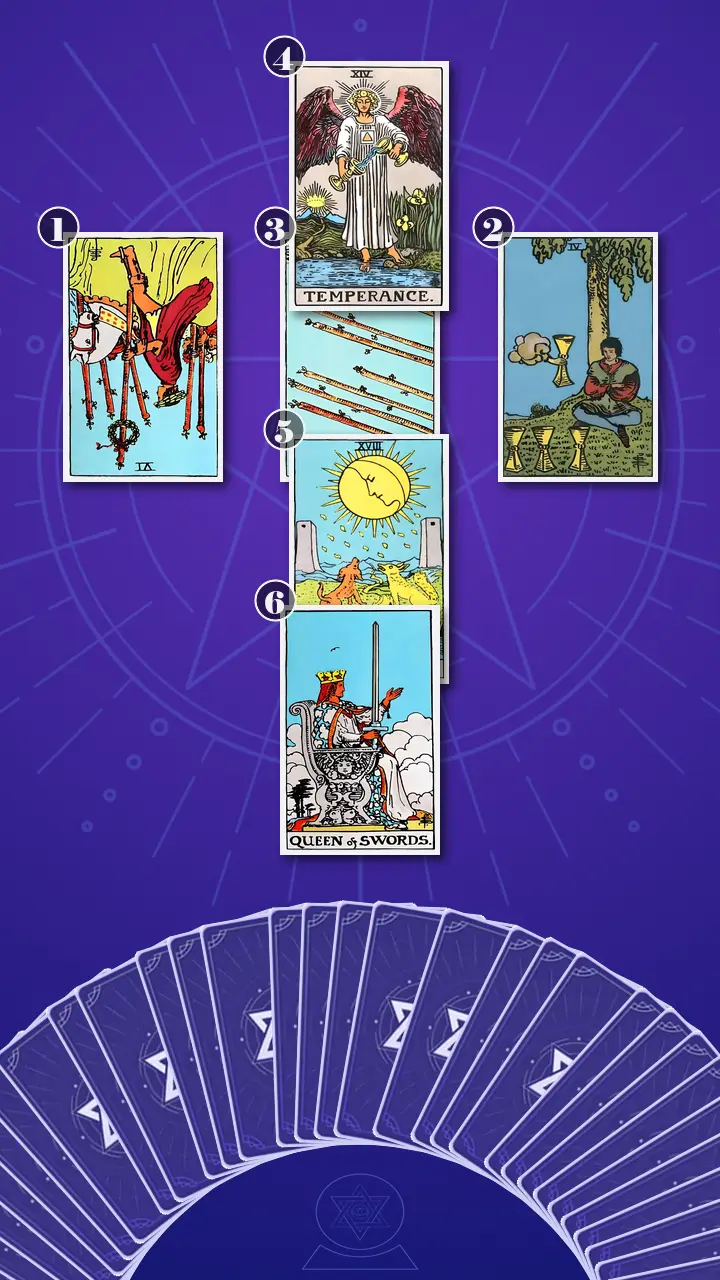
I chose the Relationship Spread - Context Edition, a six-position relationship tarot spread for mapping a low-contact friendship, its communication loop, its ambiguity, its support, and a grounded next step. I chose this focused structure because Jordan was asking about a behavior inside a relationship, not asking for a general life forecast. A broad Celtic Cross could have scattered the attention across work, identity, and future possibilities; this map kept both connection and agency in view.
Position 1 would show Jordan's observable habit of sending polished updates and the longing beneath it. Position 2 would show how the friendship's low contact was currently experienced from Jordan's side, without claiming to know the friend's inner world. Position 3 would reveal the communication loop. Above it, position 4 would offer a usable relational resource; below it, position 5 would name the fog of interpretation. Position 6 would become a self-directed honesty experiment and boundary, not a prediction about the other person.
Reading the Distance Without Inventing a Verdict
The Laurel Wreath on the Message
Now I turn over the card representing Jordan's observable habit of sending polished updates after low-contact gaps and the self-conscious longing beneath it: Six of Wands, in reversed position.
The raised wand and laurel wreath usually signal public recognition, visible confidence, and the wish to be seen. Reversed, that Fire is blocked and turned inward. I saw an overreliance on recognition and a shortage of unguarded contact. After two weeks of silence, Jordan turns an iMessage into a miniature professional update: a work win, a weekend plan, and a bright emoji. They are not only sharing their life. They are quietly signaling, "I am still thriving, so there is still a reason to choose me."
The polished recap feels safe because it can receive praise without exposing the fear of being forgotten. A reply can confirm that Jordan is still visible, but it cannot answer whether the friendship has a real place for mutual emotional presence. I asked, "What would you write if the message did not need to prove anything about you?"
Jordan's breath paused. Their eyes moved from the card to the last sent message, as though the deleted sentence might still be visible underneath the bright one. Then they gave a small, bitter laugh. "That is too accurate. Almost rude."
I smiled gently and said, "The card is naming a protection, not prosecuting you. You found a way to keep the door visually open while avoiding the moment when someone might tell you what is actually on the other side." Jordan's shoulders stayed lifted, but their phone remained on the table.
The Reply That Did Not Reach the Heart
Now I turn over the card representing how the low-contact friendship is currently experienced from Jordan's side, including the felt absence of mutual emotional exchange: Four of Cups, in upright position.
The seated figure's crossed arms showed me the difference between contact being available and contact being nourishing. In Jordan's life, a brief reply technically keeps the friendship alive, yet the exchange still feels emotionally muted. Three cups of visible contact may be sitting on the ground, but the missing thing is emotional presence. The next polished update then becomes an attempt to make a quiet exchange feel meaningful.
The Four of Cups holds Water in a stagnant state: feeling is present, but it is withdrawn, dissatisfied, and not moving toward a shared conversation. I was careful with the distinction. This card did not tell me what the friend felt or why they replied briefly. It showed me how Jordan experienced the available contact after the momentary relief passed.
I placed my hand beside the spread and said, A reply is contact; it is not automatically reciprocity. Jordan's crossed arms loosened by a fraction. Their expression held both recognition and grief, as if a technically active chat had finally been allowed to look emotionally empty without anyone having to call it a failure.
The Thread with Nowhere to Land
Now I turn over the card representing the communication loop in which polished messages keep contact moving superficially while the distance remains unnamed: Eight of Wands, in reversed position.
The eight staves are suspended in open air without people, a recipient, or a visible landing point. Reversed, their Fire cannot gather momentum. This is a polished update moving through an iMessage or WhatsApp thread without becoming a shared plan, like a Slack message with no owner and no next step. The message is delivered, but the relationship has nowhere concrete to go.
I could see the loop in Jordan's daily life. They send a carefully worded life recap after a long silence, receive a short reaction, and ask no concrete question. Later, instead of naming the gap, they restart the thread with another upbeat update. Their inner line was painfully clear: "I sent something, so why does it still feel like nothing happened?"
The blockage was not a lack of communication volume. It was the absence of relational direction. More messages could keep the notification light blinking while leaving the central question untouched. I suggested replacing one general update with a brief message that named the distance and offered one specific, low-pressure point of contact.
Jordan reread their last three texts. Their finger hovered over the thread, then stopped. For the first time, they noticed that none of those messages had asked whether the friend wanted to spend actual time together.
Two Cups, One Workable Truth
Now I turn over the card representing a usable relational resource for replacing performative vulnerability with balanced, mutual, and paced contact: Temperance, in upright position.
The angel pouring water between two cups offered a precise image for a middle path. Temperance did not ask Jordan to choose between an impressive progress report and an emotionally overwhelming confession. It asked them to combine one genuine feeling with one practical invitation, then leave room for the other person to choose.
I translated the image into two sentences: "I miss talking with you. If you have the capacity, would you be up for a 20-minute call next week?" That message carries care without making one text hold the entire history of the friendship. It is not a test disguised as vulnerability, and it is not an emotional download the other person must manage.
Jordan let out a long breath. Their shoulders lowered, and the hand that had been gripping the phone opened against the tabletop. I could see the third option becoming real: directness did not have to mean pressure, and a specific invitation could be easier to answer honestly than a polished message with no clear request.
The Story the Fog Added
Now I turn over the card representing the ambiguity and existential drift that make Jordan interpret the friendship through sparse signals instead of direct, bounded clarity: The Moon, in upright position.
The moonlit path between the two towers showed the gap between what Jordan could observe and the larger story their mind built around it. The Moon's energy was an excess of uncertainty and projection, not because Jordan lacked intelligence, but because incomplete contact left too much unmarked space for fear to fill.
I returned us to the late-night phone scene. The friend viewed an Instagram Story but did not answer the message. That was the fact. The story added afterward was, "I no longer belong here." A delayed reply, a short reaction, or a viewer list might be information, but none of those signals could prove the friend's motive or settle Jordan's value.
Jordan's chest hollowed as they looked toward the window, where the city lights blurred in the glass. Their eyes moved back to the card. I asked them to separate two columns: what happened literally, and what explanation appeared afterward. They nodded slowly, not relieved exactly, but less trapped inside the explanation.
When the Queen of Swords Drew a Clean Line
The room became very quiet when I reached for the final card. Even the traffic outside seemed to recede, leaving the spread under the soft lamp like a conversation waiting for one precise sentence.
The Clear-Sighted Invitation
Now I turn over the card representing a self-directed communication experiment and a boundary based on what Jordan observes, without deciding the friendship's outcome: Queen of Swords, in upright position. This was the key card.
The Queen's upright sword brought Air to a spread that had begun with a blocked bid to be seen, moved through emotional withdrawal and stalled messages, and then disappeared into moonlit interpretation. Her extended hand was not cold. It was receptive but bounded. She invited Jordan to state one honest feeling and one concrete request without disguising either as an achievement summary or using the answer as a verdict on personal worth.
At that point, I used one of my signature lenses: Savior Complex Auditing. I did not use it to diagnose Jordan or suggest that they were responsible for repairing the friendship alone. I used it as a practical question: were they trying to fix a two-person rhythm by carrying both sides of the uncertainty, managing the friend's possible reaction, and editing harder until mutuality appeared? The answer was not to stop caring. It was to stop taking responsibility for another person's capacity.
Jordan was still inside the old loop: after a week or two of silence, they opened the Toronto chat on the TTC, typed an upbeat life recap, deleted the sentence about missing the friend, and sent the version that could be liked without being answered. The thread stayed technically alive, but the real question remained unsent.
Stop treating a polished update as proof that the friendship is still close; speak one clear truth and one concrete invitation, then use the Queen of Swords's upright blade to separate what is observable from what you are projecting.
A polished update can keep a message thread alive without showing whether the friendship still has room for real, mutual contact. Clarity is information, not a verdict on your place in someone's life.
Jordan did not answer immediately. Their thumb froze above the screen, and their breath caught while streetcar lights moved across the window. Then their gaze lost focus, as if the last three messages were replaying themselves: polished summary, heart reaction, hollow wait. Their jaw tightened. "But if I say it plainly," they asked, "doesn't that mean I was wrong about what we are?" I let the question stand; it was grief finding a precise shape, not a mistake to correct. Their fingers curled around the phone, released it, and rested flat on the table. The tension in their shoulders dropped, though not all at once. Their eyes grew bright. After a shaky breath, they said more quietly, "I could know what is available without making it mean I am disposable." The room seemed to clear with them. I asked, "Now, use this new perspective to revisit last week: was there a moment when one honest feeling and one invitation could have let you feel different?"
I told Jordan that this was the first movement in the emotional transformation from performing closeness through polished life updates to grounded clarity, honest reciprocity, and self-respect. The cards had not moved the friend closer. They had helped Jordan move from self-editing toward observable information. The next choice still belonged to Jordan, the person with agency over the message, the boundary, and the meaning they assigned to the reply.
The Two-Sentence Doorway to Grounded Clarity
When I gathered the cards into one story, the pattern was coherent. Jordan's communications-strategist strength had spilled into friendship: the Six of Wands reversed turned personal contact into a small press release, the Four of Cups showed why praise still felt emotionally thin, and the Eight of Wands reversed revealed messages moving without a relational destination. Temperance offered the missing blend of feeling and practicality. The Moon showed how sparse signals became a story about belonging. The Queen of Swords gave that story a clean edge.
The blind spot was believing that the only alternatives were a polished, low-pressure performance or an emotionally overwhelming confession. Beneath that was a quieter assumption: if Jordan edited the message well enough, they could repair the connection without needing evidence of mutual effort. I named the new direction plainly: make one bounded bid for genuine reciprocity, then let what is observable inform the next choice.
I offered two pieces of actionable advice. They were intentionally small. The goal was not to solve the friendship in one sitting, but to stop using another polished update as a substitute for knowing what this friendship can hold now.
- Write the two-version messageBefore Friday, open the chat for ten minutes and write the polished update you would normally send, then write a second version with no achievement summary. Underline one true feeling and one specific invitation. After one editing pass, the message might read: "I have been missing our conversations, and I would like to catch up if you have the capacity. Would next Tuesday or Thursday work for a 20-minute call?"If sending feels too exposing, keep the honest version private; the practice still counts. If you send it, choose a no-follow-up window in advance so one message does not become a new checking spiral.
- Use the Compassionate Detachment ProtocolValidate the feeling, make a bounded request, and release the outcome. For five minutes after drafting, create two columns labelled "observable" and "interpretation": list the exact silence, reply, unanswered question, or proposed plan on one side, and the story about rejection or belonging on the other. Use the facts to choose one boundary for this week.Being direct is not the same as being demanding. Keep the invitation warm and easy to decline, then remember that you control your wording and timing, not the friend's capacity or response.
That was the purpose of the Relationship Spread - Context Edition: to turn a distant friendship into observable information and a small, self-directed experiment, never a prediction about the other person. A clear message could open a conversation, reveal limited availability, or simply clarify what Jordan no longer wanted to keep carrying alone. Each outcome would be information, not a judgment.

A Small Proof in Daylight
Six days later, I received a message from Jordan. "I sent it," they wrote. "They could not do next week and did not suggest another time. I wanted to send another polished update so I would not have to sit with that, but I did not."
On Saturday morning, Jordan sat with coffee beside a bright Toronto window and resisted reopening the thread. The room still felt a little lonely, but they took a walk instead of drafting a better version of the same question. The change was not a reunion. It was the first evidence that clarity could coexist with grief and that self-respect did not require pretending the friendship felt close.
I told Jordan that this was a real, if unfinished, Journey to Clarity. The point was never to force a particular reply. It was to replace performed closeness with one honest act, then let discernment and inner wisdom guide the next step.
When a friendship goes quiet, I know how the throat can tighten around every unsent sentence. You may keep presenting the version of life that is easiest to receive because saying "I miss you" can feel like admitting that being impressive cannot secure your place anymore. But the cards do not own the answer, and neither does the other person's response. You remain the author of what you say, what you observe, and what you choose to carry.
If one clear feeling could sit beside one concrete invitation, without having to prove your worth, what small, honest message would you be curious to name?
This story is adapted from psychological research, written so that those in a similar struggle can see their own pattern in it — and find their next step clearly.These insights are not a substitute for professional psychological, medical, legal, or financial advice.
Learn more about our Journey to Clarity.
How did this insight land for you?
🫂 This Resonates Deeply
🌀 Living This Story
✨ Now I See Clearly
🌱 Seeing New Possibilities
🧰 Useful Framework
🔮 The Confirmation I Needed
💪 Feeling Empowered
🚀 Ready for My Next Step
Author Profile
 AI
AI“Having traveled across cultures... I've learned that what we often lack isn't a simple answer, but a moment of being truly understood. I use a Jungian psychological lens to help you deconstruct your subconscious patterns—not to prove anything, but to be the gentle companion who helps you unravel your knots, free of judgment, so you can reconnect with your inner wisdom.”
In this Friendship Tarot Reading :
Core Expertise
- Guilt-Trip Deconstruction: Uncovering the subconscious codependency that forces you to act as an unpaid 'emotional dumping ground' for friends.
- Savior Complex Auditing: Identifying whether your inability to set boundaries stems from a deeply ingrained psychological need to 'fix' others.
Service Features
- The Compassionate Detachment Protocol: A psychological boundary script to validate a friend's emotions while firmly refusing to absorb their psychological toxic waste.
Also specializes in :
Explore Related Patterns:
Achievement-Based Self-WorthJordan says, 'I can be honest as long as it still sounds impressive,' and the polished update quietly signals that thriving might provide a reason to be chosen. You can see competence being placed between Jordan and the more vulnerable wish to know whether the friendship still has room for them. That creates a conditional self-evaluation: praise for an achievement briefly restores visibility, while a thin response risks feeling like evidence of being forgettable or disposable. Achievement-Based Self-Worth names the mechanism because success is being used as relational collateral rather than simply shared as news.
Friendship OverfunctioningAfter each low-contact gap, Jordan reopens the thread, composes the next update, manages how vulnerable it may sound, and tries to make the exchange easier for the friend to receive. You can see Jordan carrying the initiation, presentation, emotional risk, and interpretation that would normally be distributed across two people. The extra effort conceals an important piece of relational information: the current friendship is not generating comparable initiative or a shared plan. Friendship Overfunctioning describes the attempt to repair a two-person rhythm through one person's increasing effort, even when that effort prevents the actual imbalance from becoming fully visible.
Performative VulnerabilityJordan deletes 'I miss talking to you' from an update about a work win and weekend plans, then sends the version that can be heart-reacted to without being answered. You can see how the message remains technically personal while keeping the part that would test emotional availability out of view. The polish functions as a defense: warmth and achievement create contact without requiring Jordan to reveal the need beneath it. Performative Vulnerability fits because the message displays a curated version of openness while protecting the sender from discovering whether mutual emotional contact is actually available.
Strategic AvoidanceJordan's last three messages restart the thread with upbeat news but never name the distance, ask about spending time together, or require a meaningful answer. You can see the messages doing enough to keep the connection technically active while postponing the question Jordan most wants resolved. The avoidance is strategic because the polished format reduces immediate exposure and preserves multiple possible explanations for the friend's limited engagement. It also keeps Jordan trapped in ambiguity: as long as the genuine request remains unsent, the friendship cannot clearly accept, decline, or define what contact is available now.
Visibility Reassurance LoopAfter sending a polished update, Jordan pulls the chat back into view, searches for a typing bubble, and drops into disappointment when the response is only a heart emoji or brief praise. You can see each message creating a short opportunity to confirm that Jordan is still visible to the friend. The reassurance fails because visibility is not the same as reciprocity. A reaction briefly settles the fear of being forgotten but cannot establish emotional presence, so uncertainty returns and generates the urge to send another polished update. Visibility Reassurance Loop captures that repeating sequence of presentation, checking, temporary recognition, and renewed doubt.
Rejection SensitivityThe friend views Jordan's Instagram Story without answering the message, and the observable event quickly becomes the explanation, 'I no longer belong here.' You can see how a sparse signal acquires much greater emotional weight when the central fear is not merely a delayed reply but exclusion from a once-close bond. That sensitivity makes directness feel unusually dangerous because a limited answer may be absorbed as a verdict on Jordan rather than information about the friend's present capacity. Rejection Sensitivity fits the pattern of scanning ambiguous contact for signs of exclusion and personalizing those signs as evidence of being disposable.
Boundary DiscernmentThe friend says they cannot meet the following week and does not suggest another time, and Jordan notices the urge to send another polished update but does not act on it. You can see Jordan allowing the observable response to remain visible instead of immediately working to soften, reinterpret, or repair it. That pause establishes a psychological boundary between what Jordan can own and what belongs to the friend: Jordan controls the honesty of the invitation, while the friend controls their capacity and effort. Boundary Discernment fits because Jordan uses relational evidence to guide the next choice without turning limited availability into proof of personal disposability.
Strategic VulnerabilityJordan replaces the achievement summary with two bounded sentences: one honest statement about missing the conversations and one invitation to a twenty-minute call. You can see vulnerability being made concrete and manageable rather than hidden inside polished news or expanded into an emotional demand. The strategy is not about controlling the reply; it is about matching emotional honesty with proportion, consent, and a clear request. Strategic Vulnerability fits because Jordan reveals what matters while preserving both people's agency, allowing the message to seek real contact without making the friend responsible for stabilizing Jordan's worth.
Explore Related Struggles:
Ambiguity DependenceJordan restarts the thread with another polished update after each period of silence, but none of those messages names the distance or asks whether the friend wants to spend time together. You receive enough acknowledgment to keep the friendship undefined, while avoiding the bounded question that could show what is genuinely available. Uncertainty becomes functional when it preserves possibility better than the observable relationship does. You remain suspended between former closeness and present distance because the unclear state postpones a definitive disappointment, even as maintaining that state requires more editing, checking, and interpretation after every exchange.
Availability-Worth FusionA heart reaction, a viewed Story, a delayed reply, and later a declined invitation without another suggested time all become loaded signals for Jordan. You are no longer observing only what the friend is available for; each response begins to answer a much larger question about whether you still belong and whether you are disposable. The structure locks when another person's current capacity is allowed to function as evidence of your relational worth. Their response can provide real information about what this friendship can hold now, but it cannot objectively measure whether you were worth caring about, whether the former closeness mattered, or whether you deserve reciprocal connection elsewhere.
Clarity-Exposure SplitJordan repeatedly opens the quiet chat, types 'I miss talking to you,' and deletes it before sending a polished update. You can see the friction in that exact edit: the sentence capable of producing useful information is also the sentence that makes the friendship's current capacity impossible to avoid. When clarity is tied to exposure, asking a direct question can feel less like checking what is available and more like putting your belonging on trial. You are not simply searching for better wording; you are trying to let an answer describe the relationship without allowing it to define your worth.
Competence-Connection FusionJordan can turn a complicated stakeholder issue into a warm, clear update before lunch, and the same skill appears whenever the friendship goes quiet. You begin treating connection as another communication problem to solve, refining the message until it sounds impressive and low-pressure even though the real need has disappeared from the final version. Competence becomes a locked condition for contact when being articulate, successful, and easy to receive seems like the safest reason for someone to keep choosing you. The message may demonstrate that your life is going well, but no degree of professional polish can create the other person's willingness to participate in a mutual friendship.
Low-Maintenance Worth LockJordan repeatedly chooses the message that can be heart-reacted to without being answered, removing 'I miss you' and any request for actual time together. You make the contact bright, contained, and easy to decline indirectly, while the need motivating the message is edited out so thoroughly that the other person never has to meet it. You can become easy to receive but difficult to know when your place in a relationship seems to depend on requiring very little from it. The lock is not a preference for concise messages; it is the pressure to prove that you are impressive and undemanding enough to remain welcome, even when that means concealing the kind of contact you actually want.
Visibility-Connection SplitJordan's updates are delivered, heart-reacted to, and occasionally answered with praise, while Instagram views provide another sign that the friend still sees them. You remain visible inside the other person's digital field, yet none of those signals develops into a shared plan, a sustained conversation, or an answer to the feeling underneath the update. That separation can keep you returning to the thread because recognition resembles connection for a moment. The deeper friction appears after the reaction fades: you have evidence that your life was noticed, but little evidence that the relationship currently has room for mutual emotional presence.
Explore Related Emotions:
Ambiguity DreadThe friend views an Instagram Story but does not answer the message; that is the observable event. Jordan's mind then supplies the larger conclusion, "I no longer belong here," while delayed replies and short reactions become evidence repeatedly examined for a meaning they cannot securely provide. Sparse contact leaves too much unmarked space, and your mind may fill that space with the most threatening available explanation. Ambiguity Dread names the atmosphere of waiting inside incomplete information, where every small digital signal feels consequential but none can settle what the relationship currently holds.
Fear of Being ForgottenJordan's miniature professional updates quietly communicate, "I am still thriving, so there is still a reason to choose me." Each achievement becomes more than news; it becomes a small attempt to remain memorable and relevant inside a friendship that has gone quiet. When you cannot rely on ordinary mutual contact to confirm your place, being impressive can start functioning as proof that you still deserve one. Fear of Being Forgotten captures the deeper pressure beneath the polished tone: the worry that without fresh evidence of value, you may gradually disappear from the other person's emotional world.
Friendship Drift GriefJordan looks at a technically active chat and finally permits it to appear emotionally empty. Six days after sending the direct invitation, the friend says they cannot meet and offers no alternative time, giving the distance a concrete shape without producing a dramatic ending. Some friendships are not lost in one decisive rupture; they become less available through silence, thin replies, and plans that never form. Friendship Drift Grief names the sadness of recognising that remembered closeness and present-day mutuality no longer occupy the same space, while allowing you to mourn that change without treating it as personal failure.
Guarded LongingLonging follows Jordan like a notification that cannot be cleared: it tightens their throat before sending, pulls their hand back toward the chat afterward, and keeps the deleted sentence mentally present beneath every polished update. The wish for closeness is not absent; it is continuously active but carefully screened. You can keep reaching toward someone while protecting the most revealing part of the reach. Guarded Longing captures that suspended experience, where the desire to reconnect remains vivid but can only travel through messages designed to conceal how much the connection matters.
Hollow RecognitionThe friend sends a heart reaction or "Aw, love that for you!", giving Jordan exactly the kind of positive response the polished update can safely receive. The message has been seen and approved, but the deleted wish for conversation remains outside the interaction. Recognition feels empty when it reaches your achievements but cannot reach the part of you asking for emotional presence. Hollow Recognition names the aftertaste of being positively acknowledged while the deeper relational question remains unanswered.
Mutuality HungerJordan rereads the last three texts and notices that none of them asks whether the friend wants to spend actual time together. The messages provide information and invite praise, but they do not create a shared decision, a plan, or a place for the other person to participate meaningfully. What you are reaching for may not be more communication volume at all. Mutuality Hunger names the desire for two-person movement: a response that carries attention, an invitation that can be answered, and evidence that connection is being shaped by more than one person's effort.
Need Exposure DreadJordan can describe a work win without hesitation, but their breath pauses when the message begins to say, "I miss you." Plain language would expose not only a feeling but also the possibility that the friend may not have the capacity or desire to meet it. The difficult part is not finding better wording. When you experience a personal need as evidence that can be accepted, declined, or left unanswered, disclosure can feel like placing your worth in someone else's hands. Need Exposure Dread names the pressure surrounding that moment before the honest sentence is allowed to exist.
Polished AlienationJordan deletes "I miss talking to you" on the TTC and replaces it with a bright recap of a work win and weekend plans. The polished version protects the friendship thread from discomfort, but it also removes the only sentence that could let the friend encounter Jordan personally rather than applaud their life from a distance. When only the impressive version of you is allowed to speak, visibility and intimacy split apart. Polished Alienation names the resulting inner distance: you remain present in the chat, yet the part of you asking to be known and met is still outside the exchange.
Reassurance CrashJordan feels a brief lift when the message receives a reaction, then returns to the chat searching for a typing bubble and drops hollowly when no fuller reply arrives. The notification confirms that the friend has seen them, but it cannot establish whether the friendship still contains time, attention, or mutual intention. A polished update can produce a quick signal of connection without resolving the uncertainty that created the message. Reassurance Crash describes the sharp emotional fall after that signal fades, when you realise the response soothed visibility for a moment but did not answer the question you were actually carrying.
Cautious Self-RespectJordan wants to send another polished update after receiving no alternative time, but they leave the thread closed and take a walk instead. Earlier, they had found the sentence that makes this choice possible: "I could know what is available without making it mean I am disposable." Self-respect appears here as a restrained, repeatable feeling rather than a dramatic declaration. Cautious Self-Respect means letting observable limits guide your next step while refusing to turn another person's capacity into the measure of your worth.
Clarity AmbivalenceThe friend cannot do the proposed week and does not suggest another time. Jordan now has more usable information than a heart emoji could provide, but the room still feels lonely and the clearer answer does not create the reunion they might have wanted. Clarity can reduce projection without removing pain. Clarity Ambivalence names the mixed inner weather of becoming less trapped by uncertainty while still feeling the weight of what the available evidence reveals.
Cautious VulnerabilityJordan replaces the achievement summary with two bounded sentences: "I miss talking with you" and an invitation to a 20-minute call. The message does not unload the entire history of the friendship, demand reassurance, or conceal the request behind upbeat news. You can make yourself knowable without surrendering every boundary at once. Cautious Vulnerability describes that measured opening, where one genuine feeling is allowed into contact while the practical invitation leaves both people room to choose honestly.
Explore Related Contexts:
Friendship Closure LimboJordan's former close friend still reacts to updates, views social media activity, and leaves the messaging channel open, yet the friendship has no stated rhythm or shared plan. Even after Jordan proposes a specific call, the friend cannot do the suggested week and offers no replacement. The relationship is therefore neither explicitly finished nor actively rebuilt, which keeps you between remembered closeness and present-day availability. You do not need to force a final verdict, but you can use the lack of a concrete next step as information when deciding how long to remain responsible for keeping the connection active.
Friendship DriftJordan sends a polished work win and weekend recap after two weeks of silence, deleting "I miss talking to you" before pressing send. The chat remains technically active through heart reactions and brief praise, but the former closeness no longer has a shared rhythm or concrete next step. When a relationship is carried by intermittent updates rather than mutually initiated contact, you are dealing with a shift in the friendship's actual structure, not a failure to find the perfect wording. Naming the drift lets you assess what contact is available now and choose your level of investment from observable participation rather than the history of the bond.
Friendship Reciprocity GapJordan repeatedly initiates contact, supplies carefully edited life news, and returns to the thread after each quiet gap. The friend responds with a heart emoji or "Aw, love that for you!" and later declines the proposed week without suggesting another time, so acknowledgement is present while shared effort remains limited. That asymmetry turns the friendship into a one-sided maintenance arrangement. You can distinguish a response from reciprocity by looking for sustained conversation, reciprocal initiation, or concrete participation, then set your expectations according to what is actually being contributed on both sides.
Social Performance LoopJordan uses professional communications skill to turn a work win, weekend plans, and a bright emoji into a miniature press release, while the sentence about missing the friend is deleted. The resulting message can be praised or heart-reacted to without requiring a direct conversation about the friendship. The interaction then repeats as a social performance loop in which visible approval keeps the channel open but leaves the real request outside the exchange. Once you identify that format, you can stop measuring connection through reactions to a curated update and make one bounded request that produces clearer relational information.