Trading Secrets for Belonging—And How to Share One Layer at a Time

The 11:40 p.m. Vulnerability Hangover
If you are 26, working a junior hybrid job in London, and reaching for a private story whenever the group conversation goes quiet, I know how easily “being open” can turn into a midnight audit of whether you still belong.
Maya described that audit to me from beneath the cool duvet in her South London flatshare. It was 11:40 p.m. The radiator clicked in the dark, the blue light from her phone made her eyes ache, and the device had grown warm in her palm from reopening the same WhatsApp thread.
She had told the group about a painful memory because the chat had shifted into confessional mode; now she was counting heart reactions to learn whether the story had secured her place. She typed, “Sorry, that got deep lol,” deleted it, watched the typing indicator appear and vanish, then opened the thread again five minutes later.
“I can never tell whether we’re close until I tell them something real,” she said when we met. “But afterward, I feel like I’ve handed over leverage.”
I could hear the contradiction in the space between those sentences. Maya wanted a secure place in the group, but she feared that privacy would leave her standing at its edge. The need to belong had begun to feel like arriving at every gathering with pages torn from a private diary, ready to use as admission tickets. Before disclosure, her throat tightened. While speaking, she felt a bright rush. When the conversation moved on, her stomach dropped as if the floor had missed a step.
“I don’t think you’re wrong for wanting closeness,” I told her. “And I’m not going to tell you that vulnerability is bad or that your friends are secretly against you. I want us to separate what is actually happening from what fear predicts will happen. Let’s give this fog a map, then put the pen back in your hand.”

Choosing the Keyhole: A Five-Card Relationship Spread
I asked Maya to place her phone face down, feel both feet against the floor, and take one slow breath while holding the question: “Why do I keep trading personal secrets for a place in my friend group?” I shuffled slowly. For me, this is not theatre designed to summon a verdict. It is a psychological transition from reacting inside a pattern to looking at that pattern from the outside.
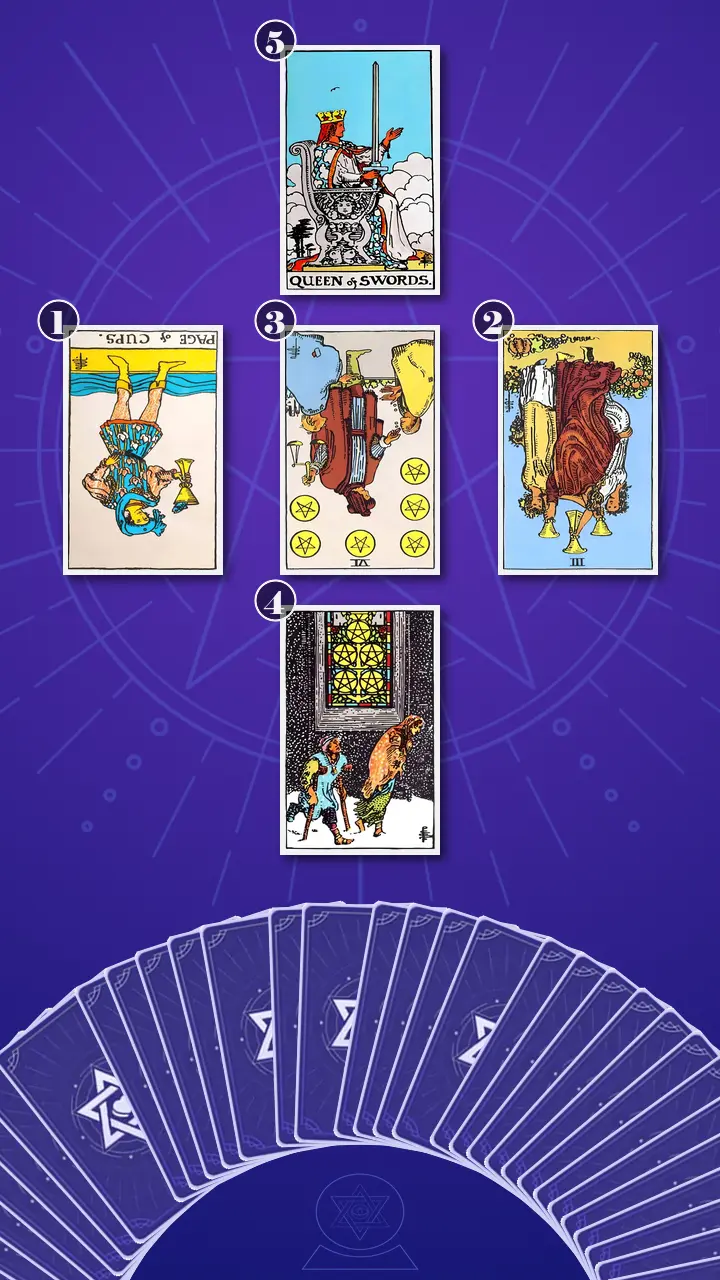
I chose a five-card Relationship Spread for friendship boundaries and belonging anxiety. This is how tarot works best in my practice: card meanings in context create a structured picture, not a fixed prediction. A larger spread would have added noise. These five positions could show Maya’s behaviour, the group culture as she experienced it, the exchange linking them, the fear beneath that exchange, and the healthier capacity waiting to be practised.
I arranged the cards like a keyhole. Maya’s role sat on the left and the group’s apparent role on the right. Between them, a central card would reveal the unspoken relational contract. Beneath it, one card would show the hidden root. Above it, the final card would offer a growth direction. The horizontal line would examine the visible social transaction; the vertical line would ask what fear kept it in place and what inner authority could rewrite it.
“The cards won’t decide whether these people are good or bad,” I said. “They’ll help us identify what you are doing, what you have actually observed, what you may be predicting, and what small boundary could produce better evidence.”
Reading the Social Script
Position One: The Feeling That Escapes Before Consent
I turned over the card representing Maya’s current role in the dynamic: the rapid disclosure, reaction monitoring, and unstable inner reference point that appeared whenever belonging felt uncertain.
It was the Page of Cups, reversed.
I pointed to the fish rising unexpectedly from the Page’s cup. “This is a private feeling appearing in public before you have decided whether the relationship is the right container for it,” I said. “The Page keeps staring at the cup, just as you watch everyone’s faces or notifications instead of checking whether you were ready to share.”
I brought her back to the Peckham pub scene she had described. The bass vibrated through a sticky table while two longer-standing friends traded breakup stories. A lull opened. Maya had intended to say only that an old relationship had been difficult, but she revealed a painful memory to the whole table. When the response was slow, she made a Fleabag-style joke about “character development” and added another detail to keep the emotional attention alive.
“It was basically, ‘I was only going to say I’d had a bad breakup, but nobody reacted, so I added the part that still hurts,’” she admitted.
The reversed Page showed emotional Water in a state of poor containment. Maya’s openness was sincere; the card was not accusing her of faking emotion. The blockage was that reception had begun to determine timing and depth. A real feeling was being performed for reassurance before quiet self-trust had been consulted.
Maya gave a brief, bitter laugh. “That’s so accurate it’s almost cruel.” Her fingers tightened around her mug, then loosened.
“Let’s be precise,” I said. “The card isn’t calling you cruel, immature, or needy. It is showing a skill you are still learning: a true feeling can deserve expression without belonging to every room.”
Position Two: When Confession Looks Like the Group Password
I turned over the card representing the friend-group culture as Maya currently experienced it, including its insider history, confessional pressure, and the possibility that she was interpreting a social habit as a compulsory rule.
It was the Three of Cups, reversed.
The ordinary version of this card celebrates friendship and mutual support. Reversed, its close circle can become unstable: cliques, gossip risk, or an overdependence on group approval. I was careful not to claim that every friend intended to gatekeep belonging. The card asked Maya to distinguish observable behaviour from the meaning anxiety assigned to it.
She had watched an ordinary WhatsApp update receive two reactions while a confidential revelation produced twenty animated messages, follow-up questions, and references to future plans. From her side of the screen, the contrast seemed to say, “Maybe this is simply how people earn access here.” Nobody had explicitly demanded a matching confession, but the warmer thread made silence feel socially expensive.
I call this kind of pattern Group Dynamic Rewriting. I listen for the invisible script beneath a conversation: who is expected to reveal, entertain, rescue, agree, or escalate so the group scene keeps moving. Maya’s script appeared to read, “When intimacy enters the room, match it quickly or risk disappearing from the scene.” The reversed Three of Cups suggested that the script was active, but not necessarily true.
“What did they actually require the last time this happened?” I asked. “And what did you predict their quiet would mean?”
Maya’s gaze moved away from the cards. “No one said I had to tell them anything,” she said. “I just saw how alive everyone became when there was something private to discuss.”
That distinction mattered. It did not absolve the group of responsibility for its culture, and it did not make Maya responsible for every awkward dynamic. It simply gave us a place where observation could replace mind-reading.
Position Three: The Social ROI Dashboard
I turned over the central card representing the relational contract linking secrets with access: the mechanism through which performative vulnerability had become an unequal exchange for reassurance and belonging.
It was the Six of Pentacles, reversed.
The figure on the card holds scales above an act of giving. Reversed, those scales expose unclear terms, conditional generosity, and an imbalance between giving freely and feeling required to pay. I saw Maya’s late-night WhatsApp screen in the image immediately. The coins had become replies, affectionate language, invitations, and insider status. The scales had become an engagement dashboard.
The morning after sharing, Maya audited whether a secret had produced enough social return. If the response seemed too small, she considered sending a clarification or revealing something more serious. Underneath the checking ran one exhausting question: “Was that enough, or do I need to explain more?”
Reversed Earth was blocked here. Privacy had become a resource spent under pressure, while attention had become the short-lived payment. Each transaction briefly soothed Maya, but it also taught her that the next feeling of exclusion might require a higher price.
“Your privacy is not the cover charge for friendship,” I said.
Maya stopped rubbing the edge of her sleeve. Her breathing paused; her eyes lost focus as though she were replaying several nights at once; then a low “Oh” left her chest.
I shifted the scale by asking a different question: “Would you still want them to know this if nobody reacted?”
She looked at the card for several seconds. “Sometimes yes,” she said. “But not the last one.”
That answer did not force a verdict on the group. It simply allowed her to stop paying automatically. A reaction is feedback, not a membership verdict.
Position Four: The Only Warm Room in London
I turned over the card representing the underlying fear sustaining the pattern: Maya’s belief that withholding private information would lead to exclusion and prove she had never fully belonged.
It was the Five of Pentacles, upright.
The two figures move through snow beneath an illuminated window. I asked Maya about the Instagram photo dump she had seen on a southbound Northern line train: a dinner she had not known about, shown on a bright screen while the brakes shrieked and damp coats pressed around her. Her jaw had locked as she checked every tag. Before the next stop, she was already selecting a personal story for the group chat.
“The thought was, ‘That is the only warm room, and I’m outside it,’” she said quietly.
The upright card made scarcity visible, but it did not predict social exile. It showed how the possibility of exclusion had become so physically convincing that almost any price for entry seemed reasonable. Long workdays, London costs, and limited energy for building other friendships made one group feel like the entire social map rather than one part of it.
I did not minimise the loneliness. An inside joke can make a table feel smaller in seconds. Learning about a plan through Stories can hurt even when there is an ordinary explanation. But when one cropped image becomes the only glowing window in the city, slower forms of care disappear from view: a friend keeping a plan, remembering a preference, accepting a no, or checking in without asking for privileged access.
Maya inhaled sharply and held it. Her eyes stayed on the stained-glass window while her fingers became still. When she finally exhaled, her shoulders dropped a fraction.
“I think I’ve been trying to prevent the loneliness before I can even find out what’s actually happening,” she said. “And I’m angry that it has cost me things I can’t take back.”
“That anger makes sense,” I said. “It may be the first part of you that understands your private life deserves consent too.”
When the Queen Raised the Sword
Position Five: Warmth Without Unlimited Access
The room became unusually quiet before I turned over the final card. Outside, a bus sighed at the kerb, and a thin opening appeared in the low London cloud, echoing the strip of clear sky painted behind the figure.
I turned over the card representing Maya’s growth direction: selective disclosure, explicit boundaries, and trust assessed through repeated evidence rather than instant emotional intensity.
It was the Queen of Swords, upright.
Her sword is vertical and exact. It separates what can be shared from what remains private. Yet her other hand is open. She is not withdrawing warmth, punishing the room, or pretending she has no feelings. Upright Air brings balanced discernment: clear language, internal criteria, and the ability to stay connected without granting unlimited access.
I pictured Maya at Sunday brunch saying, “I’m having a difficult week, but I’m not ready to share the private reason.” In that version of the scene, she stayed present, asked someone else a genuine question, and allowed the response to reveal whether the group could respect limited access. Selective honesty is still honesty.
As an artist, I could not see this as a cold instruction to “set boundaries.” I saw a blocking note in a film currently in production. Maya had spent too many scenes rushing to fill silence with a confession, as if an empty beat meant the audience had lost interest. The Queen introduced a different kind of performance: letting the silence remain long enough for other characters to reveal themselves.
In my Typecasting Analysis, I named the restrictive role Maya had been playing: the funny, emotionally fearless friend who moved every gathering into its next intimate act. The role had once helped her become visible, but the group’s familiarity with that character did not obligate her to keep performing it. The Queen was not recasting Maya as cold. She was recasting her as warm, truthful, and unavailable on demand.
At 11:40 p.m., Maya had been reopening WhatsApp to see whether a painful memory earned enough warmth to justify the exposed feeling in her chest. She was still caught inside the belief that there must be one correct disclosure, one perfect reaction, and one decisive moment that could finally certify her place.
Belonging is not bought by exposing more; choose deliberate honesty from an inner anchor, using the Queen's upright sword to decide what remains yours and her open hand to offer what trust has earned.
I let the sentence remain in the room. Then I translated it into the plainest version I knew.
Belonging is not something you have to buy with access to your private life; trust can earn the story one layer at a time.
Maya’s breath stopped. Her fingers hovered above the face-down phone, and her eyebrows drew together before her eyes brightened with sudden anger. “But doesn’t that mean I got all of this wrong?” she asked. “That I gave people leverage for nothing?”
“No,” I said. “It means you used a strategy that gave you fast contact when uncertainty felt unbearable. We can respect why you learned it without requiring you to keep paying its cost.”
I watched the thought move through her in three distinct waves. First, her body held still, shoulders high and jaw set. Then her gaze slipped past me as she replayed a recent brunch, her pupils widening when she reached the moment she had ignored her own hesitation. Finally, her fist opened against her knee. A long breath left her with a faint tremor, and her eyes reddened without spilling over. Relief arrived, but so did the unsteady blankness of real responsibility: if she no longer had to confess, she would have to decide what she actually wanted. “I could have said I was having a rough week and left it there,” she murmured. “I didn’t know that counted as honest.”
“Now, with this new perspective, think back to last week,” I said. “Was there a moment when this insight could have changed how you felt?”
She returned to the pub pause. “I might still have felt left out,” she said. “But I wouldn’t have had to turn that feeling into a story for everyone else.”
I set a ten-minute timer and asked her to write two versions of one current truth. The first was group-safe and named the feeling. The second held the full private reason. She did not have to send either version. If writing both felt exposing, the minimum version was one sentence: “I can name the feeling without sharing the cause.”
This was the decisive movement in the reading: from fear-driven oversharing and reaction monitoring toward deliberate vulnerability, selective trust, and steadier self-respect. It was not certainty, and it was not instant detachment. It was the first moment in which Maya’s own readiness returned to the decision.
Rewriting the Price of Admission
I read the spread back to Maya as one continuous story. The reversed Page of Cups showed a sincere emotional impulse escaping before she had chosen its container. The reversed Three of Cups showed a group culture in which confessional intensity appeared to receive more attention, although the group’s actual requirements remained untested. The reversed Six of Pentacles exposed the hidden contract: secrets were being measured against reassurance. Beneath it, the Five of Pentacles revealed why Maya accepted those terms. Exclusion felt like winter, and this one circle looked like the only warm room. Above the whole pattern, the Queen of Swords restored a standard that belonged to Maya.
The cognitive blind spot was not simply “oversharing.” It was the assumption that visible attention proved trust, while a muted reaction proved social failure. Maya had also mistaken a boundary for withdrawal, leaving herself only two roles: full confession or total silence. The cards offered a third option: honest feeling, limited detail, continued warmth, and observation over time.
“The shift is not from vulnerable to guarded,” I told her. “It is from using disclosure to test whether people accept you to sharing one layer at a time after someone has shown consistency, discretion, and reciprocal care. If a boundary changes the vibe, the change is information.”
I gave her three small experiments. The missing Fire in the spread mattered: insight needed one visible action before the old social script could begin to change.
- Make the three-level disclosure note.Before the next group plan, spend ten minutes in the Notes app under three headings: “Fine to share,” “Share one-to-one,” and “Mine for now.” Put one current topic under each heading so you are not deciding from inside a pressured pause.If three topics feel like too much, write only one item under “Mine for now.” Privacy does not require a courtroom argument.
- Try the Recasting Exercise.At the next brunch, drinks, or group hangout, intentionally interrupt the role of “confessional truth-teller.” Say, “I’ve had a difficult week, but I’m not ready to get into the private reason.” Let five seconds pass, then remain warm by asking a genuine question or joining an ordinary topic.Rehearse the sentence once in Notes. Use the minimum version, “Rough week, not ready to unpack it,” and leave if anyone becomes pressuring or mocking.
- Use the No-Reaction Test and Privacy Pause.When a personal story rises in the group chat, ask, “Would I still want them to know this if nobody reacted?” If the answer is no or unclear, type it into a private note and wait twenty-four hours before deciding whether to send a smaller version.After any personal message, mute the chat for thirty minutes and make tea, shower, or walk around the block. The minimum version is a ten-minute delay.
I reminded Maya that these were experiments, not moral tests. An ordinary group-chat update might feel flat because it would not produce the same rush as a confession. A friend might respond awkwardly to a boundary without being malicious. Another might become unexpectedly respectful. Maya did not need one perfect interaction to decide the entire future of the group. She only needed enough space to collect evidence without abandoning herself.

A Week Later, the Story Stayed Hers
Six days later, I received a message from Maya. At brunch, the conversation had turned personal, and someone had asked why she seemed tired. She had used the sentence exactly: “I’m having a difficult week, but I’m not ready to share the private reason.”
One friend had simply said, “Fair enough. Do you want company after this?” Another had moved the conversation toward a film they wanted to see. Nobody staged a dramatic affirmation, but nobody expelled her from the circle either. The five seconds of silence had ended without Maya sacrificing another chapter.
That night, she slept through. Her first thought the next morning was still, “What if they think I’m guarded?” This time, she smiled at the thought, left her phone face down, and made coffee before checking the chat.
I did not see that small change as the tarot performing magic. The five-card Relationship Spread had given Maya an objective frame for friendship boundaries, unequal emotional exchange, and fear of exclusion. Maya created the proof herself when she chose a different line in a familiar scene. The reading offered clarity; she exercised authorship.
Trust earns chapters; anxiety does not get to hand over the whole book.
When an inside joke makes a room feel suddenly smaller, I know how quickly a throat can tighten and how tempting it is to reach for the most private story available. If that happens to you, remember that noticing the impulse already places the pen back in your hand.
If you let one chapter remain yours the next time the conversation turns confessional, what might you become curious to notice about the people who stay warm without being handed the whole book?