The 11:48 p.m. Friendship Trial
If you have ever known that a friendship no longer fits but still needed a watertight case before leaving, I suspect you will recognize the question Jordan (name changed for privacy) brought to me: Why do I need my old friends to be wrong before I move on?
At 11:48 p.m., Jordan joined my video table from the edge of their bed in a shared Toronto apartment. The radiator clicked behind them, traffic hissed through the wet street below, and their phone looked hot in their restless hand. The old group chat was open. Three messages had already been copied into a Notes file titled Why I Am Done, and one thumb kept refreshing a newer friend's reply.
I know I've outgrown them,
Jordan said, their jaw tightening until the words seemed to pass through clenched teeth. But I still need to prove why. If nobody was clearly wrong, what gives me the right to leave?
I could hear how every screenshot struck like a tiny courtroom gavel beneath their ribs: one more exhibit, one more reason, one more chance to replace the hollow space in their chest with a clean verdict. I told them, You can outgrow a dynamic without putting every person in it on trial. I am not here to rule on your friends or tell you what fate has decided. Let's use the cards to sort the clutter, identify what your argument is protecting, and find a boundary you can actually trust.

Choosing a Staircase Out of the Courtroom
I asked Jordan to place both feet on the floor and take one unforced breath. I shuffled slowly, not as a performance of mystery, but as a practical transition from scrolling and prosecuting toward paying attention.
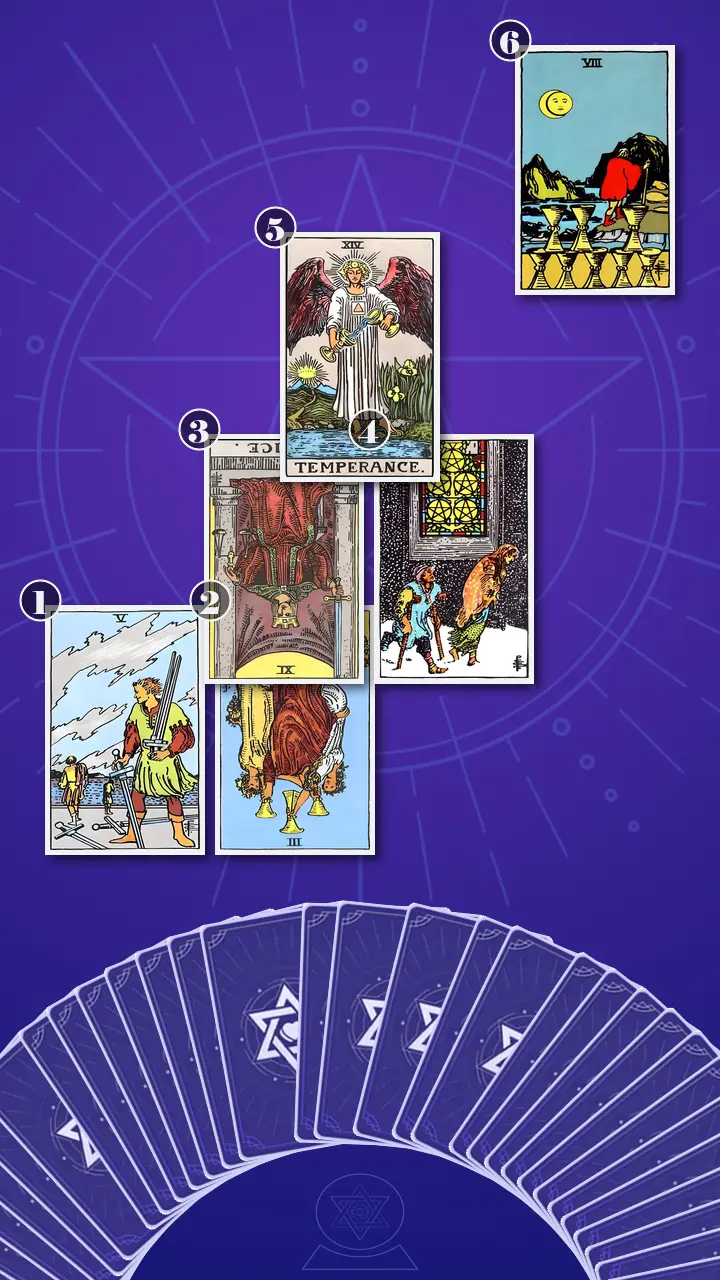
I chose the Four-Layer Insight Ladder · Context Edition, a six-card tarot spread for outgrowing a friend group without forcing the situation into heroes and villains. For anyone wondering how tarot works in my practice, I use a spread like this as an objective thinking structure. It does not reveal secret facts about absent people. It helps me separate visible behavior, relational consequences, protective reasoning, underlying fear, a possible reframe, and the next action.
I arranged the cards like a staircase rising out of a courtroom. The first two would show Jordan's visible pattern and its immediate social cost. The middle pair would expose the judgment process and the belonging fear beneath it. The fifth card would provide the leverage point, while the sixth would translate insight into one grounded boundary. The card meanings would matter only in context; Jordan would remain the person deciding what fit their reality.
Reading the Lower Rungs: Conflict, Community, and the Case
Position One: The Swords Still Being Collected
Now I turned over the card representing the present layer and visible symptom: collecting grievances and turning a social reset into a contest that must be won. It was the Five of Swords, upright.
I pointed to the central figure gathering discarded swords while two people were already walking toward the water. The separation is already happening in this image,
I said. But the person at the center is still collecting weapons.
In Jordan's life, the swords were screenshots. At 11:48 p.m., they already knew the group chat left them tense, yet they stayed on the bed arranging old messages into a sharper closing argument. The inner loop sounded like this: I already know I want distance, but I still need overwhelming evidence before I am allowed to act. The apparent victory was an airtight story. The cost was another evening still organized around the old circle.
I described this as an excess of Air: analysis, comparison, and verbal precision pushed past usefulness until thought became a weapon. The problem was not that Jordan had noticed real disappointments. The blockage came from asking those disappointments to authorize a decision they had already reached.
Jordan gave a short, bitter laugh. Their fingers stopped refreshing the screen, then curled around the phone again. That is painfully accurate. I keep calling it clarity when it is really a closing argument.
That recognition is enough for now,
I said. Friendship-breakup rumination does not make you cruel. It may mean you are trying to borrow certainty because trusting your own limit still feels dangerous.
Position Two: When Support Becomes a Loyalty Poll
Now I turned over the card representing the present layer and immediate cost: the way alliance testing and whole-group rejection can disrupt supportive connection during a friendship reset. It was the Three of Cups, reversed.
The linked figures and raised cups usually show shared joy. Reversed, their closed triangle reminded me of a group chat becoming a loyalty poll. Jordan sends selected snippets to a newer friend and waits for a response strong enough to certify that the old circle was unhealthy. If the answer is merely, That sounds complicated,
another incident gets added. The unspoken request becomes: Tell me I am not imagining it. Tell me they are the problem. Tell me I can go.
Here, Water was blocked. Support could not flow freely because it had been given a condition: agreement. The same group pressure Jordan wanted to escape was quietly reproduced in a newer friendship, with belonging once again dependent on choosing the correct side. Treating the old circle as one moral unit also erased the possibility that different people might need different levels of access.
Jordan's shoulders rose toward their ears. They looked away from the cards and rubbed a thumb along the phone case. I thought I was asking people to support me,
they said. But I get annoyed when they don't agree all the way.
Support can witness your experience without serving as a jury,
I replied. You get to ask for care, perspective, or company. None of those requires someone else to deliver a unanimous verdict.
Position Three: Justice After the Verdict Was Chosen
Now I turned over the card representing the root layer and protective mechanism: moral certainty used to authorize departure and keep Jordan's identity locked in opposition to the group. It was Justice, reversed.
I showed Jordan the inverted scales and sword. In ordinary life, this looked like the six-paragraph exit draft that catalogued every slight and anticipated every rebuttal. Observable events, interpretations of motive, and conclusions about character had merged together because the message needed to prove that leaving was morally correct. The simple present truth, I do not want to keep participating in this dynamic,
had disappeared beneath the prosecution.
I asked Jordan to imagine a product-design critique in which the conclusion had been selected before the research was sorted. Screenshots became exhibits, silence became proof, and kind memories were marked inadmissible. The algorithm had learned that outrage produced a moment of certainty, so it kept serving the same memories whenever doubt appeared. Justice reversed showed imbalanced Air: reasoning was active, but the scales were being loaded toward a preferred result.
After twenty years of conversations over cooling coffee, I have learned to listen for the moment when a beautifully organized case is carrying a very small, very human sentence: I don't want this anymore, and I am frightened that this reason is not respectable enough. That thought returned to me as Jordan stared at the card.
Their breath became shallow. Their chest lifted and stayed there while their eyes moved back over the fact-versus-interpretation distinction. If I let one good memory into the record,
they asked quietly, won't the whole boundary collapse?
No,
I said. A good memory may complicate the history. It does not get to overrule your present limit. Accountability can include your part without becoming self-prosecution, and fairness does not require continued access.
Position Four: The Empty Weekend Beneath the Anger
Now I turned over the card representing the root layer and underlying fear: social exclusion and the loss of a stable place to belong. It was the Five of Pentacles, upright.
The two figures walked through snow beneath an illuminated window. I asked Jordan about the rainy Sunday they had described to me: two blank weekends in Google Calendar, the refrigerator humming in a quiet kitchen, and an Instagram Story showing the old group laughing at a familiar bar. The empty space had felt less like a temporary gap and more like a forecast of permanent loneliness.
This was an Earth deficiency, the felt scarcity underneath the argument. Fewer notifications, familiar places that seemed socially claimed by someone else, and no immediate answer to Who are your people?
made a simple boundary feel like social freefall. The moral case offered temporary shelter by making exclusion feel chosen, controlled, and deserved.
I asked, What if the case is protecting you from having to feel the gap between groups?
Jordan's hand went still. Their eyes lost focus as if the blank calendar had appeared behind the card; then their chin lowered and a long breath left their chest. The empty Saturdays,
they said. That is the part I don't tell anyone. I make myself angry before I have to admit I might miss being included.
Anger gives ambiguity a villain; it does not always give grief somewhere to go,
I said. Naming the loneliness does not mean the boundary is wrong. It means we have finally reached the feeling the courtroom was built to avoid.
When Temperance Kept Both Cups
Position Five: The Antidote to a Guilty Verdict
The room seemed to settle as the radiator stopped clicking. Now I turned over the card representing the transformation layer and leverage point: the ability to integrate appreciation, disappointment, responsibility, and incompatibility without forcing them into a single verdict. It was Temperance, upright, the key card of the reading.
I centered the two golden cups, the water moving continuously between them, and the figure standing with one foot on land and one in water. This was balanced energy: reason and feeling remained distinct, but neither had to erase the other. In Jordan's modern life, it was a blank note with two columns, What was real and meaningful beside What no longer fits.
Jordan was still caught in the 11:48 p.m. equation: the chat was open, three screenshots were waiting, their jaw was locked, and somebody else's agreement seemed necessary. If the old circle had offered real care, they feared that leaving would become disloyal. If leaving was valid, they thought the care had to be disproved.
You do not need a guilty verdict to justify a boundary; hold what was real and what no longer fits at the same time, as Temperance keeps two cups in one continuous exchange.
I let the sentence rest between us, then translated it once more: You do not need to prove that the whole circle was bad to know that the relationship no longer fits. A boundary can be valid without a guilty verdict.
Jordan's breath stopped first. Their fingers hovered above the phone as if the next refresh had been interrupted mid-command. Then their gaze slipped beyond the screen, replaying something I could not see. Their brow tightened instead of softening. But doesn't that mean I was wrong?
they asked, the words sharper than before. That I wasted months building this case and dragged new people into it?
It means the case was trying to protect something real,
I answered. The fear of being disloyal, mistaken, and left without a place to belong. You can take responsibility for jury recruitment without declaring yourself guilty either. We are replacing an exhausting strategy, not condemning the person who used it.
Jordan's fist slowly opened. Their jaw released, their eyes shone, and a wavering exhale came from deep in their chest. Relief arrived with a brief, unsteady pause, the dizziness of realizing that clearer choices would now belong to them.
I asked, Now, with this new perspective, think back to last week. Was there a moment when this insight could have made the experience feel different?
On Line 1,
Jordan said. I saw their Story at the bar. Some of them did care about me, and I still don't want that dynamic anymore. I thought admitting the first part meant I had to go back.
This was where I used my Social Clutter Sorting lens. I do not sort human beings into worthy and unworthy piles. I help sort the current effect and appropriate access of each relationship or channel: core nourishing or energy draining. Temperance made the distinction more precise. A connection could remain worthy of respect in Jordan's history while no longer qualifying for core access to their time. Appreciation was not an automatic reservation.
I asked Jordan to set a seven-minute timer and divide a fresh note into two columns: What was real and worth respecting and What no longer works for me. They added one honest line to each, then completed: Both can be true, and the boundary I want now is less group access.
I reminded them that the note was private. It created no obligation to forgive, reconnect, explain, or send anything. If the exercise became more activating than useful, they could stop, close the app, or reduce it to two sentences. Choosing not to continue was also a valid boundary.
Nuance is not a loophole in your boundary,
I said. The shift in front of me was modest but unmistakable: from jaw-locked moral certainty and fear of social freefall toward grief and relief occupying the same breath, then toward calm discernment and the first flicker of self-trust.
Position Six: Leaving the Cups Intact
Now I turned over the card representing the action layer and cognitive integration: one proportionate boundary and a values-based departure from the old circle. It was the Eight of Cups, upright.
I followed the cloaked figure walking away from eight carefully stacked cups. The vessels had not been smashed or denounced. In Jordan's week, this could look like replying, Thanks for inviting me. I am taking some space from group plans, so I will pass,
muting the chat for 30 days, and using part of the reclaimed Saturday for a low-pressure design meetup or coffee with one newer connection.
Water was no longer trapped in alliance testing. It had become directional movement. I also noted that no Wands card had appeared. The spread did not promise a sudden blaze of motivation. Jordan would need to supply Fire through one deliberate action instead of waiting for perfect certainty or reopening another round of analysis.
Leaving the cups intact does not mean you have to keep drinking from them,
I told them. You can value what happened and still choose what happens next.
Jordan opened their calendar. Their thumb paused over the old chat, then moved toward the invitation draft instead. I did not treat that gesture as a prediction or a guarantee. It was simply the first visible sign that departure no longer had to function as punishment.
The No-Verdict Boundary: Actionable Next Steps
I drew the whole spread together for Jordan. Their early-twenties circle had offered real belonging, but changing routines and values had made its current form increasingly costly. The Five of Swords showed the grievance dossier; the Three of Cups reversed showed support becoming jury recruitment; Justice reversed revealed a verdict chosen before the evidence was fairly sorted; and the Five of Pentacles exposed the empty-calendar fear beneath the argument. Temperance restored proportion, while the Eight of Cups made room for a quiet departure that did not destroy the past.
The cognitive blind spot was the belief that a complicated history required an uncertain boundary. It did not. Jordan had been trying to solve grief by improving the prosecution. The transformation direction was from external authorization to self-trust: preserve what was meaningful, name what is unsustainable, acknowledge a limited personal part where appropriate, and choose access based on present values. A short boundary can rest on a complicated truth.
- The Seven-Minute Two-Column Exit Note On one evening this week, create two columns titled What was real and What no longer fits. Add one observable example to each. Beneath them, write one line beginning, Both can be true, and the boundary I want now is... Read it once before opening the old chat, then close it without editing the history into a cleaner moral story. Keep the note private. One bullet per column is enough, and stopping is allowed if the exercise becomes more activating than useful.
- The Fact, Story, Boundary Check Before answering the next invitation, write three phone-note lines: What happened, What I made it mean, and What I need now. Draft a reply of no more than two sentences, wait ten minutes, and remove any sentence whose main purpose is to secure agreement about who was wrong. Treat the three lines as a private sorting tool, not a legal standard or a script you owe anyone. Communicate only the boundary unless more detail is genuinely useful and freely chosen.
- The One-Week VIP Section Strategy For seven days, make your personal time reservation-only. Mute the channel that keeps reopening the trial, decline one group plan without an indictment, and reserve one reclaimed 20-minute block for a present-value choice: a weekday coffee, a Toronto design or hobby meetup, or a solo walk through a neighborhood not organized around the old circle. I use Obligation Decoupling here: guilt is a sensation, not a reservation. A quiet, reversible step still counts, and declining group access does not require rejecting every individual relationship.

A Week Later: The Quiet Proof
A week later, Jordan sent me a message at 8:03 a.m.: I used the two columns, sent the two-sentence decline, and muted the chat. I hated the uncertainty for ten minutes. Then I made coffee and didn't reopen it.
They had also reserved one Saturday hour for a small design meetup. The night before, they slept through until morning. Their first thought was still, What if I'm wrong?
But instead of reaching for the grievance file, they looked at the two-column note and gave a tired, private smile.
I did not call that closure. Jordan had not solved loneliness, replaced an entire social world, or made grief neat. They had created one piece of evidence that mattered more than another screenshot: they could feel uncertainty and still make a proportionate choice. Tarot had provided the map, but Jordan had taken the step. The authority had returned to the person whose life it was.
When your thumb hovers over the old chat and your chest tightens, wanting to leave and remembering that you were once loved there may feel like evidence against each other, especially when you do not yet know where you will belong next. Temperance offers no demand to forgive, reconnect, or renew access. It simply lets both cups remain visible.
If your boundary did not need a verdict, what is the smallest quiet step you could take while letting both the care and the incompatibility remain true?

Every reading at AceTarot is a journey to connect with inner wisdom and empower the path ahead. This reading shared here is a psychological mirror, not a private record—crafted to reflect universal emotional loops and help restore personal clarity. Please note that these insights do not replace professional psychological, medical, legal, or financial advice, and should not serve as the sole basis for major life decisions.
Learn more about our Journey to Clarity.
How did this insight land for you?
🫂 This Resonates Deeply
🌀 Living This Story
✨ Now I See Clearly
🌱 Seeing New Possibilities
🧰 Useful Framework
🔮 The Confirmation I Needed
💪 Feeling Empowered
🚀 Ready for My Next Step
Author Profile
AI Sophia Rossi
892 readings | 623 reviews
“For twenty years, I’ve listened to stories unfold over the warm aroma of coffee. I don’t believe life’s complexities always require grand theories to be solved; often, we just need a safe place to tidy up our reality. I don’t offer high-minded preaching—just grounded, heartfelt insights to help you regain your sense of control amidst the clutter of daily life.”
In this Social Tarot Reading :
Core Expertise
- Social Clutter Sorting: Objectively classifying your broad network into 'core nourishing' versus 'energy draining' categories.
- Obligation Decoupling: Dismantling the guilt associated with declining invitations from low-value, high-maintenance acquaintances.
Service Features
- The VIP Section Strategy: A pragmatic 1-week rule to enforce a strict 'reservation only' policy for your personal time, eliminating casual energetic vampires.
Also specializes in :
Explore Related Patterns:
Boundary DiscernmentJordan writes one honest item under "What was real" and another under "What no longer fits," then names the desired boundary as less group access. The later two-sentence decline and muted chat establish distance without demanding that every person be condemned or every positive memory be erased. When you practise Boundary Discernment, appreciation, accountability, and access become separate decisions instead of one moral package. You can respect what a friendship meant, assign different levels of contact to different people, and still protect your current time without turning departure into punishment.
Moral CertaintyJordan's Notes file titled "Why I Am Done," the six-paragraph exit draft, and the demand for overwhelming evidence turn an already-felt limit into a moral trial. The defensive function is not simply to understand what happened; it is to secure a verdict that makes departure feel unquestionably respectable. When you rely on Moral Certainty this way, being justified starts to feel safer than simply being finished. It can protect you from guilt and self-doubt for a moment, but it also makes every good memory a threat to your boundary and keeps your attention tied to the people you are trying to leave.
Reassurance SeekingJordan keeps refreshing a newer friend's reply, sends selected snippets, and adds another incident when the response is only "That sounds complicated." The repeated request beneath those actions is for someone else to confirm that the old circle is the problem and that leaving is allowed. When you use Reassurance Seeking to settle a private boundary, support becomes temporary borrowed certainty. Because no response can remove every doubt, relief fades and the evidence cycle restarts; rebuilding self-trust means letting care or perspective support your decision without requiring another person to authorize it.
Black-and-White ThinkingJordan fears that admitting one good memory will collapse the whole boundary: if the circle cared, leaving appears disloyal; if leaving is valid, the care appears to require disproof. A complicated set of relationships is therefore compressed into a choice between total innocence and total guilt. When Black-and-White Thinking organizes a departure, you lose access to proportionate options such as reducing group contact, retaining respect for the past, or choosing different access for different people. Holding care and incompatibility together interrupts the distortion because nuance no longer functions as a loophole that automatically cancels your limit.
Motivated ReasoningJordan chooses the conclusion before sorting the material: screenshots become exhibits, silence becomes proof, interpretations of motive become conclusions about character, and kind memories are excluded. Reasoning remains active, but its task has shifted from testing the full picture to protecting a predetermined verdict. When Motivated Reasoning takes over, you can experience a highly organized argument as objective clarity even while the evidence is being filtered around the outcome you need. Separating observable facts, the story attached to them, and the boundary needed now restores reality testing without requiring you to surrender the boundary.
Uncertainty ToleranceA week later, Jordan reports hating the uncertainty for ten minutes after sending the decline, then making coffee without reopening the chat. The thought "What if I'm wrong?" still appears, but it no longer automatically triggers another screenshot search or a new demand for reassurance. When you build Uncertainty Tolerance, doubt is allowed to accompany a proportionate choice without being promoted into evidence that the choice must be reversed. This is how authority returns to you: not through perfect confidence, but through learning that you can experience ambiguity and still choose access according to what fits now.
TriangulationJordan sends selected exchanges to a newer friend and becomes annoyed when that person does not agree completely. The newer relationship is pulled into the old conflict and given a jury role, so support becomes dependent on delivering the correct judgment. When you use Triangulation to manage relational uncertainty, a third person temporarily carries the authority you do not yet trust in yourself. The cost is that the old circle continues organizing your newer connections, while disagreement starts to feel like disloyalty; asking directly for care, perspective, or company removes the requirement that support must include taking a side.
Emotional BypassingJordan directly connects the anger to the empty Saturdays, the quiet kitchen, and the image of the old group at a familiar bar. Building a prosecution provides an organized, energizing response to a less controllable experience: missing inclusion while still knowing that the dynamic no longer fits. When you use Emotional Bypassing this way, anger and analysis do not prove that the disappointments were unreal; they prevent grief and loneliness from becoming the main emotional data. Naming the belonging gap allows you to process what departure costs without treating that cost as evidence that the boundary is wrong.
RuminationAt 11:48 p.m., Jordan is still copying messages, refreshing a reply, and refining a six-paragraph exit argument even though the desire for distance is already clear. Each round promises a final piece of evidence, yet the immediate result is another evening mentally structured around the old circle. When Rumination is used to obtain certainty, thought stops producing new decision-relevant information and begins recycling the same threat, doubt, and rebuttal. You can interrupt the loop by asking whether the next review will change the boundary or merely reduce discomfort for a few minutes, then returning attention to one present-tense action.
Explore Related Struggles:
Anger-Truth FusionJordan says they make themselves angry before admitting that they might miss being included, while the grievance file supplies memories that can intensify that anger whenever doubt returns. The anger gives the uncertain transition a clear villain and briefly makes the decision feel indisputable. When you need anger to certify what is true, a quieter fact such as missing people can appear to invalidate the entire boundary. The real friction is that your wish to leave and your wish to remain connected can coexist, while anger keeps forcing one of them out of view. Naming both gives you a basis for choosing distance without needing outrage to keep the choice intact.
Guilt-Evidence FusionJordan keeps the old group chat open, copies messages into a note titled Why I Am Done, and drafts an exit statement even though they already know they want distance. Each piece of evidence is required to do more than document a disappointment. It must establish that leaving is morally permitted. When your boundary has to pass this standard, guilt and proof become fused. You remain responsible for producing an airtight verdict before acting on a limit that is already visible, so every mixed memory can reopen the trial. Separating evidence from permission allows you to assess what happened without making another person's guilt the source of your agency.
Closure-Belonging SplitTwo blank weekends sit in Jordan's calendar while an Instagram Story shows the old group together at a familiar bar. The current group dynamic no longer fits, but stepping away also removes notifications, shared places, and an immediate answer to who their people are. This leaves you negotiating two real needs at once. You want closure from a costly dynamic, and you still need somewhere to belong after the exit. Making the old circle entirely wrong can make the empty interval feel chosen and controlled, but it cannot build the next connection. Seeing the split lets your boundary stand while the unfinished work of belonging receives its own attention.
Oppositional Identity LockJordan's attempted exit still places the old circle at the center of the evening. The chat remains open on the bed, the exit draft anticipates every rebuttal, and even a newer friendship is pulled into evaluating the old group's conduct. When your movement away is organized through constant opposition, the people you are leaving continue to define where your attention goes and what your next choice must prove. You can be physically reducing access while your time, identity, and social energy remain positioned against the same reference point. A departure becomes more fully yours when it is directed by present values rather than by the need to keep defeating the previous circle.
Triangulated BelongingJordan sends selected snippets to a newer friend, refreshes for a reply, and adds another incident when the response is only that the situation sounds complicated. The request for support gradually becomes a request for a unanimous ruling about the old circle. When you need a third person to certify that someone else is wrong, belonging is routed through agreement. The newer connection is asked to carry the authority your boundary does not yet feel allowed to hold, and disagreement starts to resemble disloyalty. Recognizing that triangle makes room for support that can witness your experience without becoming responsible for your verdict or your decision.
Explore Related Emotions:
Boundary GuiltWhen you ask what gives you the right to leave if nobody was clearly wrong, your present limit is being measured against an imagined obligation to remain loyal. The good memories then become evidence for continued access, while your wish for distance starts to look like a moral failure. Boundary Guilt is the heaviness created by that private rule. It does not prove that the boundary is unfair; it shows how strongly you have linked self-permission to another person's wrongdoing. Separating appreciation from access lets your choice rest on what fits now rather than on a total condemnation of the past.
Certainty HungerThree messages have already been copied into the grievance note, yet your thumb still refreshes a newer friend's reply. When their response is only that the situation sounds complicated, another incident gets added because partial agreement cannot supply the authorization you are seeking. Certainty Hunger is the felt sense that one more exhibit, one more endorsement, or one more precise argument will finally make departure indisputable. The appetite keeps growing because a nuanced history cannot produce absolute proof. Seeing that loop clearly allows your present limit to carry information that the archive can never conclusively provide.
Defensive LonelinessJordan finally names the hidden sequence directly: you make yourself angry before admitting that you may miss being included. Keeping the old group on trial fills the room with arguments, screenshots, and imagined rebuttals, so the quieter absence underneath never has to occupy the foreground. Defensive Loneliness is not simply being alone. It is the ache that stays armored by an active dispute because an opponent feels easier to face than an empty social space. Once you can witness that ache without treating it as a command to return, the boundary no longer has to perform the extra job of hiding what you have lost.
Empty Calendar AnxietyTwo blank weekends sit in your calendar while the refrigerator hums in a quiet kitchen and the old group appears together at a familiar bar. The open space does not register as a temporary transition; it starts to resemble evidence that leaving will strand you outside every future circle. Empty Calendar Anxiety turns an unfilled Saturday into a forecast of permanent exclusion. That forecast gives the grievance case extra urgency because proving the group wrong makes the gap feel chosen and controlled. Recognizing the forecast as a feeling, rather than a settled account of your future, returns room for new belonging to develop at its actual pace.
Friendship Drift GriefThe old circle once gave you real belonging, familiar places, and an easy answer to who your people were. Changing routines and values have made the current dynamic costly, but the Instagram Story from the familiar bar confirms that a meaningful social chapter continues without you. Friendship Drift Grief is the ache of losing a shared world without a single betrayal large enough to explain the ending. That kind of loss resists a clean villain narrative, which is precisely why prosecution can feel tempting. Allowing the friendship to have mattered lets you mourn what is ending without granting it permanent access to your present life.
Integration ReliefJordan writes one line under What was real and another under What no longer fits, then completes the sentence that both can be true while choosing less group access. Their fist slowly opens, their jaw releases, and a wavering exhale moves through their chest as the two truths stop competing for a single verdict. Integration Relief arrives when remembered care no longer has to invalidate your boundary and present incompatibility no longer has to erase the care. Your history can remain complex without making your choice incoherent. The physical release marks the return of proportion: you can hold the whole record and still decide what access fits now.
Verdict DreadAt 11:48 p.m., your old group chat is open while three screenshots sit in a note titled Why I Am Done, and your jaw tightens as you wait for one more reply. Because leaving feels legitimate only after a clean moral ruling, every kind memory or complicated response threatens to reopen the entire case. Verdict Dread is the pressure that rises when no final ruling can remove all ambiguity. You are not only weighing the friendship; you are bracing for the possibility that your own limit may have to be enough, which is exactly where your authority can begin to return.
Cautious Self-TrustA week later, you send the two-sentence decline, mute the chat, endure ten unsettled minutes, and make coffee without reopening the grievance file. The thought that you might be wrong still appears, but it no longer automatically takes control of your thumb or your decision. Cautious Self-Trust is the tentative steadiness of discovering that uncertainty can remain present while you act proportionately. It is cautious because no complete social replacement or permanent closure has arrived. It is trust because your current values and limits are beginning to guide access without borrowing a unanimous verdict from anyone else.
Bittersweet ReleaseOn Line 1, you see the old group together and admit that some of them did care about you while also knowing that you do not want the dynamic anymore. The memory remains intact, but it no longer functions as an instruction to return. Bittersweet Release holds the ache of leaving beside the lightness of ending the trial. You do not have to smash the cups, discredit every good moment, or call the ending complete. The release comes from letting respect belong to the history while access belongs to your present choice.
Hollow VictoryYour screenshots are arranged into a sharper closing argument, but the practical result is another evening still centered on the old circle. Even an apparently airtight case leaves your body braced, your attention captured, and the actual departure unfinished. Hollow Victory describes the emptiness inside that imagined win. Being able to prove that others were wrong may offer a brief surge of control, but it does not create the social future, internal permission, or quiet you were trying to reach. The mismatch exposes why winning the case cannot substitute for making the choice.
Explore Related Contexts:
Friendship Boundary ResetJordan already knows the group no longer fits, then later sends a two-sentence decline, mutes the old chat, and reserves Saturday time elsewhere. Those actions change the relationship's access rules without requiring a public indictment, while the private two-column note keeps appreciation and incompatibility visible at the same time. The practical issue is not whether every old friend can be proven wrong; it is what level of participation still belongs in your present life. You can preserve an accurate account of the care that existed, take responsibility for recruiting reassurance, and still set a smaller boundary based on current fit.
Group Chat TribunalAt 11:48 p.m., Jordan has the old group chat open, three copied messages in a file titled Why I Am Done, and a newer friend's reply under repeated review. The later six-paragraph exit draft extends the same arrangement by cataloguing every slight and anticipating every rebuttal, keeping the old circle active long after the wish for distance is already clear. The group chat has become a tribunal because departure is being treated as a verdict that must survive cross-examination. When you require overwhelming evidence before changing access, the search for proof can keep the old relationship in control of your time; separating observable events from the boundary you need restores a decision that does not depend on winning the case.
Pathless Social TransitionTwo blank weekends sit in Jordan's calendar while an Instagram Story shows the old group laughing at a familiar bar. Fewer notifications, a quiet kitchen, and no settled answer to who their people are make the space between the old circle and a future community materially visible. The missing path is not evidence that the old friendship must continue; it is the social condition beneath the demand for a decisive verdict. When you have not yet established where you belong next, proving the old group wrong can make an uncertain transition appear controlled, but naming the gap directly allows new connections to develop without turning the past into an enemy.
Zero-Sum Friendship ConflictJordan treats one good memory as evidence that could collapse the entire boundary and treats the wish to leave as proof that the past care must have been false. The old circle is compressed into one moral unit, leaving only two available outcomes: the group is guilty, or Jordan has no legitimate reason to go. That winner-or-loser structure is the defining feature of a zero-sum friendship conflict. You can recognize that some people cared, identify where the current dynamic no longer works, and assign different levels of access without making appreciation an automatic obligation to remain.