Calling a Circle Elitist While Chasing Its Approval—Weighing Both

The 11:48 p.m. Clique Approval Loop
You can call a creative circle elitist in a voice note and still let one reply from it decide whether you sleep. When Jordan came to me, approval-seeking disguised as principled rejection had reduced their London social life to a repeating sequence: criticise the circle, rewrite the message, check the reactions, return.
At 11:48 p.m., Jordan sat in a small kitchen after a crowded gallery event, their coat still carrying the stale warmth of the room. The laptop fan hummed beside a cup of cold coffee that tasted metallic. Their phone had grown warm in their palm as they deleted and rewrote a comment beneath one member's post, refreshed the Instagram Story viewer list, and recorded a voice note calling everyone at the private view performative.
The blue light sharpened the tired set of their face. Their jaw looked as if it had been holding a coin between the teeth for hours, and their shoulders remained lifted towards an invisible door.
“I know they're elitist,” Jordan told me. “So why does being left on read ruin my night? Part of me wants out, and part of me wants them to admit I belong.”
I heard the real contradiction immediately: Jordan wanted to reject a genuinely gatekeeping circle, yet feared that giving up its approval would confirm permanent exclusion. Their longing for recognition felt less like a soft wish than a notification vibrating beneath the skin, impossible to ignore even after the screen went dark.
I did not call that hypocrisy. I told Jordan, “Resentment can mark a crossed boundary and camouflage a wish. We are not going to dismiss the gatekeeping, and we are not going to shame the part of you that wants to be chosen. I want us to map both, so neither one quietly runs the whole evening.”
That was the purpose of our Journey to Clarity: not to deliver a supernatural verdict about who was good, bad, worthy, or excluded, but to separate observable behaviour from inferred motive, name the approval bid hidden inside performative detachment, and return the next decision to Jordan.

Choosing the Mirror for a Gatekept Room
I asked Jordan to place both feet on the floor, take one unforced breath, and hold one recent interaction in mind. I shuffled slowly, using the movement as a transition from the late-night prosecution of the circle to a more focused examination of what had actually happened.
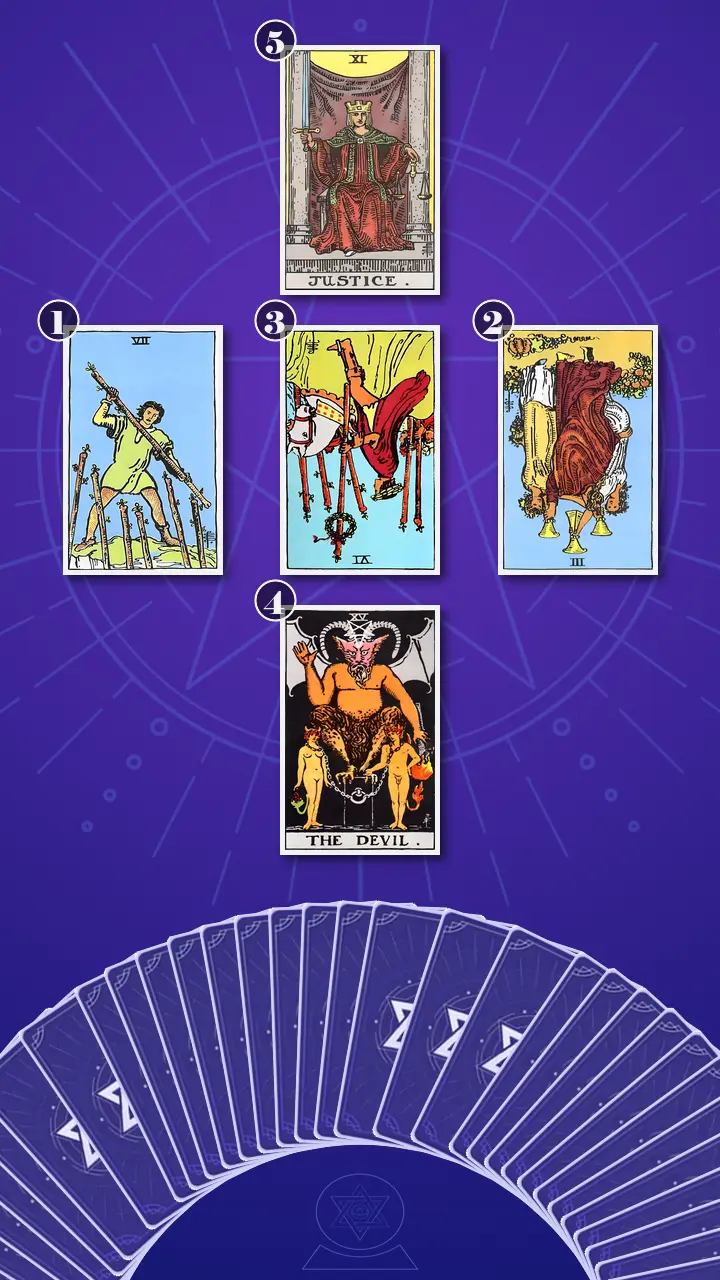
I chose the five-card Mirror Spread: Context Edition. For readers wondering how tarot works in a situation like this, I use the cards as structured prompts rather than predictions. This relationship mirror reading was the smallest spread capable of holding five separate variables: Jordan's outsider identity, their perception of the clique, the approval need reflected back at them, the attachment loop, and the boundary that could integrate those truths.
I laid the cards in a cross shaped like a hand mirror. The first card would show the defended role Jordan carried into the room. The second would examine the circle as Jordan perceived it, with special attention to the difference between documented exclusion and assumed motive. The centre card would reveal the recognition Jordan found hardest to admit wanting. Beneath it, the fourth would expose the feedback loop. Above it, the final card would offer conscious integration.
I explained why that structure mattered. A broad spread could have added predictions, distant outcomes, and environmental influences, but Jordan did not need more variables. They needed card meanings in context and a clean view of the relationship already consuming their attention. The mirror was not there to rule on whether the entire circle was elitist. It was there to show Jordan which parts of the pattern belonged to the room, which belonged to their own longing, and where choice remained available.
Two Wands, One Status Map
Position One: The High Ground Jordan Carried Inside
I turned over the card representing the defended outsider identity behind Jordan's repeated criticism and continued engagement. It was the Seven of Wands, upright.
I pointed to the lone figure on elevated ground, holding one wand against six rising from below. The mismatched shoes caught my attention: one foot appeared dressed for one role, the other for something else. I saw Jordan's divided stance in that detail, with one foot planted in a valid refusal of snobbery and the other still angled towards acceptance.
I connected the image to the way Jordan entered a private view already prepared to defend their taste and independence. Before anyone directly challenged them, they scanned the room for status cues, rehearsed a sharp response to predictable condescension, and made resistance the role through which the evening would be interpreted. It reminded me of the competitive rooms in Industry: refusing to look impressed while tracking every person who might hold influence.
The Seven's Fire was in Excess. Jordan's capacity to hold a boundary was real, but it was being deployed before the evidence arrived. Defence had become an always-on setting, like opening every app in private mode while still refreshing the same leaderboard.
I asked, “At the last gathering, what did you do to make sure nobody could mistake you for being impressed, and whose reaction were you still tracking?”
Jordan gave a short laugh that carried no amusement. Their fingers tightened around the edge of the table, then released. “That's painfully accurate. I made a joke about the venue being desperate. Then I watched one person to see if they laughed.”
I let the recognition settle without turning it into an accusation. “The objection may be principled. The performance is the part that tells us someone in that room still has authority over the evening. The useful inner sentence is: I am not impressed, so why am I tracking every sign that they are?”
Jordan's chin lowered a fraction. I could see the permanent-outsider role beginning to loosen, not because their criticism had been disproved, but because it no longer had to conceal the wish underneath it.
Position Two: When Three Cups Became a Closed Circuit
I turned over the card representing Jordan's perception of the social gatekeeping circle, including the need to distinguish observable exclusion from assumptions that had expanded around it. It was the Three of Cups, reversed.
In the upright image, three people lift their cups within a shared celebration. Reversed, I saw the triangle closing in on itself. The fruit, flowers, introductions, references, and invitations still circulated, but mainly among people already inside. Water, the energy of emotional exchange, was in Blockage: connection existed, yet it did not move freely enough to become mutual belonging.
I brought Jordan back to a delayed Overground journey. They had opened Instagram and found photos of three established members at an invitation-only gathering that had never been mentioned in the group chat. That omission was concrete. The card did not ask Jordan to explain it away as insecurity. It asked for precision before turning one exclusion into a universal theory about every member's motive.
“That omission happened,” I said. “What you cannot know yet is what every person intended. What would a camera or screenshot confirm?”
Jordan inhaled, held the breath for a beat, and looked away as though replaying the post frame by frame. “The gathering happened. Four people from the chat were there. Nobody mentioned it to me. I assumed they had all discussed keeping me out.”
“Then we keep the first three facts,” I said. “We leave the final motive unproven unless more evidence appears. That does not minimise the exclusion. It prevents one group's behaviour from colonising every uncertain moment around it.”
The line of Jordan's shoulders softened. I could see relief in that small drop: I had not asked them to trade social accuracy for forced positivity. The Three of Cups reversed validated that shared culture can become an admission test, like an invitation-only group chat using niche references as two-factor authentication. It simply refused to pronounce every member guilty on the same evidence.
Position Three: The Reply Beneath the Pointed Post
I turned over the card representing the approval need or status desire Jordan had difficulty acknowledging as personally meaningful. It was the Six of Wands, reversed, the catalyst at the centre of the spread.
I centred the laurel wreath and the crowd around the rider. Upright, the image carries visible recognition. Reversed, that recognition is withheld, doubted, or made too powerful. The Fire that had surged outward in the Seven of Wands was now folded inward. Public confidence was in Deficiency, while dependence on an imagined audience had grown excessive.
I asked Jordan to recall the second before posting a pointed joke about elitism. Underneath the polished detachment was a specific fantasy: one influential person would view it, recognise Jordan's intelligence, and offer some sign that they still counted. The laurel wreath had become a tag, a reply, a guest-list inclusion, or one name in the Story viewer list.
“Finish this privately,” I said. “The response I secretly want is...”
Jordan's thumb moved across the dark phone screen without unlocking it. Their gaze stayed on the reversed card. “I want one of them to message and say, ‘You were the only person there who actually got what was wrong with it.’ I want them to separate me from everyone else and choose me.”
A flush rose into Jordan's cheeks. Their mouth tightened as if the admission had a bitter taste, but I kept my voice level. “That is not a confession of weakness. It is useful information. A hidden approval bid behaves like an invisible command. A named one becomes something you can evaluate.”
I placed the Seven and Six side by side. In both images, one person stood above a crowd. In the Seven, Jordan resisted the people below; in the Six, Jordan waited for their recognition. The direction changed, but the status map remained the same.
“Being right about the gatekeeping does not make the approval hunger disappear,” I said. “And admitting the hunger does not make the gatekeeping imaginary.”
Jordan went very still. The embarrassment did not vanish, but it became specific enough to work with. I could see one exact reply replacing the shapeless demand to be accepted by an entire scene.
The Group Chat With a Loose Chain
Position Four: The Loop That Kept Renewing Itself
I turned over the card representing the self-reinforcing pattern of criticism, continued participation, reaction-checking, and intermittent recognition. It was The Devil, upright.
I kept my attention on the loose chains around the two figures. I did not interpret them as a sentence or as evidence that Jordan lacked willpower. The chains showed a Blockage created by repeated participation in an attachment system that felt more compulsory than it was. Jordan could mute the chat, yet reopened it every ten minutes. They could leave the viewer list alone, yet returned because the next warm signal might finally settle the question of belonging.
I mapped the modern sequence for Jordan: attend another event from fear of being forgotten, criticise the room in a voice note, spend the following day checking views, replies, and tags, receive either brief relief from one warm response or fresh prosecution material from a cold one, then repeat. Praise and rejection looked like opposites, but both kept the circle central.
“I hate how much authority this circle claims,” I said, voicing the loop back to Jordan, “and I am still giving it the rest of my evening.”
Jordan's jaw tightened before their stomach seemed to follow; one hand pressed flat against the table. Their eyes lost focus for a moment as they silently counted old nights. Then a low “Oh” left their chest, and their fingers spread against the wood.
This was where I used my Network ROI Analytics. I never use it to price friendship or reduce people to transactions. I use it to expose where attention is being invested and whether the relationship returns curiosity, respect, access, care, or only another demand for performance.
I asked Jordan to audit one gallery night. The event itself had taken two hours. The debrief, screenshots, message editing, and reaction monitoring had taken nearly four more. The return had been one warm introduction, a few ambiguous exchanges, an aching jaw, and a reciprocal friend's message left unanswered.
“The circle is functioning like a subscription you keep paying for with attention while arguing with every renewal notice,” I said. “The point is not that you must cancel it. The point is that you are allowed to examine the cost.”
I saw the Devil's loose chain become practical rather than frightening. Jordan did not have to defeat the circle or win its approval before moving. They could interrupt one checking behaviour, decline one low-interest invitation, or leave one event at a time chosen in advance.
“You do not have to prove the room is good before deciding whether it is good for you,” I told them.
When Justice Refused a Single Verdict
Position Five: The Scales Above the Loop
The room seemed to grow quieter as I turned over the card representing the integration of evidence, approval hunger, and a boundary Jordan could choose without requiring the circle's agreement. It was Justice, upright, the key card and antidote of the reading.
I pointed first to the balanced scales, then to the upright sword. Justice brought the missing Air of precise language and the Earth of a repeatable standard. Its energy was Balance: not a compromise in which Jordan pretended the circle had done nothing, but discernment strong enough to hold two uncomfortable truths without forcing either one to disappear.
I imagined the card as a Notes app with four clean headings: Fact, Feeling, Wanted, Boundary. After the next interaction, Jordan could record that an introduction was withheld, that they felt angry and exposed, that they wanted public recognition, and that they would skip the next event unless the invitation offered genuine interest beyond status exchange. Fewer invitations might follow. Justice would treat that result as information about reciprocity, not proof of Jordan's worth.
The image drew me back to my Wall Street years. On a trading floor, uncertainty became dangerous when exposure, evidence, and hope were merged into one story. The cold-looking discipline of separating them was not cruelty; it was protection from unnecessary friction. I brought that same logic to Jordan through my Toxic Hierarchy Filtration: identify the camera-verifiable power play, isolate the status meaning added afterward, name the approval bid, and choose a response proportionate to the evidence.
I brought Jordan back to 11:48 p.m.: the gallery over, the phone warm, the jaw tight, the voice note prosecuting the room while a comment was rewritten and the viewer list refreshed. The circle had left the building, yet it still held the rest of the evening.
Being right about their elitism does not erase your approval hunger; weigh both truths honestly and let Justice's scales turn judgment into a boundary you can act on.
I let the sentence remain between us before adding, “Calling the gatekeeping real and naming your approval bid are not contradictions. A workable boundary appears when neither fact is allowed to become a verdict on your worth.”
Jordan's breath stopped first. Their fingers hovered above the phone, their eyes widening before narrowing as if several recent conversations had begun replaying at once. A line appeared between their brows, and their voice came out sharper than before. “But doesn't that mean I was wrong all along? That I made this whole thing about them because I was desperate to get in?”
I did not rush to soften the anger. “No. It means one part of your account was incomplete, not false. Their conduct can be exclusionary, and your wish can still be human. Justice asks you to own your part without volunteering to carry theirs.”
Jordan's eyes shone. Their fist loosened one finger at a time, then their shoulders dropped so suddenly that the release seemed to leave them briefly unsteady. A thin, trembling breath escaped. I could see the new vulnerability behind the relief: if no universal verdict was needed, Jordan now had the freedom and responsibility to choose.
I asked, “Now, using this new view, think back to last week. Was there one moment when this distinction could have changed how the evening felt?”
Jordan looked down at Justice. “The photo dump on the train. I could have said, ‘They left me out, and I wanted to be there.’ I didn't have to spend the whole commute proving they were terrible or proving I was forgettable.”
I named the crossing I could see: this was one step from defensive resentment and compulsive exclusion monitoring towards honest discernment, self-respect, and openness to reciprocal belonging. It was not a promise that the circle would become kinder. It was a transfer of authority. Approval could become data rather than a verdict.
“Name the act. Name the bid. Choose the boundary,” I said.
The Four-Line Exit From the Leaderboard
I drew the five cards together into one coherent account. Jordan's work and social world had taught them that invitations, introductions, and insider recommendations could carry practical value, so the attention paid to the circle was not irrational. The Seven of Wands showed how a valid defence became a permanent identity. The Three of Cups reversed confirmed that some resources and recognition really were circulating through a closed circuit. The Six of Wands reversed exposed the private hope that being publicly chosen would settle Jordan's belonging. The Devil showed criticism and approval-seeking feeding the same open browser tab. Justice restored the missing distinction between what happened, what Jordan wanted, and what they could choose next.
I told Jordan that the cognitive blind spot was not simply insecurity. It was the belief that they needed a final moral ruling on the whole circle before they were allowed to change their participation. That belief kept them standing outside the private club, loudly criticising the door while quietly waiting for it to open.
The transformation direction was more precise: after an interaction, record one observable gatekeeping behaviour, one personal approval bid, and one boundary-based response. Jordan could evaluate people case by case, participate selectively, and invest more deliberately in relationships where attention moved both ways.
I framed the next steps as The Social Divestment Plan. The name sounds commercial because it comes from my old professional language, but the intention is humane: tactfully reduce an energy-draining position without provoking unnecessary drama, issuing a public manifesto, or testing whether anyone chases you. Divestment is not punishment. It is controlled reallocation.
- Run the six-minute Justice note. Today, open a private note titled “Fact / Feeling / Wanted / Boundary.” Apply it to the most recent interaction, using one sentence under each heading. Keep the fact camera-verifiable and make the wanted response exact: a reply, tag, introduction, invitation, or Story view. If four lines feel too exposing, write only “They did...” and “I wanted...” You may close the note at any point.
- Interrupt one payment into the loop. After the next group chat exchange or event, mute the relevant chat and Story notifications for two hours. Notice whether the checking urge rises, falls, or moves from your jaw to your chest or stomach. For the next invitation, decide with three written criteria: genuine interest, expected reciprocity, and available energy. The minimum version is a five-minute delay. Reopening the app does not invalidate the experiment; it gives you more accurate information about the chain.
- Reinvest one unit of attention. Within forty-eight hours, send one direct, non-performative coffee or walk invitation to someone who has already shown reciprocal interest. Send it before checking whether a high-status person replied, and let the invitation be about contact rather than visibility. Keep the message simple: “Free for a coffee or walk next week? I'd like to catch up.” No strategic reference or polished detachment is required.
My Network ROI lens made the allocation visible, while Justice kept it ethical. I was not asking Jordan to label people as profitable or worthless. I was asking whether a social engagement repeatedly consumed more attention than Jordan consciously wished to give it. Approval is data, not a verdict, and a boundary does not require the circle's consent.

A Week Later: The Quiet Proof
Six days later, I received a message from Jordan. Another private-view invitation had arrived from the circle. Instead of accepting immediately or composing a sarcastic reply, they opened the four-line note and set the timer.
They wrote that the invitation had arrived with less than a day's notice. They felt flattered and irritated. They wanted one influential member to remember them. Their boundary was to decline because the event failed two of their three criteria: genuine interest and available energy.
Jordan muted the chat for two hours and messaged a reciprocal friend about a Sunday walk. Nobody from the circle asked why they were absent, and that still stung. That night, however, Jordan slept without reopening the viewer list. Their first thought the next morning was, “What if stepping back proves I never mattered?” This time, they gave a small, rueful laugh and made coffee.
I did not read that as a solved life or perfect detachment. I read it as the first credible evidence of movement from monitoring the room to evaluating reciprocity. The cards had not chosen for Jordan, freed them by magic, or guaranteed a better invitation. They had externalised the pattern long enough for Jordan to see the available levers. Jordan moved them.
I know the strange ache of calling a room beneath us while our shoulders remain lifted towards its door, afraid that leaving first will prove we were never wanted. I also know that noticing the ache without obeying it is already a form of clarity: Justice's scales do not demand indifference, only enough honesty to keep the next reaction from becoming a ruling on who we are.
If the next reply, view, or invitation landed on Justice's scale as information rather than a verdict, what small boundary would you become curious about trying for just one interaction?