Finding Clarity on the TTC, With Your Phone Warm in Your Palm
If you keep reopening the chat thread, scrolling back to the love-bomb week like it’s evidence, then closing your phone and reopening it two minutes later because your body won’t let you be “chill”—I know exactly the kind of night you’re having.
Taylor booked my session from Toronto, and before we even started, I could picture her in that specific kind of city-stuck limbo: 8:47 p.m. on Line 1 heading north, wedged between winter coats, the train screeching like it’s mad at the rails, fluorescent light flattening everyone’s faces. Her phone screen stayed warm from being reopened too many times. She’d scroll back to week-one “good morning” texts—the ones that felt like a promise—and her chest would clamp down like she was waiting for a verdict, not a message.
When she came on video, she didn’t say “I’m anxious.” She didn’t have to. Her eyes kept flicking down to where her phone was, off-camera, like it was a second person in the room.
“I don’t want to chase,” she said, voice too careful, like she’d edited it in her head first. “But I also don’t want to lose something that felt real. The beginning was… loud. Now it’s silent. And I keep trying to figure out what the silence means.”
Her confusion had a physical sound to it—like internal feedback, a mic too close to a speaker. A tight, restless chest. The stomach-drop when the screen lit up. Then the heavy fatigue when it wasn’t them. It was like her nervous system was running “talking stage math” at full volume, all day, with no off switch.
I nodded, slow and steady, the way I do on-air when a caller is about to say something vulnerable. “We can hold both truths,” I told her. “You can miss the warmth, and also want to keep your self-respect intact. Tonight, let’s stop trying to decode them and start creating clarity for you. We’re going to make a map through the fog.”

Choosing the Compass: How the Celtic Cross Works for Mixed Signals
I asked her to take one breath with her feet on the floor—not as a mystical ritual, but as a nervous-system reset. Then I shuffled slowly, the sound of cardstock soft in my studio headphones. I’ve hosted a music therapy radio show for years; I’m obsessed with what sound does to the body. Even the pace of shuffling can shift someone from spiraling to present.
“For this,” I said, “I’m using the Celtic Cross spread.”
For anyone reading along: I choose the Celtic Cross for questions like After the love bombing stopped, what’s my next step? because it prevents the whole reading from becoming a detective story about the other person. It holds the emotional crash (present + challenge), the deeper mechanics (root + past imprint), and then—crucially—it gives a clean next step position. It’s structured enough to turn chaos into something you can act on.
I also told Taylor what we’d be watching for: the card that captures what reality feels like right now, the card that shows what’s keeping her stuck, and the position that delivers the most grounded, self-respecting move to take next—without trying to predict whether this person would suddenly become consistent again.
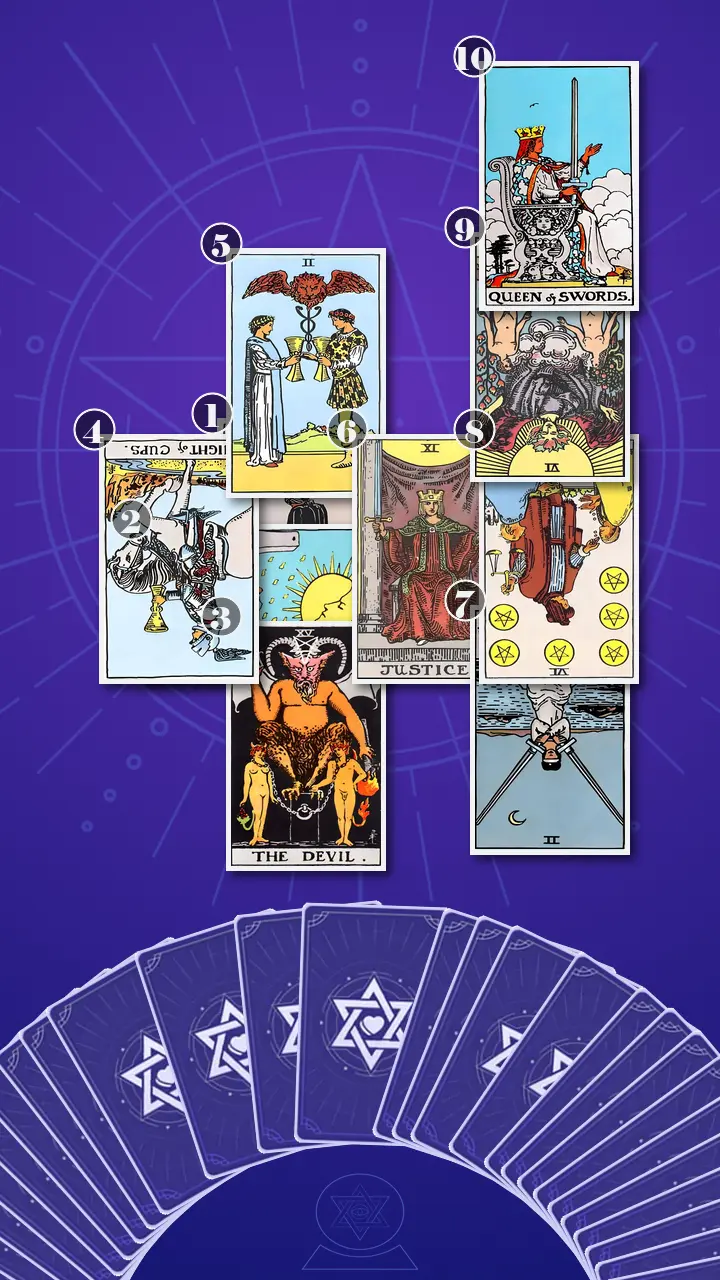
Reading the Map: From the Emotional Crash to the Pattern Underneath
“Okay,” I said, laying the center of the cross. “Let’s look at what’s true.”
Position 1 — The Present Snapshot: Five of Cups (upright)
“Now we turn over the card representing what your reality feels like right now after the love bombing stopped.”
Five of Cups, upright.
In modern life, this card is painfully specific: it’s you rereading the early affectionate messages like they’re a time machine—while the supports that still exist (your friends, your routines, your standards, your life) are right there, just… out of frame.
Five of Cups doesn’t say, “You’re dramatic.” It says, “You’re mourning.” And your mind is spotlighting what’s missing so hard that it can’t register what’s still standing behind you.
“What are you actually grieving?” I asked her gently. “The person… or the feeling of being chosen?”
Taylor let out a small laugh that wasn’t funny—more like air escaping a balloon with a tiny tear in it. “That’s… honestly kind of cruelly accurate,” she said. “Because I’m not even sure I know them that well. I just know how it felt.”
Position 2 — The Main Challenge: The Moon (upright)
“Now we turn over the card representing what is actively keeping you stuck or confused.”
The Moon, upright.
The Moon is the fog machine of tarot. It’s mixed signals, late-night theories, and the way a nervous system tries to create safety by making a story out of partial information.
I told her, “This is you treating their Instagram activity like weather you keep trying to forecast.”
And I could practically hear the internal script the card mirrors: If they watched my story, it means they still care. If they didn’t, it means they’re done. If they liked a post, it means they’re thinking of me. If they’re online but not replying, it means… anything, everything, nothing. Theories that change daily.
“Mixed signals aren’t a puzzle— they’re a pattern,” I said, keeping my voice calm on purpose. “The Moon energy makes you think clarity lives in interpretation. But interpretation is endless. It never finishes.”
Taylor’s shoulders lowered a fraction. She gave me a long exhale and a reluctant nod, like she hated that I was right. “Yeah,” she said quietly. “I’m building a whole narrative off crumbs.”
Position 3 — The Attachment Hook: The Devil (upright)
“Now we turn over the card representing the attachment hook underneath the situation—what keeps pulling you back into checking, hoping, and reinterpreting.”
The Devil, upright.
The Devil isn’t evil; it’s sticky. It’s the moment desire turns into compulsion. In 2026 terms: intermittent reinforcement. A notification loop. The kind where you don’t even want to check, but your hand moves before your brain votes.
I described the micro-chain exactly as it shows up in real life: open thread → reread love-bomb texts → draft the “perfect” message → check last-seen/likes → feel a hit of hope → crash. Repeat. Like a song stuck on a 15-second hook you didn’t choose.
Taylor went still—full-body still. That stomach-drop recognition you can see on someone’s face before they even speak. Her eyes unfocused for a beat like she was replaying her own week.
“I hate that it feels like… a hit,” she admitted. “Like, if they text, I can breathe.”
“That’s the chain,” I said, no shame in my tone. “And the wild part is—on The Devil card, the chains are loose. You’re not trapped by fate. You’re trapped by a pattern that can be interrupted.”
Position 4 — The Imprint: Knight of Cups (reversed)
“Now we turn over the card representing what the early dynamic trained you to expect.”
Knight of Cups, reversed.
This is the ‘sweep-you-off-your-feet’ phase that set your nervous system’s expectations. Romantic language. Future talk. Constant contact. And then—when the card flips—momentum becomes inconsistency. Emotional whiplash.
“This isn’t me calling them a villain,” I said. “It’s just the data: charm showed up faster than accountability.”
Taylor blinked hard. “I keep thinking, Maybe that version of them is still in there.”
“That makes sense,” I replied. “But Knight of Cups reversed asks: did you fall for the person… or for the performance of devotion?”
Position 5 — The Benchmark: Two of Cups (upright)
“Now we turn over the card representing your conscious ideal and standard for love—what you want to be true.”
Two of Cups, upright.
Two of Cups is reciprocity that doesn’t require you to audition. In modern terms, it’s a mutual Google Calendar invite: both people put it in, both people show up. Equal exchange. Mirrored effort.
“I want you to hear this clearly,” I said, and I watched her face soften because she needed the permission. “You’re not wrong for wanting connection. You’re not ‘too much’ for wanting consistency.”
Then I added the line I could tell she needed, the one that sounds like self-respect instead of punishment: “Don’t negotiate yourself downward to keep access to someone’s attention.”
She swallowed. “That’s… exactly what I’ve been doing.”
When Justice Spoke: The Contract That Cuts Off Bargaining
I slid the next card into place, and the room felt quieter—not in a spooky way, but in that studio-between-songs way, when the track ends and you can suddenly hear your own breathing.
Position 6 — Your Next Step: Justice (upright) (Key Card)
“Now we turn over the card representing your next step: the most grounded, self-respecting move to take now.”
Justice, upright.
Justice is clarity with a spine. Scales in one hand, sword in the other. It’s not cold—it’s clean. It asks you to weigh actions over words, then choose the fair line and follow through.
And because my work lives at the intersection of emotion and sound, I reached for my Melodic Mirror—one of my signature tools. “Taylor,” I asked, “if I opened your Spotify right now, what would I find in the last two weeks?”
She looked almost offended, then she laughed. “A playlist literally called ‘don’t text him’… and then, like, sad songs on repeat.”
“Exactly,” I said. “Your playlists are emotional evidence. Love bombing is usually high-BPM—fast, intoxicating, all chorus. Withdrawal is low-BPM—space, silence, gaps you fill with imagination. Justice says: stop letting the tempo of their attention conduct your body. You become the conductor.”
I leaned in, coaching tone now, because Justice needs structure. “Here’s the contract metaphor,” I continued. “Not cold, just clear. Sentence format:”
My standard is ____.
The data is ____.
So my next move is ____.
She stared at the card like it could speak out loud. Her jaw flexed once, then released.
The Aha Moment (Setup)
In my mind, I saw exactly what her body had been doing: that TTC-ride moment where her thumb keeps reopening the chat, scrolling back to week-one “good morning” texts—while her chest is tight like she’s waiting for a verdict, not a message.
The Aha Moment (Delivery)
Not ‘maybe they’ll return,’ but ‘measure the pattern and choose the fair line’—let Justice’s scales weigh the facts and let the sword cut off bargaining.
I let silence hang for a beat, the way you let a final piano chord ring out before you talk over it.
The Aha Moment (Reinforcement)
Taylor’s reaction came in layers—like watching someone’s body unlearn a reflex in real time. First, a micro-freeze: her breath caught, and her eyes widened a fraction, like a door had opened where she didn’t expect one. Then the cognition seeped in: her gaze drifted off-screen, unfocused, as if she was replaying every “miss you” text that never turned into a plan, every Sunday-night spiral, every time she’d softened her needs with a smiley face. Finally, the emotion hit—not melodramatic, just real. Her shoulders dropped as if she’d been holding up invisible grocery bags for weeks. She pressed her lips together, then exhaled, shaky at the end.
“But if I do that…” she started, and there was a flash of anger under the fear, surprising even her. “Doesn’t that mean I’ve been… like… making excuses? That I was wrong?”
I didn’t rush her. “It means you were human,” I said. “It means your nervous system grabbed for a story because stories feel safer than loss. Justice doesn’t punish you for that. Justice just stops the bargaining.”
Her voice got smaller, but steadier. “It feels… uncomfortable. But also like relief.”
“That’s the shift,” I told her. “From chasing intention to tracking consistency. From ‘they decide my worth’ to ‘I act like my standard is real.’”
Then I asked the question that turns insight into lived clarity: “Now—using this new lens—can you remember one moment from last week where you were about to send the ‘perfect’ text, and this would’ve changed what you did?”
Taylor blinked fast, then nodded. “Thursday. They sent ‘hey stranger.’ I was about to write this whole… essay. If I’d done the scales thing, I would’ve noticed: sweet message, zero follow-through. And I would’ve put my phone down.”
That was the first evidence of transformation: from confused longing toward quiet self-trust. Not certainty—discernment.
Position 7 — Your Agency: Two of Swords (reversed)
“Now we turn over the card representing your role in the pattern and where you still have agency.”
Two of Swords, reversed.
This is decision paralysis cracking open. It’s the moment neutrality stops being believable, because your body is clearly not neutral.
“Two of Swords reversed is you repeating, ‘I’m chill. I’m chill. I’m chill,’” I said, “while your nervous system is on-call.”
Taylor laughed—quiet, embarrassed, and completely seen. “I literally say that out loud,” she admitted. “To no one.”
“Then let’s give your brain a job that actually helps,” I said. “A decision container: one week, one rule, not a dramatic final act.”
Position 8 — The External Exchange: Six of Pentacles (reversed)
“Now we turn over the card representing external dynamics—the exchange pattern you’re responding to.”
Six of Pentacles, reversed.
This is the attention economy card. One person sets the terms—when, how, how much—and the other adapts to keep access. It’s paying surge pricing for basic respect.
“You’re paying extra emotional rent for basic reciprocity,” I said, and kept my tone gentle but firm. “Last-minute hangs. Vague ‘maybe later.’ And then you’re in an Uber home feeling resentful and small, telling yourself you should be grateful they made time at all.”
Taylor’s eyes flashed. Not chaotic anger—clarifying anger. “Wait,” she said, sitting up straighter, “why am I grateful for crumbs?”
“That,” I said, “is your nervous system waking up.”
Position 9 — Hopes & Fears: The Lovers (reversed)
“Now we turn over the card representing your hopes and fears about choosing yourself.”
The Lovers, reversed.
This is the fear that your choice will define your worth. The hope that if you choose perfectly, love will become “right” again. But reversed Lovers is misalignment—not failure. Chemistry isn’t always compatibility. Intensity isn’t always intimacy.
“The real decision here isn’t ‘them or not them,’” I said. “It’s ‘my standards or my craving for validation.’”
Taylor’s mouth tightened, then softened. “I hate that that’s true,” she whispered. “Because it makes it… my responsibility.”
“It makes it your power,” I corrected. “Responsibility without shame is just agency.”
Position 10 — Integration: Queen of Swords (upright)
“Now we turn over the card representing the integration outcome—the most empowering stance you can embody.”
Queen of Swords, upright.
This is the part of you that can feel the grief of Five of Cups without letting it run the plan. She speaks once, clearly. She doesn’t write a 12-paragraph thread. She doesn’t perform chill. She chooses.
“Queen of Swords is one clear sentence,” I said, and my radio-host voice got crisp. “Then you stop. Then let your actions match your words.”
I watched Taylor’s hands—she’d been fidgeting with a ring the whole time. For the first time, her fingers went still. “I want that,” she said. “I want to stop being… on call.”
From Insight to Actionable Advice: The One-Week Justice Check
I leaned back and let the whole spread settle in my mind like a playlist order that finally makes sense.
“Here’s the story your cards told,” I said. “You’re in Five of Cups grief—mourning the intensity drop. The Moon keeps you in fog by turning every tiny signal into a theory. The Devil explains why it’s so hard to stop: the attention became a compulsion loop, a nervous-system ‘hit.’ Knight of Cups reversed shows the imprint—sweetness without follow-through. Two of Cups proves your standard is healthy: you want mutuality. And Justice is your bridge: you stop decoding and start measuring. Two of Swords reversed says the stalemate is cracking—you’re ready for a container. Six of Pentacles reversed names the imbalance. Lovers reversed names the fear: that choosing yourself means admitting something painful. And Queen of Swords is the outcome: calm, clear boundaries.”
“Your cognitive blind spot,” I continued, “is thinking clarity is something they give you—like if you phrase the text perfectly or wait the perfect number of hours, you’ll earn the original version of them back. The transformation direction is the opposite: you create clarity by setting a standard and acting like it’s real.”
Taylor hesitated, then hit me with a very real obstacle—exactly the kind that makes advice either useful or useless. “But I work in marketing,” she said. “I’m on Slack all day. My brain is trained to respond. And when I try to not check… I last, like, three minutes.”
“Perfect,” I said. “Then we don’t aim for perfection. We aim for a system.”
I pulled in my Emotional BPM strategy—because her body was moving to the tempo of uncertainty. “We’re going to change the tempo of your week,” I told her. “Not by forcing yourself to not care. By giving your attention a steadier beat to follow.”
- The 7-Day Reciprocity Audit (Justice Scales)Open your Notes app. For the next 7 days, track only observable actions: who initiates contact, who suggests plans, and who follows through. No emoji analysis, no tone-reading—just the data.If you feel yourself spiraling, set a 2-minute timer: log one fact, then close the app. Track consistency like data, not like a prophecy.
- One Boundary, One Week (Decision Container)Choose one rule for seven days: don’t initiate contact twice in a row. If you texted last, you wait. And only accept plans with a time + place set at least 24 hours ahead. If it’s vague, your default script is: “I’m booked—another time.”Expect discomfort. Your brain may call this “dramatic” because it’s used to bargaining. Keep it small: one week is an experiment, not a forever decision.
- The Emotional BPM Reset (Interrupt the Devil Loop)When the urge spikes, do a 90-second body check (feet on the floor; name three sensations), then play one steady-tempo track that signals “I’m safe.” If you want, build a tiny 2-song Energy Duet: Track A for the craving moment, Track B for the grounding moment—so your body learns a new transition.Add friction: move the chat thread off your home screen, turn off read receipts, and put Instagram behind a timer if story-views are your Moon trigger.
“And if you want a Queen of Swords message—one clear sentence—you can draft it,” I added. “But no essays.”
I offered her the simplest version: “I’m looking for something consistent. If you’re not in that place, no hard feelings—just let me know.”
“Then,” I said, “you stop negotiating. One clear sentence. Then let your calendar do the talking.”

A Week Later: Ownership, Not Certainty
Eight days later, Taylor sent me a voice note while walking near the waterfront. I could hear wind and the soft slap of waves behind her words.
“I did the audit,” she said. “And it was… embarrassing how clear it was once I wrote it down. Also—I said no to a last-minute plan. My hands were shaking, which is ridiculous, but I did it. And I didn’t die.”
She paused, then added, almost surprised: “I slept. Like, a full night. I still thought about them in the morning. But it didn’t feel like an emergency.”
Later she told me: she sat alone in a coffee shop for two hours after work, phone face-down, a little lonely and a little proud—like choosing herself was quieter than she expected, but real.
That’s the Journey to Clarity I trust most: not the dramatic plot twist, but the steady boundary that gives your nervous system room to breathe. Not certainty about them—ownership of you.
And if you’re in that exact post-love-bomb crash—when the warm beginning becomes silence, and it’s brutal how your body starts treating one notification like it can decide your worth, while another part of you is fighting to not lose your self-respect trying to get the old version of them back—please know this: you’re not “crazy.” You’re in a pattern. And patterns can be changed.
If you stopped asking what they mean and started asking what your standard is, what’s one tiny boundary you’d be willing to try for the next seven days—just as an experiment?
This story is adapted from psychological research, written so that those in a similar struggle can see their own pattern in it — and find their next step clearly.These insights are not a substitute for professional psychological, medical, legal, or financial advice.
Learn more about our Journey to Clarity.
How did this insight land for you?
🫂 This Resonates Deeply
🌀 Living This Story
✨ Now I See Clearly
🌱 Seeing New Possibilities
🧰 Useful Framework
🔮 The Confirmation I Needed
💪 Feeling Empowered
🚀 Ready for My Next Step
Author Profile
 AI
AI“Through ten years of sound energy research, I’ve found that when we struggle, it's usually just our internal rhythm falling out of sync under pressure. I know firsthand the frustrating helplessness of wanting to move forward but feeling paralyzed. Without overwhelming theories, I want to be the soothing background track that helps you recalibrate, turning your heavy burdens back into a light, effortless, and harmonious melody.”
In this Love Tarot Reading :
Core Expertise
- Communication Dissonance Audit: Diagnosing arguments not by the words spoken, but by the fundamental mismatch in emotional tempo and frequency.
- Reactive De-escalation Mapping: Identifying the specific 'high notes' of defensive anger that shatter the emotional safety of the connection.
Service Features
- The Syncopation Pause: A 3-second acoustic grounding technique to interrupt an escalating argument, lowering the emotional BPM before permanent damage is done.
Also specializes in :
Explore Related Patterns:
Anxious AttachmentTaylor's eyes keep flicking toward the phone like it is a second person in the room, and her chest reacts as though the next message can decide the whole outcome. When she says that if they text, she can breathe, the attachment system is no longer just wanting contact; it is using contact as regulation. Anxious Attachment is the pattern of escalating pursuit, checking, or mental bargaining when inconsistency activates fear of loss. You can miss the warmth without letting someone else's response become the only source of relief. The grounded next step is to build a small decision container, so your body learns that safety can come from your standard, not only from their attention.
Boundary DiscernmentTaylor's next step becomes specific when Justice gives her the sentence frame of standard, data, and next move. The boundary is not a dramatic final act; it becomes one week of not initiating twice in a row, accepting only concrete plans, and letting a vague invitation meet a clear no. Boundary Discernment works because it separates self-respect from punishment. You are not trying to control whether the other person becomes consistent; you are testing whether their actions can meet a standard that already belongs to you. When Taylor says no to a last-minute plan and still survives the discomfort, the boundary stops being theory and becomes evidence.
Certainty SeekingTaylor keeps trying to figure out what the silence means, treating story views, online status, delayed replies, and the perfect message draft as if one more clue will finally make the situation emotionally safe. The search feels active, but it keeps her waiting for the other person to issue a verdict. Certainty Seeking shows up when interpretation becomes a substitute for action. You keep scanning for enough information to make the risk disappear, but mixed signals are designed to stay unfinished inside the mind. The Justice move changes the question from what do they mean to what does the pattern show, which gives your agency somewhere solid to stand.
Emotional ReciprocityTaylor's stated ideal is not a fantasy of constant intensity; it is mutual effort, the kind where both people put the plan on the calendar and both people show up. The seven-day audit turns that ideal into observable data by tracking who initiates, who suggests plans, and who follows through. Emotional Reciprocity is the shift from auditioning for attention to measuring whether the exchange is actually mutual. You stop treating basic respect as a scarce reward and start asking whether the connection has enough balance to hold you without self-erasure. That is why the next step is not to chase the old high, but to watch whether the pattern can meet the standard.
Intermittent ReinforcementTaylor's loop is concrete. She opens the thread, rereads the love-bomb texts, drafts the perfect reply, checks last-seen activity or likes, feels a hit of hope, then crashes when nothing stable arrives. The fact that her hand moves before her brain votes shows a reward loop, not a clear relational choice. Intermittent contact keeps the nervous system chasing the next possible hit because the reward is unpredictable. You are not being asked to shame the craving; the useful audit is to see how the schedule of attention trained the checking behavior. The next step is not another interpretation of their silence, but an interruption of the chain and a shift toward observable consistency.
Self-SilencingTaylor's voice is careful when she says she does not want to chase, and later she recognizes every time she softened her needs with a smiley face. She performs chill while her nervous system is on call, then tries to be grateful for vague plans and last-minute attention that leave her resentful and small. Self-Silencing is the defense of shrinking the truth so the connection does not have to be tested. You mute the standard because asking clearly might reveal an answer you do not want. The Queen of Swords stance interrupts that bargain with one clean sentence, no essay, and no emotional discounting after the sentence is spoken.
Romantic ProjectionTaylor says she is not even sure she knows them that well; she knows how it felt. She keeps returning to the week-one good morning texts and wondering whether that version of them is still in there, even while the present pattern shows silence, vagueness, and uneven follow-through. Romantic Projection turns an early emotional high into a template that gets placed over the current facts. You are not inventing the warmth, but you may be treating the feeling of being chosen as stronger evidence than consistent behavior. The clean audit is to separate the performance of devotion from the practice of devotion, then let the present pattern carry more weight than the imagined potential.
Explore Related Struggles:
Ambiguity DependenceTaylor keeps trying to read the weather of the relationship through partial signals. If they watched her story, maybe they still care. If they are online but not replying, maybe it means something. If a message sounds sweet but leads nowhere, maybe the missing context is hidden between the lines. The friction is that ambiguity keeps offering just enough material to interpret, but never enough structure to land. You can spend hours turning crumbs into theories, and the theories may feel active, intelligent, and protective. They still do not create reciprocity. Ambiguity Dependence fits because the story shows clarity being outsourced to interpretation. Your next step becomes possible when you stop asking every signal to reveal their intention and start asking whether their observable behavior can meet your standard.
Boundary Ambiguity LockJustice gives Taylor a structure because her boundary has been emotionally true but behaviorally unclear. She wants consistency, yet the moment a message arrives, the old negotiation starts. Maybe one more text, maybe a softer tone, maybe a perfectly worded essay will make the situation finally settle. Boundary Ambiguity Lock fits because the line exists in principle before it exists in action. You know what basic respect would look like, but the fog of wanting them back makes the boundary feel dramatic, premature, or too final. The one-week rule matters because it turns self-respect into something observable. No initiating twice in a row, no vague plans, one clear sentence, and then a pause. You are not building a wall; you are giving your standard enough structure to become real.
Dignity-Belonging SplitTaylor says the split out loud before the reading even begins. She does not want to chase, but she also does not want to lose something that felt real. That sentence carries the whole pressure point: one part of you is trying to protect your self-respect, while another part is still reaching for the warmth that made you feel chosen. The story keeps showing how expensive that split becomes. Softening your needs with a smiley face, preparing the perfect text, accepting vague contact, and feeling grateful for crumbs all become ways of keeping belonging within reach. The cost is that your standard starts to feel negotiable exactly when it needs to be most real. Dignity-Belonging Split fits because the next step is not about proving you care less. It is about refusing to make connection available only at the price of self-abandonment. You are allowed to want closeness and still measure whether the other person is meeting you in a way that lets your dignity stay intact.
Read Receipt Worth LockTaylor's phone is not just a device in this story. It becomes a live wire. Her eyes keep flicking toward it off-camera, her chest tightens when the screen lights up, and the chat thread starts to feel like a place where a verdict might arrive. That is the lock: a reply, a story view, a like, or a silence begins to carry more authority than your own read on the relationship. You are not simply checking for information. You are checking for relief, and the body starts treating digital contact as proof that you still matter. Read Receipt Worth Lock names the moment your sense of value gets routed through someone else's inconsistent attention. The way out begins when the signal is put back in its proper size. A message can show availability, effort, or timing, but it cannot be allowed to decide your worth.
Reciprocity DeficitThe exchange pattern in Taylor's story is concrete. Vague maybe-laters, last-minute plans, sweet messages without follow-through, and one person setting the terms while the other adapts to keep access. The problem is not that she wants too much; the data shows too little mutual structure. Reciprocity Deficit names the strain of trying to make a two-person connection function on one person's emotional labor. You can be flexible for a while, but when flexibility becomes the price of staying chosen, the relationship starts asking you to pay extra for basic respect. The next step is grounded because it does not require mind-reading. It asks you to measure who initiates, who suggests plans, who follows through, and whether effort is mirrored. That kind of clarity gives your attention somewhere fair to stand.
Relational Resurrection TrapTaylor scrolls back to the week-one good morning texts like they are evidence from a case she is still trying to win. The early version was loud, romantic, and full of promise, so the current silence does not feel like a clean ending. It feels like a missing door back to the beginning. That is where the trap forms. You are not only missing the person in front of you now; you are trying to recover the emotional climate they created at the start. Every warm memory becomes a counterargument against the colder data, even when the present pattern is showing inconsistency. Relational Resurrection Trap fits because the story is not just about wanting contact. It is about trying to bring back a version of the connection that may have been more performance than foundation. The next step is to stop using the first chapter as proof and let the current pattern testify for itself.
Idealization-Reality SplitTaylor's most honest line is that she may not know them that well; she knows how it felt. The beginning was loud enough to create a whole emotional architecture around being chosen, wanted, and pursued. The later silence then feels like a contradiction that must be solved. Idealization-Reality Split fits because the story keeps separating the feeling of devotion from the evidence of devotion. Chemistry is not the same as compatibility, future talk is not the same as follow-through, and intensity is not the same as intimacy. This struggle does not shame the part of you that responded to warmth. It simply asks you to place the warmth next to the data. When both are visible, the performance of closeness no longer gets to override the reality of consistency.
Explore Related Emotions:
Certainty HungerTaylor says she keeps trying to figure out what the silence means, and her chest clamps like she is waiting for a verdict rather than a message. You can hear how the lack of a clean answer becomes its own pressure system. Certainty Hunger fits because the craving is for the ambiguity to stop. The mind wants one final sentence that will settle the whole situation, but the story keeps showing that clarity has to come from your standard and the data, not from endlessly waiting for them to define the room.
Grounded AgencyTaylor says no to a last-minute plan, puts the phone face-down in a coffee shop, and sleeps a full night even though she still thinks about them in the morning. You can see ownership arrive in small, physical moves rather than a dramatic final declaration. Grounded Agency fits because the story's answer is not certainty about the other person; it is a system that lets you act like your standard is real. The one-week container, the observable data, and the clear sentence all return the next step to your hands.
Hypervigilant AnxietyTaylor's eyes keep flicking toward the phone off-camera, and the device feels like a second person in the room. You can see the body staying on-call before any decision has been made, waiting for the screen to light up as if it can change the whole atmosphere. Hypervigilant Anxiety fits because the checking is not casual curiosity; it is a braced state of attention. Your system has started treating contact as a safety cue, so the work becomes creating friction, time, and space before the notification gets to conduct your body.
Mixed Signal DreadTaylor treats story views, last-seen status, likes, and late replies like weather she has to forecast. You are pulled into a state where every tiny cue might become proof, rejection, invitation, or nothing at all. Mixed Signal Dread names the pressure of living inside partial information. The fear is not just that they are quiet; it is that the silence keeps asking you to interpret it, so your next step has to move from decoding signals to measuring consistent behavior.
Mutuality HungerTaylor softens when she hears that wanting consistency does not make her too much. You can see the standard underneath the spiral: she wants an exchange where both people show up, make plans, and meet effort with effort. Mutuality Hunger fits because the longing is not for drama or control; it is for reciprocity that does not require auditioning. Naming that hunger gives the next step a compass, because the question becomes whether the connection can meet a mutual standard rather than whether you can survive on attention crumbs.
Relational WhiplashThe beginning is described as loud, full of romantic language, future talk, and constant contact, and the present is defined by silence and vague follow-through. You are left trying to reconcile two tempos that do not belong in the same body. Relational Whiplash names the jolt between fast intensity and sudden inconsistency. The next step is not to argue the first version back into existence, but to notice how the swing itself is affecting your judgment, your pacing, and your standards.
Self-Betrayal AcheTaylor notices she has been negotiating herself downward to keep access to someone's attention, accepting vague maybes and last-minute plans as if basic reciprocity were a luxury. You can feel the self-protective part of her trying to stay small enough not to lose the connection. Self-Betrayal Ache fits because the pain comes from recognizing where your own standard got softened to preserve contact. The ache is not proof that you failed; it is the signal that your next move has to restore alignment between what you want and what you keep allowing.
Truth ReliefTaylor's shoulders drop after the Justice frame lands, and later she says the audit was embarrassingly clear once she wrote it down. You can feel the discomfort of facts arriving alongside a real loosening in the body. Truth Relief fits because the truth does not make everything painless, but it reduces the frantic need to keep interpreting. The next step becomes lighter when you can say, 'This is the data, this is my standard, and this is what I will do,' without needing the other person to hand you permission.
Liminal GriefTaylor keeps reopening the chat on the TTC, scrolling back to week-one good morning texts while the current silence makes the phone feel charged in her palm. You can feel the loss gather around a version of closeness that appeared quickly and then stopped giving you anything solid to hold. Liminal Grief fits because the ache sits between a real body memory and an undefined relationship. You are not only missing the person; you are mourning the moment when being wanted felt loud, effortless, and already promised, even though the actual structure had not yet proven itself.
Resentful WaitingTaylor hears the phrase paying extra emotional rent for basic reciprocity, and the crumbs suddenly become visible: vague plans, last-minute access, and the quiet pressure to be grateful for whatever arrives. You can feel the body sitting in the doorway, never fully chosen and never fully free. Resentful Waiting names the bitterness that grows when hope has to keep making room for someone else's convenience. It matters because a clean next step is not only about whether to text; it is about refusing to keep waiting in a role that makes your own needs feel excessive.
Explore Related Contexts:
BreadcrumbingTaylor identifies the pattern when she remembers the 'hey stranger' message: sweet contact, zero follow-through, and then the impulse to write an entire essay in response. The attention is small, but it is timed and flavored in a way that reopens the possibility of more. Breadcrumbing fits because the external exchange offers just enough warmth to keep you engaged while withholding the consistency that would make the connection fair. The practical move is not to become colder; it is to stop paying full emotional price for partial access.
Relationship Boundary NegotiationTaylor's next step becomes specific: one week, one rule, no initiating twice in a row, and no accepting plans without a clear time and place. The advice does not ask her to make a dramatic final decision; it gives her a contained structure where her standard can be tested against observable behavior. Relationship Boundary Negotiation fits because the story moves from decoding the other person to defining the terms under which access is allowed. You are not trying to force a result; you are creating a fair line and watching whether the connection can meet it.
Relationship Power PlayTaylor is responding to last-minute hangs, vague 'maybe later' energy, and contact that arrives on the other person's terms. Her calendar, attention, and emotional pace keep bending around someone who has not offered the same level of structure back. Relationship Power Play fits because the imbalance is built into the exchange itself: one person controls access, and the other person is pressured to adapt in order to keep the connection alive. Your next step is to move the decision point back into your own standards, where time, place, initiation, and follow-through all count as data.
Situationship AmbiguityTaylor is not dealing with a clean breakup, a defined relationship, or a clear no-contact ending. She is stuck reading silence, story views, online status, and vague messages because the connection has never given her a stable shared definition. Situationship Ambiguity names the stage where emotional intensity exists without matching structure. The next step becomes clearer when you stop treating every signal as a hidden answer and recognize that the lack of clear terms is already part of the reality you are responding to.
Digital Snooping SpiralTaylor treats Instagram activity, story views, likes, online status, and the reopened chat thread as if they are evidence in a case that never closes. The phone becomes a second presence in the room, not because it gives clarity, but because it keeps producing fragments. Digital Snooping Spiral fits because the external platform environment turns partial visibility into constant interpretation. You can reclaim ground by refusing to let micro-signals outrank direct behavior, especially when those signals keep changing the theory without changing the reality.