The Post-Dinner Drift, When the Kitchen Becomes “Someone’s Problem”
You rehearse the perfect, chill, not-a-big-deal way to ask for help… and then you just do the dishes because it’s faster and you don’t want to ruin the vibe.
Jordan sat across from me in my tiny Toronto studio corner—technically an “office,” realistically a desk, a plant that’s surviving out of spite, and a kettle that never stops working. She was 28, a junior project manager, the kind of person who can sense a missing detail the way some people sense rain.
“It’s not even about the dishes,” she said, then laughed like it surprised her. “But also—it’s exactly about the dishes.”
She described 9:42 p.m. on a Friday in a rented Airbnb near a busy main street: music bleeding out of a Bluetooth speaker, that faint fluorescent buzz from the overhead kitchen light, air that smelled like garlic and cider. Everyone melting into the couch. And her—hands in warm dishwater, shoulders tight, rinsing glasses like her body had signed up for a job her mouth never agreed to.
“I keep telling myself, ‘I’ll ask in a sec,’” she said. “After I’m calmer. After I fix this one thing. And then… I’m already done. And I’m furious. Quietly.”
Resentment, on Jordan, didn’t look like yelling. It looked like her jaw clamped so hard her words came out through a smaller doorway. It looked like that heavy stomach-drop you get when you open the fridge and realize you forgot something important—except the “something” is your own rest.
I nodded, letting the truth land without trying to polish it. “We can keep the trip feeling easy without you becoming the unpaid ops team,” I said. “Let’s try to draw a map through the fog—something practical, something you can actually use the next time you’re standing at that sink.”

Choosing the Compass: The Energy Diagnostic Map (7) for Group-Trip Boundaries
I asked Jordan to take one slow breath—not as a ritual, just as a gear-shift. Then I shuffled, the steady sound of cards sliding like a metronome. “Hold the trip in your mind,” I told her, “but especially that moment after dinner when the kitchen turns into a ghost responsibility.”
“Today,” I said, “we’ll use a spread I call the Energy Diagnostic Map (7) · Context Edition.”
For anyone reading along: I use this spread when the problem isn’t one person versus another—it’s a system. A group trip has roles, unspoken norms, and the kind of social pressure that makes you swallow a perfectly reasonable request because you’re afraid of being labeled ‘high maintenance.’ This map separates the pieces cleanly: what you do on autopilot, what you’re balancing internally, what the group atmosphere pressures you to protect, and the deeper attachment that keeps the pattern running. Then we move into resources, transformation, and a boundary you can actually implement—no predicting how a specific friend will react, just focusing on what you can control.
“We’ll start with the surface pattern,” I explained, tapping the first position. “Then your inner tug-of-war. Then the external pressure. The center is the core blockage—the knot. Under that is your resource: how you can communicate cleanly. And the last two are the bridge into action: the inner quality that changes how you show up, and the practical next step that makes fairness visible.”
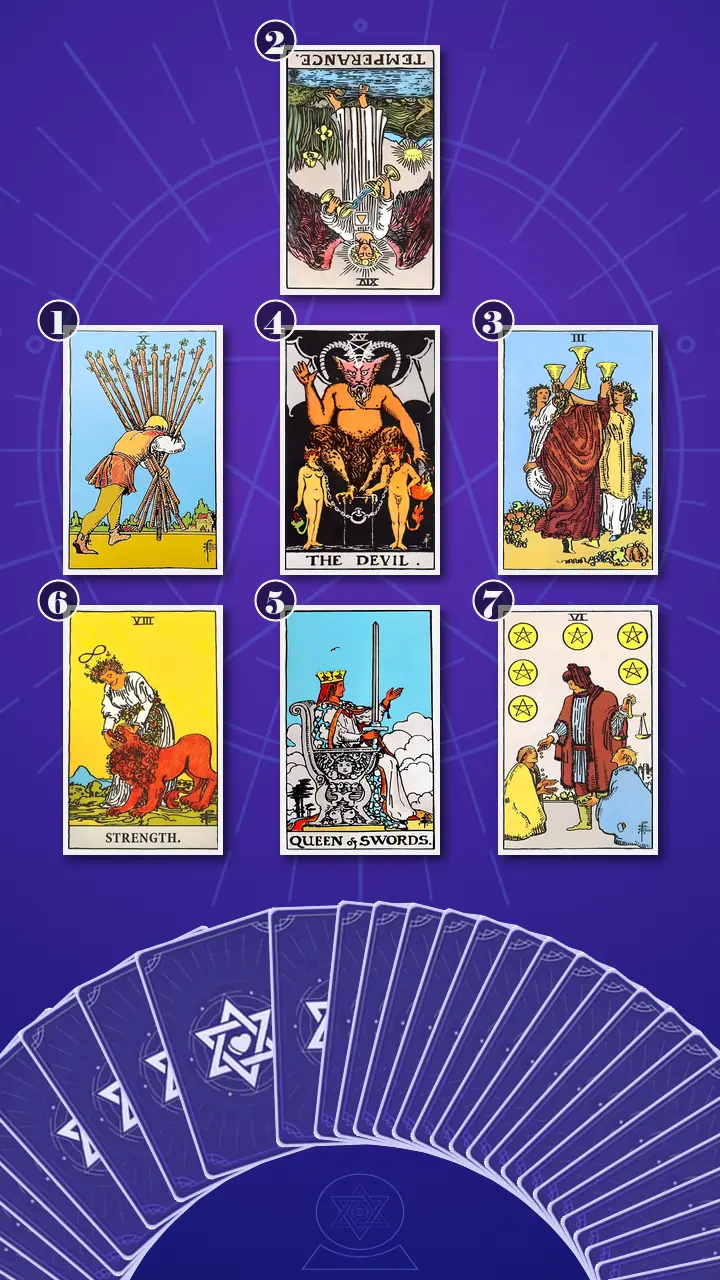
Reading the Map: From Invisible Labor to Visible Agreements
Position 1: The Autopilot Role
“Now we turn over the card representing Surface pattern on the trip: the visible, repeatable behavior of becoming the cleanup crew,” I said.
Ten of Wands, upright.
I didn’t need to overmystify it. “This is the card of carrying more than your share,” I told her, pointing at the bundled wands held tight to the chest, the figure leaning forward under weight. “In modern life terms: after dinner in the Airbnb, you’re standing at the sink stacking plates with your shoulders up by your ears, telling yourself you’ll relax once the kitchen is ‘reset.’ Everyone else is still talking and pouring another drink, and you feel that familiar split—you want to be part of the fun, but you also feel responsible for preventing the mess from becoming a bigger problem.”
Energetically, the Ten of Wands is excess—too much responsibility, too much self-assigned duty, not enough distribution. It’s fire energy that’s become strain instead of warmth.
Jordan let out a small laugh that didn’t quite reach her eyes. “That’s… brutal,” she said. Then, softer: “But yeah. That’s literally me.”
“Brutal is often just accurate,” I said, keeping my tone kind. “And accuracy is how we get actionable advice. The question isn’t ‘Why are you like this?’ It’s: what do you keep picking up automatically that could stay on the counter long enough for other people to notice it exists?”
Position 2: The Inner Tug-of-War
“Now we turn over the card representing Inner tug-of-war: what you’re trying to balance emotionally—keeping the vibe vs wanting fairness,” I said.
Temperance, reversed.
“Temperance is the alchemist,” I told her. “Balance, exchange, mixing two things until they work together. Reversed, the flow between the cups is disrupted—effort pours out of you, and it doesn’t circulate back.”
I grounded it in her reality: “You try to be the ‘easygoing’ friend—laughing it off, keeping things light—while your nervous system is already in task mode. You can feel yourself over-accommodating in real time: swallowing irritation so the group stays comfortable, ending up emotionally off even though the trip is objectively fine.”
This is blockage: the need for reciprocity gets dammed up by the fear of being the person who ‘makes it a thing.’
“And there’s a risk here,” I added, because reversals are honest. “If you get sick of being taken for granted, you might swing hard—do zero help, go quiet, and it reads as passive-aggressive. That doesn’t set a boundary. It just makes tension with no structure.”
Jordan’s fingers tightened around her mug. “I’ve done that,” she admitted. “Like… I get cold. And then I feel guilty for being cold.”
“That’s Temperance reversed,” I said. “Not ‘bad,’ just imbalanced.”
Position 3: The Social Pressure That Shapes Your Choices
“Now we turn over the card representing External pressure: the group dynamic, social expectations, and unspoken norms,” I said.
Three of Cups, upright.
The card looked almost sweet—raised cups, linked circle, celebration. “This is the vibe,” I said. “Music, snacks, inside jokes. Someone suggesting a late-night run for ice cream. In that atmosphere, chores feel like a record scratch. You catch yourself thinking, ‘If I mention dishes, I’ll be the only one not in the circle.’”
Energetically, this is balance in terms of connection—your friends are there for fun and togetherness. The problem is that the celebration becomes an unspoken rule: fun first, logistics later, and whoever cares most will handle it.
“So it’s not that they’re villains,” Jordan said quickly, like she needed me to hear that.
“Right,” I agreed. “And here’s the nuance: wanting fun is fine. But when fun relies on one person’s unpaid labor, it stops being ‘chill’ and starts being extraction.”
Position 4: The Root Knot Under the Sink Full of Dishes
“Now we turn over the card representing Core blockage: the belief or attachment that keeps you stuck in over-functioning instead of setting a boundary,” I said.
The Devil, upright.
I watched Jordan’s face before I even spoke. Her eyes flicked down and back up like she’d just seen herself in bad lighting.
“The Devil isn’t ‘you’re bad,’” I said. “It’s the feeling of being bound to a role because it buys you something you’re scared to lose.” I pointed to the loose chains. “They’re not locked. That matters.”
Then I used the contrast her mind already runs, because this is where people tend to protect themselves with good intentions.
“Inner monologue one: ‘I’m just being helpful.’ Inner monologue two: ‘I’m trying to secure my spot here.’”
I let that sit, then gave her the modern metaphor that fit perfectly. “It’s like accepting an app’s terms & conditions without reading them,” I said. “Somewhere along the way you clicked Agree to an invisible contract: Belonging in exchange for service. And the loose chain is the moment you realize no one made you sign it.”
Her throat moved in a hard swallow. She stared at the card, then at the table, like she was replaying a scene: hovering by the sink while the group laughs in the living room, feeling that stomach drop when no one stands up.
“Belonging that costs your rest isn’t belonging—it’s a job,” I added, not as a diagnosis, just as a translation.
My mind flashed, briefly, to my old Wall Street life—how often people stay trapped in a deal not because the contract is ironclad, but because they never renegotiated the terms. The market doesn’t care about your resentment; it cares about what you sign. Groups are kinder than markets, but the pattern can feel just as binding.
Position 5: The Tool You Already Have, But Don’t Use in the Moment
“Now we turn over the card representing Available resource: the communication skill or mindset you can access to set a boundary cleanly,” I said.
Queen of Swords, upright.
Jordan straightened a little—like her spine recognized the assignment.
“This is the two-line Slack message,” I said, and she snorted because she gets that. “Not the five-paragraph apology email. The Queen of Swords is one clean sentence that cuts through the fog of hints and over-explaining.”
I made it painfully specific: “Instead of doing the dishes while silently hoping someone notices, you choose one direct line at a neutral moment: ‘I’m not doing dishes alone tonight—can two people take cleanup?’ No jokes. No TED Talk about fairness. Just the request.”
This is balance in Air energy—clarity without cruelty.
Jordan’s hand drifted toward her phone like muscle memory. “I want to… put that in Notes,” she admitted, half-laughing. “Like copy/paste it so I don’t have to invent it in the moment.”
“That’s exactly how this resource works,” I said. “And here’s the line I want you to remember: Hints aren’t boundaries. They’re just quieter resentment.”
When Strength Held the Lion: Setting a Boundary Without Being Harsh
Position 6: The Turning Point Energy
I touched the sixth position. “Now we turn over the card representing Key transformation: the inner quality that changes how you show up when you speak the boundary.”
The room felt quieter as the card turned, like the building heard us.
Strength, upright.
“This is not ‘be tougher,’” I said. “It’s ‘be steadier.’ Strength is gentle authority—power without aggression.”
I grounded it in her life scenario: “You feel the heat of resentment rise when you see the sink again. Your instinct is either to snap or to swallow it. Instead, you take one breath, keep your voice steady, and repeat the boundary without sarcasm: ‘I’m not doing cleanup alone.’ You let the moment be a little awkward without rushing to fix everyone’s feelings.”
Energetically, this is balance in Fire—courage without strain.
My “Negotiation Alchemy” Lens (Because This Is a Social Negotiation)
Here’s where my old-world training and my tarot work overlap perfectly. On Wall Street, we’d never walk into a negotiation without a BATNA—your Best Alternative To a Negotiated Agreement. Not as a threat. As a stabilizer. When you have a clear BATNA, you stop begging the other side to approve your needs.
So I told Jordan: “Strength is you holding your BATNA in your body. Your BATNA might be: ‘If no one claims cleanup, I’m not doing it—someone else can do it later,’ or ‘If no one wants dishes, we do takeout tomorrow.’ It’s not punitive. It’s you refusing to be voluntold.”
Then I layered in one of my practical tools. “I also teach something I call Handshake energy exchange—it’s basically palmar biofeedback. Your hands and chest tell the truth faster than your mouth. When your palms are tense, your voice wobbles. When your sternum softens, your words land cleaner.”
Setup (30–50 words): I could feel Jordan’s usual loop activating: it’s 9:18 p.m. in the Airbnb kitchen, playlist on, glasses clinking, and she’s already stacking plates while everyone else melts into the couch. She tells herself she’ll ask in a second… but her hands start cleaning before her mouth does.
Delivery (the sentence that changes the whole reading):
Stop proving you’re “easy” by carrying the whole trip, and start practicing gentle firmness—like Strength—so the lion of group discomfort doesn’t run the show.
Reinforcement (100–200 words): Jordan froze for a beat—like a video buffering. Then her breath came in shallow, high in her chest. Her eyes went slightly unfocused, not dramatic, just that look people get when they’re suddenly remembering every time they laughed off “don’t be so intense” while their shoulders climbed up to their ears. Her jaw shifted, unclenching by millimeters. She blinked hard once, then exhaled slow, like she’d been holding air all weekend. I watched her plant both feet flat on the floor without thinking. Strength does that—brings you back into your body. “Okay,” she said, quiet but clear. “So I don’t have to be… sharp. I just have to not move.” “Exactly,” I replied. “A kind tone doesn’t require a flexible boundary.” Then I gave her a 10-minute ‘Steady Ask’ rehearsal: step into the bathroom or onto the balcony with your phone timer for 2 minutes. One hand on your sternum. Drop your shoulders. Unclench your jaw. Say the one sentence out loud three times—same words each time: ‘I’m not doing dishes alone tonight—can two people take cleanup after dinner?’ If your body spikes—heat in your face, tight throat—pause and exhale longer than you inhale. You’re not trying to feel confident; you’re practicing staying present. I leaned in slightly. “Now—with this new lens—can you think of a moment last week when this would’ve changed how you felt?”
Jordan nodded, almost imperceptibly. “Last night,” she said. “I could’ve said it before I touched the sink.”
And that was the shift: from resentful self-silencing toward calm boundary-setting that still protects connection.
Position 7: The Boundary That Makes Fairness Real
“Now we turn over the card representing Next-step boundary in practice: how to make cleanup labor fair and visible without moralizing or rescuing,” I said.
Six of Pentacles, upright.
“This is the scales,” I said. “Not vibes. Not hoping people notice. A visible agreement.”
I translated it straight into her modern life scene: “You propose a simple system the group can follow without drama: ‘Two people cook, two people clean—rotate tomorrow.’ You write it on a sticky note or a phone note and hand the marker to someone else so you’re not managing it. Cleanup stops being a personal favor you provide and becomes a normal shared part of the trip.”
This is balance in Earth—fairness that doesn’t rely on your constant vigilance.
Jordan gave a small, real nod. The practical part of her lit up. “Like Splitwise,” she said, “but for labor.”
“Exactly,” I said. “And here’s the principle: If it matters, make it visible—don’t make it heroic.”
From Insight to Action: The Boundary Script That Won’t Kill the Vibe
When I stitched the whole map together for Jordan, it formed a clean story: the Ten of Wands is you auto-grabbing the workload so the trip runs smoothly. Temperance reversed is the internal imbalance—your need for harmony steamrolling your need for reciprocity. The Three of Cups is the social gravity of “we’re on vacation,” which makes chores feel uncool to name. The Devil is the hidden contract: you pay for belonging with service. The Queen of Swords hands you the tool—one clear sentence. Strength is the embodied courage to tolerate two seconds of awkwardness without collapsing. And the Six of Pentacles turns it into a system so you don’t have to keep renegotiating in your head.
The cognitive blind spot I named gently was this: Jordan had been treating silence as the price of harmony. But silence isn’t harmony—it’s just a lack of information. The transformation direction is simple and hard: shift from silently compensating to naming one clear, specific ask and letting others respond to it.
Then I gave her next steps she could actually do on a trip, without turning into the Airbnb manager.
- The One-Sentence Ask (neutral-time version)Before dinner—mid-morning or early afternoon—say to the group: “Quick thing—can we do a cleanup rotation tonight? Two people cook, two people clean.”Keep it to one sentence. No history, no prosecution, no extra justification. If your voice shakes, slow down and lower your volume—steady reads as confident.
- Gentle-But-Immovable Delivery (10-second body reset)Right before you speak, plant your feet on the floor, drop your shoulders, and exhale longer than you inhale. Then say: “I cooked tonight, so I’m not doing dishes—who’s on cleanup?”If someone jokes “don’t be intense,” repeat once—same words—and stop talking. Let the silence do some work for you.
- The Cleanup Scales System (make labor visible)Put a quick note on the fridge: “Dishes: ___ & ___ / Trash: ___ / Wipe counters: ___.” Hand the marker to someone else and sit down.Your job is to propose the structure, not to run it. If nobody volunteers immediately, don’t rescue—say, “Cool, I’m not doing dishes—someone can grab it later.”

A Week Later: The Quiet Proof of Finding Clarity
Five days later, Jordan texted me a photo: a slightly crooked sticky note on an Airbnb fridge. Three lines. Three blanks. Under it, a marker sitting on the counter like an invitation instead of a weapon.
Her message was short: “I said it before dinner. My voice shook a little. Two people volunteered. I sat down with my drink and didn’t sprint to the sink.”
There was a bittersweet detail in the follow-up that made it real: she said she still felt a flicker of “what if I’m annoying?” the next morning—but she slept through the night. Clarity didn’t erase the old fear. It just stopped letting that fear run the whole trip.
That’s what this Journey to Clarity looked like: not becoming harsher, not becoming colder—just becoming steady enough to stop buying peace with your labor, and structured enough to let fairness be normal.
And if you’re reading this with that familiar tight jaw—because you’ve been the one stacking plates while everyone else opens another drink—hold onto this: when you keep cleaning so everyone stays happy, you’re not just washing dishes—you’re paying for belonging with your own rest, and your body knows the bill is overdue.
If you didn’t have to earn your spot on the trip, what’s one small, clear sentence you’d be willing to say tonight—just to see what changes?
This story is adapted from psychological research, written so that those in a similar struggle can see their own pattern in it — and find their next step clearly.These insights are not a substitute for professional psychological, medical, legal, or financial advice.
Learn more about our Journey to Clarity.
How did this insight land for you?
🫂 This Resonates Deeply
🌀 Living This Story
✨ Now I See Clearly
🌱 Seeing New Possibilities
🧰 Useful Framework
🔮 The Confirmation I Needed
💪 Feeling Empowered
🚀 Ready for My Next Step
Author Profile
 AI
AI“I spent years in the intense, high-stakes world of Wall Street. I know exactly how isolating and heavy the weight of uncertainty can feel in the dead of night. I use strategic, commercial logic not to be cold, but to protect you from unnecessary friction. Think of me as a fellow traveler who has walked the same rocky path—offering sharp but deeply supportive wisdom to help you clear the fog and confidently win your narrative back.”
In this Friendship Tarot Reading :
Core Expertise
- Reciprocity ROI Analysis: Objectively measuring the emotional give-and-take in your core friendships to identify asymmetrical, high-drain relationships.
- Sunk-Cost Decoupling in Loyalty: Separating the 'ten years of history' from the current reality of a one-sided, demanding friendship.
Service Features
- The Friendship Downgrade Strategy: A calculated tactical approach to gradually and decently de-escalate a toxic friendship into a low-maintenance acquaintance without triggering dramatic conflict.
Also specializes in :
Explore Related Patterns:
Boundary DiffusionJordan describes her body signing up for a job her mouth never agreed to, which is the clearest boundary clue in the whole scene. The group does not need to formally assign cleanup for the role to land on her. The unspoken rule is enough because she moves before the boundary can form. Boundary Diffusion happens when the line between your responsibility and the group's responsibility gets too blurry to defend in the moment. You feel the mess, the mood, and the possible awkwardness as if they are all yours to manage, so your yes becomes behavioral rather than verbal. The repair is to make the line visible before action blurs it again. 'I cooked tonight, so I'm not doing dishes' is not harsh. It is a clean separation between care and automatic availability.
Defensive OverfunctioningJordan's hands are in warm dishwater while everyone else drifts toward the couch, and the key detail is that her body starts solving the problem before her mouth has agreed to the job. You can see the defense in the sequence of rehearsing the ask, delaying it until you feel calmer, resetting the kitchen because it is faster, and then carrying the resentment quietly. That is Defensive Overfunctioning because the extra labor is not only helpfulness. It is a strategy for stabilizing the room. You protect the group's easy mood by becoming the person who notices, prevents, and fixes the logistical mess, which gives short-term control but trains the group to treat your effort as invisible infrastructure. The boundary is not to become less caring. It is to stop making your competence the emergency exit for everyone else's avoidance, so the task can stay visible long enough for other people to claim it.
Guilt-Driven People-PleasingJordan's thought that asking about dishes might make her high maintenance sits right beside the deeper line about belonging in exchange for service. The dishes matter because they expose a social contract you never consciously signed. Stay useful, stay easy, stay included. Guilt-Driven People-Pleasing turns care into social insurance. You are not just helping because cleanup needs doing. You are trying to prevent the fear that your needs will make you harder to love, harder to invite, or harder to keep in the group. That is why the boundary has to be specific and behavioral instead of emotional proof. Saying 'I'm not doing cleanup alone' lets you test whether belonging can survive a normal request, rather than continuing to buy your place with labor your body never agreed to give.
Self-SilencingJordan rehearses the perfect chill way to ask for help, then ends up washing the glasses anyway. The psychological hinge is not that she has no boundary in her mind. It is that the boundary never gets spoken while it can still change the situation. Self-Silencing shows up when you convert a reasonable need into private tension because you are trying to protect the social atmosphere. The group receives no clear signal, so your silence gets misread as willingness, while your body registers the cost through tight shoulders, a clenched jaw, and quiet fury. The pattern becomes especially draining because the suppressed ask does not disappear. It returns as coldness, guilt, or a delayed emotional withdrawal. A clean boundary interrupts that loop by making the need audible before resentment has to speak for you.
Boundary DiscernmentJordan's shift begins when she notices that silence has been standing in for harmony. The sink is not just a sink in this story. It is the point where kindness, fairness, group comfort, and her own rest have been getting mixed together. Boundary Discernment is the ability to separate those layers without turning the group into villains or yourself into the manager. You can want the trip to feel easy and still recognize that ease becomes distorted when one person's labor keeps absorbing the inconvenience. The boundary becomes clearer when it is set before the sink takes over. Naming a cleanup rotation turns a vague emotional burden into a visible agreement, which lets you stay connected without making your availability unlimited.
Assertive CommunicationJordan's most useful line is simple enough to say before her nervous system switches into task mode. 'I'm not doing dishes alone tonight, can two people take cleanup?' gives the group a clear request, a clear limit, and a clear next action. Assertive Communication works here because it removes the fog of hints, jokes, over-explaining, and silent hoping. You are not asking the group to read your resentment. You are giving them usable information while your tone stays steady enough to keep the moment from becoming a courtroom. The follow-up proves why the pattern matters. When Jordan says it before dinner, two people volunteer and she sits down with her drink. The boundary does not kill the vibe. It gives fairness a structure the group can actually respond to.
Explore Related Struggles:
Low-Maintenance Worth LockJordan's hands begin stacking plates before her mouth has agreed to the job. Even after she later speaks up and two people volunteer, the old question still flickers the next morning: what if I'm annoying? Low-Maintenance Worth Lock lives in that delay between needing something and allowing it to be known. You keep yourself acceptable by making your needs small, quick, and easy to miss, then wonder why other people keep benefiting from a version of You that never asks for a fair split. The story gives this struggle a practical exit point: she says the boundary before touching the sink. That timing matters because it breaks the worth bargain at the source. You do not have to become colder or more demanding; You have to stop treating your own ease as the first thing that must be sacrificed to stay likable.
Performative HarmonyThe group trip has music, snacks, inside jokes, and the soft pull of everyone melting into the couch. Inside that atmosphere, Jordan reads cleanup as a threat to the vibe, so she absorbs the interruption into her own body instead of letting the group feel it. You can see Performative Harmony in the gap between how chill the evening looks and what it costs to keep it looking that way. The peace is not built from mutual ease; it is staged through Jordan's swallowed request, clamped jaw, and quiet resentment. This struggle matters because the boundary she needs is not harshness. It is a refusal to keep producing fake ease through invisible labor. When she lets the moment be a little awkward and still says, 'I'm not doing cleanup alone,' she stops treating discomfort as something she must erase before anyone else notices.
Reciprocity DeficitThe kitchen keeps becoming Jordan's station after dinner: warm dishwater, tight shoulders, glasses rinsed while the rest of the group keeps talking. Her effort is real, immediate, and useful, but it does not circulate back as help, rest, or shared responsibility. You can feel the core imbalance in the way the trip stays easy for everyone else while becoming physically expensive for her. She is not asking for special treatment; she is asking for the exchange to become visible enough that one person's care does not become the group's default infrastructure. Reciprocity Deficit is the cleanest struggle under the boundary question because the problem is not that chores exist. The problem is that the flow of contribution has become one-directional. A clear cleanup rotation works because it turns fairness from a private hope into a shared structure.
Utility-Belonging FusionJordan keeps ending up at the sink while everyone else moves toward the couch, and the story names the hidden bargain with unusual precision: belonging in exchange for service. The dishes are not just chores in this pattern. They become the proof she offers to the group that she is easy, helpful, and worth keeping close. That is why the boundary question carries more weight than a cleanup rota. When You are fused to usefulness, a simple ask can feel socially risky because it interrupts the role that has been securing your place. You are not only asking two people to wash glasses; You are testing whether connection can survive without You silently paying for it. Utility-Belonging Fusion fits because the visible behavior is repeated service, while the deeper structure is conditional inclusion. The shift begins when Jordan says the sentence before touching the sink, because that moment separates belonging from labor and lets the group respond to her actual limit instead of her quiet over-functioning.
Systemic DepletionJordan resets the kitchen because the mess feels immediate, visible, and easier to solve than the social tension underneath it. The plates disappear, the counters clear, and the group trip keeps working, but her own rest is the thing that keeps getting misplaced. Systemic Depletion shows up when a person becomes the hidden maintenance system for a shared environment. You solve the visible problem so efficiently that the deeper imbalance has no reason to announce itself. The system looks fine precisely because You keep absorbing the cost. The boundary needs to interrupt that automatic repair cycle. When Jordan stops sprinting to the sink and lets cleanup remain visible long enough for others to claim it, she is not creating a problem; she is revealing the part of the system that was already unfair.
Unspoken Expectation LoadThe trip is governed by a rule no one formally agreed to: fun first, logistics later, and the person who notices the mess will probably handle it. Jordan feels that rule in real time, because naming dishes seems like a record scratch against the group's celebration. Unspoken Expectation Load fits because the burden is not only the dishes. It is the extra mental work of reading the room, timing the ask, softening the request, and deciding whether a fair need will make her look high maintenance. A visible agreement changes the geometry of the problem. The sticky note on the fridge, the two cook and two clean rotation, and the marker handed to someone else all move the expectation out of Jordan's head and into the shared space where the group can actually respond.
Explore Related Emotions:
Boundary GuiltJordan keeps telling herself she will ask in a second, but the second keeps moving until the dishes are already done. A practical request becomes emotionally loaded because it threatens the role she has been using to stay agreeable, useful, and safely inside the group. Boundary Guilt shows up in that exact delay. You can want fairness and still feel a body-level flinch when it is time to name it. The guilt is not evidence that the boundary is wrong; it is evidence that the old system trained her to experience ordinary limits as social disruption. The boundary she practices is small, specific, and clean: she is not doing dishes alone tonight. That sentence matters because it separates responsibility from over-apology, giving her a way to stay connected without making her own rest negotiable.
Conditional Belonging FearJordan hovers by the sink while the group laughs in the living room, and the story names the invisible contract clearly: belonging in exchange for service. The dishes matter because they expose the bargain her body has been trying to uphold before anyone explicitly asks for it. Conditional Belonging Fear lives in the thought that if she stops being useful, easy, and accommodating, her place in the group might become less secure. That fear makes silence feel safer than a fair request, even when the silence leaves her furious afterward. The boundary interrupts the contract without attacking the people in the room. When she says the ask before touching the sink, she is testing a different truth: connection does not have to be purchased with unpaid labor.
Grounded AgencyJordan moves from silently compensating to naming one clear, specific ask. The sticky note on the fridge matters because it turns a vague social fog into something ordinary, visible, and shared. Grounded Agency is the feeling of having a handle again. Instead of waiting for people to notice, hoping her hints land, or managing the whole kitchen through resentment, she chooses the next controllable action. The agency is grounded because it stays practical. She is not trying to control everyone's reaction; she is setting the condition under which she will participate fairly, then letting the group meet the structure.
Hidden ResentmentJordan rehearses the perfect, chill way to ask for help, then ends up with her hands in warm dishwater while everyone else melts into the couch. The request never leaves her mouth, so the body takes over: tight shoulders, clamped jaw, glasses rinsed with a kind of silent force. That is why Hidden Resentment fits the story so closely. The feeling is not random irritation; it is the emotional residue of repeatedly protecting the group's ease while her own limit goes unnamed. You can see the pressure building in the gap between what she wants to say and what she actually does. The sharper insight is that the resentment is giving her information. It points to a boundary that has been outsourced to hope, hints, and silent competence. Once the labor becomes visible, the feeling no longer has to hide inside politeness.
Low-Maintenance ShameJordan tries to be the easygoing friend: laughing it off, keeping the trip light, and making sure the kitchen does not become a record scratch in the middle of music, snacks, and inside jokes. The social performance is subtle, but her body tells on it through the shoulders, the jaw, and the way her hands start cleaning before her mouth can ask. Low-Maintenance Shame is the fear that having a need will make her less pleasant to be around. It turns a normal request for shared cleanup into a referendum on whether she is too intense, too demanding, or too much trouble for the group. The story's emotional hinge is that being low-maintenance has started to cost her rest. Naming the boundary does not make her harsher; it lets her stop proving she belongs by disappearing her own needs.
Mutuality HungerJordan keeps coming back to the same truth: it is not even about the dishes, and it is exactly about the dishes. What she wants is not praise for doing more; she wants the care of the trip to move in both directions. Mutuality Hunger names that deeper appetite for reciprocity. The hunger shows up because the group is warm and fun, but the practical care underneath the fun has been flowing too heavily through her. The cleanup rotation answers the hunger without turning it into a moral trial. Two people cook, two people clean, and fairness becomes a shared rhythm instead of a private wish she has to swallow.
Performative CalmJordan rehearses a chill, not-a-big-deal version of a request that actually matters to her. The outside performance is relaxed, but the body is already bracing: jaw tight, shoulders up, hands moving toward work before the words can arrive. Performative Calm names the split between the vibe she presents and the pressure she is containing. She is not calm in a grounded way; she is making calmness available to everyone else by absorbing the awkwardness herself. The clean boundary gives her a steadier form of calm. She does not need to over-explain, joke, or soften the request until it disappears; she can say the sentence and let the room adjust around the truth.
Clarity ReliefThe one-sentence ask cuts through the fog: she is not doing dishes alone tonight, and two people need to take cleanup. Nothing about it requires a long apology, a fairness lecture, or a performance of being fine. Clarity Relief comes from reducing the emotional load of the moment. Once the request is named plainly, Jordan no longer has to communicate through hints, tension, or a spotless kitchen that silently proves she needed help. The relief becomes visible in the crooked sticky note on the fridge. The boundary has left her head and entered the room, which means she can stop carrying the whole negotiation internally.
Fairness FatigueJordan is not only doing the dishes; she is also doing the mental accounting around them. She notices who cooked, who sat down, who ignored the sink, and how much tension it would create to say the obvious out loud. Fairness Fatigue fits because the drain is not one isolated chore. The exhausting part is repeatedly carrying the invisible spreadsheet of reciprocity while trying to act like nothing is happening. The cleanup rotation changes the emotional math. Once fairness is visible, Jordan no longer has to monitor the imbalance alone or turn every sink full of dishes into a private negotiation with herself.
Unseen Effort GriefThe kitchen becomes a ghost responsibility after dinner: music keeps playing, drinks keep pouring, and the mess quietly moves toward whoever cares most. Jordan's effort disappears almost as soon as it works, because a reset kitchen looks natural to everyone who did not reset it. Unseen Effort Grief captures the ache underneath the anger. It is the sadness of realizing that her care has become ambient infrastructure, useful precisely because nobody has to look at it too closely. Making cleanup visible gives that grief somewhere to go. A sticky note on the fridge is not just a system; it is proof that the labor exists before Jordan has to sacrifice herself to make it disappear.
Guilt-Free RestFive days later, Jordan sends the proof: she said it before dinner, her voice shook a little, two people volunteered, and she sat down with her drink instead of sprinting to the sink. The scene is small, but it reverses the old bargain in her body. Guilt-Free Rest fits the moment when rest stops feeling stolen. She is still part of the group, the kitchen still gets handled, and her presence no longer has to be justified by immediate usefulness. The relief is deliberately modest. The old fear flickers the next morning, but it no longer runs the whole trip; she has evidence that sitting down does not collapse connection.
Rest GuiltJordan stands at the sink with tight shoulders while everyone else sinks into the couch, and the story names the forgotten thing as her own rest. Even relaxation starts to feel like something she can access only after the kitchen has been made acceptable for everyone else. Rest Guilt is the pull that makes sitting down feel premature, selfish, or unsafe when there is still a task in view. It converts downtime into a reward she has to earn rather than a basic part of being on the trip. When she says the boundary before dinner and later sits with her drink, the shift is concrete. She is not abandoning the group; she is letting rest exist without first proving she deserves it through extra labor.
Explore Related Contexts:
Conditional Belonging PressureJordan hovers by the sink while the group laughs in the living room, and the story gives that arrangement a sharp phrase: belonging in exchange for service. The issue is not that her friends are framed as enemies; the issue is that her place in the group has started to feel safer when she is useful. Conditional Belonging Pressure captures the invisible contract that forms when acceptance seems tied to being helpful, agreeable, and low-friction. You can be surrounded by friendly people and still be operating under a social cost structure that makes rest feel risky. A boundary interrupts that contract without demanding a dramatic confrontation. By saying she will not do cleanup alone, Jordan tests whether the group can hold her as a peer when she stops paying for connection with unpaid labor.
Designated Cleanup Crew BurdenJordan is at the Airbnb sink at 9:42 p.m., rinsing glasses while everyone else melts into the couch with music, drinks, and inside jokes. The task has not been formally assigned, but her body has already taken it on, turning a shared post-dinner mess into a private job. Designated Cleanup Crew Burden captures the way a group trip can quietly create an unofficial service role. You are not just deciding whether to wash dishes; you are locating the moment where convenience turns you into the unpaid operations layer for everyone else's ease. The boundary becomes practical when the role is named before the sink claims you. A sentence like 'I'm not doing cleanup alone tonight, can two people take it?' moves the labor out of your body and back into the group, where it belongs as a shared trip responsibility.
Friend Group Logistics ResetJordan's follow-up photo shows a crooked sticky note on the Airbnb fridge with three lines, three blanks, and a marker on the counter. That small object changes the social architecture of the trip because the work is no longer floating around as a vague expectation. Friend Group Logistics Reset names the move from implied effort to visible operating agreement. You are not becoming the Airbnb manager; you are creating enough structure that the group can share basic maintenance without needing one person to monitor every loose end. The reset works because it is lightweight. Two people cook, two people clean, rotate tomorrow, and someone else holds the marker. The boundary becomes easier to respect when the group can see exactly what fairness is supposed to look like.
Friendship Boundary NegotiationJordan reaches for her phone because the line needs to be ready before the kitchen moment takes over: 'I'm not doing dishes alone tonight, can two people take cleanup?' The story keeps the wording deliberately short because the boundary has to survive real-time social pressure, not just sound good in theory. Friendship Boundary Negotiation fits because this is a peer relationship problem, not a household management problem alone. You are trying to protect connection while changing the terms of participation, which means the boundary has to be clear enough to act on and calm enough to keep the friendship space open. The negotiation is not about proving the group is wrong. It is about offering a concrete term and then allowing a small amount of awkwardness to exist without rushing back to the sink to erase it.
Invisible Domestic LaborWarm dishwater, stacked plates, rinsed glasses, wiped counters, and a reset kitchen are all visible outcomes, but the person producing them nearly disappears from the group's attention. Everyone gets the benefit of a clean Airbnb while Jordan loses the part of the night where she was supposed to be resting and participating. Invisible Domestic Labor fits because the conflict is not the existence of chores. It is the way ordinary domestic maintenance becomes socially invisible when no one names it, assigns it, or treats it as part of the shared cost of the trip. For you, the key move is making the work legible before it becomes automatic. A fridge note, two names beside dishes, and a marker handed to someone else turn the cleanup from a silent personal favor into a visible group obligation.
Low-Maintenance Friendship PressureJordan rehearses the perfect chill, not-a-big-deal way to ask for help, then does the dishes because it feels faster than risking the vibe. The group atmosphere makes a reasonable request feel like a social interruption, as if mentioning cleanup would make her the only person outside the circle. Low-Maintenance Friendship Pressure names the social rule underneath that moment. You are being nudged to prove you are easygoing by absorbing inconvenience quietly, even when the actual request is small, concrete, and fair. The useful boundary does not attack the friendship or turn the trip into a trial. It simply refuses the bargain where your rest is the price of being seen as relaxed, and it gives the group clean information before resentment has to do the communicating.
Measured Reciprocity TrialJordan calls the cleanup system like Splitwise, but for labor, and the comparison lands because the problem is distribution. The trip already has shared pleasure, shared meals, and shared space; the missing piece is a shared way to account for the work that keeps those things possible. Measured Reciprocity Trial fits the moment when Jordan asks whether the friendship group can translate good vibes into concrete fairness. You are not scorekeeping every small act, but you are refusing a setup where generosity only moves in one direction. The trial succeeds in the follow-up because two people volunteer and Jordan sits down with her drink instead of sprinting to the sink. Reciprocity becomes real when contribution is specific enough for others to claim and visible enough that you no longer have to carry the whole exchange silently.
Responsibility Without AuthorityJordan is the one who notices the sink, the plates, the glasses, and the mess that will become worse if nobody acts. Yet no one has actually made her the cleanup lead, agreed to follow her system, or given her a structure that lets her distribute the work. Responsibility Without Authority is the external bind here. You carry the consequence of the group ignoring logistics, but you do not yet have a visible agreement that allows you to assign, rotate, or stop the task without feeling like the problem. The boundary gives the responsibility a matching structure. When Jordan says she is not doing dishes alone and asks two people to take cleanup, she is not asking for special treatment; she is aligning the authority to name the work with the shared responsibility to complete it.