The 8:56 p.m. Group Chat Silence
If the second a group trip gets mentioned, you’re already opening Notes, building a mini itinerary, and feeling your shoulders creep up—while everyone else goes “down for whatever” in the chat, you might be stuck in default trip planner mode.
Taylor showed up to our session in Toronto with that specific kind of tired that looks functional from the outside and feels like carrying a sandbag on the inside. She dropped her tote by my chair, then set her phone on the table face-up—like it might buzz at any second with one more “Whatever works!” that would somehow become her problem.
She described a scene I’ve heard in a hundred modern versions: 8:56 p.m. on a Wednesday, perched at a tiny condo kitchen counter, under-cabinet lights humming like a low electrical whine. WhatsApp open. Google Flights open. Airbnb saved list open. The phone warm in her palm. Jaw clenched. Shoulders up by her ears. The chat is full of hype until she asks, “Okay, dates?” and then it goes quiet in that way that feels louder than a reply.
“I don’t even care where we go,” she said, voice tight around the words. “I just can’t do another trip where I’m chasing everyone. I want to be invited, not appointed.”
Under the resentment was something more tender: a fear that if she stops carrying the planning, the whole thing—and maybe her place in the group—will wobble. The feeling sat in her chest like a heavy paperback book left open for days, pages slowly curling.
I nodded, letting the silence be gentle instead of urgent. “We’re going to treat this like a system, not a personality flaw,” I told her. “We’re here for a Journey to Clarity—so you can still have shared fun and connection without automatically becoming the unpaid project manager of your social life.”

Choosing the Compass: Relationship Spread · Context Edition
I invited Taylor to take one slow breath in through her nose and out through her mouth—not as a mystical ritual, just as a clean transition from spiraling in the chat to actually seeing what’s happening. While she exhaled, I shuffled, the cards making that soft, papery whisper that always reminds me of blotter strips in my perfume training: the same materials, different kind of truth.
“For this,” I said, “I’m using a spread called the Relationship Spread · Context Edition.”
To you, the reader: this isn’t a romance spread in disguise. It’s a practical way to map a relationship system—in this case, Taylor versus the friend-group dynamic. The structure works because the issue isn’t choosing between Montreal or PEC; it’s a loop: her overfunctioning meets the group’s underfunctioning, and an unspoken agreement locks it in. The last two positions specifically target what keeps repeating: the avoided boundary conversation and the most empowering next step to rebalance responsibility without losing connection.
I laid the cards in a simple 2-column by 3-row grid: left lane is “You,” right lane is “Group/System.” We’d read across each row first, like two parallel lanes on a shared itinerary—either stuck in the same pattern, or re-aligned with clear owners.
“A few positions to watch,” I added. “The first card shows the role you keep stepping into automatically. The fifth is the core blockage—the sentence you keep drafting and not sending. And the last card is the antidote: the fairest, most doable rebalance move.”
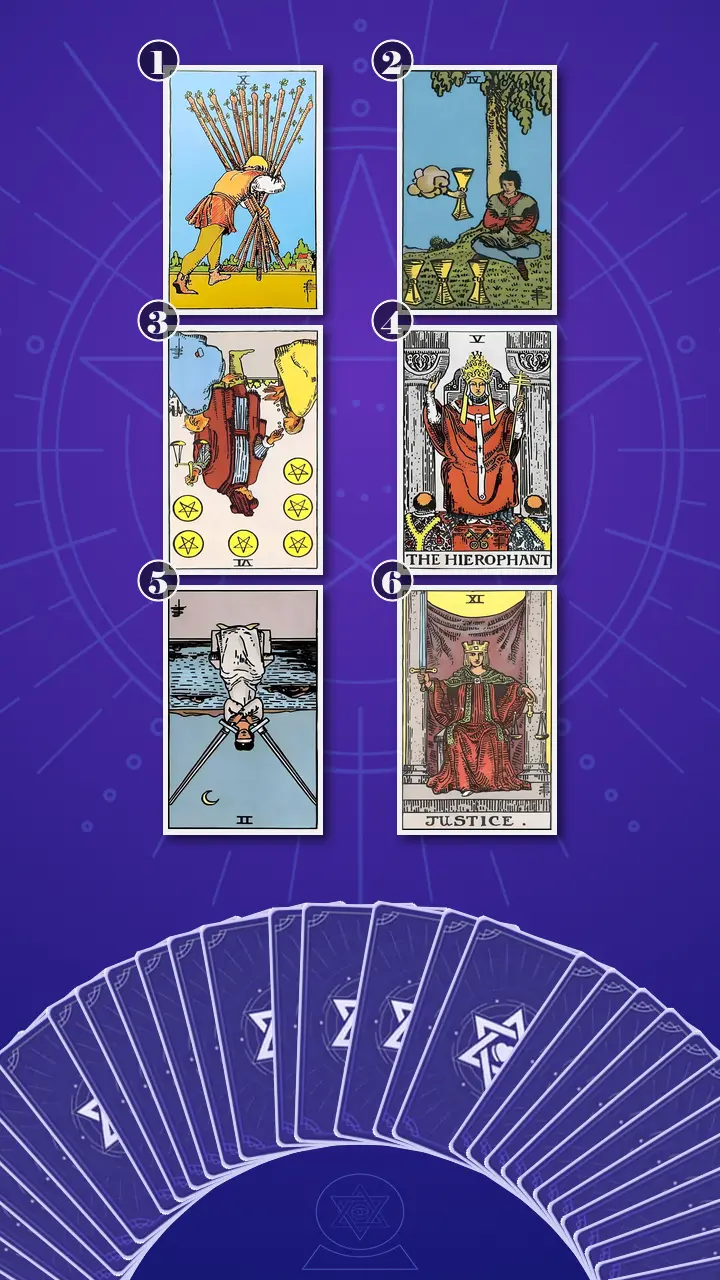
Reading the Two Lanes of the Itinerary
Position 1: Your current role in the friend-group travel dynamic
“Now flipped over,” I said, “is the card representing your current role in the friend-group travel dynamic—the observable pattern you keep stepping into.”
Ten of Wands, upright.
It hit the table with the blunt honesty of a suitcase dropped in a hallway. In the image, someone carries a bundle so big it blocks their view. And I watched Taylor’s face do that tiny, automatic recognition—like when you see your own writing on a whiteboard and realize you’ve been louder than you meant to be.
“This is the moment someone says, ‘We should do a weekend away,’” I said, using the exact modern scene this card points to, “and you immediately open Notes and outline a full itinerary. Within an hour you’ve got multiple tabs open—Airbnb, Google Flights, restaurant lists—and you’re screenshotting options while trying to sound casual in your follow-ups.”
Energetically, Ten of Wands is excess: too much output, too much responsibility, too much carrying. Not because you’re controlling—because you’re trying to keep the plan from dying in the awkward pause. But the more you carry, the less you can even see the fun you were supposedly planning for.
Taylor let out a short laugh that had a bitter edge to it. “That’s… brutal. Like, yeah. I literally start planning the same night.” Her fingers rubbed her jaw as if she could soften it by touch.
“It’s not a moral failing,” I said. “It’s a role. And roles can be renegotiated.”
Position 2: The group’s stance and participation pattern
“Now we’re looking at the group’s current stance and participation pattern—how the system responds when planning gets real.”
Four of Cups, upright.
“You send three solid options—two date ranges and a budget-friendly plan,” I said, “and the replies are emojis, ‘down for whatever,’ and silence. Nobody rejects anything, but nobody chooses.”
Four of Cups is deficiency: not enough engagement, not enough emotional ownership, not enough willingness to tolerate the minor discomfort of picking something that might not be perfect for everyone. It can look like indifference, but in friend groups it’s often decision fatigue plus conflict-avoidance: nobody wants to be the one who ‘makes it hard.’
Across the row—Ten of Wands ↔ Four of Cups—the mirror is sharp: your output rises as their participation drops. Your Google Sheet updates. Their “whatever works.” Your phone warming in your hand from refresh-refresh-refresh. Their quiet.
I watched Taylor’s shoulders lift a fraction like she was bracing for impact. “And then I’m like, okay, I’ll just decide,” she said. “Because I can’t stand it.”
“That makes sense,” I replied, “and here’s the key: your nervous system is treating group silence like a buffering wheel. You start opening more tabs to make it load faster, even though the Wi‑Fi problem isn’t you.”
Position 3: What you are giving or taking on that others are not
“Now flipped,” I said, “is the card representing what you are giving or taking on that others are not—the hidden cost of being the planner.”
Six of Pentacles, reversed.
Reversed, this card is the invisible invoice. The bill isn’t money first—it’s attention, decision-making, follow-up energy, and the low-grade stress of watching prices jump while no one commits.
“This is you giving coordination,” I said, tying it to her real-life behavior: “comparing prices, tracking who’s in, checking cancellation policies, nudging people to respond. Everyone else receives the benefit—a trip that exists—with minimal effort.”
Energetically, reversed Six of Pentacles is blockage in reciprocity. The scales are there, but they’re not being used. And when scales aren’t named, you start measuring silently—time spent, messages sent, deposits fronted—while telling yourself you don’t want to keep score.
“I don’t want to keep score…” Taylor said, and then she swallowed, “…but I also don’t want to keep paying.”
That was the sting of it: the social cost disguised as a compliment. “You’re so good at planning.” Translation: please keep doing the labor so we can keep the vibe.
Position 4: The unspoken agreement or norm that makes you the default
“Now,” I said, “we’re looking at the unspoken agreement or norm that makes you the default—the group’s script.”
The Hierophant, upright.
“This one always makes me think of workplace dynamics,” I said, letting it stay modern and plain. “The ‘meeting notes person’ phenomenon. Once someone does it well a few times, it quietly becomes their job.”
The Hierophant here is structure, but inherited structure—tradition-as-default. It’s not that your friends gathered and appointed you Supreme Travel Coordinator. It’s that the system values comfort and familiarity. ‘Taylor plans’ became a ritual because it works—until it costs you.
This is where I pulled in my own lens—my Social Pattern Analysis, the way I’ve learned to diagnose hidden interaction barriers. “In groups,” I said, “people don’t usually step up because someone ‘deserves help.’ They step up when the system makes it normal and safe to claim ownership. Right now, the norm rewards underfunctioning: if they stay vague, you’ll pick up the slack. Not because they’re evil—because the script has trained everyone.”
Taylor’s eyes shifted off the cards and toward the window. “So it’s… not that they don’t care,” she said slowly. “It’s that we’ve been running the same configuration.”
“Exactly,” I said. “A tradition is just an agreement nobody revisited.”
Position 5: The core blockage—the conversation or boundary being avoided
“Now flipped over,” I said, “is the card representing the core blockage: the conversation, boundary, or decision being avoided that keeps the pattern repeating.”
Two of Swords, reversed.
“This is the unsent draft sitting in your Notes app,” I said, and I watched Taylor’s lips press together because it was too accurate. “You type: ‘Could someone else handle lodging?’ and then delete it. You rehearse a boundary, then post another poll instead. You keep the tone light to protect the vibe, but inside you’re bracing.”
Two of Swords reversed is overflow in the mind: the decision you postpone becomes a decision anyway, just made by your actions. And the body tells the truth—jaw tight, shoulders up, chest heavy—while the chat stays ‘chill.’
I used the inner-monologue pattern the card was begging for, the blindfold logic in modern language: “I’ll ask for help after I send these options… I’ll set a boundary after we pick dates… I’ll bring it up later.”
Taylor stared at the card as if it might move. Her breath paused, then released in a quiet exhale. A beat of stillness, then she said, “Wow. Yes. It’s not that they’re lazy. It’s that I never send the one sentence. I keep hovering over it.”
“Group silence isn’t a task you have to complete,” I said softly. “But you’ve been treating it like one.”
When Justice Held the Scales: Finding Clarity Without Losing the Vibe
Position 6: The most empowering next step
I let my hands rest on the table for a moment before turning the final card. The room felt quieter, like the city outside had lowered its volume just a notch.
“This is the card representing the most empowering next step—how to re-balance responsibility without losing connection,” I said. “The boundary move you can actually try.”
Justice, upright.
Justice brings balance—Air and Earth together: clear words, concrete terms. And as a perfumer, I can’t help but think in structures. In Paris, we learned that an accord isn’t a vibe. It’s proportions. Too much of one note and the whole thing turns sharp. Friendship logistics are similar: if one person carries all the base notes—planning, deposits, follow-ups—the blend gets heavy, even if the top notes are fun.
I leaned in slightly. “Justice is roles, deadlines, receipts, split tabs. It’s the opposite of ‘hoping it will feel fair.’ It’s making fair visible.”
Taylor’s immediate reaction surprised her—she blinked hard, then her mouth twisted as if she was about to argue with herself. “But if I do that,” she said, a flash of defensiveness lighting up her tone, “won’t I sound… intense? Like I’m making it a contract?”
“That’s the old script talking,” I said. “Your personal brand in this group has become ‘easygoing, capable, will handle it.’” I let my Personal Brand Management lens come forward, not as marketing jargon, but as a social truth. “And here’s the catch: you’ve been proving you’re easygoing by doing everything. Justice is you choosing a consistent presentation that protects your self-respect: calm, direct, fair.”
The Aha Moment
Setup: She was caught in that exact moment she’d described—thumbs already moving when the chat went dead, mind sprinting to prevent the trip from falling apart, terrified that if she doesn’t rescue it, the silence will turn into proof that she’s only valued when she’s useful.
Stop proving you’re ‘easygoing’ by doing everything; start choosing clear, fair agreements—like Justice holding the scales steady.
I let the sentence sit between us for a heartbeat, like a clean line of ink on white paper.
Reinforcement: Taylor’s body reacted before her thoughts could polish it. First, a tiny freeze—her fingers stopped fidgeting, hovering above her phone like she’d paused mid-scroll. Then the cognitive shift: her gaze went unfocused for a second, like she was replaying a recent chat thread in her head—emoji reactions, the dead air after “dates?”, the way she filled it with links and options. Finally, the emotion arrived: her shoulders dropped a fraction, not all the way, but enough that the line of tension in her neck visibly softened. Her eyes went a little glassy, the way they do when someone realizes they’ve been doing something to protect belonging and it’s been costing them more than they admitted.
She exhaled again, longer this time. “I’m realizing,” she said quietly, “I keep trying to secure the friendship by securing the itinerary.”
“Yes,” I said. “And Justice is the permission to stop.”
I asked her the question I always ask when clarity lands. “Now, with this new perspective—clear, fair agreements—can you think of a moment from last week when this would’ve changed how you felt?”
Taylor didn’t answer right away. She rubbed her sternum once, like she was checking whether the heaviness was still there. “Thursday,” she said. “Hotel availability was dropping. Someone wrote ‘whatever works.’ I felt my jaw lock, and I started typing this long, too-nice follow-up. If I’d had this… I could’ve just said, ‘I’m in, but I’m not leading.’”
That was the step of transformation right there: from resentment-driven overfunctioning and “fixing the silence” to self-respectful clarity and shared accountability. Not a personality change. A system change.
The One “Justice Text” and the 24-Hour No-Spreadsheet Rule
I gathered the thread of the whole spread into one simple story—because this is how tarot works at its most useful: it turns a foggy situation into a map with cause-and-effect.
“Here’s what I see,” I said. “You start in Ten of Wands—carrying the load before anyone asks—because group silence spikes your internal pressure. The group shows up as Four of Cups: lots of hype, low commitment, ‘down for whatever,’ which reads as indifference when you’re the one watching prices rise. Reversed Six of Pentacles is the invisible invoice: you’re paying with time and mental load, and the ‘scales’ aren’t named. The Hierophant is the norm—‘Taylor plans’—a tradition nobody revisited. And the core blockage is Two of Swords reversed: the unsent boundary message. Justice is the fix, but not a dramatic one: it’s a calm, explicit agreement that redistributes responsibility.”
“Your cognitive blind spot,” I added gently, “is thinking you can negotiate fairness through over-giving and hoping people notice. You can’t. Fairness doesn’t happen automatically in friendships—you have to name the terms, or the default terms will keep naming you.”
Then I moved us into action—small, specific, doable. “Let’s make this practical,” I said. “Not a personality overhaul. A 48-hour experiment.”
I also offered one of my scent-based tools as a support, not a gimmick. “If you want,” I said, “we can use a grounding woody accord—cedar or vetiver—before you send any boundary text. It’s a ‘professional presence’ cue for your body. Think of it as sillage control: we’re keeping your message clean and short, and we’re keeping your nervous system steady while the chat goes quiet.” Taylor nodded. “I can do that,” she said. “That’s… weirdly perfect.”
- Draft the 10-minute “Justice Text” (don’t send yet)Open the group chat and type 3–4 sentences: “I’m excited to go, but I’m not coordinating this one. If we want it to happen, can two people own (1) lodging options and (2) transit options by Tuesday 6pm? If no one has bandwidth, I’m down for a simple day trip instead.”Keep it short—no over-explaining. If your chest tightens, pause. This is a draft, not a test of your worth.
- Use the 24-hour no-spreadsheet ruleFor the next trip thread, do not open Google Sheets/Notion/Notes for 24 hours after the idea is mentioned. If your hand reaches for the spreadsheet, write one line instead: “Waiting to see who volunteers.”Silence is data, not an emergency. Set a timer and do something physical (stretch shoulders, unload the dishwasher, walk to the end of your block) so you don’t spiral-refresh.
- Answer “you choose” with a single-choice promptWhen someone replies “whatever works,” send: “I can do Option A or Option B—pick one by tonight. If not, I’m out for this trip and down for a day hang instead.”Clarity beats quizzes. You’re not testing them—you’re giving the system a fair container.
“Boundaries aren’t drama,” I reminded her. “They’re structure.”

A Week Later, a Lighter Backpack
Six days after our session, Taylor texted me a screenshot. It was her draft—sent. Three sentences. No apology. Two roles. One deadline. One contingency.
Under it, two friends had replied with actual ownership. One wrote, “I can do lodging—send me the budget range.” Another: “I’ll do transit, I’ll look tonight.”
Taylor’s message under the screenshot was small and almost disbelieving: “I didn’t open a spreadsheet. I literally sat on my hands for an hour. It was uncomfortable. And then… it happened.”
She added a second message a minute later: “Also I slept. Like, a real sleep. Woke up and my first thought was still ‘what if this makes me annoying?’ But then I laughed. Because I’m allowed to be a person on the trip.”
That’s what clarity looks like most of the time: not fireworks, but a quiet shift from proving to choosing. From carrying the whole backpack to setting it down, even if your muscles still remember the weight.
When the chat goes quiet and your shoulders jump into that familiar tight brace, it can feel like you have to carry the whole trip—or risk finding out you’re only loved when you’re useful.
If you let one trip be a little less curated this time, what’s the smallest fair “term” you’d want to name—just so you can show up as a friend, not the operations lead?
This story is adapted from psychological research, written so that those in a similar struggle can see their own pattern in it — and find their next step clearly.These insights are not a substitute for professional psychological, medical, legal, or financial advice.
Learn more about our Journey to Clarity.
How did this insight land for you?
🫂 This Resonates Deeply
🌀 Living This Story
✨ Now I See Clearly
🌱 Seeing New Possibilities
🧰 Useful Framework
🔮 The Confirmation I Needed
💪 Feeling Empowered
🚀 Ready for My Next Step
Author Profile
 AI
AI“As a perfumer for fifteen years, I’ve learned to perceive human boundaries through the delicate metaphor of scent. Relationships need the right amount of space to breathe, and I've seen too many kind souls exhaust themselves trying to please everyone. I’m here with warmth and understanding—not to teach you to be guarded, but to help you gently clear the air and rediscover the comforting, safe boundaries that are rightfully yours.”
In this Friendship Tarot Reading :
Core Expertise
- Boundary Permeability Diagnosis: Identifying friends whose lack of limits is metaphorically 'bleeding into your space' and causing emotional suffocation.
- Vibe Contamination Auditing: Recognizing when a highly sensitive or negative friend is unconsciously polluting your personal psychological atmosphere.
Service Features
- The Space Calibration Ritual: A behavioral directive to implement specific 'digital and physical blank spaces', preventing enmeshment and restoring breathable boundaries.
Also specializes in :
Explore Related Patterns:
Boundary DiffusionTaylor typing 'Could someone else handle lodging?' and deleting it is the clearest boundary moment in the story. The limit exists in her mind, but it does not enter the group system, so the old default keeps running. Boundary Diffusion shows up when participation and responsibility blur. You are not formally appointed, but the group's vagueness starts functioning like an assignment because no one has named who owns what. The psychological trap is that staying connected begins to mean staying available. Once Taylor separates 'I want to go' from 'I will lead,' the friendship has room to become more mutual instead of quietly operational.
Conflict AvoidanceTaylor rehearsing the boundary and then posting another poll shows how the conflict gets avoided without disappearing. The surface stays chill, but the unsent sentence keeps charging interest inside her body as jaw tension, shoulder tightness, and resentment. Conflict Avoidance is not about having no opinion. It is about sensing that directness might threaten the vibe, so you choose extra labor over relational discomfort. In this story, the avoided conflict is the actual engine of the repeated planning role. Until someone names roles, deadlines, and limits, the group never has to adapt, and Taylor keeps paying for harmony with coordination.
Defensive OverfunctioningThe moment Taylor opens Notes, Google Flights, Airbnb, and restaurant lists before anyone has even chosen dates, her competence becomes an anxiety-management system. The group chat goes quiet, and instead of treating silence as shared responsibility, she converts it into tasks she can complete. That is the core logic of Defensive Overfunctioning: You reduce uncertainty by doing more than your fair share, especially when other people stay vague. The behavior works in the short term because the trip becomes real, the chat gets options, and the awkward pause disappears. The cost is that every rescue teaches the system to wait for your rescue. You become the person who can keep the plan alive, but you also become the person who cannot relax inside the plan, because belonging has started to feel tied to output.
People-PleasingTaylor's fear that the trip, and maybe her place in the group, will wobble if she stops carrying the planning turns logistics into a belonging strategy. She is not just choosing flights and lodging; she is trying to stay easy to include. People-Pleasing appears in the way she keeps the tone light, absorbs follow-ups, and worries that direct terms will make her seem intense or annoying. You can see the mechanism in the sentence she lands on: she has been trying to secure the friendship by securing the itinerary. The pattern becomes costly when being liked depends on being useful. The shift is not to become colder or less generous; it is to stop using invisible labor as proof that you deserve a place in the group.
Explore Related Struggles:
Boundary Ambiguity LockTaylor knows the sentence: 'Could someone else handle lodging?' She types it, deletes it, rehearses it again, and sends another poll instead, keeping the conversation busy while the actual boundary stays outside the chat. You are not confused about what would help. The lock happens between knowing the boundary and letting it enter the group system, because a clear ask might disturb the easygoing version of you everyone is used to. Boundary Ambiguity Lock keeps the pattern alive by turning silence into something you manage instead of something the group has to answer. Every extra option delays the discomfort of a direct ask, but it also quietly confirms that you are still the person who will make the plan happen when no one else moves.
Fairness-Agency SplitTaylor keeps hoping the group will notice how much she is carrying and naturally rebalance. Instead, the extra effort makes the trip more possible while leaving the terms of fairness unnamed. You want equitable participation, but claiming agency feels like making the friendship too formal. That split keeps you negotiating through effort: more options, more reminders, more careful wording, all aimed at getting fairness without having to state the terms directly. Fairness-Agency Split begins to loosen when the Justice text turns fairness into structure. Roles, deadlines, and a simple contingency do not kill the vibe; they give the friendship a container where you can show up as a person on the trip, not the operations lead.
Low-Maintenance Worth LockTaylor keeps the tone light while the workload gets heavier. She writes the too-nice follow-up, worries that roles and deadlines will sound like a contract, and keeps presenting as easygoing even while her jaw locks. You are trying to stay low-maintenance by becoming highly functional. The group gets the relaxed version of you because you absorb the tense parts privately: the price checks, the reminders, the decision pressure, the fear that a direct ask will make you seem annoying. Low-Maintenance Worth Lock makes ease feel like the price of being liked. The trap is not that you enjoy planning; it is that being clear, firm, or temporarily inconvenient starts to feel like a threat to your social value.
Unspoken Expectation LoadTaylor's group chat gets loud with hype, then goes quiet when dates, lodging, or ownership need to be named. After she has planned well a few times, the group no longer has to appoint her; the script simply waits for her to pick up the slack. You are not carrying one trip. You are carrying an expectation that stays invisible so everyone can keep the social tone casual. Because nobody names the role, refusing it can feel like breaking an agreement that nobody will admit exists. That is why default planner mode repeats even when you feel resentful. The pressure is hidden inside the group's familiar rhythm: their vagueness creates the opening, your competence fills it, and the old arrangement keeps presenting itself as the easiest path forward.
Utility-Belonging FusionTaylor says she wants to be invited, not appointed, but the moment the chat goes quiet her body starts preparing to rescue the trip. Under the logistics is the sharper fear that if she stops carrying the plan, her place in the group might start to wobble too. You secure the friendship by securing the itinerary. The dates, lodging links, budget checks, and follow-ups become more than tasks; they become proof that you are useful enough to keep included. Utility-Belonging Fusion is the point where usefulness starts impersonating connection. You may still be loved when you do less, but the current system has trained your body to treat non-planning as a social risk, so putting the spreadsheet down can feel like testing whether belonging survives without labor.
Reciprocity DeficitTaylor compares prices, checks cancellation policies, tracks who is in, watches availability shift, and keeps nudging the group toward a decision. The others still get the benefit of a trip that becomes real, but their contribution stays vague until she makes the invisible work visible. You are giving coordination while receiving very little ownership back. The strain is not just that planning takes time; it is that the friendship system lets one person absorb the cost while everyone else gets to stay relaxed. Reciprocity Deficit shows up when fairness is felt as a private ledger instead of a shared agreement. You start measuring messages, time, stress, and responsiveness in silence, then judge yourself for keeping score when the real issue is that the scale was never put on the table.
Explore Related Emotions:
Boundary GuiltTaylor types the sentence asking someone else to handle lodging, then deletes it and posts another poll instead. The boundary exists in her body before it exists in the chat: jaw tight, shoulders high, chest heavy, tone kept light. Boundary Guilt fits because the request for shared responsibility feels like it might make her too intense, too inconvenient, or less easy to love. She is not refusing connection; she is afraid that naming a limit will disturb the version of connection the group has gotten comfortable with. For You, this emotion explains why the default planner role keeps regenerating even when the unfairness is obvious. The hardest part is not knowing what to ask for; it is surviving the inner charge that appears right before You stop cushioning the ask.
Conditional Belonging FearTaylor says she wants to be invited, not appointed, and the line exposes the emotional trade she has been making inside the group. Planning is no longer just planning; it becomes a way to keep her place from wobbling when everyone else goes vague. The group chat silence hits her body like a test of usefulness. When no one chooses dates or owns lodging, she starts securing the itinerary as if securing the plan will also secure the friendship. Conditional Belonging Fear fits because the story keeps returning to one private equation: if she stops carrying the work, she might stop feeling wanted. Naming this fear gives You a cleaner view of the system, so the question becomes less about whether You are helpful enough and more about whether belonging has been tied too tightly to being useful.
Fairness FatigueTaylor compares prices, tracks who is in, checks cancellation policies, and nudges people to respond while the rest of the group gets to stay casual. The imbalance is not dramatic from the outside, but it keeps accumulating in small units of attention, time, and follow-up energy. Fairness Fatigue names the weariness that comes from hoping an unequal system will notice itself. Taylor does not want to keep score, but the story shows her mind silently counting anyway because the shared labor has never been made visible. This feeling is central to why she becomes the default planner: the group has learned that vague enthusiasm still produces a trip because she will absorb the missing structure. For You, the emotional signal is not pettiness; it is the body registering that fairness cannot keep living as an unspoken hope.
Grounded AgencyTaylor eventually sends three sentences with no apology, two roles, one deadline, and one contingency. The message is small, but it changes the social physics because it makes responsibility visible instead of letting it drift back onto her. Grounded Agency fits the moment when clarity becomes usable. Her shoulders soften, her sleep returns, and the line 'I'm in, but I'm not leading' gives her a way to stay connected without automatically carrying the system. For You, this emotion is the steadier answer inside the story. You do not have to disappear from the trip to stop being the planner; You can name a fair role and let the group show what it is willing to hold.
Resentful ExhaustionTaylor's short laugh has a bitter edge because she recognizes the role before anyone else has to name it. She starts planning the same night, not from excitement alone, but because the quiet gap after 'dates?' has trained her body to move first. Resentful Exhaustion captures that fused state where capability has become tiring and appreciation no longer feels clean. The compliment that she is good at planning starts to land like another assignment, especially when it protects everyone else's ease. For You, this emotion points to the hidden cost of being reliable in a group that has stopped checking whether reliability is still freely given. The exhaustion is not just from doing too much; it is from doing too much while still trying to sound chill.
Unburdened HopeTaylor sits on her hands for an hour and does not open a spreadsheet. The discomfort is still there, but something new happens: two friends take actual ownership, and the trip does not vanish just because she stopped rescuing the silence. Unburdened Hope names the cautious lift that appears when a familiar weight is set down and the relationship still holds. It is not a fantasy that everything will be easy now; it is the first evidence that shared responsibility can exist outside her overextension. For You, this feeling matters because hope becomes credible only after the system behaves differently. The lighter backpack is not about perfect friends or perfect boundaries; it is the relief of discovering You are allowed to be a person on the trip.
Mutuality HungerTaylor's clearest sentence is that she wants to be invited, not appointed. Under the logistics, she is naming a wish for friendship that feels shared before it becomes managed. Mutuality Hunger describes the pull toward a group dynamic where enthusiasm comes with ownership. She does not want to abandon the trip or punish the group; she wants the connection to include visible participation from more than one person. For You, this feeling reframes the question away from being overly sensitive about planning. The deeper want is simple and legitimate: to belong inside the experience, not stand outside it holding the clipboard.
Unseen Effort GriefTaylor is not only booking logistics; she is holding the mental tabs nobody else sees. Prices rise, cancellation policies change, people stay vague, and the cost lands in her attention long before anyone sends money. Unseen Effort Grief names the ache of doing relational maintenance that only becomes visible when it fails. The trip looks effortless to the group because Taylor has been absorbing the friction early, quietly, and repeatedly. For You, this feeling matters because becoming the default planner often starts with invisible competence. When the work is unseen, it cannot be shared fairly, and the sadness underneath the irritation keeps saying that You want to be recognized as a person in the friendship, not just the person who makes the fun possible.
Explore Related Contexts:
Accountability Evasion CycleThe group chat is lively when the idea is abstract, then goes silent when Taylor asks for dates. Nobody has to openly refuse, object, or take charge; the accountability is avoided through vagueness, emojis, and 'whatever works.' That avoidance creates a cycle. Each non-answer pushes the practical burden back toward Taylor, and each time she fills the gap with another poll, link, or option, the group learns that not choosing still leads to someone else choosing. Accountability Evasion Cycle names the repeated external mechanism behind the default planner role. You become the planner because the group has found a low-friction way to enjoy the possibility of a trip without absorbing the discomfort of commitment.
Designated Organizer BurdenTaylor starts planning the same night a trip gets mentioned, with Notes, Google Flights, Airbnb lists, restaurant options, screenshots, and follow-up messages already open before the group has committed to dates. The external pattern is concrete: her friends can stay casual because someone else is quietly converting vague enthusiasm into an actual itinerary. The burden is not just that Taylor is competent. It is that competence has become a social assignment. The group receives the benefit of a trip that exists, while Taylor absorbs the invisible work of comparing prices, tracking who is in, watching cancellation policies, and nudging people to respond. That is why this fits Designated Organizer Burden. You are not simply helping; you have become the default operating system for the group's leisure plans, and the role keeps reloading whenever the chat goes quiet.
Emotional Labor ImbalanceTaylor sends three solid options, two date ranges, and a budget-friendly plan, then gets emojis, 'down for whatever,' and silence. The exchange is uneven before any booking happens, because one person is managing attention, uncertainty, timing, and follow-through while the others preserve a relaxed vibe. The imbalance shows up as an invisible invoice. Taylor is paying in decision-making energy, price monitoring, social nudges, and the pressure of keeping the trip alive, while the group receives the finished experience with minimal participation. Emotional Labor Imbalance names the social economy underneath the chat. You are carrying the relational comfort of the group by making choices feel effortless for everyone else, and that makes the friendship logistics look casual only because the labor has been displaced onto you.
Old Friend Role Lock-InTaylor says she wants to be invited, not appointed, which captures the role problem with unusual precision. In the group, she is not only a friend responding to a trip idea; she is treated as the person who will turn that idea into dates, lodging, transit, and a workable plan. The story shows how a repeated role becomes a social script. Once Taylor planned well a few times, the group did not need to formally assign her the job; the pattern simply hardened into 'Taylor plans,' and everyone learned that vagueness would still produce a trip. Old Friend Role Lock-In fits because the pressure is coming from a familiar group identity that no one has renegotiated. You remain valued inside the group, but the terms of that value have narrowed around usefulness, capability, and quiet coordination.
Responsibility Without AuthorityTaylor is expected to keep the trip moving, but the group has not given her a clear mandate, shared rules, or real authority to assign tasks. She can chase dates, compare lodging, and monitor prices, yet she still has to sound casual enough not to seem intense. That creates an unfair operating position. She is accountable for the outcome if the trip stalls, but she is not formally empowered to require decisions, deadlines, deposits, or role ownership from anyone else. Responsibility Without Authority captures why the role feels so heavy. You are being treated as the person responsible for delivery while the group preserves the right to stay vague, late, flexible, and unburdened.
Travel Prep Control LoopTaylor's phone is warm in her hand while WhatsApp, Google Flights, and Airbnb are all open, and the planning effort escalates as the group becomes less responsive. The tools are not neutral in this story; they become the place where she tries to stabilize a group system that will not commit. The loop is practical and social at the same time. Silence creates pressure, pressure creates more tabs and options, and more options make it easier for the group to keep consuming choices without taking ownership. Travel Prep Control Loop fits because the planning infrastructure starts managing the group's avoidance instead of serving shared excitement. You end up using spreadsheets, polls, and saved lists to hold together a trip that has not yet earned that level of labor from everyone involved.
Unspoken Expectations GapTaylor drafts 'Could someone else handle lodging?' and deletes it, then sends another poll instead. The missing sentence matters because the group is operating on expectations that have never been made visible: who plans, who decides, who follows through, and what happens if no one has bandwidth. Without explicit terms, the default terms keep functioning. The group can believe it is being flexible, Taylor can believe she is preserving the vibe, and the same old assignment quietly lands on her again. Unspoken Expectations Gap fits because the conflict lives in the space between assumed roles and named agreements. You become the default planner when nobody has to say out loud that they are relying on you, and you are left negotiating fairness through hints instead of structure.
Friend Group Logistics ResetSix days later, Taylor sends three sentences with no apology, two roles, one deadline, and one contingency. Two friends respond with actual ownership: one takes lodging, another takes transit, and the trip stops depending on Taylor's automatic spreadsheet reflex. The reset works because the system is given a new structure. Instead of hoping the group will notice the unfairness, Taylor makes responsibility visible enough for others to step into it. Friend Group Logistics Reset names the constructive external shift already shown in the story. You are not leaving the group or punishing the trip; you are changing the operating model so shared fun has shared infrastructure.
Friendship Boundary ResetTaylor's clearest line is simple: 'I'm in, but I'm not leading.' That sentence does not reject the friendship or the trip; it redraws the edge of her role so participation no longer requires becoming the operations lead. The reset is social, not just personal. Once Taylor stops treating silence as a task she must complete, the group has to encounter the real terms of shared planning: someone owns lodging, someone owns transit, or the plan scales down. Friendship Boundary Reset fits because the story's resolution is a fairer boundary inside connection. You are protecting your place in the group by making it less dependent on unpaid usefulness and more dependent on mutual accountability.