Why Vagueposting Felt Safer, Then One Honest Message Found an Address

The Black-Screen Story with No Address
If you can write crystal-clear client copy at work but cannot text a friend that you are lost, the black-screen Story you delete before stand-up may be Performative Vulnerability, not a lack of communication skills. That contradiction brought Alex, a 25-year-old junior content designer in Toronto, to my table.
At 12:40 a.m. on a Wednesday, Alex lay in bed with an unsent Instagram DM open beneath a white lyric on a black screen. They changed the audience to Close Friends, changed it back, then changed it again. The radiator clicked against the apartment's midnight quiet. Their phone had grown hot in their palm, and their thumb kept refreshing the viewer list.
“The post wasn't about anyone,” Alex told me, looking down at their hands. “But I wanted someone to notice. I just couldn't send the actual message underneath it.”
They showed me the abandoned draft: “Can I be honest? I feel completely lost lately.” It was direct, understandable, and still unsent. The public post revealed enough emotion to be noticed while removing the coordinates anyone would need to respond meaningfully.
Alex described the feeling in their chest, and I pictured someone trying to read a subway map through a fogged window while the train was already pulling away. Their directionlessness was real, but shame kept turning the need for company into an audience test. They wanted friends to know they were lost, yet feared that saying so plainly would make them burdensome, rejectable, or less securely included.
“Why can they react to my Story but not actually check in?” they asked. Then, after a pause: “And why do I keep saying I'm fine when somebody does ask?”
I did not tell Alex that vagueposting made them manipulative, immature, or attention-seeking. That would have mistaken a protective strategy for a character verdict. I said, “The wish to be noticed makes sense. You are trying to approach connection without exposing yourself to a clean refusal. The feeling is real; the delivery has no address.”
I placed the deck between us. “I am not going to use tarot to decide which of your friends cares or predict who will reply. I want us to see the pattern clearly enough that you can choose what happens next. Let's draw a map through this fog.”
Choosing the Compass in the Fog
I asked Alex to put both feet on the floor, take one unforced breath, and hold the question in its simplest form: “Why do I keep vagueposting instead of telling friends I'm lost?” I shuffled slowly, using the rhythm as a transition from phone-speed analysis into deliberate attention. There was nothing supernatural about the pause. It gave the nervous system time to stop refreshing and start observing.
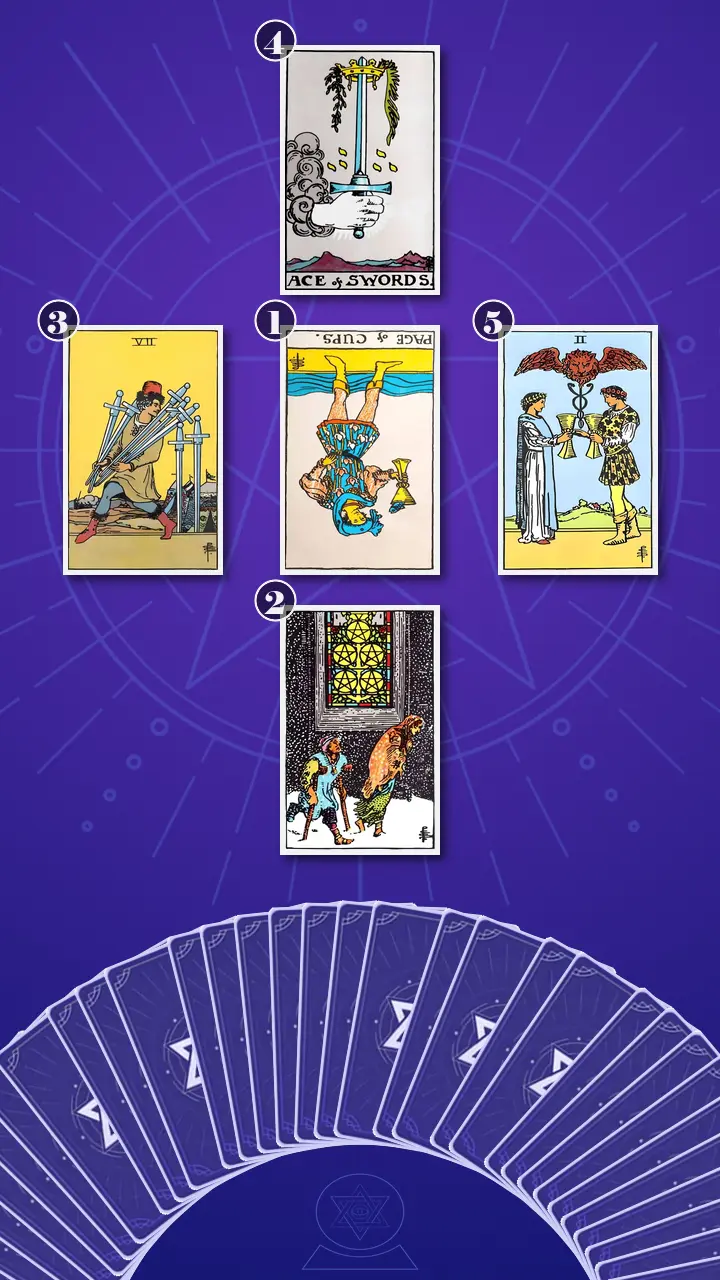
I chose the classic five-card Shadow Spread. For anyone wondering how tarot works in a situation like this, I use the cards as an external pattern-recognition tool. The imagery helps separate observable behavior, underlying fear, protective logic, available capacity, and a practical next step. It does not read a friend's mind or issue a verdict about the future.
This spread was appropriate because Alex's question was not primarily about whether their friends had behaved perfectly. It was about why controlled public visibility kept replacing direct disclosure. A larger Celtic Cross would have added unnecessary layers, while a relationship spread could have pulled our attention toward guessing what other people thought. The Shadow Spread kept us with the causal chain we could actually examine and change.
I placed the first card at the center for the visible behavior. The second went below it for the belonging fear underneath. The third sat to the left for the established defense, the fourth above for the clarifying resource, and the fifth to the right for the relational practice. The cross looked like a compass emerging from fog: behavior in the middle, fear below, ambiguity behind, clarity above, and reciprocal contact ahead.
“The cards may describe the architecture,” I told Alex, “but you remain the person who decides whether to renovate it.”
When a Feeling Becomes Content
Position One: The Message That Never Left the Screen
Now turned over was the card representing Alex's observable pattern: posting emotionally suggestive content, monitoring reactions, and withholding the direct message that would explain what support was needed. It was the Page of Cups, in reversed position.
In the image, a young messenger stares into a cup where a fish has appeared unexpectedly. I pointed to the absorbed gaze. “The feeling has arrived, but the messenger is still looking at it instead of delivering it to another person.”
In Alex's daily life, that was the 12:40 a.m. ritual exactly. A private feeling became a cryptic Instagram Story. The audience setting changed twice. The viewer list became the object of attention while the direct message stayed open underneath. The mood reached an audience, but the need, recipient, and desired response remained blocked.
I read the reversed Page as blocked Water: genuine sensitivity was present, but direct emotional delivery was deficient while curation was in excess. The post was not fake. The emotion had simply been formatted for spectatorship before Alex had decided who should receive it or what they could realistically do.
“The inner script sounds something like this,” I said. “I want them to know I'm not okay, but I need the post to remain deniable as just a lyric. I want a response, but I do not want to admit how much the response matters.”
Alex gave one short, bitter laugh. “That's accurate enough to feel a bit brutal.” Their hand moved toward their phone, stopped, and folded back into their lap.
I let the laugh settle before answering. “Accurate does not have to mean condemning. This makes sense as protection. The question is whether the protection is still giving you what you need.”
I asked them to recall the most recent cryptic post. “What did you secretly hope one particular person would ask after seeing it?”
“I wanted them to say, 'You don't seem like yourself. Can I call?'”
“Then that is useful data,” I said. “The Story was trying to request a call without containing the request.”
The reversed Page showed us the first distinction that mattered: expression can be authentic and still fail as communication. Being noticed is not the same as being accurately known.
Position Two: The Lit Window Beside the Group Chat
Now turned over was the card representing the emotional root: the fear of becoming burdensome, being dismissed, or discovering that belonging was less secure than Alex hoped. It was the Five of Pentacles, upright.
Two figures move through snow beside a glowing stained-glass window. Support is visually close, yet hardship has narrowed their field of vision so completely that the warm interior feels inaccessible. I asked Alex about the Monday-night group chat they had mentioned earlier.
At 9:18 p.m., friends had been exchanging restaurant memes while one person celebrated a promotion. Alex had typed, “Can I be honest? I feel completely lost.” The refrigerator hummed. A mug of tea went cold beside them. When three new jokes appeared, Alex erased the sentence and sent a laughing reaction instead.
“What did the jokes mean to you in that moment?” I asked.
“That everyone was already busy and in a good mood. If I brought my thing into it, I'd become the draining friend.”
In this position, the Five of Pentacles showed Earth contracted into a scarcity story. There was an excess of anticipated exclusion and a deficiency of reality-testing. Alex was still invited to plans, still present in the chat, and had previously received offers of support. None of that guaranteed unlimited availability, but ordinary busyness was being interpreted as a locked door before Alex had tried the handle.
“Which part is evidence of rejection,” I asked, “and which part has been supplied by shame or comparison?”
Alex's breathing paused. Their fingertips tightened around the edge of the chair, their gaze drifted past the card as if replaying the deleted message, and then their grip loosened with a slow exhale.
“The chat was busy,” they said quietly. “That's the fact. The part where they would all resent me was something I added.”
I nodded. “That does not mean your fear is foolish. It means the fear has been speaking with more certainty than the evidence permits.”
The Five of Pentacles did not promise that every friend would always have capacity. It revealed something more useful: Alex had been standing beside visible channels of friendship while assuming they were disqualified from entering with an unpolished need.
Position Three: A/B Testing a Friendship
Now turned over was the card representing the protective blind spot: the belief that strategic ambiguity preserved control while still producing intimacy. It was the Seven of Swords, upright.
The figure carries five swords, leaves two behind, and looks back toward the distant camp. The message is divided. Ownership is partial. Attention stays fixed on whether anyone has noticed the maneuver.
In Alex's life, this was the lyric that could be defended as “just a song.” They revealed enough distress to attract attention, then watched to see whether friends decoded the unclaimed message. At 1:07 a.m. the previous Friday, one close friend viewed a bleak joke without replying. Alex checked the timestamp, opened the friend's profile, and reread their recent messages for evidence of distance.
“If I say it directly, they can reject me,” Alex said as they followed the image. “If I hint, I can still see whether they notice.”
“And if they do not decode it?” I asked.
“I decide they don't care.”
The Seven of Swords showed Air in excess as strategy, hyper-analysis, and audience monitoring, while answerable communication remained blocked. Alex had effectively been A/B testing a friendship through Story analytics without showing either audience the actual question. That produced data, but not reliable knowledge.
My Wall Street years taught me how quickly numbers can create the appearance of certainty. A screen can fill with activity while the underlying question remains badly formed. Story views, reaction speed, and emoji choice looked measurable, but they could not tell Alex whether a friend understood the lyric, knew a response was welcome, or had the capacity to call at one in the morning.
I pointed to the swords left behind. “The missing sentence is doing most of the work here. Plausible deniability protects you from rejection and from being answered.”
Alex's jaw tightened first. Then their eyes narrowed at the card. Finally, they leaned back with a breath that sounded half annoyed and half relieved.
“So I get to avoid asking, but I still grade them on the response.”
“Yes,” I said. “Not because you are trying to manipulate anyone. You are trying to control exposure. The short-term return is safety. The long-term cost is that friends become confused, cautious, or less responsive, and their distance starts to look like proof that honesty was never safe.”
When the Ace of Swords Cut Through the Fog
Position Four: One Sentence Above the Mountains
Now turned over was the card representing the integrating truth: the move from coded public signaling to one clear, truthful sentence addressed to a chosen friend. It was the Ace of Swords, upright, and the room seemed to become quieter around it.
A single blade rises through open air from a hand emerging out of cloud. A crown waits at its point, while jagged mountains remain in the distance. I told Alex that the mountains mattered. The card did not claim their career, identity, or future had suddenly become simple. It offered clarity about the immediate need while allowing the larger route to remain unfinished.
In practical terms, the Ace looked like one private message: “I've been feeling pretty lost lately. Do you have space for a 15-minute call this week? I don't need solutions, just someone to listen.” Alex would not need a polished theory of their existential drift. They would only make the present truth answerable.
I read the Ace as balanced, concentrated Air. The same mental energy that had been scattered across captions, imagined reactions, viewer order, and deleted drafts could become discernment and plainspoken honesty. The shift was not from uncertainty to total certainty. It was from an interpretable hint to an intelligible request.
I watched Alex glance toward their phone. At 12:40 a.m., the warm screen and changing viewer list had offered movement without contact. The direct message underneath had felt dangerous because it could receive a real answer, including an awkward answer or an honest limit.
You do not need a perfectly composed public hint; name one honest sentence to one person, as the Ace of Swords' single clear blade cuts through the fog of Performative Vulnerability.
I left a pause after the sentence. Traffic hissed on wet pavement outside, briefly rising and fading like the sea behind the reversed Page.
Then I distilled the card one step further.
You do not need the whole explanation. You need one honest sentence with a recipient and one request they can actually answer.
Alex's breath stopped. Their fingers hovered above their knee as if they had been interrupted mid-scroll. Their pupils widened, then their gaze lost focus, replaying some private sequence I could not see. A flush moved into their cheeks. Their shoulders lowered by a fraction, but the first emotion to reach their voice was not relief.
“But doesn't that mean I've been doing this wrong the whole time?” they asked, sharper than before. Their mouth tightened; one hand closed into a fist and then slowly opened. “I've been angry at people for not answering something I never actually said.”
“It means the strategy protected you from a risk you were not ready to take,” I replied. “It also created a cost you can see now. Understanding that cost is not a trial of your past self. It gives your present self another option.”
The anger softened into a trembling exhale. Alex blinked rapidly, rubbed one thumb across the opposite palm, and sat in the slight dizziness that can follow when a familiar defense finally has a name. Relief was there, but so was responsibility. A clear path meant they could no longer pretend the viewer list was the only available route.
I asked, “Now, using this new perspective, think back to last week. Was there a moment when this insight could have made you feel different?”
Alex returned to the Friday-night post. “I could have texted one person, 'I'm having a weird night. Can you talk tomorrow?' They might not have answered immediately, but I wouldn't have spent an hour trying to work out what their view meant.”
To help Alex choose that one person, I brought in a framework I call Reciprocity ROI Analysis. I developed its logic after years of watching people confuse visible activity with meaningful value. I do not use it to put a price on affection. I use it to measure the evidence of emotional give-and-take: Who keeps confidences? Who respects a boundary? Who can say they lack capacity without disappearing? Who has allowed Alex to support them without turning every exchange into a performance?
The analysis exposed another trap. The friend with the longest history or fastest Story reaction was not automatically the safest recipient. I call that second distinction Sunk-Cost Decoupling in Loyalty: ten years of history is historical data, not proof of present reciprocity. The Ace's discernment was not only about writing a clear sentence. It was about addressing that sentence to someone chosen by current evidence of trust.
Alex identified a former agency teammate who had once kept a painful confidence, checked consent before giving advice, and accepted a boundary without sulking. As they described those moments, their voice steadied.
This was the spread's key emotional crossing: from guarded disorientation, shame, and audience-monitoring toward plainspoken clarity and cautious trust. Alex still felt exposed. The difference was that exposure was becoming chosen, bounded, and directed rather than public, coded, and monitored.
Two Cups, No Audience
Position Five: The One-Person Container
Now turned over was the card representing conscious integration: a private, mutual conversation with one trusted person and a specific request. It was the Two of Cups, upright.
Two people face each other with equally visible cups. Unlike the reversed Page, neither person is alone with an emotion that has become an object of fascination. Unlike the Seven of Swords, no one is looking backward to monitor a distant audience. The feeling has a recipient, and both participants retain a voice.
In Alex's life, this meant asking the former teammate whether they had bandwidth, naming that they felt lost, and requesting a short call, walk, voice note, or text exchange. Care would no longer be measured by how quickly someone reacted to a Story. It could become a bounded exchange in which one person asked clearly and the other answered honestly.
I read the card as balanced Water: emotion moving between two identifiable people with consent, limits, and room for mutual response. The upright Two of Cups was not a promise that the chosen friend would be free that evening or know exactly what to say. Tarot could not guarantee a flawless response, and neither could I. The card described a healthier structure for contact, not a predetermined outcome.
“Who has shown enough trustworthiness to receive two sentences?” I asked. “And which request would feel manageable rather than theatrical?”
Alex looked again at the Ace, then at the two raised cups. “The former teammate. A call feels intense, but a 15-minute walk after work would be okay. I could say I mostly need company while I say it out loud.”
Their hands were still restless, but they were no longer reaching for the phone. Their index finger traced the edge of the card once, then rested.
“Good,” I said. “A capacity check is not a rejection test; it is how mutual support gets consent. The goal is not maximum disclosure. It is accurate disclosure inside a container both people can enter willingly.”
The Viewer-List Exit
I gathered the five cards into one coherent line. The reversed Page showed a genuine feeling becoming content before it became communication. The Five of Pentacles revealed the belief beneath it: other people seemed inside the lit room of adult progress while Alex felt outside, reading ordinary busyness as evidence that support was unavailable. The Seven of Swords turned that fear into a clever but costly defense, offering partial disclosure, plausible deniability, and constant audience monitoring. The Ace of Swords supplied one accurate sentence. The Two of Cups gave that sentence an appropriate relational home.
The pattern made sense as a distress signal with the coordinates removed. Alex could broadcast urgency, watch for movement, and avoid the clean risk of naming where they were. But nobody could confidently arrive. The cognitive blind spot was the belief that strategic ambiguity could preserve control and still produce intimacy. In practice, it often produced attention without accurate understanding.
The transformation direction was precise: many observers to one chosen participant; a coded public update to direct private disclosure; response-speed analytics to demonstrated trust; an undefined longing to a manageable, consent-based request. The absence of Wands in the spread reinforced something important. Alex did not need to feel bold, inspired, or completely ready. Clear language could carry vulnerability while confidence was still developing.
“You do not need the whole explanation,” I reminded them. “You need one honest sentence with a recipient.”
- The five-minute viewer-list exit.The next time you want to post something cryptic after 10 p.m., save the Story as a draft and set a five-minute timer. In Notes, complete two lines: “I've been feeling ___ lately” and “Would you have space to ___ this week?” Keep the request to a 10- or 15-minute call, a short walk, a voice note, or a text exchange.Cap editing at two passes. When the timer ends, choose the post, the message, both, or neither. Sending is optional; the practice is separating expression from connection.
- The one-person reciprocity check.On Tuesday evening, spend no more than ten minutes listing up to three possible friends. Beside each name, record current evidence of trust: keeping a confidence, respecting a boundary, checking before advising, or responding without mockery. Choose by that evidence, not by friendship length or Story reaction speed. Then use: “Do you have bandwidth for something a bit real? I've been feeling lost and would value a 15-minute call. I need listening, not fixing.”Offer two low-pressure options, such as Thursday evening or a Saturday walk. Their timing or limited capacity is information about availability, not a verdict on your worth or belonging.
I asked Alex to treat both actions as experiments rather than friendship exams. A delayed response would not automatically mean rejection. An awkward response would not erase every sign of care. A warm response would not require Alex to disclose more than they wanted. The point was to replace mind-reading with observable communication while preserving privacy, consent, and choice.

Six Days Later: The Quiet Proof
Six days after the reading, I received a message from Alex. At 7:32 p.m. the previous Wednesday, they had sat at the small desk beside their apartment window, turned off Instagram notifications, and opened Notes. Traffic hissed over wet pavement below while they edited the message exactly twice.
They sent: “Do you have bandwidth for something a bit real? I've been feeling lost about work and myself lately. Could we take a 15-minute walk this week? I mostly need company, not solutions.”
The screen changed from “Sending” to “Delivered.” Their pulse jumped. The friend did not respond immediately, and Alex felt the old urge to publish a black-screen Story so somebody, anybody, would react. Instead, they put the phone face down and named the facts: a clear message had been sent, a manageable request had been made, and no response had occurred yet. They left imagined motives out.
The friend replied the next morning. Saturday worked. During the walk, Alex said, “I don't know where I'm going, and I'm embarrassed that I don't know.” The friend did not solve their career or identity. They listened, admitted they had also felt behind, and asked whether Alex wanted another walk the following week.
That night, Alex slept through until the alarm. Their first thought in the morning was still, “What if I made it weird?” This time, they smiled at the thought, got up, and left the Story analytics unopened.
I did not see that as proof that the cards had predicted a happy outcome. I saw it as proof that Alex had used the spread well. Tarot made the pattern visible; Alex supplied the judgment, the sentence, the boundary, and the courage to let another person answer freely.
Their life direction remained unresolved. Clarity did not arrive as a five-year plan or a sudden absence of shame. It arrived as a smaller ownership: the feeling could be real without becoming public content, and uncertainty could be spoken before it was fully explained. That was the first evidence of movement from guarded disorientation toward plainspoken clarity and cautious, reciprocal trust.
When I picture anyone holding a hot phone with a tight chest, waiting for one familiar name to appear in the viewer list, I remember how hard it is to want proof of belonging while fearing that a direct request might expose its limits. Simply noticing that conflict means the pattern is no longer operating entirely in the dark.
If you did not have to explain your whole life tonight, what one honest sentence could give your feeling an address, and which trusted person might you let receive it?