When 'Someday' Became a Plan: Letting Present Agreements Set the Pace
When “Someday” Opened Seven Tabs at 11:40 p.m.
I met Alex, a 28-year-old product designer in Toronto, at 11:40 p.m. on a Tuesday. Their hybrid workday had ended hours earlier, but the laptop fan was still winding down beside them. Through the closed window, I could hear streetcar brakes squeal against the rails. A radiator clicked somewhere beyond the edge of the screen.
I had a plain name for the pattern they brought to me: future-talk attachment. It was not a diagnosis. It described the moment when emotionally vivid possibilities began carrying the authority of agreements that had not actually been made.
“You can make evidence-based product decisions all day,” I said, “but one late-night ‘when we...’ text can turn possibility into a plan before midnight.”
Alex gave me a tired smile and angled their phone toward the camera. The Notes app was open beneath a message that read, “I can picture us travelling together next year.” Lisbon, Copenhagen, and Mexico City were already listed. Below them sat an unfinished draft asking what commitment and pace meant right now.
The phone had gone warm in their palm. They told me the message had produced a buoyant lift under their ribs, as if a locked door had finally opened onto a lit apartment. Yet their shoulders remained pulled toward their ears. The longing was almost architectural: they were mentally carrying furniture into a shared home while one hand still hovered over an unsigned lease.
“It feels real when we talk about the future,” Alex said. “I keep treating possibility like a decision we already made. But I don’t want to ruin a good thing by asking for a definition too soon.”
There was the central conflict. Alex wanted to trust a shared future, but feared that slowing down to check present readiness would weaken the connection. The future felt safe enough to furnish; the present felt too fragile to question.
I told them I was not going to decide whether the relationship was “meant to be,” diagnose the other person, or treat uncertainty as evidence of danger. I would not ask the cards to expose a hidden motive. “What we can do,” I said, “is make the pattern visible. We can separate a temporary emotional tide from the variables that will actually shape your long-term orbit. Let’s give this fog a map.”

Choosing the Crossroads Map: The Five-Card Shadow Spread
I asked Alex to place both feet on the floor and take one unforced breath while holding the question, “Why do I keep trusting future promises before we’re ready?” I shuffled slowly. The pause was not a mystical performance; it was a deliberate transition from rereading the message to observing what the message had activated.
I chose the five-card Shadow Spread because the words “Why do I keep” pointed to a recurring internal mechanism. A general relationship spread might have pulled attention toward interpreting the other person, while a Celtic Cross would have introduced predictive layers we did not need. This reading required a smaller, cleaner structure: behavior, root, impact, reclaimed capacity, and practice.
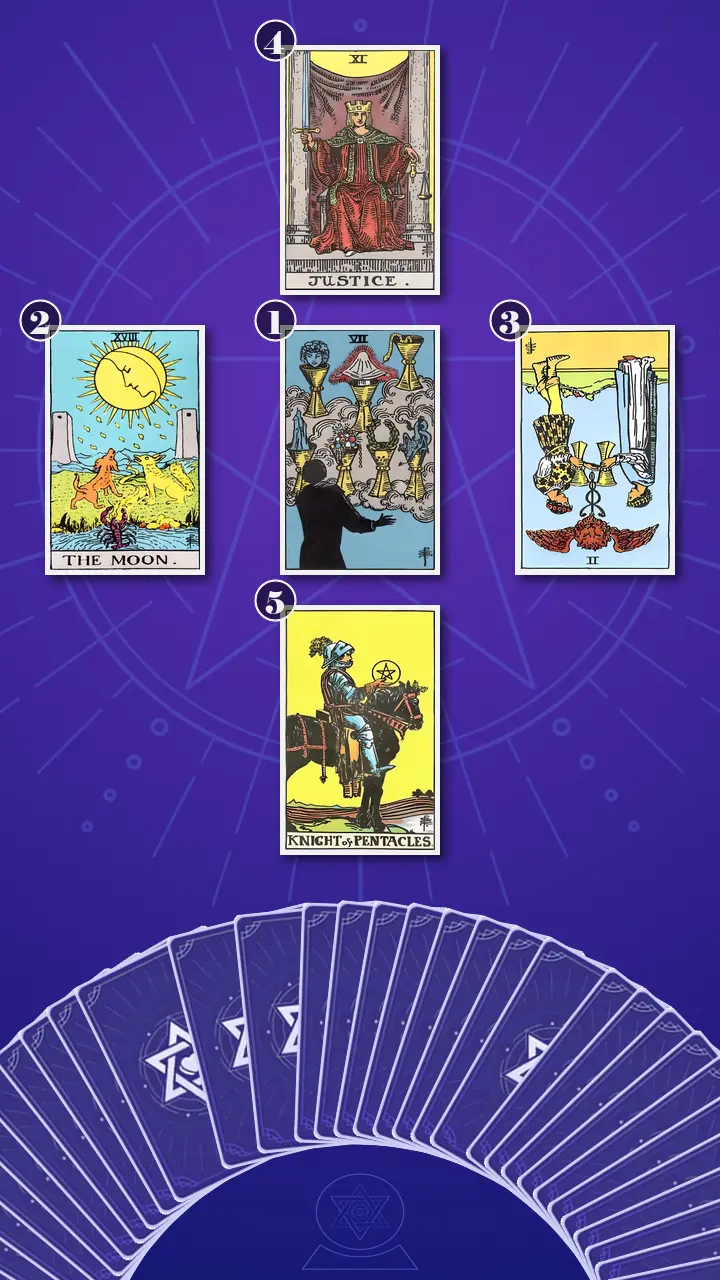
I arranged the cards as a cross. The horizontal line would reveal the loop: the observable shadow at the center, the fear underneath it to the left, and its effect on mutuality to the right. The vertical line would show a different route: the capacity Alex could reclaim above, followed by one grounded integration step below.
For anyone wondering how tarot works in a reading like this, I use it as a structured cognitive mirror. The images externalize patterns that are difficult to examine while they are moving through the body. The card meanings in context do not dictate a future. They help me ask more precise questions so the person in front of me can decide what deserves their trust.
Reading the Horizontal Loop
Seven Cups, Seven Open Tabs
I first turned over the card representing the observable shadow pattern: treating an appealing future promise as evidence of present readiness. It was the Seven of Cups, upright.
Seven cups floated inside clouds, each one holding a different vision. None rested on solid ground. I pointed to the silhouetted figure reaching toward them and asked Alex to notice how quickly a vivid image could acquire practical weight simply because it felt emotionally relieving.
In Alex’s life, the seven cups looked like seven mental tabs: the Lisbon trip, a shared place, holidays, everyday routines, integration into each other’s friend groups, a possible pet, and a distant milestone that seemed to confirm the relationship was real. One phrase about next summer had already become neighborhoods and flight windows in Notes, even though this Friday’s date was still unconfirmed and neither person had discussed leave, money, pace, or present commitment.
“They said someday,” I reflected, “and part of you heard, ‘Maybe I can finally act as though I have been chosen.’”
The Seven of Cups showed an excess of imaginative water. Imagination itself was not the problem. Hope was not the problem either. The problem appeared when emotional vividness was promoted into operational certainty. It was like converting an enthusiastic brainstorm into the official product roadmap before anyone had checked ownership, capacity, or delivery dates.
“Which part of Lisbon is observable now?” I asked. “And which part is still a sincere possibility?”
Alex let out a brief laugh, but the sound landed with a bitter edge. “That is so accurate it feels a little cruel.” Their thumb stopped moving over the phone case, their gaze drifted toward the Notes list, and then their shoulders sank by half an inch.
I slowed down. “The card isn’t mocking you for wanting the trip or the relationship. It is showing the moment when longing begins doing a job that only mutual agreement can do. Possibility is not a decision you already made together.”
The Moon and the Missing Live-Arrival Data
I next turned over the card representing the hidden fear beneath the pattern: that tolerating uncertainty or asking for evidence might threaten belonging. It was The Moon, upright.
The Moon showed a winding path continuing between two distant towers. Its light was real, but reflected. It revealed enough road for the next few steps, not the entire destination. I thought of a Toronto transit app that still displays the route after losing its live-arrival data. The destination may remain possible, but the timing and next connection cannot responsibly be filled in from hope alone.
For Alex, this was the morning after a late-night call in which the other person had said, “I can see this becoming serious.” The conversation mattered, and the warmth was genuine. Yet Alex still did not know whether they were seeing each other that weekend, whether either person wanted exclusivity, what pace felt workable, or whether there was capacity for more contact.
I gave the missing information a simple rhythm: “I feel reassured, but I still do not know whether Saturday is happening. I feel reassured, but I still do not know what ‘serious’ means to each of us. I feel reassured, but I still do not know what either of us can practice this week.”
The blockage here was not a lack of intuition. Alex’s tight chest was already registering that the path remained partly unseen. The blockage was the pressure to make that incomplete visibility disappear. Replaying the promise briefly lit more of the road in imagination, but it could not supply the missing present-tense facts.
“You can believe the feeling without promoting it to evidence,” I said. “What remains uncertain even after the most reassuring words have been spoken?”
Alex’s breath paused. Their eyes went unfocused as if a recent conversation were replaying behind them. Then a long exhale moved through their chest. “I still don’t know how often they actually want to see me,” they said. “I thought admitting that would make the whole thing less real.”
“It makes the unknown visible,” I replied. “That is different from making the connection unreal. The Moon does not say your feeling is false. It says the available light is partial.”
The Two Cups That Had Not Quite Met
I then turned over the card representing the shadow pattern’s current impact on mutuality: the gap between verbal alignment and an explicitly shared pace, boundary, or commitment. It was the Two of Cups, reversed.
In the upright image, two people raise their cups toward one another. Reversed, the exchange became difficult to level. I focused on the small space between the cups. It was not dramatic, but it was decisive: the space where two people could sincerely enjoy the same future conversation while attaching different meanings, timelines, or responsibilities to it.
Alex had already described that gap. At an Annex café, a friend had asked, “So, have you two agreed what this is?” The espresso machine had hissed behind the counter while cold air slipped around Alex’s ankles each time the door opened. Alex answered by talking about eventually living together. Under the table, their stomach dropped because they knew they had not discussed pace, weekly availability, or what commitment meant to either person.
I placed the contrast between us carefully. “I heard commitment,” Alex might have thought, “while they may have meant possibility. We shared a feeling, but we have not yet shared an agreement.”
The reversed Two of Cups showed blocked reciprocity, not proof of deception, incompatibility, or bad intent. The other person’s future language could have been entirely sincere. Sincerity, however, did not automatically establish equal meaning or mutual capacity. Shared excitement is not yet a shared agreement.
Alex looked down at the two figures. Their fingers tightened around the edge of the phone, then released it. “We did talk about it,” they said quietly. After a pause, they corrected themselves. “No. We imagined it together. That isn’t the same as agreeing to it.”
I nodded. “Exactly. The question is not whether the moment was real. The question is what both people understood themselves to be consenting to practice now.”
I also named the overcorrection risk. Alex did not need to ban all future talk, interrogate every affectionate sentence, or turn discernment into surveillance. That would make genuine intimacy harder to build. The useful move was smaller: translate one future promise into one mutual, present-tense question.
When Justice Gave Hope Its Proper Weight
The Scales, the Sword, and One Clean Question
The room seemed to become quieter before I turned the fourth card. The radiator stopped clicking, and a streetcar bell sounded once in the distance. I now turned over the card representing the capacity Alex could reclaim: weighing future language alongside present behavior, boundaries, realistic capacity, and reciprocal agreement. It was Justice, upright.
Justice held balanced scales in one hand and an upright sword in the other. The scales did not dismiss either side. Future words belonged on them, but so did explicit agreements and observable follow-through. The sword represented one direct question, not an accusation.
After a decade of readings, Justice still brings the same professional association to my mind. When I look at planetary motion, a single bright appearance may be beautiful, but an orbit is understood through repeated movement. In relationships, one radiant conversation can matter deeply without establishing the full pattern that will carry two people forward.
At that point, Alex was still treating the midnight glow as a decision deadline: either believe the whole future now or risk losing it. The unfinished pace question remained in drafts, while Lisbon already had neighborhoods, flight windows, and emotional furniture.
This was where I used the method I call Cyclical Variable Filtering. I separated temporary friction from the variables that could actually affect Alex’s long-term orbit. The temporary layer included the late hour, the warmth after intimacy, an Instagram engagement carousel, a friend’s practical question, and the discomfort of an unconfirmed weekend. The critical variables were simpler: What has been explicitly agreed? What boundaries are known? What capacity has each person named? What has been followed through more than once?
I paired that filter with Decision Timing Calibration. An emotionally intense conversation at 11:40 p.m., with no concrete present-day agreement and a body still riding a buoyant rush, was not structurally optimal for changing travel, housing, money, or calendar commitments. That did not make the feeling untrustworthy. It meant the practical decision could wait for a clearer part of the cycle.
I said, “Hope can stay in the room, but it does not get to testify as evidence. Trust becomes steadier when future words and present behavior carry equal weight.” Then I let the central sentence stand on its own.
A promise is not proof; let mutual readiness and repeated action earn their weight on Justice's scales.
For one beat, Alex stopped breathing. Their fingers hovered above the Notes app without touching the screen. Their eyes lost focus, as though they were replaying every time a beautiful “when we” had been followed by a vague weekend. Then their jaw set, and a flash of anger crossed their face. “But doesn’t that mean I’ve been wrong this whole time?” they asked, their voice sharper than before. I kept mine level. “It means you used hope to protect belonging. That strategy gave you relief until it started costing you information. Seeing that is not a verdict on your past self.” Their pupils widened, and their eyes reddened slightly. The fist resting near their chest opened one finger at a time. Their shoulders lowered, followed by a long, trembling exhale. Relief arrived, but so did a moment of almost weightless uncertainty, the dizziness that can come when an old burden drops and leaves responsibility in its place.
“Now, using this new perspective, think back to last week,” I invited. “Was there a moment when this distinction could have changed how you felt?”
Alex remembered Thursday evening. The other person had postponed a weekend conversation, and Alex had immediately opened a saved apartment listing mentioned weeks earlier. The dishwasher had rumbled beside them while they zoomed in on the floor plan, trying to make the imagined home restore what the postponement had unsettled.
“I could have let the postponement be one fact,” they said. “Not a final verdict, but not something the apartment listing needed to erase either.”
I watched their posture straighten. Justice’s energy was Balance: not equal suspicion and hope, but proportionate trust. Alex could value a promise without making it carry more weight than a current agreement, and they could ask, “When you say next year, what are you imagining we are ready to practice now?”
That distinction marked the key emotional shift. Alex was moving from hope-driven certainty and anxious future planning toward proportionate trust grounded in mutual readiness and consistent follow-through. It was not certainty replacing uncertainty. It was conscious evaluation replacing the need to erase uncertainty immediately.
One Solid Pentacle Beneath a Sky of Possibilities
The Knight Who Refused to Rush the Horizon
I finally turned over the card representing practical integration: building trust through small, present-tense agreements and observed follow-through. It was the Knight of Pentacles, upright.
The knight sat on a stationary black horse and held one pentacle steadily at eye level. The image answered the Seven of Cups directly. The reading had begun with many vessels floating beyond reach; it ended with one solid object that could actually be carried.
In Alex’s life, this meant keeping Lisbon in pencil and choosing one ordinary agreement instead. They might agree to confirm Saturday’s plan by Thursday evening, name a communication boundary that worked for both people, or keep a promised check-in. Alex could then notice how the agreement was made, revised, or kept without treating one success as proof of the entire future or one change as a final verdict.
The Knight showed a balanced expression of earth energy: patience, reliability, and attention to what can be sustained. The spread contained no Wands, which mattered. Alex did not need more chemistry, momentum, or passion. There was already plenty of emotional current. What had been missing was a container made from language, proportion, and repeated conduct.
“Trust is built in the size of what both people can carry now,” I said. “You do not need the whole map this week. You can notice whether this one thing is carried.”
Alex glanced again at the Lisbon list. This time, they did not close it or delete it. They added the word “possible” beside the title. Their shoulders softened, and the corner of their mouth lifted. “That feels much less dramatic,” they said.
“It is less cinematic,” I agreed. “Reliability often is. But an ordinary agreement can reveal more about readiness than the most beautiful description of next year.”
Finding Clarity in Words, Now, and Next
I gathered the five cards into one story. The Seven of Cups showed Alex furnishing an emotional future before the lease was signed. The Moon revealed why: present uncertainty touched the fear that belonging could disappear. The reversed Two of Cups showed the consequence, with shared feeling mistaken for shared meaning. Justice reclaimed the ability to weigh words, boundaries, capacity, and behavior fairly. The Knight of Pentacles reduced trust to one manageable unit that both people could carry.
The elemental movement was equally clear. Water dominated the first three cards through cups, clouds, reflected light, and a disrupted exchange. Feeling was not absent; it was flooding the decision. Justice introduced the clean air of language and distinction. The Knight brought earth through routine, pacing, and observable conduct. The path was not from romance to cynicism. It was from feeling the future, to naming what remained unknown, to evaluating it, and finally to building only what the present could support.
I named Alex’s cognitive blind spot gently. Postponing a present-tense question had felt like protecting the connection, but it was actually asking the future promise to carry more emotional weight. Each missing fact then created instability, and that instability triggered the search for an even stronger promise. More reassurance could soothe the loop briefly, but it could not replace a boundary, a capacity check, or an agreement.
The transformation direction was precise: Alex did not need to stop enjoying future talk. They needed to check one present-tense agreement, one relevant boundary, and one instance of follow-through before increasing emotional or practical commitment. These were the actionable next steps we chose.
The Justice Check and the Orbital Pause
- Try the eight-minute “Words / Now / Next” note. After the next future-focused message, open a private phone note. Write one exact line under each heading: “The future phrase,” “What is mutually true this week,” and “One thing I still need to ask.” Use only what has been openly said, explicitly agreed, or observably done. Do not investigate, monitor, test, or decide the relationship’s entire future. If eight minutes feels heavy, write only the exact promise and one present-tense fact. Stop there, and do not send anything immediately.
- Use the 72-hour Orbital Pause. When future talk creates an urge to change travel, housing, money, leave, or calendar plans, delay that practical commitment for 72 hours. Keep a removable calendar hold if needed, but do not book, pay, announce, or reorganize your life until one relevant present-tense agreement exists. The pause is for decision timing, not emotional withdrawal or punishment. You can still receive the affection warmly. Only the high-stakes action pauses while the temporary surge settles and the critical variables become easier to see.
- Translate one “someday” into one current practice. In a calm daytime moment, ask, “When you say you can see us doing that, what do you think we are realistically ready to practice now?” Keep the scope small. A workable answer might be confirming Saturday by Thursday, naming availability for the coming week, or discussing one boundary that matters to both people. Allow “I don’t know yet” to be a valid answer. Treat the response as information, not a pass-fail test. If a conversation does not feel useful or welcome, the private Justice note is a complete first step.
I reminded Alex that none of these practices could force readiness or guarantee a preferred outcome. Their purpose was to return choice to them. Alex could decide how much to invest based on what both people were genuinely able and willing to sustain, rather than asking a beautiful sentence to decide on their behalf.

A Week Later: The Quiet Proof
Six days later, I received a message from Alex. They had used the three-line Justice note after Lisbon came up again. Under “What is mutually true this week,” they could write only that both people wanted to keep seeing each other. Under “One thing I still need to ask,” they wrote, “What pace can we both actually sustain?”
They waited until the next afternoon rather than sending a six-paragraph message after midnight. Then they asked the present-tense question. The answer was less cinematic than the original promise: the other person liked imagining a trip together but was not ready to request leave or plan next summer. They were ready to discuss pace and to confirm Saturday’s plan by Thursday.
Alex told me there had been a small drop in their stomach when the future became less definite. They had wanted the Lisbon promise to remain large enough to prove belonging. Yet the disappointment did not send them back to the apartment listing. They kept the trip in pencil, left the calendar unchanged, and watched one ordinary agreement take shape.
Thursday’s confirmation arrived when agreed. Alex did not treat that message as proof of the entire relationship. They let it be what it was: one kept, present-tense commitment.
That night, they slept through until morning. Their first thought was still, “What if this goes nowhere?” This time, they smiled at the thought, made coffee, and left Lisbon in pencil.
I did not see the reading solve Alex’s relationship, and I would never claim that the cards had done so. I saw Alex change the standard by which they granted trust. The five-card Shadow Spread had offered a map, but Alex chose how to walk it. Their journey to clarity began with one distinction: hope could remain welcome without being made responsible for proof.
When the future feels like the first real evidence that you belong, I know why one simple present-tense question can tighten your chest. It may seem capable of taking the whole imagined home away. But noticing that fear already places your hand back on the scale; you no longer have to let it weigh the evidence for you.
If the future could stay hopeful without having to prove anything tonight, which one small present-tense agreement would you be curious to notice next, while your own version of Lisbon remains gently in pencil?