Slack Praise Felt Hollow, Then Two Minutes Made Room for Choice

The 6:18 PM Win: Why Success Felt Hollow
I first met Jordan, a 29-year-old London product marketing specialist who finished the launch, read the praise once, and opened a new task list before leaving the office because rest felt riskier than another deadline.
I asked her to take me back to the exact moment. At 6:18 on a Tuesday evening in Canary Wharf, she had closed the campaign deck while fluorescent lights buzzed above her and the laptop fan pushed warm air against her wrist. Three Slack messages said, "This is brilliant." Her shoulders stayed lifted as she opened a fresh Notion board.
By 8:47, she was on the Elizabeth line, watching a former colleague announce a promotion on LinkedIn while her own successful campaign was still open on her phone. The carriage rocked, her face floated in the dark window, and her thumb kept refreshing. "I finished it," she told me, "so why do I already feel behind?"
I heard the hollowness in her description as something almost physical: like a bell had been struck inside her chest, but instead of music, it left only a cold metallic vibration. Restless energy had carried her to the goal; once the praise faded, the energy dropped through the floor.
"A win can be real and still not be nourishing," I said. "I am not here to talk you out of ambition. I want us to understand why your achievements keep becoming new demands, then find the point where you can choose instead of automatically escalating. Let us draw a map of this fog without pretending the cards own the road."

Choosing the Map: The Celtic Cross Context Edition
I invited Jordan to take one slow breath and hold the question in ordinary language: "Why do I keep chasing wins that feel empty once they are mine?" I shuffled while she did that, using the brief pause as a transition from performing the problem to observing it.
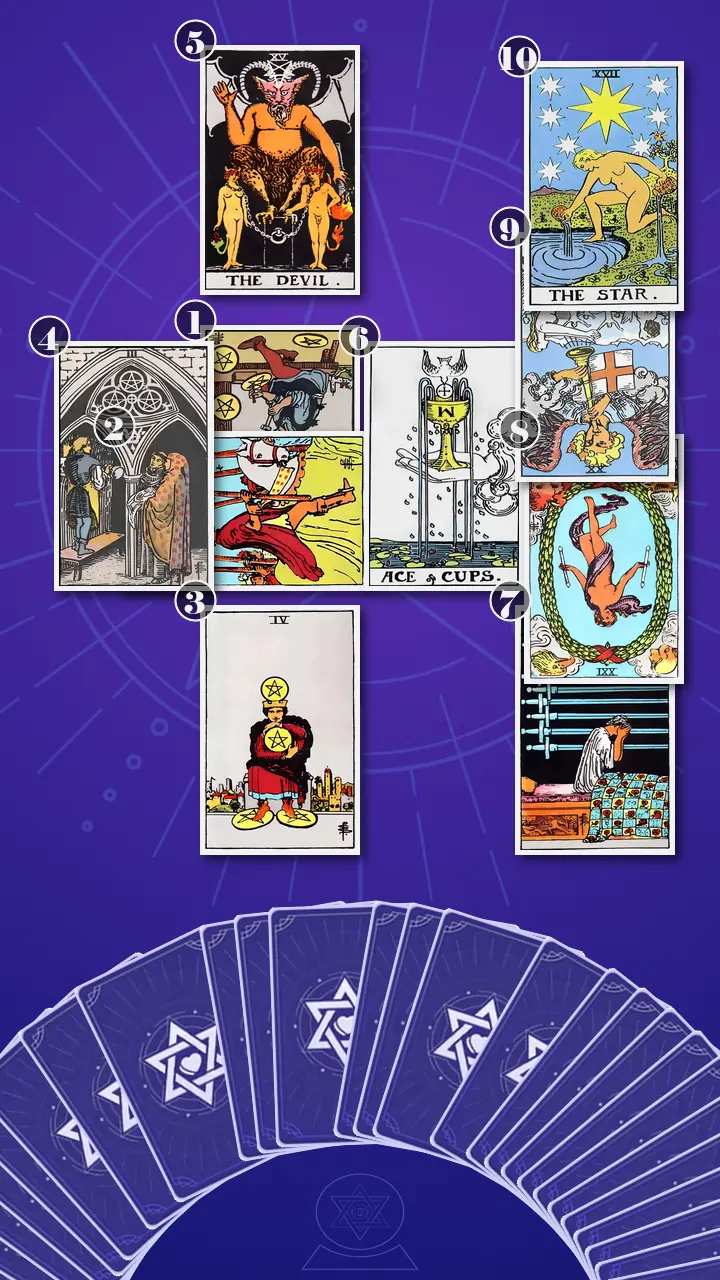
I chose the Celtic Cross · Context Edition. For anyone wondering how tarot works in a question about achievement anxiety, I use this ten-position spread as a structured reflection tool, not a fixed prediction. Its value lies in separating forces that can feel like one shapeless problem: visible behaviour, immediate friction, the belief underneath it, past reinforcement, social context, personal agency, and an available direction.
The centre would show the post-win cycle and what prevented success from landing. The card below it would excavate what achievement was being asked to secure. Position six would reveal the near-term opening, while the rising staff on the right would move from Jordan's private mental pressure through her external environment and toward integration. The spread resembled a crossroads with a path climbing out of it, which was exactly the structure her question needed.
Reading the Workbench and the Crowd
Position One: The Finished Task That Became More Work
I turned over the card representing the present situation: the visible cycle of pursuing a win, reaching it, and feeling empty afterward. It was the Eight of Pentacles, reversed.
I showed Jordan the craftsperson bent over one pentacle while a row of completed pieces lined the wall. In her life, this was the finished campaign deck reduced to one more unit of output. The craft was real, but repeated polishing and the immediate switch to a new Notion board turned skill into an achievement treadmill. The private translation was: "I finished the launch, but my brain converted it into evidence that I should begin something harder."
The reversed earth energy showed both excess and blockage. There was an excess of effort, correction, and measurable output, but completion itself was blocked from registering. The card was not saying Jordan lacked discipline. It showed discipline continuing after its useful job was done, until a finished piece felt indistinguishable from another obligation.
Jordan gave a short, bitter laugh. "That is so accurate it feels a bit brutal." Her fingers tightened around her cup, then loosened as she looked again at the row of pentacles.
"Accuracy can sting when it names a strategy that has been protecting you," I said. "But I am challenging the mechanism, not your character. Your ambition is not the problem. The missing moment is the one in which you find out what the work meant before opening the next board."
Position Two: When the Applause Became a Scoreboard
I turned over the card representing the crossing challenge: the tension between chasing another win and allowing the current achievement to register. It was the Six of Wands, reversed.
The rider carried a laurel wreath through a crowd, but in Jordan's modern life the wreath had become an announcement post and the crowd had become a Slack thread. This was the successful presentation she could not fully inhabit until she refreshed the reactions, compared the response with someone else's promotion post, and decided whether the audience had been enthusiastic enough to grant her permission to feel proud.
Reversed fire created a blockage in recognition. Praise arrived, but it could not settle internally, so Jordan kept checking for a stronger signal. Wanting recognition was not a flaw; most people need to be witnessed. The difficulty began when recognition became the condition that determined whether the work had value at all.
"When praise becomes proof, silence starts to feel like failure," I said. "What remains valuable about the campaign if the Slack thread goes quiet and nobody is available to rank it?"
Jordan's jaw shifted. Her eyes moved away from the card as if she were mentally reopening the thread. "I handled a messy launch without throwing the team under the bus," she said at last. "I was actually good in the middle of it, not just at the end."
I nodded. That answer was quieter than a reaction count, but it belonged to her.
Position Three: The Achievement Held Against the Chest
I turned over the card representing the root foundation: the fear that achievement must be retained or increased to prove self-worth. It was the Four of Pentacles, upright.
The figure held one coin tightly against the chest, with other coins occupying the head and feet. I connected it to Jordan keeping her promotion, salary, strongest campaign metric, and manager praise close as emotional insurance. Her ordinary expenses were covered, yet slowing down still felt like becoming less secure and less impressive at the same time.
Here, upright earth had hardened into an excess of protection and control. The achievement was useful evidence, but gripping it as proof of safety restricted movement, rest, and curiosity. The card asked a more precise question than "Why are you ambitious?" It asked, "What are you trying to secure when the next result has to be bigger?"
This was where I used what I call Cognitive Stratigraphy. On an archaeological site, the object at the surface is rarely the whole story; its layer and relationship to what lies beneath give it meaning. Jordan's fresh task board, Slack refresh, and late-night salary search were surface artifacts. Beneath them sat an older, once-useful lesson: competent work brought recognition, and recognition brought belonging. Deeper still was the rule that if visible progress stopped, belonging and capability might become uncertain.
I did not label that rule as trauma or force an origin story onto it. The evidence only supported calling it obsolete. An obsolete rule is not a foolish one; it is a strategy built for one context that has continued operating after the context changed.
Jordan pressed her thumb into the cardboard sleeve around her cup. "So I am not chasing only the promotion," she said. "I am chasing the feeling that nobody can question whether I deserve to be here."
Position Four: When Being Seen Helped the Work Matter
I turned over the card representing the past influence: the earlier pattern in which skilled work became meaningful through recognition. It was the Three of Pentacles, upright.
I pointed to the craftsperson working beneath a cathedral while two people consulted an architectural plan. Earlier in Jordan's career, a strong presentation, a collaborative launch, or a manager naming a real improvement had helped her recognise her competence. Being seen had supported craft and belonging. That history mattered because it showed that external recognition had not always been empty or harmful.
The card carried a relatively balanced earth energy: real skill, useful feedback, and contribution within a shared structure. The imbalance had developed later, when being witnessed narrowed into being constantly evaluated. Jordan was not being asked to reject feedback. She was being asked to retain the collaboration and craft without outsourcing the entire meaning of her work to an audience.
Her shoulders lowered a fraction. "That feels fairer," she said. "I hate advice that acts like caring about work or praise makes me shallow."
"It does not," I replied. "The issue is not whether recognition matters. It is whether recognition gets the only vote."
Position Five: The Contract Hidden Inside the Next Promotion
I turned over the card representing the conscious aim: what Jordan believed the next win would finally deliver. It was The Devil, upright.
I was careful with this card. I did not present it as a sinister omen. The Devil often exposes an attachment or bargain that feels compulsory precisely because it is familiar. Its chains are visible and loose enough to be examined.
In Jordan's life, the bargain sounded like this: one more promotion, credential, salary benchmark, or public win would finally purchase self-worth, safety, direction, and enoughness in a single transaction. The lift was genuine, but it expired, and the contract renewed itself with a harder target.
The card showed an excess of attachment energy. A career goal had been assigned too many jobs. It was expected to advance Jordan's work, stabilise her identity, silence comparison, and answer what mattered to her. No promotion could carry that entire load.
The split reminded me of Severance, though Jordan's version required no science fiction: the productive work-self knew how to keep moving, while the private self was left outside the office asking what the movement was for.
"What exact promise have you attached to the next win?" I asked.
Jordan inhaled through her nose. "That I will feel settled. That I will stop checking where everyone else is. That I will not need to prove it again."
"Then the next goal may be giving you momentum, not meaning," I said. "The chain becomes negotiable as soon as you can read the contract."
When the Ace of Cups Interrupted the Next Sprint
Position Six: The Open Hand After the Closed Grip
I turned over the card representing the near-term opening for self-exploration: a small opportunity to experience fulfilment through direct feeling before escalating the target. It was the Ace of Cups, upright, the key card of the reading.
The room seemed to quiet around it. Rain traced the window of my Cambridge study, and a single drop gathered at the bottom of the glass before releasing into the sill. On the card, a hand emerged from a cloud holding an overflowing cup, with water moving freely into the pool below.
In Jordan's life, this was a completed project followed by a phone placed face down. It was the chance to notice relief, connection, pride in a craft choice, creative energy, neutrality, or even no clear feeling yet before converting the experience into another performance requirement. Upright water offered balance and receptive movement. It did not demand that Jordan feel grateful or satisfied. It simply made her actual response usable as information.
I asked her to return to 11:36 PM in her Hackney flat: the successful launch closed, the radiator clicking, no new notifications, and her fingers already opening a spreadsheet for a harder career plan. I could see the familiar argument taking shape in her face. If she paused, she feared she might discover that the achievement had not solved anything, or that she did not know what she genuinely wanted.
On excavations, I learned that the most damaging impulse can be filling an empty space before documenting it. Absence is also evidence. Through my Ruins Restoration Thinking, I saw Jordan's post-win drop not as proof that her ambition was broken, but as a necessary fracture in an identity built almost entirely around visible progress. A careful restoration does not hide every gap with new stone. It first asks which parts still carry weight and which parts merely conceal what needs to be understood.
I said, "A win cannot do the work of telling you what matters; pause long enough to notice what nourished you before choosing what comes next." Then I gave her the card's sharper instruction:
Do not turn every achievement into another demand; let the overflowing cup show you what genuinely nourishes you before you reach for the next win.
I let the sentence remain between us.
I watched Jordan's breath stop halfway in. Her fingers hovered above the cup, motionless, while her gaze slipped out of focus as if she were replaying every launch followed by a late-night plan. Then her eyebrows drew together. "But doesn't that mean I have been doing all of this wrong?" she asked, with a flash of anger under the words. I told her no. The strategy had built real skill, income, and opportunities; recognising its current cost did not erase what it had once done for her. Her eyes reddened before she looked down. The hand gripping the cardboard sleeve slowly opened, finger by finger, and her shoulders dropped on a long, uneven exhale. Relief arrived, but it was followed by a brief blankness, almost a light-headed look. I recognised it as the vulnerability of having choice returned: if the next target was no longer automatic, she would have to participate in deciding what came next.
"Now, with this new perspective, think back to last week," I invited. "Was there a moment when this insight might have made you feel differently?"
Jordan remembered the launch debrief. Before checking how senior leaders had reacted, she had felt proud that two newer colleagues spoke openly because she had made the room safer. "That was the part that felt good," she said slowly. "I buried it under the metrics about ten minutes later."
I asked her to complete one sentence: "Before I make this useful, what did it feel like?"
"Connected," she said. Then, after a pause, "And capable, but not in the performative way."
That distinction marked the reading's central movement: not from ambition to passivity, but from comparison-driven achievement chasing and post-win hollowness toward emotionally receptive, self-defined motivation. It was a first step from proving to receiving, and from receiving to choosing.
The Night Court, the Endless Feed, and the Open Sky
Position Seven: The Performance Review That Followed Her Home
I turned over the card representing the self-position: Jordan's current stance toward rest, uncertainty, and personal agency. It was the Nine of Swords, upright.
The figure sat upright in bed beneath nine swords. I connected the image to Jordan lying awake after a successful day, replaying what could have been sharper, questioning whether the praise was deserved, and planning the next improvement before her body had rested. The workday ended, but the performance review followed her home and reopened the case.
This was an excess of sword energy: analysis continuing after it stopped producing useful knowledge. Silence became a private courtroom in which every accomplishment was cross-examined for evidence of inadequacy.
"What exact claim does your mind make when the day goes quiet?" I asked.
Jordan's lips pressed into a narrow line. "If I were genuinely good, I would not need to work this hard to stay ahead."
I separated claim from fact. The observable facts were that she had completed the campaign, received clear positive feedback, and managed a difficult team process. The additional verdict came from the inner court. Naming that difference did not eliminate the thought, but it stopped the thought from impersonating evidence.
Position Eight: A World That Never Marks Anything Complete
I turned over the card representing the external environment: visible-metric culture, professional comparison, and feedback loops that kept the chase active. It was The World, reversed.
The dancer was enclosed by a complete wreath, yet the reversed orientation suggested that completion had not been inhabited. I saw Jordan's LinkedIn profile displaying the promotion while her feed immediately supplied a larger title. I saw the workplace dashboard closing one campaign while opening the next quarter's benchmark. Even leisure could become another scoreboard if a weekend, workout, or side project had to produce visible proof.
The reversed energy showed a blockage in closure. Jordan's environment did not create the entire pattern, but it rewarded speed and made an ending look like dead space. Her private algorithm had been trained on engagement: every completed goal became a signal to show her someone further ahead.
"You do not have to turn every finished chapter into a trailer for the next one," I said. "A deliberate ending does not reduce ambition. It gives ambition accurate information about where one chapter stopped."
Jordan nodded once, then glanced at her phone without picking it up. I noticed the interruption itself: urge, awareness, choice. Small, but real.
Position Nine: The Inner Call Mistaken for a Verdict
I turned over the card representing the hopes and fears: the hope that the next win would finally satisfy her and the fear that no win could. It was Judgement, reversed.
The angel's trumpet sounded above figures rising from grey coffins. In Jordan's modern life, the trumpet was the quiet question beneath the career plan: "What matters to me when nobody is scoring it?" Reversed, the call had become another feared performance review. She expected herself to answer perfectly, make the ideal career choice, and justify every desire before she was allowed to trust it.
The energy showed a blockage in self-evaluation and renewal. Jordan hoped achievement would settle the question of worth, but feared that honest reflection would reveal how little the chase satisfied. I reframed the trumpet as an invitation, not a final sentence.
"Which value is trying to speak beneath the review?" I asked. "You do not need to turn the answer into a resignation letter, a five-year plan, or a new personal brand."
Jordan was quiet long enough for the old clock behind me to tick several times. "I like making complicated things understandable," she said. "And I like work more when people can be honest in the room. I do not know what that means for my career yet."
"It does not need to mean more today," I replied. "It is already better information than a reaction count."
Position Ten: The Star Beyond the Public Scoreboard
I turned over the final card, representing development and integration: the direction available when success supports a meaningful life instead of defining personal worth. It was The Star, upright.
The kneeling figure poured one stream onto land and another into the pool beneath a wide sky. I read the two streams as a relationship between practical work and emotional replenishment. One attended to deadlines, income, and craft; the other returned attention to connection, curiosity, rest, and private meaning. Neither stream had to cancel the other.
The Star carried balanced, replenishing energy. It suggested Jordan could let a meaningful result nourish her for longer than a notification cycle, then choose work, rest, or connection because it reflected her values. Her next goal might still be demanding and visible. The difference would be that it came from steadier interest instead of reflexive escalation.
I treated The Star as an orientation, not a guaranteed outcome. Tarot could reveal the contrast between two modes of choosing, but it could not decide which opportunity Jordan should take. The large star was not another status marker. It was a compass question: "Does this restore me, connect me, or genuinely interest me?"
Outside, the rain had thinned to a pale film on the glass. Jordan looked across the complete spread rather than at any single card. I watched her trace the visual movement from the clenched coins to the open cup, then from the dark bed to the open sky.
Restoring the Finished Chapter
I gathered the cards into one coherent account. The Three of Pentacles showed that Jordan's skill had once grown through constructive recognition and belonging. The reversed Eight of Pentacles showed that this healthy craft had narrowed into repetitive proof-making. The reversed Six of Wands made praise unstable, while the Four of Pentacles held achievement close as security. The Devil exposed the bargain promising that one larger win would finally settle worth. The Nine of Swords, The World reversed, and Judgement reversed showed how private self-interrogation, perpetual external benchmarks, and fear of an imperfect inner answer kept the cycle running.
The Ace of Cups and The Star supplied the missing resource: receptivity before escalation, followed by a value-based direction. The spread did not argue that Jordan needed less talent, less income, or less ambition. It showed that practical effort and public momentum had outrun emotional contact. Her old success algorithm measured reactions, titles, and completed units, then automatically recommended another target. The update was to include new inputs: what felt alive, what restored energy, what created connection, and what she would still value without a public ranking.
I named the cognitive blind spot directly. Jordan had been treating post-achievement emptiness as evidence that the win was too small. The cards suggested another explanation: the win was being denied closure and asked to answer a question about worth that achievement could not resolve. A larger target could restore urgency, but urgency was not the same thing as meaning.
The transformation direction was therefore precise: after a completed goal, pause long enough to name the feeling it produced, distinguish external recognition from personal meaning, and choose one value-based next step before setting a larger target. That was how the Celtic Cross · Context Edition became actionable advice rather than an abstract collection of card meanings.
I folded my Trigger Excavation Exercise into the first pause. When the disproportionate urge to open a new board appeared, Jordan would treat it as a surface artifact rather than a command. She would name the present trigger, identify the older epoch the reaction seemed to belong to, separate past assumptions from current facts, and then choose what the present actually required. Excavation was not an instruction to keep digging if the process felt overwhelming. It was a way to date the reaction so the past did not automatically govern the next ten minutes.
- The Ten-Minute Win Receipt After the next completed work milestone this week, stay at the desk before opening a new task board, put the phone face down, and set a ten-minute timer. In one private note, write three lines: "What I made," "What I did well," and "What felt alive or useful about it." Leave the next target unnamed until the timer ends. If the urge to escalate spikes, use the Trigger Excavation Exercise to ask which part belongs to the present and which part echoes an older rule about worth. Start with two minutes if ten feels wasteful or self-congratulatory. Use factual details rather than forced affirmations, and stop at any point if continuing does not feel useful.
- The Closed-Loop Success Ritual Choose one finished goal this week and spend five minutes in Notion or on paper recording what it taught you, what changed because of it, and why it is "complete for now." Close the document, put the phone face down, and spend fifteen minutes making tea or walking around the block without consuming professional updates. If "complete" feels too final, keep the words "for now." On a low-energy day, write only three lines. This is an experiment in receiving completion, not another rule you can fail.
"The point is not to manufacture pride," I told Jordan. "You may find relief, connection, disappointment, neutrality, or nothing you can name yet. All of those responses are information. Your task is only to stop the next goal from speaking before your own experience gets a turn."

A Week Later: The Quiet Proof
Six days later, I received a message from Jordan. After finishing a difficult review, she had put her phone face down and set a two-minute timer, not ten. Under "What felt alive or useful," she had written: "I made the messy middle understandable, and two people felt safe enough to tell the truth."
She did not open LinkedIn for the following hour. She closed the campaign page in Notion, made tea, and let the radiator click without covering the sound with a professional podcast. Nothing dramatic happened. That was part of the proof.
She slept through the night, but woke with "What if I am falling behind?" still first in line. She told me she smiled at the thought, made coffee, and left the evening block empty. Clarity had not erased the old reflex; it had stopped the reflex from owning her calendar.
I did not credit the cards with changing Jordan's life. The cards had provided a map, a set of symbols, and enough distance for her to observe a familiar mechanism. Jordan supplied the pause, the honesty, and the choice. Her journey to clarity was not a final answer about her career. It was the first credible movement from external ranking toward self-defined motivation.
When the Slack applause fades and your hand is already opening another task board, keeping busy can feel safer than sitting still long enough to discover whether the life you are winning is actually nourishing you. I have learned, in ruins and readings alike, that clarity sometimes begins when the fog thins just enough for you to see which structure is enduring and which one you are finally free to rebuild.
If you let one recent win rest in the Ace's open cup before it becomes another plan, what small detail of the experience, perhaps relief in your shoulders, pride in a craft choice, or warmth from collaboration, might point toward a next step that is genuinely yours?