Why Being Remembered Hits So Hard at 8:11 a.m.
When Taylor, a 27-year-old content coordinator from Toronto, sat down across from me at the little marble table in the back of my café, she gave me the exact smile I have learned to recognize over twenty years of pouring espresso and reading cards: competent on the surface, slightly wrecked underneath. It is the smile of someone who can handle hybrid work, commute delays, Slack pings, and rent math—but nearly cries because a friend remembered her extra-hot oat flat white.
She told me about 8:11 on a Wednesday in a coffee shop off Queen West. The espresso machine hissed. Wet coats steamed by the door. Her friend answered the barista with Taylor's usual order before she could open her mouth. Taylor laughed too quickly, said, 'Wow, okay, stalker energy,' stared at the pastry case, and took the paper cup with a hand that suddenly felt too aware of its own shaking. Then her throat tightened. Her chest went warm. Her whole body went strangely still, as if one tiny thoughtful detail had pressed pause on the rest of the morning.
'It was just coffee,' she said. 'So why did I feel like I was about to cry?' By the streetcar ride home, she told me, she was halfway to Googling things like 'why kindness makes me cry' and 'why being remembered hits so hard' instead of simply letting the moment be what it was.
I know that feeling well when I see it. It looks like trying to swallow sunlight with a closed throat. 'Because it probably was not just coffee,' I said. 'Sometimes the smallest kindness hits hardest because it lands where care used to be inconsistent.' As she spoke, I already knew I wanted to use a Situation-Obstacle-Advice-Outcome tarot spread for understanding why a remembered coffee order hit so hard. 'Let me help you draw a map,' I told her. 'We are not here to shame the feeling. We are here to see what it is pointing to.'

Choosing the Bridge: A Four-Card Spread for a Present Trigger and Past Wound
I asked Taylor to wrap both hands around her cup, take one slow breath, and hold the question exactly as it lived in her body: My friend remembered my coffee order—what past makes it hit so hard? Then I shuffled. In my space, that pause is not theatre. It is a handoff from spiraling to noticing.
For this reading, I chose the Situation-Obstacle-Advice-Outcome spread. When somebody is asking why a small act of care feels too big, this is one of the clearest ways I can show how tarot works in real life. The spread moves in a straight line: first the present trigger, then the older pattern underneath it, then the healing reframe, then the next lived expression. More cards would have added noise. Fewer cards would have blurred the difference between what happened at the café and what that moment awakened from much earlier.
I laid the cards left to right like a short bridge. The first position would show the visible moment: what happened when the order landed, and what Taylor did in the next ten seconds. The second would reveal the older scarcity or exclusion pattern that made the gesture feel almost destabilizing. The third—usually the hinge in a reading like this—would point to the reframing that could soften shame around receiving care. The fourth would show the small relational response that becomes possible once tenderness is allowed to mean something.
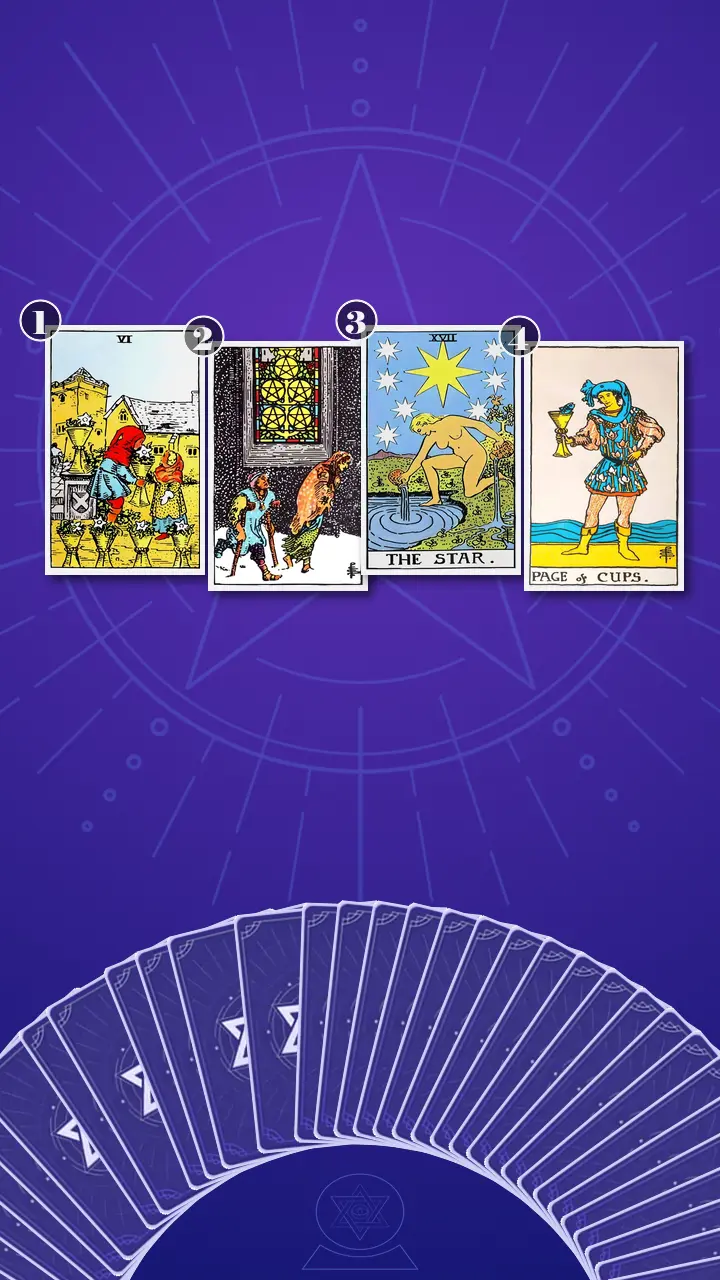
Reading the Map, One Cup at a Time
The Offered Cup in a Queen West Line
I turned over the card that represents the present relational trigger and the visible behavior in the moment the remembered coffee order lands. It was the Six of Cups, upright.
In real life, this is exactly that neighborhood café moment before work: your friend answers the barista with your exact order without checking, and in the two seconds after, you laugh, look down, and feel your throat tighten because being known that specifically feels sweet, disorienting, and much bigger than the moment should be on paper. The Six of Cups carries memory, innocence, and small gestures of care offered without calculation. Its energy here is balanced on the surface, but emotionally catalytic underneath. Nothing dramatic happened—yet something old woke up immediately.
I pointed to the image of one figure offering a cup to another. 'This is care without performance,' I said. 'No grand speech. No heavy emotional setup. Just accuracy.' Then I used one of the frameworks I rely on in the café, what I call Milk Foam Layer Analysis. 'Your joke was the foam,' I told her. 'Light, quick, social. But the espresso underneath was much stronger: gratitude, longing, and the shock of not having to repeat yourself to be remembered.' It had that quiet, devastating quality of a tiny gesture in Normal People—nothing flashy, just precise enough to go straight past the intellect.
Taylor let out a short laugh that sounded almost offended by how seen she felt. 'Okay,' she said, shaking her head, 'that is rude levels of accurate.' Her fingers curled around the cup again, and I could feel recognition beginning to replace embarrassment.
The Cold Outside the Lit Window
Next came the card representing the older imprint of emotional scarcity or exclusion that makes small acts of care feel disproportionately intense. It was the Five of Pentacles, upright.
This is the aftershock card. It is the eastbound TTC ride home, the phone still warm from rereading the moment, the stop announcements crackling overhead while your mind starts scanning old scenes—family, school, friendships, dating—for a reason this felt so loaded. The Five of Pentacles says the reaction is not random. It is the body recognizing contrast. Warmth has arrived, but part of you still relates to warmth as something visible-yet-unreliable, like passing lit condo windows on a freezing night and not quite believing any of them are for you.
The energy here is blocked and contracted. Not because you are incapable of receiving care, but because some older part of your system expects consideration to be occasional rather than steady. When that is the baseline, a simple remembered coffee order can feel emotionally expensive. The problem is not that the gesture was small. The problem is that your system learned small care was not guaranteed. That is the whole loop: downplay first, feel later.
As I said it, I glanced toward the front windows of my café. Outside, the street was damp and iron-grey. Inside, the brass lamps threw soft gold across the tables. I have closed this place on enough winter nights to know the difference between seeing warmth and feeling welcome inside it. When I see the lit window in the Five of Pentacles, that is what flashes through me every time.
Taylor's reaction moved through me before she even spoke. First her breath caught. Then her eyes drifted past the cards, unfocused, as though memory had opened a door without asking permission. Finally she exhaled and said very quietly, 'I hate how accurate this is.' That was not resistance. That was the moment the old cold baseline finally had a name.
When The Star Poured Water Where Shame Used to Live
Then I turned over the third card, the one pointing to the key reframing that softens fear around belonging and receiving care. The room changed when it appeared. The grinder in front had gone silent. Even the kitchen hiss seemed to fall away for a beat, as if the café itself knew we had reached the hinge of the reading. The card was The Star, upright.
The Star appears when the question is ready to change. Not 'Why am I like this?' but 'What need just became visible?' In modern life, it looks like sitting on your bed later that night with the city glow at the window, resisting the urge to turn one thoughtful moment into a full private case study. The figure on the card pours water onto land and pool at once, and that matters here: Taylor's task is not only to receive care from someone else, but also to let herself validate the need that care touched when she gets home alone.
I leaned in a little. 'Before I say the deepest part,' I told her, 'picture the ride home after the café: your phone still warm from rereading the moment, your shoulders up around your ears, city lights sliding across the TTC window while you keep telling yourself it was only a coffee order.'
This is not proof that you are overly sensitive; it is The Star showing you where emotional drought has been, so you can stop shaming your thirst and start receiving the water.
I let the sentence rest between us.
Then I brought in another one of my café frameworks, the one I call Social Espresso Extraction. 'In coffee,' I said, 'extraction tells me what the water pulls out under pressure. In relationships, I watch for what a precise moment pulls out of someone when it finally lands cleanly enough. Some social moments over-extract into bitterness. Some under-extract into vagueness. This one was exact. Your friend's remembered order did not invent a need out of nowhere. It revealed a note that was already there: the need to be considered steadily, not accidentally. Tenderness is information, not an indictment.'
Her reaction came in three waves. First, the physical freeze: her hand stopped halfway to her cup, her mouth parted, and her breath stalled high in her chest. Then came the cognitive seep-through: her eyes lost focus in that very specific way people do when several old scenes start replaying at once and the present room has to share space with them. I could almost feel the montage moving through her—school lunch tables, family rooms, office kitchens, the small places where being thoughtfully considered had never felt safe enough to become normal. Then came the release. Her shoulders dropped. Her jaw unclenched. Her eyes glossed over. She gave a shaky laugh that carried a thread of anger inside it. 'But if that is true,' she said, 'then I have been calling myself too much for wanting something completely normal.'
'Yes,' I told her softly. 'And that does not mean you were wrong before. It means you finally have the right language now.'
I asked her, 'Using this lens, can you think of a moment last week when this insight would have changed how you understood your reaction?' She nodded almost immediately. 'A coworker left my favorite tea by my laptop before this brutal afternoon of edits,' she said. 'I nearly cried in the office kitchen and then acted chill about it. I thought I was being ridiculous. I was not. I just felt seen.'
That was the crossing point in the whole reading: from self-accusation to self-recognition, from treating tenderness as proof of deprivation to treating it as clear information about a need that deserves acknowledgment.
The Draft That Finally Gets Sent
The last card represented the inner integration and small relational expression that become possible when the guidance is practiced. It was the Page of Cups, upright.
I love this card because it does not demand a personality transplant. It asks for beginner-level emotional honesty. In real life, it is the text that usually sits in Apple Notes drafts finally getting sent at normal volume: 'That was really thoughtful yesterday. You remembering that meant a lot.' Nothing turns into a scene. Nothing becomes a whole dissertation on your past. It is simply one true line.
The energy here is open, but not flooded. The fish rising from the cup is that surprising feeling that pops up mid-moment and does not need to be shoved back underwater. The Page of Cups says the next step is not more analysis. It is small expression. You do not need a speech. One honest sentence is enough.
Taylor pressed her lips together, then smiled in that half-braced, half-relieved way I know so well. 'So the goal is not to become someone who receives care perfectly,' she said. 'It is just to stop outrunning it with a joke.' I smiled back. 'Exactly. We are cracking a window here, not kicking down a wall.'
From Private Spiral to Steadier Warmth
Once all four cards were on the table, the story was clean. The Six of Cups showed the catalyst: a small, accurate act of care that reopened an old emotional file. The Five of Pentacles showed the older wound beneath it: warmth may have existed around Taylor, but it did not feel reliably reachable enough to become her baseline. The Star changed everything by naming the blind spot—that she had been interrogating the intensity instead of asking what need the intensity revealed. And the Page of Cups grounded the healing in lived behavior: receive, name, answer, briefly.
Her cognitive blind spot was not that she was too sensitive. It was that she kept treating sensitivity as evidence that something was wrong with her. The transformation direction was much kinder: let the feeling become data. Let it say, clearly and without a courtroom, what kind of care matters to you.
- Warm Cup Check-InAfter the next small-care moment, open Notes before you get home—on one TTC stop, one song, or two minutes max—and write three quick lines: what happened / what your body did / what this might mean you need more of.If full sentences feel too exposed, use one word only: remembered, considered, safe, or easeful. When the timer ends, stop. Small clarity counts.
- The 24-Hour Honest ReplyWithin a day, send one low-pressure message to a safe friend: 'That was really thoughtful, by the way. You remembering that meant a lot.' I use my 3-Second Latte Art rule here—the opener should be simple, clean, and brief enough to say before anxiety turns it into a production.Use the Social Thermometer first: choose a relationship that feels warm, not boiling and not iced out. You are sharing one honest line, not offering your full backstory.
- A Tiny Care Evidence ArchiveStart a private note with three columns: date / gesture / body reaction. Add one line only each time somebody remembers something specific about you—a drink, a check-in, your favorite tea, the kind of place you actually like to meet.Keep each entry under a minute. The point is not to prove people are good or force trust. The point is to gently update your baseline around what steady care looks like.
'You can let the moment matter without putting your whole past on trial,' I told her. That line seemed to land almost as deeply as the reading itself.

A Week Later, the Quiet Proof
A week later, while I was opening the café and the first smell of orange peel and espresso was lifting into the room, Taylor messaged me. 'I did the Notes thing on the streetcar,' she wrote. 'Then I sent: That was really thoughtful. You remembering that made my day. She just replied with a heart and Of course.'
I smiled at the screen because that was exactly the kind of proof I had hoped for. Not a solved past. Not a perfectly healed nervous system. Just one honest response where there used to be a private spiral.
She told me she still felt a little wobbly after sending it. She took her lunch alone in a café afterward, watched the steam lift from her cup, and sat with the strange new mix of relief and exposure for twenty quiet minutes. That is often what finding clarity looks like in real life: not certainty, but warmth you can finally stay with.
This is why I keep returning to a Situation-Obstacle-Advice-Outcome tarot spread for moments like this. It helps me walk the bridge from present trigger, to past wound, to healing reframe, to the next small act of honesty that makes belonging feel more livable.
And if you are reading this because you have been asking your own version of why a thoughtful gesture stayed with you all day, I want to leave you with the gentlest truth I know: sometimes what catches in your throat is not the coffee at all, but the shock of being considered so accurately that your body remembers every place where that kind of care never felt safely yours.
If you let that tenderness be information instead of an accusation, what is the smallest true sentence you might want to say—or even just admit to yourself—about what you needed there?
This story is adapted from psychological research, written so that those in a similar struggle can see their own pattern in it — and find their next step clearly.These insights are not a substitute for professional psychological, medical, legal, or financial advice.
Learn more about our Journey to Clarity.
How did this insight land for you?
🫂 This Resonates Deeply
🌀 Living This Story
✨ Now I See Clearly
🌱 Seeing New Possibilities
🧰 Useful Framework
🔮 The Confirmation I Needed
💪 Feeling Empowered
🚀 Ready for My Next Step
Author Profile
 AI
AI“For twenty years, I’ve listened to stories unfold over the warm aroma of coffee. I don’t believe life’s complexities always require grand theories to be solved; often, we just need a safe place to tidy up our reality. I don’t offer high-minded preaching—just grounded, heartfelt insights to help you regain your sense of control amidst the clutter of daily life.”
In this Friendship Tarot Reading :
Core Expertise
Service Features
Also specializes in :
Explore Related Patterns:
Anxiety SpiralTaylor's body goes still after a friend remembers her exact order, and the moment keeps traveling with her onto the streetcar instead of ending at the café counter. The reaction begins as warmth and recognition, then turns into a private loop of searching, rereading, and trying to work out why one small kindness felt so big. That is the shape of an Anxiety Spiral in this story: the nervous system treats tenderness as a signal that needs urgent decoding. The spiral is not random panic; it is a feedback loop where physical intensity, memory scanning, and self-questioning keep reinforcing one another until the original gesture becomes emotionally oversized. The story gives the exit route in miniature. Taylor does not need to solve her whole past before she can respond. When she writes one honest message and receives a simple 'Of course,' the loop is interrupted by contact, not by more analysis.
Emotional Self-CensorshipTaylor's quick 'stalker energy' joke lands in the exact second when the remembered coffee order becomes emotionally real. The behavior is socially smooth, but psychologically it functions as a small shield: humor creates just enough distance from being accurately known that she does not have to expose how much the gesture touched her. That reflex is Emotional Self-Censorship because the feeling is present, visible in her shaking hand and tightened throat, but the first response is to edit it into something safer and more casual. You can see the defense mechanism clearly: the body registers care, while the social self immediately downplays it. The pattern matters because the story does not frame her sensitivity as the problem. The problem is the learned reflex of outrunning tenderness before it can be received. Once Taylor can name the joke as a protective move rather than a personality flaw, she gains the option to answer care with one honest sentence instead of hiding the impact behind performance.
Self-Judgment LoopTaylor keeps translating her reaction into an accusation against herself: it was just coffee, she nearly cried, therefore something must be wrong with how much she feels. The same pattern repeats with the coworker's favorite tea, where being moved by care gets quickly rebranded as being ridiculous. That is a Self-Judgment Loop because the emotional reaction is not simply felt; it is put on trial. The cognitive distortion is subtle but powerful: sensitivity becomes evidence against the self instead of information about a normal relational need. The loop is central to why the coffee order hits so hard. The past does not only live in the hunger for steady care; it also lives in the shame that forms around wanting it. When Taylor shifts from 'Why am I too much?' to 'What need just became visible?', the same intensity becomes usable data instead of a verdict.
IntellectualizationTaylor's streetcar search history is the cleanest behavioral clue: instead of letting the remembered coffee order stay tender, she starts trying to explain why it affected her. The mind turns the feeling into a research problem, as if the right phrase or theory could make the emotional exposure less vulnerable. That is Intellectualization, not because insight is wrong, but because analysis becomes a defense against direct receiving. The story repeatedly contrasts the private case study with the simpler truth underneath it: the gesture revealed a need to be considered steadily, and that need did not require cross-examination before it could be valid. This pattern connects directly to the question because Taylor is asking what past makes the moment hit so hard. The answer is not only the older scarcity of care; it is also the coping mechanism that tries to turn tenderness into data before it can touch her. Seeing that mechanism gives You a cleaner choice between useful reflection and emotional avoidance dressed as insight.
Scarcity MindsetTaylor's remembered coffee order lands against an older baseline where small care did not feel guaranteed. The story describes warmth as something visible but unreliable, which is why a precise, ordinary gesture carries the force of contrast rather than just convenience. That is Scarcity Mindset in a relational form. The mind and body are not only responding to the coffee; they are comparing the present moment of being considered with a learned expectation that consideration may be occasional, fragile, or not really meant for You. This pattern explains why the act feels emotionally expensive. When care has been stored internally as rare, even a small gesture can feel oversized because it touches the old assumption that steadiness is not the default. The work is not forcing trust; it is gently updating the baseline with concrete evidence of care that actually happened.
Secure VulnerabilityTaylor's follow-up text changes the relational pattern without making the moment dramatic. Instead of performing chillness or writing a full explanation of her past, she sends one clean line: the gesture was thoughtful, and it mattered. That is Secure Vulnerability because the emotional truth is shared at a size the relationship can actually hold. The pattern is not about flooding the other person with every old wound; it is about allowing a real feeling to enter the relationship without apology or overcontrol. This matters because the story's healing movement is practical, not abstract. Taylor learns that receiving care does not require perfect calm, and expressing impact does not require a full confession. You can let tenderness mean something and still keep the exchange grounded, brief, and mutual.
Explore Related Struggles:
Nourishment RejectionThe remembered coffee order is not the only moment that makes Taylor almost cry. A coworker leaving her favorite tea by her laptop before a brutal afternoon of edits produces the same reaction, and she handles it the same way at first: feel the hit, then act chill, then wonder if the feeling is too much. That repetition turns the story into more than a single tender trigger. Care reaches her, but it does not get received cleanly; it has to pass through disbelief, minimization, and delayed permission. The nourishment is present, yet her system still behaves as if taking it in might cost too much exposure. This reversed struggle names the locked version of the pattern. You are not looking at someone who does not want care; you are looking at someone whose body has learned to treat ordinary care as scarce, suspiciously intense, or emotionally expensive. The first step back into agency is noticing the rejection reflex before it turns every warm gesture into something she has to explain away.
Nurture DeficitTaylor's friend remembers the exact extra-hot oat flat white before she can speak, and the gesture lands with more force than the scene seems built to hold. Her laugh comes too fast, her eyes drop to the pastry case, her hand starts shaking around the cup, and her body goes still as if a tiny detail has stepped directly onto an older bruise. The tension is not that the coffee order matters too much. It is that being considered with that level of accuracy exposes how unsteady earlier care must have felt in her system. You can see the deficit through the contrast: one small act of ordinary attention suddenly feels rare, loaded, and almost difficult to metabolize. That is why this struggle belongs at the center of the story. The remembered drink does not create the need to be considered; it reveals that the need has been living under a low ceiling for a long time. You are not being asked to dismiss the reaction as dramatic, but to notice where steady care still feels unfamiliar enough to shock the body.
Recognition-Containment SplitTaylor is recognized in a very specific way, but the recognition has nowhere simple to go at first. She covers it with a joke, looks away, carries it onto the streetcar, and starts translating tenderness into a question for Google because the feeling is too exposed to stay in the open. The split shows up between being seen and being able to hold being seen. A friend offers accurate care, but Taylor's inner system moves into explanation, containment, and self-audit before the care can become warmth. You can feel the friction in the gap between the clean external gesture and the complicated internal processing that follows it. This is the part of the story that answers why the moment keeps echoing. The issue is not only that Taylor wants care; it is that recognition arrives faster than her ability to receive it without putting herself on trial. The work is to let being noticed become information about a real need, instead of evidence that her response is excessive.
Social Self-Judgment LockTaylor leaves the café and almost immediately turns the moment into an investigation. Instead of letting the remembered order remain a clean act of care, she starts searching for why kindness makes her cry and why being remembered hits so hard, as if her response needs to be defended against an invisible charge. The lock forms when sensitivity becomes evidence against the self. Her reaction is not simply private; it becomes prosecutorial, scanning family, school, friendships, dating, and office kitchens for proof that the feeling is too large. A need for steady consideration gets converted into a case file about whether she is asking for too much. This struggle fits the story because Taylor's relief begins only when the courtroom loses authority. The line 'I have been calling myself too much for wanting something completely normal' is the hinge: it shows that the pain is not just in wanting care, but in judging the want before it can be understood. You regain clarity here by letting tenderness testify for the need, not against the person who has it.
Performative IndependenceTaylor is introduced as someone who can handle hybrid work, commute delays, Slack pings, and rent math, yet almost cries because a friend remembers her coffee order. That surface competence matters because it shows the costume the feeling has to push through before it can be seen. The performance is not loud. It is the fast joke, the competent smile, the office-kitchen chill, the impulse to keep the response brief enough that it will not become a scene. Independence has become a presentation layer that keeps need from appearing too directly, even when the need is completely ordinary. This reversed struggle captures the compressed social space Taylor has been living inside. You can function, answer messages, meet deadlines, and still have a part of you starving for accurate care. The story's movement toward one honest sentence matters because it lets independence stop doing the job of emotional invisibility.
Vulnerability Containment StrainTaylor's body reacts before her social script can catch up. The joke, the downward glance, the office-kitchen version of acting chill after the favorite tea, and the later draft of an honest message all show the same pressure point: tenderness is allowed to register, but only inside a narrow container. You can see the strain in how carefully the feeling has to be managed. A small act of care brings warmth, but it also brings exposure, so the response gets compressed into humor, silence, or a message that has to be rehearsed down to one safe sentence. The relationship is not unsafe in the scene; the vulnerability itself feels hard to pace. This struggle matters because Taylor is not trying to become emotionally flooded. She is trying to stay present with care without outrunning it, overexplaining it, or making it smaller than it is. The story's shift toward one simple text works because it gives vulnerability a livable shape rather than forcing it into a performance or a confession.
Explore Related Emotions:
Belonging ShameTaylor jokes about stalker energy the moment her friend's care lands, then looks away before anyone can see how much it touched her. Later, when a coworker leaves her favorite tea before a brutal afternoon of edits, she nearly cries in the office kitchen and acts chill again. Belonging Shame appears when the need underneath the moment feels too exposed to own directly. You want the relief of being considered, but the first reflex is to shrink, edit, or mock the feeling before it can take up space. The sharpest line in the story is Taylor realizing she has been calling herself too much for wanting something completely normal.
Borrowed Warmth AcheThe story keeps placing Taylor near warmth: the brass lamps inside the cafe, steam lifting from cups, the remembered order, the favorite tea left by her laptop, and the image of lit windows on a freezing night. What hurts is not the absence of warmth in the present; it is the older sensation of seeing warmth and not quite trusting that it is meant for you. Borrowed Warmth Ache names that specific texture. The care is real, but some part of you still holds it at a slight distance, as if it might be temporary, accidental, or meant for someone easier to keep in mind. The ache comes from being close enough to feel the heat and still needing proof that you are allowed to stay inside it.
Fear of Being ForgottenThe order is remembered before Taylor can say it herself: extra-hot oat flat white, no prompting, no checking, no performance. That tiny accuracy matters because the story keeps circling the same contrast, between being held in someone's mind and having to wonder whether your details will disappear unless you keep repeating them. Fear of Being Forgotten does not mean nobody cares about you now. It names the body-level startle that happens when someone remembers you so specifically that it exposes how braced you have been for the opposite. In this story, the coffee order hits because it briefly proves that a detail about you survived inside another person without effort from you.
Guarded LongingTaylor does want the care, but she approaches it sideways: a quick joke at the counter, a draft that takes time to send, a single sentence instead of a full explanation. Even when the gesture lands cleanly, the outward response stays small enough to feel controllable. Guarded Longing captures the pull beneath that restraint. You want steady consideration, but wanting it directly can feel too revealing, so the longing travels through humor, delayed honesty, and careful emotional volume. The feeling is not closed off; it is protected while it checks whether the room can hold it.
Inner Child AcheTaylor's eyes lose focus as several old scenes begin replaying at once: school lunch tables, family rooms, office kitchens, and the small places where being thoughtfully considered never felt safe enough to become normal. Her hand stops halfway to the cup, her breath stalls high in her chest, and the present cafe has to make room for much earlier rooms. Inner Child Ache fits because the reaction is not only adult Taylor receiving coffee. It is also a younger layer of her meeting the question of whether anyone notices what she likes, what she needs, and what would make the day softer. The ache is quiet, but it has history in it.
Tenderness OverwhelmTaylor's friend answers the barista with her exact order before she can speak, and her body responds faster than her social script can manage. She laughs too quickly, looks at the pastry case, feels her throat tighten, and becomes still around a cup that should have been easy to receive. Tenderness Overwhelm fits because the gesture is small, precise, and unperformed, yet it lands in a place where care has not always felt steady. You are not reacting to coffee logistics alone; you are feeling what happens when ordinary consideration arrives with unusual accuracy and the body has to catch up to being known.
Cautious ReceptivityA week later, Taylor sends the message she could have kept in Notes: that was really thoughtful, you remembering that made my day. The reply is simple, just a heart and of course, and nothing becomes a scene. Cautious Receptivity is the steadier state that becomes possible after the intensity has language. You let the care matter without making yourself overexplain why it matters. The boundary stays intact, the gratitude stays true, and receiving becomes something you can practice in small, livable amounts.
Shame ReliefTaylor starts with embarrassment, searching the moment as if her response needs a defense. Then the reading changes the question from why am I like this to what need just became visible, and her reaction softens into recognition. Shame Relief names the exhale that comes when the feeling stops being treated like a flaw. You do not have to put your whole past on trial to understand why the coffee order mattered. The relief comes from realizing that sensitivity can be information, not evidence against you.
Explore Related Contexts:
Soft ExclusionThe reading keeps returning to family rooms, school lunch tables, friendships, dating, and office kitchens: small social places where being thoughtfully considered never became normal enough to feel safe. Taylor is not reacting to the size of the coffee order. She is reacting to the contrast between one precise moment of being remembered and a much older pattern of standing near warmth without fully belonging inside it. Soft Exclusion names that kind of past. It is not a single dramatic rejection; it is the repeated social arrangement where care is visible, nearby, and sometimes even offered, but not dependable enough to become part of your assumed place in the room. You learn to watch warmth from the edge instead of resting inside it. That makes the friend’s order hit with unusual force. The gesture quietly contradicts an old map of the world: here is someone who noticed, retained, and acted on a detail about you without making you ask again. The intensity is not random; it is the present touching the exact social place where the past kept you half-outside.
Support Access BarrierTaylor is told plainly that the coffee was probably not just coffee, because small kindness lands hardest where care used to be inconsistent. The story then gives the exact mechanism: warmth existed around her, but it did not feel reliably reachable enough to become her baseline. Support Access Barrier fits because the present-day support is visible and real, but the path into receiving it is blocked by older social conditions. When consideration has been occasional rather than steady, a friend remembering an order can feel almost too expensive to accept cleanly. You are not dealing with a lack of care in the current moment; you are dealing with an access route that learned to treat care as unstable. That is why Taylor moves so quickly from the cup to the joke, from the joke to the streetcar, and from the streetcar to searching for explanations. The work is not to prove the gesture matters enough. The work is to notice where support is already arriving and reduce the extra toll required to receive it.
Care Reciprocity TestYour friend answers the barista with your exact extra-hot oat flat white before you can open your mouth, and later the honest text gets a simple heart and an “Of course.” The care is not dramatic; it is accurate, repeatable, and close enough to require a response from you. That turns the coffee order into a Care Reciprocity Test. The outside event is not just that someone was kind, but that a real relationship offered consideration in a form you could not easily dismiss as generic politeness. You were placed inside a small exchange where care moved toward you, and the next question became whether you could let it land without turning it into a performance, a joke, or a private investigation. The useful agency here is deliberately small. One honest sentence lets the exchange stay human-sized, so the gesture can become part of the friendship rather than being pushed back into analysis alone.