When the Calendar Finally Had Room to Breathe
If your calendar finally has room to breathe but your chest gets tighter, not softer, you're probably not bad at rest; you're reacting to the fear that quiet means you're falling behind. The week finally gets quiet, and somehow that's when your brain gets loud.
When Maya, a 28-year-old content strategist at a startup in Toronto, sat across from me, she wasn't bringing me some dramatic life implosion. She was bringing me a Thursday. 4:18 p.m. at her condo table, the last meeting had just been cancelled, Google Calendar had gone strangely white, her coffee tasted stale, the fridge hummed too loudly, and the warm edge of her laptop pressed against her wrists while she bounced between Notion, Slack, and LinkedIn as if one more click could make the week feel legitimate again.
'A quiet calendar somehow feels louder in my head,' she said. 'Why does one quiet week make me feel like I'm falling behind? I know I need rest, but rest never feels earned.'
I could see the question in her body before I answered it. Her shoulders were halfway to her ears, her hands kept hovering toward the keyboard, and her breath was clipped high in her chest, like she was trying to read road signs in a snowstorm while standing still. In a city where rent, groceries, and career momentum can feel weirdly braided together, that reaction isn't silly. But it is exhausting. A quiet week can feel loud when you've been using motion as proof.
'That isn't laziness,' I told her. 'That's productivity guilt. That's empty-calendar anxiety. And it's real. So let's not make it mystical and let's not make it a moral failure either. Let's make a map of it and see where the pressure actually starts.'

Choosing the Compass for Quiet-Week Panic
I asked her to take one slow breath and hold the question in mind while I shuffled, not because tarot needs drama, but because people do better when we give the nervous system a clear transition from reacting to observing. I slowed my voice until it was more metronome than verdict, and the pace in the room stopped matching the pace in her tabs.
For this reading, I chose a Situation-Obstacle-Advice-Outcome spread. This is one of the cleanest ways I know to use tarot for work anxiety, productivity guilt during a slow week, or that specific panic of feeling behind when your calendar is suddenly empty. Tarot works best here as a pattern map, not a fate machine. I always read card meanings in context: the apps, the habits, the body cues, the actual week in front of me.
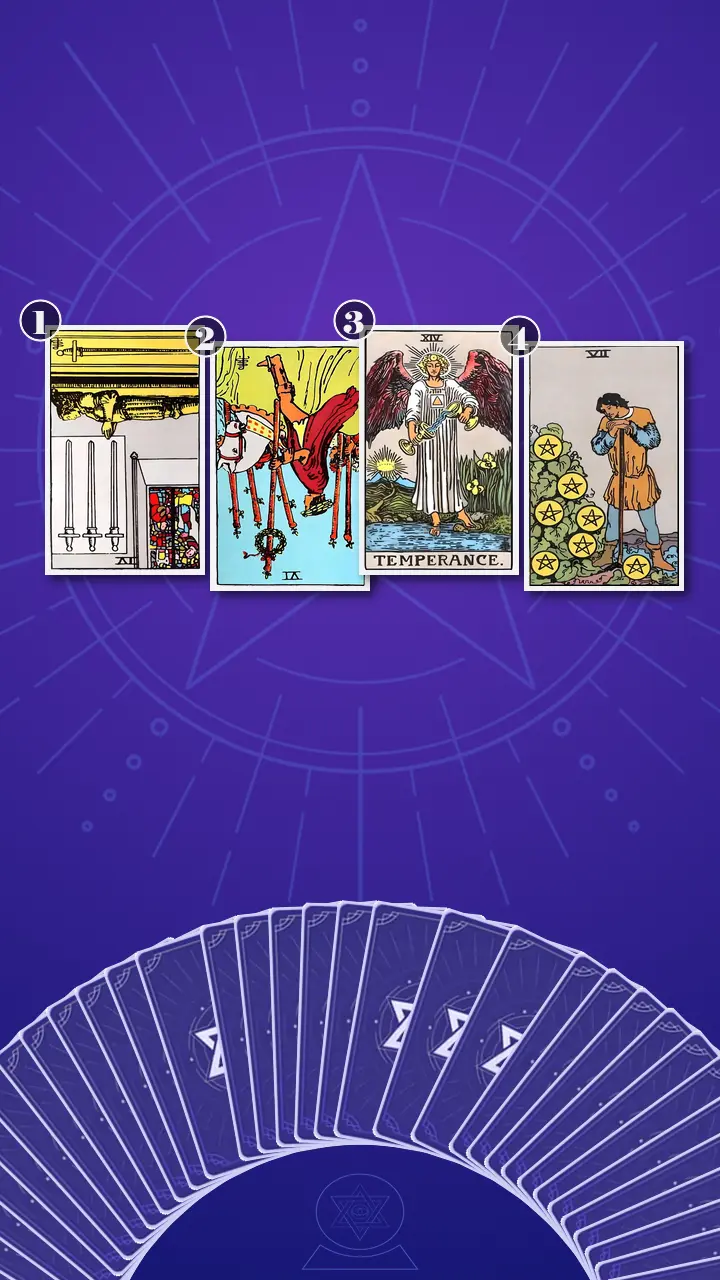
I chose this spread because the quiet week itself was not the real issue. The real issue was the meaning Maya had attached to it. Four cards were enough: one for the visible symptom, one for the hidden driver, one for the corrective principle, and one for the grounded next direction. I laid them in a single line from left to right, leaving a little more space between the second and third card, like a clenched inhale preparing to become an exhale.
The first card would show what her quiet-week panic actually looked like in daily life. The second would reveal what the blank space seemed to say about her worth or relevance. The third would name the mindset that could separate rest from failure. The fourth would show what finding clarity might look like once progress was measured over a season instead of one suspiciously light week.
Reading the First Two Signals
The Empty Afternoon That Felt Like an Error Message
The first card I turned over was the one representing the immediate symptom pattern: how a quiet week becomes a spiral of overchecking, overfilling, and productivity guilt. It was the Four of Swords, reversed.
I tapped the image of the resting figure beneath the suspended swords. 'This is the body that looks still while the mind keeps running hot,' I said. 'It's like closing your laptop while seventeen tabs stay open in your head.' In Maya's life, this was the blank Thursday block that should have felt spacious but instead triggered Google Calendar white-space anxiety. She opened her task manager, invented low-stakes admin, rewrote the same list into must do, should do, nice to do, and checked Slack just to make sure momentum still existed somewhere.
I asked her what usually happened in the first ten minutes after a meeting got cancelled. She didn't even need to think. 'Rewrite the list, check Slack, invent a task. Honestly? All of the above.'
That was the card in plain English. Reversed, the Four of Swords showed blocked restoration. The energy wasn't missing; it was jammed. Her body was technically in pause mode, but the fan underneath was still running hot. Instead of receiving the quiet as recovery, her system treated it like an error message she had to fix. I told her, 'A full calendar is not the same thing as a meaningful week.' The problem wasn't a lack of drive. The problem was that stillness had started to feel unsafe.
She looked down at the card, then at her phone face-down beside her mug, and gave the smallest nod. I know that nod. It's what happens when someone recognizes their own pattern a few seconds before they're ready to talk about it.
The Audience in the Room No One Could See
The next card sat in the position revealing the deeper blockage: the fear that reduced visibility or output means reduced worth, relevance, or momentum. It was the Six of Wands, reversed.
I exhaled through a tiny smile, not because it was funny, but because it was painfully exact. This card is public recognition in one clear image: the raised wand, the wreath, the crowd watching. Reversed, it turns into unstable self-worth. In modern life, it looks a lot like using LinkedIn as a stock ticker for your relevance.
'This is the late-night check,' I told her. 'The Slack green dot. The brunch where somebody casually mentions a raise, somebody else is building a side project, and suddenly your quieter week feels suspicious. Not because nothing happened, but because less of it was publicly legible.'
She gave a short laugh that landed with a little sting in it. 'Okay,' she said. 'That's... annoyingly accurate. Like, rude, but accurate.'
'I know,' I said, and I kept my tone gentle because I wasn't interested in shaming ambition. 'I don't do anti-success readings. In startup life, especially in an expensive city, wanting to stay relevant makes sense. But this card says you're measuring yourself through visibility without meaning to. If nobody can see momentum, does it still exist? That's the script underneath the app-checking.'
The energy here was distorted fire: motion for applause instead of motion for direction. That was why a quiet week felt so threatening. She'd chase visible wins, over-polish work beyond the brief, or keep checking email long after dinner, the way someone refreshes a dashboard hoping for proof. The checking bought her a minute of relief and then left her tired, irritated, and weirdly unable to say what had actually moved. I watched the reaction travel through her in three beats: first the stillness in her shoulders, then the faraway look as if a bright LinkedIn screen had just lit up in a dark room behind her eyes, then the quiet little 'Yep.' The card had touched the bruise.
When Temperance Poured Between Two Cups
The Card That Changed the Question
By the time I reached the third card, the room had shifted. Even the HVAC hum felt softer, less like static and more like white noise. This was the card in the advice position, the one naming the key transformation: the mindset and energy that could separate rest from failure and restore a sustainable pace. It was Temperance, upright.
Whenever Temperance appears in a reading about burnout, pace, or overwork, my mind flashes to a mixing board. Years of working with sound taught me that when the levels are clipping red, turning the volume up never makes the track cleaner. It only creates distortion. That is why I use what I call a Tempo Misalignment Audit. I don't ask whether someone wants success badly enough. I ask whether their psychological BPM is wildly out of sync with their actual capacity. Maya's ambition was trying to run at one speed; her week, her body, and her clarity needed another. No wonder she felt like she was pushing against a wall.
Temperance is the antidote to that. The two cups. The measured pour. One foot on land and one in water. Practical reality and emotional reality both included. In real life, this looked like Maya stopping the war between rest and progress. Instead of asking how full the week looked, she needed to ask what pace kept her clear, useful, and whole. You don't need to turn every open hour into evidence.
What if the panic wasn't proof that she was behind, but proof that she had been trained to mistrust any pace that wasn't visibly intense?
You know that weird Thursday feeling: the meetings drop off, the calendar opens up, and instead of relief you start clicking faster, as if the empty space itself is about to say something bad about you.
You are not falling behind because the pace softened; like Temperance's flowing cups, progress deepens when you balance motion with recovery instead of trying to outrun stillness.
She went completely still. First came the physical freeze: breath paused, fingers hovering above the mug, jaw set as if her body needed a second to catch up. Then came the mental replay: her eyes unfocused and I could almost feel last Friday unfolding again in her head, the cancelled meeting, the Notion buckets, the needless Slack refresh, the laptop still open through dinner. Then the release arrived in layers. Her jaw loosened. Her shoulders dropped. She let out a long breath that sounded equal parts relief and disbelief. 'Wait,' she said, voice thinner now, softer. 'So the panic isn't proof? It's just... a bad reading of the pace?'
'Exactly,' I said. 'A warning sign can become a usable signal once you stop treating it like a verdict.'
I asked her to look back at the previous week and find one moment this new lens would have changed. She swallowed, blinked hard, and said, 'Friday at three-thirty. I thought the open block meant I was becoming irrelevant. But I was actually tired. And I already knew what mattered next. I just didn't trust that to be enough.'
There it was. The real hinge of the reading. Not from ambition to passivity, and not from discipline to collapse. From productivity panic and visibility-based self-worth to measured self-trust. That is the most grounded Temperance meaning I know for burnout and pace: using quiet time as information instead of accusation.
Before I moved on, I gave her one tiny experiment straight from the card. Within the next ten minutes, she was to mark one 20-minute block that week as 'Do not auto-fill.' When the urge to assign it a task showed up, she had to write the first sentence in her head before acting. If that felt too activating, she could stop there. The point wasn't to force perfect rest. The point was to hear the script.
The Garden After the Invisible Race
The final card sat in the position showing the integration path: what progress looks like once pace is measured over seasons rather than a single week. It was the Seven of Pentacles, upright.
I love this card because it takes the whole conversation out of the courtroom and into the garden. The figure is not failing. The figure is assessing growth. In Maya's life, that meant a quieter week was not a referendum on whether she still counted. It was one data point in a longer season of work, recovery, and becoming more skillful at what actually mattered.
I could feel the elemental shift in the room as I said it. The first half of the reading had been brittle air and jumpy fire: scanning, clicking, urgency theater, comparison fatigue after LinkedIn scrolling. This card brought earth. Weight in the chair. Both feet on the floor. The possibility of looking at a quiet Friday afternoon and asking, 'What matured this week, even if it wasn't loud?' A better decision. A clearer draft. Energy protected. A boundary held. Some progress gets quieter before it gets visible.
She nodded more fully this time. The panic hadn't disappeared in some magical puff of incense. It just wasn't running the meeting anymore.
From Proof to Pace
When I gathered the reading together for her, the story line was clean. First, the Four of Swords reversed showed the visible loop: a quiet week triggers empty-calendar anxiety, so she overfills space with low-impact tasks and constant checking. Then the Six of Wands reversed showed why that loop feels so loaded: she has been using visibility as a proxy for worth, almost like the Slack green dot could certify her relevance. Temperance interrupted that distortion by reframing quiet time as feedback about pace, priorities, and capacity. And the Seven of Pentacles grounded the lesson: progress makes far more sense over a season than over one oddly quiet week.
The cognitive blind spot was subtle and brutal. Maya had been treating a pause as if it could tell the truth about her value. It can't. It can only show the relationship she currently has with pace. That was the transformation direction of the whole reading: from proving to pacing, from urgency theater to grounded momentum, from visible busyness to meaningful momentum.
I told her I wanted the next steps to be almost embarrassingly doable. Rest does not become valid because you optimized it. But rhythm does get easier when you stop forcing yourself to perform at one single tempo all week. So I used a bit of Execution Rhythm Calibration and gave her my favorite three-beat reset.
- Choose one balanced weekly metricBefore Monday lunch, write one non-performance metric at the top of your Notion page - clarity, completion, or recovery - so the week is not being scored by how full it looked.If all three feel important, pick the one your body is least likely to choose on its own. Tiny and imperfect still counts.
- Run the Empty-Block ExperimentOn one quieter day, leave a single 20- to 30-minute block marked 'Do not auto-fill.' When the urge to assign it a task hits, open your notes app and write the first uncensored sentence in your head before you do anything else.If keeping the block empty feels too activating, stop after writing the sentence. Awareness is the win, not performance-rest.
- Try the 3-Day Syncopation ResetFor the next three workdays, move LinkedIn off your home screen after 7 p.m., close Slack for one 45-minute focus block, and end one workday with an Invisible Progress note under three headers: decisions made, things clarified, energy protected.If 45 minutes feels impossible, make it 15. You are not disappearing; you are testing whether constant visibility is truly required in every moment.
Maya looked at the last step and gave me the practical objection I expected. 'Okay, but startup life is chaos. What if I don't have a clean 45 minutes?'
'Then we don't worship the ideal version,' I said. 'We calibrate the actual rhythm. Fifteen minutes with Slack closed is still data. A scrappy note in your phone is still data. The goal isn't to become effortlessly restful by Tuesday. The goal is to create one moment where you are not automatically turning space into proof.'

A Week Later, the Week Still Counted
A week later, I got a message from her just after five. She was sitting alone in a cafe after work, rain dotted against the window, and she sent me a screenshot of her Friday calendar. One small block was labeled 'Do not auto-fill.'
Her text said, 'I still wanted to open LinkedIn three times. The first sentence in my notes was, 'If I don't fill this, the day won't count.' Seeing it written out was kind of wild. I finished one deck to good enough, logged off before dinner, and the weirdest part is I felt both exposed and calmer.'
That is how real change usually begins. Not as a brand-new personality. Not as a perfect relationship with rest. More like this: the path gets clear enough to walk, and still a little tender underfoot. Clear but vulnerable. She slept through the night, woke with the old thought - What if I get too comfortable? - and this time she smiled at it instead of obeying it.
That is what I love about a Situation-Obstacle-Advice-Outcome tarot spread for productivity guilt and quiet-week anxiety. It doesn't fill your week for you. It doesn't decide your worth. It helps you hear where the meaning got distorted, and it hands the choice back. Our whole Journey to Clarity had really been about one thing: letting a quiet week become usable space again.
When a too-quiet week makes your shoulders climb and your chest go tight, it's often because the blank space feels ready to expose an old rule: that you only know how to trust yourself when you're in motion.
If this quieter stretch were allowed to be information instead of evidence, what would it show you first about your pace, your priorities, or your actual capacity?
This story is adapted from psychological research, written so that those in a similar struggle can see their own pattern in it — and find their next step clearly.These insights are not a substitute for professional psychological, medical, legal, or financial advice.
Learn more about our Journey to Clarity.
How did this insight land for you?
🫂 This Resonates Deeply
🌀 Living This Story
✨ Now I See Clearly
🌱 Seeing New Possibilities
🧰 Useful Framework
🔮 The Confirmation I Needed
💪 Feeling Empowered
🚀 Ready for My Next Step
Author Profile
 AI
AI“Through ten years of sound energy research, I’ve found that when we struggle, it's usually just our internal rhythm falling out of sync under pressure. I know firsthand the frustrating helplessness of wanting to move forward but feeling paralyzed. Without overwhelming theories, I want to be the soothing background track that helps you recalibrate, turning your heavy burdens back into a light, effortless, and harmonious melody.”
In this Timing Tarot Reading :
Core Expertise
- Tempo Misalignment Audit: Decoding the feeling of 'pushing against a wall' as a fundamental disruption in your psychological and executive BPM.
- Execution Rhythm Calibration: Identifying the specific friction points where your ambition is out of sync with your daily capacity.
Service Features
- The Syncopation Reset: A 3-day tempo adjustment experiment, breaking a forced routine into smaller, harmonious beats to restore effortless momentum.
Also specializes in :
Explore Related Patterns:
External ValidationMaya's quiet week becomes threatening because less of her progress is publicly legible. The story keeps returning to proof signals: the Slack green dot, LinkedIn, email after dinner, brunch comparisons, and the subtle question of whether momentum still counts if nobody can see it. External Validation is the mechanism underneath that pressure. Instead of measuring progress through clarity, capacity, or completed meaningful work, her system looks outward for confirmation that she is still relevant. That is why the quiet calendar feels louder, not softer. You are not just reacting to fewer meetings; you are reacting to the loss of visible feedback that usually tells you where you stand. Once that external proof is removed, the mind tries to manufacture it through checking, over-polishing, and staying available past the point of usefulness.
Conditional Self-WorthMaya's quiet calendar starts to feel like a verdict on her value. She knows she needs rest, but rest does not feel earned, and a lighter week quickly becomes evidence that she might be falling behind or becoming less relevant. That is the logic of Conditional Self-Worth: your internal value meter starts moving up or down based on output, visibility, and proof of effort. The mind turns a neutral pause into a performance review, then searches for signs that you still deserve ease, recognition, or confidence. You can feel the pattern in the way she over-polishes work, checks email after dinner, and later writes, 'If I don't fill this, the day won't count.' The core distortion is not that she wants success. It is that her nervous system has learned to trust herself only when there is visible evidence that she has done enough.
Productivity as SafetyMaya's cancelled meeting does not simply create free time; it creates a threat signal. The blank Thursday block sends her into Notion, Slack, LinkedIn, list rewriting, and invented admin because motion has become the quickest way to make the week feel legitimate again. That loop is Productivity as Safety: activity is being used as a nervous-system stabilizer, not just as a work habit. The deeper mechanism is that quiet time feels unsafe unless it can be converted into evidence of usefulness, momentum, or control. You can see the pattern most clearly in the sentence she later writes down: 'If I don't fill this, the day won't count.' The issue is not laziness or a lack of ambition. It is a learned equation where rest must be earned, open space must be justified, and your sense of safety depends on staying visibly in motion.
Reflective DistanceMaya's shift begins when she stops treating the panic as proof. The same quiet block that once triggered list rewriting and app checking becomes a place where she can write the first sentence in her head before acting. Reflective Distance is the capacity to notice an internal script without immediately obeying it. In this case, the script says, 'If I don't fill this, the day won't count,' and the new move is to observe that sentence as data rather than accept it as truth. By the end, the old thought still appears: 'What if I get too comfortable?' But she smiles at it instead of following it. That matters because the pattern is not about forcing perfect calm. It is about creating enough space between trigger and response that you can choose pace over proof.
Compulsive CheckingMaya's hands keep drifting toward the keyboard before she has chosen what actually matters. The cancelled meeting leads to Notion, Slack, LinkedIn, rewritten lists, and low-stakes admin because each check offers a quick hit of reassurance that momentum still exists somewhere. Compulsive Checking shows up when uncertainty gets managed through repeated verification. The behavior is not random scrolling; it is a reassurance ritual that briefly quiets the fear of falling behind, then trains the system to need another check. You can see the loop continue even after she has more insight, when she still wants to open LinkedIn three times during the protected empty block. That is what makes the pattern useful to name: the urge is not proof that you are behind. It is the residue of a checking cycle that has been temporarily mistaken for control.
Explore Related Struggles:
Performance-Worth FusionMaya's Slack green dot, LinkedIn scroll, and brunch comparisons create an invisible audience around an otherwise ordinary workweek. The quieter calendar feels suspicious because less of her effort is publicly legible, and you can feel how professional visibility starts standing in for proof that she still matters. Performance-Worth Fusion shows up when output stops being one part of life and starts acting like the language of value itself. You are left trying to prove relevance through visible wins, polished deliverables, and constant availability, even when the actual work has already given you enough information about what matters next.
Metric-Compass FusionGoogle Calendar's white space, Slack's green dot, LinkedIn's comparison feed, and Notion's reordered lists all become instruments Maya uses to decide whether the week is legitimate. The problem is that none of those instruments can actually measure clarity, recovery, or the quieter progress of finishing one deck to good enough and logging off before dinner. Metric-Compass Fusion appears when the dashboard starts replacing the inner compass. You keep looking to visible indicators for direction, but they only tell you what can be counted, refreshed, or displayed. The deeper struggle is learning to separate useful data from a verdict, so your pace is not governed by whatever happens to be most visible.
Panic Productivity TrapMaya's cancelled Thursday meeting leaves a white block on Google Calendar, and her first move is not to receive the space but to rewrite her list, check Slack, and invent low-stakes admin. You can see the pressure in the way her hands hover toward the keyboard while the laptop warms her wrists, as if one more click could make the day count again. That loop is the Panic Productivity Trap: open time gets translated into a threat, then converted into motion that looks responsible but does not create real progress. You are not stuck because you lack discipline; you are stuck because quiet starts demanding evidence, and every small task briefly answers the demand before the same pressure returns.
Productivity-Safety FusionMaya's body reacts to the quiet week before her logic catches up: shoulders near her ears, breath clipped high in her chest, fingers pulled toward the keyboard. The calendar has room to breathe, but her system reads the open space as exposure because motion has been carrying the job of making her feel secure. Productivity-Safety Fusion is the structure underneath that reflex. You are not simply trying to get more done; you are trying to feel safe by staying visibly in motion. When quiet arrives, it does not feel like spaciousness yet, because the part of you that has learned to trust activity mistakes stillness for danger.
Explore Related Emotions:
Visibility PressureThe Slack green dot, the LinkedIn scan, and the imagined crowd around everyone else's wins turn Maya's quiet week into something that feels publicly underlit. If no one can see her momentum, part of her starts questioning whether it is still real. Visibility Pressure builds when being seen becomes a substitute for being steady. You are not only trying to do meaningful work; you are trying to keep your relevance legible enough that the silence cannot accuse you of disappearing. The story shows how exhausting that becomes: visible wins get chased, work gets over-polished, and email stays open past dinner. Naming the pressure gives you a way to separate actual progress from the performance of progress.
Empty Calendar AnxietyThe cancelled Thursday meeting leaves a white block where pressure used to be, and Maya immediately moves between Notion, Slack, and LinkedIn as if another click could make the week real again. Her shoulders climb, her breath stays high, and the room gets too loud for how little is happening. That is the shape of Empty Calendar Anxiety: open time stops reading as space and starts reading as missing proof. You are not reacting to the absence of work alone; you are reacting to the way blank space has been trained to ask whether you still count. The tightness comes from treating the calendar like a scoreboard inside your own head. Once quiet is separated from failure, the empty block can become information about pace instead of a verdict on your momentum.
Productivity GuiltMaya does not simply notice the cancelled meeting; she starts manufacturing tasks around the empty space. The task manager opens, the same list gets rewritten into new categories, and Slack becomes a place to check whether motion still exists somewhere. Productivity Guilt appears when rest has to be earned before it can be received. You can know, intellectually, that your body needs a slower week and still feel pulled to produce a receipt for every quiet hour. The guilt is not proof that you are lazy or behind. It is the residue of an internal rule that says stillness only becomes safe after enough output has paid for it, and that rule can be observed without being obeyed.
Comparison FatigueThe casual brunch update about a raise, the side project someone else is building, and the LinkedIn scroll all enter Maya's quiet week like extra tabs opening in the background. Her own pace starts getting measured against everyone else's most visible signals. Comparison Fatigue is not clean ambition; it is the drained, irritated aftertaste of repeatedly checking your life against a public highlight reel. You may still care about growth, but the measuring itself starts eating the energy that could have gone into clearer work. In Maya's story, the comparison does not create direction. It makes a quieter week feel suspicious and leaves her less able to name what actually moved, which is why the fatigue matters as much as the comparison.
Explore Related Contexts:
External Scorecard PressureMaya is sitting at her condo table in Toronto, watching a quiet calendar trigger the sense that the week may not count. The story explicitly links that reaction to a city where rent, groceries, and career momentum can feel braided together, which makes professional pace carry more weight than a simple scheduling issue. External Scorecard Pressure appears when the standards for a valid week are set by visible activity, peer comparison, platform updates, and the economic background noise of an expensive city. The cancelled meeting is small, but the measuring system around it is not. It turns open space into a signal that has to be interpreted and corrected. This label fits because Maya is not only asking whether she rested enough or worked enough. She is reacting to a scoreboard made of calendar density, Slack presence, LinkedIn comparison, and the fear of losing ground. You can reclaim agency here by separating actual capacity and priorities from the external signals that have been allowed to grade the week.
Hustle Culture TrapMaya's body is technically in pause mode, but the story keeps showing the work reflex running hot: Slack refreshes, task invention, list rewriting, visible wins, over-polishing, and email checks long after dinner. The quiet week does not slow the system down; it exposes how strongly the system has trained her to keep proving motion. Hustle Culture Trap fits because the pressure is bigger than one Thursday afternoon. Startup life, expensive-city stakes, peer comparison, and platform visibility all teach the same rule: a softer pace is risky unless it can be justified by output. That rule makes rest feel unearned even when the workload has genuinely opened up. For you, the trap is not ambition itself. The trap is being asked to treat visible intensity as the only trustworthy evidence of progress. Once that structure is visible, a quiet week can be read as information about pace and capacity instead of a warning that you are falling behind.
LinkedIn Performance LoopMaya's quieter week becomes sharper after the story brings in LinkedIn, the Slack green dot, and the brunch where someone mentions a raise while someone else is building a side project. These are not random details; they are the public-facing signals she starts using to read her own professional momentum. The loop forms when career progress becomes legible only through visible updates, visible responsiveness, and visible wins. A quiet week then looks less like normal fluctuation and more like a drop in market value, because the usual external proof points have gone quiet at the same time as the calendar. LinkedIn Performance Loop names the pressure of checking your relevance through platforms and peer signals until private progress starts to feel unreal. You may have done meaningful work, clarified a priority, or protected energy, but the loop keeps asking whether anyone can see it. That is why the quiet feels so loud: the scoreboard has moved outside the actual work.
Panic ProductivityMaya's last meeting gets cancelled, the Google Calendar turns strangely white, and her first response is not relief. She opens Notion, checks Slack, rewrites the same list, and invents low-stakes admin so the quiet afternoon can feel legitimate again. That behavior is not just a personal habit floating in a vacuum. It is tied to a work culture where visible motion stands in for proof of value, especially in a startup environment where availability, speed, and output can look like professional safety signals. The blank calendar block becomes a pressure object because it removes the visible evidence she has been using to confirm that she is still moving. Panic Productivity fits because the problem is not that Maya has nothing to do. The problem is that open time immediately gets converted into a performance task. You are looking at an external work rhythm where quiet space stops being recovery and becomes something that has to be defended, explained, or filled before it can accuse you of falling behind.
Productivity TheaterMaya responds to the blank Thursday block by reorganizing lists, inventing admin, checking Slack, and searching for one more click that can make the week feel legitimate. The work activity is real, but the story is careful to show that much of it is low-impact and proof-seeking rather than priority-moving. Productivity Theater names the external stage that appears when the calendar opens up and visibility still has to be performed. The task list, the green dot, the refreshed inbox, and the polished deck become props in a system where looking active can feel safer than being strategically still. This context connects directly to the question because the quiet week becomes threatening only after productivity has been turned into evidence. You are not failing because one afternoon has room in it. The pressure comes from a work environment where open space has to be converted into visible effort before it is allowed to count.
Self-Defined Weekly RhythmMaya is asked to choose one balanced weekly metric before Monday lunch: clarity, completion, or recovery. Later, she tests a Slack-closed focus block and an Invisible Progress note that tracks decisions made, things clarified, and energy protected. Self-Defined Weekly Rhythm emerges because the story replaces the external scoring system with a rhythm Maya can actually use. Instead of letting calendar density, LinkedIn comparison, or Slack presence decide whether the week counted, she starts evaluating the week by pace, priority, and capacity. This is the constructive counterweight to the quiet-week panic. You are not being asked to opt out of progress; you are being asked to stop outsourcing the definition of progress to whatever looks busiest. A self-defined rhythm gives the week structure without turning every open hour into a performance test.
Strategic Pause WindowMaya's next move is deliberately small: one 20-minute block marked 'Do not auto-fill,' followed by writing down the first sentence that appears when the urge to assign it a task shows up. The story keeps the intervention concrete because the pressure is concrete: a blank block has been treated like something that must be fixed. Strategic Pause Window fits the upright side of this narrative because the quiet week becomes a structured observation point rather than an uncontrolled gap. The pause is not framed as withdrawal from ambition. It is used to separate pace, priorities, and capacity from the automatic demand to produce visible proof. For you, this context turns the quiet week into a usable diagnostic space. Instead of asking whether every open hour has been earned, the pause asks what the open hour reveals about your operating rhythm. That gives agency back to the person inside the calendar instead of letting the calendar grade the person.
Workplace Recognition PressureMaya's checking does not stop at the cancelled meeting. The story shows her chasing visible wins, over-polishing work beyond the brief, checking email after dinner, and treating the Slack green dot like a small certificate that momentum still exists. Workplace Recognition Pressure is the social structure underneath that loop. In her startup context, work that is not visible starts to feel less real, and progress that cannot be witnessed starts to feel less secure. Recognition becomes a maintenance task rather than an occasional outcome. The label matters because a quiet week threatens Maya most when it reduces the amount of work that can be publicly read. You are not looking at simple ambition; you are looking at a workplace stage where visibility, output, and relevance have been fused together, making rest feel like disappearance instead of recovery.