The 11:43 P.M. Blank Square
When Jordan sat down at the back table of my café, with the late-afternoon light on the sugar jar and a cappuccino going untouched between her hands, I was already thinking what I so often think when someone comes to me asking why a planner, a Notion dashboard, or a habit app has started to feel weirdly accusatory: if nobody is grading you anymore but one blank square still lands like red pen in the margin, this is probably not a motivation problem. It is an old rule wearing modern clothes.
She told me about Sunday night in her shared Toronto apartment: 11:43 p.m., phone light turning the duvet blue, radiator hissing, fridge humming down the hall. She had opened her tracker to log a five-minute stretch. Then she saw one unchecked square from Friday and, instead of stretching, started renaming categories and changing colors like she was trying to negotiate with the page. Her chest dropped. Her stomach pulled tight. There was that tiny freeze before movement returned. The missed square was small, but in her body it hit like an elevator suddenly dropping one floor lower than expected.
‘I know one missed day should not matter this much,’ she said, looking down into the foam, ‘but it does. If I can’t do it properly, I almost don’t want to log it at all. I keep turning routines into tests.’
I told her I didn’t hear laziness in that. I heard all-or-nothing productivity shame. I heard broken streak anxiety. I heard a woman who genuinely wanted habits to support her, but who kept getting pulled into an older system where support tools quietly became surveillance tools. The smell of espresso was still warm in the room, and I said what I always say when the shame arrives before the insight does: ‘Then let’s not try to make the page prettier. Let’s make the pattern clearer. We’re here to draw a map through the fog.’
Choosing the Compass: A Situation-Obstacle-Advice-Outcome Spread
I asked Jordan to wrap both hands around the cup, take one full breath, and hold the question exactly as she had asked it: what school rule still runs me when I miss one square? Then I shuffled slowly, not as theatre, but as a way of letting the nervous system catch up to the conversation. In my café, people understand this instinctively. Sometimes the body needs one small ritual to stop acting like every discomfort is an emergency.
For her, I chose a Situation-Obstacle-Advice-Outcome spread. This is how tarot works at its most practical for habit tracker guilt: not by predicting whether you will become a perfect routine person, but by showing the mechanism. This four-card spread was cleaner than a larger one because her issue had a clear trigger, a clear hidden influence, a clear turning point, and a clear next-step path. We did not need ten cards and a dramatic destiny. We needed one honest line from symptom to rule to remedy to practice.
I told her what I would be looking for as I laid the cards from left to right. The first card would show the visible pattern: what happens in the minutes right after the miss. The second would reveal the hidden rule underneath it: the internal authority that makes one lapse feel morally charged. The third would name the antidote: the exact energy that interrupts harsh self-policing and restores self-trust. The fourth would ground everything in real life: what consistency looks like when it becomes returning instead of performing.
Reading the Red Pen in the Margin
Position 1: The Loop That Looks Like Planning
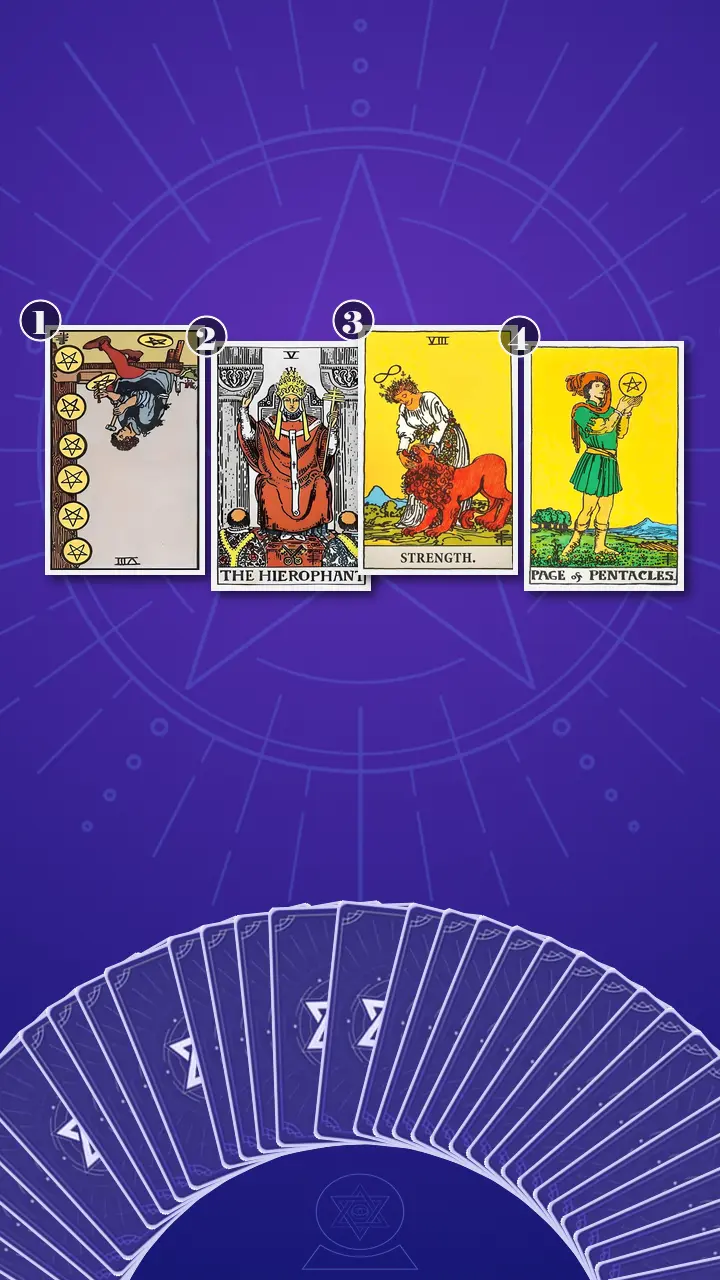
I turned over the first card and said, ‘This card shows the observable pattern from the diagnosis: what happens behaviorally and emotionally right after one habit square is missed.’ It was the Eight of Pentacles, reversed.
I have always loved how direct this card can be. In its upright form, it speaks of repetition, craft, practice, skill. Reversed, that same work ethic can sour. Here, the row of pentacles looked almost painfully modern to me, like a grid of visible checkboxes on a tracker dashboard. The workbench became a phone screen. The bent solitary posture became that curled-over-bed posture she had just described: late at night, shoulders up, face lit by the app, trying to fix the system instead of doing the five-minute habit.
I told her, ‘This is the moment when routine stops feeling like practice and starts feeling like inspected labor. The energy here is blocked earth. Heavy. Contracted. Not no effort—too much effort going into the wrong place. It’s like reopening the spreadsheet and formatting cells for twenty minutes instead of sending the one email. You mean to return to the habit, but the blank square gets louder than the habit itself.’
I let the card sit there between us and added, ‘You are not failing because you’re incapable of consistency. You are getting trapped in a loop where protecting the record starts to matter more than building the skill.’
Jordan gave a short laugh that had some bite in it. ‘Wow,’ she said. ‘That is accurate enough to be rude.’ Then she rubbed her thumb against the warm ceramic as if trying to file down the edge of the recognition.
Position 2: The Rule Behind the Rule
I turned the second card. ‘This one reveals the internalized school rule and worth-based fear that turn a small miss into a moralized problem.’ The Hierophant, upright.
The room went quieter for me the second I saw it. The stone pillars. The formal symmetry. The kneeling students. I have spent twenty years in a café watching people try to turn life into something neat enough to deserve approval, and The Hierophant always shows me the same thing: structure mistaken for virtue. I told Jordan, ‘This is the inner headmaster card. The blank square is not landing as neutral information. It is landing like a classroom rule. Like a private-school rubric you carried into adulthood and quietly applied to your own planner.’
I pointed to the card and said, ‘One missed square is data. The verdict is the school rule. This is the part of you that hears, beneath something as ordinary as a missed stretch or vitamin, an older message: good students stay neat, on time, and consistent. A habit tracker stops helping the moment it starts grading.’
For one beat, Jordan didn’t answer. First her jaw set. Then her eyes drifted past the window as if she were replaying a different room altogether. Then the breath came out long. ‘The blank square really does feel accusatory,’ she said. ‘Like I’m not even reacting to the habit. I’m reacting to what it says about me.’
I nodded. Looking at the clean lines of The Hierophant, I had a quick flash of my earliest inventory sheets behind the counter—rows and rows of boxes that helped me keep beans, milk, sugar, timing, order. Useful, yes. Holy, no. A list can guide a day. It should never be allowed to decide a person’s worth.
When Strength Put a Hand on the Lion
Position 3: The Card That Rewrote Reset
When I reached for the third card, the air in the café seemed to settle. The grinder in the back had finally gone silent, and the room felt suddenly spacious, as if the reading itself had been waiting for this hinge. ‘This card names the key reframe,’ I said, ‘the remedy that interrupts the harsh self-policing loop and restores self-trust.’
The card was Strength, upright.
I smiled the moment I saw the woman and the lion. ‘Yes,’ I said softly. ‘This is exactly the medicine.’ Strength is not force. It is not harsher control. It is not dragging yourself by the collar back toward a perfect streak. It is calm contact. It is nervous-system steadiness. It is the hand that knows panic is loud but not automatically true.
And here I used one of the diagnostic metaphors that has lived in my body for years behind an espresso machine. ‘In my café, I call this a Stress Flavor Profile,’ I told her. ‘When an espresso is over-extracted, people blame the bean. They say the coffee is bad. But often the bean is not the problem at all. The bitterness comes from too much pressure, held too long, pulling the harsh notes forward. That’s what I see in your habits. Your discipline isn’t weak. It’s being over-extracted by the inner headmaster. Strength says the answer is not more pressure. The answer is a better relationship with the moment the bitterness starts.’
At 11:43 p.m., with the phone lighting the duvet blue and the gap in the app suddenly feeling bigger than the habit itself, it can honestly feel like the old classroom script has walked back into the room. That is usually the moment Jordan tries to yank herself into being good again.
You do not need to yank yourself back into line; you need to place a steady hand on the lion and prove that one missed square does not get to run the whole story.
She went very still. First, there was the physical freeze: her inhale stopped halfway, and two fingers hovered above the saucer as though they had lost their instructions. Then came the cognitive slip: her gaze unfocused over my shoulder, and I could almost watch her replay Friday night frame by frame—the app, the gap, the lecture, the color-coding detour. When she came back, her expression did not melt into relief right away. It tightened. ‘But if I don’t tighten the rules,’ she said, and there was a quick flare of resistance in it, almost anger, ‘doesn’t that mean I’ve been doing it wrong this whole time?’
I shook my head. ‘No. It means you were using command where you needed relationship. The clean grid is not the reset. The return is.’ I let that sit for a second, then continued more gently. ‘A real reset is not when the tracker looks clean again. A real reset is when you can see the gap, stay on your own side, and return anyway.’
Her shoulders dropped once, then farther. The breath that left her the second time sounded surprised by its own softness. There was relief in it, but also that strange lightheadedness that comes when a bag you have been carrying for too long suddenly comes off one shoulder and your body has to remember how to stand without it. I asked, ‘With this new perspective, can you think of a moment last week when this insight would have changed how you felt?’ She nodded almost immediately. ‘Friday,’ she said. ‘I would’ve just stretched for two minutes instead of rebuilding the app.’
That was the breakthrough. Not a personality overhaul. Not a magical end to perfectionism. Just the first real move from shame-driven self-surveillance to gentle self-trust, from using consistency as proof of being good to using consistency as the skill of returning after a miss.
Position 4: One Pentacle, Not a Full Report Card
I turned over the final card. ‘This one grounds the transformation in a practical learning stance and a realistic next-step way of relating to consistency.’ It was the Page of Pentacles, upright.
I loved the visual conversation immediately: many pentacles in the first card, one pentacle here. Many judged outputs, one studied object. ‘This,’ I said, ‘is your healthier ending. Beginner’s mind. One habit. One rep. One honest note. The tracker becomes a lab notebook, not a GPA. You stop asking, “How do I keep the page spotless?” and start asking, “What helped me return?”’
The Page of Pentacles brings healthy earth back into the spread. Grounded, teachable, realistic. It is the energy of beta-testing a routine instead of trying to launch version 10.0 overnight because a productivity reel made it look easy. It is the opposite of the Sunday-reset fantasy. It says one minute of stretching counts if one minute is what gets you back in contact with yourself.
Jordan gave me a small, almost embarrassed smile. ‘So I don’t have to restart from page one every time?’ she asked.
‘Exactly,’ I said. ‘Consistency is not never missing; it’s getting less dramatic about returning.’
The Return-First Rule: Actionable Advice for Broken Streak Anxiety
When I looked across the whole line of cards, the story was beautifully clear. First came the overworked apprentice: the part of Jordan whose routine had turned into inspected output. Then came the inner headmaster: the inherited school rule that made compliance feel equal to worth. Then came Strength, the antidote: calm self-contact instead of harsher self-command. Finally came the Page of Pentacles, who offered a new identity entirely—not star student, not failed student, just a human being learning a skill.
Her biggest blind spot was thinking organization was repair. Every late-night redesign gave a flash of relief, but it was false relief, the same way over-stirring a bitter cup does not make it sweeter. She kept trying to fix the atmosphere around the habit by making the system cleaner, when what she actually needed was a kinder way to meet the shame spike in her body. In other words: support had been replaced by grading. The transformation direction was simple, but not easy—from report card to feedback, from self-grading to self-support, from resume only when perfect to return without redesign.
I also brought in one of my café rules. Behind the counter, I use what I call Alertness Scheduling: I never diagnose the whole espresso machine by the last exhausted pull of the night. Closing-time pressure lies. I suggested she apply the same wisdom to her habits. You do not need a stricter system at 11:40 p.m. You need a smaller next rep.
- The Visible Gap PracticeTonight, when you open the tracker in bed and feel that stomach-drop, place one hand on your stomach or chest and say quietly, ‘Shame spike, not emergency.’ Leave the missed square visible. Then do the two-minute version of one habit right there: one stretch, one vitamin, one paragraph, one glass of water.If your body braces hard, stop after one breath or one tiny rep. The win is not feeling perfect; the win is interrupting the old rule while it is still active.
- The 24-Hour No-Tweaks RuleFor one tracker only, make a rule for the next week: no renaming categories, no changing colors, no catch-up rules after 10 p.m. If the redesign urge hits, drop every idea into a note called ‘Tracker tweaks later’ and do one live action before touching settings.Optimization feels productive because it numbs the sting for a minute. If the app is too activating, do the habit first and log it later—or skip the log once and still count the return as the success.
- The One-Rep Lab NotebookPick one habit only for the next seven days and define the minimum viable version in advance. At the end of each day, record just one word: ‘done,’ ‘missed,’ or ‘returned.’ On Sunday, write one plain learning note in your phone: what made returning easier this week?Choose a low-stakes habit rather than one already tangled with heavy self-judgment. The point is to build evidence that you can come back, not prove maximum discipline.
A Week Later, the Square Was Still There
Five days later, Jordan sent me a screenshot. The Friday square was still blank. She had not backfilled it. She had not hidden it under a prettier template. Next to Sunday was a plain note: ‘2 min stretch.’ Monday: ‘vitamin.’ Tuesday: ‘returned.’ No fireworks. No perfect streak. Just a human record that had stopped pretending to be a verdict.
She added one more line: ‘I still had the first little panic when I saw the gap. But this time I did the habit before I argued with myself.’ I could almost see the scene she meant—a kitchen light, an imperfect page, maybe morning coffee in a chipped mug, and that tiny bittersweet pause where the old script still knocks but no longer gets to move in.
That is what finding clarity looked like in this reading. Not becoming flawlessly consistent. Not winning some private war against imperfection. Just shifting the tracker from surveillance back to support, and letting one missed square become information instead of identity.
When one tiny blank square can make your stomach drop and the whole week feel morally spoiled, it makes sense that a support tool starts to feel like surveillance.
If consistency were allowed to mean returning instead of performing, what is the smallest version of one habit you might be willing to come back to this week—with the square still visible?
This story is adapted from psychological research, written so that those in a similar struggle can see their own pattern in it — and find their next step clearly.These insights are not a substitute for professional psychological, medical, legal, or financial advice.
Learn more about our Journey to Clarity.
How did this insight land for you?
🫂 This Resonates Deeply
🌀 Living This Story
✨ Now I See Clearly
🌱 Seeing New Possibilities
🧰 Useful Framework
🔮 The Confirmation I Needed
💪 Feeling Empowered
🚀 Ready for My Next Step
Author Profile
 AI
AI“For twenty years, I’ve listened to stories unfold over the warm aroma of coffee. I don’t believe life’s complexities always require grand theories to be solved; often, we just need a safe place to tidy up our reality. I don’t offer high-minded preaching—just grounded, heartfelt insights to help you regain your sense of control amidst the clutter of daily life.”
In this Introspection Tarot Reading :
Core Expertise
Service Features
Also specializes in :
Explore Related Patterns:
Authority HypervigilanceWhen the unchecked square from Friday lands like red pen in the margin, the tracker stops behaving like a record and starts behaving like a classroom authority. You are no longer reading a neutral gap; you are reading a rule, so the page pulls your attention toward inspection instead of support. The old school rule keeps showing up in modern clothes. Once a tool feels like it can grade you, the nervous system starts treating it like surveillance, and the task becomes restoring the line between information and judgment.
Conditional Self-WorthThe line If I can't do it properly, I almost don't want to log it at all shows that the record has started to carry a value test. You are not just logging a habit; you are checking whether the day still counts. You keep imperfection and legitimacy tied together, so a small lapse feels expensive because it starts to say something about who you are. The habit is no longer just a habit, because the act of recording it has become a referendum on whether you are allowed to count as consistent.
Productivity as SafetyYou are asking the tracker, Notion dashboard, and habit app to hold the discomfort of imperfection, make the day feel manageable, and keep the shame spike from spreading. In that setup, the system is doing emotional labor, not just record-keeping. That is why support starts to feel like surveillance. Once productivity is carrying the job of emotional protection, any gap feels unsafe, and the system itself becomes the place where you seek relief instead of simply returning to the habit.
Self-Judgment LoopYou can see the loop in the order of events: the gap appears, your body drops, and then you move into renaming categories and changing colors instead of stretching. That is shame turning itself into a control ritual. The problem is that the ritual never answers the original miss, so it keeps the miss emotionally alive. The page becomes the place where you rehearse punishment first, which is why the loop can keep running even when nothing is actually getting fixed.
Black-and-White ThinkingOne missed day should not matter this much, but it does is the cleanest sign that you are collapsing a gray situation into a binary one. The routine becomes either clean or ruined, useful or failed, instead of something that can absorb a normal miss. That split is why the blank square feels bigger than the habit itself. When every lapse is turned into a test, the middle ground disappears, and returning starts to feel like a moral correction rather than a normal part of consistency.
Explore Related Struggles:
Grade-Identity FusionJordan does not simply notice an empty Friday square; she feels it arrive like red pen in the margin. At 11:43 p.m., the tracker stops being a record of one missed stretch and starts acting like an old classroom rule, complete with the quiet demand to stay neat, on time, and consistent. You can see the pressure in the way her body reacts before her reasoning catches up. Her chest drops, her stomach tightens, and the habit gap begins to feel like evidence about her as a person. That is the center of Grade-Identity Fusion: the record no longer describes what happened; it starts deciding whether you count as disciplined, reliable, or good. The useful break in the pattern comes when the square is allowed to stay visible without becoming a verdict. Once the tracker is demoted from report card to feedback, consistency can become the skill of returning instead of the performance of never missing.
Habit-Identity FusionThe story keeps narrowing from a whole week to one tiny blank square, and then from that square to a question of self-definition. Jordan says she is not just reacting to the missed stretch; she is reacting to what the miss seems to say about her. You can feel the habit record turning into a mirror. A skipped vitamin, stretch, or paragraph no longer stays in the category of behavior; it starts reflecting back a verdict about reliability. That is Habit-Identity Fusion: the tracker confuses a data point with a personal definition. The shift at the end matters because the square is still blank. Jordan does not erase it, backfill it, or hide it under a prettier template. She does the next small action with the gap still there, which lets the habit become a practice again instead of a courtroom for the self.
Monitoring-Safety FusionJordan opens a tool that is supposed to help her stretch, take vitamins, or keep a simple routine, but the moment she sees a gap, the tool starts watching her back. The phone light on the duvet, the untouched habit, and the sudden freeze all show how quickly support turns into inspection. You are not only checking progress in this pattern; checking becomes the condition for feeling safe with yourself. A clean dashboard offers temporary calm, while a visible blank square feels like exposure. That is why the app cannot stay neutral: it carries the power to decide whether the day feels intact. Monitoring-Safety Fusion names the point where self-tracking stops being information and becomes emotional security infrastructure. The repair is not a stricter tracker; it is proving that you can leave the gap visible, take one small action, and still remain on your own side.
Productivity Shame BindJordan says one missed day should not matter this much, but it does, and the body tells the truth before the explanation arrives. The chest drop, the tight stomach, and the urge to negotiate with the page show that the missed square has been charged with more than habit data. You are watching effort get tied to self-accusation. The routine promises support, but the old productivity rule turns support into a test: do it properly, keep the streak clean, prove that you are still on track. The more she cares about consistency, the more a small lapse can feel morally loaded. Productivity Shame Bind names the knot between wanting to build a life-giving routine and feeling punished by the very structure meant to help. The practical freedom is small but concrete: name the spike, keep the square visible, and let the next tiny rep count without requiring the page to look innocent first.
Panic Productivity TrapJordan means to log a five-minute stretch, but the unchecked square diverts her into renaming categories and changing colors. There is movement, effort, and problem-solving energy, yet the body never actually returns to the habit. The friction here is that the detour looks responsible. Rebuilding the tracker feels like repair because it creates a cleaner surface and briefly dulls the sting of the miss. Underneath, the live action is still waiting, and the old rule stays in charge by making system maintenance feel safer than imperfect participation. Panic Productivity Trap captures that productive-looking loop where pressure produces motion without contact. The exit begins when one tiny rep happens before the redesign, because the nervous system learns that return does not require a spotless interface first.
Explore Related Emotions:
Rulebook ShameThe blank square lands like red pen in the margin, even though nobody is grading Jordan anymore. A habit log that should simply record a missed stretch starts carrying the old classroom message that good students stay neat, on time, and consistent. Rulebook Shame is the sting of being measured against an inherited standard that no longer fits adult life but still has emotional authority. For you, the missed square hurts because it seems to place you back under a rule where being consistent is not a skill you practice, but a condition you have to meet to feel acceptable.
Self-Audit AnxietyThe tracker was meant to support Jordan, but it quietly becomes a surveillance tool. Every square starts to feel like evidence, and even the decision to return has to pass through an argument with herself first. Self-Audit Anxiety captures the pressure of living under constant internal inspection. For you, the app is not the real authority; the deeper strain comes from the part of you that keeps checking, grading, and building a case, until support turns into self-monitoring and consistency stops feeling kind.
Broken Streak AnxietyAt 11:43 p.m., Jordan opens the tracker to log a five-minute stretch and sees the unchecked Friday square. The square is tiny, but her body reacts as if the entire record has dropped out from under her, with the gap becoming louder than the habit itself. Broken Streak Anxiety names the fear that one miss has contaminated the whole system. For you, the pain is not just that a routine was interrupted; it is that the interruption starts to feel like proof that the return is already ruined, so redesigning the tracker briefly feels safer than touching the habit again.
Pattern Recognition CalmIn the café, the work is not to make the page prettier; it is to make the pattern clearer. The key distinction lands cleanly: one missed square is data, while the verdict belongs to the old school rule. Pattern Recognition Calm is the steadiness that appears when the mechanism finally has a shape. For you, clarity lowers the volume because the tracker no longer has to be obeyed as a judge; it can become a lab notebook again, a place to study what helps you return.
Verdict DreadJordan says the blank square feels accusatory, like she is reacting to what it says about her instead of reacting to the habit itself. The tracker stops behaving like a neutral record and starts acting like a private verdict. Verdict Dread is the inner drop that happens when information turns into judgment. For you, one missed square becomes frightening because it seems to pronounce something final about your discipline, your reliability, or whether you are doing adulthood correctly, even though the factual event is only a missed entry.
Cautious Self-TrustFive days later, the Friday square is still blank. Jordan has not backfilled it, hidden it under a cleaner template, or restarted from page one; she logs two minutes, a vitamin, and a plain returned. Cautious Self-Trust is the quiet steadiness of staying on your own side while the old rule still knocks. For you, trust does not arrive as total confidence; it shows up as the small decision to leave the gap visible, do the next rep anyway, and let returning count as real consistency.
Optimization FatigueInstead of stretching, Jordan renames categories and changes colors, trying to negotiate with the page. The redesign gives a quick hit of control, but the habit itself stays untouched. Optimization Fatigue is the drained feeling that comes from endlessly improving the container while avoiding the exposed moment inside it. For you, the tiredness is not laziness; it is effort being pulled into formatting, tweaking, and repairing the system because the actual return feels too charged to approach directly.
Performance FreezeHer chest drops, her stomach pulls tight, and there is a tiny freeze before movement returns. In that suspended moment, the five-minute stretch is no longer a small action; it has become a performance with a standard attached. Performance Freeze names the body-level stall that appears when doing the thing starts to feel less important than doing it correctly. For you, the freeze is the split second where the routine turns into a test, and the safest-feeling move is to pause, perfect the system, or avoid logging altogether.
Explore Related Contexts:
External Scorecard PressureThe unchecked Friday square lands like red pen in the margin even though no teacher, manager, or parent is present. Jordan is alone in bed with a phone and a tracker, yet the grid behaves like an outside evaluator watching the record. The pressure comes from the scorecard structure itself: visible boxes, streak logic, clean rows, and the implication that a blank space needs an explanation. Once the page starts acting like a report card, the five-minute stretch becomes secondary to defending the visible record. For you, this context names the way a neutral tool can become an external authority. The tracker is not only recording behavior; it is staging a small evaluation scene, and your agency returns when the scorecard is demoted back into a piece of information.
Model Student Performance TrapJordan says the blank square feels accusatory, and the reading names the older message underneath it: good students stay neat, on time, and consistent. The missed stretch is not being treated as neutral data; it is being processed like a classroom compliance failure carried into adult life. That is why the tracker becomes more than a wellness tool. The visible gap turns into a private rubric, and the adult routine starts answering to a student-performance environment where neatness and worth were made to look identical. For you, this context points to the school rule still running the page: consistency has been coded as proof of being good. The useful move is not to polish the record harder, but to notice when an old grading system has borrowed your planner and started speaking as authority.
Quantified Self BurnoutAt 11:43 p.m., Jordan opens the tracker for a five-minute stretch and ends up renaming categories and changing colors instead. The habit app has become so charged that managing the measurement system takes priority over doing the small action it was meant to support. That is the structure of Quantified Self Burnout in this story: the tool keeps producing data, but the data surface becomes louder than the lived routine. The checkboxes, streaks, and formatting choices create an inspection environment where self-support is replaced by self-monitoring. For you, the key is that the exhaustion is not proof that habits are impossible. It is evidence that the measurement layer has started taking more energy than the habit itself, and the practical repair begins by making the next rep more important than the dashboard.
Zero-Sum Self-Improvement CultureJordan's line is precise: if she cannot do it properly, she almost does not want to log it at all. One missed day is not staying one missed day; it is being treated like a total loss of the routine's legitimacy. The wider pressure is a self-improvement culture that frames consistency as a clean streak or a failed streak, with very little room for ordinary interruption. That zero-sum structure turns a blank square into evidence that the whole system has been contaminated. For you, this context explains why returning can feel harder than starting over. A zero-sum rule says the page must be spotless before it counts, while a workable routine says the visible gap can stay there and the next small action can still be real.
Wellness Optimization TrapJordan responds to the gap by redesigning the system: categories, colors, settings, and the promise that a cleaner layout will make the feeling manageable. The planned stretch disappears while the optimization work briefly feels like control. The trap is that optimization looks responsible from the outside. It has the aesthetic of progress, but in this story it is delaying the one thing that would actually restore contact with the habit: a small rep done in real time. For you, this context separates useful structure from system-tweaking as avoidance. A better tracker will not override the school rule by itself; the sharper intervention is to notice when the urge to optimize is trying to negotiate with shame instead of helping you return.