Finding Clarity in the 8:53 p.m. Phone Glow
If you’re a hybrid desk-job person in London who swears you’ll have a calm Sunday night… and then loses an hour to Sunday Scaries doomscrolling with Slack and Instagram open like they’re the same app, you’re not alone.
Alex arrived to my little pop-up reading corner in Shoreditch with that specific kind of tired you can’t fix with coffee. Their coat was still damp from the drizzle. They set their phone face-down on the table like it was a hot pan.
“Sunday night always feels louder than it should,” they said, and then they laughed—small, like the laugh was trying to get out of the way of something heavier.
They described it with a timestamp, as if their body had started keeping receipts.
“8:53 p.m.,” they said. “Radiator clicking. Flat’s dim. I’m half on the sofa with my laptop open just to check Monday. And my phone’s warm in my hand, like… I don’t know, like it’s part of me.”
As Alex spoke, I could hear it: the tiny choreography of a modern Sunday spiral—thumb flicking between Slack, Gmail, Instagram; the little red badges like emergency lights; the laptop balanced on knees, not really used, but not closed either. Their eyes were heavy, but their hands kept moving in the air as they talked, as if even describing the loop made their fingers restless.
What they wanted was simple and almost heartbreakingly reasonable: real rest. A balanced week. Sleep that actually lands. Social plans that don’t get cancelled at the last minute because they’re depleted before Monday even arrives.
But the contradiction was right there in their own words: “If I don’t check now, tomorrow will hit me harder.” They wanted to put the phone down to feel better—yet they kept checking to feel in control.
The dread in their body wasn’t abstract. It was a tight chest under soft fabric, heavy eyes that didn’t lead to sleep, and that itchy, restless-hand sensation—like their nervous system was trying to scroll its way out of a corner.
I leaned forward, lowering my voice the way I do when I can tell someone is bracing for a verdict.
“Okay,” I said gently. “We’re not here to scold your phone habits or prescribe a perfect ‘weekly reset.’ We’re here to get you clarity—what’s actually happening on Sunday nights, what fear is powering it, and what a realistic next step looks like.”

Choosing the Compass: How Tarot Works for Sunday Scaries
I invited Alex to take one slow breath in through the nose, out through the mouth—nothing mystical, just a nervous-system handrail. Then I shuffled, not like a magician, but like someone sorting a messy drawer: slowly, on purpose, letting the question settle.
“Today,” I said, “we’ll use the Celtic Cross.”
And if you’ve ever Googled something like why do I keep checking Slack on Sunday night or Sunday night anxiety about Monday work, here’s why I love this spread for it: the Celtic Cross is a compact diagnosis. It holds the surface symptom and the deeper mechanics at the same time—what’s happening now, what’s crossing it, what’s underneath it, what’s been building, what you’re aiming for, and the direction your system naturally wants to move if you give it a better structure.
This issue isn’t a simple yes/no. It’s a loop: stimulus, dread, checking, numbness, sleep loss, Monday drag… repeat. Ten positions let me map the loop without reducing you to a moral story about “discipline.”
I pointed to the center of the layout. “The first card is the lived reality: your Sunday-night pattern as it actually happens. The crossing card is the force that interferes—even when you decide to stop. And the card above it is your conscious aim: the version of balance you’re trying to reach.”
Alex nodded once, like that structure alone was a relief.
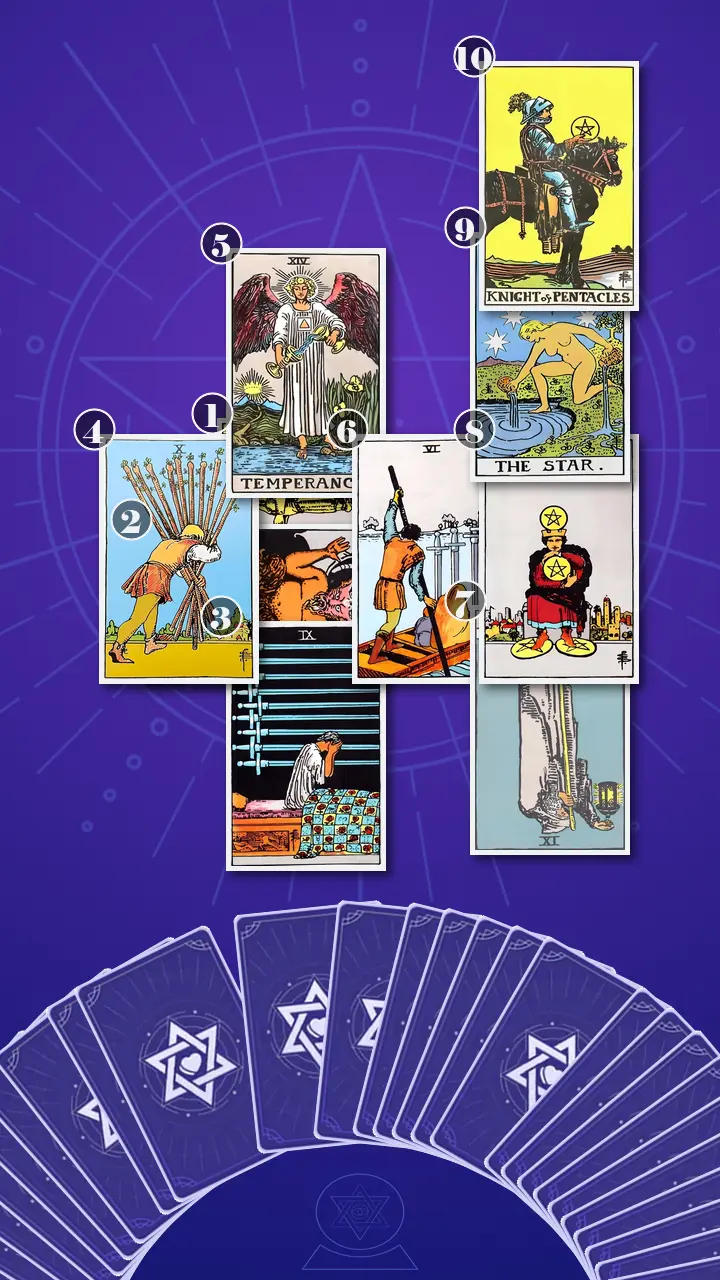
Reading the Map: Card Meanings in Context
Position 1 (Current symptom): Four of Swords, reversed
“Now we turn over the card that represents the current symptom: the Sunday-night doomscroll loop and blocked recovery,” I said.
Four of Swords, reversed.
In the Rider–Waite image, there’s a figure lying down like they’re meant to be resting—yet three swords hang above them, like thoughts that never really clock out.
In modern life, this card is painfully specific: It’s Sunday night and you’re physically in bed, but mentally you’re still at your desk. The room is quiet, the phone is bright, and you keep telling yourself you’re winding down while your nervous system keeps taking in input—emails, Stories, news—so sleep gets postponed and Monday starts before you’ve recovered.
I watched Alex’s face as the meaning landed. Their mouth twitched, and then—there it was: a quick, bitter little laugh.
“That’s… yeah,” they said. “It’s so accurate it’s kind of rude.”
I nodded. “Doomscrolling isn’t rest—it’s low-grade stimulation in a duvet.”
Reversed, Four of Swords isn’t saying you’re bad at resting. It’s saying your recovery is blocked. Your body is horizontal but your mind is still receiving. That’s not ‘relaxing.’ That’s like leaving your work laptop on your bed: technically you’re lying down, but your system never gets the memo that you’re off-duty.
“Before we call it a discipline issue,” I added, “I want you to notice something: the urge to keep checking isn’t random. It’s trying to do a job.”
Position 2 (What crosses it): The Devil, upright
“Now we turn over the card that represents what crosses it: the compulsive relief loop that keeps the mind tethered,” I said.
The Devil, upright.
Alex’s gaze dropped to the card and stayed there. Their fingers—without thinking—tapped once against the table, like a phantom notification.
In real life terms, The Devil shows up as this: You pick up your phone for comfort, not information—then you can’t put it down. It’s the loop where you check to feel in control, feel worse, and check again. Slack badge counts, infinite scroll, calendar anxiety—blending into the same “I have to” feeling.
I described it as a close-up, because that’s how compulsion lives: not as a big dramatic decision, but as a reflex.
“Thumb hovering over the same three apps,” I said. “You’re thinking, ‘I’m choosing this.’ And then—two minutes later—there’s this quieter thought underneath: ‘Why does it feel like I can’t stop?’”
That’s the Devil’s trick: it sells control as comfort. It promises, one more swipe will fix the feeling—like the For You Page is a therapist. But it tightens the night.
“The chain isn’t your phone,” I said, keeping my voice steady. “It’s the belief that checking equals control.”
As an artist, I think in scenes. And this card always makes me think of two classic film archetypes at once: the Wall Street energy—where vigilance feels like virtue—and the Godfather line that becomes a lifestyle: just when I thought I was out, they pull me back in.
Alex winced, then whispered, “Yep,” like they were grateful it wasn’t being framed as a personal flaw.
Position 3 (Deep root): Nine of Swords, upright
“Now we turn over the card that represents the deep root: anticipatory dread and the fear of falling behind,” I said.
Nine of Swords, upright.
This is the 2 a.m. card. The room is dark. The mind is loud. The body is exhausted and still somehow on high alert.
I didn’t talk about “anxiety” as an abstract concept. I talked about the body, because that’s where Alex was living it: lights off, blue-screen glow on their hands, jaw clenched without noticing, shoulders creeping up even under the duvet. A tight chest that doesn’t respond to “calm down.”
“This,” I said, tapping the edge of the card, “is the part where your brain turns Monday into a private horror trailer. It storyboards it. Edits it. Adds a soundtrack. And you watch it on repeat.”
Alex swallowed. Their eyes went unfocused for a second, like they were replaying their own footage.
“What’s the specific Monday disaster your mind keeps rehearsing?” I asked. “Missed message? A meeting where you look incompetent? A messy handover? Name the headline.”
They exhaled through their nose. “Missing something important,” they said. “Like… a Slack thread I should’ve seen. Then Monday is me trying to catch up, and everyone can tell.”
Nine of Swords is the engine beneath the scrolling. It says you’re not doomscrolling because you’re lazy. You’re doomscrolling because your brain thinks vigilance is the only way to stay competent enough to be safe.
And the cruel part? Scrolling doesn’t stop the dread. It just postpones it—while stealing the sleep that would actually make you more capable.
Position 4 (Recent buildup): Ten of Wands, upright
“Now we turn over the card that represents the recent buildup: overload and carrying too much for too long,” I said.
Ten of Wands, upright.
The image is someone hauling a bundle they can barely see over—moving forward, but at a cost.
In Alex’s life, it looked like: too many “quick” things that weren’t quick. Hybrid work where Slack, email, design feedback, and your actual creative brain live on the same screen. A week that expands to fill every gap because London makes everything—social life included—feel like it takes planning, travel time, money, energy, and a little bit of emotional bandwidth you’re not sure you have.
“Sunday becomes the first moment your body notices the load,” I said. “Not because Sunday is the problem—because Sunday is the first quiet stretch where the weight finally has room to be felt.”
Ten of Wands is excess energy: too much responsibility held too tightly. When you carry that all week, the mind starts looking for the cheapest escape hatch. Doomscrolling is cheap in the moment. Actual rest can feel expensive—like you have to earn it.
Alex’s shoulders dropped a millimeter, like hearing “this isn’t random” gave them a foothold.
When Temperance Poured Between Two Cups
Position 5 (Conscious aim): Temperance, upright
“Now we turn over the card that represents your conscious aim: balance, pacing, and a workable weekly rhythm,” I said, and I slowed down a little. “This is the bridge card in this reading.”
Temperance, upright.
The room felt quieter in that way it does when a truth shows up that isn’t dramatic—just clean. Outside, a bus hissed past on wet pavement. Inside, Alex finally stopped moving their hands.
Temperance is an angel pouring water between two cups. One foot on land, one in water. A path leading toward the horizon. It’s not a vibe of punishment. It’s a vibe of regulation.
Setup: It’s Sunday evening, the flat finally goes quiet, and you tell yourself you’re “just checking one thing”—Slack, the calendar, a quick scroll—and suddenly it’s late and your hands still feel restless around a warm phone. You’re stuck between wanting real rest and fearing that if you stop checking, you’ll fall behind and lose control.
I looked at Alex. “Your goal isn’t to become a different person by Monday,” I said. “It’s to build a repeatable handoff.”
You do not need a perfect reset to deserve rest; you need a steadier pour between work, sleep, and social life, like the angel moving water between two cups.
I let the sentence sit between us—like a film cut to silence after a loud scene.
Reinforcement: Alex’s reaction came in layers, not all at once.
First, a tiny freeze—like their breath caught. Their fingers hovered mid-air, as if they were about to reach for their phone out of habit and then remembered they didn’t have to.
Then their eyes softened and went a little glassy, not in a collapse way—more like recognition. The kind you feel when you’ve been white-knuckling something and someone finally says, “You can unclench.”
Finally, a long exhale. Their shoulders dropped. Their jaw loosened, visibly. And with that release came a flicker of vulnerability—almost dizzying, like when you step out of a too-loud club and the quiet street feels unreal for a second.
“But if I don’t do a full reset,” they said, voice thin, “doesn’t that mean I’m just… stuck like this?”
There was the resistance, honest and brave. I didn’t argue with it. I reframed it.
“No,” I said. “It means we stop treating your nervous system like it needs a courtroom verdict and start treating it like it needs a routine it can trust.”
This is where my own toolbox comes in—not as a gimmick, but as a way to make the next step feel seeable. I pulled a scrap of paper toward us.
“I use something I call the Mondrian Grid Method,” I told Alex. “It’s how I deconstruct big, blurry goals into clean blocks—like abstract art. Not to make life rigid. To make it legible.”
I drew two boxes side by side, then a small third beneath them. “Work. Rest. People,” I said. “Not as identities. As modes. Temperance isn’t asking you to erase Work Mode. It’s asking you to make the handoff visible.”
Then I offered the concrete practice—straight from Temperance’s pour:
The 10-minute ‘Two-Cup Handoff’ (do it tonight or next Sunday):
Set a timer for 10 minutes. On paper (or Notes), draw two columns: WORK and REST. Under WORK, write the one thing Future-You needs to start Monday (a single first task, not a full plan). Under REST, write the one cue that tells your body it’s safe to power down (shower, stretch, audiobook, tea, lights dim). Then put your phone on charge out of arm’s reach for the remaining minutes.
I watched Alex’s face for the “morality test” flinch. So I said it plainly:
“Boundary + lowering the bar,” I continued. “If putting the phone away spikes anxiety, you’re allowed to do a two-minute version and stop. This is an experiment, not a verdict.”
Then I asked the question that locks Temperance into lived memory: “Now, with this new lens—can you think of one moment last Sunday where this would’ve changed the night by even five percent?”
Alex blinked, then nodded slowly. “When I opened Gmail,” they said. “If I’d written the one Monday task… I might’ve stopped chasing the feeling.”
That was the shift: from a browser with 27 tabs open—one of them autoplaying alarm—to one intentional tab closure. From Sunday-night dread toward the first inch of steadier self-trust.
Changing Trains, Not Teleporting
Position 6 (First movement): Six of Swords, upright
“Now we turn over the card that represents the first movement: a calmer transition and less reactive Sunday night,” I said.
Six of Swords, upright.
This card doesn’t promise instant joy. It promises crossing.
In modern life terms: the change starts quietly—fewer tabs, earlier wind-down, a phone moved across the room. You’re not instantly healed or instantly happy—you’re just moving out of rough water. It’s the feeling of leaving the noisy room and choosing a calmer one, even if you arrive gradually.
I used a London metaphor because Alex’s nervous system lived on Transport for London logic: “This is changing trains,” I said. “Not teleporting to peace. You don’t need a personality transplant. You need a gentler transfer.”
They smiled—small, but real.
Position 7 (Inner stance): The Hermit, reversed
“Now we turn over the card that represents your inner stance: isolation without nourishment and screen-lit withdrawal,” I said.
The Hermit, reversed.
The Hermit upright is wise solitude. Reversed, it’s solitude that doesn’t feed you. The lantern becomes the screen: a narrow beam of light that can guide you—or trap you in a tunnel if it’s all you look at.
For Alex, it sounded like: “I’m recharging alone,” when what’s actually happening is, “I’m numbing out because reaching out feels like effort.”
“The trap here,” I said carefully, “is confusing being alone with being restored.”
Alex’s eyes dropped to their hands again. “Yeah,” they admitted. “Sometimes I cancel plans because I feel… not together enough. Then I scroll other people’s weekends and feel worse.”
The Hermit reversed isn’t a command to be more social. It’s an invitation to make solitude intentional—real reflection instead of passive input.
Position 8 (External field): Four of Pentacles, upright
“Now we turn over the card that represents the external field: guarded work-life culture and a tight schedule,” I said.
Four of Pentacles, upright.
This card is a tight grip. In an environment position, it often means: time, money, energy, availability—all held close. The city behind the figure is alive, but the posture is braced.
“This is what a tight work-life budget feels like,” I said, “when every hour has to be protected and nothing has room to breathe.”
For a lot of Londoners in their late twenties, this lands in a very real way: the rent voice, the TfL tap, the ‘I should save’ hum in the background. Even if you’re not actively thinking about money, your body acts like it can’t afford to be tired tomorrow.
So you clamp down. You keep Slack on. You keep checking. And doomscrolling becomes the lowest-effort release valve—because it asks nothing of you upfront.
Position 9 (Hopes and fears): The Star, upright
“Now we turn over the card that represents hopes and fears: genuine replenishment versus fear it will not last,” I said.
The Star, upright.
The Star is one of my favorite cards because it’s honest about healing. It’s soft, but it’s not naïve. It’s the wish for a version of life that feels lighter without needing to look polished all the time.
“You want real replenishment,” I said to Alex. “Not a productivity performance. But part of you is afraid it’s too fragile. Like if you relax, something will break.”
They nodded once, hard. “Yes,” they said, and their voice cracked on the last consonant.
“The Star asks you to let restoration be simple enough to repeat,” I said. “Not aesthetic. Not optimized. Repeatable.”
Position 10 (Integration): Knight of Pentacles, upright
“Now we turn over the card that represents integration: slow, steady habits that can actually survive a tired week,” I said.
Knight of Pentacles, upright.
This is the card that makes “boring” feel holy.
The Knight of Pentacles isn’t a dramatic reinvention. It’s steady, methodical, committed to what works in the real world. It’s the routine that survives tired Mondays. It’s the charging cable across the room. It’s the same small ritual, repeated, until your nervous system starts believing you.
Alex made a face—half relief, half skepticism. “So the answer is… being kind of boring,” they said.
“Yes,” I said, smiling. “But boring in the way that keeps you free.”
It was the opposite of all-or-nothing rules. Not “delete every app.” Not “be perfect.” Just: build a system that doesn’t collapse the moment you have a normal stressful week.
The Sunday Shutdown Lite: Actionable Advice That Doesn’t Require a New Personality
I leaned back and threaded the whole spread into one story, so Alex could feel the logic rather than just hear ten separate meanings.
“Here’s what I see,” I said. “You’re starting from blocked recovery (Four of Swords reversed), crossed by a real compulsion loop that promises relief (The Devil). Underneath, there’s anticipatory dread—your mind pre-living Monday like a disaster movie (Nine of Swords). That dread got louder because you’ve been carrying too much without enough buffer (Ten of Wands), inside an external culture that rewards guarding your time and staying available (Four of Pentacles).”
“And the path forward isn’t punishment,” I continued. “It’s Temperance: a deliberate handoff between modes. That creates a real crossing (Six of Swords), which helps solitude become nourishing again (Hermit reversed re-balanced), and it restores the Star-level wish—gentle replenishment—through Knight of Pentacles consistency.”
The cognitive blind spot was clear: Alex had been treating scrolling as a way to manage uncertainty. As if being plugged in was the only way to stay competent and safe for Monday. But the cards showed the opposite: the checking was stealing the very resource—sleep—that would make Monday easier.
“The key shift,” I said, “is to stop using scrolling to manage uncertainty and start using small, repeatable boundaries to end the day on purpose.”
Alex immediately raised a real-world objection—the kind I respect, because it means they’re thinking like a designer, not a dreamer.
“But I can’t even find five minutes,” they said. “Because if I put my phone away, I start thinking about everything I didn’t do. Then I panic, then I’m back on it.”
“Perfect,” I said. “That’s data. So we make the boundary time-based, not willpower-based. And we keep the first version embarrassingly small.”
Then I offered the plan in clean, low-friction steps—things you could actually try if you’ve ever searched how to stop doomscrolling on Sunday night without deleting everything:
- The Two-Cup Handoff (10 minutes)Next Sunday (or tonight), set a timer for 10 minutes. On paper, draw two columns: WORK and REST. Write one sentence under WORK: your single Monday “first task” (the first domino, not a full plan). Under REST, write one body cue you’ll do right after (shower, stretch, tea, dim lights, audiobook). Then put your phone on charge out of arm’s reach until the timer ends.If anxiety spikes, do the 2-minute version and stop. This is an experiment, not a morality test.
- The 20-minute Phone-Out-of-Reach WindowFor one week, create a 20-minute window before sleep where your phone is physically across the room (top shelf, hallway, anywhere “annoying”). Keep a paperback or notebook by your bed. The goal is not “no screens forever”—it’s one intentional end-of-day boundary.Expect the “I’ll miss something” voice. Don’t debate it—reduce the stakes and stick to the timer.
- A Slack Boundary You Can Actually Say Out LoudTurn off Slack/email notifications from Sunday 7 p.m. to Monday 8 a.m. for one week. If you feel guilty, use my Oscars Speech Training: write a two-sentence script you can tell yourself (or your team if needed): “I’m offline Sunday evening so I can start Monday focused. If it’s urgent, text.”Keep it under 20 seconds. If it takes a paragraph, it’s trying to negotiate with The Devil.
- The Tab-Close Ritual (60 seconds)Close your laptop completely (not sleep mode), put it away physically, and wipe your desk/coffee table for 60 seconds. You’re giving your brain a visual “end credits” cue that the work scene is over.Pair it with one low-stimulation bridge (lo-fi playlist, comfort rewatch like The Office or Fleabag, or an audiobook sample) so the quiet doesn’t feel like a cliff.
“Pick just one of these to pilot this week,” I told Alex. “Knight of Pentacles doesn’t want a grand plan. It wants a repeatable one.”

A Week Later: The Quiet Proof
Five days later, I got a message from Alex that was almost comically short:
“Did the Two-Cup thing. Wrote one Monday task. Phone across room. Slept. Woke up and didn’t immediately brace.”
They added, a beat later: “Still wanted to check. But it wasn’t… the whole night.”
That’s what progress looks like in real life: not a cinematic transformation montage, but a quieter nervous system. A week that begins with a clearer shutdown. A little more social energy because sleep wasn’t bartered away for the illusion of being caught up.
Alex told me they still had a flicker of doubt the next morning—What if I’m behind?—but this time they noticed it, smiled once, and got up to make tea before touching their phone.
That’s the Journey to Clarity I care about: not certainty. Ownership. A steadier pour.
And if you take nothing else from this reading, take this: when Sunday night goes quiet and your hand still keeps reaching for the glow, it’s not because you’re lazy—it’s because a part of you thinks being “plugged in” is the only way to stay competent and safe for Monday.
If you didn’t have to earn rest with a perfect reset, what’s one tiny boundary you’d be willing to try just to end Sunday on purpose?
This story is adapted from psychological research, written so that those in a similar struggle can see their own pattern in it — and find their next step clearly.These insights are not a substitute for professional psychological, medical, legal, or financial advice.
Learn more about our Journey to Clarity.
How did this insight land for you?
🫂 This Resonates Deeply
🌀 Living This Story
✨ Now I See Clearly
🌱 Seeing New Possibilities
🧰 Useful Framework
🔮 The Confirmation I Needed
💪 Feeling Empowered
🚀 Ready for My Next Step
Author Profile
 AI
AI“I’ve always felt our lives are films currently in production. As an artist, I know that when you feel stuck, it’s often because you’ve bravely stayed in a painful scene for just a little too long. I’m not here to coldly analyze you. I want to sit closely with you, look at those difficult moments with profound empathy, and gently hand you the pen so you have the courage to write your next beautiful act.”
In this Career Tarot Reading :
Core Expertise
- Workplace Typecasting Analysis: Identifying how your office ecosystem has boxed you into a marginalized or undervalued 'supporting role'.
- Leadership Narrative Construction: Rewriting the script of your professional identity to command authority and visibility.
Service Features
- The Protagonist Reframe Directive: A micro-behavioral script for your next cross-departmental meeting to instantly disrupt your established subordinate persona.
Also specializes in :
Explore Related Patterns:
Boundary DiffusionAlex's Sunday evening has no clean edge between work, sleep, and social life. The same screen holds Slack, Gmail, Instagram, news, design feedback, and attempted comfort, so the body is lying down while the mind keeps receiving signals from every mode at once. This is Boundary Diffusion: the line between on-duty and off-duty becomes porous enough that rest cannot fully start. The issue is not only the phone itself; it is the collapse of context. Work cues enter the sofa, the duvet, the social scroll, and the final minutes before sleep. The pattern matters because blurred boundaries make every part of life contaminate the next. Work steals sleep, sleep debt drains social energy, social withdrawal feeds comparison, and Sunday becomes the place where all three systems collide. A small physical boundary, like the phone across the room or the laptop closed, becomes psychologically powerful because it gives the nervous system a visible end point.
Compulsive CheckingAlex's thumb moving between Slack, Gmail, Instagram, and the warm phone in their hand is not just a screen habit; it is a regulation strategy that has become automatic. The checking gives a brief hit of perceived control, especially around the fear of missing a Slack thread, but the relief is short-lived enough that the hand reaches again. The mechanism underneath is a compulsive checking loop: uncertainty creates bodily dread, checking promises reassurance, the new input creates more activation, and the nervous system asks for another check. You are not looking for information anymore; you are trying to lower the threat level of Monday by staying plugged in. That is why the story keeps returning to the same contradiction: wanting to put the phone down to feel better, yet checking to feel in control. Once the loop is named as a coping mechanism rather than a character flaw, the target becomes clearer: not perfect discipline, but a boundary strong enough to interrupt the reassurance cycle before it consumes the whole night.
Control CopingAlex keeps the laptop open and the phone close even while saying they want real rest. The behavior has a clear function: if work remains visible, Monday feels less unknown; if the apps stay within reach, the body can pretend uncertainty is being managed. That is Control Coping. The strategy is not irrational at the surface level, because checking can create a momentary sense of order. The problem is that the nervous system starts relying on monitoring as its main way to feel safe, so the same action that promises control keeps rest from becoming believable. The story shows why the answer is not to shame the impulse. The checking is trying to do a job. But when control becomes the only route to calm, every quiet moment becomes a threat to be managed instead of a space to recover.
Productivity as SafetyAlex's Sunday night is built around the belief that staying plugged in will make Monday safer. Slack, Gmail, the calendar, and the half-open laptop become proof that they are still responsible, still prepared, still doing enough to avoid being exposed as behind. The coping mechanism is Productivity as Safety: competence gets fused with constant readiness. Rest stops feeling like recovery and starts feeling like a risk, because a quiet Sunday evening leaves room for the thought that something important might be missed. This pattern explains why a perfect reset would not solve the problem on its own. You are not just managing tasks; you are managing the fear that being offline means being unprotected. The useful shift is to make readiness small, visible, and finite, so your nervous system can learn that safety does not require constant availability.
CatastrophizingAlex's mind turns one possible missed Slack thread into a full Monday disaster: catching up, looking incompetent, and everyone being able to tell. The story shows the brain editing a small uncertainty into a private horror trailer, then replaying it until the body reacts as if the danger is already happening. That is Catastrophizing in action. The cognitive distortion is not simply that Monday feels stressful; it is that the mind jumps from an ambiguous work cue to the worst plausible outcome, then treats that imagined outcome as something that must be prevented tonight. The more vivid the imagined disaster becomes, the more checking feels rational. But the same loop steals sleep, which removes the very resource that would make Monday more manageable. Naming this pattern helps separate preparation from threat rehearsal: one helps you act, the other keeps your nervous system trapped in preview mode.
Social ComparisonAlex cancels plans when they feel not together enough, then scrolls other people's weekends and feels worse. The social world does not disappear during withdrawal; it returns through Instagram as curated evidence that everyone else is living more fully. That is Social Comparison as a cognitive trap. The mind is already depleted, so it does not process the feed as neutral information. It uses other people's visible weekends as a measuring stick against Alex's private exhaustion, which turns alone time into self-evaluation instead of recovery. The pattern helps explain what is off in the social part of the story. Alex is not simply choosing solitude; they are replacing nourishing contact with passive comparison after cancelling the kind of connection that might have replenished them. The repair is not forced socializing, but making solitude intentional enough that it stops becoming a comparison chamber.
Explore Related Struggles:
Monitoring-Safety FusionAlex keeps the laptop open just to check Monday while their thumb moves between Slack, Gmail, and Instagram, even though they already know the glow is making the night worse. The phone is not only a device in this scene; it becomes a safety handle, something their body reaches for when Monday starts to feel too close. You can feel the structural bind in the sentence about checking now so tomorrow will not hit harder. Monitoring promises protection, but it also keeps the threat alive by feeding more input into a system that needs shutdown. The struggle is not a lack of discipline; it is the way competence, safety, and constant checking have been fused into one reflex. That fusion explains why sleep, work, and social life all get pulled into the same loop. If being plugged in feels like the only way to stay capable, rest starts to feel risky, unread messages feel like exposure, and Sunday night becomes a rehearsal for falling behind before the week has even begun.
False Recovery LoopAlex is half on the sofa with the laptop open, heavy-eyed but still receiving Slack badges, emails, Stories, and the warm pressure of the phone in their hand. The body is in a rest posture, but the room is still wired like a workstation, and the night never gets a clean ending. You are looking at a recovery system that has been replaced by low-grade stimulation. The scrolling feels softer than work and easier than making a plan, but it keeps the same input channel open, so the body never gets the message that it is safe to power down. The loop becomes false recovery because it imitates rest without delivering restoration. Sunday looks quiet from the outside, yet inside the pattern is still active: check, brace, numb out, lose sleep, drag into Monday, then return to the same ritual when the next quiet evening arrives.
Energy Distribution StrainAlex wants a balanced week, sleep that actually lands, and social plans that do not collapse at the last minute, but the same Sunday attention keeps getting spent on work signals and feed signals. Slack, Gmail, Instagram, calendar dread, and the need to be ready all draw from one limited pool. You can see the strain in how work, rest, and people stop functioning as separate modes. Work bleeds into the sofa, the phone bleeds into bedtime, and social life becomes something to cancel because the week has already claimed the available energy before Monday arrives. The core issue is not that one life area is broken in isolation. The allocation system is off. Attention gets routed toward vigilance first, recovery second, and connection last, so the week begins with sleep and social capacity already underfunded.
Boundary Control StrainAlex puts the phone face-down like it is too hot to hold, but the laptop still stays open for one more look at Monday. The boundary is visible in the room, yet control keeps pulling a thread through it. You are not watching a simple failure to set limits. Each limit creates a small exposure point: what if a Slack thread appears, what if something urgent is missed, what if Monday begins with proof that they were not prepared enough. The boundary is supposed to protect rest, but it also threatens the very control signal Alex has been using to feel steady. Boundary Control Strain names that friction. A workable limit has to be small and time-based because the deeper struggle is the pressure between wanting an off-duty edge and needing the reassurance that comes from staying reachable.
Visibility-Isolation SplitAlex cancels plans because they do not feel together enough, then stays close to other people's weekends through Instagram. Connection remains visible, but participation moves farther away. You can feel the split between being exposed to social life and having enough restored energy to enter it. The feed keeps the social world open as an image stream, while the body stays on the outside of actual plans, comparing from a dim flat instead of recovering or reaching out. This is not a command to become more social. The struggle is the way screen-lit visibility can make isolation feel socially active while still leaving the need for real contact unmet. Until Sunday rest becomes more nourishing, social life keeps turning into something watched from a distance.
Rest-Permission SplitAlex does not simply want to rest; they seem to need proof that they are ready enough to rest. The story catches this when actual recovery starts to feel expensive, as if a perfect reset has to be completed before the body is allowed to stand down. You can hear the split in the question about whether failing to do a full reset means being stuck like this. Rest becomes conditional, almost like a reward for having already solved Monday, rather than a resource that makes Monday more survivable. This is why a tiny handoff matters more than a dramatic Sunday overhaul. The struggle is the gap between needing recovery and feeling permitted to take it before everything is controlled, cleared, and morally earned.
Explore Related Emotions:
Cautious Self-TrustAlex writes one Monday task, moves the phone across the room, sleeps, and wakes without immediately bracing. The change is small enough to be believable, which is exactly why it matters. Cautious Self-Trust fits because the story does not end with instant certainty or a flawless routine. You still feel the pull to check, but the pull is no longer the whole night. A limited boundary becomes evidence that you can interrupt the loop without needing to become a different person by Monday. The emotional movement here is quiet and embodied. Trust returns through one repeatable action, one slightly clearer morning, one moment of making tea before touching the phone. It is confidence with training wheels, grounded in proof rather than hype.
Chronic OverwhelmAlex’s week is made of too many supposedly quick things that are not quick: Slack, email, design feedback, creative attention, commuting logic, social planning, money pressure, and the basic work of staying available. By Sunday, none of it has disappeared; it has only been carried into the quiet. Chronic Overwhelm fits because the pressure is not contained inside one app or one night. It spreads across work, sleep, money, social energy, and the body’s ability to recover. You are not reacting to a single notification; you are carrying a weekly load that has learned how to occupy every empty space. This is why doomscrolling becomes tempting. When actual rest feels expensive and the week feels overfilled, passive scrolling offers a cheap release valve. The emotional cost is that the load never gets fully set down, so Sunday becomes the place where everything finally asks to be felt.
Doomscrolling AnxietyAlex keeps moving between Slack, Gmail, and Instagram while sitting in a dim flat with a warm phone in hand and a laptop still open. The body is asking for an ending, but the screen keeps supplying tiny reasons to stay alert, so the evening becomes a loop of checking, scrolling, bracing, and checking again. Doomscrolling Anxiety fits because the phone is not functioning as entertainment in this story. It is being used as a control panel for uncertainty, with work alerts and social feeds blending into the same glow. You are trying to reduce the pressure by taking in more information, but the extra input keeps the pressure alive. The emotional texture is a wired kind of tiredness: heavy eyes, restless hands, a tight chest, and the feeling that one more swipe might make tomorrow safer. The story shows how the loop offers momentary control while quietly stealing the recovery that would make Monday feel more manageable.
Grounded AgencyAlex does not solve the whole week; they create one manageable handoff. The phone moves across the room, the laptop closes, and the next morning they notice the behind-at-work thought before choosing tea over immediate checking. Grounded Agency fits because the power in this story returns through concrete, modest choices. You are not asked to delete every app or become perfectly disciplined. You are given a structure small enough to survive a tired week, which makes action feel possible rather than performative. The emotional shift is from being pulled by the glow to having one hand on the steering wheel again. Agency here is not loud or grand; it is the steady feeling that you can make the next boundary real, even while uncertainty still exists.
Hypervigilant AnxietyAlex names the fear with precision: missing something important, like a Slack thread they should have seen, and then spending Monday trying to catch up while everyone can tell. That single imagined miss turns the whole evening into a watchtower. Hypervigilant Anxiety fits because the checking is powered by a felt need to keep scanning. You are not calmly planning Monday; you are trying to prevent an invisible slip from becoming visible. The body joins the surveillance, with restless hands, a tight chest, and heavy eyes that still cannot fully power down. The work boundary dissolves because competence starts to feel dependent on constant availability. In that state, rest can seem risky, as if going offline means losing the only shield between you and embarrassment tomorrow. The story shows a nervous system trying to earn safety through vigilance, even when vigilance is costing it sleep.
Rest GuiltAlex wants real rest, but stopping does not feel simple because the mind immediately asks what might be missed. The phone goes face-down like a hot pan, yet the belief underneath is still active: if they do not check now, tomorrow will hit harder. Rest Guilt fits because rest has become tied to proof of readiness. You can want sleep and still feel as though you have to earn the right to receive it. In Alex’s story, a perfect weekly reset becomes the imagined entry fee, and anything less can feel like negligence. The emotional pressure is subtle but heavy. Going offline is not just a practical boundary; it stirs the feeling of being irresponsible, behind, or not prepared enough. Naming Rest Guilt helps separate the body’s need for recovery from the false requirement that every loose end must be handled before rest is allowed.
Sunday ScariesSunday night feels louder than it should for Alex: the radiator clicks, the flat is dim, the laptop is open, and Monday has already started to press into the room. They are technically still inside the weekend, but their body is already rehearsing the impact of the next workday. Sunday Scaries is the most direct name for that in-between weather. You are not only worried about a task; you are feeling the whole week lean forward before you have had a chance to land. The quiet of Sunday does not soothe the system, because quiet gives the carried load enough space to become noticeable. The feeling is anticipatory and physical rather than abstract. Sleep is nearby but does not arrive cleanly, because the mind keeps treating tomorrow as something that must be softened in advance. The more Alex tries to prepare through checking, the more Sunday becomes charged with Monday’s emotional noise.
Clarity ReliefAlex’s shoulders drop when the pattern is named as something readable rather than random. The loop becomes visible: stimulus, dread, checking, blocked recovery, sleep loss, Monday drag, and repeat. Clarity Relief fits because the relief is not coming from denial or forced positivity. It comes from seeing the mechanism clearly enough to stop turning it into a morality story. You can feel the pressure lift when the question changes from what is wrong with me to what is this loop trying to manage. That kind of relief is practical and emotional at the same time. It gives Alex enough distance from the spiral to notice choice points: one first task, one phone boundary, one end-of-day cue. The story shows clarity arriving as a calmer way to hold the same facts.
Social BurnoutAlex names a specific social consequence: plans get cancelled at the last minute because they are depleted before Monday even arrives. The issue is not a lack of desire for people; it is that the week has already spent the energy those plans would need. Social Burnout fits because the social world is present as both a longing and a pressure point. You may want connection, but when sleep has been traded for checking and the weekend has been filtered through other people’s posts, reaching out starts to feel like another demand. The story shows how recovery and social life are linked. When Sunday night becomes a drain, Monday absorbs the impact, and the rest of the week has less room for spontaneity, warmth, or follow-through. The emotional weather is a tired wish to be part of life while not having enough charge left to enter it.
Explore Related Contexts:
Always On AvailabilityAlex keeps Slack and Gmail within reach on Sunday because missing one thread feels like it could make Monday visibly harder. The workday is not officially happening, but the expectation of readiness is already active in the flat. Always On Availability names that pressure precisely: You are being trained to act reachable even during hours that should belong to recovery. Hybrid work makes the boundary harder to see because the same screen holds design feedback, email, calendar pressure, and personal scrolling. The external issue is an availability culture, not a lack of personal discipline. Once the rule becomes visible, You can replace vague vigilance with a smaller protocol: one Monday task, one urgent-contact channel, and a Sunday window that is allowed to close.
Doomscrolling LoopAlex's thumb keeps moving between Slack, Gmail, and Instagram while the laptop stays open on the sofa, even though the stated goal is real rest. The phone is not being used for one clean task; it is carrying work alerts, social comparison, and low-grade stimulation in the same glowing surface. That is why Doomscrolling Loop is the sharper label than generic screen time. The external environment is built to keep feeding You new signals, and each signal briefly promises control while pushing sleep further away. The story shows the loop as situational and physical: red badges, warm phone, heavy eyes, restless hands, and a Monday fear that keeps refreshing itself. You regain agency here by treating the loop as a designed attention trap, then putting friction back into the room.
Sleep Debt LoopAlex's eyes are heavy, but the heaviness does not become sleep because the phone keeps delivering input. The story repeats the same exchange: check to feel prepared, lose the wind-down, start Monday with less of the resource that would actually make work easier. Sleep Debt Loop is the right context because the lost sleep is not incidental. It is produced by a Sunday system where work uncertainty and digital stimulation borrow from tomorrow's capacity. You are not being asked to optimize sleep as a lifestyle performance. The useful insight is structural: every extra check has a cost, and a small shutdown ritual protects the next day's attention before the debt compounds.
Sunday Scaries LoopThe Sunday night timestamp is doing structural work: 8:53 p.m., radiator clicking, flat dim, laptop open just to check Monday while the phone stays warm in hand. You are seeing the weekend's final quiet hours converted into a rehearsal space for Monday. The loop holds because work uncertainty, sleep pressure, and social depletion are stacked into the same hour. Slack threads, calendar dread, red badges, and the fear of missing something important make the night feel like a test of competence before the week has even started. Sunday Scaries Loop fits because the real conflict is not one app or one night of scrolling. It is a recurring transition failure where rest is available in theory, but the external structure of work readiness keeps pulling You back into pre-work mode.
Work Life Boundary CreepThe laptop balanced on Alex's knees and the phone glowing in hand turn the sofa into a second desk. Nothing dramatic has to happen for work to enter the evening; Slack, Gmail, and calendar checking drift in through tiny exceptions that look reasonable at the time. Work Life Boundary Creep fits because the boundary is not broken by one big demand. It erodes through small permissions: just check Monday, just scan the thread, just keep the laptop nearby, just scroll while half-resting. That creep is why sleep and social life both pay the cost. When the work scene never gets a clear end cue, You arrive at Monday less restored and start cancelling human plans before the week even begins.
Friendship Time ScarcityAlex names social plans that get cancelled at the last minute because depletion arrives before Monday does. The story also places that cancellation inside London logistics: travel time, money, planning, and emotional bandwidth all have to be budgeted before seeing people is even possible. Friendship Time Scarcity fits because the social problem is not a lack of caring. Work spillover and sleep loss are consuming the same limited energy that friendships require to stay alive in a busy city. When the week-later message mentions a little more social energy, it shows the hinge clearly. Protecting rest is not separate from social life; it is the infrastructure that lets You stop treating connection as an optional extra after work has taken the first claim.