Forced Positivity and an Unopened Draft Before the First Honest Test

The 11:47 p.m. Bright-Side Loop
If you are a Toronto-based digital marketing coordinator who answers a 6:00 p.m. Slack message with “all good” while reopening the same workload complaint, I may have just described the first scene I shared with Maya.
At 11:47 p.m. in the kitchen of her shared Toronto apartment, I watched Maya type three wins into Apple Notes and post a smiling photo. The phone warmed her palm; the refrigerator hummed beneath the blue screen light; and a draft titled ‘What Needs to Change’ remained unopened for the fourth night. Her throat tightened while her jaw held the smile in place.
When she finally looked up, she asked me, “Why do I keep forcing positivity when something needs to change? I can always find a bright side, but I keep waking up to the same problem. Maybe I just need a better attitude.” She could list the flexible work arrangement, the stable income, the kind coworkers, and the parts of her role she genuinely enjoyed. That was exactly what made the recurring workload and boundary problem so difficult to challenge: gratitude was real, but the condition remained unchanged.
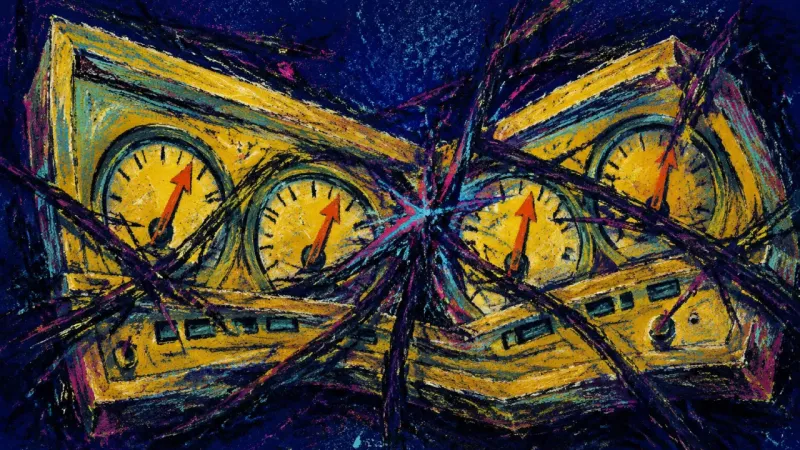
The apprehension I could see was not a vague cloud. It moved through her like a painted-over dashboard warning light, bright on the surface while a red signal kept pulsing underneath: tight throat, clenched jaw, shallow breath, and the effort of holding still when her body wanted to pause.
I did not ask her to become less hopeful or to make a dramatic career decision. I told her, “We can let the good parts stay good without using them to erase the part that hurts. Today, we’ll draw a map through the fog.” I have always felt that our lives are films still in production, and my work is not to rewrite someone’s scene for them. It is to sit close enough to the difficult frame that I can gently hand the pen back.
Choosing the Four-Layer Insight Ladder
I asked Maya to place both feet on the floor and notice the first body signal that appeared when she thought about the same concern returning. Then I shuffled slowly, not as a performance of mystery, but as a way to let the conversation cross from reaction into attention.
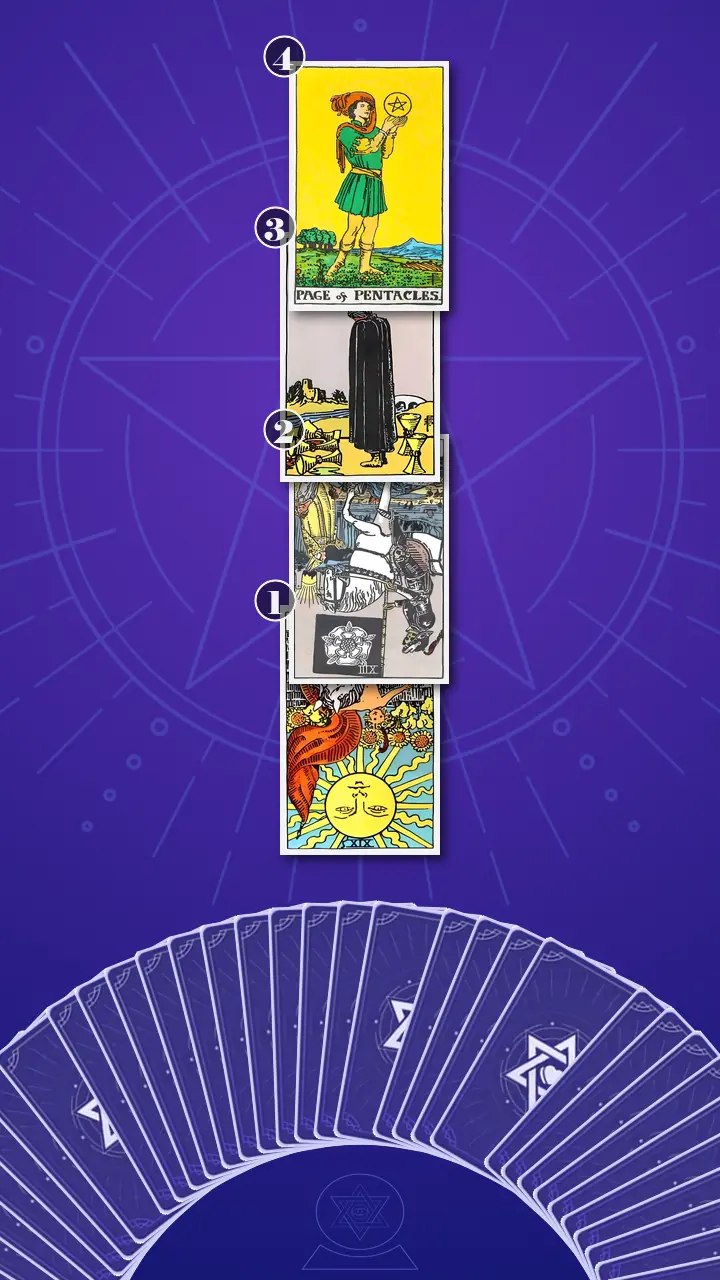
For anyone wondering how tarot works in this kind of reading, I chose a classic spread called the Four-Layer Insight Ladder. This was an inner-excavation question: not a request for a prediction, but an attempt to uncover the defence mechanism, limiting belief, and fear beneath a polished emotional presentation.
The four-card structure gave us the shortest complete chain for this problem. A larger spread such as the Celtic Cross could introduce timelines, outside influences, and outcome positions that were not necessary for Maya’s focused why-question. The Four-Layer Insight Ladder kept the reading centred on self-awareness, agency, and card meanings in context rather than forecasting what she must do.
I explained the ladder to her and to the reader following along: the first position would show the visible behaviour of performing optimism; the second would reveal the fear of uncertainty beneath it; the third would offer the transformational insight that lets disappointment become usable information; and the fourth would turn that insight into one small, reviewable experiment. We would read upward from a brightly painted stage façade toward a real, workable garden.
Reading the Brightness Without Looking Away
Position 1: The Sun Reversed and the Smile She Kept Lit
Now I turned to Position 1, the position depicting the diagnosis-level behaviour of immediately performing optimism, reassuring other people, and covering the recurring signal that something is not working. I turned over The Sun, in reversed position.
In the Rider–Waite–Smith image, the exposed child, white horse, open red banner, and four sunflowers suggest uncomplicated vitality and visible joy. Reversed here, that light became overmanaged. Maya was not pretending that every good thing was false; she was making every good thing carry the burden of proving that the difficult thing did not count.
I connected the card to the scene she had brought me: an upbeat Instagram photo after a draining day, a cheerful “No worries!” sent to a stressful Slack request, and a gratitude list written before she recorded what had actually happened. She was treating each uncomfortable Slack notification like a branding problem, changing the tone of the message instead of checking what the message was pointing toward.
The energy was an excess of bright public Fire and a blockage of genuine clarity. Positivity had become image maintenance rather than open vitality. I asked her, “Before you write the reframe, what fact would still be true if you did not have to sound hopeful?”
An old memory from my editing days flickered through me. I remembered brightening a frame until an actor’s warning expression nearly disappeared; the scene looked polished, but the story had lost information. I recognised the same problem in Maya’s notes. A brighter story cannot update an unchanged condition.
Maya did not nod. She gave a short, bitter laugh and rubbed the edge of her phone. “That’s almost rude,” she said. “I really do turn every problem into a gratitude exercise.”
I told her that I did not hear ingratitude or failure in that habit. I heard a quick attempt to restore control and keep other people comfortable. The possibility of change was not being refused because she was lazy; it was being postponed because admitting the signal might require a conversation before she knew how the conversation would end.
Position 2: Death Reversed at the Threshold
Now I turned to Position 2, the position revealing the psychological root beneath the positive performance: resistance to uncertainty and fear of losing control once change begins. The card was Death, in reversed position.
In tarot, Death represents endings, transition, release, and necessary transformation; it does not predict a literal death. Reversed, its energy is blocked at the threshold. The skeletal rider keeps moving, the white rose remains visible against the black banner, and the sun is already rising between the distant towers, but Maya was waiting for a guarantee before crossing toward it.
I brought the image into her ordinary week. At 6:40 p.m. on a Wednesday, she had sat at the kitchen table with half-finished dinner, the radiator clicking beside her, and a calendar adjustment drafted to protect two evenings from work. She reopened the same pros-and-cons note, added one more reason to wait, and cancelled the conversation she had planned with her manager. In her words, a calendar event called ‘Change’ was sitting in draft mode because she wanted to know every consequence before clicking send.
The energy here was blockage, not a lack of intelligence. Her internal script was, “I’ll act when I know the outcome.” That sentence offered short-term control while keeping the condition exactly where it was. I watched her shoulders lift toward her ears, then slowly lower as she recognised the difference between postponement and preparation.
This was where I used my signature Hero’s Journey Alignment. I told Maya that she looked less like someone failing to move and more like someone standing in the classic Refusal of the Call before a major character evolution. That archetype was not a moral verdict. It showed the precise scene: the call toward an honest adjustment had arrived, and she was trying to negotiate with uncertainty until the call became safe enough to accept.
“That is why I keep waiting,” Maya said. Her fingers had been pressing into her sleeve; now they loosened. I answered, “You do not need to know whether the next chapter is perfect. You only need to stop asking positivity to serve as proof that the current chapter is sustainable.”
When the Five of Cups Made Room for Truth
Position 3: The Honest Turn Toward What Still Stands
Now I turned to Position 3, the position introducing the emotional and cognitive shift that interrupts the defence cycle by allowing disappointment to become specific, non-catastrophic information. The card was Five of Cups, in upright position.
The room seemed to quiet around us. Even the radiator’s click fell into the background as I looked at the three overturned cups, the two standing behind the cloaked figure, the bridge, and the distant home. The card did not ask Maya to deny the spill or stare at it forever. It asked her to turn her body far enough to see the whole scene.
I returned to the Friday night bar near Ossington Avenue, where a friend had asked how the week really went. Maya had lifted her glass as ice knocked against it and said, “It could be worse,” while traffic hissed through the open door. The three spilled cups became three specific disappointments: four evenings interrupted by work, the postponed manager conversation, and the exhausting pressure to present herself as fine. The two standing cups were the flexible income and meaningful parts of her role that she still wanted to protect, along with friendships that offered genuine care.
Upright, the Five of Cups brought Water back into the reading. Its energy was honest movement and emotional balance: not drowning in disappointment, and not sealing it behind a bright script. I asked Maya to write the sentence, “This part disappointed me, and this part still matters.” The goal was not to make the positive side longer or more impressive. It was to stop using gratitude as a cancellation notice for an unmet need.
Through my Hero’s Journey Alignment, this was the moment the heroine stopped refusing the truth of one scene. The call was not to burn down her job, abandon the city, or reject every good thing. It was to let the honest scene exist long enough to reveal what needed changing and what deserved protection.
The Sentence the Cups Were Waiting For
At that point, I saw the old argument: if Maya admitted disappointment, she would owe everyone a dramatic decision; if she stayed grateful, nothing had to move. She had mistaken emotional honesty for an irreversible verdict, and the pressure to choose perfectly kept her staring at the spilled cups.
Acknowledging disappointment is not negativity; it is the information needed to choose what should change and what remains worth protecting.
You do not need to pretend the spilled cups are full; name the disappointment, then turn toward the two still standing to decide what remains worth carrying forward.
For one second, Maya’s face went blank and her pupils widened; her fingers froze above the phone while her inhale stopped halfway. Then her eyes lost focus as if they were replaying the four evenings of interrupted work, the postponed manager conversation, and the familiar line, “It’s fine.” When her gaze returned, the tight muscle at her jaw released. Her hand uncurled from her sleeve. A small laugh caught low in her chest, followed by a long exhale that trembled at the edges. She looked at the card and asked, “So I can say I’m disappointed without deciding I have to quit tomorrow?” Her voice was quiet, not triumphant. Relief lowered her shoulders, but a brief, dizzying blankness followed: the vulnerable space left when the bright script was gone. I let the silence remain kind. Even the radiator’s click sounded like a metronome for a new pace. This was the first inch from forced positivity and certainty-seeking self-silencing toward honest emotional data and grounded self-trust.
I asked, “Now, use this new perspective to remember last week. Was there a moment when naming the disappointment, before the gratitude list or the bright reply, might have let you feel different?”
Maya opened Apple Notes and wrote one concrete fact before adding any positive language: “I have had four evenings interrupted by work this week.” Her breath went quieter. Under it, she wrote, “I can name this without deciding my whole future tonight.” Then she made two columns: ‘What is disappointing’ and ‘What remains worth protecting.’ The three spilled cups had become information; the two standing cups had become resources, not excuses.
The Pentacle Held at Eye Level
Position 4: The Page of Pentacles and the Small Test
Now I turned to Position 4, the position grounding the key shift in one reversible, observable experiment so Maya could gather evidence instead of waiting for perfect certainty or returning to affirmations. The card was Page of Pentacles, in upright position.
The Page studies one pentacle at eye level while standing in a cultivated field, with furrows underfoot and a blue mountain in the distance. The card’s balanced Earth energy did not demand that Maya solve the mountain. It asked her to hold one condition in attention, repeat a small practice, and learn from what happened.
I connected that image to her real options. She did not need to decide whether to quit, redesign her life, or accept every expectation. She could choose one variable, such as after-hours Slack notifications, set a boundary for fourteen days, record sleep quality or Sunday-evening dread, and review the evidence on a date she chose in advance. The Page replaced certainty-seeking with grounded curiosity.
I watched Maya move her phone away from the spread and toward the blank note. The gesture was small, almost ordinary. That was the point: the cards were not choosing her future. They were helping her create a fair test through which she could hear her own judgment more clearly.
From a Bright Story to a Workable Test
When I laid the four cards together, their story became clear. The Sun reversed showed Maya painting over the dashboard warning light with gratitude, polished replies, and motivational content. Death reversed showed why: the possibility of change felt like a threshold whose consequences had to be controlled before she could step through it. The Five of Cups restored the feeling she had been editing out, separating a specific disappointment from total failure. The Page of Pentacles then gave that feeling somewhere practical to go: one boundary, one variable, one review date.
Maya’s cognitive blind spot was not a lack of gratitude. It was the hidden equation that discomfort meant she was handling life badly, and that admitting one condition was unsustainable meant declaring her whole life wrong. The transformation direction was more precise: move from immediately reframing discomfort as gratitude to naming the unmet need, protecting what remained valuable, and testing one small change before seeking a positive interpretation.
I used my Vision Actualization lens to rewrite the limiting narrative that insisted she was not ready for the next stage of her life’s plotline. The old version said, “I must find the perfect perspective before I am allowed to act.” The more useful version said, “I can act as a learner while gratitude and disappointment coexist.” That was not an inspirational slogan. It was a sentence she could test against a real calendar.
I offered Maya these actionable next steps. They were not commands, predictions, or a demand for an all-or-nothing decision. They were small ways to let lived evidence become part of her self-trust.
- The Fact-Feeling-Need PassOn the next weekday evening when the familiar frustration appears, open Apple Notes and write three separate lines, each under fifteen words: one observable fact, one honest feeling, and one unmet need. Do this before writing a gratitude list. If another person needs to be involved, send a trusted friend or manager: “I’ve noticed something keeps bothering me. I’m not asking you to fix it; can I talk it through for ten minutes?”Set a ten-minute timer and write facts before interpretations. You do not have to send the note, explain the feeling, or make a decision when the timer ends. If your jaw tightens or the exercise feels too exposed, close the note and return later.
- The Two-Week Single-Variable TrialBy Thursday, choose one recurring condition rather than redesigning your whole life: for example, after-hours work messages. Set one boundary, such as no work notifications after 7:00 p.m. on two chosen nights, place it in Google Calendar or Slack settings, and review the result on the second Sunday. Record one observable measure after each trial day, such as sleep quality, interruptions, or dread before work.If fourteen days feels too consequential, begin with forty-eight hours and decide later whether to extend it. A trial is not a permanent promise; you can stop, revise, or ask for support at any point.
- The Character Bible DirectiveSpend ten minutes writing the exact psychological and behavioural specifications of the future self you want to embody today. Begin with two columns, ‘What is disappointing’ and ‘What remains worth protecting,’ then add three first-person lines: “When I notice a recurring signal, I name it before reframing it.” “I protect the parts that still matter.” “I do not need a final answer to run a small, honest test.” Choose one protective action, such as keeping one evening free or asking a trusted friend to listen before offering advice.The positive column does not need to balance the disappointment numerically. The smallest version is one item in each column and one decision about what you want to protect. You are writing a usable character guide, not auditioning for perfection.
I reminded Maya that these next steps did not ask her to abandon stability or prove that her concern was severe enough. They gave her a way to gather information while respecting rent, work realities, relationships, and her own pace. I had interpreted the cards, but Maya remained the author of the next act.

The First Quiet Proof
Five days later, I received a message from Maya: “I paused Slack after 7 p.m. on Tuesday and Thursday. I wrote the fact-feeling-need note, then asked my manager for ten minutes.” She had not quit, fixed the team, or transformed into someone who never doubted herself. She had created new evidence.
On the second Sunday, she told me that the dread had not vanished, but it no longer filled the entire room. She wanted to protect the flexibility and the meaningful campaign work, and she also needed clearer priorities and a boundary around late requests. The disappointment had become specific enough to guide a conversation.
The plan was clear but fragile: she slept through one full night, then woke with the first thought, “What if I’m being difficult?” This time she smiled, opened the note, and let the question sit beside the evidence.
That was Maya’s first small proof of the emotional transformation: from forced positivity and certainty-seeking self-silencing toward honest emotional data, cautious experimentation, and grounded self-trust. The Four-Layer Insight Ladder had not handed her an answer. It had helped her notice that she could hold gratitude and disappointment together without abandoning either herself or the parts of life she valued.
We all know the moment when the same problem returns, our throat tightens behind a practiced smile, and staying positive starts to feel less like hope than an attempt to keep control while admitting that something needs to change. In this reading, finding clarity was not a final answer handed down by the cards; it was the fog thinning enough for Maya to see the three spilled cups, the two still standing, and one workable path between them.
If you let one disappointment be true without turning your whole life into a failure, what small change would you be curious to observe—and what would you want to keep protected?