Rightmove Tabs and a Tight Chest Lead to a 48-Hour Readiness Pause

The 10:42 p.m. Rightmove Spiral
“You can manage five client deadlines without blinking, but a Sunday-night engagement carousel sends you from Instagram to Rightmove because comparison fatigue makes your own relationship feel behind,” I told Maya (name changed for privacy) during the opening minute of our video session.
It was 10:42 p.m. in her rented London flat. I watched her close an Instagram carousel, then two property tabs: Rightmove and Zoopla, four one-bed flats already saved. Rain ticked against the dark window, the radiator hissed behind her, and the phone looked almost glued to her palm by the heat of repeated scrolling. Her free hand kept pressing lightly against the centre of her chest.
Her partner had sent, “Long day, can we talk tomorrow?” Maya had responded by drafting, “Should we choose a moving month?” She wanted a shared future, but the moment that future became a deposit, a commute, and two names on one lease, her breathing turned shallow. So she reached for logistics, because a moving date was easier to manage than not knowing.
“I know I am not ready,” she said, looking past the camera. “But slowing down feels like going backwards. If we were really solid, why would the next step feel this difficult?”
The relational uncertainty was not floating around her as an abstract worry. I could see it working like a drawstring around her ribs: every unanswered minute pulled it tighter until her restless hands tried to loosen it by making another plan. This was milestone-driven relationship anxiety in its most recognisable form, wanting to secure visible progress while privately resisting the commitment being accelerated.
“Wanting commitment is not the problem,” I said. “And hesitation is not a character flaw. You are not planning because you feel certain; you are planning because uncertainty feels unbearable. I am not here to predict what your partner will do or decide whether you should move in. Let us use the cards to map the loop, separate the signals inside it, and find the point where your choice comes back online.”

Choosing the Switchback Map
I asked Maya to put her phone face down, take one unforced breath, and hold one question in mind: “Why do I keep forcing major relationship steps before I am ready?” I shuffled slowly. The small ritual was not about summoning certainty; it gave her nervous system a clean transition from reacting to observing.
“I am using the Transformation Path Grid, Context Edition,” I said. “It is a six-card spread designed to trace a repeating pattern and then build an interruption. It is especially useful when the issue is not which partner to choose, but why the same trigger keeps producing the same action, relief, and cost.”
This is how tarot works in my practice: I use the images as an external pattern-recognition tool. Card meanings in context can make an invisible assumption visible, but the cards do not issue commands, read another person's mind, or guarantee an outcome. Maya would remain the person with the evidence, boundaries, and final vote.
I arranged the cards in two rows of three. The upper row would show the visible behaviour, the belief constricting her options, and the fear beneath that belief. The lower row would introduce the corrective principle, one practical behaviour, and a standard for mutual integration. The layout resembled a switchback path: the first row entered the pattern, while the second returned by a slower route that could actually be walked.
I also pointed to the vertical pairs. Forced movement would sit above calibrated pacing. A restrictive rule would sit above a grounded experiment. Private uncertainty would sit above reciprocal conversation. That structure was why I had selected this spread: it was large enough to explain why Maya felt stuck, but focused enough to produce actionable next steps without manufacturing a prediction.
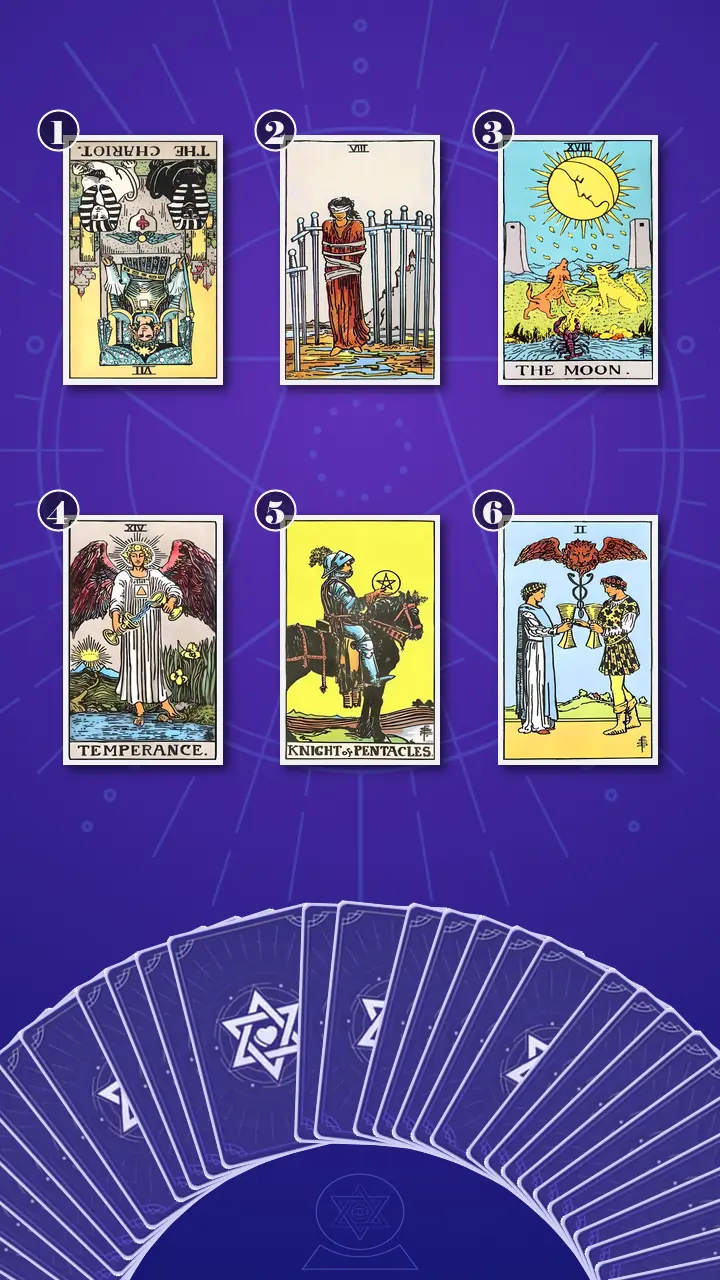
Reading the Automatic Loop
Position 1: The Plan Moving Faster Than the Person
“The card I am turning over now represents the presenting behaviour: the way you initiate major relationship steps and logistics when uncertainty appears, even while noticing that you are not ready,” I said.
It was The Chariot, reversed.
I drew Maya's attention to the black and white sphinxes facing different directions, the armoured charioteer standing rigidly above them, and the absence of visible reins. Reversal did not make this a bad omen. It showed Chariot energy in blockage and excess: a strong drive for control was pushing outward movement before the competing parts of her had agreed on a direction.
I connected the image directly to the evening she had described. After her partner asked to continue a tense conversation tomorrow, she opened Rightmove, built a cohabitation checklist, and proposed a moving month. The decisive-looking plan hid a quieter hope that the lease renewal, reference checks, or some other practical obstacle might delay the very step she had initiated.
“The inner script sounds something like this,” I said. “One part of me wants visible closeness. Another part of me is hoping I can keep my own front door for longer. So I make a plan because planning looks more decisive than being divided.”
For a moment, Maya stared at the two sphinxes. Then she gave one short, bitter laugh and folded her arms across her chest.
“That is so accurate it is almost rude,” she said. “I keep calling it being proactive, but half the time I am already looking for reasons the plan cannot happen.”
“That does not make your desire for closeness false,” I replied. “It means closeness and control have become tangled. The Chariot is asking for inner agreement before acceleration. A deadline can organise a decision, but it cannot manufacture readiness.”
Position 2: The Two-Button Screen
“The card I am turning over now represents the immediate belief blocking paced decision-making: the assumption that slowing one milestone means losing progress or jeopardising the relationship,” I said.
It was the Eight of Swords, upright.
I showed her the blindfold, the loosely wrapped bindings, and the partial enclosure formed by the swords. The figure looked trapped, but the structure was not sealed. Here, Air energy had become contracted and over-rigid. Analysis was no longer creating options; it was enforcing one frightened rule.
“This is like looking at a phone screen with only two buttons,” I said. “One says, ‘Move in now.’ The other says, ‘This relationship is failing.’ If I do not agree to cohabitation, then it must mean we have no future. The interface looks decisive only because the option you need was never added.”
Maya's actual menu was wider. She could renew separately for six months, postpone one milestone without postponing the relationship, try ordinary midweek routines together, identify readiness criteria, or choose a review date. None of those choices guaranteed an outcome, but each was more accurate than treating a shared lease and a breakup as the only available routes.
“Move forward or lose everything is a fear-shaped menu, not the full list of options,” I said. “Urgency is real as a sensation. It is not automatically evidence of necessity.”
I watched her inhale and stop halfway. Her index finger hovered above the rim of her mug, her gaze drifted away as if she were replaying the last lease conversation, and then the finger slowly settled.
“We could renew separately and set a review date,” she said quietly. “I genuinely did not count that as progress before. I thought it meant we were avoiding the issue.”
“A defined pause can be an engagement with the issue,” I said. “The useful question is whether the pause gathers information or merely hides from it. We can design for the first.”
Position 3: The Forecast Mistaken for a Fact
“The card I am turning over now represents the deeper fear beneath forced progress: that remaining in uncertainty will expose a loss of control over your emotional safety,” I said.
It was The Moon, upright.
Outside Maya's window, rain spread the streetlights into pale, uncertain halos. The environment seemed to join the card: a winding path disappeared between two towers, visible for only a short distance. Beneath the moon, a dog and a wolf reacted differently while a crayfish emerged from dark water. I read those figures as reasoning, alarm, and half-formed feeling all speaking at once.
The Moon did not tell me that danger was coming. It showed unsettled Water, an excess of projection meeting a deficiency of confirmed information. Maya had received one fact: “Long day, can we talk tomorrow?” Her fear produced a forecast: “We are losing momentum, and they may decide I am not serious.” Her body supplied a separate signal: “I am uneasy about moving in at this pace.”
“Those three inputs are arriving together,” I said, “but they are not interchangeable. The delayed reply is incomplete information. The breakup story is a forecast. The tight chest may contain genuine information about your pace. If you collapse all three into one emergency, a major commitment starts to look like the fastest exit from ambiguity.”
I asked her to remember the northbound Victoria line journey when her thumb kept refreshing the chat while she searched neighbourhood commute times. The carriage had screeched around a bend, bass had leaked from someone's headphones, and she had started a shared Notes checklist before receiving any further message. She was responding to an imagined full conversation while the real one had not yet happened.
“It is like navigating London in heavy fog,” I said. “Not seeing the entire route does not prove there is no route. It does mean a forecast should not be treated as a street sign.”
I watched Maya's jaw release first, then her shoulders. She looked down at the card for several seconds before speaking.
“I thought the tight chest meant the relationship was in danger,” she said. “But part of it might be my body saying the move itself is too fast. I have been using one feeling to answer two different questions.”
“Exactly,” I said. “We do not need to dismiss your intuition, and we do not need to obey every fear-generated conclusion. We need separate containers for fact, forecast, and bodily information.”
When Temperance Slowed the Clock
Position 4: The Measured Pour
The radiator clicked off. The rain softened, and the room became quiet enough for me to hear Maya set her mug on the table. I turned over the card I considered the reading's central lever.
“This position represents the key interruption to the accelerated-intimacy trap: separating emotional reassurance, practical convenience, and actual readiness so they can be paced rather than compressed into one major decision,” I said.
It was Temperance, upright.
I pointed to the measured stream passing between the angel's two cups, one foot resting on land and the other in water. Unlike the opposing sphinxes, these two elements were not being forced to become identical. Temperance held them in active relationship. Its energy was Balance: emotion remained present, practical reality remained present, and neither was permitted to take over the entire decision.
In Maya's life, the measured pour meant giving three conversations three distinct containers. One conversation could address reassurance about the relationship. Another could examine London rent, deposits, council tax, and commuting. A third could ask whether each person was emotionally ready to share a home. Those concerns had arrived together, but they did not need one shared deadline.
I felt an old Wall Street reflex surface, not the appetite for speed, but the discipline of checking what could actually support a high-impact move. I call that lens a Resource Readiness Assessment. External timing can look attractive while internal readiness remains under-resourced. Maya had a lease deadline and potential rent savings, but she did not yet have an unpressured yes, enough evidence about ordinary shared routines, clearly stated boundaries, or a mutual understanding of what cohabitation meant.
I explained that I was not reducing love to a commercial transaction. I was using strategic logic to stop attractive market timing from overruling emotional consent. My related Strike Timing Calibration did not produce a verdict of now or never. It identified the next responsible decision point: after a deliberate pause, one readiness conversation, and enough lived evidence to make the choice proportionate.
I brought Maya back to Sunday night: the engagement carousel, the Rightmove tabs, and the drafted moving-date message. Her chest had tightened before she typed, yet the plan had briefly looked like proof that the relationship still had momentum. She had been trying to solve readiness with a deadline.
Speed is not proof of security; let Temperance's measured pour turn one pressured leap into a sequence of honest, mutual steps.
I left a few seconds of silence around the sentence. Then I said:
A relationship is not made safer by moving faster. Real commitment begins when your readiness is allowed into the room, even if its answer is ‘not yet.’
For one beat, Maya did not breathe. Her fingers froze around the mug, her pupils widened, and her gaze slipped out of focus as if several moving-in conversations had started replaying behind her eyes. Her mouth tightened before any relief arrived.
“But does that not mean I have been wrong this whole time?” she asked, her voice suddenly sharper. “I started all of this. I made it sound like I was ready.”
“It means the strategy gave you short-term relief and long-term friction,” I replied. “Recognising that now does not make your earlier self foolish. She was trying to protect the relationship with the tool she had. You can update the tool without turning your past into a prosecution.”
I watched the anger give way in stages. Her eyes reddened slightly. Her shoulders descended, the fist beneath her folded arm opened, and a shaky breath left her chest. The release carried a brief, almost dizzy blankness with it: if urgency was no longer in charge, she would have to choose rather than simply react.
“Now, using this new perspective, think back to last week,” I said. “Was there a moment when this insight could have changed what the situation meant to you?”
Maya described standing in her agency kitchen while a colleague mentioned renewing a solo lease. The fridge had hummed, burnt espresso had coated her tongue, and an unexpected wave of envy had loosened her shoulders before guilt pulled them up again.
“I wanted my own front door for a little longer,” she said. “I treated that as proof I was failing at commitment.”
“Temperance gives you a more accurate sentence,” I said. “I can want a future with you and still need more time before this specific step. That is not compliance disguised as commitment. It is paced self-trust.”
I named the movement plainly: this was the first crossing from urgency-driven milestone acceleration and false-binary thinking toward mutual readiness and revisable commitment. The clarity was relieving, but it was also vulnerable. Maya could no longer outsource the decision to a lease renewal, an engagement carousel, or the pressure to look certain.
Building What Two People Can Actually Hold
Position 5: One Pentacle, One Reversible Test
“The card I am turning over now represents the practical response: choose one reversible step, define what it is meant to clarify, and agree when to review it,” I said.
It was the Knight of Pentacles, upright.
The Knight sat on a stationary dark horse and studied one pentacle while cultivated fields stretched behind him. I read this Earth energy as the grounded resource that had been missing from Maya's loop. She did not need more activation or another dramatic declaration. She needed enough steadiness to let observable experience accumulate.
In practical terms, Maya and her partner could choose one ordinary midweek evening together that included commuting, cooking, chores, downtime, and separate personal space. They could define what the evening was meant to reveal, record what actually happened, and wait until an agreed review date before introducing the next housing decision.
“The next step is not a test of love,” I said. “It is an experiment designed to show us what daily life together feels like when nobody is performing a perfect weekend version of the relationship.”
This was not indefinite suspension. The Knight's patience was balanced rather than deficient: one test, one purpose, one review point. The option to revise remained intact, and separate finances, housing rights, privacy, and an easy exit would be protected. A trial would create information, not silent consent to a final step.
I saw Maya unlock her phone without opening the chat. She went to Notes instead and typed, “What would an ordinary Wednesday teach us?” Her breathing stayed even while she wrote.
“That feels almost too small,” she said.
“Small is useful when it produces evidence you can trust,” I replied. “Announcement-ready progress is not the only kind of progress. The Knight values what can be sustained over what can be posted.”
Position 6: The Two-Informed-Yeses Standard
“The final card represents integration: mutual, informed commitment in which hesitation can be discussed without being treated as rejection,” I said.
It was the Two of Cups, upright.
I highlighted the two figures exchanging cups at equal height. Neither ran ahead. Neither pulled the other across the space. I did not read the card as a promise that Maya's relationship would reach a particular milestone. I read it as a standard she could use when considering any commitment.
In modern life, the card looked like two people naming what felt exciting, what remained uncertain, and what boundary applied to the next step. They would agree only to the part supported by two informed yeses and leave the rest open for later review. The conversation itself could become evidence of intimacy, even without a cohabitation announcement at the end.
Its Water energy was reciprocal and balanced. The private alarm of The Moon had become information held in separate cups and offered honestly. Emotional connection no longer required one person to drive the timeline while the other tried to catch up.
“The next step needs two informed yeses, not one person's urgent proof,” I said. “A yes can be specific. A not-yet can be specific. Either person can ask for more information or change an answer later. That is ongoing consent, not indecision.”
Maya looked at the paired figures and pressed her lips together. I saw recognition, relief, and a thin line of sadness cross her face.
“Part of me still wants the clean announcement,” she admitted. “The keys, the photo, everyone knowing we are serious.”
“Of course,” I said. “You are allowed to want the symbol. The question is whether the lived agreement can hold the weight of that symbol. If the image arrives before the mutual yes, it becomes another way to ask the milestone to reassure you.”
She nodded slowly. This time, I did not see her reach for a calendar.
The Strategic Holding Pattern
I laid the spread's two rows back into one coherent story. The Chariot reversed showed Maya forcing visible movement when her inner needs pulled in different directions. The Eight of Swords revealed the restrictive rule that made slowing down look equivalent to losing the relationship. The Moon exposed the emotional engine beneath it: incomplete information became a forecast of abandonment, while her genuine hesitation about cohabitation went unheard.
The lower row answered each part of that loop. Temperance replaced force with calibration. The Knight of Pentacles replaced the false binary with one evidence-producing step. The Two of Cups replaced private urgency with reciprocal information and two informed yeses.
The core pattern reminded me of changing a project dashboard to green while two critical dependencies remain unresolved. The colour looks calmer, but the underlying conflict has not disappeared. Maya's cognitive blind spot was treating a pause in one milestone as a withdrawal from the entire relationship. Her transformation direction was more precise: pause the milestone, keep the relationship conversation active, and separate desire, fear, practical convenience, and available evidence before committing.
I called the action plan The Strategic Holding Pattern. A holding pattern is not anxious stagnation and it is not avoidance without an end date. It is a short, intentional period in which Maya stops increasing commitment pressure and uses the time to build the resources required for a cleaner decision. The return on that pause is not guaranteed certainty. It is less friction, better evidence, and a choice she can recognise as her own.
- The 48-Hour Temperance PauseAfter the next delayed reply, lease email, or engagement carousel triggers a milestone proposal, Maya will put the draft in Notes instead of the chat and set a reminder for 48 hours later. During that window, she will set an eight-minute timer and write one sentence under each heading: “What I genuinely want,” “What I fear waiting would mean,” and “What the available evidence actually shows.” If needed, she can send one holding message: “I care about this, and I want to come back to it after I have checked what I actually feel rather than answering from urgency.”Minimum version: make a two-minute voice note naming one desire, one fear, and one fact. If her chest tightens or the exercise becomes overwhelming, she can stop and return later. The pause applies to the specific milestone, not the whole relationship.
- One Reversible Cohabitation ExperimentThis week, Maya and her partner will choose one ordinary midweek evening that includes commuting, food, chores, downtime, and separate personal time. They will use a one-page shared note with four prompts: “What are we testing?” “What would make this workable?” “What felt difficult?” and “When will we review it?” They will set one review date after the experiment and agree not to move it earlier simply because uncertainty returns. At the review, each person can name one yes, one hesitation, and one boundary.Keep money and relationship reassurance in separate parts of the conversation. Preserve separate finances, housing rights, privacy, and an easy exit where relevant. The experiment creates evidence; it does not count as consent to a shared lease.
I made one boundary explicit before we closed: these practices were not tests Maya had to pass, and they could not guarantee what her partner would choose. Tarot had helped us organise the pattern, but the cards were not the authority over her timing. Maya was. She could pause, revise, decline, proceed, or ask for more information without converting any one choice into a verdict on her worth or the entire relationship.

A Week Later: The Message That Did Not Become a Deadline
Six days later, I received a message from Maya. She had moved the drafted moving-month text into Notes, waited 48 hours, and used the Desire-Fear-Evidence check. What she wanted was the relationship and more ordinary time together. What she feared was that asking to slow down would make her partner reconsider everything. What the evidence showed was that they had handled difficult conversations before without the relationship disappearing.
She had then sent the holding message. In a 20-minute conversation at a quiet café, she and her partner agreed not to choose a moving month yet. They planned one ordinary Wednesday together and set a review date three weeks later. No one had been negotiated past a hesitation.
Her final line read, “I still felt scared, but scared did not get to send the calendar invite.”
She slept through the night. Her first thought in the morning was still, “What if slowing down ruins it?” This time, she recognised a forecast rather than an instruction.
I did not read that week as proof that Maya had solved her relationship or eliminated uncertainty. I read it as the first concrete evidence of her Journey to Clarity: urgency had paused long enough for curiosity, self-trust, and mutual readiness to enter the room. The cards had not rescued her. They had given her a clean structure in which she could hear the wisdom her body and experience were already offering.
I know how a delayed reply can tighten the chest until choosing a moving date feels easier than admitting, “I want this relationship, and I may not be ready for this step.” When pausing feels dangerously close to being left, simply noticing that speed and security are not the same thing means the old loop is no longer completely invisible.
If slowing this one decision did not have to mean going backwards, what small, revisable choice could let your actual readiness join Temperance's measured pour before the calendar gets a vote?