A Slack Offer at 9:18 P.M.—Then a Bounded Yes, Still in Control

The “I'm Good” Reply at 9:18 P.M.
I knew Alex (name changed for privacy) was the person who would spend twenty minutes reviewing a teammate's draft, then say “I'm good” before that teammate finished offering the same help back. At 9:18 p.m. on a Tuesday, they appeared in my video window from a small Toronto kitchen table. A radiator clicked behind them. They took a sip of cold coffee, winced at its metallic taste, and rubbed one thumb along the edge of a phone that was still warm in their palm.
On the screen was a half-finished Google Doc. On the phone was a Slack message from a colleague: “I can review the first section tonight.” I watched Alex type, “Thanks, but I've got it,” delete the sentence twice, and finally send a polished version that meant the same thing: no help required, nothing to see here.
“The weird part is that I want them to review it,” Alex said. Their shoulders lifted for a second, as though relief had tried to enter, then folded inward. “But if I accept the offer, I have to admit the extra hour didn't fix anything. And if they help and I'm still stuck, what does that say about me?”
That was the contradiction in full view: Alex wanted concrete relief, but the moment it arrived, they rejected it to protect their sense of control. Then the unchanged document seemed to confirm the belief that support would never have made a difference. Resignation sat across their shoulders like a wet winter coat they had forgotten they were allowed to take off. Beneath it, I could see longing, shame, and a jaw held tight enough to keep all three from speaking at once.
“You aren't broken for protecting yourself this way,” I told them. “Refusing gives you a few seconds of relief from being seen. The problem is that those seconds keep costing you movement. We aren't here to pressure you into accepting every offer. We're here to examine why the door closes so quickly, and to find out whether you can open it only as far as you choose. Let's make a map for that.”

Choosing a Map for the Help Refusal Loop
I asked Alex to place the phone face down, take one ordinary breath, and hold one precise question in mind: “Why do I keep turning down help, and what would let me accept it without losing agency?” I shuffled slowly. The movement was not a performance of mystery. It created a clean pause between the automatic reply and the chance to observe what happened underneath it.
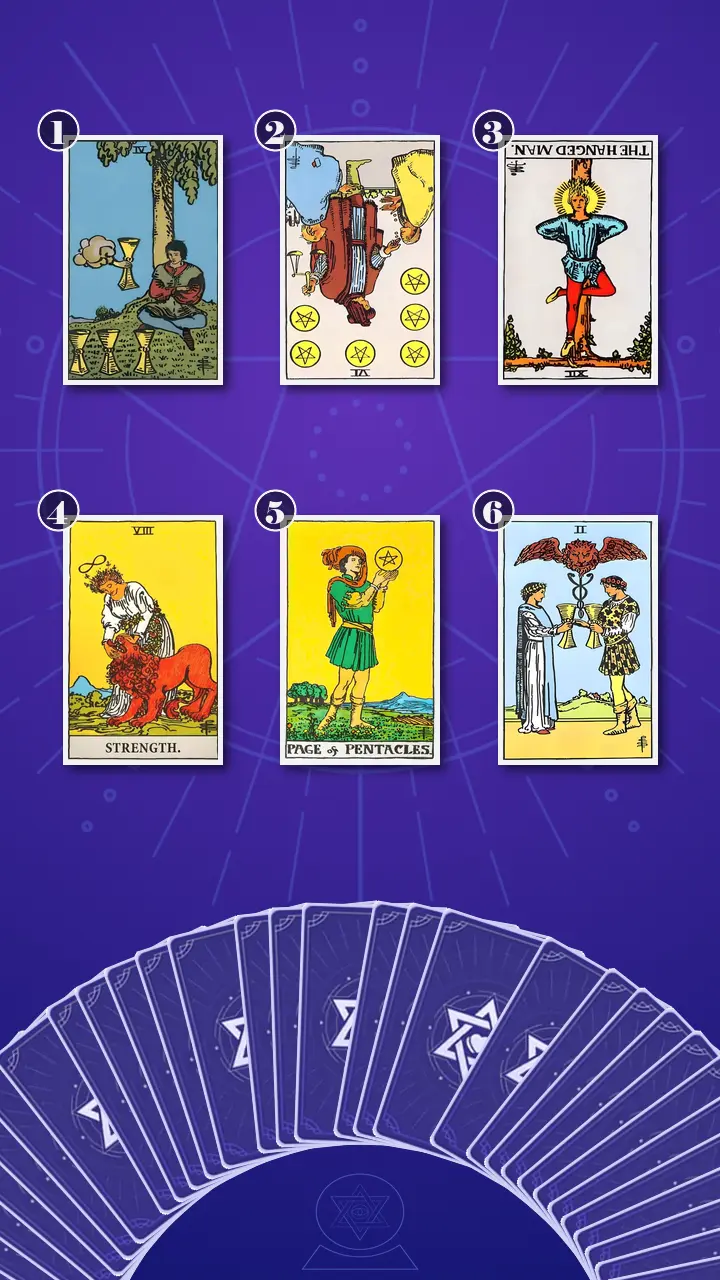
For this reading, I chose the Transformation Path Grid (6) · Context Edition. This six-card tarot spread is designed for a repeating system rather than a single yes-or-no decision. Alex was not comparing two offers or asking me to predict whether a particular person would help. They were trying to understand a Help Refusal Loop: an offer appeared, refusal brought short-term relief, isolation preserved the stalled problem, and that lack of movement reinforced the next refusal.
This is how tarot works in my practice. I do not treat the cards as orders or fixed outcomes. I use their images to separate observable behaviour from the meaning a person has attached to it. Card meanings in context can turn a shapeless emotional pattern into something we can point to, question, and test. Alex would remain the author of every decision.
I laid the cards in two rows of three. The top row would reveal the present refusal, the immediate blockage around receiving, and the fixed perspective beneath it. The lower row would show the turning-point quality, one bounded action, and a model of support that could preserve consent and dignity. As an artist, I saw the layout as six frames of unfinished footage: the first three compressed like a locked corridor, the last three opening into a walkway whose ending had not yet been written.
Reading the Locked Corridor
Position One: The Cup Dismissed Before It Was Read
I turned over the card representing the present state: the observable Help Refusal Loop at the exact moment an offer appears and is dismissed. It was the Four of Cups, upright.
I pointed to the seated figure beneath the tree, arms crossed, while a fourth cup arrived from outside the frame. “The cup is visible,” I said, “but its contents have not been inspected. That distinction matters. This card does not tell me that the offer is good, safe, or useful. It shows me that the decision has been made before evaluation.”
The card replayed what I had just witnessed. At 9:18 p.m., Alex saw a Slack message offering to review only the first section of a stalled document. Their shoulders briefly lifted with relief, then folded inward while they typed, “Thanks, but I've got it.” In practical terms, the offer remained unopened. Alex had read the words, but they had not examined the scope, the conditions, or the usefulness of the specific contribution before returning to the same paragraph alone.
I read the energy here as Blockage. The emotional water of the Cups suit was present, but it was not circulating. Longing could not reach the offer because guardedness closed the body first. The problem was not a lack of support in that moment. It was the speed with which the offer became a feared verdict.
“The last time someone offered to review, carry, collect, or listen,” I asked, “what did they literally offer, and what did your mind add before you answered?”
Alex gave a brief laugh that landed with more bitterness than humour. “That's so accurate it feels a bit brutal. For one second, I want to say yes. Then I think, if I look too closely at the offer, I'll have to admit how stuck I am.” Their fingers rubbed the rim of the coffee mug, tightened around it, and then loosened without lifting it.
“I hear why that stings,” I said. “I'm not asking you to judge the crossed arms. They have been doing a protective job. I am asking whether they still need to make the whole decision before you know what is being offered.”
I let the distinction settle before naming it plainly: “You are not refusing the task; you are refusing the meaning you fear the help will carry.”
Position Two: The Invisible Ledger Behind a Small Favour
I turned over the card representing the immediate blockage: what makes receiving support feel incompatible with agency. It was the Six of Pentacles, reversed.
In the Rider-Waite-Smith image, one figure holds scales while distributing coins to people below. Reversed, those scales can feel less like balance and more like an invisible scorecard. “A colleague offers twenty minutes,” I said, “and your mind converts those minutes into status loss, future obligation, or evidence that you cannot do your job.”
I brought the image directly into Alex's workday. During a deadline crunch, a colleague could offer a twenty-minute review and explicitly leave the final decision with Alex. Even then, Alex might imagine a performance score being adjusted somewhere off-screen. To restore their status, they might decline the review and volunteer for another person's task, leaving the original bottleneck intact while adding a second one.
Here, I read the reversed energy as Blockage intensified by Excess. Reciprocity was blocked because the mind performed too much accounting. A defined contribution became a line item in an invisible Splitwise balance that had to return to zero immediately. The overcorrection was just as costly: Alex proved they were not dependent by carrying even more work.
“If you accepted those twenty minutes,” I asked, “which possibility feels most threatening: being judged, owing them, losing authorship, or still being stuck afterwards?”
Alex's jaw tightened. Their gaze moved from the card to the unfinished document behind the video window. “Being judged first. Still being stuck second. But honestly, they all arrive as one feeling.”
I used a lens I call Persona Fatigue Diagnosis. I was not diagnosing Alex as a person. I was examining the psychological cost of maintaining a social character that had become too rigid. At work, Alex had been cast as the endlessly useful colleague: quick with feedback, calm under pressure, never the unfinished draft. It created a Severance-style split screen, with polished competence in Slack and private stuckness after the laptop closed. Any incoming support threatened to break continuity between those two versions.
“That character helped you earn trust,” I said. “But now you are spending so much energy staying in character that collaboration feels like being exposed. The exhaustion is not proof that you are incapable. It may be the cost of performing capability in a form that never gets to receive.”
Alex went quiet. Their thumb stopped moving along the mug. I saw recognition arrive without full agreement, the way a room changes when someone has opened a window but the old air has not yet cleared.
Position Three: The Frozen Cursor at 10:46 P.M.
I turned over the card representing the underlying root: the fixed perspective that keeps the refusal repeating after each setback. It was The Hanged Man, reversed.
The upright Hanged Man can describe a deliberate suspension that permits a new perspective. Reversed, the pause can become prolonged stalling: time passes, effort continues, but no fresh view enters. I looked at the suspended body, the crossed leg, and the halo that suggested insight was possible even while movement had stopped.
“This is the frozen cursor,” I told Alex. “It is 10:46 p.m. You are rereading the same client brief under the blue-white light of the laptop. You consider sending one clarifying question, decide the reply will not help, and run the same search-and-rewrite cycle again. When the result remains unchanged, the repetition gets renamed realism.”
I read the energy as Blockage. A useful pause had been deprived of its purpose. Alex was not surrendering to a new perspective; they were remaining suspended inside the conclusion that another perspective could not matter. The apparent control of repeating a familiar approach had replaced actual movement.
“Think of one task you have approached the same way at least three times,” I said. “What outside question have you ruled out before testing it?”
Alex became completely still. Their breath flattened, their eyes lost focus for a moment, and then their shoulders sank by a fraction. “Last Thursday, I reread the brief for nearly two hours. I could have asked what the client meant by ‘more human.’ I didn't. I told myself they'd just repeat it.”
“What would it have meant if you had asked and the answer still wasn't useful?”
“That I was out of excuses,” they said quietly. “That maybe I really couldn't do it.”
I did not rush to reassure them that help would always work. It would not, and pretending otherwise would make their caution less safe. Instead, I separated what could be known from what had been predicted: “A question can receive an unhelpful answer. A colleague can misunderstand. A boundary can be ignored, in which case you can narrow or end the exchange. But an untested offer cannot honestly count as failed support.”
When Strength Changed the Genre
Position Four: A Gentle Hand, Not a Transfer of Control
The room seemed to become quieter before I turned the fourth card. Even the radiator's clicking stopped for a few seconds, leaving the unfinished Google Doc and Alex's face suspended in the same pale rectangle of screen light. This was the card representing the key turning point: the inner quality that could interrupt the loop without giving away personal choice.
I turned it over. It was Strength, upright.
I directed Alex's attention to the woman's calm expression and her gentle hand on the lion's muzzle. She was neither fighting the lion nor pretending it was absent. “Strength is not asking you to crush the heat of embarrassment,” I said. “It is the capacity to remain beside that heat without letting it write the reply.”
I read this energy as Balance. Vulnerability and self-command could occupy the same frame. In Alex's real life, that balance might look like feeling their face grow warm and still typing, “Could you review just the opening paragraph for clarity? I'll make the final edit.” They would not need to feel fearless, become comfortable with dependence, or offer blanket access. The courage would be in allowing one bounded contribution while keeping the next decision visible.
I replayed the loop aloud: one second of relief at the Slack offer, the automatic “I'm good,” then the same document an hour later, with heavier shoulders and the refusal now posing as proof that support would never have changed anything.
At that point, I used Internal Monologue Auditing, my way of identifying the destructive genre an inner narrative has adopted. Alex's internal film had become a punitive courtroom drama. The unfinished draft was Exhibit A. Accepting feedback was a confession. Remaining stuck after receiving help would be the final verdict. With that genre running in the background, even a twenty-minute review had to feel enormous because every scene had already been edited toward conviction.
“Strength changes the genre,” I said. “This is no longer a trial deciding whether you are competent. It is observational footage from one limited experiment. You remain the director. You choose the collaborator, the scene, the duration, and which notes make the final cut.”
Accepting help is not handing over the wheel; it is choosing one passenger, one stretch of road, and the point where you can ask them to get out.
I left a few seconds of silence around the sentence, then placed my finger beside the gentle hand on the card.
You do not have to prove independence by refusing every offer; you can keep your agency while accepting one bounded contribution, like Strength's gentle hand on the lion.
For one beat, Alex's breath stopped and their fingers hovered above the phone as if the old reply were waiting beneath them. Then their gaze slipped past my video window. I could see them replaying a recent memory rather than looking at the card. Their eyebrows drew together, and a flash of anger sharpened their voice. “But doesn't that mean I've been wrong every time I said no? Like I created the whole problem?” I answered before shame could turn the insight into another weapon. “No. Refusal protected you from exposure, disappointment, and unsafe or unequal exchanges. It made sense as protection. We're noticing that it now gets applied before discernment has a chance to work.” Alex's eyes reddened slightly. Their fist opened against the table, then their shoulders dropped on a long, uneven breath. Relief arrived, but so did the unsteady feeling of having no old verdict to hide behind. “Oh,” they said. “So I would still have to choose.” “Yes,” I replied. “That responsibility is not a punishment. It is the evidence that your agency stayed with you.”
“Now, using this new perspective, can you think of a moment last week when this insight might have made you feel different?” I asked.
Alex opened the recent Slack thread without sending anything. “Thursday,” they said. “I could have let my account lead review slide seven for twenty minutes. I could have kept the final copy. I turned their offer into them taking over the entire deck, but that wasn't what they said.”
I asked Alex to draft a bounded response: “Yes, could you help with slide seven for twenty minutes? I'll keep the final edit and the client recommendation.” They rated the discomfort seven out of ten. I reminded them that drafting was not consent to send. They could revise it, delete it, choose someone safer, or stop entirely. The point was to see whether specificity made room for choice.
I named the crossing we had reached. It was not a sudden transformation into someone who trusted every offer. It was one step from resigned self-protection and automatic help refusal toward evidence-based trust in bounded, reciprocal support. Receiving one contribution did not transfer ownership of Alex's work, identity, or life.
Position Five: One Pentacle, One Data Point
I turned over the card representing the action step: one small, bounded experiment capable of generating new evidence. It was the Page of Pentacles, upright.
The Page held one pentacle at eye level in an open field. I saw focused curiosity rather than mastery. “This is not a company-wide migration of your personality,” I said. “It is one ticket on a project board. One paragraph. One errand. One fifteen-minute call. One question.”
I read the Page's energy as Balance in an early, practical form. The card did not ask Alex to decide whether support worked in general. It invited them to study one tangible exchange. Alex could choose a fifteen-minute review of one paragraph, record the scope and the decision they intended to retain, then note what changed, what did not, and what remained theirs.
“The thought to audit here is: ‘If this goes awkwardly, the whole idea has failed,’” I said. “The Page answers: ‘This is one data point, not a referendum on whether I am capable.’ Support becomes believable through evidence, not pressure.”
Alex looked at the Slack thread again, this time without picking up the phone. Their mouth shifted into a cautious half-smile. “One paragraph feels almost annoyingly doable,” they said. I heard the irritation as a good sign, not because they had agreed with me, but because the idea had become small enough to argue with realistically.
Position Six: Two Cups and Both Names in the Version History
I turned over the final card, representing integration: a self-directed model of support in which receiving and contributing can coexist. It was the Two of Cups, upright.
I placed it beside the Four of Cups. In the opening card, one cup had been offered toward an isolated figure. Here, two people met each other's gaze and raised their cups deliberately. “The image has changed from unilateral offering and reflexive refusal to mutual recognition,” I said. “Both people remain visible.”
In Alex's life, this could look like turning a laptop toward a trusted friend and asking for one possible next step. Alex could question the suggestion, use only part of it, and make the final choice. The friend could contribute without taking over. Receiving would not make Alex passive; it would make them an active participant in a consent-based exchange.
I read this energy as Balance and renewed flow. It was less like being rescued and more like two people carrying opposite ends of the same table. It was a shared document in which both names remained in the version history.
“Who can hear ‘yes,’ ‘no,’ or ‘only this much’ without punishing you?” I asked. “That matters more than forcing yourself to accept whatever is offered.”
Alex named one colleague and one close friend. Their voice stayed tentative, but their posture had changed. They were no longer folded around the phone. “I can receive this and still remain an active person in the exchange,” they said, testing the sentence aloud.
“Exactly,” I replied. “Two of Cups is not an obligation to be open with everyone. Discernment is part of your agency. Equal support leaves room for boundaries, questions, disagreement, and a clean no.”
The Director's Cut of a Bounded Yes
I gathered the six cards into one coherent sequence. The Four of Cups showed the offer rejected before inspection. The reversed Six of Pentacles revealed the invisible ledger that translated receiving into debt or diminished status. The reversed Hanged Man exposed the deeper assumption: repeating a familiar approach felt safer than testing a perspective that might leave Alex without the protection of “nothing would help anyway.” Strength made the discomfort tolerable without erasing it. The Page of Pentacles converted courage into one observable experiment. The Two of Cups showed what the experiment was moving toward: chosen participation rather than rescue.
The past influence in this story was not a destiny I could claim to read. It was the learned equation Alex had been carrying into each new scene: help equals loss of control. Their present symptom was the polished refusal. Their core conflict was the desire for relief against the fear that receiving would expose helplessness. Their available resource was not sudden confidence. It was the gentler and more credible capacity to stay present, state a boundary, and keep the final decision.
I named the cognitive blind spot directly: Alex had been using the lack of movement after refusing help as evidence that help would not have worked. The loop created its own proof. It was like archiving a useful Slack message without opening the attachment, then citing the unopened file as evidence that it contained nothing useful.
The transformation direction was therefore precise: treat one small, specific offer as a time-limited experiment rather than a verdict on independence. A boundary could turn help from a judgment into information. The door did not need to be thrown open. Alex could open it only far enough for one agreed contribution, then decide what happened next.
I gave Alex three pieces of actionable advice. Each one was deliberately small, because the goal was to create usable evidence rather than stage a dramatic personality overhaul.
- The One-Breath Offer Pause When a friend or colleague next makes a specific offer, take one ordinary breath before answering and ask, “What exactly did you have in mind?” Read only the literal offer before deciding whether to accept, narrow, or decline it. Minimum version: type the question in a draft and leave it unsent. Curiosity does not commit you to saying yes.
- The Task-Scope-Ownership Request Before Friday, use one existing work offer and send: “Yes, could you review only the opening paragraph for clarity? Please spend no more than fifteen minutes. I'll handle the rest and make the final edit.” Cap preparation at two minutes and ask someone whose role already includes this kind of collaboration. If the full request feels too exposing, ask for one unclear sentence rather than a full review. You can decline follow-up advice outside the stated scope.
- The Director's Cut of Self-Compassion Within three minutes after the exchange, pause the punitive replay and describe the scene as an objective, supportive editor. Write three bullets in your notes app: “What they contributed,” “What I still controlled,” and “What moved, even slightly.” Do not score yourself on gratitude, comfort, or performance. Record observable footage. One awkward exchange is one scene, not the ending of the film.
Before we closed, I reminded Alex that accepting help was not automatically the brave or correct choice. Some offers carry pressure. Some people ignore boundaries. Some exchanges genuinely are unequal. Alex retained the right to choose a safer person, reduce the scope, stop halfway, or say no. The new freedom was not compulsory openness. It was the ability to make the decision after examining the offer rather than before it arrived.

A Week Later: Comment Access, Not Ownership
Six days later, I received a screenshot from the same kitchen table: “Could you review only the opening paragraph? I'll make the final edit.” Three comments came back. Alex used two, declined one. They still wondered, “Did I look incompetent?” Then they kept the evidence.
Nothing magical had happened. One document had moved. One colleague had respected the stated limit. Alex's shame had not vanished, and they had not become comfortable receiving every kind of support. The difference was smaller and more important: they had tested shared effort without surrendering authorship.
I saw this as the first quiet proof of the Journey to Clarity. The six-card Transformation Path Grid had not predicted that help would save Alex. It had made the hidden editing process visible, separated a real offer from a feared verdict, and returned the pen to the person whose life was still in production.
I want to leave you with the same gentleness I offered Alex. When someone offers the exact thing we secretly want, the jaw can tighten before the relief even lands, because saying yes risks exposing that private effort has not restored the control we were trying so hard to protect. Simply noticing that reflex is already a frame of clarity. It is not an order to accept.
So I will leave you with the image that changed across the spread: if one unopened cup could become comment access rather than an ownership transfer, which ten percent of an offer might you feel curious enough to let in?