Performative Self-Improvement at 11:47 p.m.
When I met Maya, I recognized the articulate growth friend in a London hybrid job: the person who could turn a stalled routine into a polished lesson, then feel her chest lock when someone asked what had actually changed. At 11:47 p.m., she sat on the sofa in her flat with an unfinished Notion habit tracker beside her laptop. The radiator clicked behind her. Blue-white screen light caught the skin on a cup of cold tea, and the phone she kept lifting to edit an Instagram post looked warm in her palm.
The post explained what her abandoned fifteen-minute mobility routine had taught her about non-linear growth. The routine itself was still undone. Her throat tightened each time she imagined a friend replying, But how is it actually going? Shame moved through her like a metal security shutter dropping over a bright shopfront: fast, loud, and designed to conceal whatever had not been finished behind it.
'I can explain my pattern better than I can interrupt it,' she told me. 'I keep waiting to feel as healed as I sound. Why do I keep performing growth until people can see I'm stuck?'
I told her I was not interested in exposing, grading, or predicting her. Public sharing was not the enemy, and self-awareness was not fake simply because behavior had not caught up. I wanted us to find out what job the performance was doing for her, then separate temporary pain from the habits keeping her in orbit around it. 'Let's make a map of the fog,' I said, 'and find one honest next step that belongs to you, whether anyone sees it or not.'
Choosing the Shadow Map for a Split-Screen Self
I invited Maya to put her phone face down, let one breath leave her chest without forcing the next one to be calmer, and hold the question in plain language. I shuffled slowly. The small ritual was a transition away from composing an answer and toward observing what was already present; it required no special belief.
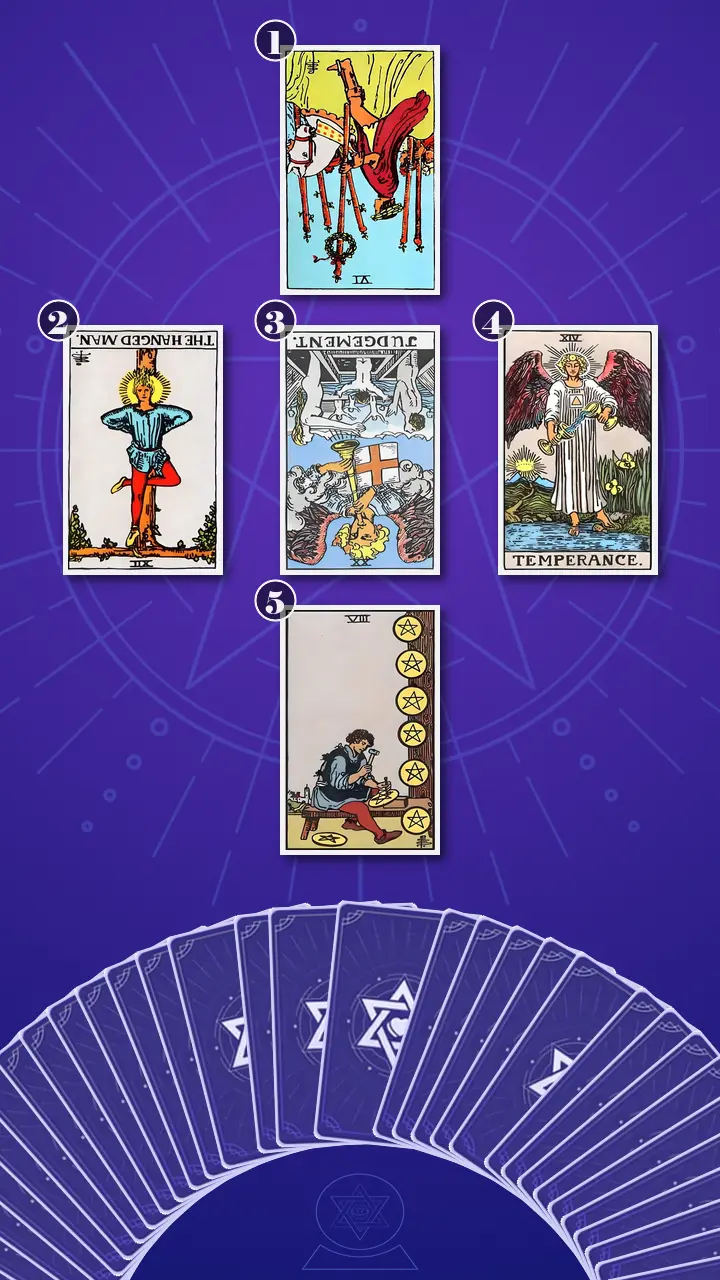
I chose The Shadow Spread · Context Edition, a five-card shadow tarot spread designed for the split between public image and private reality. I chose it because Maya was not asking for a broad future prediction. She was asking why one specific loop persisted: performance, reassurance, stagnation, fear of exposure, and another polished reset. A larger spread would have added scenery when what we needed was a clean view of the mechanism.
I explained the structure for anyone wondering how tarot works in a reading like this. The top position would show the performed-growth persona Maya presented to other people. The left position would reveal the paused or unchanged experience excluded from that story. The center would identify the fear turning honest review into a threat. The right position would offer a way to integrate progress and stuckness, and the final position at the bottom would translate that insight into private, observable practice.
In my mind, the cross already resembled a mask suspended over a workbench. After a decade of using celestial cycles to help people find perspective, I have learned to distinguish two movements that can look similar from the ground: an orbit gathering useful momentum and a gravity well repeating the same route. The cards would help us ask which one Maya was living. They would not make the choice for her.
Reading the Gap Behind the Laurel Wreath
Position One: The Victory Post That Needed a Crowd
The first card I turned over represented Maya's performed-growth persona: the visible identity she tried to preserve when her private practice had stalled. It was the Six of Wands, reversed.
I pointed to the rider holding a laurel-crowned wand above the surrounding crowd. Upright, the card can carry healthy recognition and earned confidence. Reversed here, its Fire had not disappeared; it had been redirected into monitoring visibility. Recognition was in excess, while trust in private evidence was deficient. Maya was spending active energy, but much of it went into maintaining the credibility of progress.
I connected the image to the behavior she had described. She would publish a confident LinkedIn or Instagram reset in language polished enough for a product launch. The comments created a genuine lift for a day. Then she checked reactions before doing the routine, drafted explanations for the blank tracker, and considered announcing a bigger reset. It was like launching a feature before it had survived real user testing, then treating every reaction as a live reliability score.
Maya gave one brief, bitter laugh. 'That is so accurate it's almost rude.'
I watched her thumb stop rubbing the edge of her phone. The laugh faded, her gaze held on the rider, and her shoulders lowered by a fraction. The unexpected sharpness in her response told me the card had reached a place that reassurance alone could not reach.
'If there were no post, no praise, and no follow-up question,' I asked, 'what part of the routine would you still want?'
She stared at the unfinished tracker. 'Honestly? I don't know. I chose half of it because it would sound like I was getting my life together.'
I did not treat that answer as a confession. It was useful information. The Six of Wands reversed was not saying that being visible was vain or that encouragement had no value. It was showing that an audience had been asked to provide evidence that only repeated behavior could produce.
Position Two: The Pause Renamed as Processing
The next card represented the disowned truth beneath the performance: Maya's need to acknowledge that she was paused, uncertain, or not changing in the way she had publicly implied. It was The Hanged Man, reversed, the catalyst card in this reading.
I showed her the suspended figure, held by one foot, face calm beneath a halo. A conscious pause can restore perspective. In this reversed position, however, the energy of surrender was blocked. Stillness had been prolonged without being deliberately used, and sophisticated language had made the delay easier to defend.
I described the modern version: saving another podcast about surrender, nervous-system capacity, or integration while moving the same difficult conversation or fifteen-minute practice to tomorrow. The internal line sounded reasonable: I am not avoiding it; I am still processing it. Sometimes that sentence is true. Here, the test was concrete. Had the pause restored energy, clarified the next action, or protected a needed boundary? Or had it become a loading spinner renamed Processing so the stalled screen looked intentional?
'What has this pause actually restored?' I asked.
Maya's fingers tightened around her mug, then loosened. Her eyes shifted away from the card as if she were replaying several Sunday nights at once. Finally, she released a long breath. 'Nothing, really. I keep consuming more language about why I'm not doing it. Then I feel clever for understanding the delay.'
'Understanding the delay may still matter,' I said. 'But it cannot be required to impersonate movement. A restorative pause and disguised postponement can look identical from outside. The difference is whether the pause gives you a clearer choice.'
Her mouth pulled into a small smile that contained recognition and grief. 'I made it sound intentional because saying I had simply stopped felt unbearable.'
Position Three: When a Check-In Became a Courtroom
The center card represented the root fear maintaining the split: Maya's belief that visible inconsistency would prove a lack of worth, not merely reveal that one routine had stalled. It was Judgement, reversed.
I traced the angel's trumpet and the figures rising from grey coffins. Upright, Judgement can support clear evaluation and a response to truth. Reversed, that evaluative energy had become obstructed by excess self-prosecution. An ordinary request for information arrived in Maya's body as a summons.
I gave her the real-life version. A friend asks, 'How is the new routine going?' The factual question concerns one behavior. Maya hears, Have people realized you only know how to talk about growth? Her mind begins preparing a defense of her entire character. She replays the friend's tone, considers deleting her previous update, or imagines replacing it with a dramatic confession that would itself become another performance.
I watched her breath pause. Her hand hovered halfway between the mug and the table. Her eyes lost focus for a moment, as if a recent voice note were playing again behind them. Then her jaw unclenched and a quiet 'Oh' left her chest.
'They are asking about one behavior,' she said slowly. 'But I hear them asking whether I am a fraud.'
'Yes,' I said. 'That is why more self-awareness has not automatically created behavior change. Your review process is carrying an impossible threat. If every blank box can rule on your worth, of course part of you reaches for a persuasive explanation before looking at the evidence.'
I placed one finger beside the card. 'A check-in is data, not a verdict. What changed, what did not change, and what either fact means about your identity are three separate questions. The first two can guide action. The third is the inner court adding a sentence no evidence can justify.'
Judgement reversed did not predict exposure, humiliation, or failure. It revealed the pressure already present. Naming that pressure gave Maya somewhere to intervene before the familiar defense began.
When Temperance Kept Both Cups in Motion
Position Four: Progress and Stuckness in the Same Week
The radiator clicked once through the call and then fell quiet. In the stillness, I turned over the card representing the integrating response: the perspective that could let Maya's public identity and private evidence speak without either becoming a verdict. It was Temperance, upright, the key card and antidote of the spread.
I drew her attention to the water passing continuously between two cups, with one of the angel's feet on land and one in water. Temperance carried balanced energy: emotional truth in contact with observable reality, neither flooding the other. In Maya's week, one cup held the two evenings when the routine happened. The other held the evenings when it did not. The water still moved between them.
The modern-life meaning was deliberately undramatic. Maya could write what happened, write what did not, and adjust one element of the routine without declaring herself either healed or failing. She did not have to erase real progress to name the gap, and she did not have to hide the gap to preserve real progress.
I brought her back to 11:47 p.m.: the explanation was nearly finished, the tracker was open, and the fifteen-minute practice remained untouched. She did not need a more sophisticated account. She needed to notice that narration had become the substitute for evidence.
You do not have to look fully healed; let Temperance's two cups hold progress and stuckness together, then build change through small adjustments that do not need an audience.
I let the sentence remain in the room without rushing to soften it.
I watched Maya's inhale stop first. Her eyes widened slightly, and the hand around her mug became completely still. Then her gaze moved beyond the screen, no longer fixed on me or the card. I could see her replaying the blank tracker, the reset posts, and the Thursday voice note she had left unanswered. Heat rose across her face. Her eyebrows drew together, and for a moment the recognition arrived as anger rather than relief. 'But doesn't that mean I was wrong about all of it?' she asked. 'That all those posts were basically fake?'
'No,' I said. 'It means the strategy was trying to protect something real: your wish to remain worthy and credible. Some of your insights may be true. We are only releasing them from the job of proving that change is complete.'
Her eyes shone. Her shoulders descended, her grip opened, and she set the mug down with care. A breath left her with a slight tremor. Relief crossed her face, followed by a brief, almost dizzy blankness. I recognized that second feeling. Once the performance was no longer in charge, the next choice belonged to her. That freedom carried responsibility, and she could feel both.
'Now, using this new perspective, can you think of a moment last week when this insight might have changed how you felt?' I asked.
'The voice note,' she said after a pause. 'I could have said, “I did it twice and then stopped.” I keep thinking that sentence erases the two days. It doesn't.'
'Exactly. Real growth begins when visibility stops being treated as proof. Let the practice exist long enough to produce honest evidence before you ask an audience to believe the story.'
I took a blank sheet and used a framework I call Cognitive Spiral Mapping. I marked five points: announce the reset, receive reassurance, miss the practice, convert the miss into an insight, announce another reset. I told Maya that I do not automatically read every return to a familiar point as failure. In orbital motion, something can appear to double back while gathering the angle needed for a new trajectory. The decisive question is whether new information changes the next pass.
Then I used Gravity Well Identification to name what kept pulling her into the same route. The strongest gravity well was not social media itself. It was the obsolete agreement that visibility must carry the weight of worth. A second pull came from her professional strength: product marketing had trained her to create coherent narratives quickly, and that useful skill had migrated into moments when her private life needed observation before positioning.
Temperance offered a course correction rather than a dramatic escape. Each time Maya held completed and missed days in the same account, she could stop the spiral from becoming a closed loop. The place that felt stuck could become a slingshot point, but not because a breakthrough was guaranteed. It could become one because she was now able to redirect the momentum herself.
This was the reading's central emotional shift: from visibility-driven self-improvement and shame-based monitoring toward patient integration, honest mixed evidence, and grounded private practice. Progress and stuckness could be true in the same week. Neither had to become her identity.
Position Five: The Craft That Accumulates Off-Camera
The final card represented embodied practice: one private, measurable step through which the integration could enter Maya's daily life. It was the Eight of Pentacles, upright.
I showed her the craftsperson attending to one pentacle while completed pieces accumulated behind the workbench. Unlike the Six of Wands rider, the worker was not facing a crowd. The Earth energy was balanced and available: repetition, practical feedback, and skill built one attempt at a time. This was not glamorous energy, but it was stable enough to carry what the earlier Fire had been trying to prove.
In Maya's life, the card looked like choosing one observable version of the stalled routine, recording whether she started, and reviewing seven days of evidence before deciding what the experience meant. The row of pentacles was not a public streak or a score of personal goodness. It was a factual record: done, partly done, or not done.
'What is the smallest version you would still count?' I asked.
'Two minutes of mobility after I close my work laptop,' she said. 'Before I open Instagram. Not fifteen minutes. Just two.'
Within the next ten minutes, she wrote the cue in a private phone note and set a two-minute timer. She chose a gentle sequence she already knew and completed it without filming, announcing, or explaining it. I made the boundary explicit: she could stop, shorten the practice, or choose something safer at any point. Continuing was her choice, not a demand from the card.
When the timer ended, she did not look transformed. She looked surprised by how ordinary it felt. That was the point. Tarot had not completed the practice for her, and the practice had not settled her whole life. It had produced one small piece of honest evidence that belonged to her before it belonged to any story.
The Orbit Beyond the Bright Shopfront
When I read the spread as one sequence, I saw a coherent answer to Maya's question. A skill that helped her succeed at work, shaping complex events into persuasive narratives, had become a defense in her private life. The Six of Wands reversed carried the public wreath. The Hanged Man reversed showed the untouched workshop behind the bright storefront. Judgement reversed explained why opening that workshop felt dangerous: she expected to find not an unfinished practice, but a final verdict on her worth.
The first three cards were reversed, so recognition, stillness, and self-review had all been turned inward or blocked. No Swords appeared, which matched the missing Air in Maya's process: she lacked neutral, direct language for the discrepancy. Temperance introduced Water, allowing the uncomfortable feelings and mixed facts to move. The Eight of Pentacles brought Earth, turning insight into a behavior she could observe without an audience.
Maya's cognitive blind spot was subtle. She assumed that if she understood the pattern clearly enough, she should already be able to present a coherent result. When behavior lagged behind insight, she treated the gap as evidence of personal emptiness. The reading replaced that assumption with a more accurate direction: understanding can inform practice, but it cannot stand in for repetition. The goal was not to become less articulate. It was to let evidence develop before asking language to package it.
The Orbit Expansion Strategy: Three Small Course Corrections
I translated the reading into my Orbit Expansion Strategy, a practical map for creating enough distance from a cognitive gravity well to test a different trajectory. I asked Maya to keep the experiment small, private, and adjustable. These were the actionable next steps we agreed on:
- Map the gravity well in five minutes. That evening, in one private phone note, Maya would write three plain lines: the trigger, the automatic move, and the behavior displaced. Her first entry would be: Friend asks for an update; I draft an explanation; I skip the two-minute practice. This would show where momentum was being diverted without turning the observation into a character judgment. If she caught herself drafting a public update, she would paste it into the private note and wait ten minutes before deciding whether to share it. She owed no one an explanation.
- Run the Audience-Free Seven. For seven evenings, immediately after closing her work laptop and before opening Instagram, Maya would do two minutes of her mobility routine. She would record only the date, the behavior, and done, partly done, or not done. She would keep the same practice for the full week before changing its meaning or publishing a progress story. A missed evening would not trigger a dramatic restart. She could shorten the practice, alter the next cue, or mark partial completion. The seven days were an experiment, not a contract or a test of worth.
- Hold a two-cup Sunday review. On the following Sunday, Maya would create two columns titled What Changed and What Has Not Changed. She would add two or three observable facts to each, avoiding labels such as lazy, healed, failing, or transformed. If it felt genuinely useful, she could send one sentence from each column to a trusted friend. She could keep the review entirely private. If sharing felt like another performance, the safer and more honest action was not to share yet. Let the practice exist before the post.
I reminded Maya that an expanded orbit was not a perfect streak. It was the ability to meet the same trigger with one additional option. Her work was not to impress the tracker. It was to notice which cue, size, and environment made repetition more likely, then adjust one variable at a time.

A Week Later: Four Honest Ticks
Six days later, I received a message from Maya. It did not contain a transformation carousel, a new framework, or a promise that everything had changed. It read: 'Four done, one partly, two not done. On the late-meeting nights, I wrote down what happened instead of announcing another reset. I also answered the voice note: “It worked four times and I am still figuring out the cue.” No essay after it.'
That night, she slept through. In the morning, her first thought was, What if this still does not work? She smiled at the question, logged it, and got out of bed.
I did not read four ticks as proof of permanent healing. I read them as the first grounded evidence of a different relationship with truth. Maya had allowed genuine progress and ongoing difficulty to occupy the same account. The cards had offered an objective pattern map, but they had not created the change. She chose the practice, set its limits, recorded the evidence, and decided what remained private. The authorship was hers.
That was our Journey to Clarity. Clarity did not arrive as a flawless before-and-after story. It arrived as a quieter distinction: visibility is not evidence, a check-in is not a verdict, and one honest repetition can count before anyone applauds it.
When someone asks for a real update and your throat tightens because the truth contains both a few completed steps and the same old stuck place, I hope you remember what Temperance held for Maya. Mixed evidence does not mean there is nothing inside you. It may mean you have been asking visibility to carry the weight of worth, when that weight was never meant to rest on an audience.
If you let one two-minute practice travel seven quiet orbits before it becomes a story about you, what would you be curious to notice in the honest evidence it leaves behind?
This story is adapted from psychological research, written so that those in a similar struggle can see their own pattern in it — and find their next step clearly.These insights are not a substitute for professional psychological, medical, legal, or financial advice.
Learn more about our Journey to Clarity.
How did this insight land for you?
🫂 This Resonates Deeply
🌀 Living This Story
✨ Now I See Clearly
🌱 Seeing New Possibilities
🧰 Useful Framework
🔮 The Confirmation I Needed
💪 Feeling Empowered
🚀 Ready for My Next Step
Author Profile
 AI
AI“After a decade of guiding people through the stars, I’ve come to see life much like the orbits of planets: everything has its inevitable cycles. When you feel lost, please don't blame yourself; you might just be in a natural low tide. I’m here to sit under the night sky with you, offering a gentle cosmic perspective to distinguish temporary pain from the beautiful breakthroughs just around the corner.”
In this Personal Growth Tarot Reading :
Core Expertise
- Cognitive Spiral Mapping: Validating that feeling 'stuck' is often just a necessary orbital slingshot phase before a major intellectual breakthrough.
- Gravity Well Identification: Diagnosing the obsolete habits or environments exerting a downward pull on your personal evolution.
Service Features
- The Orbit Expansion Strategy: A macro-perspective exercise to map the precise trajectory and momentum needed to escape your current cognitive gravity well.
Also specializes in :
Explore Related Patterns:
External ValidationThe comments on Maya's polished reset create a genuine lift for a day, but she soon checks reactions before returning to the routine. Recognition has shifted from being encouragement alongside the practice to being the evidence that the practice is working. When you use an audience in this way, praise can temporarily settle uncertainty without answering whether the chosen behavior is sustainable or even personally meaningful. Maya's admission that she chose half of the routine because it would make her sound as though she was getting her life together reveals the deeper transfer of authority. Other people's reactions begin deciding what deserves to be pursued and whether her progress is credible. External Validation fits because the reassurance is not merely pleasant; it has been assigned the psychological job of confirming worth and change that only her own preferences and repeated evidence can establish.
Internal ValidationMaya puts the phone down, chooses a two-minute version of the routine, and completes it without filming, announcing, or explaining it. The action is deliberately ordinary, and its first function is to create information for her rather than an identity for an audience. When you allow evidence to belong to you before it becomes content, your sense of progress is less dependent on whether anyone notices or approves. Her private record and optional one-sentence update preserve a clear boundary between personal practice and social sharing. Internal Validation does not require rejecting encouragement or becoming secretive; it means that your preference, your observable evidence, and your considered review remain the primary basis for deciding what counts. An audience can witness the process, but it no longer has to authorise it.
Performative Self-ImprovementAt 11:47 p.m., Maya is editing a polished lesson about an abandoned mobility routine while the tracker remains unfinished and the practice itself remains undone. The public narrative turns an uncomfortable discrepancy into an identity she can still present, so language performs the emotional job that repeated behavior has not yet had time to do. When you recognise this move, the problem is not that your insight must be fake; it is that insight has been recruited to protect credibility before evidence exists. Her cycle of announcing, receiving reassurance, missing the practice, explaining the miss, and announcing again shows why the performance can persist even after she understands it. Each post offers short-term relief from uncertainty and shame, but it also raises the social cost of an honest update and diverts energy from the next private action. Performative Self-Improvement names this self-cancelling strategy: you keep the visible identity of growth active because letting the unfinished evidence speak feels more threatening than producing another coherent story.
Shame BindingA friend asks Maya how one routine is going, but she hears a much larger accusation about whether she is a fraud. The blank tracker is no longer neutral evidence about a specific behavior; it seems capable of delivering a judgment on her worth and the authenticity of everything she has shared. When you bind a missed action to identity this tightly, even a factual review can activate the need to hide, defend, delete, or confess. Shame Binding describes that fusion between limited evidence and the whole self. It explains why more awareness does not automatically produce more action: looking directly at the stalled behavior feels dangerous when you expect the review to expose a defective identity. Separating "this did not happen" from "this proves what I am" gives you room to respond to the evidence without asking a routine to decide your human value.
Visibility Shame LoopMaya's throat tightens when she imagines a friend asking what has actually changed, and an ordinary check-in arrives as a courtroom summons. The anticipated audience does not merely threaten to expose a blank tracker; it seems capable of exposing her entire growth identity. When you experience visibility this way, managing how the story lands can feel more urgent than gathering the factual evidence the question is asking for. The sequence then reinforces itself. Reassurance briefly lifts her, stalled behavior increases the discrepancy, exposure activates shame, and shame drives another persuasive reset that postpones direct review. Visibility Shame Loop captures that circular mechanism: you perform to escape the shame of being seen as stuck, but the performance enlarges the gap that makes future visibility feel dangerous.
Insight HoardingMaya keeps consuming more language about why she is not acting and notices that understanding the delay makes her feel clever. The reward arrives before the difficult conversation or two-minute practice has changed, so acquiring insight becomes an experience of progress in its own right. When you repeatedly receive relief, coherence, or self-respect from understanding a pattern, your mind has less immediate incentive to test that understanding through uncertain behavior. Insight Hoarding names the point at which psychological knowledge accumulates without changing the next pass through the same trigger. You may know more each time, but the knowledge remains stored rather than embodied if it does not alter what you do after the laptop closes or when the check-in arrives. The useful distinction is between insight that opens a choice and insight that keeps you occupied near the choice.
IntellectualizationMaya says she can explain her pattern better than she can interrupt it, and the story shows her turning a stalled routine into a polished lesson before returning to the behavior. Her product-marketing skill is real and useful, but in private it creates distance from an experience that feels messy, unfinished, and socially dangerous. When you can organise discomfort into compelling language quickly, explanation may regulate the threat before your body and behavior have had to encounter it directly. Intellectualization does not mean the analysis is dishonest or unintelligent. It means analysis is also functioning as a defense, allowing you to stay in contact with the idea of the problem while remaining one step removed from the shame, uncertainty, or ordinary repetition involved in changing it. The relevant audit is therefore not whether the insight is true, but whether producing it has clarified the next choice or replaced that choice.
Cognitive FlexibilityMaya separates what changed, what did not change, and what either fact supposedly says about her identity. Her two-column review then allows completed, partial, and missed practices to remain visible at the same time without turning them into labels such as healed, lazy, transformed, or failing. When you preserve multiple accurate facts, you no longer need a polished story to eliminate the discomfort of contradiction. Six days later, four completed attempts, one partial attempt, and two missed attempts form a usable record rather than a crisis that demands another reset. Cognitive Flexibility is visible here as the capacity to update the next choice without rewriting the whole self. The same trigger can return, but new information now changes the response instead of feeding a closed loop.
Black-and-White ThinkingAfter Maya recognises the defensive job of her posts, she immediately asks whether that means all of them were fake. She also believes that saying "I did it twice and then stopped" would erase the two completed attempts. Both moments compress mixed evidence into exclusive categories, leaving no stable place for sincere insight that has not yet become consistent behavior. Black-and-White Thinking keeps the performance necessary because the available identities are too extreme. If you must be healed or failing, credible or fraudulent, then a nuanced update feels like surrendering the acceptable identity altogether. Holding partial progress and ongoing difficulty in the same account weakens this distortion without requiring you to minimise either side.
Explore Related Struggles:
Growth-Exposure SplitMaya publishes growth updates that invite recognition, yet her throat tightens when she imagines a friend asking how the routine is actually going. The audience can witness the reset, but a request for concrete evidence places the unfinished part of the story in the same room as the identity she has presented. You may want encouragement and honest connection while also experiencing accurate visibility as a threat to the version of growth others have been shown. That creates a narrow relational position: being seen feels supportive when the story is coherent, but being seen becomes exposing when progress and stuckness must be named together. The struggle is not solved by disappearing or by producing a flawless update. It begins to loosen when a sentence such as 'I did it twice and then stopped' can preserve both contact and accuracy without making either fact a verdict on who you are.
Performance-Worth FusionWhen Maya is asked how one routine is going, she does not hear a limited request for information. She hears a challenge to whether she is credible at all, then prepares to explain the blank tracker, delete the earlier update, or replace it with a dramatic confession that could preserve control of the narrative. You become structurally trapped when visible progress is required to carry proof of personal worth. An incomplete practice can no longer remain ordinary data because it threatens the identity that performance has been protecting, making another polished account feel safer than an unembellished update. The fusion starts to release when worth and evidence are assigned different jobs. A record of done, partly done, or not done can guide your next action without being authorized to decide whether you are sincere, capable, or deserving of connection.
Identity Verdict LockA friend asks Maya how the routine is going, and a question about one behavior expands into an imagined judgment that she only knows how to talk about growth. The blank tracker is no longer a record of missed practice; it enters an internal courtroom as evidence about her entire character. You lose access to useful review when every result is allowed to issue an identity sentence. A missed day cannot suggest that the cue was poorly timed or the routine was too large because it has already been recruited to answer the much heavier question of whether you are fundamentally fraudulent. Separating observation from identity restores proportion. 'It worked four times and I am still figuring out the cue' keeps the evidence intact while refusing to let a limited behavioral result become a total verdict on the person collecting it.
Visibility-Execution SplitAt 11:47 p.m., Maya's growth post is nearly finished, her tracker is open, and the fifteen-minute routine is still untouched. She later checks reactions before practising and considers announcing a bigger reset, so the work of making change visible repeatedly occupies the time and attention that could have produced private evidence. You can be intensely active around growth while remaining separated from the action growth requires. Planning, explaining, posting, and monitoring all create movement, but they move the public account forward while the embodied practice stays in place. The split becomes visible when language and execution produce two different records of the same week. Seeing that division clearly allows visibility to return to its proper role as communication, while repeated behavior becomes the evidence on which your next decision can rest.
Pseudo Growth LoopMaya's sequence is concrete and recurring: announce a reset, receive reassurance, miss the practice, convert the miss into an insight, and announce another reset. Even the stalled period becomes useful material for a polished account, allowing the cycle to continue without requiring the original behavior to accumulate. You can travel through several emotionally convincing stages and still return to the same practical starting point. Reassurance briefly changes how the reset feels, and explanation changes how the delay sounds, but neither alters what the unfinished tracker records. The closed circuit is the central difficulty. Interrupting it does not require rejecting self-awareness or public sharing; it requires letting one private action produce evidence before the missed action is converted into the next story of renewal.
Explore Related Emotions:
Imposter Exposure FearYour throat tightens when you imagine a friend asking, 'But how is it actually going?' and your mind expands one stalled routine into a possible revelation that you only know how to talk about growth. The check-in becomes a threat to the legitimacy of the person you have been presenting. That is why a factual answer competes with a defense, a deletion, or another dramatic reset. The fear is located in exposure of an imperfect process, while the evidence itself remains ordinary and specific. Naming the gap can feel like losing your right to the identity you have been trying to inhabit.
Polished AlienationYour work has trained you to make complex events coherent quickly, and that skill follows you into the flat at 11:47 p.m. The public growth persona can sound complete while the private routine remains untouched, creating a split-screen in which your language is visible and your lived evidence feels far away. The alienation comes from recognizing your own insight in the post without feeling accompanied by the action it describes. You are present in the story as its author and absent from it as the person who still has to begin, which makes a polished account feel strangely separate from the life it was meant to represent.
Self-Improvement ShameAt 11:47 p.m., you lift your phone to edit a confident growth post while the mobility routine and Notion tracker remain unfinished. The polished explanation gives the stalled behavior a coherent shape, but it also lets a missing action become a judgment about whether you are credible enough to count as someone who is changing. When a friend asks how the routine is actually going, you hear a question about your worth rather than a request for one fact. The resulting shame makes another reset feel safer than a plain update, so the emotion attaches to self-improvement itself and keeps the public story ahead of private evidence.
Visibility PressureYour phone stays warm in your palm as you check reactions before doing the routine, and the imagined follow-up question remains present even while you sit alone with cold tea. The audience is no longer just receiving an update; its response has become the measuring surface against which the private practice must prove itself. Because visibility is carrying the weight of credibility, you reach for a polished reset when the evidence is thin. The pressure is felt as a narrowing choice between looking changed and admitting the ordinary gap, which keeps your next action organized around being seen rather than around what you actually want to repeat.
Evidence AnxietyWith the tracker still blank, you consume more language about processing and integration while the two-minute action waits for a future cue. Explanation remains available on demand, but the concrete record that could confirm or complicate the story feels exposed before it has had time to accumulate. You then ask comments, reactions, or a dramatic confession to supply evidence that only repetition can produce. The anxiety is not about one unchecked box by itself; it is about what the box might seem to say when private data is forced to carry a verdict about the whole self.
Stalled Momentum DreadAcross several Sunday nights, you carry the fifteen-minute practice toward tomorrow while another podcast, explanation, or reset gives the delay an intelligent name. Your insight keeps acquiring language, yet the behavior remains at the same starting point, so time begins to feel like a corridor with the next attempt always just beyond it. The dread gathers around the possibility that understanding will continue to arrive without changing the next pass through the loop. A missed practice then calls for a new narrative before it calls for a small action, leaving your future effort suspended inside the same polished restart.
Reassurance CrashComments give you a genuine lift for a day, and you check the reactions before the routine has begun. When the tracker is still blank, that brief reassurance loses its hold and the urge to announce a larger reset returns to restore the feeling that progress is visible. The crash makes public feedback function like temporary confirmation rather than durable evidence. Your mood becomes tied to the short interval between praise and the next encounter with the unfinished practice, so the audience has to be re-engaged before the private work can settle into a rhythm.
Truth ReliefYou answer the voice note with 'I did it twice and then stopped,' and later record four done, one partly, and two not done without adding an essay. The facts become specific enough to hold on their own, so the sentence does not erase the two completed days or inflate them into a transformation. The relief arrives when accuracy no longer needs a defense. You can let progress and ongoing difficulty occupy the same account, meet the next question with one honest line, and keep the rest private until sharing serves you rather than the performance.
Cautious Self-TrustOver seven evenings, you keep one cue and let the record show done, partly done, or not done before deciding what the week means. A missed night leads to a smaller practice or an adjusted cue, giving you repeated contact with your own choices instead of demanding a perfect streak. The self-trust here is cautious because it grows from observed follow-through and honest revision. Four ticks, one partial, and two misses do not settle your whole life; they give you enough grounded information to keep experimenting without asking anyone else to certify who you are.
Grounded AgencyYou choose two minutes after closing the work laptop, set the timer, and complete the sequence without filming or announcing it. The action is small enough to observe and adjustable enough to belong to the person doing it, so the next step is determined by your choices rather than by the card or the audience. That private evidence restores authorship at the level where change actually happens. You can shorten the practice, stop, alter the cue, or continue, and each option remains yours to evaluate. Agency feels grounded here because it is attached to an observable act and a boundary you set yourself.
Integration ReliefOnce you place the two completed evenings beside the evenings that did not happen, the account becomes more accurate without becoming a prosecution. You can write what changed and what has not changed in the same review, allowing mixed evidence to remain present instead of forcing it into healed or failed. That wider container creates relief with a quiet, practical quality. A check-in can return to being data, and a private practice can be allowed to grow before it is packaged for anyone else. The pressure eases because truth no longer has to arrive as a finished identity.
Explore Related Contexts:
Personal Brand PerformanceMaya turns an abandoned mobility routine into a polished Instagram lesson, checks the reactions before returning to the practice, and considers announcing a larger reset when the tracker remains blank. A professional strength in product marketing has migrated into her private life, where positioning the story can happen faster than testing the behavior. LinkedIn and Instagram can reward a coherent progress narrative immediately, while private evidence takes repetition and remains largely invisible. When you are working inside Personal Brand Performance, public credibility starts carrying more weight than the unfinished process itself, so being seen as someone who is growing can consume the time and attention needed to find out what is actually changing.
Praise as Performance ContractThe comments under Maya's reset post create a genuine lift for a day, but the exchange changes once she checks reactions before doing the routine and prepares explanations for the blank tracker. A friend's simple question about how it is going then carries the force of a review of everything she has publicly implied. Praise has become an informal contract: visibility provides reassurance now, while Maya is expected to preserve a convincing account of progress later. If you recognise this arrangement, the useful distinction is not between sharing and silence. It is between encouragement that supports an unfinished practice and approval that quietly requires you to keep performing certainty after the evidence has become mixed.
Private Incubation PeriodMaya places the cue in a private phone note, sets a two-minute timer, and completes a familiar sequence without filming, announcing, or explaining it. She then keeps the same experiment off-camera for seven evenings before deciding what the results mean or whether anyone else needs to see them. Privacy is functioning here as temporary development space, not as concealment. A Private Incubation Period lets you gather incomplete evidence without converting every attempt into a reputation claim. Because you retain control over the duration, limits, and eventual disclosure, the practice has room to become useful before it is asked to become a story.
Insight Integration WindowMaya maps the sequence from announcing a reset to receiving reassurance, missing the practice, converting the miss into insight, and announcing again. She then attaches one two-minute action to closing her work laptop and records only done, partly done, or not done. The insight now has a narrow route into observable reality: it can shape the next cue, scale, or environmental adjustment without being presented as proof that the whole pattern is over. During an Insight Integration Window, you do not need another grand explanation. You need enough structure for what you understand to influence what you test next, while leaving unchanged facts visible in the same account.