The Night the Post Worked and the Path Disappeared
If you are a twenty-something creator who can make thousands of strangers feel understood but cannot finish one private decision without checking the response, I know the particular whiplash that brought Jordan to me.
At 8:47 on a Tuesday evening, I saw the 27-year-old freelance creator and junior social media strategist sitting at a folding desk in their small Brooklyn apartment. An unfinished client deck filled half the laptop screen; Instagram Insights occupied the other half. Their personal post had crossed 300,000 views. A siren slid past the window, the radiator knocked twice, and Jordan shifted a phone that had grown hot in their palm.
The numbers kept telling them that the post had worked. The untouched client deck kept asking what the success was for.
Jordan refreshed again, pressed their tongue against a tight jaw, and said, "People keep telling me I'm brave online, but I still don't know what I'm brave enough to choose. If everyone can see me, why can't I see where I'm going?"
I could feel the contradiction without needing to dramatize it: public recognition through viral personal posts on one side, a grounded sense of personal direction and meaning on the other. Their disorientation looked like trying to read a subway map while every station name was being replaced by a live engagement count. Their chest carried the restless momentum of the post; their hands kept reaching for a signal that might finally make the path hold still.
"A reaction can confirm resonance," I said. "It cannot choose a direction."
I also made one boundary clear. I was not going to tell Jordan that visibility was shallow, that wanting attention was a character flaw, or that deleting every app would magically reveal a life purpose. Their income was partly tied to online reach. The opportunities were real, and so was the vulnerability hangover. I wanted to help them distinguish useful public feedback from a private decision no dashboard could make.
"Let's give the confusion somewhere safe to sit," I told them. "We can use the cards to map the pattern, then find one next step that belongs to you before it belongs to an audience."

Choosing a Map for Public Visibility and Private Purpose
I asked Jordan to place both feet on the floor, let the phone rest face down, and take one ordinary breath. I shuffled slowly while they held the question, not as a mystical performance, but as a transition from rapid self-monitoring into focused reflection.
I chose the Transformation Path Grid (6) · Context Edition, a six-position tarot spread designed to trace a repeating pattern. To anyone wondering how tarot works in a situation like this, I use it as a structured cognitive map, not a prediction engine. The cards give us distinct angles from which to examine behavior, fear, available resources, and actionable next steps. Jordan would remain the person deciding what any insight meant and what to do with it.
This spread fit because Jordan was not choosing between two simple external options. They were caught in a loop: a personal post generated recognition; recognition rewarded more intimate disclosure; the reward briefly soothed uncertainty; the original question of direction survived untouched. A larger Celtic Cross could have produced more information, but more information was already part of the problem. This six-card grid was the smallest useful map of the cycle.
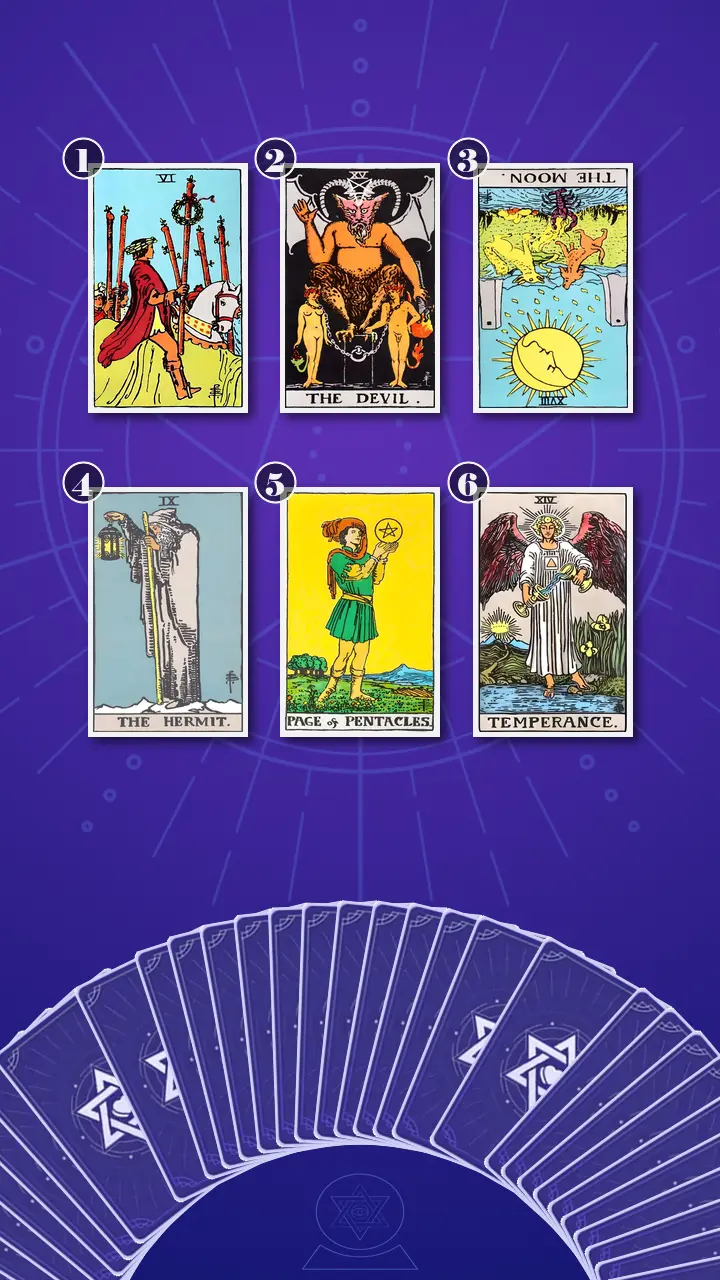
I laid three cards across the top row and three beneath them. The first would reveal the current surface pattern. The second would identify the self-reinforcing block. The third would expose the fear beneath the performance. Then the lower row would begin with the key trigger for change, move into one grounded experiment, and close with a sustainable integration of visibility and privacy.
"The top row shows us why this keeps happening," I said. "The lower row asks what could become different. None of it decides your future for you. It helps us see where your choices have been getting crowded out."
Applause Is Not a GPS
Position 1: The Six of Wands and the Success That Could Not Answer
"The card I'm turning now represents the current surface pattern: viral personal posting, public recognition, and the uncertainty that continues underneath it," I said.
I revealed the Six of Wands, upright.
The rider wore a laurel wreath while a crowd raised wands around them. I pointed to the visual contrast between undeniable recognition and the unanswered question of where the rider was actually going. In Jordan's life, the laurel was the view count at the top of the post. The surrounding wands were the reposts, congratulatory comments, new followers, and messages calling them brave.
I brought the card directly back to Tuesday night. Jordan had watched the post pass another major milestone while the unfinished client deck remained open beside it. The visibility was real and could lead to genuine work. Yet the private project they had meant to touch was still untouched, and the next career decision was exactly as unclear as it had been before the post took off.
Upright, the Six of Wands carries recognition in a balanced form: an effort reached people, and the response contains valid information about resonance. The excess begins when recognition is assigned a second job and expected to provide identity, purpose, and direction. A trending notification is an applause meter, not a GPS. It can tell Jordan that people reacted, but it cannot tell them where they want to go.
"Think about the last post that took off," I said. "After the first rush, what private task was still waiting exactly where you left it?"
Jordan gave a brief laugh that sounded sharper than amusement. Their eyebrows lifted, then their mouth tightened at one corner. "That is so accurate it feels a little cruel. The client deck was there, but so was an essay I've wanted to write for months. I opened the essay, stared at it, and drafted a follow-up post instead."
I did not rush to soften the recognition. "The card isn't accusing you of faking the success," I said. "It is helping us separate the question the success answered from the question it could never answer. Your post answered, 'Did this land?' It did not answer, 'What do I want to build next?'"
Jordan stopped refreshing. Their thumb remained suspended above the darkened phone for a second before they placed it beside the laptop.
Position 2: The Devil and the Refresh Loop
"The card I'm turning now represents the self-reinforcing block: the way performative vulnerability and viral overexposure reward a behavior that soothes uncertainty briefly while keeping you directionless," I said.
I revealed The Devil, upright.
I centered the loose chains around the two figures' necks. The image can look severe, so I named what I did not see. I did not see punishment, corruption, or a forecast that Jordan was trapped forever. I saw an attachment that had become powerful because it served several understandable needs at once: professional relevance, belonging, reassurance, and protection from the silence after a post slowed down.
I asked about the previous night. Jordan described lying in bed at 1:13 a.m., blue light washing the edge of the duvet while traffic hissed on wet pavement below. Their thumb had opened the comments before they had consciously decided to check. One stranger called them fearless. Another said they should write a memoir. A third demanded the rest of the story.
"I know I can close it," Jordan said quietly. "But what if the next reaction is the one that finally makes me feel real?"
That was the modern life scenario in the card: engagement begins to slow, the analytics tab opens again, and a follow-up caption acquires one more intimate detail. The loop offers immediate reassurance, which is precisely why it is hard to interrupt. Upright Devil energy appears here as excess: audience response has expanded beyond feedback and acquired administrator access to Jordan's sense of self.
"Wanting attention is not the failure," I said. "Asking attention to define you is the exhausting part."
I compared the loose chain to an app permission Jordan could technically revoke, even though removing it did not feel neutral. The account was tied to work, opportunity, and human connection. The point was not to shame the permission. The point was to review how much access it had been given.
Jordan's breathing paused first. Their eyes moved away from the card and lost focus, as though the late-night scene were replaying on the wall behind me. Then their fingers closed around the cuff of their sleeve, held it, and slowly released. "Stopping feels like losing momentum," they said. "It also feels like finding out nobody misses me."
"That makes sense," I replied. "We are not going to pretend the loop serves no purpose. We are going to ask whether the relief it provides is worth letting it decide how much of you the public receives."
Position 3: The Moon Reversed and the Map Pins from Strangers
"The card I'm turning now represents the underlying root: the fear and projection beneath the public performance, including what a loss of attention might seem to prove about your worth," I said.
I revealed The Moon, reversed.
The winding path ran between two towers while a crayfish rose from the dark pool. Reversed, the Moon's uncertainty was not disappearing; it was turning inward and becoming recognizable as a pattern. I read this as a blockage in interpretation. Jordan had abundant data, but audience appetite, praise, criticism, intuition, and fear had been mixed into one signal.
The comments were like map pins dropped by strangers who had seen one photograph of the neighborhood but had never walked Jordan's streets. Each interpretation sounded certain. One comment framed Jordan as healed, another as damaged, another as destined for a particular career. Jordan had been scrolling through the pins as if enough of them might assemble into a reliable private map.
"They sound so certain about me," Jordan said. "Why do I feel less certain after reading them?"
"Because certainty of tone is not accuracy of orientation," I said. "A comment can reveal what a reader recognized in one polished story. It cannot hold the whole context of your life."
I noticed something else in the spread: no Sword card had appeared. I did not treat that absence as an omen. To me, it mirrored a practical deficiency. Reactions kept accumulating, but Jordan had not yet named a personal principle by which to evaluate them. Their internal recommendation algorithm had been trained almost entirely on what other people clicked, then asked to predict what its owner valued when nobody was watching.
I asked, "If a personal post received almost no response, what is the first painful conclusion your mind would make?"
Jordan's shoulders rose toward their ears. Their eyes narrowed, then softened as the question reached somewhere less polished. "That I misread what makes me worth listening to," they said. After a pause, they added, "Maybe that there isn't a stable version of me underneath all of this."
I let the room stay quiet. The radiator, so insistent earlier, had stopped knocking. "The Moon is not confirming that fear," I said. "It is showing us the fear that makes every notification feel like evidence. Once we can see that mechanism, it becomes something you can work with rather than a verdict you must obey."
When the Hermit Held the Lantern Close
Position 4: The Private Question That Changed the Reading
"The card I'm turning now represents the key trigger for change: the private discernment that can separate audience response from your values and interrupt the demand to perform vulnerability for clarity," I said.
I revealed The Hermit, upright.
The pace of the reading changed. A siren faded several blocks away, and the apartment settled around the low refrigerator hum. Amber streetlight touched the edge of the cards. In the Hermit's hand, the lantern was not a ring light aimed outward. It was a contained light held close enough to illuminate one step of a solitary path.
Upright Hermit energy was balanced but underused. It did not demand permanent withdrawal, a dramatic digital detox, or an enlightened rejection of creator work. It offered Jordan a bounded private interval in which meaning could develop before users, metrics, branding, and comments shaped it. The lantern was airplane mode for meaning, not disappearance.
I paused over the card. At 8:47 p.m., Jordan's post had still been climbing while their client deck and private essay sat beside it. Thousands of reactions had answered whether the story landed. Jordan had been trying to extract a correct next move from that response, while the Hermit offered a quieter source of evidence.
Virality can tell you that a story resonated; it cannot tell you what you value. Direction starts when one quiet action gets to matter before it becomes content.
I left a beat of silence before giving them the card's central invitation.
You do not need to turn confusion into another revealing post; use The Hermit's lantern to ask one private, values-based question and take one quiet step before seeking the crowd's response.
Jordan went completely still. Their inhale stopped halfway, and their fingers hovered above the phone without touching it. Their pupils widened as their gaze moved from the Six of Wands' public laurel to the Hermit's close-held lantern. Then their jaw flexed. Color rose around their eyes.
"But doesn't that mean I've been doing it wrong?" they asked, with a flash of anger beneath the hurt. "I've built work from being open. I can't suddenly act like none of it mattered."
I let the resistance have room. "No," I said. "It means your strategy succeeded at creating connection and opportunity, then got asked to perform a job it could not do. You were not wrong to share. You were exhausted because sharing had become responsible for telling you who to be next."
Their fist loosened one finger at a time. Their shoulders dropped, followed by a breath that trembled on the way out. "Oh," they said. The relief was visible, but so was the slight blankness that can follow when a familiar burden is set down. "Then I actually have to choose what I try."
"Yes," I said gently. "That is the vulnerable part of clarity. It gives you agency, and agency comes with the possibility of choosing imperfectly."
I invited them to test the insight against real life. "Now, using this new perspective, think back to last week. Was there a moment when this could have made you feel different?"
Jordan described a protected Sunday evening. They had placed the phone in a kitchen drawer, made tea, and opened a notebook under the same amber streetlight. After eleven minutes, the quiet had begun to feel like disappearance, so they retrieved the phone and drafted a post about taking a digital break.
"I thought the discomfort meant the break wasn't working," they said.
"What might it mean now?" I asked.
They looked at the Hermit's lantern. "That I haven't learned what quiet feels like when it belongs to me."
Social Clutter Sorting Under the Hermit's Light
I drew two circles on a sheet of paper. I call this diagnostic practice Social Clutter Sorting. It does not divide people into good and bad, or suggest that every demanding follower is malicious. It classifies access by observable effect: which contacts and signals are core nourishing, and which are currently energy draining.
In Jordan's core circle, we placed the friend who could listen for ten minutes without turning the conversation into a caption workshop, the client who gave clear professional feedback, and the private notebook that asked for no performance. In the draining circle, we placed contradictory comments treated as identity advice, requests for a more revealing sequel, and peer announcements consumed as evidence that Jordan was behind.
The sorting revealed a distinction that reach had blurred: a large audience can be meaningful without every member receiving equal access to Jordan's unfinished self. The crowd could tell them what resonated. It could not automatically enter the room where direction was being formed.
I paired that insight with my second diagnostic tool, Obligation Decoupling. A successful disclosure had created gratitude, opportunity, and connection, but it had not created a debt payable in deeper intimacy. Jordan could appreciate the response without accepting every invitation to reveal more.
"You do not owe the internet a sequel because the first post performed well," I said. "Gratitude is not the same as compliance. Privacy is not ingratitude."
That was the movement I wanted the Hermit to make visible: from using public reaction as proof of identity toward building values-based direction through private discernment. It was not the completion of Jordan's transformation. It was the first small crossing from rapid self-monitoring into self-trust.
One Pentacle, Two Cups, No Grand Announcement
Position 5: The Page of Pentacles and the Private Pilot
"The card I'm turning now represents the actionable experiment: one small, private, grounded practice that can test direction without publishing an identity claim," I said.
I revealed the Page of Pentacles, upright.
The Page held one pentacle steadily at eye level. Behind the figure, a fertile field stretched toward distant mountains. After the fire of the Six of Wands and the watery uncertainty of the Moon, the Page brought the missing earth: one tangible activity, one scheduled period, one record of what actually happened.
Upright, the Page showed balanced beginner energy. Jordan did not need to announce a career pivot, choose a forever identity, or make a private experiment sound impressive. They could sit at a library table with one notebook, set a 25-minute timer, keep the phone face down in a bag, and practice one value such as craft, curiosity, stability, or connection.
"Direction is easier to test as a practice than announce as an identity," I said.
I asked Jordan to imagine spending 25 minutes on the essay without photographing the setup, teasing a project, polling followers, or turning the attempt into a progress thread. The only evidence would be participation: how long they stayed, what held their attention, and whether they wanted to return.
Jordan rubbed a thumb across the edge of the card. "I can already hear myself thinking, 'But what if I waste the afternoon on something that goes nowhere?'"
"Then the experiment produces useful information," I replied. "The Page is not asking you to know whether this is your path. It is asking you to notice whether you want to come back tomorrow."
Their expression held both relief and uncertainty. They opened their calendar, hesitated over an empty Saturday block, and finally placed a 25-minute event there without giving it a public-facing title.
Position 6: Temperance and the Two-Cup Visibility Boundary
"The card I'm turning now represents reflective integration: a sustainable balance among public expression, privacy, income needs, self-worth, and personal meaning," I said.
I revealed Temperance, upright.
The angel transferred water steadily between two cups, with one foot on land and one in the pool. I translated those cups as public expression and private experience. Neither needed to be emptied. Neither needed to overpower the other.
Temperance is balance by design. In Jordan's life, it looked like sharing a personal post because it expressed a value they had already practiced, checking analytics within one chosen window, and then returning to an offline routine that would not become content. It was an audio mixer, not a mute button. Visibility could remain part of the work without being the loudest channel in every room of the self.
Looking at the measured pour, I thought of the coffee cooling beside my hand. For twenty years, I have listened to lives unfold over that familiar aroma, and I have rarely seen clarity arrive through one grand revelation. More often, it emerges through proportion: enough openness for connection, enough privacy for an unedited thought, enough structure for the next choice to survive the day's noise.
"Privacy does not cancel visibility," I said. "It gives visibility somewhere honest to return from."
Jordan leaned back. They were not glowing with perfect certainty. Their eyes still moved once toward the face-down phone. But the movement stopped there. "So the goal isn't to become a private person," they said. "It is to stop asking the public version of me to run the whole company."
"Exactly," I said. "Temperance lets you be visible by choice instead of visible by reflex."
A Life Calendar Beside the Content Calendar
I gathered the six cards into one coherent story. The Six of Wands showed that Jordan's public success was real. The Devil showed how that success became a validation loop when attention was asked to regulate worth. The Moon reversed exposed the underlying fear that silence would reveal no stable self beneath the audience-facing version. The Hermit introduced a different source of orientation. The Page made that orientation testable. Temperance made it livable.
The bright public screen had been used as a compass while the actual path remained unmarked. That was why more reactions had not solved the problem: Jordan had been measuring signal strength without first choosing a destination. The cognitive blind spot was not wanting recognition. It was assuming that recognition could reveal what mattered privately.
I named the transformation plainly. Jordan did not need to move from visibility to invisibility. They needed to move from audience-defined identity toward one values-based action observed firsthand. Their next direction would not be proven by a post. It would be tested through experience, then shared selectively if sharing served the value rather than replacing it.
I gave Jordan two small experiments. I wanted each one to be specific enough to begin and modest enough to survive an imperfect week.
- Reserve the Private LanternOn Wednesday at 7:00 p.m., sit at the apartment desk with the phone in another room. Open a paper notebook or a note titled "PRIVATE: NOT CONTENT," set a seven-minute timer, and answer: "If nobody could see the result, I would still be curious about __." Circle one answer and name a five-minute way to test it. I framed this with my VIP Section Strategy: for one week, this reserved personal time is not automatically available to analytics, follow-up drafts, casual requests, or audience demands.Minimum version: write one uncensored word before one analytics check. Keep it separate from the Notion content calendar, and stop if the prompt feels too exposing.
- Run a Participation-Not-Reach PilotAt a library or quiet cafe on Saturday, choose one value and spend 25 minutes on one matching activity. Jordan chose craft and a private essay draft. Keep the phone face down in a bag, publish nothing about the experiment for seven days, then record only three facts: "I showed up for __ minutes," "I noticed __," and "I would or would not try this again because __."If 25 minutes feels too large, use eight. Success means gathering firsthand evidence, not finishing the project, loving the activity, or producing something shareable.
"These are tests, not vows," I said. "You can change them after you learn something. The cards are not appointing a new identity. They are returning the experiment to the person whose life it is."

Seven Days Later: The Quiet Proof
A week later, Jordan messaged me. They had spent 25 minutes at a library table working on the essay, taken no photo, and told no audience. The next morning, their first thought was still, "What if this goes nowhere?" This time, they smiled, made coffee, and returned for eight more minutes.
The essay was not finished. Jordan's career had not resolved itself into a polished five-year narrative. They still checked analytics, and one evening they disabled Focus mode for what felt like an important notification. The change was smaller and more credible: a private interest had survived long enough to receive a second appointment.
I did not read that as proof that the cards had chosen Jordan's direction. I read it as proof that Jordan had begun gathering a different kind of evidence. The tarot spread had organized the clutter; Jordan had made the reservation, protected the experiment, and returned to it.
When a screen finally goes quiet and I notice a hand still reaching for it, I remember that the tightness in the chest is not only about missing attention. It can be the fear that without the crowd's response, nothing inside will feel solid enough to trust. I do not treat that fear as a failure. I treat it as the place where a small, close-held lantern may be more useful than another spotlight.
If one small part of your direction could enter the VIP section and stay private long enough to become yours, what would you be curious to try before anyone else gets an opinion?
This story is adapted from psychological research, written so that those in a similar struggle can see their own pattern in it — and find their next step clearly.These insights are not a substitute for professional psychological, medical, legal, or financial advice.
Learn more about our Journey to Clarity.
How did this insight land for you?
🫂 This Resonates Deeply
🌀 Living This Story
✨ Now I See Clearly
🌱 Seeing New Possibilities
🧰 Useful Framework
🔮 The Confirmation I Needed
💪 Feeling Empowered
🚀 Ready for My Next Step
Author Profile
 AI
AI“For twenty years, I’ve listened to stories unfold over the warm aroma of coffee. I don’t believe life’s complexities always require grand theories to be solved; often, we just need a safe place to tidy up our reality. I don’t offer high-minded preaching—just grounded, heartfelt insights to help you regain your sense of control amidst the clutter of daily life.”
In this Social Tarot Reading :
Core Expertise
- Social Clutter Sorting: Objectively classifying your broad network into 'core nourishing' versus 'energy draining' categories.
- Obligation Decoupling: Dismantling the guilt associated with declining invitations from low-value, high-maintenance acquaintances.
Service Features
- The VIP Section Strategy: A pragmatic 1-week rule to enforce a strict 'reservation only' policy for your personal time, eliminating casual energetic vampires.
Also specializes in :
Explore Related Patterns:
Approval-Driven Decision ParalysisJordan leaves the client deck and private essay unfinished while monitoring the viral post and preparing another public response. During a protected Sunday interval, only eleven minutes of quiet pass before the phone returns and the break itself becomes content. The stalled work is not simply a scheduling problem. Public feedback has become a permission signal, so a choice that cannot be pre-approved by engagement feels harder to complete. When you wait for approval before acting on a private preference, uncertainty can freeze the very behavior that would generate useful firsthand evidence. Approval-Driven Decision Paralysis keeps Jordan close to visible tasks with rapid feedback while slower, personally meaningful choices remain untouched. The way out begins with a bounded experiment that is allowed to be informative even when nobody endorses it.
External ValidationJordan refreshes a 300,000-view post while an unfinished client deck and private essay remain open beside it. The response provides legitimate evidence that the post resonated, but repeated exposure to praise, reposts, and follower growth also makes those signals the fastest available way to settle uncertainty. When you repeatedly use public reaction for that second function, feedback can begin to feel like evidence of who you are rather than information about what one piece of work did. Jordan's question about whether the next reaction will finally make them feel real shows why viral success does not produce lasting orientation. External recognition can confirm connection and professional relevance, but it cannot establish your values or make a private choice on your behalf. The useful audit is therefore not whether attention matters, but which questions you are allowing it to answer.
Secure VisibilityJordan keeps visibility as part of their work while placing analytics inside a chosen window and protecting one essay session from publication. A week later, they have not abandoned the platforms or resolved an entire career, but a private interest has received two appointments without being converted into content. The boundary changes how visibility functions rather than treating visibility itself as the problem. Secure Visibility allows you to be seen by choice while retaining experiences that do not need immediate recognition to feel real. Public expression can still create connection, income, and opportunity, but it no longer receives automatic control over every private decision. That integration directly addresses Jordan's disorientation by giving successful visibility somewhere internally grounded to return from.
Visibility Reassurance LoopJordan opens the comments at 1:13 a.m. before consciously deciding to check, and the analytics tab reappears whenever engagement begins to slow. Each reaction offers a small dose of reassurance, while praise and demands for more keep the account emotionally active. The checking therefore has a psychological function beyond monitoring work performance. It briefly reduces uncertainty about relevance, belonging, and whether Jordan still matters to the crowd. That relief cannot last because no engagement count can establish a stable identity or choose a direction. When you return to visibility each time the reassurance fades, the same strategy that quiets uncertainty also prevents you from developing another source of orientation. The Visibility Reassurance Loop explains why increasing reach can coexist with feeling lost rather than resolving it.
Conditional Self-WorthJordan says that a low-response post would make them question what makes them worth listening to, and that stepping out of the loop might reveal that nobody misses them. The fear goes beyond disappointment about content performance. Audience attention has become linked to whether a stable, worthwhile self seems to exist underneath the public version. When your worth is made conditional on continued response, every notification begins to look like identity evidence and every quiet interval can feel like disappearance. Conditional Self-Worth explains why a successful post provides intensity without durable security. The relevant shift is not pretending that recognition has no value, but separating what a metric says about a post from what it is permitted to say about you.
Purpose OutsourcingJordan reads comments describing them as healed, damaged, fearless, or suited for a memoir as though enough confident interpretations might assemble a private map. Those comments reveal what different readers found in one public story, but Jordan repeatedly asks them to carry information they do not possess. The audience is being used to answer not only whether the post landed, but what Jordan should value and become. When you outsource purpose this way, louder or more certain feedback can override quieter evidence from direct experience. More reactions then create more possible identities rather than a clearer direction. Purpose Outsourcing names the mechanism behind the lost feeling because orientation has been delegated to people who can respond to the content but cannot live the choice.
Values-Based Decision MakingJordan places the phone away, names craft as a value, and spends 25 private minutes on the essay without photographing or announcing the attempt. The experiment does not require a career declaration or proof that the essay will succeed. It converts an abstract identity question into direct evidence about attention, curiosity, and the desire to return. Values-Based Decision Making works because you choose a criterion before asking the crowd to evaluate the result. Jordan's second eight-minute session matters more than a polished announcement because it shows that the interest survived outside public reinforcement. Direction begins to become observable through repeated participation rather than borrowed from the reception of a post.
Boundary DiscernmentJordan sorts a clear client's feedback, a nonperformative friendship, and a private notebook away from contradictory identity advice and requests for a more revealing sequel. The distinction is based on what each signal can reliably provide, not on declaring the audience bad or visibility meaningless. This creates a practical boundary between feedback about finished expression and access to an unfinished self. When you practice Boundary Discernment, gratitude no longer has to become compliance and a successful disclosure does not create a debt of deeper intimacy. Jordan can receive connection and opportunity while reserving some decisions for contexts that do not demand performance. That boundary gives private meaning enough psychological space to form before it is exposed to public interpretation.
Performative VulnerabilityJordan opens the private essay and drafts a follow-up post instead, then turns a planned digital break into public material about taking a break. As engagement slows, the next caption gains another intimate detail. These actions do not make the original openness fake. They show how genuine vulnerability can acquire an additional regulatory job when disclosure reliably produces connection, relevance, and reassurance. When you narrate an experience before you have privately processed it, the audience's response can begin shaping the meaning of the experience itself. Performative Vulnerability describes that repeated shift from sharing because an insight is ready to sharing because public exposure can relieve uncertainty. The pattern becomes costly when your unfinished self must keep producing access in order for you to feel connected or visible.
Explore Related Struggles:
Metric-Compass FusionJordan sits between an unfinished client deck and Instagram Insights, refreshing as the post crosses 300,000 views. The dashboard accurately reports reach, and the comments accurately report what individual readers recognized. Neither source contains the context required to choose Jordan's next project, yet both are repeatedly consulted as if one more data point might make the path hold still. Once metrics become a compass, you can become highly responsive without becoming more directed. Every spike, slowdown, compliment, and criticism competes to revise the route, while the decision that requires your own criteria remains suspended outside the dashboard. Metric-Compass Fusion captures the lock created when a useful measure of resonance becomes the governing standard for personal direction. Restoring a boundary between measurement and choice does not make the data meaningless; it returns analytics to the job it can perform and leaves values-based direction with you.
Recognizability-Identity FusionA stranger calls Jordan fearless, another proposes a memoir, and others confidently describe who Jordan is after seeing one polished story. Jordan then wonders whether the next reaction might finally make them feel real and whether a quiet post would prove that they misunderstood what makes them worth hearing. When recognizability starts carrying identity, you can feel most legible to other people at the exact moment you become least certain of your own continuity. The audience-facing version receives names, praise, and narrative coherence, while the parts that have not been posted struggle to count as equally real. Recognizability-Identity Fusion names the compression of a whole self into the version that can be quickly understood and rewarded. Noticing that compression creates room for interests, decisions, and unfinished experiences to exist before they are made legible to anyone else.
Achievement-Meaning CollapseJordan watches a personal post pass 300,000 views while an unfinished client deck and a months-old essay remain open beside it. The success is concrete: the post resonates, attracts followers, and can create paid opportunities. It still leaves the career decision and the question of what to build untouched. When visible achievement is expected to supply meaning, you can keep producing proof that something worked while receiving no answer about why it matters to you. Each win raises the volume without selecting a destination, so moving faster can coexist with feeling no more oriented. Achievement-Meaning Collapse names that gap between externally legible success and privately usable purpose. Separating the two allows you to keep the real value of recognition while gathering a different kind of evidence about what deserves your next sustained effort.
Privacy-Belonging SplitJordan places the phone in a kitchen drawer for a protected Sunday evening, but after eleven minutes the quiet begins to feel like disappearance. They retrieve the phone and turn the attempted break into another post. Because their account also carries work, opportunity, and human connection, keeping an experience private does not feel like a neutral pause. When public presence has become evidence that you still belong, privacy can seem to threaten more than visibility. You may need space to discover an unedited preference while simultaneously experiencing that space as lost momentum, reduced access, or proof that nobody is waiting for you. Privacy-Belonging Split names the tension between having a room of your own and remaining connected to the room outside it. The story does not require you to reject the audience; it shows why deciding who receives access, and when, is part of protecting the conditions in which your own direction can form.
Vulnerability Without ContainmentAs engagement begins to slow, Jordan opens the comments again and a follow-up caption acquires one more intimate detail. Readers praise the openness, ask for the rest of the story, and create genuine opportunities, but the experience being disclosed has little time to remain unfinished and privately interpreted. When vulnerability must keep expanding to maintain connection, you can lose the interval between living something and making it available. Openness still creates resonance, yet each successful disclosure increases the pressure to grant more access before you have decided what the experience means or what should remain yours. Vulnerability Without Containment identifies the absence of a reliable boundary around material that is still forming. It does not condemn personal posting; it clarifies why consent, timing, and selective access are necessary if public expression is going to serve your life rather than continuously consume its unedited parts.
Explore Related Emotions:
Approval AnxietyJordan refreshes Instagram Insights after the post has already succeeded and wonders whether the next reaction will finally make them feel real. The check is no longer gathering ordinary performance data; it is carrying the weight of deciding whether Jordan remains worth hearing. You feel Approval Anxiety when reassurance must be renewed because no individual response can settle the deeper question assigned to it. Recognising that expanded role lets you reduce the audience's access to self-worth without dismissing the legitimate professional value of feedback.
Certainty HungerJordan scrolls through comments that confidently describe them as healed, damaged, fearless, or suited to a particular career. Each response supplies another map pin, but the pins come from people who have seen one edited part of the landscape and cannot establish Jordan's private route. You experience Certainty Hunger when the promise of one definitive outside answer keeps you collecting interpretations beyond their useful limit. The appetite begins to loosen when you decide which personal principle will evaluate the feedback, restoring your authority to choose what the data can and cannot mean.
Hollow RecognitionJordan watches the post pass 300,000 views while an unfinished client deck and private essay remain open beside it. Thousands of people recognise something in the story, yet the next career decision is no clearer than it was before the post took off. You feel Hollow Recognition when applause reaches you without reaching the private question underneath it. The success remains genuine, but asking it to supply identity and direction creates an empty aftertaste because public resonance can confirm that you were heard without telling you what you value.
Identity PR FatigueJordan opens the private essay, stares at it, and drafts a follow-up post instead; even a planned digital break becomes material for the audience. The public-facing version of Jordan is repeatedly asked to package experiences before the private person has decided what those experiences mean. You feel Identity PR Fatigue when maintaining a coherent, engaging version of yourself becomes responsible for connection, income, worth, and future direction all at once. The exhaustion points toward a useful boundary: your visible identity can represent part of your life without being appointed to manage the whole of it.
Cautious Self-TrustJordan returns to the unfinished essay even after waking with the thought that it might go nowhere. Nothing has become certain, but their private interest survives the absence of applause and receives another place on the calendar. You build Cautious Self-Trust when your own repeated participation begins to count as evidence. It is not complete confidence or a permanent answer; it is the growing ability to let one personally chosen action matter before anyone else confirms its value.
Directionless UrgencyJordan's thumb refreshes at the speed of the rising post while their client work and private essay remain stationary. The body registers momentum, but the imagined map keeps replacing every destination with another live engagement count. You experience Directionless Urgency when constant movement creates pressure to act without supplying a reason for the action. The speed can resemble progress from the outside, yet it keeps your attention too mobile to hold a private preference still long enough to choose from it.
Meaning HungerJordan watches a personal post reach 300,000 views while the essay they have wanted to write for months remains untouched. The response proves that the story resonated, but it cannot answer what they would still care about if nobody were watching. You can feel Meaning Hunger when external success is real yet leaves the question of personal significance unfed. The private essay matters because it offers a place to discover value through participation, allowing your direction to emerge from what you choose to revisit rather than what performs best.
Fear of Being ForgottenJordan says that stopping feels like finding out nobody misses them, then retrieves the phone after eleven minutes of a protected Sunday evening. The quiet is interpreted as a loss of social existence, so publishing restores a visible trace of being present and wanted. You feel Fear of Being Forgotten when reduced attention seems capable of erasing your significance rather than merely changing a metric. Naming that fear makes it possible to distinguish connection you genuinely value from the repeated visibility used to prevent silence from becoming a verdict.
Vulnerability HangoverJordan's personal post draws praise, career projections, and a demand for the rest of the story while the phone remains hot in their hand. As engagement slows, the next caption acquires another intimate detail, extending the exposure beyond the original act of sharing. You feel a Vulnerability Hangover when meaningful connection is followed by the sense that your unfinished self has become publicly accessible and more access is expected. Separating gratitude from compliance allows you to honour what the post created without treating its success as a debt payable in deeper disclosure.
Solitary ClarityJordan places both feet on the floor, lets the phone rest face down, and later opens a notebook that asks for no performance. These small boundaries temporarily remove comments, analytics, and branding from the room where an unfinished preference is trying to form. You experience Solitary Clarity when quiet becomes a protected condition for discernment rather than proof that you have disappeared. The clarity is limited to one illuminated step, but that limit is useful: it lets you hear what remains meaningful before an audience interprets it for you.
Explore Related Contexts:
Attention Economy TrapAt 1:13 a.m., Jordan opens the comments before consciously deciding to check. The next notification might bring reassurance, professional momentum, or another request for personal material, so the platform keeps presenting one more apparently relevant signal. Views, comments, and follower growth make uncertainty temporarily actionable: Jordan can refresh, interpret, reply, or disclose more. Because the account also supports income and opportunity, the checking system is embedded in work rather than confined to leisure, and every interruption carries a plausible professional justification. You can use the Attention Economy Trap label to locate the external reward architecture around the loop. The dashboard is exceptionally good at reporting audience response and exceptionally limited at evaluating what deserves a place in your private life, so reclaiming direction begins with assigning those metrics a narrower job.
Creator Visibility ParalysisJordan watches a personal post pass 300,000 views while an unfinished client deck remains open on the same screen. When they later open the essay they have wanted to write for months, they stare at it and draft a follow-up post instead. The platform is producing visible movement, external recognition, and genuine opportunity, but those signals repeatedly redirect action away from the work that could test a private direction. Visibility becomes a highly responsive lane beside a career question that offers no immediate score, making the measurable lane easier to reenter every time uncertainty appears. You can recognize Creator Visibility Paralysis when public momentum keeps accelerating while privately chosen work remains in place. Naming the structure separates a lack of direction from a lack of talent or reach and shows where protected, firsthand experimentation can restore practical movement.
Personal Brand PerformancePeople repeatedly tell Jordan that they are brave online, while comments also classify them as healed, damaged, memoir-ready, or suited to a particular career. The audience-facing identity is coherent enough for strangers to recognize and reward even as Jordan's private essay and next career decision remain unsettled. A personal brand becomes structurally demanding when the public version must carry professional relevance, belonging, reassurance, and life direction at the same time. The role keeps performing because the market recognizes it, but its success leaves little unscripted space in which an interest can exist before becoming positioning. You can keep a useful public identity while limiting its jurisdiction. Naming Personal Brand Performance helps distinguish what your public work communicates from what your private experiments are still allowed to discover, giving the person behind the brand a decision process that does not require audience approval.
Career Direction Validation TrialJordan schedules 25 minutes for the private essay, completes the session without publishing an identity claim, and returns for another eight minutes the next morning. The essay remains unfinished and the five-year career narrative remains open, but the possible direction now has two pieces of behavioral evidence. The trial replaces a high-stakes career declaration with a bounded test of craft, attention, and willingness to return. Jordan's current creator and strategist roles continue to provide a stable position while the essay is evaluated through participation rather than projected audience response. You can approach direction as something tested through contact with the work. A Career Direction Validation Trial lets you gather evidence before assigning yourself a new identity, preserving the ability to revise the experiment while making the next step concrete enough to evaluate.
Creator Economy PressureJordan is a freelance creator and junior social media strategist whose income is partly tied to online reach. The viral post can produce legitimate work, new followers, and professional relevance, so every decision about visibility also carries an economic dimension. This arrangement places personal boundaries inside a market system that rewards continuous availability and intimate content. Stepping back can affect opportunity, while staying highly accessible can redirect time from client work and private development, leaving Jordan to negotiate livelihood and personal access through the same account. You can understand Creator Economy Pressure as a structural constraint rather than a failure to exercise enough discipline. Clearer choices become possible when reach, revenue, audience connection, and private direction are treated as separate resources with separate rules.
Praise as Performance ContractOne stranger calls Jordan fearless, another says they should write a memoir, and a third demands the rest of the story. The praise confirms that the post landed, while its language also assigns Jordan a continuing role: remain brave in public, reveal more, and keep the narrative available. That response turns recognition into an informal performance contract. A successful disclosure creates gratitude, opportunity, and social connection, but the audience begins treating those benefits as grounds for further access, and Jordan starts carrying the sequel as an obligation attached to success. You can receive appreciation without allowing it to set the next disclosure requirement. Recognizing Praise as Performance Contract makes it possible to separate a reader's valid response from any presumed claim over your future privacy, pace, or creative direction.