From Therapy Performance to Honest Contact: Naming What Stalled

When Performing Progress in Therapy Felt Safer Than Saying I'm Stuck
I met Jordan (name changed for privacy), a 28-year-old communications coordinator in Toronto, at the moment before work when therapy homework had quietly become a quarterly update. At 7:18 a.m. on a Tuesday, they reopened a Google Doc before checking Slack, turned scattered notes into three neat bullets, and watched the cursor blink beneath the sentence they had deleted. The kettle clicked off; cold screen light lay across the table; their phone was warm from repeated edits.
Jordan could explain therapeutic patterns, boundaries, and emotional reactions with impressive precision. But when their therapist asked, 'What changed since last time?' they mentally sorted the answer into wins, lessons, and evidence before admitting the same behavior was still happening. When I asked why they kept performing progress instead of saying, 'I am stuck,' they answered, 'I can explain the pattern, so why am I still doing it? If I admit I am stuck, the whole session will show that I have failed.'
Shame was not a vague cloud around them. I could see it as a wire pulled tight from jaw to sternum, holding the breath high and turning every unfinished thought into something that needed better wording. Beneath the fear of exposure, I heard a quieter longing: Jordan wanted genuine help and closeness, but wanted to control what being understood might reveal.
I am Esmeralda Glen. As the seventh generation of a Highland healing family, I have spent sixty-seven years watching seasons change without asking them to produce a polished report. I told Jordan, 'I do not hear a character flaw here. I hear a protective strategy that has become exhausting. Let us use the cards as a mirror, not a verdict, and draw a map through the fog together.'
Choosing a Ladder for the Unfinished Work
I asked Jordan to place both feet on the floor, take one unforced breath, and hold the question in plain language. I shuffled slowly, treating the pause as a transition from performance mode to observation, not as a supernatural test.
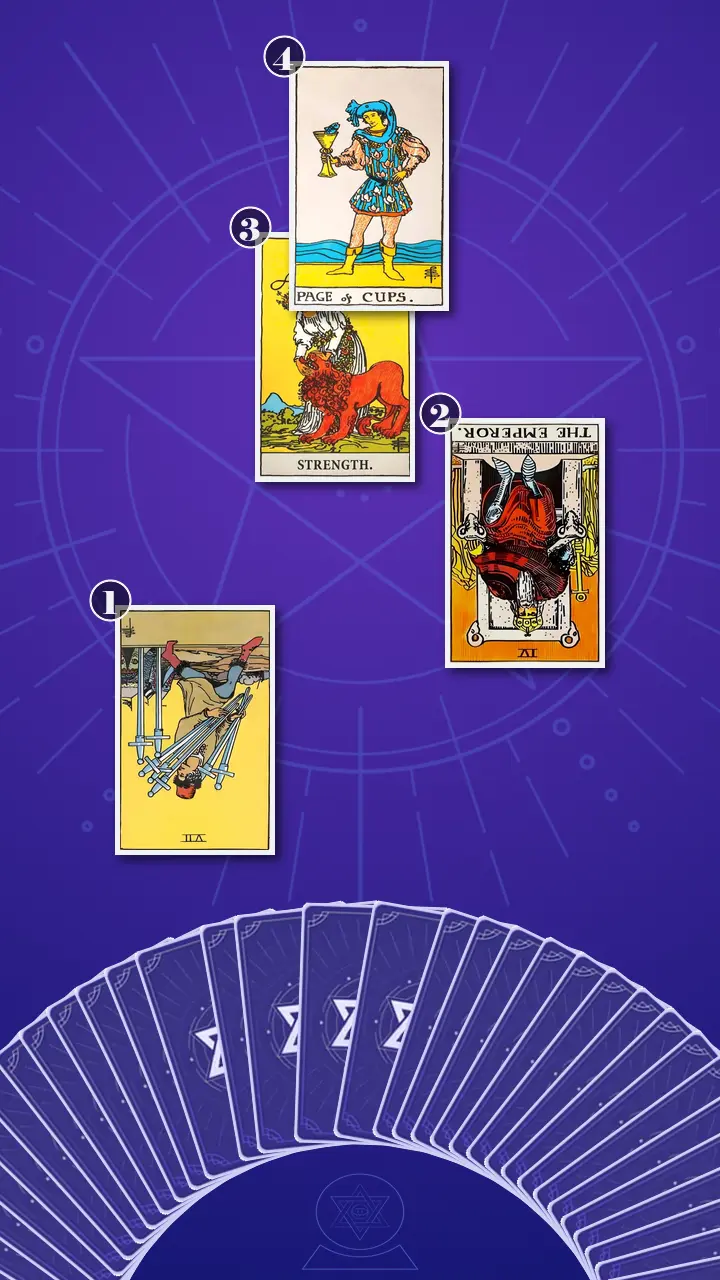
For this self-reflection, I chose the Four-Layer Insight Ladder · Context Edition, a four-card linear tarot spread for feeling stuck in therapy. This is how tarot works in my room: the images give a structured surface for noticing patterns that ordinary explanation may smooth over. I read card meanings in context, alongside the person's lived choices and observations.
I chose this spread because the question describes a repeating loop. It can show the visible report, the hidden rule maintaining it, the leverage point that interrupts it, and one practical next step. A larger spread, such as the Celtic Cross, would add past, environment, hopes, and outcome positions that could invite prediction or outside judgment. Four layers were enough to keep the focus on Jordan's choices, boundaries, and observations.
The first card would hold the present condition: polished homework and omitted stuckness. The second would look beneath it at the maintaining mechanism, the Power-Intimacy Split between controlling the frame and being genuinely seen. The third would name the transformative insight. The fourth would translate that insight into a modest therapy-room action. The ladder, I explained, was a way of climbing toward finding clarity one rung at a time.
The Report Beneath the Report
Position 1: The Sentence Left in Version History
Now I turn over the card for the position called Presenting pattern: the observable performance of progress, including polished therapy homework, rehearsed updates, and the omission of the sentence 'I am stuck.'
The card is the Seven of Swords, in reversed position. I focused Jordan on the figure glancing backward, the five swords carried away, and the two left standing behind. Reversed, this is not a declaration that Jordan is lying. It is a blockage becoming visible, the first movement toward coming clean with information that has been selectively managed.
Reversed, the Seven of Swords looks like Jordan opening a therapy homework document with five neat conclusions ready to carry into the appointment while the two unresolved swords stay outside the room: 'I did not do this,' and 'I do not know what to try next.' The behavior is selective editing used to make uncertainty manageable, not a moral verdict. A polished explanation can be true and still leave out the truth that matters most.
I asked, 'What sentence would you edit out if you were trying to look like therapy was working?' I described the Google Docs version history I could almost see: polished bullets above, a deleted line below, the cursor hovering over its blank space. Jordan gave a small, bitter laugh. 'That is too accurate. Almost cruel.'
I let the laugh have room before replying. 'You are not bringing no progress; you are bringing the part of the progress report that was edited out. We can be precise about the protection without shaming you for needing it.' Jordan's smile thinned, and their hand moved from gripping the phone to resting flat on the table. The recognition had landed, but it had not yet become permission.
Position 2: The Internal Competence Audit
Now I turn over the card for the position called Maintaining mechanism: the Power-Intimacy Split beneath the performance, including the internal rule that control and competence are safer than being genuinely seen in uncertainty.
The card is The Emperor, in reversed position. I pointed to the stone throne, the armor beneath the red robe, and the scepter and orb. Upright, the Emperor can give structure and boundaries. Reversed, that structure is in excess: a private authority has turned order into a performance standard, and every therapy session must look measurable, organized, and productive before it feels safe.
In modern life, this card turns therapy into a quarterly review. Jordan arrives with headings, metrics, action items, and a controlled agenda, just as they would in a polished Slack status update. The same structure that creates order also blocks the therapist from seeing where the work became unclear, repetitive, or emotionally unfinished. I thought of Severance, not as a diagnosis, but as a useful image: the capable professional role keeps functioning while the unprocessed part remains separated from the visible account.
Jordan's jaw tightened. I asked, 'When your therapist asks what did not work, what rule takes over? Is it, I need a measurable improvement, I need to sound self-aware, or I cannot let them see me unsure?' After a pause, Jordan said, 'If I cannot show measurable movement, they will see me as...' The sentence stopped there. I watched their chest brace around the missing word: incompetent, resistant, out of control, perhaps unworthy of respect.
I said, 'The goal is not to arrive unprepared; it is to stop making preparation prove your worth. We are not throwing away structure. We are asking structure to serve contact instead of replacing it.' Jordan looked down at the cards, shoulders still raised, but the report voice had gone quiet.
When Strength Met the Lion of Stuckness
Position 3: The Hand That Did Not Force the Lion
The room changed when I reached for the third card, the Leverage point: the shift that can interrupt the Inner Conflict by replacing proof of progress with honest contact and naming the stalled point. I turned it over slowly. It was Strength, in upright position.
The woman's calm hand on the lion's muzzle offered a different energy entirely. Here power is balanced, not absent. Strength asks Jordan to stay present with the tight chest, the pause, and the possibility of being understood, rather than overpowering the moment with another concept. One direct sentence can be a stronger act than another polished conclusion because it invites collaboration while keeping agency intact.
At this point I used my signature lens, Somatic Shadow Sensing. I do not mean the body is predicting an outcome. I mean I notice where the unsaid material has taken shelter: Jordan's jaw held the edit, the breath stayed high as if bracing for review, and the chest carried the fear that a blank answer would become a public verdict. The body was not the enemy of the insight; it was a record of the cost of maintaining it.
Before I said more, I asked Jordan to picture the 7:18 a.m. Toronto kitchen: the cursor after a messy sentence, the jaw tightening, three tidy bullets replacing the blank. They were carrying proof into the appointment while the unchanged pattern stayed outside, quiet but physically present.
Stop treating a polished progress report as proof of worth; let Strength's calm hand meet the lion of stuckness through one honest sentence.
You do not have to prove that therapy is working before you can tell the truth about where it stopped. Naming the stuck point is not a verdict on your competence; it is the information that lets real inquiry begin.
I waited. Jordan's breath froze first; their fingers hovered above the homework page, as if even touching it might restart the editing. Then their gaze lost focus and returned to the deleted line, replaying the moment they had replaced 'I did not do this' with a cleaner explanation. A quick flare of anger crossed their face. 'But does that mean I have been doing therapy wrong?' they asked.
I said, 'No. It means we have found information that was protected. You can decide what to share, how much context to give, and when to stop.' The HVAC clicked off. In the new quiet, Jordan's eyes shone, their clenched hand loosened one finger at a time, and their shoulders dropped with a long, uneven exhale. The relief was real, but it brought a brief light-headed blankness, the vulnerability of having a path without a script. Their voice came back softer. 'I could say I am stuck and wait one breath before explaining.'
'Now, use this new perspective to remember last week,' I said. 'Was there a moment when naming the stalled point could have made the conversation feel different?' This was not a demand for a breakthrough. It was the first step from shame-driven therapy performance and rigid self-monitoring toward embodied honesty, collaborative curiosity, and grounded self-trust.
Position 4: The Message Before the Explanation
Now I turn over the card for the position called Practical integration: the unfinished account that can enter the next appointment as a question, with a boundary around how much context Jordan chooses to share.
The card is The Page of Cups, in upright position. The fish rising from the cup and the Page's surprised, attentive posture made the message small and unmistakable. The emotional element is open and receptive, not flooding. This is the balance after Strength: curiosity can meet the feeling before expertise edits it into a conclusion.
In daily life, the Page of Cups is Jordan bringing the half-finished page, pointing to an answer marked unclear, and saying, 'I made this look more complete than it felt.' One unexpected feeling can appear in the notes app as a question rather than a mistake. Jordan does not lose intelligence or self-direction; they become a beginner for one honest moment, long enough for the therapist to respond to what is actually there.
Jordan's hands unclasped. They looked at the blue water on the card, then at their own unedited phone note. 'That sounds less like confessing everything and more like giving the session something real to work with,' they said. I nodded. 'Exactly. A partial message is still usable information.'
From Proof to Contact: Finding Clarity in One Unfinished Sentence
I gathered the four cards into a single story. The Seven of Swords reversed showed the edited report Jordan carries into therapy: visible effort in one hand, the repeated behavior and blankness left outside. The Emperor reversed revealed why the editing works: an internal ruler confuses control, competence, and completed homework with safety. Strength does not remove structure or demand surrender; it changes power into the ability to remain present. The Page of Cups gives that courage a form, one unpolished emotional sentence another person can meet.
The blind spot was not a lack of insight. It was the assumption that a clear explanation proves a changed pattern, while an exposed stall proves incompetence. That assumption kept mental static circulating through the same overstimulated system. My transformation direction was simple: move from shame-driven therapy performance, hyper-analysis, and rigid self-monitoring toward embodied honesty, collaborative curiosity, and grounded self-trust. Stuckness is information before it is a verdict.
I described this as Ecosystem Bandwidth Restoration. In nature, a living system does not regain capacity by forcing every cycle to look productive; it clears, rests, and makes room for exchange. Jordan had been running every feeling through a high-speed filter, trimming the messy material before it could be received. The point was not to abandon preparation, but to let one clean patch of mental bandwidth open around the truth.
For that opening, I offered my Grounding Transmutation Ritual. Before editing, Jordan could press both feet into the floor, notice the temperature and texture beneath them, loosen the jaw on one exhale, and name three physical sensations without explaining them. Then they could touch the homework page. It was a sensory practice for returning rumination to the body, not a magical shortcut and not a requirement to disclose anything.
I left Jordan with three bounded next steps:
- Ground, then leave one sentence uneditedBefore the next appointment, use the Grounding Transmutation Ritual, then open the existing homework document and add one plain sentence beginning, The part I am not showing is... If it feels appropriate, read only that sentence to the therapist before giving context.Set a 10-minute timer. The shortest version is I am still stuck on this. Stop or reduce it to three words if the exercise feels too exposing.
- Keep structure, remove the auditTwo minutes before therapy, list only three headings: repeated, unclear, and want help with. Mark one homework answer unclear without researching a better therapeutic term, then ask at the start of the session, Can we look at the part I could not organize?Keep the preparation limit and choose what remains private. Do not replace rigid control with total disengagement.
- Let the feeling arrive firstChoose one repeated moment from the week, write the feeling underneath the explanation in a single word, and bring the half-finished note into the appointment. If it matches your experience, say, I made this look more complete than it felt.One sentence is enough. Let the therapist ask what would be useful to explore before adding the full explanation; a partial message is still usable information.

The Quiet Proof of an Unfinished Page
Four days later, Jordan sent me a message that read, 'I left the sentence in. I said I am still stuck on this before explaining. My therapist asked what would help us look at it.' On the walk home they felt exposed and did not edit that feeling into a lesson.
I did not read the message as proof that therapy was suddenly fixed. I read it as a small, sturdy change in the relationship with uncertainty. Jordan had brought unfinished work into collaborative inquiry, kept a boundary around how much to share, and discovered that being seen did not require arriving with a completed checkbox.
That is what the Four-Layer Insight Ladder offered: not a forecast, not permission from the cards, but a way to notice the loop and choose the next rung. The cards did not make Jordan the author of a new life. Jordan was. Tarot only held the image steady long enough for their own inner wisdom to become specific.
When your therapist asks what changed and your jaw locks around a polished answer, it can feel safer to prove competence than risk being seen as stuck and out of control, even while the part of you wanting genuine closeness is still waiting in the room.
If one unfinished sentence could arrive before the explanation, what small kind of honest contact would you be curious to notice in the room?