Idealizing Potential Until One Question Tested Emotional Readiness

The 11:40 p.m. Chat and the Unavailable Future
If your week is full of stand-ups, streetcar commutes, and plans with friends, but you keep Friday night unbooked for someone who has cancelled twice, this is what waiting for potential can look like. I met Maya, a 29-year-old UX designer in Toronto, with her phone turned face down beside my cards.
She had told me about the previous Wednesday at 11:40 p.m. She sat on the edge of her bed with a dating chat open, the phone warm in her palm, blue screen light catching the laundry chair in the corner while the radiator ticked in the quiet. She compared a tender voice note from two weeks earlier, where he had said, “I feel really comfortable with you,” with that evening’s vague reply: “This week is kind of wild lol.”
One small sign made her think the connection had finally changed; the next silence made her reopen Notes and type three compassionate explanations for why he might be overwhelmed rather than uninterested. Her chest had the tight, restless pressure of a phone vibrating in an empty pocket. She wanted emotionally ready intimacy, but she was investing in an idealized version of someone who remained emotionally unready.
“I know they are not ready,” she said, “but I can see who they could become. The connection feels too meaningful to dismiss just because the timing is bad. I keep wondering whether one more honest conversation would change everything.”
I listened without turning her hope into a character flaw. Her question was the one underneath searches like why do I romanticize emotionally unavailable people: Why do I keep idealizing people who never become emotionally ready?
“I am not going to ask the cards to predict whether this person will eventually choose you,” I told her. “We can use them as an objective map of the pattern you are living inside. We will separate what has happened from what you have had to imagine, then find the next small place where your own judgment can come back online. That is our Journey to Clarity.”

Choosing a Compass for Mixed Signals
I invited Maya to take one slow breath and name the question in present-tense language. Then I shuffled at an even pace, letting the sound of the cards create a simple transition from mental replay to deliberate attention. The point was not to summon an outside authority. It was to give her thoughts a structure sturdy enough to examine.
For this reading, I chose the classic five-card Shadow Spread. Although the presenting context was dating, the question was not how two specific people would interact. It was why the same pattern of idealization kept returning. This five-card structure is the smallest map that still covers the conscious symptom, the hidden projection, the fear underneath it, the behavior that maintains it, and the practice that can integrate it.
This is how tarot works in my practice: the cards provide symbolic prompts, while the evidence comes from the person’s lived experience. They do not make a decision for Maya, reveal a guaranteed future, or turn an emotionally unavailable person into a secret promise. They help bring a vague inner rhythm into audible focus.
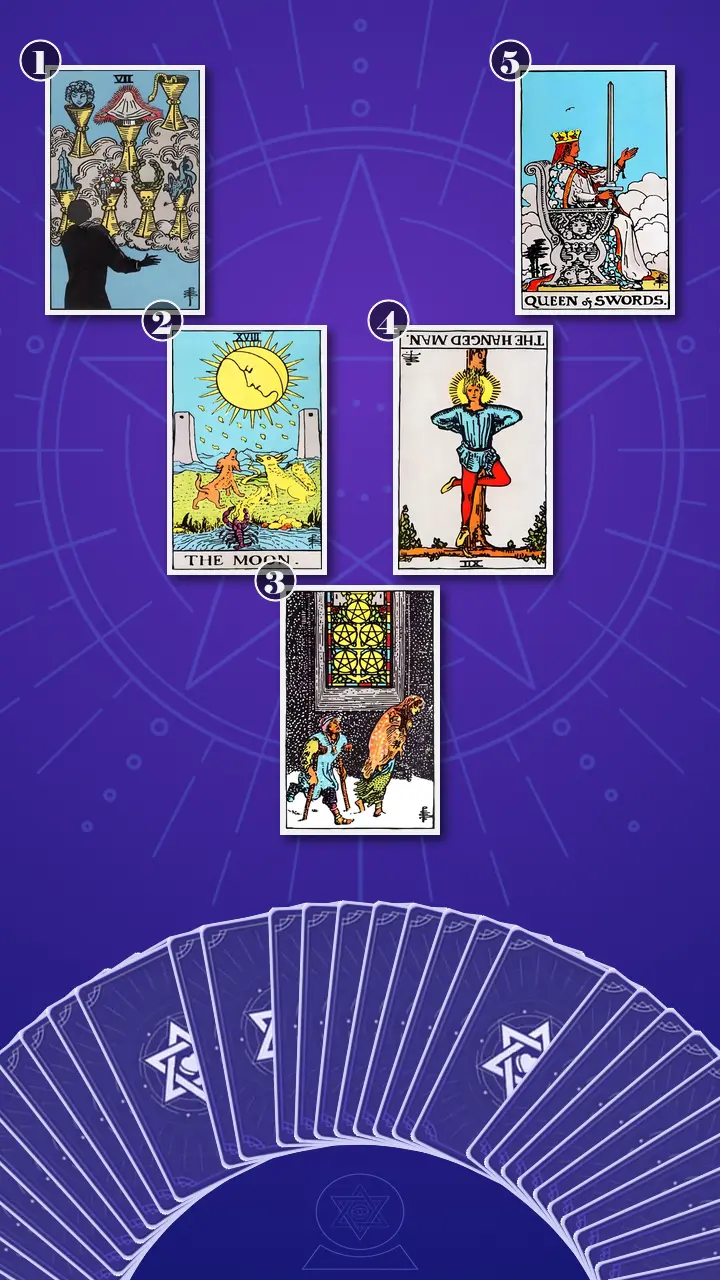
I arranged the cards in a shallow V. The first would surface the presenting behavior: magnifying brief signs of connection and treating imagined potential as evidence of readiness. The second would reveal the projection beneath that idealization. The central card would show the fear of being unchosen. The fourth would expose the suspended waiting that kept the pattern alive. The fifth would offer a conscious practice of discernment, direct communication, and self-respect.
I pointed to the descent and ascent of the layout. “We are going down through fantasy, ambiguity, and fear,” I said, “then back up through pattern recognition into clearer action. We are not condemning your imagination. We are giving it a boundary so it no longer has to do the job of evidence.”
The Cups That Kept Opening New Tabs
Position 1: The Future in Separate Browser Tabs
“Now turning over is the card representing the presenting behavior: magnifying brief signs of connection and treating imagined potential as evidence of emotional readiness.”
The card was the Seven of Cups, upright. I described the silhouetted figure facing seven cloud-borne cups, each carrying a vivid possibility: jewels, a castle, a veiled figure, a promise of reward. The figure could see everything, but could not physically hold any of it. In this position, the upright card showed an excess of emotional imagery and a shortage of present-tense proof. The feeling was real, but it had no reliable container.
I connected it to the voice note Maya had replayed. “A thoughtful late-night message after several thin days can open several future tabs at once,” I said. “You may begin screening scenes of weekend trips, being introduced to friends, finally receiving a vulnerable conversation, or hearing them say they are ready. They did not say it, but maybe it means they are getting closer. They did not make a plan, but maybe it means they are scared. One demonstrated moment starts carrying the weight of a whole imagined relationship.”
I asked her to notice the difference between the relationship she could describe vividly and the relationship she could point to in repeated behavior. This was not a demand to become cynical. It was the first version of a Potential-to-Proof Check: let possibility remain possibility until the person’s actions make it more solid.
Maya did not nod. First, her thumb stopped moving against the edge of her phone. Then her eyes left the card and went briefly unfocused, as though she were replaying a private sequence of messages. Finally, she gave a short, bitter laugh and said, “That is too accurate. It is almost rude.”
“I understand,” I said. “The card is not accusing you of being foolish. It is showing how ordinary emotional details become powerful when you are longing for a mutual relationship. Hope is not the problem. The problem begins when hope outranks the evidence.”
Position 2: The Road That Disappeared Between the Towers
“Now turning over is the card representing the projection and unresolved ambiguity beneath the idealization: the missing information you keep filling with a preferred emotional story.”
The Moon appeared upright. Its winding path disappeared between two towers, while a dog and a wolf reacted beneath the lunar light and a crayfish emerged from the dark pool. I read the card as an uncontained Water current: intuition, empathy, and imagination moving quickly through an unclear landscape. The blockage was not that Maya could not understand another person. It was that she was using understanding to complete a road whose destination remained invisible.
I brought her back to the rainy Line 1 commute she had described. At 8:47 p.m., wet coats had smelled faintly of wool, the fluorescent carriage lights had buzzed, and the reply on her screen had read, “Sorry, been in my head lately.” She had refreshed the chat, checked recent Stories, and searched for signs of work stress, an ex, family trouble, or fear of intimacy.
“Maybe they are stressed; maybe they are scared; maybe they mean more than they can say,” I repeated gently. “Those explanations may be possible. But which one did they directly communicate? When missing information becomes a detailed emotional profile, it can feel like intuition while functioning as a soothing story.”
Then I gave her a distinction I use often: “Chemistry can be real and still not be a relationship offer. A warm conversation can be sincere and still exist inside a connection that does not make consistent room for you.”
Maya’s shoulders rose toward her ears. She rubbed the fogged edge of her phone with one finger, then looked at the chat as if the wording might rearrange itself. I asked, “What do you know from direct communication, what do you sense, and what are you adding so the uncertainty hurts less?”
Position 3: The Lit Window on the Other Side of the Cold
“Now turning over is the card representing the underlying fear that releasing the connection could feel like proof of being unchosen or lacking worth.”
The Five of Pentacles appeared upright. Two figures moved through falling snow beneath an illuminated stained-glass window. The window was visibly warm, but the people remained outside it. I told Maya that the card did not mean she was destined to be excluded. It showed the emotional equation that made an unavailable possibility feel safer than a definite loss.
I used the coffee-shop scene she had given me: a snowy Sunday near Queen Street West, an oat latte cooling beside her phone, streetcar bells scraping faintly through the glass while a couple shared a table inside. She had kept the afternoon open in case he finally reached out.
“If I stop waiting,” she said quietly, “I have to feel what waiting was protecting me from.”
“Yes,” I said. “And that feeling may be real without being a verdict. Their limit is information, not a verdict on your worth. Releasing an undefined connection can briefly feel like stepping outside the lit window of belonging, but it does not prove that this was your only doorway into mutual love.”
Her throat tightened. She pressed her lips together, looked toward the rainy window, and let out a long breath that seemed to come from below her ribs. I did not rush to brighten the moment. The purpose of this card was not to make the grief disappear. It was to let her see that she had been protecting herself from a painful meaning, not simply waiting for a person.
“When friends tell you to focus on behavior,” I continued, “they may be seeing the cold outside the window. You have been trying to preserve the image of warmth. Both observations can exist, but only one tells you whether this particular relationship is sheltering you.”
Position 4: The Draft That Stayed Suspended
“Now turning over is the card representing the maintenance strategy: postponing direct evaluation, remaining suspended, and treating waiting as evidence of devotion or insight.”
The Hanged Man appeared in reversed position. The suspended figure still carried a halo, but the useful pause had become a holding pattern. In this position, the reversal showed blocked perspective: Maya had already received enough information to ask a small question, yet she kept waiting for the information to become painless before allowing it to affect her choices.
I brought her into the mostly empty downtown tech office at 6:20 p.m. on Thursday. The HVAC hummed above her, Figma tabs glowed across a second monitor, and a cold coffee sat beside the keyboard. She had revised the same draft four times: “I like you, and I want to understand what you are looking for.” Each time, her stomach had knotted and her finger had closed the draft.
“A pause can create perspective,” I said. “But a pause can also protect a fantasy. You may have been calling it patience because patience sounds generous, while the calendar quietly keeps spending your attention.”
Maya looked down. “I am not waiting for more information,” she said. “I am waiting for the information to hurt less.”
That sentence changed the temperature of the room. I could see the sharp recognition arrive before she tried to soften it. Her fingers flexed once, and I sensed two competing impulses: send a long message that explained everything, or avoid the subject entirely and return to the safer loop of interpretation.
“Neither a long explanation nor a dramatic ultimatum is required,” I told her. “The card’s blocked gift is perspective. For one week, put observable action in one column and your interpretation in another. Do not decide everything at once. Just allow the record to speak before the next story does.”
She gave a small, uneasy smile. “So waiting is not automatically wisdom.”
“Waiting is not neutral when it keeps spending your attention,” I said. “You can pause without placing your life on hold.”
When the Queen of Swords Let Evidence Speak
Position 5: The Open Hand Beneath the Raised Sword
The room became very quiet before I turned the final card. Outside, a streetcar bell sounded once and faded, leaving the silence unusually clean.
“Now turning over is the card representing the integrative capacity: clear standards, direct questions, and decisions based on repeated behavior rather than imagined potential.”
The Queen of Swords appeared upright. Her sword was raised into the clear air above the cloud line, while her other hand remained open toward what approached. I read her constructive Air as the antidote to diffuse Water and suspended thought. She did not ask Maya to suppress tenderness. She asked her to give repeated communication and behavior the same authority she gave chemistry and empathy.
This was the key card, and I told Maya that its energy was clear discernment, self-respect, direct communication, and emotionally honest boundaries. The Queen’s sword could divide evidence from projection without cutting off the open hand that still wanted genuine connection.
I then used one of my signature tools, the Communication Dissonance Audit. I explained that I diagnose mixed signals not by the words spoken alone, but by the mismatch between emotional tempo and sustained frequency. I was not asking whether his warm message had been fake. I was asking whether the connection’s ongoing rhythm—plans made and kept, questions answered, vulnerability returned, emotional space reciprocated—matched the intimacy Maya heard in one beautiful moment.
“The question is not whether he has hidden depth,” I said. “The question is whether his current way of communicating gives you anything reliable to build with. A person can have unrealized potential. Potential is still not a present-tense offer.”
The Sentence Beneath the Clouds
I brought her back to the 11:40 p.m. bedroom: the warm phone, the ticking radiator, the old voice note above the vague reply, and her body already leaning toward the version of him she hoped was still there. She was caught between preserving hope and admitting that hope had been doing more work than the relationship.
Potential is not proof of readiness; let repeated behavior, clear questions, and the Queen's upright sword separate hope from evidence.
For a moment, Maya did not move. First, her breath paused and her eyes widened slightly. Then her gaze lost focus as if the last several weeks were being replayed without the usual compassionate edits: the cancelled plans, the delayed replies, the intimate words without present-tense commitment. Finally, her jaw loosened. Her closed hand opened on her knee, and a trembling exhale moved through her chest. Her eyes grew bright, not with panic, but with the painful relief of hearing a distinction she had been trying to form alone.
She looked at the Queen again. “That does not mean I have to stop caring,” she said, her voice quieter now. “It means I stop using caring as evidence that this can work.”
I asked her, “Now, use this new lens to think back to last week: was there a moment when separating repeated behavior from imagined potential could have let you feel differently?”
She named the third cancellation. He had said they should do something soon, but he had not offered another time. Her empathy had supplied the rest. The Queen’s sword did not make the moment meaningless; it made the information readable.
That was the first movement from hopeful preoccupation toward grounded openness guided by mutuality and evidence. The grief was still present. So was attraction. The change was that neither one was allowed to overrule Maya’s standards. She could remain open to connection without suspending her self-respect while waiting for someone else’s emotional readiness to arrive.
I also told her what I watch for when a clear question produces a defensive response. Through my Reactive De-escalation Mapping, I identify the high notes that can shatter emotional safety: sudden blame, sarcasm, demands that she prove her feelings, or withdrawal used to avoid a simple answer. I do not use those signals to label a person as bad. I use them to assess whether the conversation can remain honest and safe.
Evidence Before Investment
When I placed all five cards together, the story became coherent. The Seven of Cups showed how one intense interaction opened a series of imagined browser tabs. The Moon showed why the tabs stayed persuasive: every gap invited a compassionate explanation. The Five of Pentacles revealed the emotional cost beneath the analysis, the fear that ending the possibility would confirm Maya was not the person anyone would choose. The reversed Hanged Man showed her waiting after the useful insight had already arrived. The Queen of Swords offered the missing structure: name what is needed, ask clearly, and compare words with repeated action.
I told her that she was not failing to understand him. She was allowing imagined future intimacy to carry more weight than the relationship currently being offered. It was like approving a product roadmap from a beautiful Figma prototype before checking whether the feature had ever worked in production. It was also like falling in love with a film trailer and waiting indefinitely for the full story to be released. The trailer could be moving. It was still not the completed relationship.
Her cognitive blind spot was not a lack of information. It was the belief that one more explanation, one more patient month, or one perfectly phrased conversation would turn inconsistent evidence into consistent availability. The transformation direction was more practical: move from judging a person’s imagined potential to recording whether their current, repeated actions meet a short list of mutuality and emotional-readiness standards.
“This is not a cold or transactional way to date,” I said. “It is a way to stop asking imagination to perform the job of evidence. You decide what standard matters to you. You decide how much investment is appropriate. The cards can clarify the pattern, but you remain the person who chooses the next step.”
The One-Page Potential-to-Proof Check
- Separate the signal from the storyBefore replying to the next vague dating message, open a two-column note titled What happened and What I made it mean. For five minutes, record only the exact words, timing, and action in the first column, then place your explanation in the second.Implementation tip: If tracking feels intense, log only one interaction this week. The goal is not to grade a person; it is to let observable behavior have a voice.
- Name one readiness standard and ask onceChoose one standard, such as plans are made and kept or a direct question receives a direct answer. When you genuinely want clarity, ask: “I enjoy seeing you. Are you open to building something consistent right now?” Then observe the answer and the following seven days of contact, plans, and openness.Implementation tip: Before sending, use my Syncopation Pause: put the phone down, listen to one steady sound in the room, take three quiet seconds, and let your emotional BPM lower. Do not add a long explanation that makes the question easier to avoid.
- Return one evening to your own lifeChoose one Friday or weekend evening you would normally leave open for a maybe, and make a 45-minute plan that does not depend on a reply: a nearby class, dinner with a friend, a gallery visit, or a solo walk with a podcast. If the person texts later, answer when convenient rather than cancelling the plan.Implementation tip: This is not a test or a performance. It is a calendar boundary. You can leave early, keep your phone off for twenty minutes, and notice one thing that feels different when your time is no longer a waiting room.
I emphasized that the direct question was not a demand for a lifelong decision. It was a present-tense invitation to see whether mutuality existed now. If the conversation became heated, Maya could use the Syncopation Pause before responding, then step away if she felt flooded. Clarity does not require her to remain in an emotionally unsafe exchange.

A Week Later: The Quiet Proof
Six days later, I received a message from Maya while I was making tea. She had used the two-column note after he sent another warm but indefinite text. The first column said that he had replied after four days, suggested seeing her soon, and offered no time. The second said that she wanted those words to mean he was finally ready. She read the two columns twice, then chose not to build a third explanation.
That evening, she asked the short question. He answered that he liked her but was not able to build something consistent. Maya told me she did not debate him, translate his answer, or send a second message to make it easier to hear. She protected the evening she had left open, met a friend near the waterfront, and let the answer be information rather than a verdict.
She slept through the night, but woke with the thought, “What if I got it wrong?” This time she smiled, opened her calendar, and kept the gallery plan. The question remained; it no longer owned the day.
I do not call that a perfect ending. I call it a small, real proof of agency. The connection had not transformed into the relationship Maya wanted, but her relationship with evidence had changed. She had moved from anxious hope invested in imagined future intimacy toward grounded openness guided by mutuality, self-respect, and repeated behavior.
That is the heart of this Journey to Clarity. A tarot reading cannot make another person emotionally ready, and it should never ask you to wait for a prediction. It can help you hear the difference between the emotional music of a possibility and the steady rhythm of a relationship that is actually making room for you. You remain the author of the boundary, the question, and the next small act.
When you keep your phone face-up and your weekend half-empty for someone who will not clearly meet you, it can feel less like waiting for a text and more like trying not to hear the old fear that you were never going to be chosen. If you let their repeated behavior be the information for just one week, what small piece of your time or attention might you want to return to yourself?