The 11:52 p.m. Photo That Turned Into a Performance Review
You see an old yearbook photo in a group chat and suddenly you’re doing a full “life audit” in your Notes app instead of going to sleep—classic timeline shame.
Jordan told me that line almost verbatim, but what I remember most wasn’t the words—it was the way her hand hovered over her phone like it had its own nervous system.
She described the exact slice of time: 11:52 p.m. on a Tuesday in her Toronto bedroom. The blue light from her phone painted the ceiling in a cold aquarium glow. The phone itself was warm from being gripped too long. The room was dead quiet except for that low fridge hum you only notice when you should be asleep. She toggled between the yearbook throwback and LinkedIn “just for a minute,” and her chest tightened as if someone had quietly cinched a strap around it.
“Seeing that photo made me feel like I missed a deadline I didn’t know I had,” she said, almost like she was embarrassed to admit it. “It’s not that I hate my life, it’s that it doesn’t look impressive on paper.”
I watched her swallow, then press her thumb to the side of her mug like she could smooth out the feeling. Shame has a particular physics to it. In Jordan’s body it landed as a tight chest with a hollow, dropping sensation in her stomach—like the floor in a condo elevator stuttering for half a second, just long enough for your body to panic before your brain can explain it.
“You’re not broken for reacting,” I told her, keeping my voice gentle and practical—the way I talk to people in my café when they come in looking steady on the outside and wrecked behind the eyes. “A memory isn’t a report card—until your brain turns it into one. Let’s try to draw a map through the fog. Not to predict your life. To help you find clarity and one real next step.”

Choosing the Compass: The Horseshoe Spread for Timeline Shame
I asked Jordan to take one slow breath in and out—not as a mystical thing, just a clean transition from spiraling into noticing. While she held her question in mind, I shuffled the deck the way I tamp espresso grounds: steady, repetitive, not rushed. A small ritual is sometimes just a way to tell your nervous system, we’re here now.
“Today we’ll use the Horseshoe Spread,” I said. “It’s a classic.”
For you reading this: the reason I chose it is simple. When someone asks, “Why do I feel behind, and what’s next?” they usually don’t need a dramatic prediction. They need meaning and a practical direction. The Horseshoe Spread is designed for exactly that arc—past imprint, present pattern, hidden driver, the main blockage, outside pressure, advice, and a grounded direction. It shows how one trigger (like a yearbook photo) activates a whole inner storyline, without forcing a deterministic outcome.
As we lay seven cards in a gentle arc, a few positions do the heavy lifting in this kind of reading: the present-day pattern (what you’re reinforcing), the main blockage (the loop that keeps you stuck), and the advice card (the reframe that restores self-trust). When the cards are placed in a curve, it also visually reminds you: you don’t fix the feeling by jumping ahead. You walk the bend with awareness.
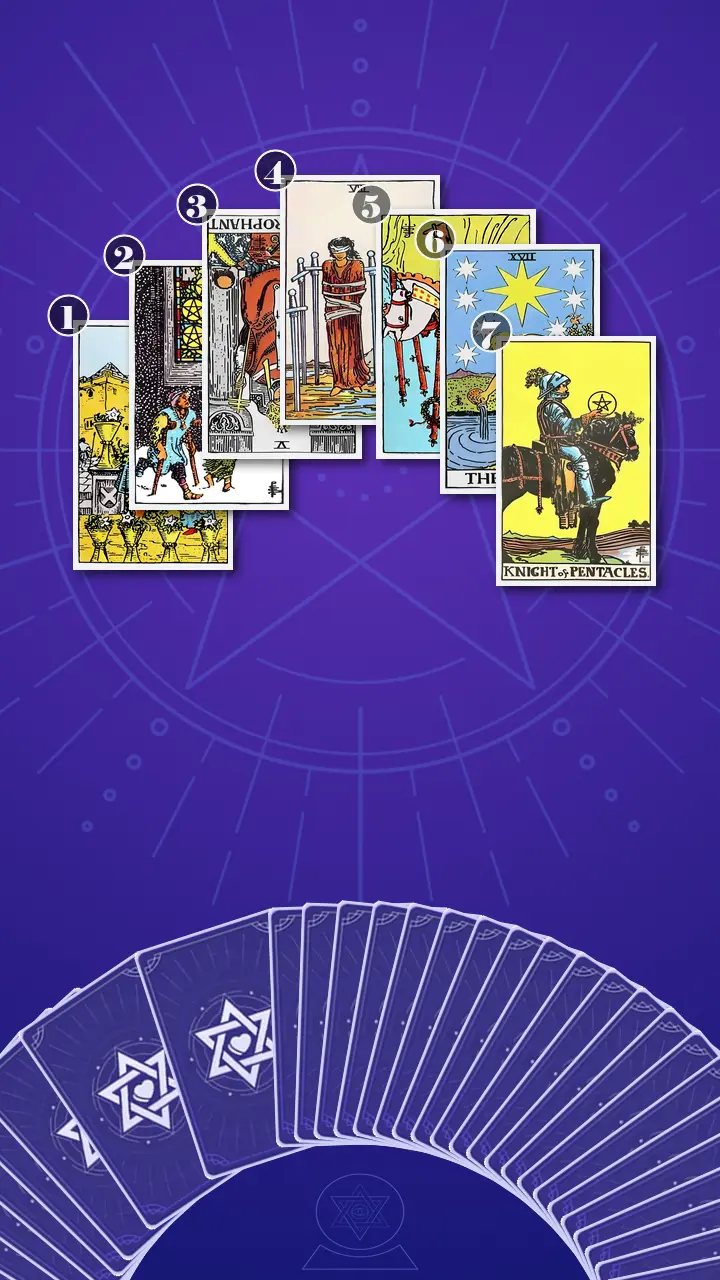
Reading the Arc: Card Meanings in Context
Position 1: What the yearbook photo is emotionally plugging into
“Now flipping over is the card that represents what the yearbook photo is emotionally plugging into—the memory-imprint behind the reaction.”
Six of Cups, upright.
I nodded at the image like I recognized an old regular at my café. “This is that exact moment when something innocent turns into a measuring stick,” I said.
In modern life, it looks like this: a friend posts a yearbook throwback in the group chat and you feel a genuinely soft, sweet nostalgia for about three seconds—then it flips. You start comparing ‘who you were supposed to become’ with ‘what you can prove today.’ The memory becomes a benchmark, and suddenly you’re auditing your life like it’s overdue homework.
Energetically, this card is balanced at the start—warm water, a real tenderness. But it can tip into excess when the sweetness becomes a standard your present self can’t possibly meet. The cup with the white flower is the clue: a pure, lovely thing that your brain turns into a purity test.
I used the “sweet-to-sharp” switch on purpose. “It starts as ‘Aww, look at us,’” I said, and then I softened my voice into the sharper edge: “‘Wait—what did I do with all that time?’”
Jordan let out a short laugh that was half recognition, half sting. Her shoulders lifted toward her ears, then dropped—like her body was admitting the truth before she wanted to.
Position 2: The observable present-day pattern of ‘feeling behind’
“Now flipping over is the card that represents the present-day pattern—what ‘feeling behind’ looks like in real life.”
Five of Pentacles, upright.
“This is the ‘outside the lit window’ feeling,” I said. “Not always because you’re actually excluded. Because you feel excluded.”
In modern life: you’re alone at night, scrolling LinkedIn and Instagram after the photo, and your brain interprets everyone’s milestones as a locked door you’re standing outside of. Even if you’re paying rent and showing up at work, it feels like you don’t ‘belong’ in the room where real adulthood is happening—so you focus on what’s missing and call it failure.
Energetically, this is deficiency—not of talent, but of perceived belonging. Your attention gets magnetized to what you don’t have. The lit window in the card is the part I always point at: support exists, warmth exists, real progress exists. The figures just don’t turn toward it.
Jordan’s reaction came in a three-beat sequence I’ve learned to watch for.
First, physiological freeze: her breath paused, and her fingers stopped moving mid-fidget on the mug handle.
Then, cognitive seep: her gaze unfocused past my shoulder as if her brain was replaying a scroll—promotion posts, engagement rings, rooftop birthdays—like a highlight reel she didn’t audition for.
Then, emotional release: she exhaled through her nose, a small sound like she was trying not to make it a big deal. “It’s weird,” she said. “My job is… fine. I pay my bills. But one LinkedIn post and suddenly I’m convinced I’m failing at adulthood.”
“That’s exactly what this card does,” I told her. “It turns fine into not real.”
Position 3: The deeper belief system behind the comparison reflex
“Now flipping over is the card that represents the hidden driver—the belief system behind the comparison reflex.”
The Hierophant, reversed.
“Underneath the spiral is an internal committee,” I said, tapping the card lightly. “It keeps asking, ‘Will this look legitimate?’”
In modern life, it looks like this: you don’t even fully want the conventional checklist—but you still use it as the scoreboard. So you feel guilty for craving a more personal path and anxious because you can’t summarize your life in socially approved milestones.
Energetically, reversed Hierophant is blockage—not because tradition is evil, but because you’re letting rules you didn’t choose run your self-worth. Those temple pillars become an invisible set of rails in your head: title by age, relationship by age, “impressive” by age.
I asked her the question this position demands: “What’s one ‘by this age I should…’ sentence you would never choose on purpose if no one else could see your life?”
Jordan’s mouth twitched like she was deciding whether to confess. “By 30, I should… have something that looks like a clear identity,” she said. “A title that makes sense. Something people don’t have to ask follow-up questions about.”
“That’s the committee talking,” I said softly. “Not you.”
Position 4: The main internal blockage that keeps you stuck in analysis
“Now flipping over is the card that represents the main internal blockage—the loop that keeps you in analysis instead of action.”
Eight of Swords, upright.
“This is the mind-made trap,” I said. “And it’s convincing.”
In modern life: you run so many scenarios (‘stay, leave, pivot, move, don’t move’) that every choice starts to feel like a trap. You treat uncertainty like danger, so you keep waiting for perfect clarity. The result: you do the safest thing—re-plan, research, rewrite—because it feels like action without requiring risk.
Energetically, this is excess Air—thoughts tightening into a cage. I mirrored her inner tabs out loud, rapid-fire, because that’s what the card feels like in the body: “If I stay, I’m settling. If I leave, I’m reckless. If I pivot, I’ll look flaky. If I don’t pivot, I wasted my potential.”
Jordan’s jaw tightened on instinct; I saw it in the little muscle near her ear. Her shoulders rose. Her breath got shallow.
“Planning can be a form of self-soothing… and still keep you stuck,” I said, making sure it landed as compassion, not a scold. “It gives you a hit of control. But it steals the one thing that actually creates clarity: a real-world step.”
She nodded once, small. “I make ‘Plan (FINAL)’ and then ‘Plan (actual final)’ and I feel calmer for like ten minutes,” she admitted. “Then it’s worse.”
“Because the plan becomes the substitute,” I said. “Not the bridge.”
Position 5: What in your environment is intensifying the ‘behind’ narrative
“Now flipping over is the card that represents external pressure—what around you is turning your life into a scoreboard.”
Six of Wands, reversed.
“This is visibility pressure,” I said. “Toronto can feel like a stage even when you’re just trying to live your life.”
In modern life: your environment is basically a highlight-reel machine—engagement posts, promotions, ‘I moved to X city!’ announcements. When you don’t have a visible milestone, your progress feels invisible—even to you. So you start chasing proof (titles, announcements, status) instead of choosing metrics that actually match your life.
Energetically, this is deficiency of inner validation paired with an excess reliance on applause. I said the line I use like a north star in social-media-heavy readings: “If it needs applause to feel real, it’s not a stable metric.”
Jordan’s eyes narrowed—not in disagreement, but in that “oh, I hate how true that is” way. She looked down at her phone face-up on the table and, very deliberately, turned it over.
When The Star Spoke: Practical Hope Instead of a Verdict
Position 6: The key reframing and emotional medicine
I let the room go quiet for a second. In my café, there’s a moment right after the espresso machine stops hissing when the whole place seems to inhale—the pause before the next thing begins. This felt like that.
“Now flipping over is the card that represents the advice—the emotional medicine that restores self-trust and future orientation,” I said. “This is the heart of your reading.”
The Star, upright.
In modern life: the antidote is a quieter kind of hope. You stop trying to outrun comparison and start rebuilding self-trust through small, repeatable actions that make your life feel like yours. Not impressive. Not optimized. Just honest, steady, and real enough that you can stand in it.
Energetically, The Star is balance returning after constriction. Two streams of water: one for emotional replenishment—what restores you. One for practical grounding—what you repeat.
As I spoke, I could feel Jordan still fighting for a “right answer.” That late-night, phone-warm urgency. Notes app open to yet another five-year plan—but the chest still tight. That’s the setup almost everyone with decision fatigue recognizes: you’re trying to solve your entire future in one sitting because you don’t trust it will hold you if you don’t.
Stop treating your timeline as a verdict and start treating it as a landscape you can heal and re-water, like The Star pouring steadily into the same ground.
I let the sentence sit between us.
Then the reaction hit—layered, not neat.
First, her face went still, eyes widening just a little, as if her brain had lost its usual argument for a moment.
Second, a flush rose in her cheeks and her eyes shimmered—not dramatic tears, just that thin edge of emotion you get when you realize you’ve been punishing yourself with a rule you never agreed to.
Third, she did something small but huge: her shoulders sank. Not slumped—released. Like she’d been holding a heavy tray all day and finally found a counter to set it down on. She exhaled, shaky at the end, and for a second looked almost dizzy with the unfamiliar sensation of not rushing.
“But if I stop treating it like a verdict,” she said, and there it was—brief anger, brief resistance—“doesn’t that mean I was… wrong? Like I wasted time?”
I shook my head. “No. It means you were trying to survive the feeling with the tools you had. The Star isn’t a scolding card. It’s repair. It says: the photo didn’t prove you’re behind. It proved you still care—and caring deserves nourishment, not a verdict.”
Here’s where my own café instincts become part of the reading. I have a practice I call Sacred Timing: coffee has peak flavor windows—minutes where it’s at its truest. If you try to force it outside that window, you don’t get better coffee; you get bitterness. Your life works like that too. Trying to force clarity at 1 a.m. through more scrolling and more planning is like drinking espresso that’s been sitting too long. It’s not proof you’re undisciplined. It’s proof you’re asking your mind to do a job it can’t do in that window.
“So,” I continued, “The Star gives you a different question: if you trusted your pace for one month, what would you stop doing for optics—and what small, consistent thing would you nourish instead?”
I watched her eyes move to the card again, the way someone looks at a map after being lost. “Okay,” she said quietly. “That feels… possible. Not easy. But possible.”
“That’s the shift,” I told her. “Not from confused to certain. From shame to a grounded kind of self-trust. From ‘I’m behind’ to ‘I can build evidence.’”
Position 7: A realistic, non-fated next-step direction
“Now flipping over is the card that represents the direction—what kind of progress you can choose to build now,” I said.
Knight of Pentacles, upright.
In modern life: what’s next isn’t a dramatic pivot—it’s choosing one realistic track and showing up for it long enough to create evidence. One skill, one routine, one project, one rhythm. Confidence comes from receipts: the small, boring proof that you can commit without needing it to be perfect.
Energetically, this is balanced Earth. No fireworks. Just follow-through.
“Evidence beats reassurance: one small step creates more truth than ten perfect plans,” I said, and Jordan actually smiled—small, but real—like something in her body recognized the relief of that.
From Insight to Action: A Private-Metric Reset You Can Start Tonight
I leaned back and stitched the spread into one clear story, because this is the part where a tarot reading becomes actionable advice instead of just an interesting mirror.
The yearbook photo (Six of Cups) isn’t the problem; it’s the spark. It plugs into an old expectation—who you thought you were supposed to become. Then, in the present (Five of Pentacles), your nervous system reads everyone else’s milestones as a locked door, so you self-exclude and call it failure. Underneath (Hierophant reversed) is that internal committee measuring you by inherited timelines you don’t even endorse. The blockage (Eight of Swords) is how your mind tries to escape discomfort by chasing perfect certainty—scenario tabs, five-year plans, endless re-routing—until you feel trapped. And your environment (Six of Wands reversed) amplifies it by rewarding what’s visible, not what’s true.
Your cognitive blind spot is this: you’ve been treating legibility as the same thing as alignment. If your life can be explained quickly at a wedding table, it feels safer—so your brain keeps optimizing for optics. But the transformation direction in this spread is different: shift from chasing a single “correct” timeline to building evidence-based self-trust through one consistent, values-aligned commitment.
To make that real, I offered Jordan a few small experiments—because the Knight of Pentacles doesn’t want a grand reinvention; it wants something repeatable.
- The 10-Minute “Star Reset” for comparison nightsTonight, set a 10-minute timer. Put your phone face down. Drink a glass of water. Then write two lines in Notes: (1) “What am I feeling?” (2) “What do I actually need?” Stop after two lines—no fixing, no planning.Expect your brain to call this “not productive enough.” That’s the training. If shame spikes, end early; the win is stopping the spiral, not finishing perfectly.
- One private metric for one week (no posting)Pick one private win metric for the next 7 days—something small and concrete (example: “2 focused work blocks,” “1 networking message,” or “3 walks”). Track it in Notes without telling anyone and without posting it.If it feels weirdly threatening to keep it private, that’s data. You’re unhooking from the applause scoreboard.
- The 30-day “one track” commitmentChoose one realistic track for 30 days that creates evidence: one course module per week, one portfolio edit session every Sunday, or one networking touchpoint every Wednesday. Put the repeating calendar event in your phone before you pick a “perfect” plan.Make it embarrassingly small. The goal is consistency, not intensity—Knight of Pentacles energy only shows up when you keep returning.
Before Jordan left, I added one more tool from my own practice: Aroma Anchoring. “Pick a scent you already associate with calm—fresh coffee, vanilla, even your hand lotion,” I said. “Use it only during your Star Reset. Over time, your body learns: this smell means I’m safe enough to stop proving.” It’s not magic; it’s nervous-system training.

A Week Later: Quiet Proof in a City That Never Stops Scoring
Seven days later, Jordan texted me a photo—not of a milestone, not of a new title. Just her Notes app. At the top it said: “Private Wins (Week 1).” Under it: three bullet points, plain and unpretty. Two focused work blocks. One message sent for an informational chat. One walk on a day she usually would’ve stayed on the couch doomscrolling.
“I didn’t post any of it,” her message read. “I wanted to, though. But I didn’t. And weirdly… it felt more real.”
Her follow-up was softer, honest in a way I trust: “I still had the stomach-drop once. I still wanted to rewrite my whole life at midnight. But I did the 10-minute reset and went to sleep. I woke up scared I’d regret not ‘figuring it out’… and then I laughed a little, because I realized I’m learning a different pace.”
That’s what a Journey to Clarity actually looks like. Not a dramatic reveal. A quiet shift from “I need a verdict” to “I can build trust.” From career crossroads panic to one repeatable step that makes your life feel like yours again.
When an old photo turns your chest tight and your stomach hollow, it’s not because you’re failing—it’s because you’re trying to feel proud in your own pace while fearing that anything less than a visible milestone means you wasted your potential.
If you didn’t have to ‘catch up’—just had to rebuild trust in yourself—what’s one small, repeatable thing you’d be willing to show up for this week?
This story is adapted from psychological research, written so that those in a similar struggle can see their own pattern in it — and find their next step clearly.These insights are not a substitute for professional psychological, medical, legal, or financial advice.
Learn more about our Journey to Clarity.
How did this insight land for you?
🫂 This Resonates Deeply
🌀 Living This Story
✨ Now I See Clearly
🌱 Seeing New Possibilities
🧰 Useful Framework
🔮 The Confirmation I Needed
💪 Feeling Empowered
🚀 Ready for My Next Step
Author Profile
 AI
AI“For twenty years, I’ve listened to stories unfold over the warm aroma of coffee. I don’t believe life’s complexities always require grand theories to be solved; often, we just need a safe place to tidy up our reality. I don’t offer high-minded preaching—just grounded, heartfelt insights to help you regain your sense of control amidst the clutter of daily life.”
In this Personal Growth Tarot Reading :
Core Expertise
Service Features
Also specializes in :
Explore Related Patterns:
Comparison TrapJordan’s 11:52 p.m. switch from the yearbook photo to LinkedIn is not random scrolling; it is a comparison sequence. Her attention moves from one old image to a stream of public milestones, and suddenly a fine job, paid bills, and ordinary stability stop feeling real. The Comparison Trap works through selective attention. Your mind takes other people’s curated proof of progress and uses it as a diagnostic tool for your entire life, while discounting the quieter evidence that does not photograph well. This pattern is especially convincing because it feels like research. You are gathering data, but the data set is distorted: promotions, engagement rings, rooftop birthdays, and move announcements are being treated as the full story of adulthood. The psychological cost is that your life becomes visible mainly through what appears to be missing.
Exclusion SpiralJordan names the outside the lit window feeling with unusual precision. She is not only seeing other people’s milestones; she is reading them as proof that real adulthood is happening inside a room she has somehow failed to enter. Exclusion Spiral is the mechanism where comparison turns into perceived non-belonging. The mind does not stop at they have something I do not; it moves into there is a legitimate life everyone else is living, and I am outside of it. That spiral matters because it can make functional reality feel invalid. Paying bills, showing up at work, and taking small steps still exist, but they are discounted because they do not match the imagined room. The repair starts when you stop treating visible milestones as proof of membership and start building private evidence that your life is already a place you can stand inside.
Visibility Shame LoopJordan’s environment is described as a stage, and that detail matters. Promotions, engagements, city moves, and status updates turn progress into something that seems to count only when it can be announced. Visibility Shame Loop forms when private growth feels unreal unless it can be seen. Jordan’s progress becomes emotionally unstable because the metric is no longer whether a step fits her life; it is whether the step can be summarized, posted, applauded, or understood without follow-up questions. The week-later text shows the pattern beginning to loosen. She wants to post the private wins, but does not, and they feel more real rather than less. That is the corrective experience: You build evidence that your life can be valid before it is visible.
Social Clock ComplianceJordan’s line about missing a deadline she did not know she had is the clearest signal here. The yearbook photo does not only trigger memory; it activates a hidden calendar where identity, career clarity, relationships, and public legitimacy are supposed to arrive by a certain age. Social Clock Compliance shows up when you do not fully endorse the conventional checklist, but still let it grade you. Jordan can name that she wants a more personal path, yet the internal committee keeps asking whether her life looks legitimate enough on paper. That is why the behind feeling lands with so much force. You are not simply comparing achievements; you are measuring yourself against inherited timing rules that were absorbed before they were consciously chosen. The next move is not to win the public timeline, but to identify which deadlines are actually yours.
Values-Based Decision MakingJordan turning the phone face down is a small action, but it marks a real psychological boundary. She begins moving away from what will look legitimate and toward what can be repeated, tracked, and felt as her own. Values-Based Decision Making appears when the metric changes from optics to alignment. Instead of trying to solve her entire future in one night, Jordan chooses one private win metric and one realistic track that can generate evidence over time. This is the upright repair pattern in the story. You do not regain self-trust by finding the perfect public identity; you regain it by making commitments small enough to keep and honest enough to matter. The next step is not dramatic certainty, but repeatable proof that your life can be guided by chosen values instead of visible pressure.
Nostalgia LoopJordan’s group chat yearbook photo begins as a soft memory, then almost immediately turns into a late-night Notes app audit. The past stops functioning as a memory and becomes evidence, as if the younger version of her handed the present version a performance review. That is the core mechanism of a Nostalgia Loop: the brain returns to an old image not simply to remember, but to measure. You are not just looking back; you are checking whether your current life has honored, betrayed, or failed the imagined promise of who you were supposed to become. The loop tightens because nostalgia feels emotionally legitimate. It starts tender, so the judgment that follows can feel like truth instead of a cognitive distortion. The useful audit question is not whether the old photo proves you are behind, but whether your mind has turned a memory into a benchmark it was never built to be.
Explore Related Struggles:
Analysis ParalysisJordan does not freeze because there are no options. She freezes because every option immediately opens another tab in her mind: stay, leave, pivot, move, do not move, choose wrong, waste potential, look flaky, settle. The more she tries to think her way into safety, the narrower the room gets. Her Notes app becomes the visible artifact of the loop. A five-year plan gives a short hit of control, then collapses back into the same midnight urgency because no plan can replace the feedback that comes from a real step. Analysis Paralysis fits because the blockage is built from over-processing, not laziness. You are trying to make the future certain before you move, but the story keeps showing that clarity arrives after contact with reality, not before it.
Inherited Timeline LockThe yearbook photo begins as a soft memory, then turns into a deadline Jordan never consciously agreed to. She is not only remembering who she used to be; she is measuring her current life against an imagined version of who she was supposed to have become by now. That pressure sharpens when she names the age-based sentence underneath it: by 30, she should have a clear identity, a title that makes sense, and a life that does not require follow-up questions. You can feel the trap in that standard because it asks your life to be legible before it is allowed to be real. Inherited Timeline Lock fits because the central struggle is not simple ambition or insecurity. It is the way borrowed milestones start running the inner scoreboard, making your own pace feel suspect unless it matches a script you did not fully choose.
Metric-Compass FusionJordan keeps looking at public signals as if they can tell her whether her private life is on course. Engagement posts, promotion updates, rooftop birthdays, and relocation announcements become a kind of external dashboard, while her own quieter progress disappears from view. The reversal shows up when visibility stops being information and starts becoming the compass itself. If a step cannot be posted, named, or admired, it feels less real, so the need for proof begins steering choices that were supposed to come from alignment. Metric-Compass Fusion fits because the story is not just about comparison. It is about losing the difference between evidence that looks impressive and evidence that actually builds self-trust. The private wins matter precisely because they begin separating your direction from the applause scoreboard.
Life Audit ExhaustionThe old photo does not stay in the past. It pulls Jordan into an immediate self-review, as if one image from a group chat can demand evidence from every year that followed. That is why the scene feels so physically draining: the phone is warm in her hand, the room is quiet, LinkedIn is one tap away, and sleep gets replaced by a private performance review. A memory that could have offered tenderness becomes a ledger of what has not been proven yet. Life Audit Exhaustion fits because the struggle is the compulsive conversion of ordinary reflection into total evaluation. You are not simply asking what comes next; you are making your whole life defend itself at the exact moment your body needs rest.
Explore Related Emotions:
Rulebook ShameWhen you name the sentence by 30, I should have a clear identity, the hidden rulebook becomes audible. It is not just a wish for direction; it is a demand that your life be clean, explainable, and easy for other people to approve. Rulebook Shame fits because the pain comes from measuring yourself with standards you would not freely choose if no one could see your life. The title, the neat identity, the no-follow-up-questions version of adulthood all become tests of worth. The story loosens that grip by separating the committee's voice from your own. Once the rule is visible, it stops being the whole atmosphere. You can begin asking whether a metric actually belongs to you before letting it define your pace.
Status AnxietyYou do not describe hating your life; you describe the sharper problem that it does not look impressive on paper. That distinction matters, because the distress gathers around visibility, not around the actual absence of a life. Status Anxiety enters through the highlight reel: LinkedIn posts, engagement rings, rooftop birthdays, city moves, and every announcement that seems to certify someone else's adulthood. The feed trains your attention to treat public proof as emotional safety, so private progress starts to feel less real. The pressure is especially sticky because you do not fully want the conventional checklist, yet you still measure yourself against it. Naming Status Anxiety helps separate your own values from the applause scoreboard, giving you room to ask what would count even if no one saw it.
Timeline ShameAt 11:52 p.m., you see an old yearbook photo in a group chat, and the night immediately turns into a Notes app life audit. The photo does not stay a memory; it becomes a clock, a benchmark, and a silent question about what you should have become by now. That is why Timeline Shame fits this story so tightly. Your body reacts before your mind can organize the argument: chest tight, stomach dropping, phone gripped too long, sleep pushed away by the need to measure your life against an invisible deadline. The feeling is not simply that other people are ahead. It is the private sting of believing your own pace has somehow failed a rule you never clearly agreed to. Naming it gives you a cleaner map: the pain is coming from the timeline metric, not from proof that your life is actually over or off track.
Cautious MomentumA week later, the proof is not a new title or a public milestone. It is a Notes app page called Private Wins, with two focused work blocks, one informational-chat message, and one walk on a day that could have disappeared into scrolling. Cautious Momentum names that quiet forward motion. It does not erase the stomach-drop or the urge to rewrite your whole life at midnight; it gives you a repeatable track that can survive those moments without becoming another performance. The movement is intentionally unglamorous because glamour was part of the trap. One small commitment, repeated long enough, creates a different kind of truth: you are not waiting to feel fully ready before you begin building trust in your own pace.
Cautious Self-TrustAfter the line about not treating your timeline as a verdict, your shoulders do not collapse; they release. That physical detail matters because the body is not suddenly certain, but it has found a small counter to set the weight down on. Cautious Self-Trust is the fragile steadiness that appears when you stop demanding a complete life answer at midnight. The two-line reset gives your inner state a container: what am I feeling, what do I actually need, and no requirement to fix the whole future before sleep. This trust is careful, not grand. It sounds like possible, not easy, but possible. That is enough to change the weather from proving to practicing, from chasing reassurance to building one piece of evidence you can stand on.
Choice Paralysis OverwhelmThe future arrives all at once in your head: stay, leave, pivot, move, do not move. Each option creates another tab, and every tab carries a possible version of failure, so planning begins to feel safer than touching real life. Choice Paralysis Overwhelm names the moment when your mind tries to protect you by running every scenario, then accidentally turns the whole room into a maze. The repeated plans calm you for ten minutes because they simulate movement, but they cannot give the feedback that only one real-world step can provide. This is why the story's next direction is deliberately small. One skill, one routine, one message, one track: the point is not to solve the entire future in one sitting. The point is to make the next choice light enough that your system can actually enter it.
Self-Audit AnxietyThe yearbook photo sends you from the group chat to LinkedIn and then into the Notes app, where the night becomes a private performance review. Instead of sleeping, you start trying to prove to yourself that your choices still add up. Self-Audit Anxiety shows up in that exact loop: checking, comparing, rewriting, re-planning, and trying to extract certainty from a mind that is already overloaded. The audit feels productive for a moment because it gives you a hit of control, but it also turns your life into evidence that must be defended. The deeper structure is the confusion between being legible and being aligned. If your life cannot be summarized quickly, it starts to feel unsafe, even when parts of it are working. This label points to the inner pressure to evaluate yourself instead of simply locating the next honest step.
Verdict DreadWhen you say the photo made you feel like you missed a deadline you did not know you had, the memory becomes more than nostalgic. It starts acting like a judge, turning every detour, delay, and unfinished plan into something that could be used against you. Verdict Dread is the tight, hollow feeling that appears when your timeline stops feeling like a landscape and starts feeling like a final assessment. The stomach-drop matters here because the body is reacting to imagined judgment before any actual decision has been made. The question underneath is not only what comes next. It is whether the past can be allowed to exist without being sentenced as wasted time. Once that dread is named, the next step can become evidence-building rather than a desperate attempt to overturn an internal ruling.
Explore Related Contexts:
Adulting Performance PressureJordan says her job is fine and she pays her bills, but one LinkedIn post can still make her feel like she is failing at adulthood. That detail matters because the story is not about total collapse or lack of basic competence; it is about ordinary adult stability being dismissed because it does not look impressive enough on paper. The external pressure is the performance layer around adulthood. Engagement announcements, promotions, titles, visible moves, and clean identity labels become the proof that someone has entered the room where real adulthood is supposedly happening. When Jordan cannot point to a milestone that photographs well or summarizes easily, she starts reading her own life as incomplete. Adulting Performance Pressure names the social script that turns normal functioning into insufficient evidence. You are being asked to perform adulthood as a visible status display, while the actual task may be quieter: choosing a track, keeping a routine, building receipts, and letting your own life become real through use rather than applause.
Career Identity AuditJordan's line that she does not hate her life, but it does not look impressive on paper, pulls the story directly into a career identity audit. The issue is not whether she has any structure at all; the issue is whether her work and direction can be summarized in a title that makes other people stop asking follow-up questions. That creates a pressure to make identity legible before it is actually stable. A clear title, a clean narrative, and a socially approved explanation start functioning like credentials for being taken seriously. The audit becomes especially sharp because the yearbook photo reminds her of an earlier imagined self, then LinkedIn supplies a marketplace of polished adult identities to compare against. Career Identity Audit fits because Jordan is measuring her life through the professional proof it can provide. You are not just asking what job comes next; You are asking what kind of public identity can hold the complexity of the life You are building without flattening it into optics.
Life Script PressureJordan says she does not fully want the conventional checklist, but she still uses it as the scoreboard. The pressure shows up in the lines about having a title by a certain age, a relationship by a certain age, and something impressive enough that other people do not need extra explanation. That is the force of a life script: it can govern the evaluation even when it no longer fits the person living under it. Jordan's present path becomes harder to trust because it does not package itself into the expected sequence. The conflict is structural because the surrounding culture rewards legible scripts while her actual direction may still be forming. Life Script Pressure fits the hidden machinery behind the late-night audit. You are not only deciding what to do next; You are deciding which inherited measurement system still deserves authority over your choices. Naming the script makes it possible to keep useful structure without letting the old checklist own the whole future.
LinkedIn Performance LoopJordan does not stay with the yearbook photo as a private memory; she toggles from the throwback into LinkedIn and then into the wider highlight reel of promotions, engagement rings, rooftop birthdays, and city-move announcements. Her Toronto bedroom becomes a comparison chamber because the phone brings other people's public milestones into the exact hour when she is least able to verify her own pace through real-world action. The loop works by converting visibility into evidence. When someone else's update appears polished, dated, and socially legible, Jordan's quieter progress starts to look less real, even though she is paying rent, working, and functioning. The platform environment rewards announcement-ready growth, so anything private or unfinished gets pushed into the category of not counting. LinkedIn Performance Loop is the external stage where her question gets intensified. You are not only comparing lives; You are comparing public proof systems, and those systems are designed to keep generating fresh reasons to audit yourself. Breaking the loop starts with moving progress back into a private metric before letting the feed define what has value.
Quarter-Life CrisisJordan's question combines the exact ingredients of a quarter-life crisis: a past-self trigger, an age-based audit, career legibility pressure, and an urgent need to know what comes next. The old photo does not just remind her of school; it makes her compare the person she imagined becoming with the adult life she can currently prove. The crisis is externalized through the systems around her: LinkedIn milestones, socially approved timelines, visible adult status markers, and the pressure to present a clear identity by 30. Those structures turn uncertainty into a public ranking problem, so normal transition starts to feel like evidence of falling behind. Quarter-Life Crisis fits because the story is not about one decision in isolation. You are at a threshold where the inherited timeline is losing authority, but the replacement structure has not fully formed yet. The useful next move is not a dramatic reinvention; it is one grounded commitment that starts building proof from the inside out.
Social Clock PressureThe yearbook photo lands in Jordan's group chat at 11:52 p.m. and immediately turns into the feeling of a deadline she never officially agreed to. She is not reacting to the photo alone; she is reacting to the by-age scoreboard attached to it, where 30 is supposed to come with a clean identity, a recognizable title, and proof that the earlier version of herself was not wasted. That pressure is social before it is personal. Titles, relationship milestones, and public markers of being impressive become the measuring system, even though the story shows Jordan questioning whether she actually wants that checklist. You can see the structure clearly: the past self in the yearbook becomes evidence to prosecute the present self, and the question becomes whether her life is on schedule enough to be legitimate. Social Clock Pressure fits because the main conflict is not a single bad night of comparison; it is an external timeline being treated like a performance standard. The useful move is to separate real direction from inherited timing rules, so You can ask what needs to be built next without letting age-based benchmarks define the entire map.
Five-Year Plan PressureJordan runs the future through too many tabs at once: stay, leave, pivot, move, do not move. She even names the pattern through Plan FINAL and Plan actual final, where each new plan gives a short hit of control before the pressure returns harder. The structure here is not ordinary planning; it is the demand that the whole future become coherent before she is allowed to take a step. A five-year frame becomes a defensive requirement rather than a practical tool, especially when the wider environment is already judging whether her life looks clear enough. Planning starts replacing contact with reality, so the next step keeps getting postponed until certainty arrives. Five-Year Plan Pressure fits because Jordan's question about what comes next is being overloaded by the need for a complete verdict. You do not need to solve the entire timeline in one sitting to regain agency. The story points toward a smaller track that can create evidence before the whole map is finalized.
Private Momentum WindowJordan's practical shift begins when the phone goes face down and progress is moved into private evidence: two focused work blocks, one informational chat message, one walk, and a 30-day one-track commitment. The story does not ask her to make a public announcement or force a dramatic pivot; it gives her a small structure that can hold up for more than one comparison night. This is a window because the external conditions are still noisy, but Jordan has started building a protected measurement system inside them. A private metric lets progress become real before it is visible, and one repeatable track reduces the pressure to make the entire future coherent at once. The next stage is defined by receipts, not reassurance. Private Momentum Window fits the what-next side of the question. You are not being told to catch up to someone else's timeline; You are being given a way to create local proof that your pace can be trusted. The agency comes from returning to one chosen action often enough that it becomes evidence.
External Scorecard PressureThe reading names Jordan's environment as a highlight-reel machine: promotions, engagement posts, I moved to another city announcements, and other visible markers of progress. Even Toronto is described as feeling like a stage, which turns ordinary life into something that seems to need proof, polish, and an audience. The scorecard is external because the metrics come from the surrounding visibility economy. Progress becomes believable only when it can be announced, applauded, or recognized quickly by other people. Jordan's private growth therefore loses weight, even when it may be more aligned than the public milestones she is comparing herself against. External Scorecard Pressure captures why the story keeps returning to optics. You are not simply lacking motivation; You are operating inside a measurement system that overvalues what can be seen. The next useful move is to build evidence that does not need public confirmation before it can count.