The Brunch Check That Changed the Weather
If your first move at group drinks is opening the calculator app before anyone finishes saying, “we can just divide it evenly,” that’s not just being organized; that’s money-triggered hypervigilance.
When Maya, a 29-year-old UX designer, came to me over Zoom from Toronto, she didn’t begin with childhood. She began with brunch in Ossington. As she described it, I could practically feel the sticky syrup on the table and hear forks clinking against plates while somebody laughed loud enough to turn heads. Then the check landed, and before the server had taken two steps away, her banking app was open, her shoulders were up by her ears, and her jaw had locked hard enough to make the next sentence come out too bright.
“Outwardly, I’m chill,” she told me. “Internally, I’m like, do the math fast, keep it light, don’t let the mood dip.” She wanted splitting the bill to be a present-day moment—simple, fair, adult. Instead, the second money came up, she heard her parents’ fights inside it, like old audio bleeding through a thin apartment wall into an otherwise quiet room.
I have heard some version of this question many times from late-20s women in expensive cities: why does splitting the bill make me anxious when I can run a design sprint, present to stakeholders, and handle real life just fine? The feeling Maya described was not abstract. It sat under her sternum like a smoke alarm wired straight into bone—small, shrill, already convinced something terrible was about to happen. It was almost Severance-like: one highly competent part of her could run her life, while another clocked in the second a restaurant bill appeared.
“That makes sense to me,” I told her. “It’s not irrational if your body learned that money changes the weather. We don’t have to shame the reaction to understand it. Let’s make a map, and see if we can find some real clarity inside the noise.”

Choosing the Compass for Money Anxiety in Relationships
I asked her to take one slow breath and hold one recent money moment in mind—not as mystical theatre, but as a focusing device. Then I shuffled until the energy of the session felt less scattered and more honest.
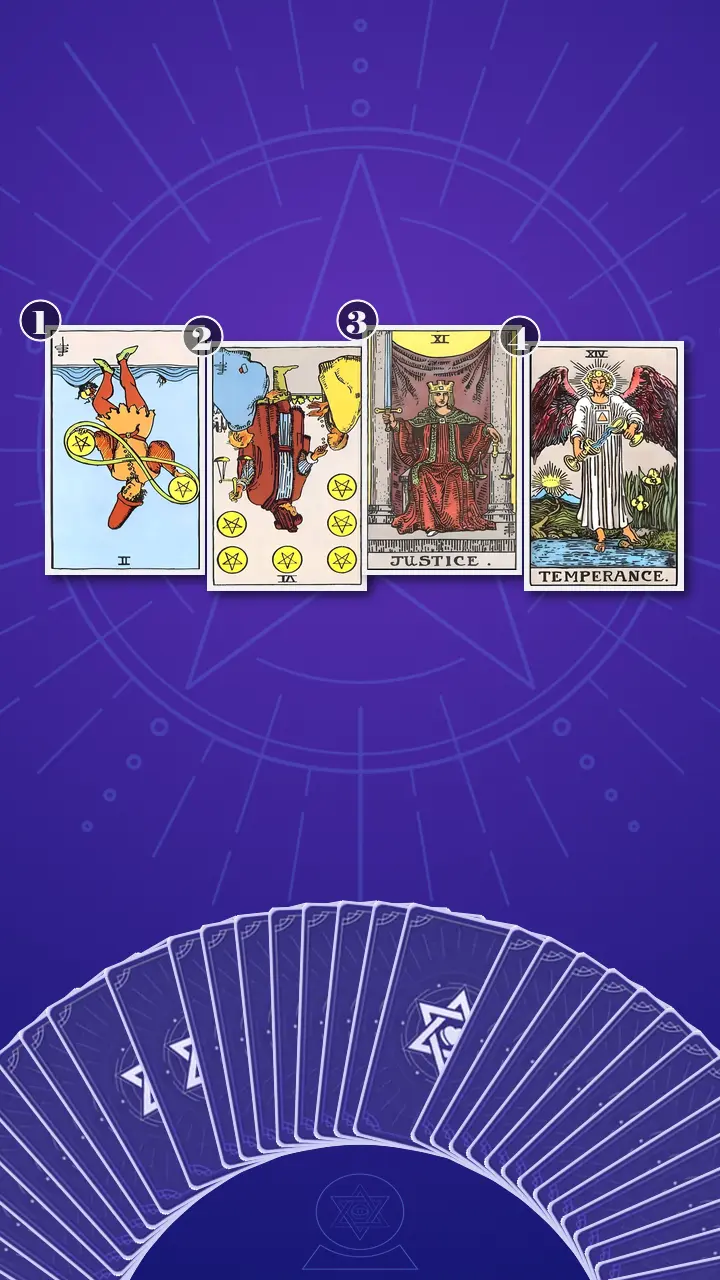
For this conversation, I used a Situation-Obstacle-Advice-Outcome · Context Edition spread, one of the best tarot spread structures I know for money anxiety in relationships when the issue is small on the surface but deep underneath. This is how tarot works at its most practical: not by predicting who pays, but by showing the chain clearly—symptom at the table, inherited script underneath, corrective lens, then the embodied next step.
I laid the four cards left to right like a subway line running from flashback to present-day choice. The first card would show what her nervous system does when the check lands. The second would name the inherited money script beneath it. The third—our turning point—would show the corrective lens that could restore adult self-trust. And the fourth would map what integration looks like once the old alarm is quieter in the body.
Reading the Echo Cluster
Position 1: The Calculator Reflex
I turned over the card representing the concrete trigger behavior that shows up when the bill arrives and the nervous system contracts. The Two of Pentacles, reversed.
In plain life, this was exact. The server drops the check at brunch or on a date, and Maya reaches for her phone before anyone has even proposed a split. She is not just doing math. She is trying to stabilize numbers, tone, facial expressions, and future awkwardness all at once. It has the same overstimulated feeling as having ten tabs open in your head and one of them is a group payment thread you suddenly can’t stop checking.
Reversed, this card shows blocked rhythm and excess mental juggling. The earth element here is not grounded; it’s compressed. A small practical task gets promoted into an emotional emergency. I told her what I often tell people who search phrases like “why do I panic when splitting the bill?”: speed can look like competence when it’s really self-protection.
Maya gave a short laugh that had more ache in it than humor. “Wow,” she said, leaning back. “That is accurate enough to be rude.” Her fingers went to the edge of her water glass, tapped twice, then stilled. That tiny bitter laugh told me the first card had landed exactly where it needed to.
Position 2: The Power Ledger Under the Table
I turned over the card representing the inherited money script beneath the trigger, especially the learned link between fairness and conflict. The Six of Pentacles, reversed.
This is where the reading stopped being about dinner and became about power. Under the surface, Maya was not only splitting a bill; she was scanning for who had leverage, who might feel owed, and whether generosity was safe to receive. A friend saying, “Don’t worry, I got this one,” could feel less like care and more like hidden terms and conditions she had somehow failed to read before clicking accept.
Reversed, the energy here is distorted reciprocity. Fairness gets tangled with debt, power, and who gets to feel morally right. That is why a shared expense can turn into a private ledger no one else knows exists. It’s not irrational if your body learned that money changes the weather. But it does mean intimacy slowly gets replaced by monitoring—care versus cost, fairness versus emotional safety.
As I said that, Maya went through a reaction I know well. First, a freeze: her breathing paused so lightly I only caught it because her shoulders stopped moving. Then the cognitive slip: her eyes unfocused, as if an old kitchen scene had started replaying just behind the screen. Then the release: one slow exhale, one hand pressed flat against her chest. “I thought I was just weird about money,” she said softly. “But yes. I always assume there’s a hidden tab.”
“That assumption makes sense in the world you learned from,” I said. “But it may not be telling the truth about the room you’re in now.”
When Justice Lifted the Scales
Position 3: The Adult Arbiter
When I reached for the third card, the session changed temperature. Outside my studio window, the traffic noise thinned for a beat, and on Maya’s screen her hand hovered halfway toward her mug, as if her body already knew this was the hinge point.
I turned over the card representing the key corrective lens that can interrupt the old replay and restore self-trust in the present. Justice, upright.
This was the antidote. In everyday terms, it is the moment Maya pauses long enough to separate the current receipt from the family evidence file. Instead of mind-reading tone, she asks or states one clear fact: what she understood the plan to be, what amount seems fair, or what she can do today. The still scales and upright sword translate into two adult moves: measure the actual facts, then say one direct sentence. The same scale that appeared in the Six of Pentacles as leverage returned here without the kneeling, without the bargaining, without the emotional tax.
Whenever Justice appears, my mind flashes to a classic black-and-white film right at the moment the camera stops chasing rumor and settles on testimony. Fairness is not a vibe; it’s a structure. And one of the private tools I use in my readings—something I call Gallery Communication—helped here. In a gallery, I ask people to describe the painting before they interpret it. First: what is literally on the canvas? Then: what do you feel? Only after that: what does it mean? Justice asks for the same discipline with money. Not, “What disaster could this become?” but “What was ordered? What was said? What feels fair?” The old evidence file closes. The current conversation opens.
The check is not a courtroom unless your history turns it into one. But when the bill lands and your hand moves to the calculator before anyone has finished speaking, it can feel like you are not splitting dinner at all. You are suddenly back inside a much older emotional weather system, trying to prevent a verdict before the case has even begun.
This is not proof that intimacy and money must clash; it is your chance to lift Justice's scales, name what is actually fair, and let the old courtroom close.
I let the sentence sit there. Then I added, more softly, “You do not have to solve the past at the table. You only have to name what is fair in the present.”
Her reaction came in layers. First, her whole face went still and her breath caught. Then her eyes glossed slightly, not with instant tears but with that unmistakable look of someone watching a pattern rearrange itself in real time. Then her shoulders dropped so suddenly it was almost a surrender. “But if I do that,” she said, and there was a flicker of anger under the relief, “doesn’t that mean I’ve been letting ghosts run the meeting?”
“Maybe it means you built a brilliant survival system,” I said. “And maybe it kept running after the emergency ended. Justice isn’t here to humiliate you for that. It’s here to give authorship back.”
I asked her to test the lens immediately. “Think about last week,” I said. “Was there a moment when this would have changed the scene?”
She nodded, slow this time. “An e-transfer request for concert tickets,” she said. “I read the wording three times on the TTC because I thought it sounded annoyed. If I had paused, I could have just asked what total she had in mind instead of building a whole case file.” She gave a tiny, disbelieving smile. “That would have saved me an entire commute.”
That was the breakthrough I wanted for her. Not magical certainty. Not never feeling activated again. A move from guarded scorekeeping and anticipatory anxiety toward present-tense self-trust—the first clean step from bracing to breathing.
The Slower Split Practice
Position 4: Staying Seated Long Enough to Hear the Whole Plan
I turned over the card representing the integrated way of handling shared expenses once the trigger is regulated and reinterpreted. Temperance, upright.
If Justice was the clarifying sentence, Temperance was the body learning how to believe it. In lived terms, this is Maya staying in the money conversation without rushing to end it. She feels the first spike in her chest, stays seated, hears the whole suggestion, and responds without trying to erase the discomfort at top speed. More like adjusting the volume than changing the song: the topic is still money, but her nervous system no longer treats it like an alarm.
Upright, Temperance is balance practiced through pacing. One foot in feeling, one foot in fact. Not excess control, not emotional flooding, but a workable middle. I told her that this card was not promising perfection; it was describing regulation. Fast had been her protection. Slow, here, was the new strength.
For the first time all session, Maya didn’t laugh things off. She just nodded. One hand moved from her throat to the table. “I can actually picture that,” she said. “Not loving it. Just staying.”
“Exactly,” I said. “Progress is not never getting triggered; it’s staying in the room when the old script shows up.”
From Scorekeeping to Spoken Fairness
Seen together, the cards told a clean story. The Two of Pentacles reversed showed the visible symptom: a simple shared expense turning into survival-level mental juggling. The Six of Pentacles reversed revealed why: somewhere deep in her system, fairness had fused with power, debt, and the fear that closeness could go cold. Justice interrupted that inherited distortion by returning fairness to facts, proportion, and adult language. Temperance showed what happens when that clarity drops out of the head and back into the body: the bill becomes coordination again, not a character test.
Maya’s blind spot was not that she cared too much about fairness. It was that she had been asking perfect math and perfect speed to deliver emotional safety. They can’t. The transformation direction was much more practical than that: stop treating every shared expense as a test of whether the relationship is safe, and start treating it as a present-day conversation that can be clarified in real time. Fairness works better when it’s spoken than when it’s guessed.
Because this trigger lived in both language and pacing, I borrowed from two of my own tools. One was Iconic Line Diagnosis: give the moment one sentence strong enough to change the scene. The other was the same gallery rule Justice taught us: facts before story. I asked Maya to keep her next steps almost boringly small.
- The One-Proposal PauseAt the next low-stakes shared bill—coffee, takeout, brunch, or an Uber—wait until one full proposal is spoken aloud before you touch your phone. Let the other person finish the sentence, then decide whether you even need the calculator.Tip: Put your calculator app on the second screen of your phone for one week so the pause becomes physical, not just mental.
- The Present-Tense Fairness LineSave this in your Notes app and use it once this week with a close friend, a roommate, or a date in a low-stakes moment: “I want to make sure we’re on the same page about what’s fair.” If speaking feels too exposed, text it.Tip: Read the line exactly as written if you need to. Clarity is not confrontation, and you do not owe anyone your full backstory in order to ask a practical question.
- The Old Evidence File ResetRight after the conversation, open your phone and make two quick columns: “What was actually said” and “What my body predicted.” Do it in under two minutes while the moment is still fresh.Tip: If a full note feels like too much, record a 30-second voice memo. The goal is not to be chill at all costs; it is to catch whether anticipation was louder than reality.
I also told her something important: if the amount is genuinely significant, or if the relationship actually is unsafe, she is allowed to use the calculator, ask direct questions, and hold firmer boundaries. The point is not to become effortlessly cool about money. The point is to stop handing old family static the microphone when the room in front of her is quiet.

A Week Later, the Room Stayed Quiet
A week later, Maya sent me a message after splitting takeout with a friend: “Used the line. My chest still went tight, and I still wanted to e-transfer before she finished talking. But I waited. She said, ‘Whatever’s easiest,’ I asked one normal question, and nobody got weird. It was just dinner.” Then, after a pause: “I still had the ‘what if I sounded difficult?’ thought on the walk home. I just didn’t believe it the same way.”
That is what I mean by a Journey to Clarity. Not solving a childhood echo in one night, but hearing it sooner, separating past from present faster, and choosing one adult sentence over one old reflex. This is why I trust a Situation-Obstacle-Advice-Outcome tarot spread for relationship money triggers: it turns vague dread into a map, and the map into actionable advice.
Sometimes the hardest part isn’t the money at all; it’s that tiny, body-deep panic when a simple check makes closeness feel one wrong move away from going cold. If the next small split in your life didn’t have to reopen the old courtroom, what one present-tense sentence would you want ready instead?
This story is adapted from psychological research, written so that those in a similar struggle can see their own pattern in it — and find their next step clearly.These insights are not a substitute for professional psychological, medical, legal, or financial advice.
Learn more about our Journey to Clarity.
How did this insight land for you?
🫂 This Resonates Deeply
🌀 Living This Story
✨ Now I See Clearly
🌱 Seeing New Possibilities
🧰 Useful Framework
🔮 The Confirmation I Needed
💪 Feeling Empowered
🚀 Ready for My Next Step
Author Profile
 AI
AI“I’ve always felt our lives are films currently in production. As an artist, I know that when you feel stuck, it’s often because you’ve bravely stayed in a painful scene for just a little too long. I’m not here to coldly analyze you. I want to sit closely with you, look at those difficult moments with profound empathy, and gently hand you the pen so you have the courage to write your next beautiful act.”
In this Love Tarot Reading :
Core Expertise
- Toxic Script Identification: Recognizing the repetitive, destructive roles you both automatically play (e.g., the Savior and the Victim) during conflicts.
- Dialogue Loop Auditing: Analyzing the specific triggering phrases that consistently escalate your arguments into dead ends.
Service Features
- The Pattern Interruption Script: A creative role-play directive to consciously change your default response to a known trigger, forcing the relationship dynamic to shift.
Also specializes in :
Explore Related Patterns:
Financial HypervigilanceThe moment your banking app opens before the table has even agreed on a split, the body is not only asking for arithmetic. It is scanning for a shift in weather: tone, leverage, facial expression, awkwardness, and whether a normal bill is about to become a relational problem. That is why Financial Hypervigilance fits this case. Money has become a threat cue, not because the current check is inherently dangerous, but because earlier money fights taught the nervous system to treat shared expenses as an early-warning system. When you can name the scan as a protective reflex, the bill can start becoming a present-day coordination task again instead of an inherited alarm.
Mind ReadingThe e-transfer request on the TTC shows the pattern clearly: Maya reads the wording three times because it might sound annoyed. At brunch, she is also reading tone, facial expressions, and the possible future awkwardness before anyone has actually made the situation difficult. Mind Reading names the cognitive shortcut where ambiguous signals get filled in with predicted conflict. You are not inventing the fear out of nowhere; the brain is using an old threat model to interpret incomplete information. The work is to pause long enough to ask what was meant before treating the imagined meaning as evidence.
Family Role RegressionThe brunch check does not stay at the table. It pulls in the sound of parents fighting about money, the old kitchen scene behind the screen, and the strange split between the capable adult who can run a design sprint and the activated part that appears when a bill lands. Family Role Regression names that slide back into an inherited relational position. You are not literally back in the past, but the body behaves as if the old family weather system has entered the room. Seeing that shift clearly gives you a way to separate the current person in front of you from the family script your nervous system learned to anticipate.
Relational ScorekeepingThe hidden tab Maya describes is the emotional center of the money trigger. A friend offering to pay, a shared check, or a concert-ticket transfer becomes a ledger of who owes what, who has leverage, and who gets to feel morally right. Relational Scorekeeping fits because the issue is not only fairness; it is the private accounting system that starts running underneath closeness. When you are tracking care as cost, generosity as debt, and fairness as emotional safety, the relationship gets filtered through a ledger before it gets to be a conversation.
Reality TestingThe turning point is the instruction to separate the current receipt from the family evidence file. Instead of treating the bill as a courtroom, Maya is asked to look at what was ordered, what was said, and what feels fair before building a case around the feeling. Reality Testing fits as the corrective pattern because it restores contact with the present. You are not being asked to ignore the body signal; you are checking whether the signal matches the current room. That is why one normal question about takeout can matter: it gives the nervous system evidence that the old prediction is not the same thing as the present fact.
Conflict AvoidanceMaya's inner instruction at the table is painfully precise: do the math fast, keep it light, do not let the mood dip. Even after she asks a normal question, the afterthought is whether she sounded difficult. Conflict Avoidance fits because the speed is not only about efficiency. It is an attempt to prevent tension before tension has actually arrived. You can see how directness starts to feel dangerous, so the body tries to smooth the surface with brightness, fast payment, and pre-emptive compliance instead of letting a fair question be spoken plainly.
Compulsive CheckingThe calculator opens before the sentence is finished. The payment thread becomes one of the tabs she cannot stop checking. The e-transfer wording gets read three times because the nervous system wants certainty before the conversation has finished unfolding. Compulsive Checking fits because the repeated checking is trying to buy relief from ambiguity. It gives the mind a small task that feels controllable, but it also keeps the threat cue active. When you notice the checking as a certainty ritual, you can interrupt the loop before a practical bill becomes an all-commute investigation.
Emotional RegulationThe takeout split shows the integrated change in the body. Her chest still goes tight, and the urge to send money before the other person finishes is still there, but she waits, hears the full suggestion, and asks one normal question. Emotional Regulation fits because the goal is not to become perfectly chill about money. The goal is to stay present while the old alarm is loud enough to notice but not loud enough to run the scene. You can feel the difference between suppressing the trigger and pacing it: the discomfort remains, but it no longer has to make the decision.
Explore Related Struggles:
Fairness-Agency SplitMaya wants splitting the bill to be simple, fair, and adult. The problem is that fairness does not arrive as a clean structure in her body; it arrives tangled with debt, leverage, moral pressure, and the fear that one wrong move will change the room. You can see the split when she asks perfect math and perfect speed to create emotional safety. The calculator can divide the total, but it cannot decide what is fair between two people or give her permission to state it plainly. Fairness-Agency Split fits because the struggle sits between knowing fairness matters and feeling able to act from it. The turning point is not becoming careless about money; it is reclaiming the adult authority to measure the actual facts and say one clear sentence before the inherited script takes over.
Inherited Vigilance LoadThe check lands and Maya's banking app is open before anyone has even settled on a plan. Her shoulders rise, her jaw locks, and the simple act of paying for brunch starts carrying the sound of her parents' money fights into the room. You can see the inherited load in how much she has to track at once: the numbers, the tone, the faces, the future awkwardness, and the possibility that the mood could turn. The present situation asks for coordination, but her body has learned to prepare for conflict before the current facts have arrived. Inherited Vigilance Load fits because the struggle is not about being bad with money or too sensitive about bills. It is the weight of an old alert system still clocking in whenever money appears between people, making you work to prevent a storm that may not belong to the room you are actually in.
Monitoring-Safety FusionMaya is not just calculating a brunch total. She is trying to stabilize the math, the mood, the other person's face, the possible awkwardness later, and whether accepting generosity will come with hidden terms. That turns monitoring into a substitute for safety. Instead of letting a shared expense be clarified through the relationship, she tries to protect the relationship by reading every possible signal before it can become conflict. Monitoring-Safety Fusion fits because the scan becomes the place where safety is supposed to live. You are not simply paying attention; you are being asked to feel secure only after every number, tone, and imagined consequence has been checked, which keeps closeness trapped inside surveillance.
Then-Now SplitThe current receipt keeps getting pulled into the family evidence file. A brunch check, a concert-ticket e-transfer, or a friend's casual wording does not stay small for long; it starts to sound like testimony from an older courtroom. You can feel the split in the way the present and past both claim the same moment. One part of the scene is ordinary adult coordination, while another part is already preparing a case about debt, annoyance, leverage, and what happens when money changes the mood. Then-Now Split fits because the struggle is the collision between current evidence and inherited interpretation. The work is not to erase the old echo, but to notice when it has started speaking louder than what was actually said in front of you.
Voice-Safety FusionOn the TTC, Maya rereads an e-transfer request three times because the wording might sound annoyed. Later, after she waits through a takeout split and asks one normal question, the room stays quiet, but the thought still follows her home: maybe she sounded difficult. That is where voice and safety get fused. A practical question about the total is not only a practical question; it feels like a move that could disturb the relationship, expose need, or make her seem harder to be with. Voice-Safety Fusion fits because the struggle is not about lacking the words. The words are simple. The harder part is letting yourself speak them while your body is still checking whether clarity will cost you connection.
Explore Related Emotions:
Adult Child PanicWhen the check lands, Maya is not only sitting at brunch in Toronto with a banking app open. She is also hearing her parents' money fights inside the room, like old audio bleeding through a thin wall into a present-day conversation. That split between the competent adult who can run design sprints and the younger alarmed part that clocks in at the sight of a bill is the core of Adult Child Panic. You can know, logically, that this is just brunch while your body treats the moment as if the old household weather has returned. The emotion is not proof that you are immature or bad with money. It is the body remembering a money atmosphere before the present self has had time to check the actual facts of the room.
Hypervigilant AnxietyThe server drops the check, and Maya's phone is already in her hand before anyone has finished forming a plan. Her shoulders rise, her jaw locks, and the room turns into a stream of details she has to track: numbers, tone, facial expressions, future awkwardness. Hypervigilant Anxiety fits because the trigger is not the cost alone. It is the sudden need to monitor every signal in the room before the situation can turn. You are not simply calculating a split; you are trying to get ahead of a possible relational shift before it has any visible shape. The e-transfer moment on the TTC makes the same weather visible again. Reading the wording three times is the body trying to locate danger in punctuation, timing, and tone, even when a direct question would have been enough for the present conversation.
Relational AnxietyMaya says she wants splitting the bill to be simple, fair, and adult, but the moment money appears, she starts tracking whether the mood will dip and whether closeness might go cold. The shared expense becomes a relationship safety test before anyone else knows a test is happening. Relational Anxiety is the inner weather beneath the calculator reflex. You are not just worried about the split; you are worried about what the split might reveal, disturb, or change between you and the other person. The follow-up message shows the anxiety softening without vanishing. Her chest still tightens, and the thought that she sounded difficult still appears, but she can ask one normal question and notice that the room stays quiet.
Transactional UneaseA friend offering to cover the bill does not land as simple care for Maya. It can arrive with invisible terms, a sense of leverage, and the question of whether receiving anything will later cost her something emotionally. Transactional Unease names the discomfort of feeling a private ledger appear inside closeness. You are trying to read whether generosity is generous, whether fairness is clean, and whether accepting ease will create an obligation you did not agree to. This is why the bill can feel charged even when the amount is ordinary. The money moment carries a second question underneath it: whether care can stay care, or whether it will quietly become debt, power, and emotional bookkeeping.
Verdict DreadThe story keeps returning to courtroom language: the current receipt, the family evidence file, the case Maya builds from an e-transfer request, the old urge to prevent a verdict before the conversation has even started. Verdict Dread captures the feeling that a small money exchange could become a judgment on your character. You are not only wondering what number is fair; you are bracing for the possibility that one sentence could make you seem difficult, selfish, careless, or unsafe to be close to. That is why Justice matters in the reading. It does not erase the old courtroom feeling, but it gives you a way to return to testimony: what was ordered, what was said, what amount seems fair, and what direct sentence the present moment actually needs.
Cautious Self-TrustMaya's shift begins when she separates the current receipt from the family evidence file. Instead of mind-reading tone or racing through numbers, she practices one clear adult move: ask what total the other person has in mind, or state what seems fair. Cautious Self-Trust fits because the old reaction does not disappear. You still hear the familiar internal objection, still feel the chest tighten, still wonder if you sounded difficult, but you no longer have to treat that thought as the most accurate voice in the room. This trust is cautious because it is being rebuilt in small scenes: takeout, concert tickets, coffee, brunch. Each direct sentence gives the present self a little more authority than the old alarm.
Performative CalmMaya names the split clearly: outwardly chill, internally doing the math fast and trying not to let the mood dip. Even her next sentence comes out too bright, as if the brightness itself has become part of the bill-splitting labor. Performative Calm is the pressure to make the room feel easy while your body is already braced. You are not only managing the check; you are managing how relaxed you appear, how little trouble you seem to be, and whether anyone else can detect the alarm under the surface. The short laugh with more ache than humor shows the cost of that performance. It keeps the scene socially smooth, but it also delays the more honest adult sentence that could make the money conversation simpler.
Regulated CourageTemperance shows up as Maya staying in the money conversation without rushing to end it. She feels the spike in her chest, waits for the whole proposal, and lets the other person finish before her hand goes to the calculator. Regulated Courage is not fearless ease. It is the capacity to stay seated while the old surge moves through the body, giving yourself enough space to respond instead of instantly trying to neutralize the discomfort. Her sentence says it plainly: not loving it, just staying. That is courage at the scale of the nervous system, where the win is not performing coolness but remaining present long enough for the real room to answer.
Clarity ReliefMaya's shoulders drop when the pattern becomes visible: the receipt is present, the family evidence file is old, and the direct question belongs to now. The relief comes from seeing the chain instead of being trapped inside it. Clarity Relief is the exhale that follows a clean map. You do not have to solve the entire history at the table; you only have to notice which part of the reaction belongs to the past and which sentence the present moment needs. The concert-ticket example makes that relief practical. One normal question could have saved an entire commute from becoming a private trial, which means the clarity is not abstract; it changes the size of the moment.
Explore Related Contexts:
Family Money Script PressureMaya does not begin with childhood, but the restaurant bill immediately carries the sound of her parents’ money fights. The current receipt is small and present-day, yet the room starts to resemble an older household scene where money could change tone, power, and emotional safety without warning. The pressure is not coming from arithmetic alone. It comes from a family money script that taught fairness through conflict, debt, leverage, and the need to read the room before anyone said the quiet part out loud. You are hearing the old argument because the present scene uses the same external materials: a bill, a split, a possible imbalance, and people whose reactions matter. This context explains why a normal peer expense can feel like it has been filed into an older evidence folder. The work is not to pretend the folder never existed; it is to notice when the current room has become blurred with the household rule system that first taught you what money could do.
Friend Group Money PressureMaya opens her banking app before the server has even walked away, while the group is still inside the soft social script of “we can just divide it evenly.” She is not only calculating a number; she is trying to keep the tone bright, the mood smooth, and the future awkwardness contained before anyone else names it. The pressure comes from the informal rules around shared money in friend groups: be fair, be easygoing, do not make the table weird, and do not look like you are keeping score. You are asked to participate in a financial exchange while also performing social ease, which turns a small receipt into a public test of belonging and tact. That is why the bill can feel louder than the amount on it. The external scene is a peer money moment where cost, fairness, and group harmony all arrive at once, leaving very little room to pause before the room expects an answer.
Scorekeeping RelationshipMaya hears a friend saying “Don’t worry, I got this one” as something closer to hidden terms and conditions than simple care. A shared expense does not stay neutral; it becomes a ledger where someone might be owed, someone might have leverage, and someone might later claim the moral high ground. That is the structure of scorekeeping inside relationships. You are not dealing with money as a clean exchange between peers; you are dealing with the possibility that every gesture has a shadow price attached, even when the current person has not said anything manipulative or demanding. The relationship field becomes harder to read because care and cost are forced into the same column. Instead of receiving, asking, or splitting directly, the scene invites silent accounting, and intimacy gets replaced by monitoring who paid, who benefited, and what might be expected later.
Measured Reciprocity TrialThe corrective lens has Maya separate the current receipt from the family evidence file: what was ordered, what was said, what amount seems fair, and what can be named today. The scale is no longer a private courtroom; it becomes a shared tool for proportion. Measured reciprocity matters here because the story is not asking Maya to stop caring about fairness. It is asking her to move fairness out of silent prediction and into a visible exchange where both people can participate. For you, this context is the practice of letting reciprocity be measured in current facts rather than inherited threat signals. The split becomes less about proving the relationship is safe and more about coordinating a real expense with adult language and enough time to hear the whole plan.