Checking Never Feels Enough?

A clear audit of Financial Hypervigilance, the tarot cards that mirror it, and reading insights for this money-scanning pattern.

Financial Hypervigilance
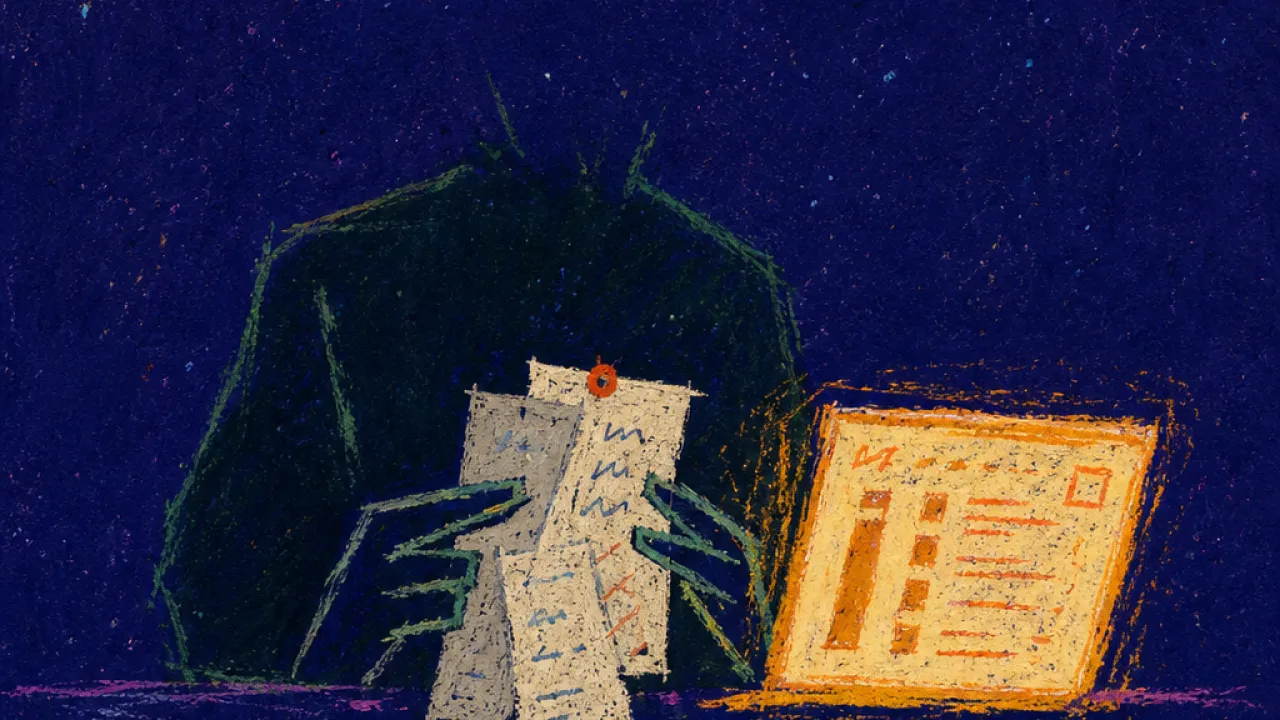
A figure pins receipts beside a glowing balance screen, amber light cutting into green-black shadow across the desk

What is this really?

You track balances, receipts, due dates, pending charges, and tiny price changes with a kind of automatic precision, even when nothing urgent is happening. Part of you is trying to stay ahead of uncertainty, keep control within reach, and avoid the sickening jolt of being caught off guard. Yet the more safety you try to create through constant checking, the more your day starts to shrink around the next number on the screen, much like the figure in the Four of Pentacles clutching his coins so tightly that his whole body becomes arranged around holding on.

Why did it happen?

At some point, watching the numbers closely may have helped you feel prepared when life felt unpredictable or when one missed detail seemed to change the whole day. Over time, that alertness can turn into a subconscious loop: even after you check, your body asks for one more scan, one more calculation, one more small proof that everything is still under control. The result is not clarity so much as a quiet mental drain, where ordinary choices start carrying more tension than the moment seems to require.

How does it feel?

  • You open your banking app while waiting for coffee, thumb hovering over the balance before the screen has fully loaded; after you close it, your chest may still feel tight, like your body has not received the update yet. Let that signal exist for a moment without making it prove anything.
  • At work, you reread the benefits email line by line, zooming in on numbers and dates while your shoulders creep toward your ears; even when the math is clear, your breathing may stay shallow, as if another hidden line is about to appear. It is okay to pause before turning the next detail into a task.
  • When friends suggest dinner, you glance at the menu online, scroll past the drinks, and quietly calculate tax and tip before replying; in that small pause, your jaw may lock and the room can feel slightly farther away. Not deciding instantly is still a valid place to stand.
  • Alone at night, you line up receipts, subscriptions, and pending charges in separate tabs, switching back and forth until the numbers blur; your eyes may feel dry, and the back of your neck may hold a dull pressure that does not lift when the spreadsheet balances. You can let the open tabs be information, not a verdict.
  • After buying something ordinary, you keep the receipt in your hand longer than needed and replay the purchase while walking home; your stomach may dip each time you remember the amount, even if the purchase fits your plan. That body response can be noticed without treating it as an emergency.

Financial Hypervigilance in Tarot Cards

That reflex to check the number before your body can settle is the center of Financial Hypervigilance. The tight chest after closing the banking app gives the pattern a physical trace, not just a budget line. From a Jungian perspective, archetypal theory can frame this as a visible struggle between the part that seeks certainty and the part that needs room to live. The cards below reflect the unconscious dynamics behind that scanning habit: Tarot Cards that may feel sharply familiar.

The Devil
Upright
The chained figures remain upright and conscious beneath the central form, while the loops around their necks are visible enough to be examined rather than hidden. The scene portrays a constricting system whose power is reinforced by continued participation and by the belief that there is no meaningful room to move. You may organize growth around gaining enough financial control to eliminate uncertainty, only to find that each new safeguard creates another metric to monitor. The image frames development as recognition of the bond itself: responsible financial awareness can remain, while the automatic equation between constant surveillance and safety becomes available for revision.
Two of Pentacles
Upright
The two pentacles travel around a figure who must keep moving to preserve their loop, while the background sea never becomes still. The image gives material uncertainty a rhythmic quality in which each adjustment creates the conditions for the next adjustment. You may mentally rebalance accounts after every minor expense, even when the total remains within plan, because your attention is trying to match each perceived fluctuation in real time. The loop clarifies why exhaustion can persist despite accurate bookkeeping: the internal task is not merely calculation but continuous prevention of surprise.
Four of Pentacles
Upright
The figure has acquired four pentacles, yet possession has not opened his posture; each coin has become another point that must be defended. The crown, heart, hands, and feet are all recruited into the same holding strategy, leaving security fused with immobility. You may treat stronger control, more detailed tracking, or a larger buffer as the condition that will finally permit ease. The growth threshold is visible in the image as a cognitive distinction between responsible stewardship and a defensive system that continually moves the definition of enough.
Six of Pentacles
Upright
The robed figure controls both the scale and the flow of coins while two people occupy dependent positions below him. The scene makes resource allocation, unequal access, and the authority to define fairness visible at once. You may monitor who contributes, who borrows, who receives help, and whether family money is being allocated correctly because ambiguity in the household system feels unsafe. The vigilance may reveal genuine power differences, but it becomes a trap when every act of support is retained as unresolved evidence and no exchange is allowed to become complete.
Seven of Pentacles
Reversed
The worker stands beside visible growth but remains absorbed in evaluating the pentacles, while the tool under his hands suggests effort temporarily displaced by inspection. The image distinguishes cultivation from the compulsion to keep measuring cultivation. You may use financial safety as the dominant proof that personal growth is real, discounting emotional flexibility, skill, relationships, or lived capacity when the numbers do not move fast enough. In the reversed orientation, measurement becomes a bottleneck: the audit intended to confirm progress interrupts the broader practices through which progress develops.
King of Pentacles
Reversed
The king occupies a fortified seat surrounded by signs of accumulated resources, and the pentacle rests under his direct control. The carved bulls and distant castle reinforce endurance, ownership, and authority over the material environment. You may assume that family safety depends on personally monitoring every account, purchase, or request, especially when earlier instability taught you that missed details carry consequences. In the reversed orientation, stewardship hardens into overcontrol, making it difficult for other family members to develop agency or for you to discover that responsibility can be distributed without abandoning care.
Nine of Swords
Upright
The figure sits upright in a dark bed with both hands covering the face while nine swords form an unbroken row across the wall. The body has stopped for the night, but the mental field remains crowded with sharp, repetitive content and no visible source of new information. You may replay purchases, forecast bills, or mentally search for a missed charge after the practical accounts are closed. The image shows how financial vigilance can migrate inward when external checking is unavailable, turning the mind into a nighttime monitoring screen that repeats threat scenarios without producing additional clarity.

Financial Hypervigilance in Tarot Card Reading Insights

For anyone who keeps checking the number even after the spreadsheet balances, others have brought this same money-scanning reflex into readings. Here is how the cards appeared when people sat with the tension between certainty and everyday choice. Below are Tarot Reading Insights that speak to this pattern.

Psychological Patterns Related to Financial Hypervigilance