Scorekeeping Cut Her Warm Reply Short, Then She Made One Direct Ask

The 10:14 p.m. Relationship Audit
'You can facilitate a tense product critique at work, but one unanswered text on the commute home turns your relationship into an audit of who cared last: relationship scorekeeping in real time.' I said this to Jordan (name changed for privacy), a 29-year-old product designer who lived in a small Toronto apartment and worked through irregular deadlines.
At 10:14 p.m. on a Tuesday, she had typed 'I miss you too' in reply to her partner's message, 'Can we reset?' Then she reopened the old iMessage thread. The radiator clicked beside the kitchen window, leftover curry hung warm and sharp in the air, and the phone pressed hot against her palm. She counted who had initiated the last three plans, deleted the affectionate sentence, and sent, 'Yeah, we should talk.'
'Why do I keep score when I want our relationship to move forward?' she asked me. She wanted closeness, but giving warmth first felt like making all her previous effort disappear. Her chest was tight, her jaw had set, and her thumb kept wanting to search the thread again. Resentment sat inside her like a private spreadsheet with no final row, constantly importing old charges into the present.
I did not call the pattern petty or unforgiving. I told her that the ledger seemed to be trying to protect something legitimate: fairness, visibility, and the right not to carry the relationship alone. 'We do not have to erase what happened or decide your partner's entire character tonight,' I said. 'We can make the pattern visible, find the need underneath it, and let our Journey to Clarity give you choices instead of another verdict.'

Choosing a Bridge Through the Receipts
I asked Jordan to put both feet on the floor, take one slow breath, and hold the question without trying to solve it immediately. I shuffled at an ordinary pace. The small ritual was a psychological threshold, a way to move from rereading evidence to observing the pattern in front of us.
Today, I used a Relationship Spread · Context Edition. This six-card relationship tarot spread was designed for a repeating interaction pattern involving reciprocity, conflict residue, boundaries, and the difficulty of moving forward together. It is more precise here than a larger spread because it keeps attention on what Jordan can observe and change, without pretending to know her partner's private motives or predict the relationship's outcome. This is how tarot works in my practice: the images provide a structured language for self-examination, while the person asking the question remains the authority on her life.
The first card would show Jordan's concrete scorekeeping behavior and contracted emotional stance. The second would show the visible reciprocity signal she was reacting to, not an invisible account of her partner's thoughts. Justice would sit at the center as the shared interaction loop and interpretive bridge. The lower cards would reveal the relationship's existing resource and the protective pattern that kept closeness tied to proof. The final card would translate the insight into one self-directed communication or boundary practice.
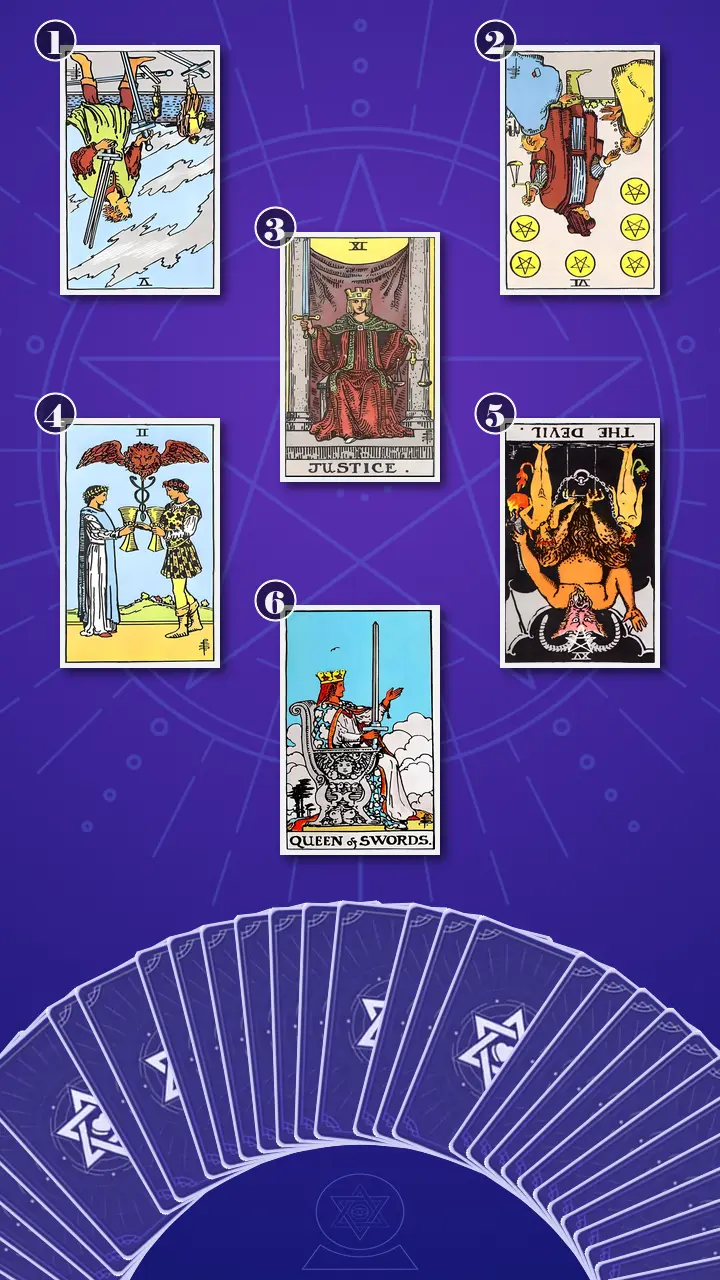
The Map Begins Where the Fight Ended
Position 1: The Reply She Cut in Half
Now turning over the card for the position that shows the concrete scorekeeping behavior and contracted emotional stance, I found the Five of Swords, in reversed position.
In the Rider-Waite-Smith image, one figure still holds the swords while the others withdraw beneath a gray, unsettled sky. Reversed, the Air of conflict has turned inward. It is not the active fight anymore; it is the residue Jordan keeps in her hand after the fight has technically ended. At 10:14 p.m., she begins a warm reply, searches for the sharpest lines from the last argument, and sends something cooler so moving closer will not feel like losing twice.
This is a blockage of reconciliation, not a prophecy of another conflict. The energy is overcorrected protection. Jordan wants peace, but she has made peace conditional on preserving enough evidence to prove that the hurt mattered. I asked, 'What would repair look like if you named the hurt without trying to win the case?'
She gave a small, humorless laugh. 'That is too accurate. Almost cruel,' she said. Her fingers stopped halfway to the mug, and the laugh left a thin silence behind it. I told her that recognition did not require self-accusation. The behavior made sense as protection, even if it was now keeping the door closed to the contact she wanted. She looked back at the card, her expression caught between being seen and not wanting the pattern to be true.
Position 2: The Splitwise Balance Nobody Else Can See
Now turning over the card for the position that shows the visible reciprocity signal Jordan is reacting to, I found the Six of Pentacles, in reversed position.
The merchant's scales and distributed coins became, in Jordan's life, an emotional Splitwise balance that only she could see. Texts, date plans, apologies, groceries, expenses, rides, and emotional check-ins were being assigned value even though they did not share one reliable unit of measurement. She noticed that her partner had apologized and offered to make dinner, then compared those gestures with who initiated the last difficult conversation and carried the last three plans. Each new act became payment toward an outstanding balance.
Reversed, the Earth energy is blocked by scarcity and conditional exchange. Jordan is not imagining that effort can be uneven. The problem is that an observable gap becomes a totalizing verdict, and warmth becomes something she can release only after the numbers feel morally balanced. I said, 'This card does not tell us why your partner acts. It shows the signal your nervous system is tracking and the transaction it is building around that signal.'
She drew in a quick breath. 'I do not need everything to be equal,' she said, almost before I finished, 'but if I stop counting, how will I know I am not carrying it again?' Her chest tightened for a moment, and she named the categories herself: initiated plans, apologies, and emotional check-ins. I let the pause stay intact. The exhaustion was not in the number of items alone; it was in turning care into measurable proof.
I answered, 'We can take the gap seriously without making a secret total responsible for communicating it. A private ledger can record imbalance, but it cannot negotiate repair.'
When Justice Turned the Ledger Face Up
Position 3: The Shared Dynamic Beneath the Count
The room became quieter when I turned the central card. Now turning over the card for the position that reveals the shared interaction loop, especially how silent accounting and indirect tests keep the relationship from moving forward, I found Justice, in upright position.
Justice brought the scales, the upright sword, and the centered posture into the middle of the spread. The card did not ask Jordan to become a judge of her partner. It asked her to become precise about what happened, what it affected, and what fair repair would require now. The energy was balanced Air: discernment restored through language that both people could actually hear.
I told her to imagine a shared design brief instead of a hidden spreadsheet. In product work, an acceptance criterion kept inside one stakeholder's head cannot be reliably met by everyone else. The same principle applied here. If the standard for repair stayed private, every apology could fail an invisible test.
This was also where I used my Shadow Projection Analysis. I explained that I use it as a separating lens, not as a verdict that Jordan was imagining the problem or that her partner was innocent. I wanted to distinguish the observable action from the triggered internal narrative. 'I initiated the last three plans' was a fact. 'If I initiate warmth again, my contribution will disappear and I will be the only one carrying us' was the fear attached to it. The fear deserved care, but it was not the same thing as evidence of the other person's intention.
Traveling across cultures has taught me that people often ask for an answer when what they first need is a sentence sturdy enough to hold two truths. Jordan could be genuinely under-supported in some areas and still be using silent tests that made repair harder to recognize. She could keep a boundary without prosecuting the whole history.
At 10:14 p.m., in the memory she had just described, she was trapped between 'If I reply warmly, I will disappear into giving' and 'If I stay cool, I will create more distance.' The radiator clicked twice. Her jaw held the old decision in place. She wanted a perfect historical verdict before risking a present request.
Stop using the scales to keep an invisible account of every past exchange; use Justice's upright sword and balanced scales to state one clear truth, one boundary, and one fair present-tense request.
For a moment, Jordan's breath stopped halfway in. Her thumb hovered above the imaginary search bar; then her eyes unfocused, as if the old message thread had opened behind them and replayed every delayed reply, every plan she had arranged, every apology she had judged too small. Her lips parted, but no argument arrived. The first sound was only a low exhale. Her clenched hand loosened one finger at a time, her shoulders dropped, and a faint flush rose around her eyes. Relief came with a brief, almost dizzying blankness. Without the ledger running, she could not immediately calculate what to do next. She looked frightened by that freedom and steadied by it at the same time. 'Oh,' she said quietly. 'That would make it something they can answer.'
I handed her a blank note card. 'Later, set a seven-minute timer and title the note What I need now. Write only three lines: What happened: ...The impact on me: ...A fair next step could be: ... Keep each line to one sentence. You do not have to send it, and if your body feels more activated, put the phone down and return later.'
Then I asked, 'Now, use this new perspective to think back to last week. Was there a moment when separating fact, impact, and request could have made you feel different?' Jordan nodded, but not with certainty. This was the first crossing from resentful vigilance toward vulnerable directness and clearer boundaries. Grounded trust had not arrived as a feeling she could force. It had begun as the possibility of making fairness visible.
A Standard That Can Be Seen
Justice did not promise that a clear request would guarantee agreement. It gave Jordan a way to receive new information without making every present interaction carry the burden of settling the entire past. The sword became one clean sentence. The scales became a shared measure. The reading's central insight was not that fairness mattered less; it was that fairness needed a shared language, not a hidden spreadsheet.
Position 4: Two Cups, Phones Face Down
Now turning over the card for the position that shows the relational resource that can support mutuality and repair, I found the Two of Cups, in upright position.
The two figures raised separate cups toward one another. Their mirrored gaze suggested attention without fusion: two people could bring distinct experiences into the same conversation without one person's pain cancelling the other's. In Jordan's life, the image looked like a quiet check-in at home with both phones face down, each person finishing one sentence without interruption, and both agreeing on one next repair.
Upright Water brought balance through present contact. I asked her to remember one recent moment when both of them had shown up for a conversation, plan, or practical task in a way that felt mutual, even if it had not solved everything. She remembered a Sunday morning when her partner had listened through the whole account of a difficult workday and then asked what kind of support would actually help.
Jordan exhaled, and her face softened before suspicion returned. 'That moment does not settle the whole history,' she said. 'But it was real data too.' I agreed. The Two of Cups was not permission to romanticize the relationship or erase disappointment. It showed that reciprocal presence could exist in one honest exchange, and that one moment could matter without becoming proof that everything was fixed.
Position 5: The Loose Chain in the Search Bar
Now turning over the card for the position that exposes the underlying fear and protective grip behind scorekeeping, I found The Devil, in reversed position.
The figures in the Rider-Waite-Smith image still wear chains, but the chains are loose enough to recognize as changeable. Reversed, the Major Arcana energy is a binding pattern becoming conscious. Jordan's ledger had been telling her, 'If I stop checking, my effort disappears.' It gave her a brief sense of control and evidence, then returned her to guarded conversations in which every repair felt insufficient.
The challenge was not having standards. It was using past debts to control present access to warmth, forgiveness, or closeness. Jordan described the familiar moment: her thumb hovering over the message-thread search bar to verify whether an old apology had finally been repaid. I invited her to see the loose chain as a choice point. 'You can stop checking one item without pretending it was fine,' I said. 'That item can become a request, a boundary, or a pause.'
Her jaw released slightly. She rubbed the hinge of it with two fingers, then let her hand fall into her lap. 'I can stop checking this item without dropping the standard,' she said, testing the sentence. I repeated the distinction because it mattered: Dropping the score is not the same as dropping your standards. Releasing one audit did not require accepting vague apologies, giving immediate warmth, or staying in a situation that felt unsafe. It meant choosing a more visible form of protection.
Position 6: The Sentence That Can Actually Be Answered
Now turning over the card for the position that translates the key shift into one self-directed communication or boundary practice, I found the Queen of Swords, in upright position.
Her raised sword represented precise language; her open hand preserved receptivity. Upright Air returned as clarity with a boundary, not as a prosecutorial replay. The card asked Jordan to replace indirect tests with one observation, one impact, and one present request.
I gave her a sentence: 'When plans repeatedly depend on me to initiate, I feel alone in carrying this part of the relationship. Could you choose and organize our next plan?' It did not decide her partner's motives. It did not cite every dinner, apology, or unanswered message. It named an observable pattern, its effect on her, and something concrete the other person could answer.
Jordan opened Notes on her phone and typed a shorter version. The action-card echo was visible in the way she paused before pressing send. 'Being direct may feel exposed,' she said, 'but it gives them something real to answer.' I watched her underline organize our next plan. The sentence was firmer than silence and less armored than a case summary. It left room for a response without handing over her judgment.
Fairness Needs a Shared Language
When I laid the six cards together, the story became clear. The reversed Five of Swords showed Jordan holding conflict residue after the argument had ended. The reversed Six of Pentacles turned that residue into a material-looking ledger of texts, plans, apologies, money, and emotional labor. Justice received the imbalance and converted it into observable facts, personal impact, and a discussable repair standard. The Two of Cups showed the capacity for mutual attention. The Devil reversed revealed the cost of treating closeness as something that had to be earned through a complete accounting. The Queen of Swords gave the pattern one grounded exit: speak one precise truth and make one request that can be answered.
The blind spot was not that Jordan cared too much about fairness. It was that she had begun treating proof as the prerequisite for closeness. That belief created the loop: closeness felt unsafe until fairness was proven, so she counted effort and stored grievances; counting produced a brief sense of control; the guarded reply made repair feel insufficient; the resulting distance created more evidence to count.
The transformation direction was a shift from privately measuring past contributions to naming a present need, boundary, or repair request and letting reciprocity be discussed rather than tested. The core contradiction remained real: she wanted the relationship to move forward while continuing to keep score. The cards did not ask her to choose denial over discernment. They showed her how to keep discernment and release the ritual that made every new moment answer for every old one.
I introduced the practice I call the Projection Detachment Exercise. It helps separate a partner's actual behavior from the internal narrative activated by that behavior. I told Jordan that the exercise was not designed to talk her out of a boundary. It was designed to make the boundary, request, or pause clearer than the fear speaking over it.
- Use the Projection Detachment ExerciseWithin ten minutes of the next scorekeeping trigger, open Notes and set a seven-minute timer. Write one sentence under Observable fact, one under Impact on me, and one under Fair next step. Replace motive claims such as 'you do not care' with visible actions such as 'I initiated the last three plans.'If the exercise makes your chest tighten or your thoughts race, stop and put the phone down. Keep the note private, especially if direct discussion could expose you to retaliation or pressure.
- Release one ledger item as a testChoose one recurring item, such as who planned the last date. When the urge to search the old thread appears, place the phone across the room for ten minutes, then label the item in Notes as request, boundary, or no longer a test. Decide whether you want to ask your partner to initiate the next plan, set a limit on your own planning labor, or stop auditing that item.Start with the least charged item. Releasing one test does not erase the event, guarantee agreement, or require immediate warmth.
- Ask for one visible act of reciprocityBefore one conversation this week, ask for a specific present-tense action: 'Could you choose and organize our next plan by Friday?' Or invite a ten-minute check-in with the question, 'What is one thing that would make this week feel more mutual?' Observe the response without combining it with every previous result.Keep the conversation to one issue. A request tells you more than ten silent tests, but the other person's response remains theirs and does not define your worth.
The point of this Justice-centered six-card Relationship Spread for relationship scorekeeping and reciprocity repair was never to tell Jordan whether to stay, leave, forgive, or trust on command. Its value was more practical: it helped her make one standard visible, protect one boundary, and ask for one form of mutual effort while remaining connected to the present.

A Week Later, One Message Sent
Six days later, Jordan sent me a screenshot: 'When plans keep depending on me to initiate, I feel alone carrying this. Would you organize Friday's plan?' Her partner replied with a concrete time. Jordan smiled, then woke thinking, 'What if I am wrong?' She did not reopen the old thread.
That was not a solved relationship. It was a small piece of evidence of a different kind: Jordan had made the standard visible instead of asking silence to communicate it. The cards had not made the request for her. She had moved from resentful monitoring toward vulnerable directness, visible boundaries, and the cautious beginnings of grounded trust.
When you want to lean back toward someone but your jaw tightens and your mind starts recounting every unanswered text, the ledger can feel like the only thing keeping your care from becoming invisible. I hope the image of Justice stays useful there: not a final verdict, but a sword for one clean truth and scales for a standard another person can actually see.
If you did not have to settle the whole history tonight, what one present truth would you want to make visible?