Chemistry Felt Like an Answer at 11:38; Alex Asked About Pace

The 11:38 p.m. Relationship Forecast
I recognised the pattern when Alex, a 28-year-old account manager at a small London agency, told me she could manage six client threads before lunch but turn one brilliant date into a three-month relationship forecast before bed.
She took me back to 11:38 p.m. on a Tuesday in her rented Hackney flat. She had been sitting cross-legged on the duvet, rain ticking against the window and the radiator clicking beside her, while her thumb scrolled to the funniest part of a WhatsApp exchange. The phone felt warm in her palm. Her chest still buzzed from the kiss.
“They joked about us taking a trip,” she said. “I opened my calendar. We haven't discussed exclusivity, or even what we're both looking for, but it felt so real. If the spark is this obvious, why are we still asking questions?”
That was the chemistry-to-commitment shortcut in real time: mistaking intense chemistry for proof of mutual relationship readiness. Her longing had the physical insistence of fragrance sprayed too close to the throat, warm and immediate, but so concentrated that every quieter note disappeared. She wanted to feel unmistakably chosen, yet asking for clarity felt like opening a window that might let the connection escape.
“I won't ask the cards to predict what this person secretly wants,” I told her. “That information belongs to them. What we can do is examine why the spark has been given the job of answering for both of you. Let's draw a map through the fog without putting the attraction on trial.”

Choosing a Four-Card Staircase Through Dating Ambiguity
I invited Alex to take one slow breath and hold the question in mind while I shuffled. I use that pause as a change of pace, not as a performance of mystery. It gives the nervous system a moment to stop racing ahead of the inquiry.
I chose The Shadow Spread · Context Edition, a four-card tarot reflection using The Devil, The Moon, Justice, and Temperance to examine chemistry and commitment readiness. For anyone wondering how tarot works in a relationship reading, this spread is reflective rather than predictive. It cannot reveal an absent person's private intentions. It can show the pattern through which attraction, fear, assumptions, and choice are being organised inside the person asking.
I arranged the cards like an ascending staircase. The first position would show the visible chemistry-to-commitment shortcut. The second would uncover the fear sustaining it. Justice, at the central hinge, would offer the conscious reframe. Temperance would turn that insight into a grounded practice Alex could test in ordinary life.
“We're not deciding whether fast commitment is right or wrong,” I said. “We're asking whether the pace is mutually understood and freely chosen.”
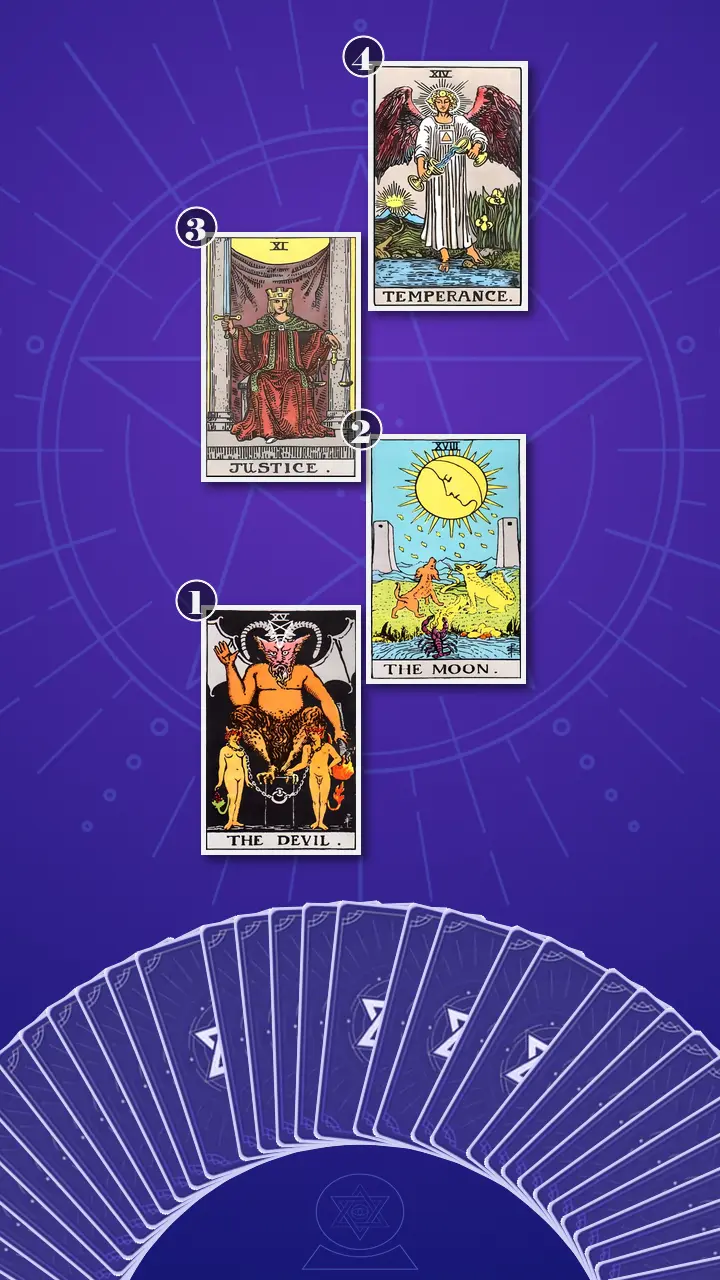
Where the Spark Became a Binding Story
Position One: The Devil and the Post-Date Replay Loop
“Now I'm turning over the card that represents the presenting shadow,” I said, “the observable pattern of replaying intense interactions and mentally fast-forwarding the connection.”
The card was The Devil, upright.
I directed Alex's attention to the loose chains around the figures. The image did not tell me that desire was dangerous or that the connection was doomed. It showed me a compelling feeling acquiring an unchosen conclusion. The attraction was real; the belief that it had already bound two people to commitment was still available for examination.
I described the energy as excess: heat and momentum expanding faster than reflection. At 11:38 p.m., Alex had reopened the same WhatsApp thread, replayed the kiss, and upgraded a future-oriented joke into evidence that the relationship had advanced. The private script underneath it was simple: It felt this strong, so surely it means we're moving toward commitment. If I question that, maybe I break the spell.
“A spark is a feeling, not a signed agreement,” I said. “That distinction doesn't downgrade the date. It stops one charged moment from doing the work of a mutual conversation.”
Alex gave a short, bitter laugh and rubbed the heel of her hand against her chest. “That's so accurate it's actually a bit brutal.”
“I hear that,” I replied. “But I'm not calling you naive or telling you to distrust your excitement. This shortcut has been giving you a few hours of relief from not knowing. We're simply noticing the price: the relief fades, and you have to return to the same memory for another dose of certainty.”
Position Two: The Moon on the Northern Line
“Now I'm turning over the card that represents the hidden root,” I said, “the fear that slowing down or asking clearly will weaken the chemistry, delay commitment, or make an unwanted answer feel like proof that you aren't worth choosing.”
The card was The Moon, upright.
The Moon's winding path became the gap between an intense memory and an intention that had not been named. I asked Alex to recall 8:17 the following morning on the Northern line: the packed carriage screeching near Euston, damp wool in the air, patchy signal, and blue-white screen glare pressing behind her eyes. The reply had not arrived, so she had used the previous night's kiss to complete the unfinished story.
I named this energy as a blockage. Uncertainty was not being allowed to remain incomplete. Like dating autocomplete, Alex's mind finished a sentence the other person had not written: What I know is that we had an intense date. What I'm assuming is that they want the same future. What I'm scared to ask is whether they actually want the same pace.
“The Moon is not evidence that they're misleading you,” I said. “It shows where incomplete information invites projection. The hopeful explanation may feel kinder than the unknown, but it still leaves you decoding instead of participating.”
Her breath caught first. Her fingers stopped against the mug, and then her gaze slipped past the cards as though the carriage scene were replaying behind my shoulder. Finally, she exhaled from deep in her chest and let both hands rest open on the table.
“I keep calling it chemistry when I might really be asking to feel chosen,” she said. “If I ask what they want and it isn't me, I lose the date and the story I built around it.”
“You may lose a particular interpretation,” I said gently. “But information about someone else's capacity or preference is not a measurement of your worth. Do not make one charged moment do the work of a mutual conversation.”
When Justice Gave the Spark Some Breathing Room
Position Three: The Scales Between Feeling and Agreement
The rain strengthened against the studio window as I moved to the central card. Its sound briefly filled the room, then seemed to recede when I placed my fingers on the edge of the card.
“Now I'm turning over the card that represents the conscious reframe,” I said, “the shift from treating chemistry as a verdict to weighing it alongside mutual intention, clear language, and a pace both people are choosing.”
The card was Justice, upright, the catalyst and antidote of the reading.
I showed Alex the balanced scales and upright sword. Justice was not a cold verdict. I read it as a clean split-screen. On one side belonged the kiss, banter, bodily rush, longing, and genuine desire. On the other belonged explicit language, reciprocal initiation, consistent follow-through, stated intentions, and an agreed pace. Its energy was balance: neither category erased, neither asked to impersonate the other.
I suggested that Alex open a two-column note. Under What I feel, she could record attraction, ease, excitement, and longing. Under What we have established, she could record exact words, initiated plans, follow-through, and anything still unconfirmed. The exercise would not put the spark on trial. It would stop one person's feeling from answering for two people.
My fifteen years as a perfumer supplied the clearest language I had for this. A brilliant top note can fill a room in seconds, but its projection cannot tell me how the fragrance will develop on skin six hours later. I call this Intimacy Distance Calibration: stepping back just enough for the structure to become perceptible. The distance does not weaken the scent. It prevents intensity from overwhelming every other source of information.
I also saw a boundary becoming too permeable. Alex's emotional certainty had crossed the line between her identity and the other person's, then written both parts of the agreement. Justice restored that boundary: I know what I feel. I can ask what you intend. I do not have to manufacture your answer while I wait.
I brought her back to 11:38 p.m.: the warm phone, the replayed kiss, the future already assembling in Notes. She had been trapped in the demand to reach the correct conclusion, while pace, exclusivity, and intention had never entered the conversation.
Chemistry is not proof that commitment is ready; use Justice's scales and sword to weigh felt intensity against mutual words and observable choices before calling it readiness.
I let the sentence settle, then added, “Chemistry can be true and still be incomplete. It tells you that something is felt, not what two people have agreed to build.”
Alex's breath stopped. Her thumb froze against the edge of her mug; then her eyes lost focus, as if she were replaying every future-oriented joke at once. Colour rose along her cheekbones. “But doesn't that mean I've been wrong this whole time?” she asked, sharper than before. I let the anger arrive without correcting it. “It means you found a fast way to soothe a painful unknown. It worked briefly. Now you can choose a method that gives you real information.” Her fist opened one finger at a time. Her shoulders dropped, but the relief did not look weightless. She blinked into the responsibility of having to ask, listen, and perhaps hear an answer she did not want. A small, unsteady laugh escaped her. “So I don't have to pretend the kiss meant nothing. I just can't make it speak for them.” I nodded. The room felt newly spacious, and the rain softened against the glass.
I asked, “Now, using this new perspective, think back to last week. Was there a moment when this distinction could have made you feel different?”
Alex remembered sitting in a crowded Hackney pub, bass vibrating through the bench and citrus lifting from the other person's drink. She had been about to ask what they were looking for when their knees touched and the conversation became flirtatious again. She had swallowed the question to protect the mood.
“I thought wanting clarity would ruin the chemistry,” she said. “But I was also deciding that being chosen mattered more than finding out whether I chose the actual situation.”
“Exactly,” I said. “Being chosen is not the same as participating in a choice.”
That recognition marked the first movement from charged attraction and instant certainty towards paced curiosity, mutual clarity, and grounded self-trust. It was not certainty about the relationship. It was trust that Alex could tolerate an unanswered question long enough to ask it clearly.
When Temperance Poured Time Between Two Cups
Position Four: Letting Compatibility Appear in Ordinary Light
“Now I'm turning over the card that represents grounded integration,” I said, “a small, self-directed practice for holding chemistry and uncertainty together without forcing a conclusion or choosing on the other person's behalf.”
The card was Temperance, upright.
I traced the movement between the angel's two cups and the stance with one foot in water and one on land. The cups became attraction and practical knowledge. Temperance did not ask Alex to cool the connection until it became dull. Its energy was balanced flow: desire and discernment developing together at a sustainable pace.
I described an ordinary week rather than a dramatic turning point: a daytime coffee, one honest question, a normal workday between messages, and a two-minute evening note. Alex could notice whether plans were reciprocal and whether conversation still felt caring without the high-production atmosphere of a late-night date. The inner language became: I can like this and let it unfold. I can notice desire and still leave room for evidence.
Her shoulders softened. “That sounds less like waiting around and more like giving myself time to see what I'm actually choosing.”
“Yes,” I said. “Temperance is not indefinite ambiguity, and it isn't a rule that everyone must date slowly. It asks whether your pace is chosen rather than driven by fear. When your mind announces the entire future after one charged moment, try the phrase: Possible, not promised.”
The Blank Space Where Readiness Becomes Visible
I read the four-card sequence back to Alex as one coherent story. The Devil showed how attraction had become a binding conclusion. The Moon revealed why: ambiguity touched the fear of not being chosen, so private certainty felt safer than a direct question. Justice separated feeling from agreement and returned each person's intentions to their rightful owner. Temperance showed the available resource, enough ordinary time for reciprocity, compatibility, and boundaries to become visible.
The blind spot was not that Alex felt too much. It was that her private certainty had been doing work only mutual information could do. She had treated momentum as a destination and the fear of a mismatch as a reason not to check whether both passengers had chosen the same route.
The transformation was therefore precise: chemistry could become an invitation to gather evidence, not a verdict about commitment. Alex did not need to suppress excitement. She needed to keep feeling, fact, agreement, and open questions in separate containers until both people chose to combine them.
I translated that shift through my Blank Space Protocol. In this case, blank space meant distance from the conclusion, not coldness towards the person. It was oxygen, not a dating game. Alex would not delay replies on purpose, withdraw warmth, or perform indifference. She would simply stop filling every pause with a privately authored future.
- The Seven-Minute Feeling-Fact-Open Question Note.After the next charged date or message exchange, open Notes before rereading the chat and set a seven-minute timer. Write one sentence under Feeling, one exact word or observable action under Fact, and one unresolved issue under Open Question. Circle facts that are mutual, such as both people setting a date, naming the same intention, or following through.If three headings feel clinical, record a private 60-second voice note instead. One line in each category is enough, and the note never has to be shared.
- The 24-Hour Blank Space and One-Question Check-In.After an intense interaction, let one ordinary 24-hour cycle pass without assigning the relationship a destination. Reply naturally, keep existing work and social plans, and make one two-minute evening note. At a quiet coffee, walk, or phone call, if it feels safe and useful, ask: “I like what's happening between us. How are you thinking about pace, and what are you open to building right now?”The minimum version is drafting the question privately. You are requesting information, not persuading anyone, and a vague response is still information you can weigh without debating it.
“These are experiments, not commandments,” I said. “You define what commitment means, how much uncertainty fits your boundaries, and whether this particular connection deserves another step. The cards offer a structure. You remain the person making the choice.”

A Week Later, the Quiet Proof
A week later, Alex sent me a message. After another lively date, she had used the three headings before opening WhatsApp for a second read. Under Feeling she wrote, warm, excited, wanted. Under Fact she wrote, we both confirmed Saturday coffee. Under Open Question she wrote, Are we moving towards the same kind of relationship?
She asked the question over coffee. The answer was honest rather than cinematic: the other person liked her and wanted to continue, but was not ready for exclusivity. Alex sat alone with a flat white afterwards, disappointed and oddly steady, deciding whether that pace worked for her.
The next morning, her first thought was still, What if I lose this? The difference was small but real. She did not reach for the kiss as proof. She opened the note, read the exact words, and reminded herself that her preferences belonged on the scales too.
As I closed The Shadow Spread · Context Edition in my mind, I did not credit tarot with giving Alex an answer about the relationship. The cards had made her pattern legible. Alex created clarity by asking, listening, and retaining the right to choose what happened next.
Many of us know the tight-chested moment when calling a spark “commitment” feels safer than asking a clear question that might touch the fear of not being chosen. If that is where you find yourself tonight, remember that making room for the unknown does not extinguish the connection. It simply clears enough air for two separate voices to enter it.
If the spark did not need to prove your worth or decide the future tonight, what one small question would you place on Justice's open scale and feel curious enough to ask?