Staying for Shared History as Anger Builds, Then Naming One Need

Staying Because of Our History: The 12:40 a.m. Message That Said 'Sleep Well'
I recognized Jordan's contradiction before she had finished taking off her coat: at twenty-nine, she could write a flawless client boundary by 4 p.m., then delete her own direct relationship message at 12:40 a.m. because resentment felt less frightening than changing what the relationship meant. Jordan worked in customer success, shared a Toronto condo and a social circle with her partner, and had become exceptionally good at sounding calm everywhere except inside her own body.
I listened as she took me back to the bedroom after another tense evening. The HVAC hummed behind a thin wash of traffic, blue phone light lay across the sheets, and the device felt warm in her restless hands. She had typed, 'I cannot keep pretending this is fine,' opened first-year photos, deleted the draft, and sent 'Sleep well' instead. Her jaw stayed locked long after the screen dimmed.
'Why do I keep staying for our history while anger builds?' she asked. Then she gave me the sentence I knew would return throughout the reading: 'I keep saying it's fine, and then I'm furious over something tiny.' I could hear the present-tense need beneath the softened message, but I could also hear the grief and guilt attached to every year she feared making meaningless.
To me, her anger looked less like a wild fire than five unresolved support tickets merged into one vague subject line. None received the response it needed, so the pressure kept reopening in her jaw, chest, hands, clipped replies, and irritation about dishes or texting tone. I told her that I would not turn the cards into a command to stay or leave. I wanted to help her separate what the history meant from what the present was asking her to notice.
'We can make this smaller,' I said. 'We do not have to solve the whole relationship tonight. We can draw a map of one current truth, one need, and one choice that remains yours. That is our Journey to Clarity.'

Choosing a Compass at a Relationship Crossroads
I asked Jordan to put her phone face down and take one unforced breath. I shuffled slowly while she kept the question in mind, not as a request for a prediction, but as a way to move from replaying the argument to observing it. The small ritual gave her attention somewhere steadier to land.
I explained that I was using the five-card Relationship Spread: Context Edition. For anyone wondering how tarot works when resentment is building in a long-term relationship, I use the cards as an external thinking surface: the images give private patterns a shape, while the position meanings keep the interpretation accountable to observable life. The cards cannot read another person's private thoughts, guarantee a response, or decide the future.
This spread fit because Jordan was not asking for a simple stay-or-leave verdict. She needed to see how suppressed conflict, the retaining force of shared history, an emotionally real foundation, unequal standards, and a possible boundary interacted. It was the smallest classic relationship structure that could hold all five parts without adding so many layers that the present question disappeared.
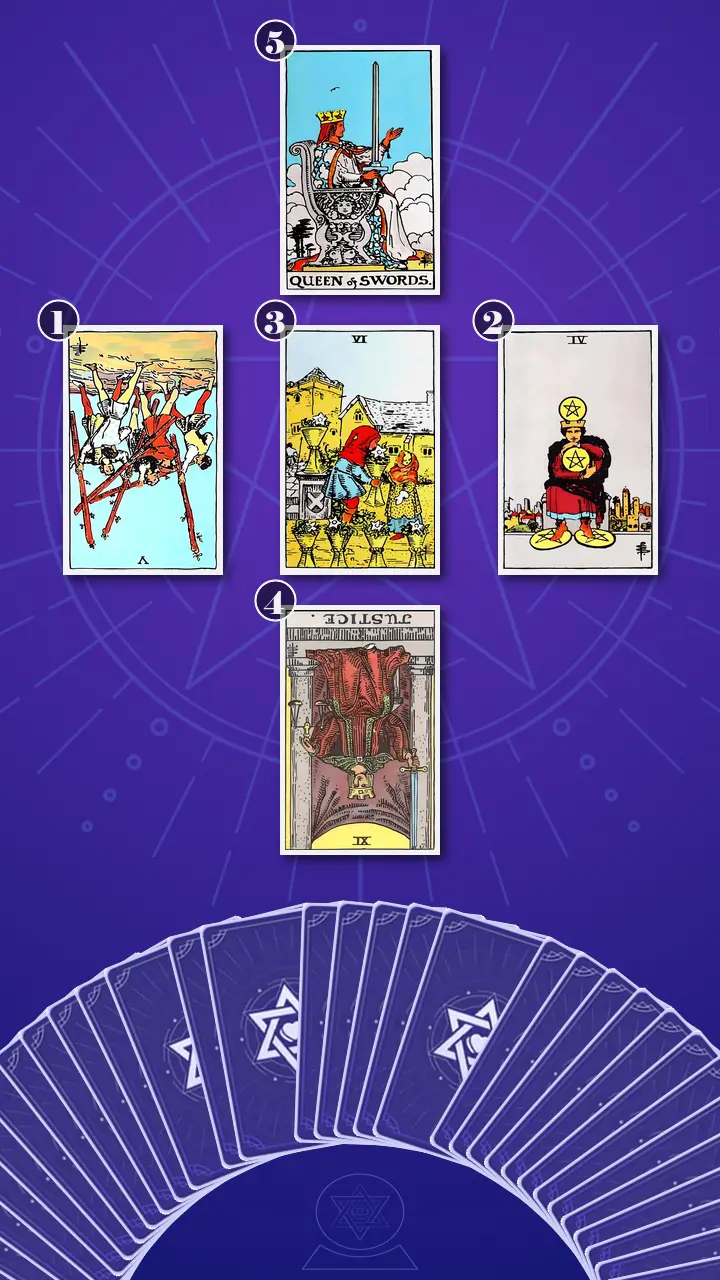
I placed the third card in the centre, the first to its left, the second to its right, the fourth beneath the centre, and the fifth above it. I told her that the first position would show her current self-state, especially how conflict was being suppressed; the second would show the retaining force as she experienced it, without claiming anything about her partner's inner world; the third would reveal the shared history holding emotional meaning; the fourth would expose the psychological blockage; and the fifth would offer a boundary-led experiment rather than a predicted outcome.
The Tangled Staves Behind 'It's Fine'
Position 1: The Five Drafts Behind One Polite Text
'Now I am turning over the card for Jordan's current self-state: the observable pattern of suppressing conflict until anger leaks through withdrawal, clipped replies, or a smaller argument,' I said. 'The card is the Five of Wands, in reversed position.'
The Rider-Waite-Smith image showed five raised staves crossing without a coordinating figure or shared target. I told Jordan that I saw the same structure in the message she had described. At 12:40 a.m., she conducted the entire argument internally while the visible message thread stayed polite. She wrote one direct sentence, imagined five possible consequences, deleted it, and sent 'Sleep well.' The next day, the original friction appeared through one-word replies and disproportionate anger about a minor household habit.
Reversed, the Fire was not absent. It was blocked and turned inward. Jordan's irritation carried useful information about an unmet need, but because the first signal never became language, the energy could only travel sideways. The longer she insisted that nothing was wrong, the more pressure the smaller conflict had to carry. In this pattern, anger leaks out where the clear request was edited out.
I asked her to listen for the five competing drafts in her mind: 'I want to say I cannot keep pretending this is fine, but if that starts a bigger fight, maybe I should say nothing. If I say nothing, the evening stays intact. If the evening stays intact, perhaps I am being fair. If I am being fair, maybe I can stop feeling this way.' The visible calm was immediate relief. The delayed cost was a conversation that never arrived intact.
Jordan gave a short, bitter laugh instead of nodding. 'That is painfully accurate. It is also a little cruel.'
I watched her thumb stop above the phone, her breath pause, and her fingers tighten around the edge of the cushion. Then her gaze moved from the card to the deleted-message story, as if replaying the exact sentence she had removed. 'I am not calling you cruel,' I said. 'I am showing you where the conflict has been forced to live. Anger is information here, not a moral failure. We can decide what to do with it before it becomes a flood.'
Position 2: The Grip Around What the Years Mean
I moved to the card on the right, the position showing how Jordan experienced the relationship's retaining force: the perceived need to preserve its value and continuity, without claiming access to the other person's private state. The card was the Four of Pentacles, upright.
The crowned figure held one pentacle tightly against his chest, pinned two beneath his feet, and kept the city at a distance. I recognized the posture in the anniversary scene Jordan described. The night before a dinner reservation, she looked from the shared Google Calendar to the lease folder and the photograph from their first apartment. Her chest tightened as she thought, 'We have built an entire life. I cannot blow it up over one phase.'
Upright, this Earth energy was an excess of preservation and control. Jordan was not merely protecting the living relationship. She was protecting her authority over what the years meant. Loosening her grip began to feel like admitting that the investment had lost value, so honest movement registered in her body as danger even when no immediate decision was required.
I said, 'This is the difference between preserving meaning and preserving continuity. The years can matter without creating an automatic contract for more silence.' History can explain her loyalty; it could not set today's boundary for her.
I then placed the warm-phone image beside the card. I asked her to imagine both hands closing around a relationship archive while no hand remained free for a present conversation. 'If this mattered that much, I have to keep protecting it,' she said quietly. Her shoulders rose, her eyes went to the calendar notification, and then she looked away. I saw tenderness there, but also the first small grief of realizing that protecting the past had been narrowing the present.
Position 3: The Memory Archive at the Center
I turned over the centre card, the bond's emotional foundation, the shared history and positive memories Jordan used as evidence that she should continue staying. It was the Six of Cups, upright.
The Rider-Waite-Smith scene held two children in a sheltered courtyard, one offering a cup filled with white flowers. I connected it to the moment Jordan had described on a crowded TTC train. At 6:18 p.m., after a difficult exchange, Google Photos surfaced a picture from the relationship's first year. Wet coats and rain filled the carriage, the brakes shrieked near Bloor-Yonge, and the phone warmed her palm as she enlarged the image. She could almost feel the old kitchen and hear the joke caught in the frame.
Upright, the Six of Cups offered genuine tenderness, emotional memory, and a real foundation. I did not ask Jordan to call those memories fake or irrelevant. The imbalance came when the preserved water of the past was asked to answer a present-tense question. Nostalgia proves that something mattered, not that it still works the same way now.
'The photo is not lying to you,' I said. 'It is telling you that this moment mattered. It simply cannot report on what happened last night, what you need this month, or what happens after you speak clearly.' The problem was not that Jordan loved the history. The problem was that the history had been given more authority than current evidence.
I noticed her hands soften around the imagined phone, then close again. 'I miss who we were,' she said. 'And I am angry about who we are in this pattern. Both things are true, which makes me feel like I am betraying one of them.' I let the silence stay kind. There was no need to force grief into a verdict.
When Justice Reversed Tilted the Evidence
Position 4: The Internal Hearing With Unequal Rules
I placed the fourth card beneath the centre, the position for the current relational challenge and psychological blockage: applying unequal standards to past loyalty and present anger, then postponing accountability and clear evaluation. The card was Justice, in reversed position.
The scales had lost their reliable balance, and the upright sword looked destabilized through reversal. I told Jordan that the image resembled an internal hearing where years of good memories were admitted immediately, while her clenched jaw, recurring disappointment, and deleted requests were repeatedly dismissed as overreaction. Her private question sounded like this: 'Yes, this hurt, but what about everything they have done for me?'
Reversed, Air had become distorted and blocked. Jordan was not lacking intelligence or evidence. She was weighing two kinds of evidence by different rules. The history column had unlimited weight, while the current-impact column was treated as emotional noise. That distorted evaluation kept the core contradiction intact: preserving the past seemed morally fair, while responding honestly to anger felt ungrateful.
I asked her to bring one recent incident to mind without inviting the best years or the worst years into the room. She looked at me sharply. 'If I do that, am I not being unfair?' she asked.
'Only if the purpose is to erase context,' I said. 'The purpose is proportion. You do not need a final verdict to record what happened.' I invited her to use the same simple incident log she already used at work: event, impact, requested resolution, next step. Her professional life had taught her to distinguish a camera-recordable service failure from a prediction about someone's character. I wanted to give that skill back to her personal life without turning the relationship into a customer ticket.
I heard the pattern through my own Communication Dissonance Audit, a signature method I developed through ten years of sound-energy research. I do not diagnose an argument by its loudest words alone. I listen for the mismatch between emotional tempo and spoken tempo: Jordan's messages sounded reassuring while her body was keeping a much faster, harsher record. The dissonance was not proof of what her partner intended. It was evidence that Jordan's own communication had fallen out of sync with her experience.
Her breath came out slowly. She opened a note and typed only three words: 'Dismissed. Chest tight.' She read them back, and the scales seemed less like a judge demanding a permanent ruling and more like a tool for returning one current fact to the record. I watched her move from exhaustive proof toward one observable incident.
The Upright Sword That Separated Meaning From Permission
Position 5: The Queen's Upright Sword and Open Hand
Before I turned the final card, the room became unusually quiet. Even the traffic seemed to recede behind the HVAC hum. I was opening the position for a boundary-led next experiment: state one present need clearly, define a proportionate limit, and observe the response before making further decisions. The card was the Queen of Swords, in upright position, the key card and the antidote.
The Queen held one sword straight upward while extending her other hand toward the horizon. Her Air was clear and balanced. The sword offered a clean sentence and a standard; the open hand left room to hear a response without surrendering the boundary. Moving clouds remained in the background, reminding me that clarity did not require an emotionless sky.
I translated the image into a modern scene Jordan could test. She could schedule a twenty-minute conversation and say, 'When the issue is dismissed and we continue as if nothing happened, I become withdrawn and resentful. I need us to address it directly. If it keeps happening, I will step out of the shared plan and revisit it when a real conversation is possible.' The sentence did not erase the relationship's history or predict its future. It made the request visible and kept the follow-through within her control.
I also saw why the Queen was the right place for my Communication Dissonance Audit. The tangled staves at the beginning represented five competing drafts. The Queen's sword reduced them to one line that could actually be heard. I could distinguish the words spoken from the emotional frequency underneath them, not to expose anyone else's motives, but to help Jordan stop asking herself to sound fine while her body was recording no. A boundary was not a verdict; it was a condition reality could answer.
For the setup, I named the bind I could see: she was trying to decide whether one honest sentence would cancel years of tenderness. Her mind was running the whole relationship like a courtroom, demanding a final ruling before it would permit a single current need. I watched her phone hover above the table, ready to soften the truth again.
Your history is not a verdict that requires silence; let the Queen's upright sword separate what was meaningful then from what is acceptable now.
I let the sentence rest between us. Then I added, 'History can remain meaningful without becoming a verdict: what was true then does not get to silence what you need now.' For one second, Jordan froze completely: her breath stopped, her phone remained suspended, and her fingers held the draft without scrolling. Next, her eyes lost focus as she replayed the first-year photos, the anniversary reservation, and every small argument that had carried a much larger unnamed need. Her mouth opened, but no explanation arrived. Finally, her shoulders dropped, one hand unclenched, and a shaky breath moved out of her chest. Her first words were not relief. 'But doesn't that mean I was wrong all along?' I told her that naming a present boundary did not rewrite the past or make her loyalty foolish. It changed the next experiment. She blinked hard, looked at the upright sword, and gave a quiet, uneven laugh that held grief and permission together.
'Now,' I asked, 'use this new angle to recall whether there was a moment last week when this insight could have made you feel different. What might you have noticed before the smaller fight took over?'
We did not send anything that night. I suggested a seven-minute timer and four private lines in her Notes app: 'What happened that I could record on camera:', 'The impact on me:', 'What I need now:', and 'What I will do if this keeps happening:' I told her she could complete only the first two lines, stop whenever her body felt overwhelmed, and keep the note private. The point was not to force a confrontation or a stay-or-leave decision. It was to let the present exist beside the history with equal permission to matter.
That was the key shift I wanted her to feel: a movement from nostalgia-led silence and accumulated anger toward present-tense discernment and grounded self-respect. The Queen did not promise that the relationship would continue or end. She returned ownership of the next question to Jordan.
From Sunk-Cost Loyalty to a Present-Tense Boundary
When I laid the five cards together, I could see the whole mechanism. Blocked Fire in the reversed Five of Wands swallowed the first honest sentence. Fixed Earth in the Four of Pentacles gripped the relationship's accumulated value. The Six of Cups supplied real tenderness, but nostalgia then tried to function as current evidence. Justice reversed showed the distorted air created by unequal standards. The Queen of Swords restored clear language, proportion, and an open hand.
This answered why the resentment kept building. Jordan was not staying because the past was meaningless or because she lacked courage. She was using continuity to protect the meaning of the past, and that protection postponed the present conversation. The blind spot was believing she needed certainty about the entire relationship before she was allowed to name one current need. I told her that she could honour what had been real without granting it automatic authority over what was acceptable now.
The transformation direction was deliberately small: notice the body signal, record one camera-recordable event, name its impact, state one need, and watch what follows. I would not ask her to prosecute the relationship or to turn anger into cruelty. One clear sentence could carry more truth than a complete prosecution of the relationship.
The One-Sentence Sword and the Three-Second Pause
I gave Jordan three low-pressure next steps. Each one could stay private unless she freely chose otherwise, and none required a final decision about the relationship.
- Capture the first deleted sentenceOnce this week, when Jordan notices a clenched jaw, chest pressure, or restless hands after an exchange, she can open Notes and record the time, the observable trigger, and the first uncensored sentence. She can do it at her kitchen table, on the TTC, or in a bathroom before a shared plan.The minimum version is three words, such as 'jaw tight, dismissed.' Noticing the signal does not require sending a message, confronting anyone, or making a relationship decision.
- Run the Present-Tense Evidence CheckDuring one lunch break, Jordan can set a seven-minute timer and complete four lines for one recent recurring incident: Event, Impact, Need, and Next step. She should describe only what a camera could record before considering what the incident means about the entire relationship.Do not send the note or decide whether to stay or leave during the exercise. If seven minutes feels too large, write only the event and the body impact, then stop.
- Use the One-Sentence Sword with a Syncopation PauseFor one recurring behaviour, Jordan can draft three lines: 'When [observable event] happens, the impact on me is [specific impact]. I need [present request]. If it keeps happening, I will [action within my control].' If direct communication feels safe and appropriate, she can offer one twenty-minute conversation window after dinner rather than raising every grievance at 12:40 a.m.Before replying if the exchange escalates, use my Syncopation Pause: take three quiet seconds, feel both feet, notice one steady sound, and lower the emotional BPM before speaking. Then listen for the response without adding a long apology or retracting the request.
I also explained that my Reactive De-escalation Mapping could help her notice the high notes in her own defensive anger: the sudden sharpness, clipped cadence, or urge to bring in every old grievance. The map was not a way to control another person. It was a way to recognize when one present request was about to be buried beneath accumulated heat.
If direct communication could expose Jordan to retaliation, coercion, surveillance, housing instability, financial control, or any other safety risk, I would not treat disclosure as the mature or required choice. Private documentation, trusted support, and a safer context could be the most self-respecting next step. The cards were a reflective tool, never a reason to surrender consent or access.

A Week Later, One Sentence Stayed
Five days later, I received a message from Jordan: 'I used Event, Impact, Need, and Next step for one incident. I left the first sentence in the draft. I still do not know what I will decide about us, but I know what I need to watch now.' I read it twice before replying. She had not solved the relationship. She had made the present visible.
A week later, Jordan told me she had slept through the night after writing the note; morning still brought the thought, 'What if I am wrong?' She made coffee, left the question unanswered, and went to work with one sentence still undeleted. The relief was real, and so was the uncertainty.
I saw that as the first proof of grounded self-respect: not a dramatic ending, not a guaranteed repair, but a small change in who was allowed to speak. The five-card Relationship Spread had helped Jordan move from compressed anger to a current need, a visible boundary, and an observed response. The decision remained hers.
When your jaw tightens while you type 'It's fine,' you may be trying to keep the past meaningful and the present undisturbed at the same time, even as your anger asks not to be edited out.
I leave the cards as a quiet visual sequence: tangled staves becoming one upright sword, a clutched archive beside an open hand. Finding clarity may begin when history is allowed to keep its meaning without being asked to defend the future for you. If your history did not need defending for one moment, what present-tense truth would you let yourself name in a single sentence?