Taking Saturday Off Standby After Months in Situationship Limbo

The 10:47 p.m. Relationship Waiting Room
At 10:47 p.m. on a wet Toronto Tuesday, Maya (name changed for privacy) sat on the edge of her bed with tomorrow's product review glowing on her laptop and a four-day-old message glowing on her phone. The radiator clicked behind her. Wet tires hissed along the street below. She was twenty-eight, paid downtown rent, and could facilitate a difficult stakeholder meeting without blinking, yet she had just declined a confirmed dinner because the person she was seeing had said they might be free.
She described the body sequence before she described the relationship: a band tightening across her chest when she opened the thread, a brief release when she found the warm line again, then restless energy when she returned to an empty calendar. Her longing moved like perfume released into a room with no open window. One beautiful note filled every corner until it became difficult to distinguish what was present from what had merely lingered.
“I know they aren't ready,” she told me during our consultation, one thumb rubbing the edge of her phone case. “But what if they're almost ready? I don't want to pressure anyone, but I'm disappearing inside their timeline. I keep calling it patience when it feels more like suspension.”
I heard the central conflict immediately. Maya wanted a mutual relationship that existed in the present, but she was protecting a possible future because leaving the waiting position felt like forfeiting her chance to be chosen. Months of affection, late-night messages, and vague plans had turned the undefined connection into a product roadmap whose most important feature was always marked coming soon, with no owner and no delivery date.
“I don't hear someone foolish or weak,” I said. “I hear someone using patience to protect herself from grief. That strategy makes sense, even if it is costing you now. We aren't going to predict when another person will become ready, and we aren't going to manufacture a scary verdict. Let's use the cards to map what is observable, what you are adding to the gaps, and what remains yours to choose.”
That was the purpose of our Journey to Clarity: not to make the decision for Maya, but to help her see the structure of her situationship limbo clearly enough to reclaim her authority within it.

Choosing the Compass for an Undefined Relationship
I asked Maya to place both feet on the floor, take one unforced breath, and hold the question without trying to improve it: Why do I keep waiting for someone to become ready for me? I shuffled slowly. The pause was not a mystical performance. It was a transition from scrolling, explaining, and anticipating into sustained attention.
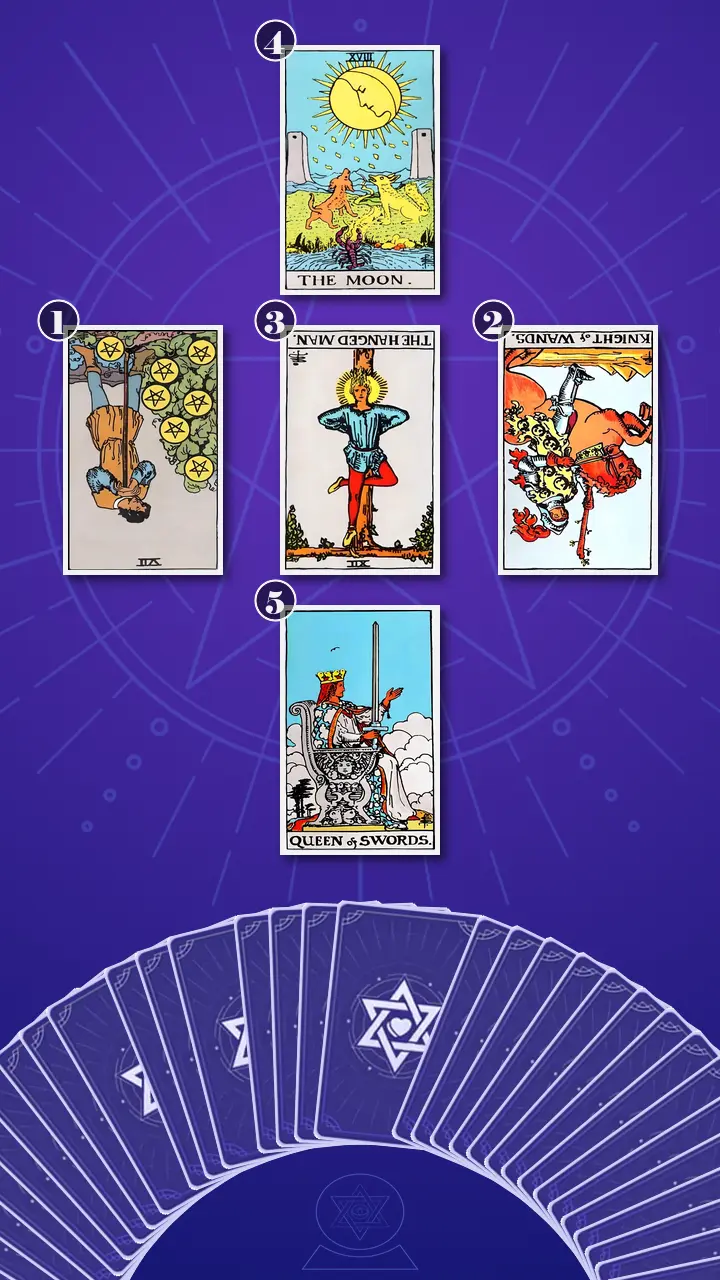
I chose the Relationship Spread · Context Edition, a contextualized five-card relationship tarot spread. Its structure was concise enough to prevent us from getting lost in speculation while still examining the whole pattern: Maya's stance, the other person's observable availability, the dynamic created between them, the hidden belief sustaining that dynamic, and Maya's most constructive next step.
I explained that Position 1 would show how Maya was currently participating in the wait. Position 2 would look only at behavior she could observe, such as direct answers, confirmed plans, and follow-through. Position 3 would reveal what happened when her patience met intermittent engagement. Position 4 would uncover why uncertainty felt safer than clarity. Position 5 would return the inquiry to her own standards and choices.
This distinction matters when I explain how tarot works. I do not use a relationship reading to claim access to someone else's private thoughts or to announce whether they will eventually commit. I use the cards as an objective cognitive tool: each position separates a tangled experience into a question that can be examined. Card meanings in context then give intuition an image, while facts and dialogue keep the interpretation grounded.
I arranged the cards as a cross. The Hanged Man would eventually occupy the center, with the first two cards forming a horizontal tension, The Moon above, and the Queen of Swords below. It looked like a compass whose needle had been held in place. Our task was to discover what had immobilized it and what Maya could move without controlling anyone else.
Reading the Map Without Reading a Mind
Position 1: The Investment That Kept Asking for One More Weekend
“The card I am turning over now represents your observable waiting behavior,” I said. “It shows where your calendar, attention, and emotional investment are still organized around this connection.”
The card was the Seven of Pentacles, reversed.
In the traditional image, a figure leans heavily on a tool and looks down at seven pentacles growing on a vine. I turned that downward gaze into Maya's modern scene: at 10:47 p.m., she was scrolling back through months of messages while her unused calendar remained open beside the thread. Time, voice notes, affectionate exchanges, and weekends held in reserve had become a crop she kept inspecting for proof of progress.
Reversed, the Seven of Pentacles showed blocked earth energy. Investment was continuing, but neutral assessment had stopped. Maya was not only asking, What is growing? She was also thinking, I have already given this six months, so leaving now would mean those six months were pointless. The amount invested had quietly become an argument for investing more.
I asked her to compare past investment with present return. Had the connection measurably developed during the last month? Were plans confirmed more consistently? Had direct questions begun receiving direct answers? Had reciprocity become easier to recognize without reopening old messages?
Maya's breathing paused. Her gaze slipped away from the card as if she were replaying several empty Saturdays at once. Then she gave a short laugh with a bitter edge and pressed her palm against her sternum.
“That's so accurate it feels a little rude,” she said. “Leaving now would make all the waiting feel pointless.”
“The card isn't calling the time pointless,” I replied. “You learned what hope feels like in your body, what ambiguity costs, and what you need more of. But information does not become a debt you must repay with another month. We can respect what you invested without requiring the investment to dictate your next decision.”
The distinction softened something in her face. She did not look relieved yet, but she stopped defending the crop long enough to examine it.
Position 2: The Tentative Invitation That Never Became a Plan
“The next card represents the other person's observable availability and follow-through,” I said. “I am deliberately keeping this position out of their private mind. We are reading what has happened, not inventing a diagnosis for why it happened.”
The card was the Knight of Wands, reversed.
The knight's horse rears beneath him while his wand points toward movement. Upright, that fire can be bold, warm, and adventurous. Reversed, I saw an excess of ignition paired with a deficiency of sustained direction. The energy arrived vividly, but it did not reliably travel anywhere.
I connected it to a Tuesday night Maya had described. At 11:08 p.m., her phone vibrated with an intimate message: Miss you. We should get away somewhere soon. Her shoulders dropped, and she opened Google Calendar to scan the next month. By morning, her direct question about meeting that week had received a heart reaction but no date. The emotional calendar invitation felt urgent, but the practical invitation remained marked tentative and was never accepted.
“This feels like movement, so maybe this time it means the relationship is moving,” I said, giving voice to the loop. “Then the factual cut arrives: no time, no place, no confirmed plan.”
I left room for both truths. The affection might have been sincere, and the follow-through was still inconsistent. An affectionate message can be real and still not be readiness. Chemistry and consistency are not enemies, but they are not substitutes for each other either.
Maya's fingers, which had been circling the rim of her mug, became still. She looked at the knight, then at the blank square for Saturday on her laptop.
“I keep measuring how strongly I feel the moment,” she said, “not what happens after it.”
“Exactly,” I said. “Potential is not the same as participation. You don't have to dismiss the spark. You only have to stop making it carry evidence it does not contain.”
Position 3: When Patience Hardened Into Suspension
“The card at the center represents the self-reinforcing dynamic created when your patience meets intermittent engagement,” I said. “This is the connection's current operating pattern.”
The card was The Hanged Man, reversed.
The figure hangs from one foot beneath a living wooden frame. His head is illuminated, suggesting that a voluntary pause can offer perspective. Reversed, however, the pause can become a blockage: stillness continues after it has stopped producing a new view.
I brought Maya back to the edge of her bed. One hand had been on the laptop and one on her phone. She had paused Hinge despite no mutual agreement about exclusivity, declined a confirmed dinner, deleted a clarity message twice, and kept Saturday available. Yet her inner sentence was, I am not choosing this. I am only waiting until they know what they want.
“But those are choices already being made,” I said gently. “They are choices about your friendships, your evenings, your dating life, and how much attention remains on standby. Waiting is also a decision, and it is already using your time.”
Her chest lifted and held. Her eyes stayed on the single bound foot. Then she leaned back for the first time since the reading began and released a slow breath that seemed to come from below her ribs.
“I thought not deciding meant I couldn't make the wrong decision,” she said. “But my calendar has been deciding for me.”
This was where I used my Boundary Permeability Assessment. I asked where Maya's identity and schedule ended and the undefined connection began. The answer was not that she cared too much. The issue was that a casual maybe from someone else could cross into her calendar and override a confirmed desire of her own. The relational boundary had become so permeable that possibility was receiving access usually reserved for an actual agreement.
I also used my Intimacy Distance Calibration. In scent terms, the concentration was uneven: Maya's attention had saturated the room, while the shared structure remained faint and intermittent. She kept adding emotional material because the relationship itself did not feel present enough. The result was not deeper intimacy. It was less oxygen around her own life.
I remembered a formula from my perfumery years in which I kept adding jasmine to make the heart of the fragrance clearer. The jasmine was beautiful, but every addition made the composition harder to read. The solution was not more intensity. It was space between the notes.
“I may not control whether they become ready,” Maya said slowly, testing the language, “but I can choose what I remain available for.”
That was the Hanged Man's catalyst. It did not demand an immediate breakup or a dramatic ultimatum. It simply changed the camera angle from the message thread to Maya's own calendar. The pause was no longer an empty place where someone else might eventually act. It was a participation choice she could review.
Position 4: The Moonlit Story Built From Partial Data
“The card above the center represents the hidden belief beneath the challenge,” I said. “It will help us understand why preserving uncertainty can feel safer than receiving information.”
The card was The Moon, upright.
A winding path runs between two towers beneath a moon that gives enough light to move but not enough to see every detail. A dog and a wolf face the same sky from different sides of instinct. The card did not tell me Maya's intuition was wrong. It showed an environment of partial visibility in which imagination and fear could both become excessive because direct information was deficient.
I pictured the Sunday-night scroll she had described: sleet tapping the kitchen window, the refrigerator humming, and leftover noodles cooling while she examined timestamps, punctuation, an old travel comment, a heart reaction, and the tone of a voice note. It was like zooming into a low-resolution screenshot and hoping greater effort would reveal information the image had never captured.
I asked her to separate one recent interaction into three lines.
What I know: They sent a warm message saying they missed me.
What I am assuming: They are becoming ready for a committed relationship.
What I hope: The waiting is about to become mutual and secure.
Maya looked at the three statements for several seconds. The room had grown so quiet that the radiator's next click sounded unusually sharp.
“The hope isn't fake,” she said. “But I keep promoting it into the facts column.”
“Yes,” I said. “The Moon asks for humility under limited visibility. It does not require you to crush hope or turn uncertainty into a negative verdict. It asks you to let facts, assumptions, and hopes remain separate long enough to hear what each one is actually saying.”
I asked what she feared a clear answer might mean if it did not preserve the future she imagined.
Her jaw tightened. “That I waited because I wasn't worth choosing. That everyone else knew how to do this and I didn't.”
“That fear explains why uncertainty has been protective,” I said. “As long as the future stays open, the verdict about your worth never arrives. But another person's readiness is not a measurement instrument for your value. You do not need certainty about their feelings to get clear about your limit.”
Her eyes became glossy, though she did not look away. I could see grief entering the reading beside relief: grief not only for what might end, but for the imagined relationship she had already been living beside the real one.
When the Queen Raised Her Sword Above the Clouds
Position 5: Warmth With a Clear Edge
The rain had stopped by the time I reached the final card. Light from the window sharpened along the table, and the room seemed to inhale with us.
“The card I am turning over now represents your self-directed guidance,” I said. “It translates the whole reading into observable readiness, one relational standard, and a boundary around your own time. It does not decide for the other person.”
The card was the Queen of Swords, upright.
She sat upright where the Seven of Pentacles figure had bent over old growth. Her sword stood vertically above the moving clouds, while her other hand remained open toward the horizon. I read this as balanced air energy: precise enough to distinguish facts from projections, yet receptive enough to allow an honest answer.
At 10:47 p.m., Maya's calendar was still open because no plan had been confirmed. One warm message from four days earlier glowed brighter than that night's silence, while her chest tightened around the thought of finally asking what the relationship was. She had been trapped inside the demand to make the perfectly patient choice, as though one wrong move could destroy a future she was responsible for preserving.
I told her, “Readiness is not a future promise that patience can earn. It is a pattern you can observe in the present, and you are allowed to decide how much of your life remains available while that pattern is unclear.”
Then I brought my two diagnostic lenses together. Through Intimacy Distance Calibration, I saw that Maya did not need to become colder. She needed enough space to perceive whether the connection had a stable scent of its own when she stopped supplying all the atmosphere. Through Boundary Permeability Assessment, I saw the practical threshold: warmth could reach her without automatically gaining unlimited access to her evenings, attention, or romantic availability.
You do not need to keep proving your patience; choose present evidence and a clear boundary, like the Queen of Swords raising her blade above the clouds.
I let the sentence remain between us.
Maya froze first. Her fingers hovered above her phone, and her breath stopped just before the inhale. Then her eyes lost focus, as though the old message thread, the declined invitations, and every deleted boundary draft were replaying behind them. Her pupils widened. A line appeared between her brows, and anger arrived before relief.
“But doesn't that mean I was wrong this whole time?” she asked. Her voice was low and suddenly rough. “That I wasted all of it because I was too scared to ask?”
Her shoulders remained high for another moment. Then her fist loosened against her thigh, one finger at a time. Her eyes reddened. She exhaled with a small tremor, but the release left her looking briefly unsteady, as if putting down the weight had also revealed that she would now have to choose where to stand.
“No,” I said. “It means patience protected something you were not ready to grieve. Seeing its cost now does not make your earlier self foolish. It gives your present self new information.”
I invited her: “Now, with this new perspective, think back to last week. Was there a moment when this insight could have made the situation feel different?”
She remembered a friend's Thursday invitation for Saturday ramen. The person she was seeing had mentioned maybe this weekend three days earlier, so Maya had left her friend's message unanswered. By Saturday afternoon, neither plan existed.
“I couldn't have made them confirm,” she said, “but I could have decided that an unconfirmed maybe didn't own Saturday.”
I nodded. That sentence marked the reading's emotional transformation: from hopeful vigilance, sunk-cost waiting, and worth-based fear toward evidence-based discernment, self-defined boundaries, and grounded openness to reciprocity. It was not certainty. It was the first usable form of trust in her own standard.
The Queen's open hand also mattered. I offered Maya a plain-language example: “I like you, and I am looking for a relationship with consistent plans and a clear conversation about exclusivity. Is that something you are available to build now?”
The sentence named a need once. It did not diagnose, threaten, bargain, or demand immediate transformation. The other person would remain free to answer honestly. Maya would remain free to decide what an unclear answer meant for her own participation.
A boundary does not decide for them; it decides what you will keep participating in.
Clearing the Air With Three Practical Boundaries
I gathered the spread into one story. The Seven of Pentacles reversed showed Maya counting accumulated time as proof that the connection should eventually pay off. The Knight of Wands reversed showed bursts of affection that produced emotional momentum without dependable direction. The Hanged Man reversed revealed how those two forces locked together: every warm return renewed an indefinite pause. The Moon showed why the pause was so compelling. Ambiguity preserved hope while postponing the grief and worth-based fear that clearer information might activate. The Queen of Swords offered the available resource: present evidence, direct language, and control over Maya's own participation.
The spread's movement was equally clear. Blocked earth counted the investment. Unstable fire restarted anticipation. The center became suspended. Moonlit water blurred what was known and imagined. Finally, balanced air gave Maya language. I also noted the absence of Cups. I did not interpret that as an absence of feeling. I read it as a deliberate focus on the missing evidence of mutual emotional participation, rather than a license to speculate about what either person privately felt.
Maya's cognitive blind spot was not hope itself. It was treating accumulated investment and intermittent intensity as evidence of current progress, while treating waiting as though it were neutral. The transformation direction was therefore specific: stop measuring the other person's potential and define the behaviors that would let her recognize readiness now.
I asked her to keep the next steps deliberately small. None required her to send a final message that night, end the relationship on the spot, or unpause a dating app before she felt ready.
- The Seven-Minute Facts, Hopes, and Needs Note Tonight, open a blank note and use three headings: What happened, What I hoped it meant, and What I need now. Put one recent interaction under the headings, using no more than one sentence in each section. Finish by writing one time-protecting boundary, such as: I will not hold Saturday without a confirmed plan by Thursday evening. Set a seven-minute timer and stop when it ends. This is private information for you, not an ultimatum or a message you must send.
- The Present-Evidence Readiness Check In the Notes app, define three observable readiness criteria: confirms plans, answers direct relationship questions, and initiates with reasonable consistency. For the next seven days, record only direct answers, kept plans, cancellations, and completed follow-through. Put explanations or motive guesses in a separate column labelled story I am adding. Keep each entry under sixty seconds. A proposed but unconfirmed plan does not count as a kept plan, and the log is not a score of anyone's character.
- The Blank Space Protocol Choose one evening this week and set a confirmation cutoff. If no plan is confirmed by that time, reply to a friend, book a film, visit the library, or make another plan that will happen regardless of a late text. Add a private review date within two weeks to check the present facts, your needs, and the cost of continued ambiguity. This is not strategic silence designed to make someone chase you. The blank space gives oxygen back to your own life and lets the relationship's actual level of participation become easier to perceive.
I explained that my Blank Space Protocol comes from the same principle I learned at the perfume bench: space is not emptiness when it helps each note become distinguishable. Maya did not need to become guarded, punish the other person, or pretend not to care. She needed enough breathable distance for affection, evidence, and self-respect to stop collapsing into one indistinct cloud.
If she later chose to ask the Queen's direct question, she could ask it once and listen for the answer in both language and follow-through. If the response remained unclear, she would not need to translate it into a future promise. She could return to the review date and decide what level of ambiguity she was willing to continue living inside.
“So clarity isn't getting them to say the right thing,” Maya said.
“No,” I replied. “Clarity is knowing what you asked, what you observed, what you need, and what you will choose from there.”

A Week Later, Saturday Was No Longer on Standby
Six days later, I received a short message from Maya. At her Thursday cutoff, no Saturday plan had been confirmed, so she replied yes to ramen with her friend. When a vague invitation arrived late on Friday, she answered: “I already have plans tomorrow, but I'm open to choosing a day next week if you want to set something up.”
She did not report a cinematic rush of confidence. Her thumb still hovered before she sent the reply. She still felt the old pressure across her chest, followed by a small ache when she realized how ordinary the boundary looked compared with the enormous meaning she had assigned to it.
She slept through the night, then woke with the thought, What if I got it wrong? This time, she smiled at the thought, left the ramen booking in her calendar, and got out of bed.
I considered that the quiet proof. Maya had not solved the relationship or learned the other person's private future. She had simply stopped requiring uncertainty to manage Saturday on her behalf. Tarot had supplied a structured mirror, but she was the one who looked, named the pattern, and made a different choice.
That was the real Journey to Clarity: not certainty about whether someone else would eventually choose her, but ownership of what she chose to remain available for. The relationship's outcome was still open. Maya's life was no longer required to stay closed around it.
I know how many people recognize the tight-chested instant when one warm message makes an imagined future feel real again. Letting that possibility loosen can feel painfully close to admitting you were never worth choosing. I would hold the Queen's open hand beside her sword here: your affection does not need to be denied, and your time does not need to be surrendered in order to prove that affection is sincere.
If readiness were something you could notice in this week's air rather than a promise waiting beyond the clouds, what one present trace and what one calendar limit would you name for yourself?